Category The Model Engineer and Amateur Electrician

Publisher: Percival Marshall
Place of Publication: London, England
Dates of Publication: 1898 – 1948
Frequency: Monthly
Language: English
Continued as: The Model Engineer until April 1948

The Model Engineer and Amateur Electrician: 1920

Herreshoff, in his usual way, eviscerated the rule and took those elements and those only that counted. A canoe body to run over the water—the exact amount of lateral resistance needed for the S.A. in
the form of a metal fin—the lead disposed in the most effective form at the lowest point in the forms of a torpedo halved and bolted on the bottom of the fin. Such was the Wee Win.

Read MoreThe Model Engineer and Amateur Electrician: 1920

The Model Engineer and Amateur Electrician: 1915

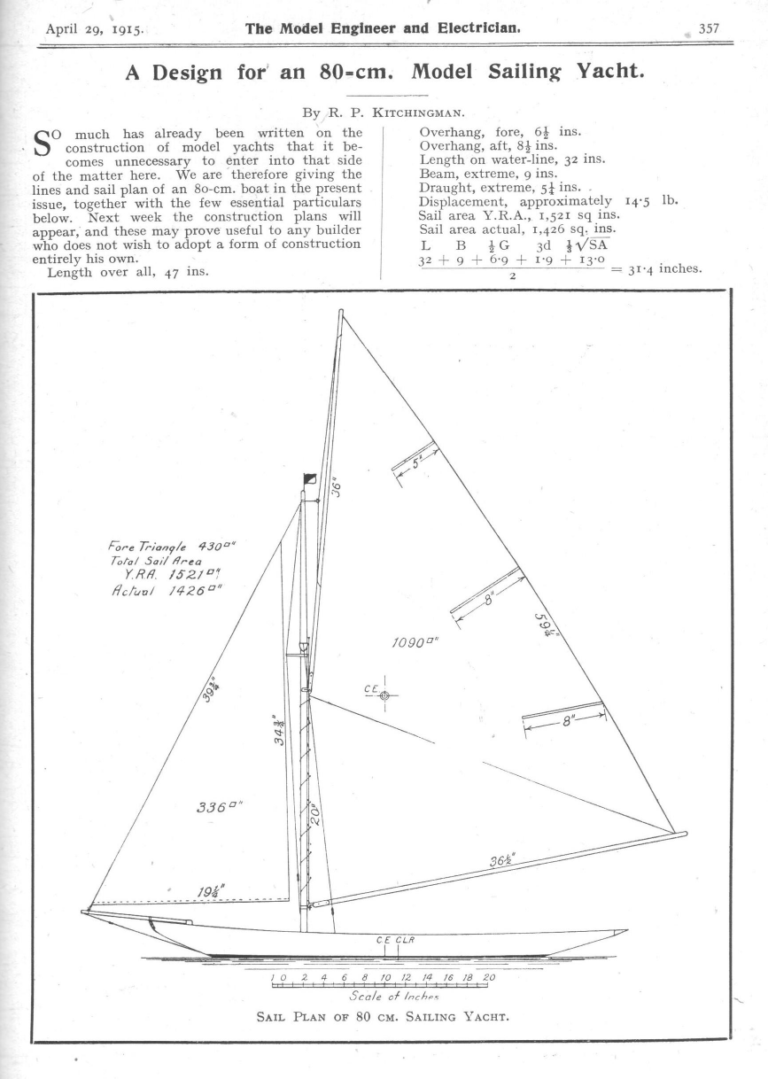
The hull of a yacht is represented by three sets of lines, which are known as the cross-section or body plan, water line plan, and buttock line elevation. Any line that is a curve in one plan is always a straight line in the other two.
If the intersection of these lines coincide in all these drawings the shape of the hull must of necessity be fair in curvature, 7.¢., free from bumps, always, of course, providing the curves in the plans are not
unfair.

Read MoreThe Model Engineer and Amateur Electrician: 1915

The Model Engineer and Amateur Electrician: 1914

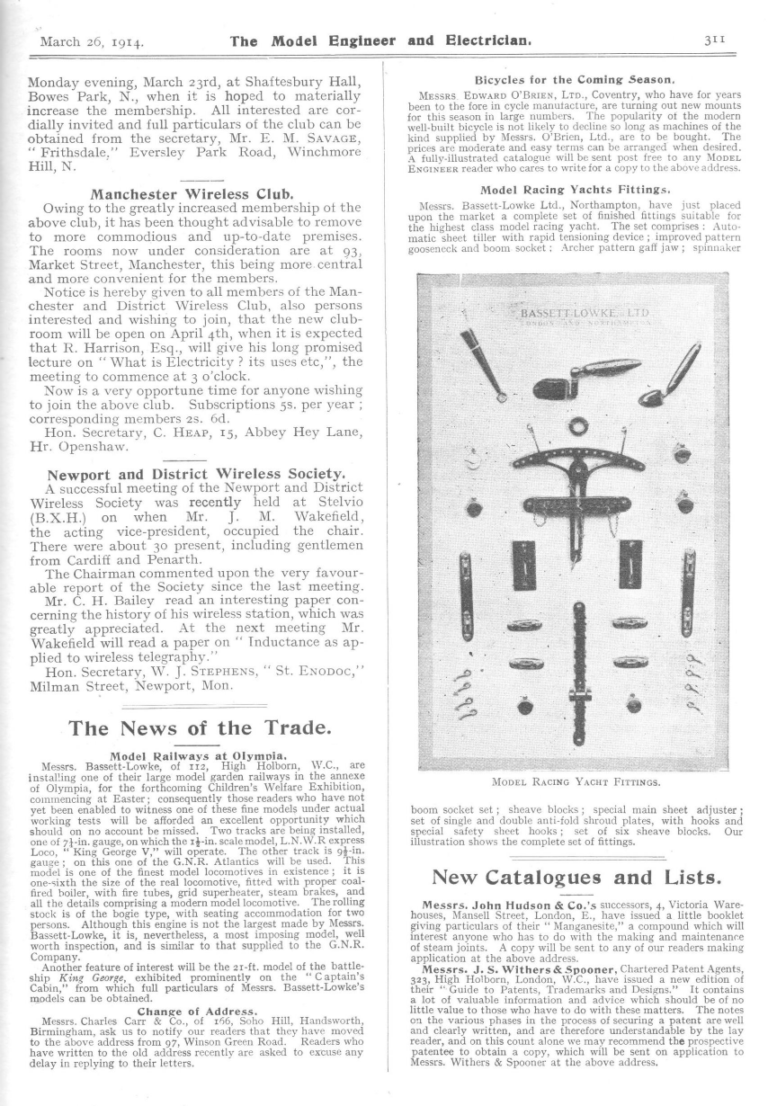
Messrs. Bassett-Lowke Ltd., Northampton, just placed upon the market a complete set of finished fittings suitable for the highest class model racing yacht. The set comprises: Automatic sheet tiller with rapid tensioning device; improved pattern
gooseneck and boom socket; Archer pattern gaff jaw; spinnaker boom socket set; sheave blocks; special main sheet adjuster; set of single and double anti-fold shroud plates, with hooks and special safety sheet hooks; set of six sheave blocks.

Read MoreThe Model Engineer and Amateur Electrician: 1914

The Model Engineer and Amateur Electrician: 1912

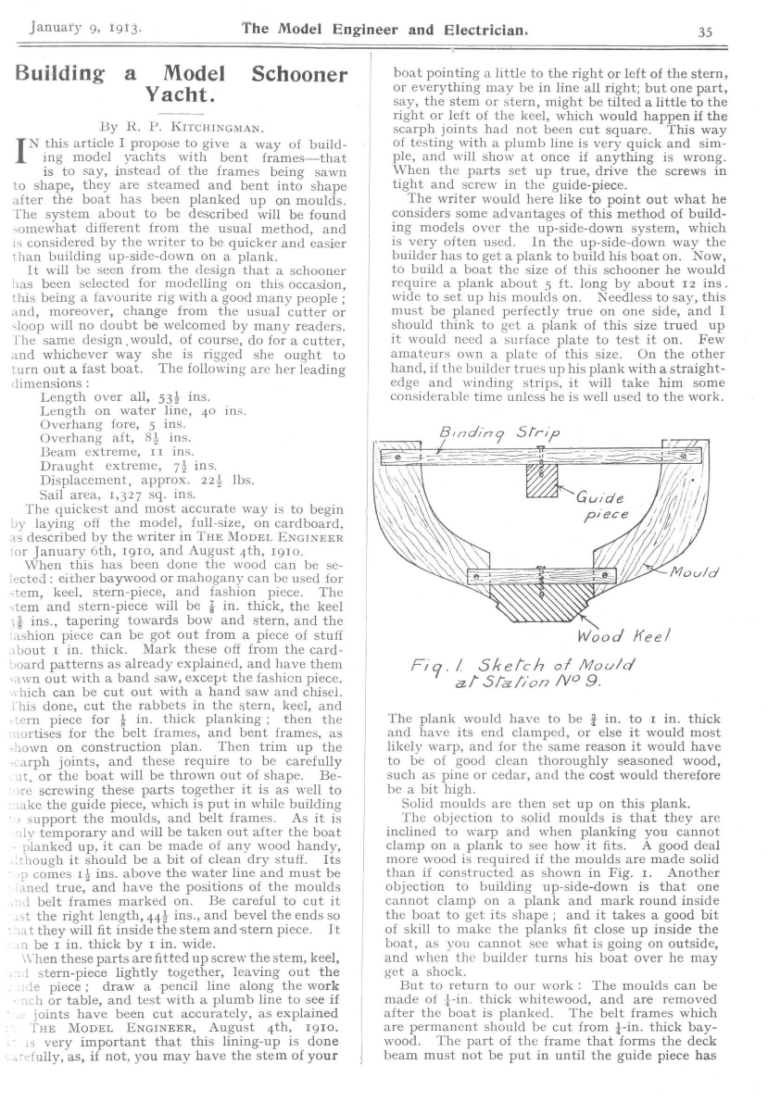
Materials: For the stem, keel and general framework, birch is as good as any timber. The knees and fittings are best made from holly or some fruit tree, such as apple or pear, the knees being naturally grown. For the ribs either Canadian cheese tubs, which can be bought at any grocer’s for a few pence, or hazel rods split down and planed to thickness, are as good as anything.

Read MoreThe Model Engineer and Amateur Electrician: 1912