- Three Interesting Russian Yacht Designs
- PETREL Semi-scale cruising yacht built from full-size plans in our June issue Part Three

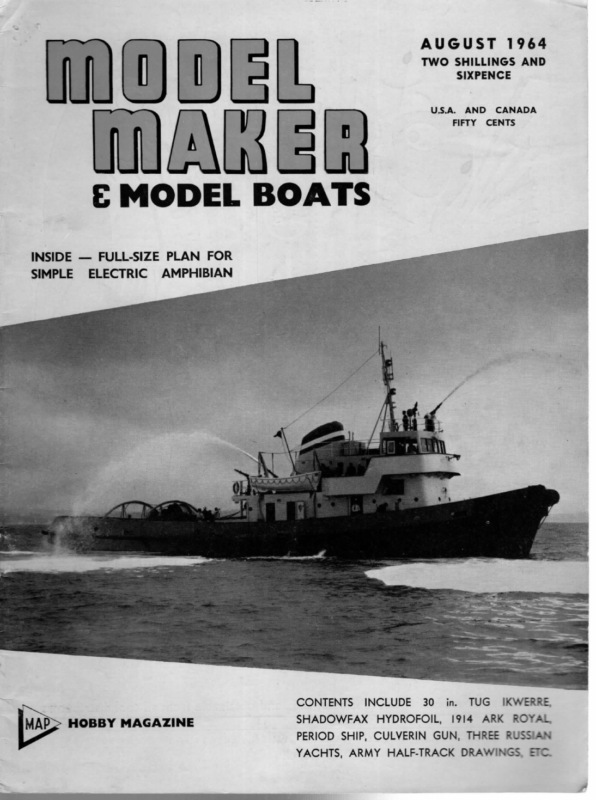
AUGUST 1964 TWO SHILLINGS AND SIXPENCE U.S.A. CANADA AND FIFTY CENTS E MODEL BOATS INSIDE — FULL-SIZE PLAN FOR SIMPLE ELECTRIC AMPHIBIAN CONTENTS HOBBY MAGAZINE INCLUDE 30 SHADOWFAX HYDROFOIL, in. TUG IKWERRE, 1914 ARK ROYAL PERIOD SHIP, CULVERIN GUN, THREE RUSSIAN YACHTS, ARMY HALF-TRACK DRAWINGS, ETC. UNH
MODEL IMANRIEIR} Three Interesting Russian Yacht Designs Met of the European modern yacht designs we see tend to be for smallish boats to a local, if any, class, except of course, for the few A & M class designs which have been produced in Western Europe. The further East one goes, the odder the drawings look to British eyes ; many are stylish, but quite obviously designed for sailing on calm lakes in relatively light breezes. The sturdy, allweather hull which is commonplace in this country represents quite a different approach to sailing. We were, therefore, particularly interested to find three designs to International classes in a recently published Russian book on model boating, each of which more nearly approaches our ideas of yachts though, in the case of the Marblehead, lighter than is customary here, and perhaps, in the 10R designs especially, a little ‘“‘dated’’ in some than the current trends. The A boat is curious in that it combines a heavy displacement with beamy lines reminiscent of pre-war 50 Ib. boats, though with a modern skeg. The most up-to-date at first glance is the M, but that very narrow transom, weakish sections, and light displacement suggest that she would be in trouble running down Fleetwood lake in a blow. It is, however, encouraging to see Russian interest in international classes, and we look forward to the time when we can welcome active participation by yachtsmen from that country, Dimensions of the three boats illustrated as as follows: L.O.A, L.W.L. Max, beam L.W.L. beam Draught SA respects. The 10 has an attractive body plan, quite in contemporary style, but its fin and skeg shapes are rather prewar and its waterline and displacement are rather less Disp, Lead weight A 76.5 10R 7D in, in. in. sq. in. 16.5 15.5 12,2 1,581 11.8 11.4 11.4 1,116 Ib. 45.1 14.3 in. in. Ib. 55.5 61.6 M 50 S12 49.8 10.5 9.1 10.2 800 26.7 17.8 10.5 ek sa Unfortunately sheer and no adequate waterline plans accompanied this ‘A’ design. 392
1964 AUGUST mNAKONDS — / PAWAT! 3 A Hie at Za eee alt 12 \ ar A s/ J Viren Baap These illustrations, and that of the Marblehead overleaf, are photo- graphed from the Russian book “The Young Model Shipbuilder”. . 14 15 tt ———_ == 1 _TBA 40 ; “1 : 12 13 S =: = oe ee 9 ‘ Be eS es ee eea = = Ee == yo ail 2 14 13 2Se a eS \ “14, 3 = 1 2 a A oe ee ee”) bannacm 69002 AY SSS 10 1 12 pu 5 5 a 10F = 8 = Ft. EUR 6 foo ,§ SSS 15 6 ‘i 7 8 oS — CS) 7 8 eater tee W r—12—— = 393 TTT) | 6 5 3 Ee 2 1
EE 394
FORESTAY —— SHROUD Oy A p> PETREL Semi-scale cruising yacht ALTERNATIVE 18 SHEET MAST HEEL built from full-size plans in our June issue SHROUDS ALTERNATIVE i Part Three GOOSENECKS Bn FORESTAY* TILLER STRAP oe next step in constructing this little 18 in. cruiser is to seal the hull with sanding sealer, tissue cover, brushing the tissue on with more sanding sealer, and apply further coats, rubbing down with very fine glasspaper until a perfect surface results. Colour coats, either of dope or enamel, can then be applied, masking as appropriate. If using enamel over sanding sealer, be careful when masking as it is easy to peel the enamel when removing the tape. Use a paper, which smooth masking tape or can later be soaked off; ordinary cellophane tape, pressing a thumb along applying it. gummed if using reduce its stickiness by the sticky side before Colour scheme is up to individuals, as is the choice of lining the deck. The original looks quite handsome with a pale grey deck and coachhouse roof, all over royal blue hull and cabin sides, a narrow white spars, etc. waterline band, and bright varnished Now comes a moment of decision. Are you going to simulate scale rigging and fittings, or rig more as a functional model? We would suggest a compromise, especially since miniature scale fittings for a model of this type are not available and are quite hard to make. The part which shows most is the method of stepping the mast; the functional way on a small yacht is to insert a screw or cup-hook in the heel of the mast and cut it off to leave a small metal peg projecting. This locates in a hole in a slip of ply glued to the deck, and if several holes are provided adjustment of the mast position is possible when trimming the yacht. A nearer scale appearance would be achieved by stepping the heel of the mast into a glassless metal or plastic porthole cemented and pinned to the deck, but this allows no adjustment. Many small cruisers, particularly with auxiliary or outboard motors, have masts made to lower fairly simply, and these are stepped in a tabernacle as sketched. Any of these systems can be used, or a compromise adopted — the port ring or tabernacle can be fixed to the mast butt and the metal peg hidden underneath, so that a scale appearance is maintained but the mast position is still adjustable. The mast — a length of 4 in. dowel tapered at the top — is supported by the usual triangle formed by two shrouds and a forestay, but to simplify rigging the forestay acts as the jib uphaul and also a jack to which the luff (fore edge) of the jib is attached. The end of the line (braided flax or linen, or other light but strong non-stretch line) is hooked or sewn to the head of the jib, passed through a screw-eye in the foreside of the mast, down to the jib tack (fore lower corner), through an eye in the boom, and is made off in a bowsie. Beneath the boom, at the same point, another eye carries a hook which engages in an eye on the deck, thus holding down the tack end of the boom and allowing the forestay to be tautened by means of the bowsie. The tack of the jib itself is sewn firmly to the eye on top of the boom, and its clew (the after corner) to an eye fitted at the other end of the boom. The shrouds are simply a pair of lines made off to eyes at the same height on the mast, each being carried down and through an eye each side, near the deckedge and slightly abaft the mast, then made off to a bowsie as sketched. Eyes are fitted to the main boom to which the corners of the sail are sewn, anda short line is hooked or sewn to its head, taken up through a hole in the mast, down and through the jib hoist eye, and back to be made off to a bowsie, enabling the sail to be drawn up tight. Both sails are sewn with thread to the forestay, in the case of the jib, and the mast, for the main, the stitches being a simple spiral which holds the sail edge snugly in place without being tight. The foot of each sail is left free except, of course, for the stitches securing the corners. Both booms are from & x 4 in. spruce (or similar wood) and they can be bound with thread where eyes are screwed in, or strapped with a strip of metal foil soldered in place, the eyes being soldered 402
1964 AUGUST to the metal. The jibboom fixing has been de- scribed; the main is secured to the mast by a goose- neck which can be two screweyes hooked one into the other, or two eyes in the mast and one in the boom with a stub of wire soldered to the mast eyes to act as a hinge pin. Both are sketched. The sheets (lines controlling the swing of the booms) can be made off to the screw-eyes position on the booms and led through further eyes to be made fast on a king-post in the cockpit. The conventional model yacht sheets fitted with bowsies and hooking on to horses on the deck destroy any scale appearance, and a scale sheet winch, etc. would be hardly practical. Small sheaved blocks in place of screw- eyes would improve scale appearance; one 5-tonner, similar to this model, in which we have sailed, used sheets led through sheaves to a _ king-post, the technique being to take a turn round the post and retain the sheet ends in one hand, the other operating the tiller. Polythene sheet (food bags, etc.) would do for the sails, but nurses veiling or other finely woven cotton or linen looks much better. With such small sails it is difficult to cut much flow into them, and it is best merely to draw them out from the dimensions given and cut and make them flat. Ensure that the leaches (after edges) of both sails are parallel to the selvedge of the cloth, and sew as fine a hem as possible along the leaches. Hems on the other edges can be a little bigger, but no more than ;% in. if possible. A small triangle of the material sewn into each corner will reinforce and add to appearance, as will lines of stitching about 2 in. apart running at right angles to the leaches. Deck eyes can be screw-eyes soldered into scraps of brass sheet 3% or 4 in. square, screwed in on a touch of Araldite. It is best to screw in place, remove, apply adhesive in the hole, and rescrew into place. ARK ROYAL [Continued from page 404] slatted mat over which the seaplane taxied, the mat being hauled up to the stern and the machine hoisted in. I don’t think either the Germans or ourselves went very far with this Heath Robinson gadget. SAILS—The Admiralty drawing of this Ark Royal shows that she originally carried a sail on her mizzen mast to steady her steering (she was very slow and very tubby)—surely the only aircraft carrier that ever carried one! Before I forget I should like to thank the Admiralty for their kindness in digging out the drawing which I used as a base and for allowing me to use it. 1939-45 War—On the outbreak of war, Ark Royal —which had some time previously been re-named Pegasus to leave the old name free for bigger ships— worked on odd jobs in Home waters and later as an accommodation ship. I had no idea what happened to her at the end, but I note Messrs. Linton and College in the Ian Allan Publication, “Warships of World War II” report her as being finally scrapped at Grays in 1950. Surely Ark Royal the Third, with her long service and her very small cost, must have earned a very good dividend. A scrap of brass bent as sketched should be soldered to the top of the rudder post and a shaped — duckboards or tiller fitted to it. Cockpit fittings gratings, cushions, etc., are according to taste. FOR MODELLERS—In my opinion she is worth modelling. The length to beam ratio is low, she had no flare, and the only sheer is a negative one, i.e., her poop was higher than her fo’c’sle. The two aircraft cranes were steam driven and, in fact, she would make an unusual ‘Period Piece’. PARTICULARS—Displacement 6,900 tons. 3524 ft. between perpendiculars — 366 ft. 502 ft. max. beam and 174 draught. Single renee triple expansion engines, 3,000 h.p. 11 Length overall. screw— to give knots. Her armament was negligible—four 12 pounders only—but a few modern 20 mm. guns were added to help deal with Hitler. Her original aircraft complement was supposed to These were Short seaplanes with folding be 10. wings, hoisted in by the steam cranes and stowed in the hold. There was a so-called flying deck on which air- craft could be spread and prepared for hoisting out and flight and, to keep the deck as clear as possible, the anchors and cables were managed from below, which is why the hawse pipes were so close to the water. 403