- In the Tideway
- 1964 BRITISH OPEN ‘A’ CLASSCHAMPIONSHIPS AND INTERNATIONAL Gosport, August 9th
- Foreign Boating or what modelers in other countries are up to

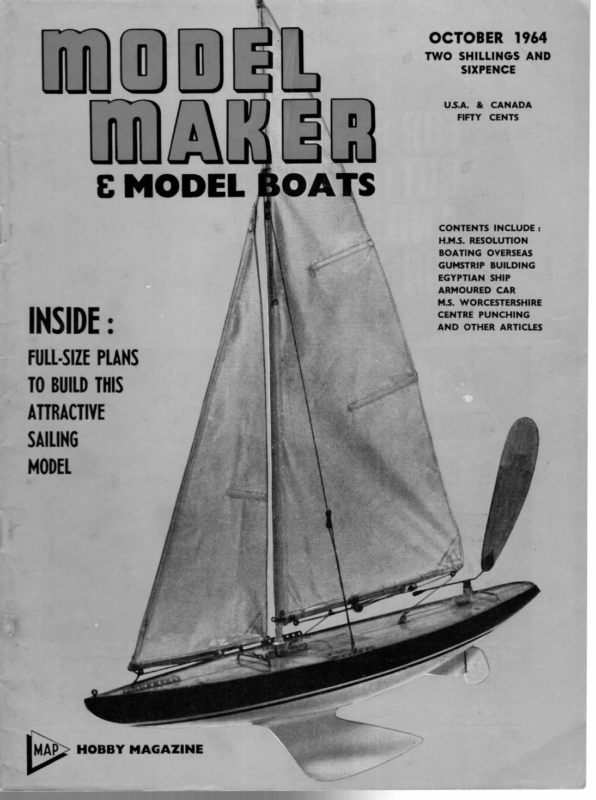
OCTOBER 1964 TWO SHILLINGS AND SIXPENCE U.S.A. & FIFTY CANADA CENTS CONTENTS INCLUDE : H.M.S. RESOLUTION BOATING OVERSEAS GUMSTRIP BUILDING EGYPTIAN SHIP ARMOURED CAR INSIDE : FULL-SIZE PLANS TO BUILD THIS ATTRACTIVE SAILING EL HOBBY MAGAZINE M.S. WORCESTERSHIRE CENTRE PUNCHING AND OTHER ARTICLES
emia In the Tideway Wet. there’s no doubt that the young lady in the photos on the right is in the tideway! These fascinating pictures were processed from 35 mm. transparencies sent to us by T. E. D. Dodds, of R.A.F., Seletar, Singapore. Mr. Dodds lives in a bungalow on the northern beach at Kampong Layang, Singapore, and the photographs were taken during the north-east monsoon which gives strong and steady winds in the spring. The local Malay youths find conditions ideal for sailing their scalish outrigger yachts, rowing a couple of hundred yards off-shore and releasing the models shorewards. Speed is astonishing and yet the models never put their bows under. On average extremely well-built, the hulls are polished hardwood and quite ornate; the black objects on the outriggers are cones from nearby trees, significance unknown. The model in the picture flies a pennant won in a race at Changi village and apparently changed hands at a_ price equivalent to £4.13.0d. — a lot of money to the locals, indicating that modellers are the same the world over! We particularly like the feminine angle, though here is an obvious difference. Few clubmembers’ wives would splash about so enthusiasti- cally. In contrast, Mr. Dodds mentions that local fishermen neglect the use of sail and use very narrow beam sampans; occasionally, however, one sees a Bermudan rig or an enterprising character standing, arms spread, with a large sheet of polythene to speed his homeward journey. Records Quite a number of new European R/C_ speed records have been set so far this year, times having been lowered six times in four categories. The latest marks set, with the 1963 figures in brackets after each, are as follows: 30 watt speed, M. Nouailles, France, 86.9 secs. (117 secs.). 300 watt speed, C. Bordier, France, 37.0 secs. (41.07). 32 speed, K. Matschulat, 27.5 secs. (28.6), and 10 c.c. speed, also Matschulat, 24.5 secs. (28.2). These times are all for the standard triangular course, 30 metres between buoys, one lap, a turn, and a second lap in the opposite direction. We expect to see at least three of these boats in action at Ulm a few days after writing these lines, and therefore hope to give photographs in our next issue. We also hope to catch them (or at least boats of similar performance) on 8 mm. cine film, which will provide an oportunity of showing modellers in this country some of the leading Continental boats in action. Looking at the times returned in the R/C speed eliminators, it is obvious that considerable strides have been made in this country. Two or three models completed the course in under 50 speed is simple enough to lay out. go at it? REMAINING M.P.B.A. REGATTAS, 1964 Sept. 20 20 20 secs., whereas the 1963 winning time was 60 secs. and the 62 time (admittedly over a four-lap course) 73.9 secs. The gap in speed opened up over us in the last couple of years by, especially, the Germans, has rapidly closed; in rough water we would probably win but we could be a second or two behind under the smooth conditions customary for many Euro- course, which What about one of our enterprising clubs having a 20 20 27 Oct. pean meetings. It would be illuminating to see what times our boats could return on the standard Naviga 466 27 4 Wulfruna M.B.C., West Park Pool, Wolverhamp- ton. 11 a.m. Fee 2/6d. — R/C Steering. Brighton and Hove S.M.E., Hove Lagoon — R/C. Cheltenham S.M.E., Arle Court, Cheltenham — R/C, S/R. Kingsmere Model Power Boat Club, Rushmere Pond, Wimbledon Common. 11 a.m. No fee. — S/R, R/C. Fleetwood M.Y, and P.B.C., Fleetwood — R/C. West London M.P.B.C., Victoria Park, E. 11 a.m. No fee — S/R Regatta. Burnley M.B.C., Shempsens Park, Burnley — R/C. Southern Counties Steering Championships. 11 Portsmouth and District M.P.B.C., Canoe Southsea. 11 a.m. — R/C Steering, R/C and special event for superhets. 18 25 Brighton — as above. Fleetwood — as before. Lake, Speed
WMOWEL IMVANRIEIR 1964 BRITISH OPEN ‘A’ CLASS CHAMPIONSHIPS AND INTERNATIONAL Gosport, August 9th ham) Juanita both with 13 pts. and D. A. Wilkinson’s (Fleetwood) K.796 Ayala lying third with 12 pts. Monday, although bright, brought a complete relapse of sailing conditions, with the wind as slight as it had been the previous morning and gradually falling. A 9.30 a.m. start was made with the pairs getting away pitifully slowly and again by lunchtime a single heat had been completed. After the lunch break hopes were up for a repeat of Sunday’s weather with the wind is 10 a.m. on the morning of Sunday, August 9th, the 1964 National Open ‘A’ Class and International Model Yacht Championships got under way at Gosport. After his customary welcoming of competitors, the Mayor of Gosport, Councillor H. W. Cooley, started the first pair in the National Com- petition in fine but calm conditions — in fact, the wind was light and variable, and mainly from a westerly direction. Scoring for this the first day was set at 2 pts. down the lake and 3 pts. back and, despite the lack of wind, a complete heat was concluded by lunchtime. Things looked brighter after lunch, however, and when sailing resumed at 1.45 p.m. the wind had backed to the south east and freshened to a good, moderate sailing breeze, much to the satisfaction of the skippers. Scores at 4 p.m. showed K. Jones’ (Birkenhead) K.806 Mersey Beat in the lead with 15 pts. with E. G. Leech’s (Fleetwood) K.809 Kai-Sara tying for second position with C. H. Elsom’s (Clap- picking up throughout the afternoon but, alas, it was. not to be. At 2.30 p.m. O.0.D. C. E. Brazier was forced to call a halt due to absolute lack of wind. Things did pick up later in the day, though, and by 5 p.m. Mersey Beat held her lead at 29 pts. to the 28 pts. of R. J. Burton’s (Clapham) K.743 Reward and the 26 pts. of R. Gardner’s (Gosport) K.809 Debutante. With the situation becoming desperate and the first two days of the week gone with the minimum of sailing, Tuesday the 11th was relied upon to produce some better weather —and luckily it did. Although still fairly calm in the morning, two complete heats were hurried through by lunchtime and, after the meal competitors were overjoyed to find that the wind had risen. Racing went on far into the evening and the best use was made of the now Force 3 gusting breeze. Ayala had by now pulled ahead with 52 pts., Debutante lay second at 51 pts. and Reward (last year’s winner) stayed in reach with an accumulated total of 48 pts. Wednesday saw the completion of all out- standing resails leaving the final 13 heats to be completed. Two of these were run off before lunch and sailing continued on until 4 p.m. to allow competitors and their friends to attend the Regatta Dinner and Dance held in the evening. A total of 21 heats had been completed. The National ‘A’ Class champs drew to a close on the morning of Friday the 14th after some calm and drizzling weather on the Thursday with R. Gardner’s Debutante a narrow winner from Ayala by 108 to 107 pts. Debutante is a new boat this season, as her high sail number indicates, but apart from this rather obvious fact we Top: The triumphant R. Gardner with top honours boat “Debutante” and daughter who crewed. Top right: Belgian ‘*Bingo Cat’? catches a gust and hurries away from Jacobsen’s ‘““Hambure’”. Left: ‘*Debutante’’ chased, ‘*Gaoth-Nair’’ the chaser. Opposite page top, I. to rn: K519 is P. Smart’s ‘“*‘Wisp”’ — background ‘‘Gaoth-Nair’’. ‘“‘Lady Gay” from “Colleen Dawn”. Ki. Pollahn releases ‘‘Moonshine’’ with “*Xarifa’’ away fast too. Bottom, I. to r.: K782, ‘‘Exodus”’ and ‘‘Moonshine’”’ slide away. Could be a resail as ‘*The Saint” comes ctose to ‘‘Rapture’. Background boat is ‘Juanita’? — “‘Phillipa’? nearest camera looks odd — that’s a flagpole behind her mast ! 472
know very little of her origin for reasons unknown to us the names of her builder and designer are veiled in secrecy. A start was made on the International Championship at 2.30 p.m. with five countries competing. Debutante raced for Gt. Britain, G. Van Hoorebeke’s Bingo Cat for Belgium, H. Boussy’s Patricia for France, Kl. Pollahn’s Moonshine for Germany and H. A. Shield’s Gaoth-Nair for Scotland. Belgium led on Friday evening with 14 pts. to England’s 13 and Germany’s 10. Scotland trailed with 6 pts. The outcome after a complete day’s racing on Saturday, 15th, showed England to have pulled back on Belgium and overtaken her to win the Champs BRITISH Pos. 1 2 3 4 5 6 7 9 10 11 12 13 14 Yacht Debutante Ayala The Saint Juanita Reward Mersey Beat Lady Gay Moonshine Gaoth-Nair Hamburg Patricia Firecrest No. K.809 F.45 K.760 26 27 29 30 we 13 _— = Laird Levison 11 10 8 10 10 9 9 13 7 7 18 12 Exodus Phillipa Barika Emme Elvira Orchid Serenade Wisp K.782 Priest Highlander —F Boardman <= 27 23 10 100 12 23 19 11 28 17 25 25 28 25 21 20 3 8 5 2 92 92 87 81 16 22 17 20 14 28 28 19 18 N. J. Fish W.N. Pratt D. Pinsent G. V. Hoorebeke R. Fogaty Fleetwood Y.M.6m.0.A. Paignton Belgium Gosport Alexander wt au =i = = ae = — = 4 6 8 2 4 8 10 15 14 13 16 17 5 22 21 24 13 16 16 13 8 2 7 14 13 15 1, 14 3 15 13 11 8 10 11 2 1 4 0 11 0 20 12 13 13 9 4 9 12 22 12 8 8 H. Atkinson = Sg 3 J. Lording Gosport = K. A, H. P. Y.M.6m.0.A. Gosport Gosport Gosport Hill = Te = A. Levison W. Meyer Dight Francis Francis Smart Debutante Bingo Cat Moonshine Patricia Gaoth-Nair Y.M.6m.0.A. Germany After Daniells Jill Levison = R. Gardner G. Van Hoorebeke KI, Pollahn H. Boussy H. Shields —= > Levison —< ot —- England Belgium Germany France Scotland 49 10 2 10 14 18 7 8 2 107 103 20 13 Gosport Me 7 3 Total 108 28 E. G. Leech Boussy — 4 5 20 == =r K.771 K.621 K.722 L.519 K.S.9 17 14 23 30 Nash <= After Highlander = K.463 K.809 B.35 G.118 F.45 9 29 23 Clapham Fleetwood France Gosport Leeds & Bradford Lewis Moonshine Atkinson M.Y.C. Germany After Daniells Jill Levison Gosport = _ G.115 11 15 11 18 Ee Tee Lewis Moonshine After Daniells Jill H. Kretschmann A. & T. Schollar K.789 12 4 Tues. Wed. Thurs. Fri. 25 24 23 10 Gosport Germany Scotland Germany R. Dehon K.616 K.757 K.715 B.35 K.656 Clapham Birkenhead After Daniells Jill Levison Mod. Drumbeat — Mon. 15 A. & S. Frost KI. Pollahn H. A. Shields Fr. Jacobsen Arabesque IJI K. 754 23 25 Daniels H, Boussy L. Davis E. Gorst Caribee G.106 Colleen Dawn K.787 24 Clapham R. J. Burton K. Jones 19 20 21 C. H. Elsom K.743 K.806 Rapture Hugin Trixie I Bingo Cat Xarifa 17 Builder [as Fleetwood Bournville Sun. 1 Points scored on Design = K. 679 Vanity Fair Kia-Sara RESULTS Ciub Gosport D. A, Wilkinson D. Lippett K.777 G.118 K.S.9 G.125 CHAMPIONSHIP Skipper R. Gardner K.796 K.797 .720 OPEN with a fine 28 pts. to 23. Belgium won the “Wing and Wing” cup with a fastest time of 2 min. 46 sec. (scored on Friday) and England took the “Johnny” cup for the highest number of windward boards (total 6), both trophies being presented by Mrs. H. W. Cooley, Mayoress of Gosport. So ended the National and International Championships for 1964 with a win in both categories for a local boat, and despite the bad weather towards the end of the week, spirits were constantly high. Thanks go to Hon. Sec. W. E. Long and Gosport Model Yacht Club members for their hospitality and assistance in supplying details for the preparation of this feature. 16 16 27 12 16 18 18 12 14 18 12 16 11 28 23 23 13 pts. pts. pts. pts. 13 pts. 10 16 5 10 100 97 10 8 5 75 73 5 70 8 5 71 70 12 15 24 7 10 17 6 3 0 6 2 0 70 68 68 67 63 10 9 5 5 8 8 2 5 10 2 8 0 2 60: 60 59 58 55 49 47 47 43 35
OCTOBER 1964 Foreign Boating or what other modellers countries up in are to EORGE MIDDLETON, Secretary of the Model Ship and Power Boat Club of South Australia, took these photos at the first regatta to be held on a new club lake in Adelaide. The yacht section of the club (opposite) could have done with a_ spot more breeze —a large number of boats never got wet, so calm were conditions — but the power boat enthusiasts were in their element. A total of about 58 boats from three clubs were present and competitors and spectators numbered around 2,000. The Society of Experimental Engineers and the Bowden Model Power Boat Club were represented as well as the M.S.P.B.C., and the meeting on the new circular 240 ft. dia., 20 in. deep lake was a great success. Photos: Bob Jackson (right) tanks up his well finished 10 c.c. powered hydroplane — it’s a glow motor; note accumulator ready to be hooked up. Centre yacht in top pic. and leading one below is the sender’s modified “Lady Betty”, carrying a bowsprit. Below: A group of club boats at the lakeside. Tugs seem to be popular judging from these shots. The stern wheeler is the work of Bill Perin. That sweet looking tug “Veronica” in the next shot is electric powered and was built by M. Wragg. R. Capp’s 60 in. “Argus” wishbone schooner is virtually a twice-size model from H. E. Andrew’s design in M.M. Plans Service. Finally the line-up at the bottom shows Herb Croker’s fine model of a modern police launch which took the honour of being first boat on the water. 475 |
MINNOW 18 in. miniature racing model By F. DRAPER UR last small sailing model, Petrel, attracted a surprising number of modellers. and this charming little design, though not a beginner’s project, should prove equally popular. We have sailed the prototype locally, and can report excellent performance for so tiny a model. The profile and bulkheads are cut from ; in. hard balsa and assembled on a flat board as in the sketch. A small block is used each side for the extreme stern, and two & in. balsa cheeks cemented midships to receive the fin; this last is from ;; in. ply and cemented in place, followed two % in. balsa shapes, one each side. When are cut by the lead torpedo is cast and cut (or cast in two halves) part of these 4 in. sheets will be cut away, but for the moment they are left in full outline. Planking of ; in. baisa is now applied to the hull; the prototype managed with three planks each side but more can be used. When dry, sand to a smooth shape and apply a coat of glass fibre resin with one thickness of tissue (Holt’s No. 0 pack). Allow to dry, then remove from board, trim the sheerline and add ;% in. sq. balsa inwales. Cut out bulkheads and profile to about 4 in. width. File and sand hull outside to leave a thin glass-fibre skin over the balsa. Now prepare the lead weights (see Petrel articles, etc.) and mark and cut out the 4 in. balsa sheets each side of the fin (do not cut the ply core). Strap the lead in place with rubber bands and check model in a bowl of water. Adjust lead by filing and/or moving slightly fore or aft until model floats just a fraction below designed Iw.]. This allows for weight of rig, paint, etc. Cut deck and paint and/or line as required. Make fittings from scraps of brass sheet, wire, screw-eyes, etc., as drawn, and fit deck. A covering board (,); x 4 in.) round edge of deck gives an attractive finish. Also make and fit the rudder and mast and sails, etc.; on the prototype the sails were white polythene mull ill make. sheeting and the luff of the mainsail was sewn into a pocket sliding over the mast. Eyes for jib hoist, etc., were then screwed in through the polythene. With the model complete, but with the hull unpainted, again check flotation and adjust the load until the model sits level just a shade below the waterline. Screw the leads in place, then glass-fibre entire fin and skeg, covering the lead and making nice fillets to fair in the lead to the fin and the fin to the hull. File and sand to finish before painting. The simple little vane gear used on the prototype will be the subject of a short article next month. 476
placeinrts wire bras from Go sen ck aesnidszemhsaltfehxraoucgtlypaedsreadw.naisplani eatPbomnsislcrenwgy,ud; HM
ck ~— minium or dural i a. Ae / |i
Sar el =< : —,, before glass-fibre 1/16" ply skeg and applied a Brass slip / i lég. brass tube bey Ee cee = mee rudder Mast step using similar to shrou fitted into alu eZ | ey blo 16g. brass wire sharpened to needle point fits bearing in brass slip. Rudder glued to wire with resin etc. Use only numbered sections ee TTT Mast step using U section. block aluminium or dural Pee oe 12 Mast | hee (AN N I7/, itl \\\ Me U section sec fibre patches Ps Reduce sections we 1/16" to allow for planking thickness pe aie N.B. U-section shown ee inverted in this sketch KT C= ss Rae LZ LED Li((( CS yyy Lt UCC o))} ) TS) UX e277] FIG, 1 QT Se ay Beis SS <=». FIG.3 ship Models in Wood Second of three related articles on ship model materials by E. C. Freeston, M.S.N.R. ANY ship models made of wood could have been vastly improved by an intelligent use of the characteristics of timber, and so a certain degree of knowledge is desirable of the good and bad points of a piece of wood of the many sorts available to the purchaser, if he wishes to make better models. So before offering suggestions of the best timbers to use it will be advantageous to know something of the nature of wood. Let us start then with the tree newly felled, lying on the forest floor. If you look at the stump left in the ground you will see it is marked with a series of concentric circles, one of which is made every year the tree grows and so they are called annular or growth rings; therefore by counting the number cf re rings you can arrive at the age of the tree. ig. 1. When the in a variety wood or the most usual sawn. tree is taken to the mill it is sawn up of ways according to the species of purpose for which it will be used, the being through and through or plank Fig. 2. The planks are then stacked under cover in the open air to season (the meaning of which I will ex- plain later), each plank being separated from its neighbour by slips of wood in order that air can reach all surfaces. During the seasoning period the wood shrinks a little in length, more, tangentially to the rings and more still, radially. It also tends to bend away from the heart as if to straighten out the growth rings except the centre plank where the rings are at right angles to the face. Fig. 3. A plank like this is the least likely to bend or twist as the other planks do and is therefore the best piece of wood from the tree as it is the most stable. Now there is no mystery about the seasoning of timber though many people have little idea of what it means. Obviously, when a tree is newly felled it has a high moisture content and seasoning briefly means removing the excess moisture to a degree which is adequate for the purpose for which the timber is to be used. If it is to be used for a centrally heated office it would need to be drier than if destined for ordinary building purposes. But timber however old will always absorb or give up moisture, and so swell or shrink according to its surroundings, which accounts for doors binding or drawers sticking during damp rainy winters. It is not a fault of inadequate seasoning primarily, as the tendency is always present even in wood which may be centuries old. Today air seasoning is too long a process for present day needs and so the excess moisture is often evaporated in steam heated kilns. But to go to a wood yard and purchase a board of kiln dried timber expecting to acquire a stable piece of wood to be made into a ship model immediately is just silly for the reason given above. The more intelligent way is to estimate what your future commitments will entail and to purchase sufficient so that you can store it yourself in the conditions under which your future model will be displayed. If the model is intended for your living room or for a museum then the wood should not be stored in a damp garage or tool shed, but in a warm workroom or in a dry loft. These conditions may not be available to every model maker but are the ideal at which to aim. Having acquired your seasoned wood the next question is how to use it to the best advantage. Now wood is stronger along the lines of the growth rings but will split easily across the rings in the direction of the rays; which accounts for the cracks to be seen down every telegraph pole, which are usually made from a single tree trunk. Therefore, supposing you choose to make a ship’s hull by hollowing out a solid block of wood (Fig. 4), the left hand side would be the weaker for here you are cutting across the rings. The better way is to cut the block in half lengthwise, and then reverse one half end to end. Fig. 5. You can now partly hollow out each half and glue and dowel the two pieces together, qj FIG.4 Y) FIG.5 WWE FIG.6 488 FIG.7
OCTOBER inserting between them a keel piece of quarter sawn stuff. In this way you are making use of the natural strength of the timber, and furthermore, each side is now of equal strength as the stresses are balanced. If however, you are making the same hull by the bread and butter method, and intend to saw away the inside of each plank before assembly, try to arrange the lines of the growth rings in a similar fashion. Fig. 6. This can be achieved by selecting planks in which the heart wood is the middle of the board. In making a built-up ship model, either by steaming the ribs over formers or by cutting the frames to shape, the wood should be cut on the quarter for 1964 Here you will require wood of as straight a grain as possible, so choose a piece of straight grained timber and cleave it lengthwise. Plane it to a tapered square, chamfer the four corners and then glasspaper or scrape the octagonal piece to a circular section. The mast so made may then bend but it will not split or crack with a long diagonal fracture as it could and probably would if merely sawn haphazardly from a plank, or made from a dowel rod, if you happen to put too much strain on one side when setting up the shrouds nice and tight. Finally, if you are making a solid core by fastening several planks together, for constructing a hull of gummed paper strip, soldered tinplate strip or fibre glass, or to plank over in imitation of a builtup ship, though there is then no need to bother about the direction of the growth rings, you should at least reverse each plank so as to attempt to equalise any opposing tendency to warp. Fig. 7. Thus, by using the information you now possess of the basic facts of the nature and characteristics of timber you should be able to adapt this knowledge for the improvement of your next model. BOILERS glass is not critical, greatest strength and most stable conditions. This applies also to the planking for the hull, for then there is the least likelihood of the wood splitting when bending it to shape. It follows that wood for keels, stems or sternposts should be cut in the same fashion in order that they shall have no tendency to twist. Another point is the making of masts and spars. [Continued from page 494] conversant with the material, it may be mentioned of the line being provided by the column of water; all very scientific. To cut the glass, it is only neces- sary to pass a triangular file across at the dividing HOOD The length of laps as shown on the profile on the drawing and these lapped forwards instead of aft. The writer can think of no explanation of why this was done. To distinguish them the “out” strakes are shown with dotted shading near the bows. A model of this ship of % in. to 1 ft. would be 1072 in. long by 12% in. beam and of 32 in. draught, [Continued from page 487] in the softer metal of the back of the plates. In Hood it was in three tiers, the upper being 5 in. thick, the middle 7 in. and the lower 12 in., all of them tapering slightly in thickness towards bow and stern. At the ends, since it was laid in a recess in the shell plating, it was flush with it, but, horizon- tally, the three tiers were clearly visible. Each was solid in itself, that is that the 12 in. plating was 12 in. thick and not made up by adding layers of 5 in. plus 7 in. The aggregate weight of the side and deck armour and that of the turrets and barbettes and conning tower was immense, totalling one third of the ship’s displacement. In all warships of this period the shell plating of the hull was continuous in the fore and aft direction, the ends or butts of the plates being connected internally by butt straps, and it was not until the advent of the “Tribal” class destroyers in 1935 that the merchant ship practice of lapping the butts of the after end of each plate one over the other was adopted. It seems, however, from photographs, that in Hood there was an unsual exception for in two of the strakes of the forecastle there were three butt it must not obstruct the Make the glass steam tight to the brasswork by introducing a rubber ring into each gland nut. A piece of rubber tubing that will just slip over the glass and still pass into the gland nuts is put on to a js in. rod revolving in the lathe to make a batch of packing rings. Wet the rubber and offer up a sharp knife or backed razor blade. Each ring should be about #5 in. wide. When tightening the gland nuts, exercise care as the rubber is compressed, adjust each nut in turn. do not use a spanner — finger tight glands will be steam tight, and risk of glass breakage is also somewhat reduced. One should not be alarmed if the first attempt to fit the glass results in breakage, alignment should be checked before fitting another and screwing back the hexagonal cap with a little compound. that a coloured line engraved along the wall provides easy reading of the water level; magnification point and break between the fingers. but & in. waterway of the upper fitting. out of the elbow until alignment is obtained, then ‘bring up the hexagonal locknut. The flange of the lower fitting may need a thin copper washer to get the screwed gland pointing in the right direction. Put a little jointing compound such as ‘Hermetite’ on all screwed tails before finally screwing home. Glass tubing as used in the chemistry laboratory may be used, but as 3 in. dia, Schellbach gauge glass is available from Mr. Whiston, use this. This tube is superior to the plain type. For readers not corresponding to 30 ft. and the displacement would be from 85 to 90 lbs. or nearly one hundredweight. If built of wood “bread and butter” fashion the simplest way would be to use 8 in. planks. The body plan being half the scale required the waterlines shown on it could be used to set out the shape of each plank by doubling all the measurements, drawing a fair curve through all the points so fixed and sawing along the curve, finishing the fairing with a plane. This would give a succession of slices which, joined together, would produce the hull in a series of steps which, carved away, would give the correct form. By sawing out most of the wood interior to each plank a hollow hull would result and the wood cut away could be used for a model of another ship. The hull could be completed as a wood model or used as a former for one in tinplate. 489 HT