- Model Maker Trophy Fleetwood, September
- TRIMARANS—E. J. Charlton describes and discusses his own thoughts and successful experiments on this intriguing aspect of model yachts

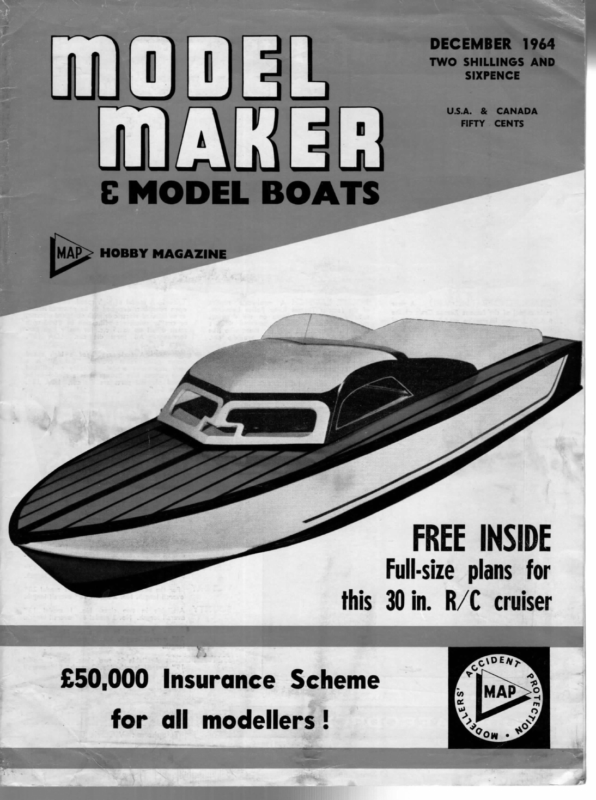
FREE INSIDE Full-size plans for this 30 in. R/C cruiser — £50,000 insurance Scheme for all modellers ! So SS So
MAKER TROPHY Fleetwood, September 27th ’ ‘ | 1 Right, the Mayor of Fleetwood came down to start a pair off and also kindly gave up further time to present the prizes. Fleetwood Commodore J. Blundall holds his flags, official starter W. Hugman steps back (extreme right). Boats are ‘“‘No Bad” and ‘‘Tempest’’. Below, ‘‘Carioca” and ‘‘Tantivy’ runing, and, on the bank, top, the winner, “Gigi’’, and ‘Cassius X’’. Note the ventral spine fairing off from ‘‘Gigi’s’’ fin, a feature of the ‘“Foxtrot’’ design. tions were as good as the Model Maker Trophy has ‘ : ever y had. arrive, , The leaving one-day race. 28th 27 It to boat, sail, was from a Sidcup, formidable announced by failed total the for to a O.O.D., Norman Fish, that a cracking pace would be set to complete as many heats as possible and the final positions would be taken on the scores at 5 p.m., after all re-sails and adjustments for byes, etc., had been cleared. In fact 10 rounds were sailed of the 14 needed, a splendid achievement which speaks for the co-operation of competitors and all officials. _ From our position on the bank it was a most enjoyable race, and this appeared to be an opinion shared by those participating. A lot of good-natured banter was exchanged and there was much exhorta- fee weekend of September 26th/27th saw the annual Scottish invasion of Fleetwood, with the Wade Trophy on the Saturday and Model Maker Trophy on the Sunday. Saturday’s was a team race, with 10 English boats versus 10 Scots (actually nine Scots and one home club member seconded to them). The blowy open water of Fleetwood is quite a change for the parkaccustomed Scots, and the Fleetwood team aggregate of 278 to the Scottish total of 172 reflects this. It might have been more, but the Southerly wind which veered to W.S.W., giving a reach changing to a long leg and tack, suited some of the visitors. Top individual scores were David Wilkinson, Cassius X, 37 for Fleetwood, and Wesley Rodrick, No Bad, 27 for Scotland. On Sunday the wind had veered to N.W. but later backed to W. It was a spanking top suit breeze (some skippers changed to 2nd suit and one went to 3rd) and with sunshine for most of the day, condi- 566 |
1964 DECEMBER With a bag full of wind “Cassius X” leads from ‘Davina’, above left, while “Tempest”? seems likely to take 3 from “Gigi’’, above right. ‘‘Anne YI’? (right) sails ‘‘Typhoon” and, far right, ‘First Attempt” sails top-placing Scottissh boat ‘ : . . ; tion Rag Time’’. of boats in strong Scottish accents; sailing was nevertheless serious and of a good standard. Len Maskell becomes the first two-time winner of the Trophy, having won in 1960 when the race was also at Fleetwood with the same boat. It was fine weather for Foxtrots, all four of which placed well up and three in the first six. Most of the Scots found condi- tions a little fresh for them, Tommy Buchanan being the only one to score in the high thirties, but all thoroughly enjoyed them- was also awarded another, presented anonymously, which turned out to be a toffee apple and a note selves. Apart from the winner, prizes were available for second and third place boats, top-placing design to a Model Maker Plan, furthest-travelled entrant, and, reading “If ye canna lick th’ ither boats, lick this!” The hilarity which greeted this, and the manner in Which it was accepted, were typical of this entire friendly and good-humoured meeting. from around the same distant part, it was decided hard, as well as the club ladies who did the same of course, a small memento for the mate of each of the top three boats. Since there were several Scots to award the distance prize to the Our thanks must go to Norman Fish and the other keen officials who gave up their time to work lowest-scoring (in a different but welcome direction) and, of course, boat, which was in fact one of the group from _ Victoria. Huw Bourns, the recipient of this prize, the club itself for offering its facilities and laying on the organisation so effectively. : No. a= KS80 = : KS71 Yacht Skipper April Glen-Rose Aeolus Connie Jeanette J. Bette W. Jennings KS83 ‘No Bad W. Rodrick 937 Anne VI R. Mackarel 1324 Tempest 1124 Bitsa Fiona 1358 1441 1429 1390 1180 1359 Victoria W. Cunningham A Design Daniels Doris H. Priest pee Ww. Hee iniature ‘a Macdona! Mod. G. Gentles Alexandra O/D certo Witty Skippy J. Bell Fleetwood Witty ‘Trumpeter Davina IT J. Roberts E, Latham Fleetwood Fleetwood ee riest eseenerty itchcraft Priest Witchcraft itchcraft Saltcoats leetwoo: A. Bell Fleetwood ‘First Attempt pico oe G. Miller pares P, es oe : Hubeed Lilhilda D. Bush Leeds & Bradford Adams sap eag . oer Sr Adams Coronet J.M. Fitzgerald Birmingham 1187 ‘Gigi 4 688 1. 2, Gigi Olitaire Carioca Dunning eetwoo L. Maskell . Holt Leeds & Bradford ie a irkenhead 401 pts. 3. 4. Rag Time Tempest 39 38 riest pts. pts. ans Mod. Foxtrot Mod. octurne Ss. 9 Cassius X 37 10 MM : plans, against 23 of 42 the last time there was a big entry; it Type 37 MM Twelve of the 27 were seems pts, pts. that the average in any Marblehead event these days is s, ) Anne VI 567 [ollows: ae Bet Bee i c WASP i ts od ace *) service are as AIDA Foxtrot Mod. Adams those from ape Maker bits itchcraft Littlejohn RESULTS 41 pts. lan 10 3 Mascot R. , 100 1179 Tantivy ‘ MM no Wasp 1034 3 Of the designs sailed, MM701 Witty Parkinson just MANTA Fleetwood Fleetwood be NORMA E. Smith D. Wi’kinson should oman Greeco Cassius X It as enjoyable a race. : Foxtrot Daniels them. . Manta O/D leetwoo give itchcraft Adams Fleetwood . Carter Norma Priest Fleetwood K. Hadwin Melody Witty 1965 and TRE tion details are known we will ah aida T. Buchanan in as Foon as date and organisa ib ag 1428 oes sailed in Scotland Witchcraft Priest 1133 request for the Trophy to be icc Elusive Typhoon — We have already received a Designer 7 rae Jittlejohn Victoria W. M. MacKenzie KS81 KS101 Rag Time bs Sa habs ueens Par H. Bourns KS14_ = Club W. B. Roger J. Mathieson about Plans half the available entry through Plans Department. from our
WMO MEL IMVANRIEIR} —E. J. Charlton describes OR those interested in trimarans as model sailing yachts the following treatise may be of some technical use. First, I consider the tricat to be an advancement on the catamaran. This is because the tricat potential is greater owing to the use of hydrodynamics incorporated into the float design, whereby greater stability and ultimate speed will evolve. It is simply a matter of finding the correct formula of hull design with waterline length to sail ratio coupled to perfect float configuration. We all know that multi-hull craft eventually reach a point of no return when flying a float or wing and capsize. My aim is to either stop this from happening or to minimise it to such an extent that it will only happen under the most extreme of weather conditions, when model sailing, in any case, may be abandoned. I would like to quote from the booklet, printed by the Amateur Yachting Research Society, called “Trimarans” written by that eminent yacht designer Erick J. Manners. This is what he wrote: “It did not appear logical to me to simply stabilise narrow sailing hulls with what might be termed the orthodox symmetrical buoyant displacement float. “Stemming from my early tuition in aeroplane wing theory the hypothesis I formulated was to utilise the extra forces exerted from fluid dynamics so that their components were orientated to resist excessive heel providing stability as well as to militate against leeward drift. “Indirectly as in the aeroplane wing, it is necessary to employ asymmetry to these ends. For obvious reasons a buoyant float of any shape on the end of an outrigger will add a little dynamic stability but I have proved that an asymmetrical shape without any of the former’s flotation value will do as well and more effectively. It will stabilise a sailing boat just as wings facilitate lifting an aeroplane and maintain it in stable flight’. All of this has been proved by designing tricats with asymmetrical floats, that is, floats of sleek shape with very small flotation value which actuate upon the water in such a way that hydrodynamic lift occurs and keeps the boat stabilised. However, the correct formula of certain angles of incidence, attack, toe-in, and outrigger lengths, plus the float length and position, all play a very important part in achiev- ing the necessary lift from the forces of fluid dynamics. We all know that these fluid forces only operate whilst passing along, over or under the asymmetrical shape. In other words, so long as the asymmetrical and discusses his own thoughts and successful experiments on this intriguing aspect of model yachts floats were passing through the water, fluid dynamics exerted lift. The static buoyancy in full sized tricats was suf- ficient to allow a man to stand on the float without it sinking beneath the surface. So the formula appears adequate enough to break down to model form. Upon doing this I discovered several anomalies. For instance the lateral resistance, although adequate full size, appeared almost non-existent in model form and I added an aluminium fixed centre board. The bows of the centre hull dipped alarmingly on a run down wind (I consider that models need the centre of buoyancy further forward to offset this phenomenon) so I merely added splash-boards each side of the bow. But the most difficult problem of all was static buoyancy, in other words, sufficient buoy- ancy in the floats to keep the model stable at rest. It is often a fact that when scaling down from full size the complete performance of the boat alters and many idiosyncrasies occur — to overcome them successfully means, in the end, completely redesigning your model. So it is with the float buoyancy factor. Remember, these floats are designed to give dynamic lift but I discovered in model form that the initial buoyancy needed to keep the model stable whilst stationary was lacking. My boat capsized before she moved forward. I reduced sail and tried again; this time she shot away at tremendous speed but capsized after a few yards. Obviously I either had to reduce sail or increase float buoyancy, but seeing that fantastic burst of speed made me want to retain it at all costs. The wind pressure in the sails was greater than the dynamic lift exerted from the floats. I dwelt upon the principle of leverage, and deduced that with longer outrigger arms the dynamic lift would be increased but also expected a little broaching-round to occur. This proved correct to a certain degree— she capsized more gracefully and took longer to do it, but no broaching occurred! It became obvious that initial buoyancy in the floats was necessary. To achieve this without losing asymmetry I made larger floats but retained the float formula. We now had a boat that sailed but in sudden gusts of wind she went over. I was loth to increase the float buoyancy value any further because 582 aan TRIMARANS
DECEMBER 1964 dynamics to stabilise the boat at speed and still retain initial stability whilst moving slowly or stationary, it is as well to study what experiments have already been carried out so that a complete understanding of the problem is at our command. Let’s therefore dwell upon what has already been tried out. The Amateur Yachting Research Society have published many booklets on yacht research — they are a gold mine of information and have been of incalculable use to me in my own experiments. There have been at least 45 different types of float fitted in various positions and at different angles on numerous outrigger arms. These outrigger arms have been tried both rigid and extendable — they have been tried hinged (hinged means that the hull or boat is allowed to heel to wind or sea but the floats remain constant at water level following the contours I was afraid of losing the asymmetrical formula. It is obvious that the larger the floats the less dynamic lift we can expect, coupled to the fact that bigger floats create weight and resistance and therefore can only slow the boat down, and since it is speed I am seeking, then I must retain the essentials of speed. The full sized trimaran designer Erick J. Manners suggested I utilise a model form of his tri-cruiser floats. This I did, with a tremendous improvement. I took the boat to Norfolk to show Mr. Manners how far I had progressed but mainly I wanted his expert opinion. We sailed the boat on a nearby ool. He did not seem displeased with her perormance except her wish, when at speed on a broad reach, to bury the bow of the working float deep into the water causing, at times, a sudden diving action. She would then come to a stop, right herself, and continue sailing her course. We discussed the boat’s shortcomings at length and decided upon cures. The buoyancy in the floats would be slightly de- creased but brought further forward, the floats increased in length and of slimmer build, making them nearly as long as the boat. These would be set further forward to offset the plunging potential. The boat itself was to be given a longer stern but “countered” to bring the centre of gravity further aft. The heavy solid ramin mast was to be replaced by a light, tubular aluminium mast, set 2 in. further aft. Finally, we decided to discard the transom rudder and incorporate a skeg rudder of larger proportion, and when possible to design new sails of lower aspect ratio. All this was done except the sails and though advised to do all these alterations one at a time to study each new reaction carefully, I felt all of them were necessary and quick progress is far more re- warding than the cautious, careful approach though less is learned and if the boat is still wrong which alteration caused the fault? However, she sailed remarkably well and in light winds she moved quite fast but gusts of heavy wind on a blustery day still bowled her over. So now I’m thinking of incorporating a set of dual purpose adjustable floats. I have not designed them yet but they will have considerable initial buoyancy to offset ‘capsizability’ and beneath them I shall fix a chord or dynamic plane which I hope will push the float out of the water as she moves forward, thereby decreasing wetted surface and drag. This way I expect to achieve ultimate and initial stability and retain the speeds this craft is capable of giving. If we are to utilise the exerted forces of fluid of waves). I believe a hinged mast has also been tried out so that only the mast heels to wind pressure, leaving the boat and floats stable. Various types of hull have been designed to discover the one best suited to this type of boat. Quite a few years of research and considerable expense has been poured into making the trimaran a safe, seaworthy and fast sailing yacht. It seems to have boiled down to two types. 1, the American favoured orthodox symmetrical buoyant float; 2, the Erick Manners asymmetrical dynamic hydrofoil. It is, however, obvious to any reader by now that this particular field of yachting or designing has a vast potential of experimentation. We all know that boats travel faster on the water than in it; it is equally obvious that a vessel will travel even faster above it suspended on foils (as William Prior’s hydrofoil sailing craft). But it is also a fact that hydrofoil sailing craft are difficult to steer. Since yachting is a sport and the sport is based on racing, then to enhance the sport we must explore every avenue where the slightest possibility of increasing speed occurs. Hence the study of tricats. Multi-hulls are an absorbing and exciting field of yachting, they will develop as time goes by and reach undreamed of speeds. My own tricat has already sailed faster than my very fast catamaran Felix II. 1 am convinced that a phenomenal turn of speed lies hidden in my tricat; seeking it out has absorbed me for a whole year so far. With every experiment I expect to make a giant step forward, but always it turns out to be a very small step but at least it’s in the right direction. It is not easy to advise model yachtsmen on the best formula for tricat design. There are so many approaches to the problem that to advise against any [Continued on page 591]