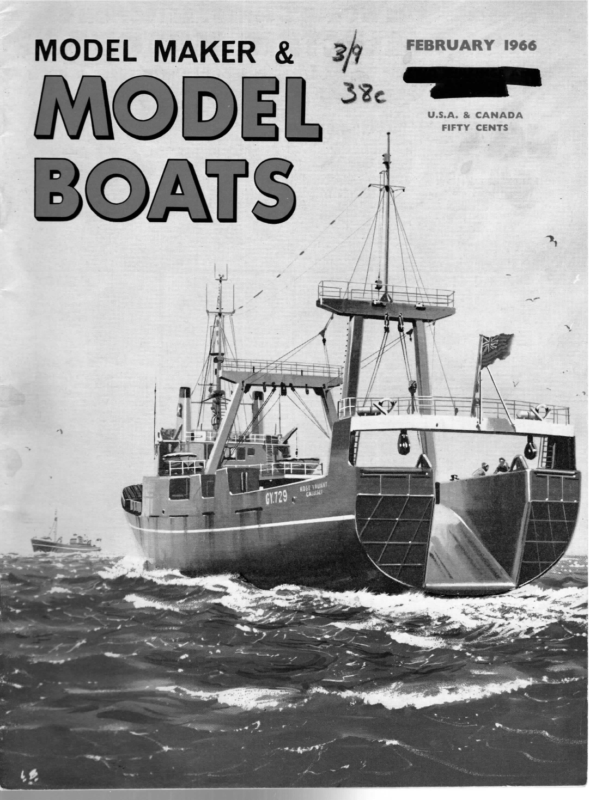
- A Face-Lift for an Old Lady E. W. Gearey describes the conversion of an A Class yacht for R/C sailing in the Q Class

MODEL MAKER & 3h FEBRUARY 1966 U.S.A. & CANADA FIFTY CENTS
FEBRUARY 1966 A Faee-Lift for an Old Lady E. W. Gearey describes the conversion of an A Class yacht for R/C sailing in the Q Class I HAVE been a confirmed R.C. power boater for about 12 years, having progressed from my first boat, a Veron Police Launch with electric power and sequence control with single valve receiver, via home made transmitter and a Wavemaster, Motor Patrol Boat, St. Laurie fibreglass and others with gradually advancing radio contro] systems, to my last, a Chris Craft Commander with Gannet engine and full controls via a 6 channel transmitter and reed receiver. My fellow members of the London Radio Control Models Society were gradually being converted from power boats to R.C. yachts and in June, 1964, seeing them sail at the Rick Pond, with eight boats on the water at the same time and racing to slightly modified Yacht Racing Association Rules, convinced me that this was what I really wanted. My power boat colleagues had been rather slow in adopting superheterodyne receivers and I had become a little tired of sailing all by myself in steering and speed events, In July, 1964, I was fortunate enough to be offered a good “A” Class yacht at a reasonable price which I snapped up, loaded the boat on the car roof-rack and was off home to my garage-workshop to plan her conversion to radio control. The yacht was Arabesque, registered A671, built in the early 1950’s by Arthur Levison, of Farnham, to a design by A. W. Littlejohn, and she had had an extremely good sailing record, having won the “A” The first regatta available following these trials was at Poole —Arabesque was duly entered and I found myself, a complete novice, sailing against some of the best boats in the country and also, may I add, being made very welcome, the brotherhood of R.C. yachtsmen being, I found, even stronger than that of power boaters and that is saying quite a lot. I was in for a very pleasant surprise, for Arabesque acquitted herself extremely well in the light winds of the first day and reasonably well on the second day with its high winds and rough water. What was even more surprising was the fact that, with no previous experience of sailing either model or full National Championship shortly after being built and had many more successes since then. There being little of the 1964 sailing season remaining my immediate aim was to have Arabesque on the water as soon as possible in order to put both her and myself to the test of competitive sailing and, what would be even more useful and important, to pick up hints and tips from the owners of other yachts who I found were no less prepared than their power boat brethren to discuss with a newcomer to the hobby all matters pertaining to that hobby. On the basis of this experience and advice I would be in a far better position to plan the thorough final con- version at the end of the season. I already had a superhet receiver which had been made for me by a colleague of the London R.C.M:S. and this I coupled to four of the relays from my old E.D. receiver in order to operate two control units— one for the sails and one for the rudder. A gear box, which I had built to operate a Kitchen Rudder on my Commander, was readily adapted to drive a winch for controlling the sails, and a smaller gear box was put to use to give progressive rudder control. These units were rather rough and primitive but they worked satisfactorily on the bench and sub- sequent lengthy trials on my home water, the Moat at Elstead, showed that they worked equally well under varying sailing conditions. size yachts, I was managing to sail Arabesque reasonably well. A further outing at Gosport regatta a few weeks later was not so successful, as one of the gears in the rudder control unit stripped on the first day and could not be repaired for the second day’s sailing. The experience gained and advice received at both these regattas and during many hours sailing at Elstead had provided the necessary information to enable me to plan the major refit to be carried out during the winter months. The radio equipment had proved itself adequate and reliable and would only need tidying up and the addition of some means whereby crystal frequencies of both transmitter and receiver could be easily and rapidly switched to eliminate interference by or with any other yachts sailing with me at any one time. The sail control unit had been found not to have sufficient power to pull the sails in under conditions of strong winds and the winch drum and guides would 63
MODEL BOATS Diagram 1—Old rudder is shown shaded. New one in outline. In my case Arabesque was fitted with a very convenient handle inside the hull, fitted to the keel bolts, and this I wanted to retain as I do a lot of single- handed sailing and the handle was essential for lifting the yacht into and out of the water, The height to which the handle projected inside the hull precluded the use of the separate box method. It was decided, therefore, to fit the sail and rudder control units to the underside of the deck with leads and plugs connecting them to the radio unit in a watertight case which would be fitted on one side of the carrying handle, the watertight case to carry the power pack being on the other side of the handle. All sockets, switches, etc., on these cases would be at the top and so out of the way of any stray water have to be modified to prevent the sheets tangling and catching up as they had done on several occasions. The rudder control unit had not been strong enough and the rudder had been found te be too small to give the quick manoeuvrability which is essential when racing, Arabesque was obviously too heavy as, with the extra weight of radio, control units, and power pack, she was sailing too low in the water. She was sailing on a load water line that was much too high. After all, she had been designed by an expert to sail on a definite predetermined waterline and it was therefore decided that the restoration to the designed Load Water Line should be the basic consideration when carrying out the refit. Her designed L.W.L. was 52.9 in. and to restore this it would be necessary to bring her total weight with radio, power pack and control units down to her designed weight of 55 lbs. This weight would be made up of the combined weights of various separate items, viz. 1) Radio, 2) Power Pack, 3) Control Units (a) Sail, (b) Rudder, 4) Hull, 5) Mast, spars, rigging and sails, 6) Lead keel, deadwood and handle. The refit was planned so that the various items enumerated would be tackled in the order set out and the reason for this will become obvious during the description of the which might enter the hull, It was found that the receiver, relays and battery could be comfortably contained in a plastic box 74 in. x 54 in. x 2 in. and the power pack in a similar type of case 6 in. x 34 in. x 24 in., these cases being readily obtainable as sandwich boxes. It was also worked out that the minimum size of hatch opening to allow easy insertion of all these items into the hull was 53 in, x 4 in. and the existing hatch opening was enlarged to this size. The edges of this new opening were suitably reinforced below the deck and a suitable surround was fitted above the deck 4 in. away from the edges and 4 in. high to prevent any water washing over the deck gaining direct access to the side of the hatch cover, which was cut very accurately to fit closely inside this raised surround. Further waterproofing was obtained by seating the hatch cover on strips of foam plastic with an adhesive backing, This can be readily obtained as draught sealing strip for doors and windows and it is surprising the amount of water it will absorb, Arabesque (Continued on page 83) refit which follows. Items 1, 2, 3a and 3b would be contained within the hull and an immediate decision had to be taken as to how this was to be accomplished. The majority preference is for all these items to be contained within a watertight box about 10 in. x 10 in. x 8 in, deep which is let into the deck with a watertight seal. Through the top of this box protrude the winch drum of the sail control unit and the arm for rudder control, together with the on-off switch for the receiver. This method makes for very easy overhaul and repair as the entire box can be removed from the yacht and any adjustments carried out on the bench. The minority favour the fitting of the sail and rudder control units to the underside of the deck and connecting them to the receiver with leads and plugs. In many of these types of layout the radio control unit is actually on a chassis fitted direct to the inside of the hull and access is obtained through quite a small hatch in the deck. One advantage of this method is that there is only one watertight seal required, but to my mind the radio, which is normally very susceptible to moisture, is particularly vulnerable as even the most watertight boats at times take in water in the most inexplicable manner. 64