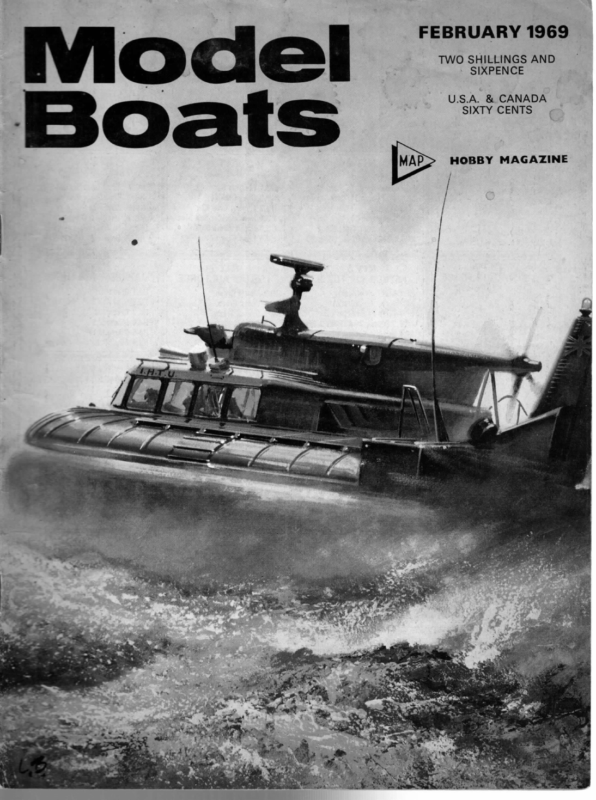
- Blue Glass An interesting semi-scale sailing model By C. S. Gould

FEBRUARY 1969 TWO SHILLINGS AND – SIXPENCE U.S.A. & CANADA SIXTY CENTS, HOBBY MAGAZINE
. ! | i Blue Glass An interesting semi- scale sailing model sce tac eve hae Seeeteandice eae eneel By C. S. Gould NE of the club members offered me a g.r.p. hull of the famous German ocean racing yacht tion could only be approximated. The slide follows our +M pattern, being made of 1/16 in. ply laminations in the same fashion as the conventional metal one; it is much lighter and, with a little Vaseline, has proved trouble free. Stormvogel. This was one of five made from a superbly finished mould. An immediate start was made on producing a suitable fin and skeg design which would give a model having the appearance of a super Marblehead class yacht. Bath tests showed that some 15 lb. of lead would be needed to give a l.w.l. just touching the transom; Initial sailing trials were made free-sailing in light weather, and indicated a nice easily-driven hull with no obvious vices. However, later outings in heavier weather showed the need for one or two modifica- with a length o.a. of 55 in. and a beam of 12 in., this gave a SO in. w.l., the forward 5 in. overhang producing a pleasing appearance. Comment on the absence of overhangs in the M class has been made in these pages before, and while it may be an old-fashioned viewpoint, the quest for speed within the Marblehead limit seems to be rapidly worsening the appearance of these boats. It was decided that the mast, rig, and sails could be borrowed from my China Boy Marblehead, so that completion of this glass fibre hull would only call for inwales, deck beams, deck and deck fittings, plus fin, etc. The fin is made up from twelve obeche laminations, resin bonded, with lead bulbs, cast from a modified China Boy mould, epoxied to each side. The hull finish follows the rest of my models— powder blue hull, white deck with lined-in planks, and king-plank picked out in maroon. Three coats of varnish were then applied, rubbed down between each, then burnished with car cleaner and polished. After a gold coving line was applied to the hull, the model was floated in ‘used’ bath-water, the slight soap film providing an excellent guide for masking tape, enabling a neat red waterline to be painted. This method also assists one’s ego when the time comes for launching, should there be any spectators or, worse, club members, about ! Hatch covers are 1/16 in. ply, resin glued edge to edge, and the windows are painted blue and shaded white to simulate glass. Strips of ply, + x 1/16 in., form the frames, and stainless wire glued to the frames simulates bars. The hatches were painted maroon followed by three coats of varnish and polishing. Radio control of, initially, rudder only was envisaged, so sheet horses almost the full width of the deck were fitted and provided with adjustable stops, so that a number of courses could be sailed at good efficiency. Not that this is really important, since most of the sailing in our club (Medway Marine Model Society) is for pleasure only; however, we have four or five yachts under R/C, and eventually there will, no doubt, be some friendly competition, especially as our home water is unsuitable for free-sailing races. An allowance of 4 in. had been made on the mast slide, as with a free-lance fin and skeg the mast posi- tions. When sailing off the wind there was a tendency for the stern to lift—not that the bow buried, since it has tremendous reserve buoyancy, out more a change of trim. Rather than remedy this by altering the fin, a small compartment was built in the stern and some square 5 oz. lead weights were moulded. In strong winds two of these trim weights are needed, but they can be dispensed with in light airs. In strong winds (Force 5 and above), when beating in 3rd suit, there was a tendency to come into irons. The mast was moved forward and a 3rd suit main was used with a 2nd suit jib, which appeared to cure it. Bearing in mind that I wanted to use a selfcentring rudder servo, and that balance should there- fore be delicate, I finally decided that the sail plan was quite far enough forward for good appearance, and it would be better to fill in the after edge of the fin, which had in any event been kept shorter than scale. The increase in wetted area, according to Froude, makes little difference on a boat of this size and speed. The improvement in sailing to windward, following this modification, is most marked, and the mast was even brought back } in. At about the time I was doing these mods., a photo of Stormvogel appeared in a yachting periodical, and I realised how much it would have helped had I known what her rig was; she had a bowsprit and the 76
—s FEBRUARY 1369 main sail area well forward, with a small mizzen mast ! Fortunately, I have quite a selection of sail combinations which can be tried. In light to moderate winds she carries the mainsail off a Marblehead and my 10 rater’s top suit jib. At the other end of the scale, a sister from the same mould recently did her maiden runs, while waiting for her proper sails, with the rig off a $M Marktoo ! Radio in my model is a 10-channel Remcon, though at present only two channels are used, for an Aquamite servo on the rudder. There are currently three of these hulls sailing, and two more under construction. If anyone is interested, the moulder is B. Turner, 94 Ewart Road, Rochester, Kent, and you can see them sailing on Sundays on our water at Upnor, or, of course, on Navy Days at Chatham ! Turbinia was an interloper, a trespasser guilty of very bad manners to say the least, and that impression still remains, though I shall show that it is quite erroneous. The fact that Parsons was Irish may have had something to do with this, but he was the youngest of the six sons of the great Earl of Rosse (6th Bart, 3rd Earl). Parsons graduated at Trinity College, Dublin, and Clare College, Cambridge. Now TURBINIA (continued from page 59) Speculation was aroused and some said Cobra had struck the iron hard Haisboro’ Sand. Others blamed the turbine for driving Cobra at too high a speed. Although Cobra was never commissioned the Admiralty had adopted her after stringent trials. A court martial and enquiry were held and it was decided that Cobra was inherently a weak ship. This disaster is never mentioned by writers and for the denouement to show that Parsons was not as lawless as the above account makes him. I quote from the following letter to The Times. seems to be taboo for some reason or other; on the other hand Viper’s grounding is often mentioned. The least that can be said is ‘the start of the great Turbinia at the Naval Review turbine era was very inauspicious’. I am very proud that Turbinia is preserved suitably in Newcastle, the forerunner of a great era which still continues; Turbinia Works still exist but do not produce turbines any more; builder’s (house) supplies To the Editor of The Times. Sir, Your correspondent at the great Naval Review — writes of the remarkable performance of Turbinia can be obtained there ! “the fastest vessel in the world’—that she “contrived at the cost of a deliberate disregard of authority to make a brilliant but unauthorised exhibi- THE SPITHEAD INCIDENT tion of astonishing speed”. On arrival at Spithead Turbinia would doubtless be assigned a particular berth suitable for her size, from which proceedings could be witnessed, but in some quarters the subsequent behaviour of Turbinia aroused a furore. The following account I happened to be on board Turbinia at the time and in justice to her designer, the Hon. Charles Parsons and to Mr. Leyland, who were running her, I ask leave to state that the astounding runs she made between the A and B lines on Saturday were in obedience to a message brought by picket boat that the Admiral wished her to show her best speed more especially for the benefit of His Royal Highness Prince Henry of Prussia, who was watching from the appeared in The Times. Extract from:— Review of the fleet by the Prince of Wales (From our special correspondents) H.M.S. Powerful, Spithead, June 27th, 1897. “During the passage of the Royal Procession the lines were kept creditably clear by the vigilant and ubiquitous patrol boats told off for that purpose, but in spite of all their efforts some few small craft and steam boats managed to defy their authority. Among these was the now famous Turbinia, the fastest vessel in the world. At the cost of deliberate disregard of authority, she contrived to give herself an effective advertisement by steaming at astonishing speed between the lines A and B after the Royal Procession had passed”’. This account caused the world to believe German warship Koenig (Wilhelm). The exhibition of speed, so far from being unauthorised was specially invited by the authorities. Experts will like to know that on this run Turbinia topped the unprecedented speed of 34 knots; a noticeable feature was the absence of vibration. I am your obedient servant, Carlton Club. George Baden-Powell. Without any doubt whatsoever, the latter version is the correct one but the false version still persists to this day. Indeed, whenever Turbinia is mentioned up crops the false version. The museum contains a large oil painting depicting Turbinia making her record run between the lines of naval might of the world. The artist has caught Turbinia at her best, showing what a marine greyhound she was. that 77