- STROLLER 1969 10-RATER CHAMPION DESIGNED BY sTAN wITTY
- Readers Write

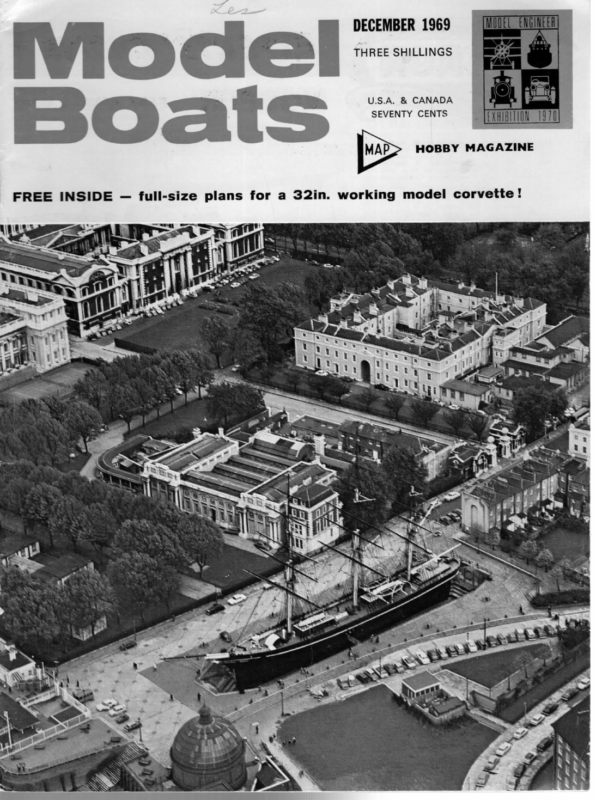
DECEMBER 1969 THREE SHILLINGS U.S.A. & CANADA SEVENTY CENTS HOBBY MAGAZINE FREE INSIDE — full-size plans for a 32in. working model corvette! ‘<< ~~
MA MODEL BOATS S T R O L L E a4 1969 10-RATER CHAMPION At the time of writing there is no clearly dominant type of ten-rater. It seems there is room for development in yachts of both vee or flat section, with a fairly wide variation in displacement, though it is apparent that the long reign of the heavyweight is over. The ten-rater shown is fairly conventional in hull form, and carries a moderate draught fin and bulb in a way which allows full use to be made of the power available. There can be no doubt that the trend in favour of bulb-keel designs will continue. The extra stability STROLLER ae | ! | wt ot [ XX permits a lighter hull, hence the need for sharp sections forward. The sight and sound of a yacht with full bow sections chunking to windward is very pleasant, but probably not the best way of doing things. While the hull is similar to the original, the shapes of the plane areas of the appendages have been adjusted slightly. In the writer’s view, the design of fin and skeg rudder for a bulb-keel yacht requires a different technique than for a fin keel. On the latter, the skeg area can be reduced to the minimum, providing the fin root is fairly central, but as this is as bane ee 3 % GARBOARD 520 colada RADIUS OPTIONAL
SNED Y WITTY F seldom possible in a non-prognathous bulb type. The area of the skeg, and in particular the position and length of the base, plays an important role in obtaining good balance over a wide range of conditions. In addition, the uprushing stern wave gives the skeg several degrees of positive incidence when the hull is heeled, thus not only decreasing any tendency to luff, but by offloading the fin, also reducing the leeway angle and improving stability, since the centre of area of the skeg is much higher than that of the fin. When the angle of heel is appreciable, there must be some slight reduction in height of the stern wave, thereby regaining some of the energy from the hull wave formation. Not so long ago, a view widely held was that the after edge of the fin adjacent to the hull should be cut away to release pressure tending to keep the boat off the wind. This always seemed an odd notion to the writer. At times the pressure could be seen boiling out across the hull to windward through the gap. It should be borne in mind, though, that this type of appendage evolved originally by shortening and cutting away area on the pre-vane era craft, and thence to scalloping away the after edge of the fin towards the hull. Part of the reason for the considerable success of the flipper fin was that it was = usually combined with a smooth and easy profile giv- ing low resistance in most conditions, particularly considering the blunt nosed sections so often used. Nevertheless, viewed on its own, there is no doubt that this | \ \ \ _ arrangement has certain advantages compared with the modern fin and bulb. Flipper fins still have quite a following in the U.S. and I note that the top two Ms in their Eastern Div. Championships were both \ _ \ _ Rabbit, _ reason.for this preference is that weed does not snag the easy profile of the flipper fin. Prognathous bulb keels are highly efficient, but on some lakes, tend to pick up weed and fishing lines, or on occasion a spare push bike wheel, all of which may lead to an increase in parasitic resistance. I would not wish to knock this type, though, and in fact have designed three of the same since the design shown was completed. It remains to be seen whether ten-rater bulb keels will ultimately go deep, as in the ‘M’ class. This is not a certainty, for in the ‘M’ class the ACTUAL area of both sails and spinnaker increase with height, while | modified to this configuration from Wasp and White keel though craft. most of the fleet were sailing bulb I understand, though, that part of the under the new ten-rater rule, this is not the case. It | _ _ | may be that the extra resistance of the deep bulb will make extreme ventures in this direction unrewarding, unless accompanied by a worthwhile increase in sail area and/or height. The original sailplan sent out with the lines was to the old rule, so when putting together this article a new sailplan was drawn to obtain rather more spinnaker area. As the hull is of a type which can sail efficiently at fairly large angles of heel, the sailplan is quite high, with a luff-to-foot ratio of nearly five to one in the main. On the whole, the design is fast and responsive over a wide range of conditions, and if built to give more than a passing resemblance to the lines, will produce “i qa first-rate performance in any class of competition. 521 ee |
DECEMBER 1969 were below 95db and 10 above, of the 10 above all but one were using tuned pipes. Sound waves from a model power boat consist of a wide band of frequencies, and noise which sounds harsh to one person may not bother another person, though it is generally accepted that high frequency noise causes more annoyance than low frequency noise. It can be seen from the tables that a large number of the boats gave a higher reading on the ‘A’ range than on the ‘B’, showing that the noise was predominantly in the higher frequency range. It should also be noted that when sound levels are measured in decibels, an increase of 6db on the meter reading is equivalent to doubling the level of noise emitted. Also, if the distance from the microphone to the noise is doubled, then the meter reading would drop by 6db. Therefore, a boat showing a reading of 104db is emitting four times the noise of a boat showing only 80db. It appears that there are two schools of thought on the question of how to measure noise and what should be accepted as a maximum level. The main problem is the expense of obtaining a calibrated noise Readers Write BOURNVILLE ACTION Dear Sir, After reading Mr. E. C. Boden’s article on the problems of noise in the October Model Boats, my fellow club ~~ members suggested setting up a noise committee. At the moment my Club has elected three members, with the possibility of electing a further two members. The committee members are:— and Baker Mr. L. Hyett, Mr. R. myself, acting as chairman. The committee’s first act is to state quite definitely that:— (a) If at any regatta held at Bournville the committee consider a Competitor’'s boat to be noisy, he will not be allowed to sail, unless he can silence his boat to the satisfaction of the committee before his allotted sailing time. (b) It intends to make sure that the committee's own club members do not attempt to run noisy boats. It intends to make the problems of (c noise known to as many non-club members as possible, and to offer advice to the novice. The Bournville Club will be grateful if you would mention this as a warning to other modellers of our intentions. Birmingham 32 J. Daniels. PIPES WITHIN PIPES Dear Sir, Regarding E. C. Boden’s article on the noise problem in October Model Boats’, | should like to add a little more to the ‘tuned pipe’ saga, before we are perhaps panicked into banning tuned pipes, which would be a pity, as they represent a major factor in the development of high-powered twostrokes As | am interested in building and tuning full-sized (motor cycle) two strokes, as well as model engines, | try to keep well abreast of developments in the motor cycle world, one of which, | understand, is giving promising results. This consists of fitting a tail pipe inside the double-cone expansion cham- ber, with the level indicator. One method suggested to overcome this problem, is to construct a cheap wide band amplifier and indicator unit. The club committee then listen to all the club boats in turn and also note the meter readings. From these comparisons figures and the views of the committee on the noise emitted, an agreed maximum for the water may be arrived at. The main problem for the above method, as I see it, it does not allow a club to decide if their boats would be accepted on someone else’s water. I feel that the only way to overcome this problem is for the M.P.B.A. to agree on what is an acceptable maximum noise level and all clubs try and obtain the use of a noise level indicator to check their boats against the agreed level. Failing this a wide band amplifier and indicator unit could be constructed as suggested above, and when completed have the maximum noise level point calibrated by comparison with another meter. I am sure there are many people who will not agree with these views but I do feel something will have to be done to reduce noise, as many clubs are in danger of losing their water. length of the internal pipe so arranged that its end comes roughly Opposite the maximum diameter of the expansion box. | understand that this length is not too critical but the tail pipe should be a gas tight joint at the end of the expansion chamber. The thinking behind this idea is that the expansion chamber has no free exit but only an indirect one through the internal tail pipe. This makes a very large reduction in noise level, while giving a more vigorous reflected pulse in the exhaust system, which increases the power output at high r.p.m. This modification applied to a ‘hot’ Japanese 350cc. is reported to have improved performance to such an extent that it revealed hitherto unsuspected handling problems under road racing conditions. Sounds just the job for model boats! Why not try it, you tuned pipe fans, before the safety first element puts us out of business? The supplementary expansion § box suggested by E. Boden would still be applicable to this type of tuned pipe if noise level is still offensive. By all means let's preserve our sailing waters, but don’t kill technical progress while doing it. Leeds. D. Boothroyd. A CLASS MATTERS Dear Sir, | would like to congratulate Mr. Shaw on his excellent article entitled ‘A-class Reflections’. | feel that this type of article is of more interest than the normal type of report published, stating that boat ‘A’ beat boat ‘B’ with no attempt being made to describe developments in the classes. | do feel, however, that some of the views expressed in this article are open to some question, particularly with regard to the heavy displacement yachts such as Moby Dick. \t appears to me that at present and for all round conditions, the 60 in. LWL, 70 Ibs. ‘A’ Boat has one very big weakness, this being the lack of liveliness downwind in winds of moderate strength and above. In order to make the heavy boat competitive in light to moderate breezes with the small sail area given by this configuration, the designer is forced to adopt a very easily driven hull form, having a fairly deep V-shaped midsection. This section, coupled with the 525 great weight, makes the boat very steady both to windward and downwind, but makes the acceleration very poor. Thus, when marginal planing conditions and above are reached, this type of hull is completely out-accelerated by the U-shaped, 54/58 Ibs. displacement boat (which also has approximately 100-150 sq. in. more sail area). As was mentioned in the article, the Lewis designed Moby Dick did best in the lighter breezes, owing to the number of downwind boards which it must inevitably have lost in the stronger breezes. In both the 10-Rater and Marblehead classes, there is at present a definite trend towards lighter displacement and, while the A-Class is a different proposition owing to the factor D in the measurement formula, | do think that the A-Class will also feel the effects of this trend. In fact, Priest foresaw this development with his Highlander design, which is definitely at its best in the stronger breezes, having won the championship on four occasions, and each time at Fleetwood. In fact, it has seemed through the history of the Championship that the lighter boats do better at Fleetwood and the heavier boats come out on top at Gosport. When designing my own A-Class, with Fleetwood conditions in mind, | decided on a U-sectioned, min. displacement type of yacht, as the downwind performance is so much _ better with this type of hull form in strong breezes, and it is important to win both ways of the lake. | would like to point out also that in the report of the ‘A-Class’ nationals it was stated that Bobcat had won more ‘windward’ boards than Emperor. In view of the changing conditions at Fleetwood it quite often happened that the boats were sailing downwind for three points and to windward for two points. This actually occurred when Bobcat sailed Emperor. On the Sunday at Fleetwood, in a good three tack beat, Emperor lost no heats at all, in- cluding sailing both Kami-Sama_ and Genesis, and again on Tuesday in a 2nd suit one leg beat Emperor was once again unbeaten to windward. The comparison between beats won. as counted as the amount of three points dropped was completely misleading in this case. Carshalton Chris Dicks.