- RACING MODEL YACHT CONSTRUCTION Part Two G.R.P. coated balsa hulls By C.R. Griffin
- STAMPEDE A MODERATE DISPLACEMENT ‘A’ CLASS DESIGN DEVELOPED FROM TWO EARLIER MODELS BY ROGER COLE
- Round the Regattas
- Readers Write…

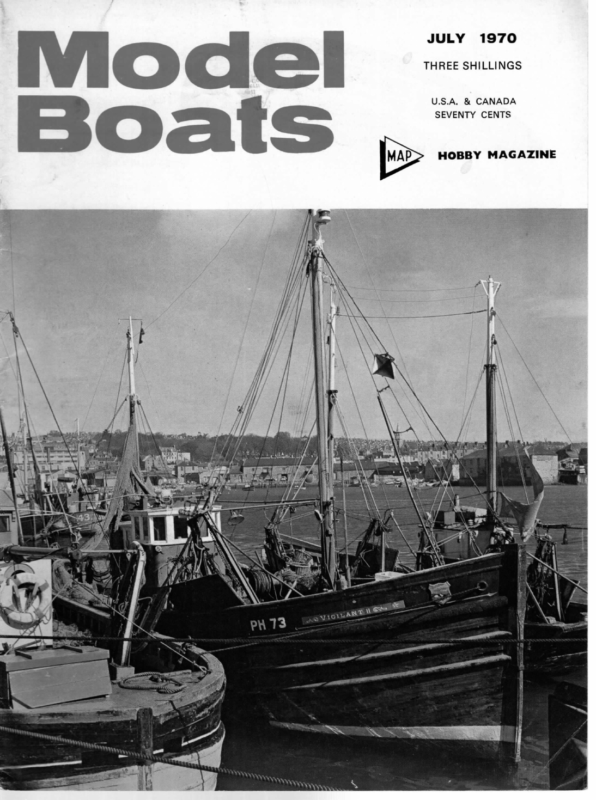
JULY 1970 THREE SHILLINGS U.S.A. & CANADA SEVENTY CENTS HOBBY MAGAZINE
RACING MODEL YACHT CONSTRUCTION Part Two G.R.P. coated balsa hulls J XHE planks are cut approximately % in. wide, although where a heavy tumblehome is required or the bow section is fine and flared, 4 in., ¢ in. or even 5/16 in. wide planks are useful. Normally when planking it is not good practice to use short planks (called stealers) but as in this case the planking is only a base for the top coating, it is possible to use a few short ones. Divide the greatest section (usually No. 6) into equal } in. approx. spaces; it usually works out at 12 or 13 planks but it does depend on the beam and displacement of the hull. Should the section not divide equally into } in. spaces, make the spaces a little larger or smaller to suit and cut the planks a similar width. Divide all the shadow sections 2-10 and transom into the same number of spaces as that calculated for the initial section. No. 0 and 1 shadow sections are divided into one less in number spaces. Spring a } in. square timber spline through the marks and see if they form a fair curve, and correct where necessary. Starting from the recess in the inwales, place a plank in the recess and hold it there with a few clothes pegs. Mark off at each section the width at each point by stepping back one space width from the first visible space mark. Remove the plank and connect all the marks by a fair curve using a spline. Cut two planks to this shape, one for each side of the hull. Glue into position, using clothes pegs, dressmakers’ pins or map-pins to hold the plank whilst the glue dries. The writer’s personal experience was that balsa cement does not create as strong 278 By C.R. Griffin a joint as does Aerolite 306 glue, although using the latter extends the building time. Repeat the planking process for the other side of the hull. Make two ‘L’ shaped stainless steel chainplates as shown in Fig. 6 and fit these at the designed position by cutting a slot with a padsaw and screwing downwards into the inwales. The next plank either side of the hull is shaped by marking off the section spacings on the ribs at each point on the plank and connecting in a smooth curve. Slightly chamfer the edge of this plank which contacts the sheer plank already fitted. When holding this plank in position, to allow the glue to dry, use pins pushed at an acute angle through both planks. Continue this process until the planks meet the backbone. If at any time the planks show a tendency to lift off the shadows because there are no ribs to which to glue the plank, put a pin through the plank into the shadow whilst the glue is drying. Having completed the balsa wood planking, lightly sand the hull to make a reasonably true surface ready to take the coating. At this point, depending on how well the construction was preplanned, it is possible to either build in the fin and skeg before coating or fit them after coating. When building Stan Witty’s Bambi the fin and skeg were pre-fitted but because it was the intention to take a moulding from the hull I did not glue these items in position. Therefore, after the slot in the backbone in front of, between and aft of the fin and skeg had been filled with ?in. x $ in. spruce, these items were removed.
JULY 1970 Coating the balsa wood hull is reasonably simple, and the manufacturer’s instructions are easy enough to follow. Two layers of tissue and resin are sufficient to give a strong protective coating. The use of colouring in the resin does save painting, but it delays the setting time of the resin, as does the temperature of the workroom. On Bambi, Holts resin was used, but I feel that a resin such as Beetle would give better results. When the coating is thoroughly dry, say 24 hours, sand the hull with wet and dry paper, commencing with 120 grade and working up to 400 grade. After checking the hull against the templates for accuracy, polish with Gumption and then metal polish. A really superlative surface can be obtained but it does take time. Remove the hull and shadows from the building board by removing the screws securing the cross pieces to the building board, invert the hull and after fitting some temporary deck beams remove the shadows. It may be necessary to break the shadows in order to remove them (see later note on split shadows). File and sand the inwales level, then fit the king plank, which is slotted to receive the upper ends of the fin and skeg. Glue and screw the mast heel fitting to the fin if this type of mast fitting is intended. Fit the fin through the slot in the hull and into the slot in the king plank using wood glue, and when dry run a tissue reinforced fillet around the fin where it meets the inside of the hull. Fit the rudder tube to the skeg using epoxy and No. 1 x = in. C.S. brass screws. Fit the skeg into the hull in a similar manner to the fin, checking for true alignment with the fin. Half notch the deck beams, cut from 5/16 in. spruce, into the inwales and king plank at the planned positions. Fit bracing beams from the fin to the inwales (see photo) to prevent excessive strain on the hull by the shrouds. Fashion the garboard pieces from balsa wood and place into position using polyester or epoxy resin or, if pre- ferred, the garboards may be built up with Plastic Padding. Check that the one inch minimum radius garboard rule is not infringed. Cut the deck from .8 mm. marine plywood and give the underside two coats of varnish. Give the inside of the hull two coats of varnish. The edge of the deck which contacts the inwales is then given another coat of varnish, and, whilst still wet, screw the deck into Heading photo shows planking in progress on a Marblehead hull. This actual hull has ribs, but the planking method is identical. The ribs may be seen in the photo at right, which shows one of the chainplates and also the bracing beams which take the shroud loads. SHADOW MARK OFF IN PLANK G WIDTH AT EACH SECTION DIVIDERS SET TO APPROPRIATE so eeaadh Vo PLANK WIDTH \ \ = PLANK TEMPORARILY POSITIONED position using No. 0 x } in. CS. brass screws. Alternatively, the deck may be fitted using a turpen- tine thinned coating of Sealastic, then screwed. The hull is now at the stage where only the lead bulb and the fittings have to be attached, but more on this subject will be given in later articles. To use a hull built by this method as a male plug for a female mould, fill in the slots in the backbone but leave a slight indentation as a guide to the position of where the fin and skeg should be fitted in the G.R.P. hull. Polish the hull with a wax release agent, then spray or brush on a coat of parting agent. The latter gives a very fine finish to the mould. Essentially the mould consists of layers of glassfibre thoroughly impregnated with polyester resin. The resin is supplied in liquid form which, by the addition of a hardener, causes a chemical change to take place turning the liquid into a hard solid. Most suppliers of glassfibre laminating materials issue precise instructions on the correct use of their products and it is best to follow these. The only pointers that are necessary are that the first layer of fibre be tissue type and that a further two layers of chopped strand mat will give a strong yet pliable mould. The process of laminating is rather smelly, so that adequate ven- tilation of the work area is necessary, as is the maintenance of an even temperature of about 65° F. (18° C.). At this temperature the resin will solidify in approximately 45 minutes in the mixing container or in 90 minutes when applied to the hull surface. Leave the mould on the plug for twenty four hours at room temperature to allow the resin to cure. Remove the mould from the plug. Affix supports to the mould using resin and glassfibre to enable the mould to be kept steady whilst moulding. Moulding a fibreglass hull When the mould is throughly dry, coat the interior with a thin, even coat of wax release agent. Spray or brush on a thin coat of mould parting agent to enable the hull and mould to part easily and to give the hull a very fine surface finish. Mix the laminating resin and hardener and give the inside of the hull a first coat; the use of thixotropic paste prevents both running and sagging of this coat. Allow this first coat to become tacky and then lay on to this strips of glassfibre mat, coat with resin and (Continued overleaf)
MODEL BOATS SIMPLE ‘ PROPELLER CHECKER [sus extremely useful little gadget was pressed on the Editor some years ago at a regatta, with the promise of a little information to follow in the CHECKS IDENTICAL HEIGHT OF LOWEST POINT OF EACH BLADE TE. > ~SPACER TO SUIT PROP = 2 BUSH TO SUIT SHAFT CHECKS IDENTICAL BLADE ANGLE AND SECTION CAMBER Au post. Nothing further was heard, and although we have an idea as to who and where it was, we’re not sure. If the modeller in question likes to drop a card to us, we’ll see he gets a small payment for the idea. Basically the checker is a simple jig which ensures that all blades of a prop are at the same plane angle to the hub and have the same pitch angle and camber at the maximum chord point. It is, of course, only really useful for metal props. We checked one or two commercial ones and the results were quite surprising! As shown, the gadget is a piece of brass sheet bent and filed to the desired angle and section, with a soldered wire angle and a bush which accepts a piece of 2BA or 4BA studding on which the prop can be screwed. It must be possible to ‘lift’ the prop to locate each blade in turn, so a bit of spare length in the studding is needed. Care should be taken to get the bush soldered in squarely, though, of course, any error would be the same for each blade. Obviously the device is capable of refinement. An adjustable angle for pitch, by means of a separate end-piece, is the first thought; different end-pieces for different sections is a follow-on. An adjustment in diameter would be useful; in conjunction with a sleeve for the bush and a set of end-pieces, the gadget would then be a universal checker for any size and pitch of prop. YACHT CONSTRUCTION (from preceding page) remove all air bubbles by using a roller or stiff stippling brush. Apply the second layer of glassfibre mat, again rolling or stippling out all air bubbles. Run a reinforcing strip along the middle of the hull and at any points of stress in the hull. Allow the hull to dry thoroughly for approximately 24 hours then cut off all excess material above P.S. BRITANNIA (continued from page 277) Phase 5. 1945 to 1956 Britannia, which had changed her name once again in phase 4, to Skiddaw, was returned to Messrs. Campbell, and also given a major overhaul, and be- came once again P.S. Britannia. The alterations this time included the changing of her boiler for the third time, the fitting of two slim, flanged funnels, the removal of the large teak deckhouse, the removal of the two lifeboats with their davits from the fore side of the paddleboxes either side, and moving the bridge slightly further forward. This final phase saw Britannia visiting her old haunts, but it was not for long and she was finally scrapped in 1956. 280 the deck line and carefully remove the hull from the mould. Again, the hull can be coloured using colour pigments, thereby avoiding the necessity of painting or subsequent maintenance. The finished hull shape can be polished to a firstclass finish using 600 grade wet and dry paper followed by metal polish or Gumption paste. Particulars of Britannia Builders: Messrs: S. McKnight and Co. Engines: Messrs. Hutson and Sons. Length overall: 2364 ft.; Hull breadth: 263 ft.; Draught: 94 ft. 459 gross tonnage. Compound diagonal engine. H.P. cylinder 37 in. L.P. cylinder 67 in. Stroke: 67 in. Horsepower with normal draught: 304. Acknowledgements: Mr. I. G. Ireland of Torquay for plans and photographs; South Coast Pleasure Steamers by E. G. B. Thornton, M.B.E., M.LE.E. (T. Stephenson and Sons, Prescot, Lancs.); Warships of World War Two; Messrs. Lenton and College; Ian Allan Ltd.
MODEL BOATS STAMPEDE A MODERATE DISPLACEMENT ‘A’ CLASS DESIGN FROM TWO DEVELOPED EARLIER MODELS BY ROGER COLE STAMPEDE is a development of two previous boats, these being Scheherazade II and my last design, Wrong Direction. Wrong Direction was drawn out in late 1967, but my college career did not afford me the time to build the design. A friend started to build her some time later, and I have only recently been able to complete her. She is a development of the boat I have used for the past few years, Scheherazade II, a Daniels-designed moderate displacement, medium water-line yacht. I felt at that time that Scheherazade II was fairly good off the wind but needed a bit more power for windward work. The power needed could have been obtained in several different ways: 1) An increase in beam 2) An increase in draft 3) An increase in displacement Methods 1) and 2) were discarded for the following STAMPEDE Mi) designed by copyright of Roger R. Cole The Model Maker Plans Service 13-35 Bridge Street, Hemel Hempstead, Herts INTERNATIONAL “A CLASS y reasons: 1. An increase in beam would have been detrimental to the downwind performance. 2. Any extra draft would involve a_ heavy penalty and thus a substantial reduction in sail area, which would tend to impair the yacht’s light weather ability. It was decided to adopt the third alternative. By increasing the displacement it is possible to improve the ballast ratio of the boat. If one takes a 52 lb. ‘A’ boat one finds about 40 lb. of lead beneath her keel. Take now a yacht of 64 Ib. displacement. Her hull weight will not be much more than the 52 lb. boat, so the extra 12 Ib. will go into her lead ballast. To accommodate the extra displacement, it was decided to increase the 55.5 in. of Scheherazade II to 57 in. for Wrong Direction. The beam was kept at a moderate 15.2 in., but the floors were steepened, producing a powerful, yet fairly easily-driven hull of 68 lb. displacement. These dimensions gave her a sail area of around 1,500 sq. in. Stampede is an attempt to improve the concept still more. Wrong Direction has proved quite impressive to windward, but is generally slower than Scheherazade II off the wind. In the new design, downwind performance should be very good as the displacement has been reduced to 58.75 lb., the beam reduced to 14.5 in. and the floors flattened. Windward power has been maintained by hardening the turn of the bilges, thus forming a much stiffer section than on the previous designs. Sail area works out at around 1,490 sq. in. Stampede has been carefully balanced and because of this the forward sections are a little fuller than I would like. To sharpen them up any more would have needed a degree of tumble-home to balance them out. Roger Stollery has pointed out the importance of a fine bow in his Warlord article, and it 286 STATION SPACING A TOY 625° ‘a’ To 8 86″ JB LUFF tet. SUIT 2na « ara ALL v 23″ A 80″ 8 2″ 423″ OA 64 60 58 74 53 67 FEET 80 / B21″ [ fs 21
JULY 1970 seems that ‘A’ boat designers have been particularly guilty of producing ‘bashers’. The hull form is quite orthodox as are the appendages, the latter being more normal than those on Wrong Direction. Scheherazade II’s action through the water at speed is rather a fussy one, and in both Wrong Direction and Stampede I have attempted to minimise this fault. In Wrong Direction the waterlines forward are relatively fine, but the sections are still fuller than the ideal, due to the long forward overhang. In Stampede, the overhang has been shortened and the sections are better so her action at speed should be quite clean. The sailplan on Stampede follows closely that used on “WRONG DIRECTION” “STAMPEDE” The hull forms of the Daniels-designed Scheherazade II and my own Wrong Direction are also quite normal, although the Daniels design is not a metacentroid and my own design is. To turn for a moment to the sections and waterlines at the bow, DIMENSIONS ARE DISPLACEMENT L.O.A. 82.5 58-75 Ib. in., COPIES LINES) a CLR — LENGTH 2 BEAM ” ORAFT DISPL. LEAD OA. we MAX CB L.W.L. 56.25 in., OF THE MAX DRAWING would be perfectly satisfactory. *(See Model Boats, Sept. 1969) BEAM BELOW Wrong Direction which was, in turn, developed from the experiments I did on Scheherazade I]*. The percentage of area in the foretriangle is greater than is usual and I believe this layout to be more efficient. However, if one were to use a more conventional sailplan I have no doubt the yacht’s performance 15 in., W.L. (FULL SIZE ARE AVAILABLE, PRICE 12/6d. BEAM BODY 14.5 PLAN, in., DRAUGHT HALF-SIZE POST FREE, FROM M.M.P.S. SHEER 12.1 in. AND WATER- AND
MODEL BOATS Round the Regattas Far left, Hove and Brighton skipper F. Jennings turns Mata Hari at the end of a windward leg, and, left, Mr. Rusty running in top suit, etc., both at Hove’s 19th April meeting. Opposite, Mrs. Ken Jones christens one of the new German boats, with Fritz Jacobsen holding the stern against the influence of the champagne. Bottom, the Danish boat being retrimmed by Jens Brandt, with Hamburg V sailing by. Both these pictures from Birkenhead, April 26th. Leicester M.P.B.C. Open Regatta [SHE third Leicester M.P.B.C. open regatta was held at Market Bosworth on May 3rd still watching despite the late hour. In the 10 c.c. multi boat, the local hero, Ivan Robinson, again proved his considerable multi boat experience by winning for the second meeting running. It is clear that with the larger number of competitors who were prepared to travel great distances to the regattas, that something must be done to speed up the meeting, perhaps by having invitation speed, or a qualifying time for speed events. Although this proposal was outvoted at the last R/C conference, the time must surely come! and NEES ee ea attracted an unexpectedly high number of entries, with 13 Southern, London and Midland area clubs represented. The exceptional weather perhaps contributed to the large numbers, the only clouds seen all day being smoke clouds from a big bush fire on the other side of the lake. The meeting started shortly after 10.30 with the Naviga steering event, in which there was a total of 53 entries, and this continued until early afternoon. Quite remarkable was the fact that at the end of the event there was not one single clear round, undoubtedly due to the early timing of the meeting and the consequent lack of practice. In the i/c Class there was a very close finish, with a fractional point calculation putting D. Hughes of Bournville just ahead of D. Jeffery of Hounslow. Alan Bird, of Coventry, had an easier win in the electric class with a score that gave him fifth place overall. The six speed classes followed immediately, with a total of over 120 runs. The 23 cic. event suffered most from early season bugs, and times were slower than expected in view of the experience of the competitors present, with Fred Osman of Southampton winning for the second time, with his reworked Super Tigre 15. The first of the National speed records for the Naviga course fell during the 5 c.c. event, the 34 c.c. record being beaten by four 34 c.c. boats, the fastest of which was D. Harvey’s ST 19 powered flattie. 30 watt and 100 watt electric speed records were also beaten by Alan Bird and Philip Connolly of the home club. Pleasing in the 100 watt event was the turnout of six competitive models in a class which has only been in existence for a few months. In the larger unrestricted electric event, all three models suffered to some extent from accumulator trouble, and the worst affected was the current record holder, Rod Burman of Mortlake. Many thanks, incidentally, Rod, for the use of your wattmeter for 30 and 100 watt power measurements. The 34 c.c. multi boat event which followed shattered the calm and serenity of the electric events, and produced a really excellent final with all five boats on the same 1/3rd of the lap for most of the race. The inevitable bumps and near misses went down particularly well with the crowds who were Results: F3V (47) F3E (6) F1V25 (10) F1V5 (25) F1V15 (19) F1E30 (3) F1E100 (6) F1E500 ’ (3) ist 2nd 3rd ist 2nd 1st 2nd ist 2nd 1st 2nd 1st 2nd 1st 2nd ist D. Hughes BV D. Jeffery HL P. Connolly LC A. Bird CV P. Connolly LC F. Osman SL M. Long SL A. Hazledene S D. Harvey WT B. Pollitt SL J. Johnson HL A. Bird CV D. Homey WT P. Connolly LC R. Burman ML P. Connolly LC 133.4 133.2 131 130 127 25.3 30.0 23.7 25.0 20.5 21.0 60.6 68.3 49.0 52.4 34.6 37.5 2nd A. Bird CV Up to 3$.c.c. multi Over 34 c.c. multi 1st J. Johnson HL ist |. Robinson 2nd M. Jeffery LG HL 2nd M. Long pts. pts. pts. pts. ‘pts. sec. sec. sec. sec. sec. sec. sec. sec. sec. sec. sec. sec. SL 10-Rater Open Cup Event, Hove Lagoon, Sunday 19th April, 1970 Eight skippers from five clubs in Southern England sailed two hard rounds in a brisk southwest wind, which called for careful spinnaker setting off the wind if the boats were not to be knocked flat in the occasional gust. . The weather leg was a close beat, and only a few skippers were capable of achieving the compromise of fetching the line in one leg and achieving sufficient speed close to the wind, and yet beat the boat sailing freer and faster but having to guy out before crossing the line. Final placings were: 294 504 points F. Shepherd, ‘Zebedee’, Guildford M.Y.C. 44 points B. Brewster, ‘Mr. Rusty’, Guildford M.Y.C. 38 36 31 25 23 points points points points points T. F. F. E. P. Knott, ‘Dixie Rondo’, Clapham M.Y.C. Chattock, M.Y.S.A. Jennings, Hove and Brighton M.Y.C. Hunt, Hove and Brighton M.Y.C. Dunkling, M.Y.S.A.
JULY 1970 Bradford M.E.S. The Bradford and Shipley M.E.S. held their first Regatta of 1970 on Sunday, 3rd May, at Bradford Moor Park. The weather was warm and sunny, and the lake in perfect condition. Straight running was the first event, followed by R/C steering on the snooker course as described in the May issue in Model Boats, and R/C speed best of two runs on a figure eight course. The first places in all R/C events were controlled by pro, pro outfits. Eleven clubs attended. Results: S/Running 15 entries 300 pts. 290 pts. 260 pts. 1st S. Hudson (Bradford) … 2nd D. North (Featherstone 3rd L. Senior (Huddersfield 130 pts. 119 pts. 108 pts. 1st G. Lindstrom (Bradford) 2nd K. Wells (Oldham)… 3rd J. Northage (Bradford) 29.0 secs. 30.0 secs. 30.9 secs. ist F. Bradbury (Manchester) 2nd S. Hudson (Bradford) 3rd P. Smith (Portsmouth) 25.4 secs. 25.9 secs. 26.5 secs. ist E. Spain (Sunderland) R/C Steering Speed over 6 c.c. What was probably the first international race of the model yachting season was held at Birkenhead on Sunday, 26th April. For the weekend, two Germans and one Dane had come over specially to collect three boats from Ken Jones, one Marblehead and two ‘A’ boats. One of the photographs shows the christening of the German boat Hamburg V by Mrs. 6). Aragorn K. Roberts W. Perry J. Brandt F. Jacobsen D. Hindley W. H. Jones 20 entries For the Annual Open Radio Control Regatta of Birkenhead M.Y.P.C., held at Gautby Road Lake, Birkenhead on 19th April, 1970, a cold north-western blowing made conditions difficult at first, but as the day wore on the wind dropped and sailing became easier. Twenty-five entrants from Wolverhampton, Featherstone, Manchester, Oldham, Crosby, Liverpool, Bradford, Birkenhead and Runcorn took part in the Radio Control Snooker Course (Steering). Ken Roberts had christened his new boat Shenendoah, which is to the Satanita design. There were two trophies sailed for, the Birkenhead Trophy donated by Fritz Jacobsen and to be sailed for every time a British boat meets a German boat, and the Hamburg Trophy, to be sailed for when a German boat meets a Danish boat. There was a fleet of six boats, Hamburg V, Shenendoah, Checkmate, now owned by Jens Brandt, Aragorn, Commando and Die Valkyrie, last year’s club champion. The wind steadily grew stronger as the afternoon went on, with several of the lighter boats having to change down to second suits. The eventual result was a win for Ken Roberts with his new boat. Shenendoah Die Valkyrie Checkmate Hamburg V Commando 21 entries Power boats at Birkenhead Jones with champagne on the Sunday morning; Fritz Jacobsen can be seen holding the stern. In the afternoon the racing started at 2.30 after 2}. 2). 3). 4). 5). Sr 57 entries Speed up to 6 c.c. Birkenhead International Naviga course 2nd N. Wrigglesworth teoctsctones 3rd S. Wrigglesworth (Featherstone) The winners were: 1. D. L. North, Featherstone, 0.D., Merco 61 es 2. J. Lindstrom, Bradford. Tornado, Merco 3. F. Bradbury, Manchester. Swordsman, OS80 Under 6 c.c. Speed (7 entrants) , 85 pts. 70 pts. 65 pts. 1. J. Lindstrom, Bradford. Own Design. Fuji 33 2 min. 55 secs. (the only boat to complete the course) Over 6 c.c. Speed (13 entrants) 1. C. B. Atherton, L’pool. Blue Streak, Merco 61 1 min. 28.25 1 min. 33 2. G. Tipton, Manchester. Own Design. OPS10 Multi Speed (10 entrants) A. Clegg, Manchester. MC20 Miles 80 Frank Bradbury challenged the winner to a five-lap race at the end and after the boats had set off, things went a little haywire on the controls and it was then realised both the boats were operating on the same frequency. Everybody saw the funny side of it! After the events the prizes were awarded in the boat house and a welcome cup of tea enjoyed by all. Birkenhead Birkenhead Denmark SVOa Hamburg Birkenhead Birkenhead Swindon M.P.B.E.C. The Swindon Model Power Boat and Engineering Club held its annual regatta at Cheney Manor Lake, Swindon, on Sunday, 3rd May. Once again, it was decided to cover all three types of boats. The weather was favourable, with continuous sun all day; however, the number of competitors was down despite the SR_ steering counting towards the Southern Counties Steering Championship and the R/C speed toward entry into Europe. There were 60 competitors representing 10 clubs. There were, however, very good performances achieved in all events, and the best of these was in the SR steering with J. Blacknell (St. Albans) scoring a maximum three bulls and two competitors finishing with 13 pts. In the SR nomination the errors were (Continued on page 297) 295
MODEL BOATS Readers Write… A wallet of chrome-vanadium spanners in the small B.A. sizes is sent to writers final ques- of letters offering something new or interesting to say. THE M.Y.A. AND R/C In Dear Sir, It is evident from his remarks that your correspondent, Mr. C. Jeffries, did not read my letter carefully enough, because in his letter in the April issue he still writes about ‘The Sh have already tried to explain that it is the member Clubs of the Association who control the sport, formulate new rules and amendments and_ stage Championships, not a separate group of individuals who are erroneously thought to be ‘The M.Y.A.’ The Association’s Constitution does not permit individual action, but of course it is necessary to have a _ information and present it in suitable form for agreement by the Clubs in Annual General Meeting, besides carrying out various essential routine matters for the proper conduct of the sport. It will therefore be seen although an individual or Club a new rule, a set of that, may rules or amendments to existing rules, such proposals must be submitted to Council, who may propose amend- ments, but subsequent ratification is made by the Clubs at the next A.G.M. No individual or Club takes credit for having proposed a set of rules and had them adopted. It is a communal effort in the name of ‘The M.Y.A.’ Mr. Jeffries will, | hope, now understand that if, as he states correctly, the Radio Control Racing Rules require revision, then this is a task which must be undertaken by a member or members of an affiliated Club well qualified amendments must to be do so and submitted the to Council as explained above. This is how the ‘R’ Class came to be adopted and, in fact, they were propeeas by his own Club and agreed y all Clubs at an A.G.M. In regard to the venues for National Championships, Clubs must send their applications to the M.Y.A. General Secretary in time for the May Council meeting, together with the name of an appointed 0.0.D. for each event. Selection is then made by majority Council vote. In the case of the venue for the 1966 ‘Q’ Class Championship, the true facts are as follows. Paignton M.Y.C. applied in a_ perfectly constitutional manner to stage the event, had every right to do. They cated the Championship, as they were allo- but the ‘Q’ Class owners boycotted it because they were not Prepared to travel as far as Paignton and wished to adhere to the Poole, Gosport, Surbiton circuit. In spite quite of their protest the rightly in my view, Council, refused to accede to pressure from the owners. Never before had the Council faced the problem of a wholesale refusal of owners to attend a Championship and the Council would not create a precedent on this occasion. After all, it would be an jmpossible situatio n if, for instance, all ‘M’ Class owners in London and the South refused to travel to Birkenhead or Fleetwood for a Championship, and vice versa. This, then, is the true reason why the event was not held in 1966. As far as the Pd i i ate of an 0.0.D. is concerned, | have already explained that this is entirely the responsibility of the Club staging the event and the Council does not nominate 0.0.Ds. and 1967 Surbiton, to Mr. Jeffries’ ‘Q’ Class Championships at but do not think that my presence helped in any way, so | cannot understand why he appears so anxious that an M.Y.A. official should attend this event. It appeared to me that the competitors were far too engrossed in the racing to worry about who was watching. | hope this letter will serve to get the facts straighter than Mr. Jeffries has attempted to do. . Westcliff-on-Sea. Norman D. Hatfield Hornchurch. HMMM… Dear Sir, f Your remarks in recent issues about the M.Y.A. have amazed me and after considerable thought | feel that they cannot be justified. The M.Y.A. is a body of true amateurs; a magazine such as yours, produced to earn LSD, is in no position to mount the high horse. | cannot understand why you should consider the to be a_ secret society. Its primary function — the racing of model yachts—is carried out entirely in public. A copy of every edition of the M.Y.A. News-—the official journal —is sent free of charge. Your conspicuous absence at model yachting events would seem to betray a lack of genuine enthusiasm on your part. You_ state in that Model Boats Model is Racing Yachts unquestionably the World’s leading magazine jects of model yachts on the sub”and that the *. . . magazine can reasonably claim to be the main source of information on contemporary model marine matters.” Yet you complain that model yachtsmen expect your magazine to be devoted entirely to their interests and support a large technical staff. | have yet to meet the model yachtsman who expects either of these things. Surely it is hardly surprising if you get some pretty hot queries. | might also ask has it not occurred to you that the M.Y.A. could also do with forty eight hours in every twenty four? Mr. Jeffries’ remarks are ridiculous. | have no doubt that the M.Y.A. considered the R/C rules very carefully before adopting them, regardless of who drew them up. It is the M.Y.A. which has had the rules printed and published and handles distribution. It is an M.Y.A. official who keeps a register of Q class yachts and issues numbers and certificates. Of course the M.Y.A. stages the Q class championship. Dates and venues for this and all M.Y.A. championships are considered and settled at the fs ceding year’s Council meetings. Furthermore, the event is not held in strict rotation. Re-reading his fourth paragraph | am amazed at how Mr. Jeffries contradicts himself. & No evidence is put forward to support his contention that the rules are out of date. As the 1969 Q class Championship proved a very successful event | am left in some doubt as to the validity of this remark. | notice that Mr. Jeffries came bottom in this event, so maybe this has something to do with his dissatisfaction. | am sure that he will be very inter- 296 A. G. Sheward DEFLATIONARY Dear Sir, Many of your readers’ letters are rather on the serious side of model boating. How about something brighter, like what is the strangest thing that has happened to you, as a result of your hobby? And | will kick-off with an experience of my own. Over here we have our own private lake, which is, in fact, an old disused stone quarry, surrounded go ‘Headquarters’ Council and various officials to collate propose reply tion, | SerBPARAG attended the 1965 ested to hear that Mr. F. Jennings, the Chairman of the M.Y.A., made a visit to Gosport during the Q class championship last year to watch the proceedings. | did so myself. In conclusion, | would like to ask Mr. Jeffries what he or any other R/C yachtsman has done for the M.Y.A. in the past five years. down some by steep vertically. 60 ft. deep, and rock walls which Only the original access road once used by the lorries affords a descent to the water level, and here we have placed a_ small pontoon. Recently | was trying out a very hot FI-V5 model, when it stalled in the middle of the lake. Nothing daunted, | leapt into our inflatable Fina rubber boat, and, rowing in the traditional way, viz., with my back towards where | was going, | set off briskly to retrieve. Suddenly, to my horror, there was a slight bump, and a loud hissing noise! | looked round, to find that | had rowed right into the~ razor-sharp transom flaps of the model. | was subsequently told that | rowed the hundred-odd yards to shore in a time that would have done credit to a good ¢.c. matically and, as speed rowed model! | had autoto the nearest shore, luck would have it, there was a tiny ledge of rock, just above the water-level, on to which | smartly pulled myself. It was only at this stage that | realised that | had actually rescued the model, despite my haste. My friends came hurrying around the rock wall, eee ue with a length of rope, with which to haul me up, this being the only way, short of swimmi ng. But, before they would pull me out of my predicament, they insisted that the model should go first, explaining that since the Championship Eliminators were only a week away, the boat was not expendable. Presumably | wasll And since the boat did, in fact, win the regional eliminators a week later, per- haps they were right at that! Falaise, France. D. B. Thomas THE GREAT BRITAIN Dear Sir, | was surprised and somewhat pained to read the comment by Mr. King on the subject of the salvage of the Great Britain. As a naval architect and a life-long ship modeller, | cannot but feel that Mr. King’s remarks are both uncharitable and in questionable taste. As regards the point of the operation, the Great Britain is unquestionably one of the most historic ships ever constructed and all modern shipping, being propeller-driven and of metal construction, depends upon her as an archetypal ancestor. To a naval architect she is of ex- treme interest in many respects. Her lines are clipper-type and preceded the introduction of the clipper by the Americans. The first American teaclipper, the ‘Rainbow’, was launched after Great Britain went into service, and the second (‘Seawitch’) had lines modelled upon those of the Great Britain. The construction of the ship is of extreme interest, both to the special-