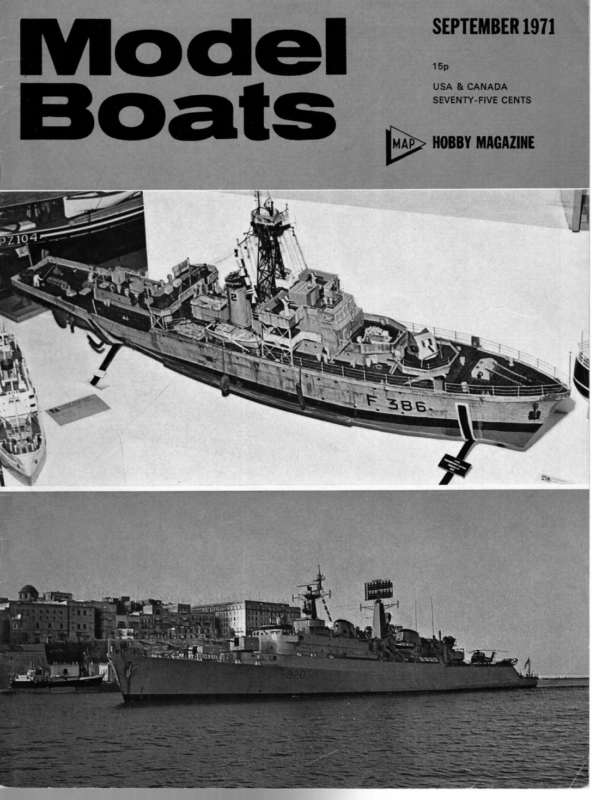
- In the Tideway
- TORNADO 58 in. l.o.a., 55 in. w.l. free-lance radio-controlled yacht BY C. S. GOULD
- Racing Model Yacht Construction Part 15 For this month’s instalment, Sailmaking, Roy Griffin temporarily hands over to George Clark, well-known for good sails
- ‘Shortbow’ The late Stan Witty’s adaptation of his popular Marblehead ‘Longbow’ to the 1/2M or MM 25 in. class. By courtesy of L. Conner

1971 tates ieeh ch intel SEPTEMBER In the Tideway | post readers will have heard the saying ‘You can please all of the people some of the time. and some of the people all of the time, but you can’t please all the people all the time’, or words to that effect. Nothing could be truer in respect of a magazine, and especially a magazine like this one, where an attempt is made to cater to the tastes of a wide group of readers, all of whom have their own interpretation of what model boating means. If we attempt to list them. we have the vane-sailing yachtsmen, the growing band of radio yachtsmen, the scale sailers, the tethered hydroplanes, straight runners, radio power boaters (which break down into several groups), the non-working scale builders, period ship fans, miniaturists, and the non-building armchair enthusiast, just as broad headings. Several of these divide into sport or competition enthusiasts, and few are very interested in more than one other aspect than their particular favourite. It is part of the Editor’s job to steer a course which satisfies all these diverse interests, and you may think that it can be tricky at times. Fortunately, there are readers with catholicity of interests who enjoy just about all articles, but often those with the narrowest interests are the most vociferous, so that if we relied solely on correspondence as a basis for content balance, the result could well please a minority but fail to appeal generally. What we try to do is to sense trends and encourage any aspect of the subject which may seem to be floundering a bit, if it is apparent that there is basic interest. As an example, five or six years ago yachting was in the doldrums and this was reflected by a rela- tively small amount of yachting material in our pages. A couple of years ago it began to seem as though interest was returning, and we were fortunate enough to be able to increase the number of articles, etc., and these have coincided with, and even perhaps helped. a modest boom in sailing activities. Some of the space now occupied by sailing material was gained from other aspects which had either expanded as far as seemed likely, or had become sufficiently well established to need less editorial en- couragement. Inevitably, in having so wide a field to cover, we will get complaints from readers who feel their province neglected or unfairly treated. A letter in the July issue expressed the view that scale drawings or articles are conspicuous by their current absence. As it happens, we have some good scale material in the pipeline, starting from the next issue, which is the first of what we think of as the ‘indoor’ issues. We were taken to task by one reader for suggesting in the June issue that critics do something positive and send in what they consider to be the sort of article we should publish. This reader felt that it was up to us to ‘go out and get the sort of articles wanted’. We wonder what he thinks we are eternally trying to do? If we sold half a million copies of each issue and had a team of a dozen staff writers, we would still have a need for contributors: with a specialist magazine catering for enthusiasts, we have no option but to rely on at least some of these enthusiasts submitting notes, etc., on their projects or experiences. This is particularly so in the case of scale subjects; if a chap produces a good set of drawings for his own use, the drawings exist and if they are published, the fee for them forms a sort of bonus. Anyone appreciating the amount of work 353 The photograp shows ‘Splinter’, a tiny 12 in. yacht which | sails_ re- markably Full-size _ appear tember’s in well. pg ep- ‘Mec- cano Magazine’, so if you’re looking for a simple but inexpensive small sailing model, we can recommend this one. ogg involved in preparing scale drawings will probably also realise that there is an economic limit on commissioning such drawings. Ever thought that this is the only magazine of its type in the world, and that it has kept going for far longer than any similar publication? It has done so largely because sufficient modellers have reasoned that just as they are interested in what another modeller drew or wrote, so other modellers could be interested in something they have done. Our remark in the June issue might not seem unreasonable, viewed in this light. Sailing Days May we remind you that August 29th is an invitation day to owners of MM Class or other yachts at Hove lagoon? Frank Jennings, M.Y.A. Chairman, is hoping to see a good turnout of people who have no experience of organised model yachting. The lagoon is very easy to find, as it is on the seafront at the Shoreham end. A couple of Starlet owners are hoping that there will be other boats there, especially if radio-controlled, in the hope that they too can have a friendly race. The 1971 Model Maker Trophy will be at Dovercourt on September 18/19th and it is still not too late to enter. Write to Mrs. I. Cullingford, 19 Canning Street, Bathside, Harwich, Essex. The race is for Marbleheads, sailing is Saturday afternoon and all day Sunday, and Mr. W. Grint will be O.0.D. No entry fee, nice prize-list, and the prospect of a very enjoyable meeting. Notes New club is Cleethorpes M.B.C., which already has about 50 members and covers both power and sail. Regattas are held on the third Sunday of each month, April to October, starting 1 p.m. Publicity Officer is C. J. Wise, 57 Dugard Road, Cleethorpes, Lincs. Tom Clement of Heaton D.M.P.B.C. tells us that he has been asked by the council to repeat last year’s successful meeting at Dunbar salt water open air swimming pool—there were 54 boats from Glasgow. Edinburgh, Tynemouth, and Heaton. The date this year is September Sth, start at 12 noon, SR and R/C steering, multi-race, and D, E, and F hydroplanes. A nice day out.
MODEL BOATS TORNADO 58 in. l.o.a., 55 in. w.l. free-lance radio-controlled yacht BY C. S. GOULD LAST year’s boat Mistral, did not, I am afraid, come up to expectations. It did not have the speed on the wind of Chinook and did not have the required turning ability even after the rudder area was enlarged and the trim tab angle increased to 26 deg. Straight sailing ability was good, and maybe the real answer would have been to fit a mainsail winch. One or two mods were dreamed up but not carried out. Good speed and turning were essential in last year’s competitions, due to the introduction of steering courses, so I persevered with Chinook for the triangle events and Blue Grass for the steering, finally finishing in third spot. So it was a case of back to the drawing board, and what evolved was Tornado, a moderate chine boat with the maximum curve of the keel run further aft than Chinook with the after sections flattened out from the fin and more flare amidships giving a deck beam of 104 in., while retaining the W.L./Beam ratio of six to one when upright, terminating in a bustle type of stern with a small reverse transom. Weight consideration was given priority, bearing in mind the strength factors required around the fin area; it was decided to construct the hull in 1 mm. ply and save a few ounces, the Vee sections in the area of the fin being stiffened by four strips of hard balsa 3 in. x ¢ in. x 10 in. long and the usual ply brackets bonded to the keel webs which protrude through the backbone, which is of two strips of pine laminated ? in. x 4 in. The fin is of 4 in. thick Tufnol supplied by a friend, and although no doubt an excellent material for the job is rather heavy compared to ply, but as it is low down it should not prove too harmful. The table of weights of Tornado are as follows: Canoe body fin and skeg Hull complete ex deck Hull complete with deck, hatches, fittings Lead Displ. all up R/C, mast sails, etc. C.B. from stem C.L.R. from stem C.G. of lead 2 in. aft of C.B. 2lb. 8 oz. 3 1b. 3°02: 41b. 5 oz. 15 1b. 10 oz. 21 1b. 12 oz. 32 in. 34} in. It is proposed to use the same mast and rig as the others use, and in light winds Mistral’s mast and sails, which worked well on Chinook and B.G. in light airs, so it must have been my poor designing in the hull department. After rubbing down the ply with 320 paper, used dry, the deck was given two coats of varnish, this was rubbed down and two coats of Poly-u white were applied (I was decorating at the same time). This was rubbed flat with 320, used wet, a tip here for what it is worth — add about 12 grains of detergent to a saucer of water when rubbing down wet. The deck planks were then marked off using a laundry pen, and the King Plank was then marked out and painted in dark brown. I have not seen any article in Model Boats explaining how to mark this out, and it is a real stumbling block to beginners; a nicely lined deck and King Plank are an asset even to a badly finished boat, anyway, here’s how I do mine, which is not technically correct for a glass case model, but looks presentable. Decide on width ‘A’ also ‘B’. Draw your deck lines to the middle line and with two pairs of dividers join up where these or the combined widths coincide with the next pair of deck planks. If you wish to be technically correct width ‘B’ should be one-third of plank width. The hull was treated with two coats of varnish after the initial dry rub down, this was rubbed down wet, and then a change of colour from the previous powder blue —main reason being that under certain conditions of light on our water the light blue becomes almost invisible at ranges of 100 yards or more, so this boat is finished in tangerine with white coving line and water line, marked by the usual method of floating in the bath and masking off from the suds line. The lead is finished with Graphspeed,
SEPTEMBER there not being enough left in the tin to do the whole under-water body; in any case it is such a messy job, and due to the cold weather I had special permission to work in front of the fire. The fittings have been taken from Mistral, the rudder was the trim tab — if it proves large enough, if not the rudder can be used. Construction — after drawing out the lines on squared paper the section moulds were marked out on very stiff card suitably reinforced with glued battens and then erected on the building board. The first and last sections were cut from 5/16 in. ply and secured to the board so that they could be unscrewed when the ply skin hull was complete. The keel battens 3 in. x + in. were bent over the formers and secured to the end sections, the second strip then glued to the first and planed to the Vee shape determined by the moulds. The inwales of Ramin quartering were then bent round the chines and planed to shape, then it was a simple matter to cut out the ply panels leaving a margin of { in. or so and glue into place. The first panel can be held by commandeering the wife’s supply of pegs and, when set, this is carefully cut and planed to the chine and backbone, then the other side cut and glued in place; this has to be pinned while the glue sets as pegs can only be used on the chine side, Then follows the sides, leave a good allowance here to allow for final shaping of the sheer line, etc. After cutting out the slots for the fin and skeg, the hull can be removed from the jig, the rest is so simple and has been dealt with in great detail by several articles that further description is not needed, apart from one or two tips which may prove helpful to a beginner. (1) Do not forget to fit the mast rack before fitting the deck. (2) If you are working ‘backwards’ and need to do bath trials to find how much lead you need and also its position, say you find that 15 lb. of lead is required to obtain the correct W.L. placed in or on the hull, it will only be equal to 14 lb. when fitted on the fin as approximately one pint of water is displaced, and the water line will be a little different. (3) The lead bulbs can be moulded in two halves a little easier than in the series by Mr. Griffin. First make a wooden mould of lead shape (half), fix a piece of wood on the top to form a handle to hold it in the vice for final shaping, then paint, and coat with a release agent and immerse in a box of Ceraphite. This will take a fair time to dry out in the airing cupboard, so do it early and carry on work on the boat. Then if you allow 1 oz. of slag to each pound of lead, melt and pour your required amount into the mould, allowing a little to rasp off level before bonding to fin (fill gap if lead is longer than fin and fair off), not forgetting to set the box level with a spirit bubble, remove 1971 1 jib she was completely controllable and could be turned both ways, and seemed to really tramp when on the wind, but as I was alone there was no yardstick to check it by. Later trials have shown that she is as fast as Chinook beating and reaching, and future tuning may prove her to be faster as she has a couple of inches more on the W.L. This brings an interesting point from our American friend Mr. Kelley, and that is doing away with the skeg. One of our members had a sister to Blue Grass with sail winches which was difficult to turn, and asking my advice I told him to fit a skeg, and after doing this there was a marked improvement. This is borne out by C. A. Marchaj in his book and it appears that without a skeg the turbulence breakaway point is near the leading edge, but with a skeg this is taken further aft with better laminar flow and turning moment. It is an interesting topic for further discussion, but I am afraid I cannot agree with his other statement about the rudder going to 45 deg. —35 deg. is the optimum angle, with an absolute max. at say 37 deg. Beyond this the turning moment decreases and the braking effect increases out of all proportion, this is probably why he could not get his boat through the luff as he calls it. Having had all these troubles he mentions, I would respectfully suggest, that apart from too much rudder movement his main trouble could be in trying to sail with a top suit when really he should have changed down, at least the mainsail. Most of our troubles have been caused by being overcanvassed, apart from originally being under-ruddered. It is worth noting that two of our members have ten raters, one a Warlord and one which was kindly given by Ray Blick, and except when overpowered they are both very quick on the turn either way, and they have not had a very great addition to the rudder, and they both have skegs. This is due partly I think, because on both of these the rudder is also a long way aft of the C.P. of the sail plan and therefore has a longer moment, also these lads use a larger sail area in normal conditions than is allowed by the rule, as we are freelance, the mainsail having a very large roach, more the shape of a ‘C’ class Cat, based on my large roached sail plan for Chinook, etc. But at least it is good to see that our friends across the water have got R/C sailing organised, that is more than one can say for this side, so how about getting started? Why not make R/C sailing a branch of the M.P.B.A.? Even Jim King must be interested after his trip to the States, so how about making him ie Sec.? It is well past the time something was one. when cool, then repeat. You will also find that a mould such as a Warlord mould will give satisfactory sizes from 10 lb. down to 74 lb. each half. The mast in the photos is made from four pieces of pine and is of airfoil section ~ in. wide at its maximum section and although planed down to a minimum thickness is really strong and yet only weighs 12 oz., its big advantage is that you can really pull up on the jib stays without bending the mast. It would also be better with another type of heel fitting to that which I have used, in order to allow it to swivel to the best angle of attack, like a ‘C’ class Cat. Nevertheless,I think it has an advantage over the round tube masts but does not look quite so good. The maiden voyage was carried out in a galeforce wind and using a No. 2 M mainsail and a No. 357
| i cee MODEL BOATS Racing Model Yacht Construction Part 15 FIG.1 Sailmaking Theory and Practice As shown in previous articles in this series, model racing yachts use, almost without exception, bermudan sloop rig, i.e. basically triangular mainsails For this month’s instalment, Sailmaking, ing your sails, check the class rules if you intend to George Clark, well-known for good sails with a single fore sail (Fig 1). Before you start makrace under M.Y.A. rules. Scale models have sails dictated by their various prototypes, but the basis of cutting and making their sails is similar. It is possible to make satisfactory sails entirely by hand, but the use of the wife’s or girl friend’s sewing machine saves an enormous amount of time and produces a much better finished article. Whatever method of sewing is adopted, synthetic thread, preferably terylene, should be used; cotton will rapidly deteriorate when the sails get wet, es- pecially when sailing on salt water. As an alternative to sewing it is possible to bond some materials with suitable adhesives, or, when using polythene, welding as performed in packaging in your local supermarket is satisfactory. Emergency spinnaker or sail repairs can be carried out at the pond-side with self adhesive tape on all types of material, or if you are using polythene, the heat of a match or lighter is adequate for “welding” small tears if you are careful. Always remember to do a proper repair when you get home. Materials to Use (a) Varnished terylene is going out of favour, but good sails can be and are made from this material. A disadvantage is the liability of some types of varnish to crack at low temperature or when the material is folded; the varnish also appears to age harden. The best form of the material to use is that treated with flexible polyurethane varnish. The material is originally intended as electrical insulation and is not readily available in small quantities. (b) Terylene cloth as used for full sized dinghy and yacht sails is now the most widely used material for model racing yachts sails. It has the advantage of being available in a large number of weights, weaves and colours, also it does not crack as readily as varnished terylene. (c) Nylon tends to stretch and can only be recommended for spinnakers. (d) Polythene of various weights and colours is widely used for spinnakers and occasionally used for other sails. (e) Other fabrics, most types of cotton or linen, can and have been used for sails, but generally there is now little to recommend them. They are usually susceptible to stretching and/or shrinking when wet, also if not carefully dried after a wetting the fabric is subject to rotting and/or mildew. The materials listed (a) to (d) do not readily retain water and will not deteriorate when wet. Cotton fabrics rapidly rot if not dried thoroughly and some will also discolour when they get soaked in salt water. Always use synthetic thread, preferably terylene, for either hand or machine stitching. Do NOT use ordinary cotton which shrinks when wet, probably at a different rate from your carefully made sails. The Roy Griffin temporarily hands over to author uses “‘TRYKLO’ thread which is available in a wide range of colours. Sail Cutting The author uses a razor sharp modeller’s knife and the wife’s dressmaking scissors for cutting out. Splines are used as a guide for marking or cutting curves, cut edges can then be sealed where required with a small soldering iron. Alternatively a sharp edged electric soldering iron can be used to cut and seal in one run when using dinghy cloth; with this method you must be right on your line first time. The author rarely makes a sail without first drawing out a full size paper pattern. Having made approximately 100 sets of sails to date this is still considered to be a good method; mistakes made on paper are a lot cheaper. Remember that incorrectly drawn lines on your sails are difficult to erase should you decide to plot your sail shape direct on the material of your choice. Assuming that you are making either a full size pattern or are marking your sails out direct on the material you intend to use, you will find a large sheet of hardboard a good cheap working surface both for drawing and cutting out. Draw out curves with a spline held down with lead weights. When marking or cutting out with a knife make sure that the material is held down flat on your working surface, evenly taut, but not stretched. Use either weights or self-adhesive tape to hold the material in place while you are working. Sails should be cut out with the line of the roach parallel with the edge of the material, i.e. parallel with the ‘warp’ or longitudinal run of the cloth (Fig 2). Sail Stitching Before trying to make a sail make sure you use ‘your’ sewing machine. It is important that practise with both the material and thread that intend to use. If in doubt, ask advice from wife, can you you girl HEAT EXPOSED. ,—L APPROX 1/6* enGES SE woop on METAL STRIPS THE POLYTHENE WILL MELT BACK WHEN. HEATED AND FUSE POLYTHENE AT THE POINT OF PRESSURE BETWEEN, THE STRIPS TWO UNES OF STRAIGHT STIT CHES ABOUT 8 STITCHES TO THE IN ‘ if ONE LINE OF STRAIGHT STITCHING ONE LINE ZIG-ZAG. SWING 370 NEEDLE) aa
SEPTEMBER friend, or friend who has made sails before. Depending on the type of machine available sail hem stitching will either be straight and/or zig-zag (Fig 3). Joining Polythene. To join edges of polythene hold the edges to be joined together between two pieces of metal leaving about 4 in. of material above the edges of the metal. Run a match, candle or soldering iron along the edges of the polythene and the exposed material will fuse together (Fig 4). Sail Reinforcement. Most sails require reinforcing at the corners to allow them to be attached to masts and spars; the lighter the material used for sail making the greater this problem becomes. Generally terylene sails have double or treble thicknesses of material at head, clew and tack (Fig 5). 1971 A popular alternative to hemming the luff of the sails is the use of tape which is folded over the edge and then stitched or stuck on (Fig 7). Do NOT under any circumstances use normal cloth tape for binding the edges of sails as it will shrink and ruin your sails; the tape if used should be the same material as the sails. There are several methods of attaching mainsails to masts: (a) Lacing. This is carried out with a length of light line threaded through small eyelets in the luff of the sail (Fig 8). Eyelets are best put in with special pliers, and these are expensive, though most model yacht clubs have a pair which is available to their members. If you can’t borrow special pliers use a small punch. (b) Hook and jackline. The hooks used are similar to the hook from drapers’ hooks and eyes, and chrome plated ones look best. They are fitted to the sail either by sewing, which is rather tedious, or by using eyelets which are expanded through the eyes of the hooks (Fig 9). yao] NB: LACING FOLLOWS SPIRAL PATTERN THROUGH EYELETS AT 4″ TO 6″ JACK MASI v CENTRES The three attachment points for spinnakers are reinforced in a similar way if nylon or terylene are used; alternatively self-adhesive tape may be used, either ‘Stayput’ or ‘Sellotape X’. With polythene spinnakers the use of self-adhesive tape is almost universal. An alternative adopted by the author when using polythene spinnakers is to hem all the edges of the sails over light lines; the strain of the sail attachment is then spread evenly over the sail. eae SELF the sail. The main difficulty is the formation of the mast slot, but the end result is well worth the effort (Fig 10). With this method one must have easy access to the mast top to allow for rigging sails and for quick sail changing, which is very important when racing. ee ‘© ROWS OF STITCHING (SEE ALSO Fere (d) Another method requiring forethought when your mast is being constructed and fitted is the use of a luff pocket, where the mast is contained within the leading edge of the sail. This method is simple, but quick sail changes can present a problem, somefel co by changing sails and masts together ADHESIVE TAPE (c) A method seldom used is forming a slot in the rear of the mast and fitting a luff cord in the hem of “OR 1″ IDE,yAte FOLDED C VER spit EYELET ig Loops are formed in the line at the corners as shown in Fig 6. Polythene must be cut cleanly with a razor blade or sharp scissors, as any nick or imperfection will rapidly tear. On lightweight polythene spinnakers it is normal to leave the edges as cut, but heavier grades can be hemmed, using heat to seal the hem, or adhesive, or stitching. It is very easy to have unnecessary reinforcement at spinnaker corners — remember you need the sail to lift in zephyrs, and heavy corners are a liability in these conditions. Varnished terylene sails normally have reinforced corners. The foot and leach are left as cut and normally hems ? in. to 4+ in. wide are used up the luff. The varnish usually forms an adequate bond for the foot and the leach, and hems are not recommended for these edges. Terylene sail cloth is normally finished with reinforced corners and a hem up to the luff, the leach and foot being heat sealed with a small soldering iron to prevent fraying. Hemming the leach of sails is best avoided if possible, as it interrupts the airflow over the sail. 371 1 ). CORD IN HEM PREVENTS SAIL PULLING THROUGH SAIL SLOT CONTINUOUS SLOT IN MAST MAST CONTAINED IN POCK’! FIG.N. (e) Scale models. Follow the details of your prototype or use lacing. Having now attached your sail to the mast, there are three things left that require attention — securing the mainsail tack to either mast or gooseneck to prevent it sliding up the mast when the luff is tensioned by the second item, the halyard or uphaul acting on the top of the sail. Finally, attach the clew to the boom outhaul to allow the foot of the sail to be adjusted to control the sail camber (Fig 12). The heads of sails should have either eyelets or headboards. Headboards are usually made from plastic or aluminium and either sewn or riveted to the sails (Fig 13).
| Ti Se ae MODEL BOATS There are restrictions on headboard sizes in some M.Y.A. Classes, so check the rules before fitting them to your sails. Tacks and clews are usually fitted with eyelets. Belt eyelets from a chain store are cheap and simple to use, either fitted in place with pliers or punches which are available packaged with assorted eyelets. A FRONT OF LINE TO GIVE FLOW AND CAMBER IN. SAIL. X DIMENSION 1S APPROX, 10% OF SAIL HEIGHT We SMALL EYELET Res STITCHED ON ee! LACE HEADBOARD 4 TO SAIL WITH THREAD CLEW OUTHAUL FIG.13, BOOM GOOSENECK FiG.12, Basic Sail Shapes. There are seldom straight lines defining the edges of sails; these are normally curved, very complex when required to produce a perfect setting sail, but basically quite simple as shown in Fig 14. Foresail. The foresail is normally set on a wire or cord stay, sometimes on a luff spar. The stay AB (Fig 14) is straight to start and sags under the wind pressure on the sail to a greater or less extent depending on original tension. The amount of curve in the luff of the sails influences the flow or camber in the sail. The more that the luff of your sail diverges from a straight line the greater camber will be produced in your sail. A STATIC STRAIGHT LINE Ji8 LUFF: A A SAGSTO HERE UNDER PRESSURE ‘ 10 | | 20 ji f AG.15, of straight lines between the ends of the patterns rather than a fair curve (Fig 16). Battens can be made from thin strips of wood or plastic; the author uses a variety of thicknesses of waterproof ply to govern the flexibility of the roach. Too stiff a material used for battens or too long a batten will produce a stress point at the end of the batten pocket which will spoil the airflow over this section of the sail, and this can be worse than no batten at all. ofa auc HEAD REINFORCEMENT FORESTAY- We AS 5 HEAD TACK X IS DIMENSION IN 4 upHaut TACK & 1$ STRAIGHT LINE, CUT LUFF OF WIND FORESAIL FiG.14, Mainsail. On an 80 in. luff the author used an x dimension (Fig 15) of 5/16 in. with success. Sail cambers of between 10 to 1 and 20 to | are normal: sails with greater curve, i.e. 10 to 1 rather than 20 to 1, are used in light winds, the sails being flattened by tensioning the foot of the sail by adjusting the clew outhaul as the wind speed increases. Battens. These are best avoided if possible, as they are seldom necessary on any size of jib or mainsails on Marbleheads or 10 Raters. ‘A’ boats with their 4 in. roach allowance present a different problem, since to take full advantage of the unmeasured area the roach is pushed to the limit of the rule and this tends to make the use of battens necessary. When using battens, other than full length, the best control of the roach is obtained if the sail is cut in a series 372 Sail Numbers. Sail numbers are mandatory when racing under M.Y.A. rules, which give sizes and approximate locations for A, Q, 10r, M, and 36 in. R classes. You may either mark the material direct with felt pen or paint or cut out numbers etc., from black Fablon and stick them on the sails. Make sure any paint or ink you use is waterproof, and try out your paint or ink on the material of your choice to check that the fluid does not spread too much into the fabric weave and produce an untidy result. An advantage with Fablon is the facility for interchanging a yes boats should you have a favourite suit of sails. Sail Care. Terylene sails are not readily susceptible to damage by becoming wet, and polythene is unaffected by moisture. You should, however, always store your sails dry, either hung up or rolled around tubes, not too small a diameter: use 14 in. or more if you can. Salt water will stain dinghy cloth and your sails will benefit from being rinsed occasionally in fresh water. If you use varnished terylene, occasional immersion in warm water will remove the salt residue that accumulates when the boat is sailed on sea water. Polythene spinnakers also are best kept free of accumulations of salt. You can wash and iron dinghy cloth but be very careful, don’t under any circumstance try to iron either polythene or varnished terylene. Repair any damaged sails as soon as possible with permanent stuck on or sewn on patches. Don’t rely on your hurried pondside repair — it will let you down when it blows hard. Last Thoughts. Look at as many sails as possible before you make your own, talk to people that make sails, read about them, study photos, then try out your own ideas on a predictable boat, or better still have two similar boats, one with your new sails so that you can evaluate them against a known datum. TREBLE THICKNESS ‘AT HEAD OF SAIL ALL BATTENS FULL” LENGTH, ie. CONTINUOUS STRAIGHT ACROSS SAIL 2″ MAX, LINES BETWEEN ENDS OF BATTENS | ” MAK. FULLY BATTENED | MAINSAIL, UN- ‘A CLASS MAINSAIL NO BATTENS IN ‘M! (MARBLEHEAD) COMMON IN MODELS MAINSAIL LEACH FIG.16,
SEPTEMBER – ‘Shortbow’ PPHE correspondence in recent The late Stan Witty’s adaptation of his popular Marblehead ‘Longbow’ to the 4M or MM 25 in. class. By courtesy of L. Conner issues of Model Boats on the subject of the ‘MM’ class prompted Lester C. Conner Jr., of Framingham, Massachusetts, to look out drawings of a boat he’d built to this class. This boat was a result of Lester approaching the late Stan Witty and asking him to scale down the Longbow design to fit the 25 in. MM class; interesting that Harry Briggs of Cleethorpes had scaled the same design down to make an attractive 36R boat which appeared at this year’s 36R Championships. Lester says that his boat, built to these drawings, sails beautifully, especially in a bit of a breeze, and he feels that others may like a modern design to this particular class. Since it apparently has no name, we have taken the liberty of christening it Shortbow; it seems not inappropriate and a design needs a name for easy identification. One of the original purposes of the MM Class was to introduce newcomers to model yachting by providing all the information needed to build a yacht on one plan, but certainly a beginner looking at this drawing could be forgiven for not knowing how to build from it. The easiest answer would be for him also to obtain the plan for Water Baby ‘B’ (MM355, 30p post free) which gives full constructional information and all fittings, etc., detailed. Most small yachts seem to be of bread and butter construction, and to build from this drawing in this way the first step would be to measure accurately the thickness of the timber to be used. Lines representing the thickness would then be drawn across the —. body plan on the drawing. The station positions are then drawn on to the timber and the width of the first plank measured off at each section on tse body plan and transferred to the timber at the appropriate station. The points thus plotted are connected in a smooth curve to give the plank shape. This procedure is repeated for each plank. For further information on this method see Plans Handbook No. 2 and/or ‘Boat Modelling’. The lines of this model should make it very simple to plank, and our own approach would be to plank in % in. obeche strips on 7s or } in. balsa shadows, gluing the planks to the shadows and sawing out the interiors after completion. To draw the shadows, each section on the body plan would need reducing by a bare } in. all round and tracing out on the wood. It is noticeable that the designer applied modern M thinking to the rule by making the overall length 25% in.; the rule says 25 in. plus or minus ¢ in., plus 4-in. for a bow bumper. By using the maximum possible dimension, a gain of 1+ per cent in sailing length is obtained, and 1} per cent of, say, Fleetwood lake is 36 ft. However, the MM rule also allows 13 sq. ft. of sail, 216 sq. in. against the 200 shown, and it would be worth adjusting the top suits to this figure. Full-size copies of the drawing below are available, reference MM1117, price 30p post free, from Model Maker Plans Service, 13-35 Bridge Street, Hemel Hempstead, Herts. SHORTBOW «ee s.witty : | MM ) The Model Maker Plans Service 12-35 Bridge Street. Hemel Hemostead. Herts aes” x BY 1971 COURTESY OF L_CONNER FIN EPOXY BONDED ANO/ OR BOLTED wo Yis SLOT my Bue DECK EDGE ba 373 |