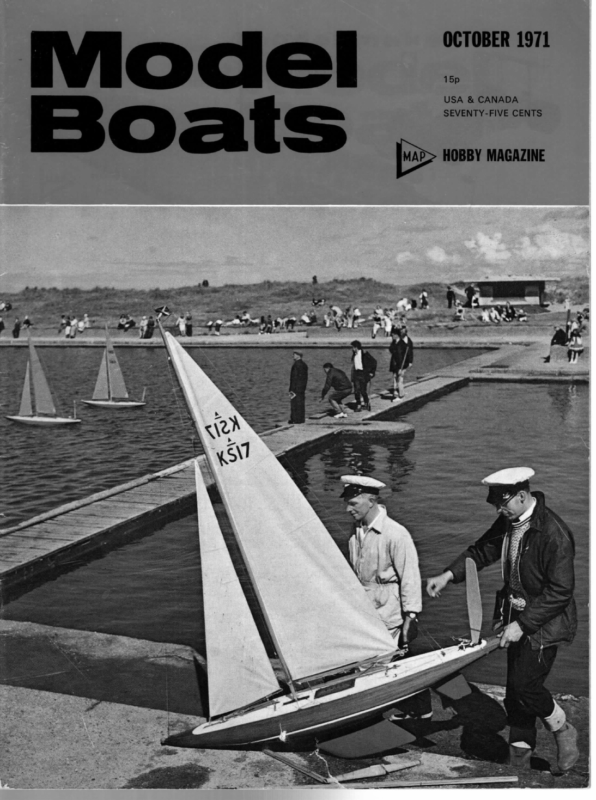
- 1971 BRITISH OPEN ‘A’ CLASS CHAMPIONSHIP and International Y.M, Cup. Reported by Joyce Roberts
- RACING MODEL YACHT CONSTRUCTION Checking a.u. weight and trim

OCTOBER 1971 1971 BRITISH OPEN ‘A’ CLASS CHAMPIONSHIP and International Y.M, Cup. Reported by Joyce Roberts PSHERE were 40 entries for this year’s Championship, 29 from England, 1 from Scotland, 1 from France, 3 from Denmark and Germany, 2 from Belgium and 1 from Holland. On Saturday before the race there was a strong wind blowing down the lake, and competitors were in a very cheerful mood, thinking that the Fleetwood weather, poor reaching winds, had at last changed. About half the fleet put in some practice, some deciding that conditions were too rough to test their boats, not wanting to break anything before the start on Sunday. Lutt Deern was damaged, and a hurried repair job had to be done to her skeg. Roger Stollery scared some of the competitors with the sight of his Clockwork Orange speeding across the lake, off wind, but very fast. Chris Dicks with Emperor was beaten twice to windward. Sunday morning arrived and faces fell, typical Fleetwood reaching wind! The entries had been split into 4 Fleets, and C & D sailed in the morning, and completed 5 heats. A & B sailed in the afternoon in even worse reaching winds, which swung in direction during this period. This made for inconsistent sailing, skippers changing their trim continually. Leading boats were Sorcerer 20, Argonaut 20, Emperor 19, Marcia 18, Zerlina 18, KU 104 18, Spinaway 18, The Shiralee 18, Lutt Deern 18, Boreas 18. Monday was sunny again, starting with a fair strength to the wind, but still a reach from the hotels. A & B sailed this time in the morning, the wind gradually coming round to a beat and run, and getting stronger. C & D got on the water at 2.30 but blue flags during the afternoon. Too wet for the by 4.36 the wind was dying away again, and by 8 it was nearly a flat calm. The Belgian boat Vrijbuiter had its skeg damaged, so had two heats to catch up on. Sorcerer continued her winning run, getting the beat from Emperor, and at the end of 12 heats had 42/60 points. Fascination also got the beat from Emperor, and Kai Ipsen had 43 points by evening. W. Meyer was sailing Lutt Deern well. and had 46. Zerlina had 45, so did Spinaway, the Joe Meir designed boat sailed by Bill Sykes and Mick Harris. Tuesday morning saw C & D finish sailing each other, completing 19 heats in all. The winds were still fluky, many were the tales of woe, how such and such a boat in a winning position had lost on the finishing line. Lutt Deern was still going well, and only dropped three to Fascination. The new Stollery design also went well and Clockwork Orange doubled its score, finishing with 60. After dinner the wind started light and reaching. Then the rain started, and the wind came round to a beat and run, but from the bridge end, which makes starting and finishing difficult. The finishing line had to be shortened for a while at this end of the lake. The strength varied considerably, but the rain got gradually heavier and heavier. As one despairing competitor said, instead of giving his number to the scorer—‘I’m wet, daft and judges, or too wet for the competitors to risk dicey turns? A & B fleets certainly seemed to be getting the worst of the weather. Lutt Deern finished with 76/95, Zerlina 75, Fascination 72, Boreas 67, Sorcerer 66, Spinaway 63%. On Wednesday morning A & D fleets sailed; there was a lovely wind, which gained in strength, and some yachts were second suits. These conditions suited Kai Ipsen, and he dropped only 2 points. The Fleetwood Moby Dick design, Carousel, did not drop any of his beats in the strong winds either. These fleets sailed 7 heats, making 26 sailed. Fascination had leaped ahead with 105/130, Spinaway had 893, not enjoying the conditions quite so much, Emperor stupid’. Another comment (not Alan Bell) ‘I’m Wet Pants’. One noticeable point, there were far fewer Winner Kai Ipsen’s boat is certainly unusual. It was designed in 1961 but not built for some years; it placed 4th at Fleetwood in 1969. Right, Genesis starting a run against Fascination. 405 Be a
IN MODEL BOATS |. Fascination 2. Zerlina D55 K875_ 4. Lutt Deern G1I32 7. Shenandoah 8. Emperor K896 887 3. Genesis 5. Spinaway 6. Moby Dick 9. Boreas 10. Norwest 11. Bobcat 879 K9I9_ G1I28 Skipper Club Kai Ipsen R. Foggarty R. Gardner Denmark Gosport Ipsen Levison Designer 55. 58.0 Disp 55.6 65.0 S.A. 5 heats 12 il Germany Parkinson J. Lewis 1473 59.0 70.0 Birkenhead Clapham J. Meir C. Dicks 62.2 57.6 A W. Meyer B. Sykes K. Pollahn Levison/ Bournville Hamburg K. Roberts C. Dicks 839 915 833 V. Knapp K. Jones B. Burton Gosport Birkenhead Eastbourne 12. Clockwork Orange 13. Kubernetes Campari 921 898 918 R. Stollery R. Norton H. Dovey Guildford Fleetwood Bournville 15. Hot Pants 9Il A. Bell Fleetwood 16. Die Valkyrie 878 W. Perry Birkenhead J. Meir J, Lewis L.W.L. 58.2 68.5 58.0 60.1 61.7 Ups} 56.9 55.8 1510 1434 26 37°65: “94. 18 46 102 124 II 19 28° 42 43 45 72 73 1435 76 1507 1521 1432 1428 Lewis Lewis Priest 56.15 58.3 54.6 60.9 66.1 52.8 1517 1468 1533 Stollery Lewis rae ) 55.0 60.2 57.2 35.5 79.5 62.0 1016 1462 1463 55.6 59.0 55.7 57.7 (Highlander) 19 14 18 18 10 45 38 18 15 13 41 38 29 33 105 132 100 122 117 634 894 1034 54 74 103 55°77 63 84 67 62 472 79 80 (75> -98 107 95 102 DA Total 157 137 136 133 1314 129 126 125 18 UE Hl 15 9 30 60 77 92 35-47 > 72.90 34° S25. 70 97 Il 110 110 1498 15 33 38 59 88 109 1540 9 33) 535 471) 83 106 106 1054 oreas 17. The Shiralee 18. KU 104 19. Sorcerer Telstar 917 916 902 817 D. Lippett H. Dodd Bournville Birkenhead A. Brown Gosport E. Carter Dicks (Emperor) Perry Lewis Ipsen Forest Gate 58.4 55.0 67.0 55.5 1468 1512 1530 Turner 54.5 64.2 1650 Lewis Lewis Priest 57.7 56.3 53.6 66.1 66.3 53.6 57.2 54.9 Priest (Highlander) (Moonraker) 21. Hamburg V 22. Pleione 23. Argonaut G135_ K906_ B39 F. Jacobsen N. Hatfield G. Van Hamburg Harwich Belgium 24. Waratah 25. Phillipa K920 789 P. Mustill D. Parkinson Birkenhead Fleetwood S. Witty iho 26. Endeavour 889 M. Rawnsley Leeds/Bradford Gi Priest 27. Marcia H1I4 J. Hoogewerff Holland Leeds/Bradford Ponies) 29. Ayala 796 J. Blundell Fleetwood Gane 30. Blue Knight 31. Carousel 900 854 P. Nash E. Leech F56 J. Bertoux 28. Blue Falcon K909_ Hoorebeke P. Maskell (Highlander) (Highlander) Priest 54.7 20 31 25 42 47 64 85 424 634 894 66 82 94 14 31 54 68 92 1501 1532 _ 13 10 20 24 33 33 42 67 87 574 724 864 (445 57 42 58.0 58.2 1420 1580 6 13 22) 27 41=” 46 55.775 68 78 1554 15 33 48 62 18 26 37 Sit 724 835 803 52.0 18 18 54.8 53.5 —_ — 65.2 1574 29 46 54.7 61.5 1624 9 24 40 534 684 — 60.9 _ 78.0 — 1394 13 5 22 18 37 24 50 45 56.3 16 53 72 7i 105 105 108 984 92 88 86 85 83 arrer i 32. 3.J.M. 33. Triby K83I D. Bush 45 Ss France Leeds Lewis (Moby Dick) H. Boussy a ait oreas 54.0 60.9 1517 7 25 35 46 63 62 76 58.5 63.2 1581 1606 14 7 27 15 44 25 56 45 7I 62 73 69 54.6 61.5 59.2 1545 1498 1620 3 10 7 20 27 19:25; 12 20 29 :35)28 44 38 36 KS20__H. Shields K822 H. Atkinson Scotland Leeds R. Dunster J. Lewis 55.2 55.2 38. MerseyBeat 39. Black Empress 40. Sovereign D54_ K604 914 e Fleetwood Gosport J. Lewis Cc. Dicks C, Dicks 54.6 56.7 54.5 36. Vrijbuiter 37. Katja B40 D56 K. Vandael K.Lindgreen ‘S. Brandt E. Latham G. Mathews Neptune Trophy (three-boat team score) Belgium Denmark |. Gosport 391 J. Lewis Ipsen 2. Hamburg 364 84. B & C came out in the afternoon, most of them anxious to get sailing in the good wind conditions. Unfortunately the wind soon dropped away to nothing, and after 14 heats the O.0.D, Joe Meir, stopped sailing until the wind came back. It did at 6 p.m. for a short while, enabling the heat to be finished, but that was all. Some skippers who had been very keen on fleet sailing now began to change their minds, B fleet certainly seemed to have had the most difficult conditions, especially as most of them preferred windy conditions, and some of A & D would have preferred far less than they had. 52.6 55.1 51.7 55.6 1601 1624 1515 17 25 4 3 I5 23 33 48 79 77 56.1 34. Huron 35. Colley 56.0 66 58 354 414 564 34 46 49 74 664 61 57 44 36 3. Birkenhead 349 B & C started at 8 a.m. on Thursday, and had a good wind, so that 8 heats were completed by lunch- time. The wind was blowing from the top of the lake, the best direction. Both Zerlina and Lutt Deern dropped a few points, Shenandoah was gradually working up through the fleet, after the first two disasterous days, when Ken Roberts did not win one heat, only getting 3 points from a run, sailed when the wind changed! Needless to say he stripped his boat down after this, knowing that Shenandoah was not really as bad as all that. Ken Jones with Nor- west also did well on this morning. After lunch A & C did 3 heats, making 29 completed. Then all the boats sailed together until 9 p.m. Fascination was steadily drawing ahead of the rest of the fleet, 132/ 165. Zerlina had 122, Lutt Deern 124 and Genesis 117. All the boats were out on Friday, and 4 heats were completed by lunchtime. This left 2 for the afternoon. There was a reasonable wind and Fas- cination, although dropping a few points, could not be caught. The interest was in 2nd-8th places, there was very few points between these yachts. Lutt Deern had a bad day, only getting 9 points, and Moby Dick got 26, nearly catching his team mate. Zerlina and Genesis were fighting it out for top English boat, Zerlina staying ahead by 1 point. Emperor, last year’s winner and runner-up in the made 8th. Here sailing Waratah. 1969 tie,
OCTOBER 1971 Left, Ken Jones’ Norwest with skegless rudder, unusual flatbottom lead on Belgian boat, and modern bow profile trend on Spinaway. unusual fittings and riggings. Clockwork Orange and Norwest were the newest designs, John Lewis having designed Norwest without a skeg. Y.M.Cup. On Saturday the top boats from the seven countries met for a 4-round race for the Yachting Monthly Cup, two rounds on Saturday and two on Sunday. A fresh wind, almost down the lake, ensured some sparkling sailing the first day, but the second saw relatively light conditions though still allowing a beat and run most of the time. A considerable number of resails became necessary on the run, due to early collisions, but those untaken did not significantly affect the results. Once again Fascination, which is happy in a hard beat, opened up an early lead, but Zerlina had by far the best of the Sunday’s sailing and must have wished for one more round. 1. 2. 3. 4. 5. 6. 7. Fascination Zerlina Denmark England 3JM France Lutt Deern Argonaut Marcia Huron Sat. 30 Germany 20 15 Belgium Holland Scotland 12 12 2 14 Sun. 19R 26R 18 ry 7RR z 13RR Wing and Wing Cup (fastest run) Marcia 1 min 25.6. Johnny’s Cup (most windward boards) Fascination. Spinaway was sailed well on the last day, finished Sth with 131} points, Moby Dick 6th with 129, Shenandoah 7th with 126, and Emperor 8th 125. It will be noticed that there is now a great difference in weight between A Class yachts, from Roger Stollery’s Clockwork Orange 35lbs, finishing llth, and Reg Norton’s Kubernetes, 79lbs, finishing 13th. Clockwork Orange could go very well in all conditions, but also could not get going at all, for no obvious reason, so it is possible that anyone other than the designer may not have done so well. Fascination is 55.6 displacement, a more manageable weight, and through not very good in light winds, obviously not very bad either. One point that English skippers agreed upon, their sails were not in the same class as Kai Ipsen’s and the Pollahn’s, and these boats obviously gained from their sails in most wind conditions. They also had a supply of different shaped spinnakers for all conditions. It will be interesting to see how many new designs are produced in the next two years. Many owners seemed dissatisfied with their present designs, and some were thinking of lighter boats, saying that there did not seem to be any advantage in a heavy boat, just made it harder work sailing for a week. Spinaway was the newest boat in the top 9, but Joe Meir designed her two years ago, incidentally Bill Sykes has made a perfect job of the boat, with all sorts of Kai turns hiS boat off on his last beat, still keeping an eye on the opposition. Susan Stollery turns the controversial Clockwork Orange. Two other Fascinations, Katja and KU104, did not fare as well as the name boat. 407 Sete se a Total. 49R 46R 33 21 19RR 19 15RR
OCTOBER RACING MODEL YACHT CONSTRUCTION 1971 beet é oo mp aeeee of Part Checking a.u. weight and trim K+ a of BE Sixteen e–— >< — Be a F ITTING THE LEAD KEEL. It will be recalled that, other than the removal of flashes of lead, no further work was done on the keel when it was removed from the mould. In preparation for fitting to the fin, file the internal flat surface of each half lead so that the two half leads mate when placed together. Clean out the fin recesses in each half lead, checking that the depth of recess is equal to one half the thickness of the fin. In order that the bulb keel may be fitted to the fin it is necessary to drill the keel to accept the locating pins or bolts and, where applicable, the clamping bolts. Drill two 4” dia. holes to take the locating pins, or bolts, and at the same time drill two 3/64” dia. clamping bolt holes with suitable recesses for the boltheads and nuts, see fig. 100. To obtain the best results when drilling lead, use a hand-drill and lubricate the twist drill with paraffin or spirits of turpentine. Check that the clamping bolts pull the two half leads closely together. Lightly file (alternatively use 120 grade wet-and-dry) the outer profile of the bulb ;however, try not to remove too much lead at this time. If a uni-piece lead bulb was cast it is still necessary to drill the two 4” dia. locating pin holes, as these facilitate both the temporary fitting of the lead for test purposes and the final location of the bulb whilst the epoxy resin adhesive hardens. Where epoxy resin is used as a C.R. Griffin fixing medium, consideration must be given to the fact that it will probably be impossible to remove the lead keel at any future time. Affix the keel to the fin so that the nose of the bulb is in line with the leading edge of the fin, or in such a position as the design dictates. Note that under the amended rules it is now permissible to fit prognathous bulb keels to the Marblehead class; prognathous keels are allowed in the 10 Rater class. Drill 4” dia. holes through the fin in line with the locating pin holes in the keel, remove the keel and elongate the fin holes to about }” in length. This allows the keel to be moved slightly in a fore-and-aft direction to correct small inaccuracies of trim. Weigh the keel and bolts and also check by the simple balance method shown in fig. 100A that the position of the centre of gravity of the keel has not been disturbed. ~~ vs buoyancy, it is evident that in order to obtain a specific trim i.e. a specific load waterline plane, the longitudinal moments of the weight of all the component parts of the yacht about a specific point must be in balance. This specific point must be the centre of flotation of the specified load waterline plane. Fig. 101 illustrates this argument. When the lead keel is fixed to the hull (complete with all fittings), an attempt is made to produce a specific load waterline plane i.e. the designed LWL plane and hence a specific trim. It therefore follows that the centre of gravity of the keel must be in such a position as to produce FIG 101 THEORY OF TRIM BALANCE DEFINITIONS. Cen- tre of buoyancy of the hull. The centre of gravity of the immersed volume of the hull where section areas are assumed to be weighted in direct proportion to their areas. The centre of buoyancy alters with the actual volume of the hull that is immersed. Centre of flotation of the yacht. The geometrical centre (or centroid) of the load waterline plane. At various longitudinal angles of trim the new waterline always passes through the centre of flotation provided that the total weight of the yacht is unaltered. The centre of flotation may be found by poising a paper pattern of the LWL plane on a knife edge held at 90° to the centreline. Centre of gravity of the yacht. The common centre of weal of the various weights forming the complete yacht. From the above definitions and the fact that the centre of gravity of a floating body will always assume a position vertically in line with and usually below the centre of 415 a eee ee | a0 a = cg. jf = LL - cgh’ Ps p5 Vrs arer A \ - a | Vee Le f ~ ie) Pa
c cc ny SSS MODEL BOATS the designed trim balance by equalising the moments of all the individual weights. It also follows that the total weight of the yacht, the all-up weight, must equal the designed weight. ASSEMBLY OF THE MAJOR PARTS TO COMPLETE THE YACHT. To refresh the memory the following parts are now either finished or are ready for assembly :1. Hull —including jib fitting and jib boom, mast slide or step, jib and main horses or deck eyes, vane gear and rudder fittings. 2. Lead keel — complete with fitting bolts. 3. Mast — with all fittings, i.e. main boom and stays, top mast, kicking strap and, if applicable, wing spreader, mast extension andjumper wires. 4. Sails — including spinnaker, complete with hooks and sheets, if fitted. It is necessary to weigh all the foregoing parts to ascertain the all-up weight; ideally weighing should be done as the work proceeds and cross checked by individual and cumulative weighing. Find the weight of the four main categories enumerated above and thus the total all-up weight. eg. Total --1. Slb:11 2.11 1b. 1 3} 14 4. 6 18 lb. oz 0z oz. Oz. position and put the relative aspect ratio sailsin appropriate position to the mast. Rolling the sails does assist in this operation. Place a flat board (the building board for example) on chocks to bring it to a level condition. Use a suitable batten, to which is attached an adjustable pointer, and check that the designed waterline marks are equidistant from the board, see fig. 101A. Unless the builder is singularly fortunate these distances will differ slightly, and in this event slacken the clamping bolts and move the keel forward to correct any transom-down error and vice versa. If the trim discrepancy is large it is advisable to check first whether any deck fittingis seriously overweight; the usual culprits are either the jib fitting or the vane gear and associated fittings. As a rough guide the former should be about 2 oz. and the latter about 6 oz. in weight. If all fittings are within reasonable weight limits carry out a flotation test before proceeding further. The foregoing suspension test makes the assumption that the underwater shape of the hull is in fact exactly as planned by the designer and also that the designer’s calculations as to the position of the centre of buoyancy and centre of gravity are absolutely correct for the hull under construction. To check that this assumption is valid it is necessary to perform a flotation test. In any case, in practice, the static trim pertaining whilst the yacht is in still water is the only acceptable benchmark If, as probably it will, the all-up weight exceeds the designed weight do not, at this point, remove any lead from the keel. However, make a note of the difference in weight which should, as a rough guide, be about 4 oz. Waterproof the fin slot and the foot of the fin using knotting, dope or Sealastic, then temporarily fit the keel to the fin so that the nose of the bulb is in line with the leading edge of the fin or in such a position as the design dictates. From the plan ascertain the distance of a vertical line through the centre of buoyancy from either the bow block or the transom. Mark this distance on the deck; note that this point should be within the handgrip. It is also advisable to ascertain and mark the position of the centre of gravity of the lead should this differ from the centre of buoyancy. Small black Fablon arrows serve the purpose well as they can be subsequently removed with ease. In the writer’s opinion it is of assistance to carry out next a test of balance, a suspension test. This has the prime purpose of establishing whether the combined centre of gravity of all the component parts of the yacht is in fact at the designed position or, if not, approximately how far from the designed centre of gravity the actual centre of gravity does lie. A flotation test can show all this and more but the correction of centre of gravity errors is more readily achieved by a suspension test Secondly, as no meniscal errors (the tendency of fluids to curve up to the point where they contact a surface) need to be contended with, possibly a more accurate reading of waterline positions is obtained. Thirdly, if a weighing device such as a steelyard is introduced into the suspension system, it is then possible to find the all-up weight at one reading with the advantage that corrections to the all-up weight can be more quickly ascertained. Suspend the hull by the handgrip at a point vertically in line with the centre of buoyancy, here it is useful to have garage or garden shed facilities but a suitable hook in the loft rafters or-a sling around a branch of the ubiquitous fruit tree will suffice. Place any unfitted fittings at the designed or estimated position on the deck for that particular rig, lay the mast athwartships at the designed 416 that the builder has, leaving aside theories on the effect of dynamic forces on the hull and the movement of the centre of buoyancy with increases in speed, these are the province of the naval architect. Float the yacht, complete with all the fittings as previously described, utilising the household bath or the clubhouse test tank and check whether the actual waterline corresponds with the designed waterline or those marks obtained in the suspension test. If the difference between the actual waterline and the designed waterline correlates with the marks obtained in the suspension test, then probably the total all-up weight is the only area of error that needs correcting. If the difference does not correlate then possibly both the total weight and the position of the centre of gravity of the keel will need adjusting. If the difference in waterlines is large, say in the region of 4” plus measured vertically at the bow or transom, it is advisable to check the results obtained by the horizontal movement of the bulb keel. Also, or, check the effect of adding light trim weights, say about 2 oz., at positions on the bow or transom. A critical examination form is attached in the hope that it may prove of assistance in the matter. On the assumption that it is only necessary to correct the all-up weight of the yacht, probably causing equal differences of waterlines, and to avoid disturbing the position of the centre of gravity of the keel when correcting the weight of a two-part keel, it is advisable to adopt one or both of the following methods. Drill one similar size hole at the centre of gravity in each half keel or drill holes of equal diameter equidistant from the centre of gravity in each half keel, see fig. 102. Consideration should be given to the fact that weight removed above the longitudinal centreline of each half lead has the effect of lowering the vertical position of the centre of gravity of the keel, if only marginally. Check weigh each half keel independently to ensure even distribution of weight, alsotest by balance that the centre of gravity of the keel is undisturbed. As a rough guide, a hole 4” in dia. and 4” deep reduces the weight of the lead by 0.64 oz., whilst a hole }” in dia. and ?” deep gives a reduction of 2.17 oz. All weight reducing holes are drilled into the flat internal face of each half lead and are subsequently filled with bootmakers’ wax to prevent the ingress and lodgement of water. Use acandle to melt the wax and
OCTOBER allow the wax to fall gently into the hole. It may be necessary to repeat the operation to fill any depression caused by the slight contraction of the wax. If a single part bulb keel is fitted, any correction of the sig %) AHEAD OF C. PENSION POINT % ABOVE @ 1S VERTICALL ©. point of suspension to obtain a balance i.e. the designed waterline is equidistant from the board. Sight at 90° to the hull, and the distance between the point of intersection of the plumb line and the centreline of the keel and the original centre of gravity can be found. This is the amount that the centre of gravity has to move, call it *X’. Secondly, on the profile plan of the keel mark off a distance equal to ‘X’ either in front of the existing centre of gravity, CG(O), if the trim weight was on the bow, or vice versa, call this point CG(n). Draw two vertical lines through points CG(o) and CG(n), call these diameters d; and d2 respectively. To obtain a balance at the new centre of gravity, CG(n), it is necessary to reduce the weight of the after part of the keel (in the example 417 nnn | Bie V 8 we (\2 X2. . of 6.56 a in.oz. From previous tests it has been established that a small weight acting at a long distance from the point of suspension requires a large weight acting at a short distance to balance, e.g. 1 oz. acting at 24” = 1 lb. acting at 14. So by making the distance(s) of the weight reducing hole(s) as far from CG(n) as possible the weight of lead to be removed can be materially reduced. As an example where X = 4’, dj + d> = 3”, then weight of lead = 23.2 oz. moment of 2 ead sel or Farocaulk was used for a temporary waterproofing and the bulb keel is of the two-part type, simply check weight about CG(n) = 23.2 = 5.8 in. oz. If the reducing that the film of sealing compound is not broken, then hole is say 2” from CG(n), then weight to be removed = tighten the clamping bolts. Allow about 24 hour sfor the sealer to harden, fill any crevices and the bolthead holes with Plastic Padding and then clean the exterior surface of the keel with 120 grade wet-&-dry. Finish by applying two coats of gloss paint, polyurethane paint or Graphspeed according to personal preference. If the keel 5.8 in oz, = 2.9 oz. or 1.45 oz. from each half lead i.e. 2 in. a hole }” dia. and 4” deep. Where it is not possible to reduce the weight with a single hole then the size and position of further holes can be computed by taking moments about CG(n). Note that the weight of lead removed from the keel should not exceed the difference between the actual all-up weight and the designed weight by more than about 2 oz. If the weight to be removed exceeds the difference between the actual all-up weight and the designed weight by more than 2 oz. then reduce the lead by an amount equal to the actual all-up less designed weight less 2 oz. and use a 2 oz. trim weight to balance. If the weight to be removed to attain the designed |.w.1. is less than the difference between the actual all-up weight and the designed weight then remove enough weight from the keel to obtain trim and remove all additional weight from the new centre of gravity, CG(n), see previous notes on lightening without disturbing centre of gravity. In all cases check by simple balance method that the centre of gravity is in the correct position and check for accuracy of waterline by a flotation test. Decision 4 needs no further explanation and decision 5 has been dealt with in the previous notes on decision 3. General notes. No attempt should be made to fix the keel permanently in position until firstly the static trim has been checked in both aspect ratio of sailplan and secondly, that the yacht has been tuned i.e. the best mast position(s) for pointing and speed has been found. However, to maintain the logical sequence of events the method of permanently fixing the keel is described next. If Sealastic is a uni-part type and epoxy resin is the fixing medium envisaged, remove all traces of the sealing compound before applying the resin. Coat the fin slot and the locating pins liberally with resin before attaching the keel. Remove excess resin and allow to harden. Fill any depressions in the keel surface, clean with 120 grade wet-&-dry and paint as required. Whilst on the subject of keels, some skippers whose local sailing waters suffer from weed infestation like to fair the nose of the bulb into the fin on the lines shown in fig. 104 to provide a measure of prevention against fouling by weed. Plastic Padding is the usual material employed for such a task. As an alternative a peardrop or triangular cross section bulb would be admirable; this shape, see fig. 104A, can be moulded as a two-part keel as easily as a circular cross section one. No doubt the pattern will take a little longer to produce but even so should be within the scope of most builders. At this stage, when the yacht is ready to be taken to the pond, and it is intended that the yacht be registered as one of a class recognised by the M.Y.A., it is time to befriend the local club measurer. Logically this should have been done before building started. It is rather point- less to take the time and trouble to tune the yacht to its optimum performance only to have to alter something because it does not conform to the rules of a particular class. QUESTION |. Does the all-up weight exceed the designed weight? Action to be takenif answer is YES See Question 2. Action to be taken if answer is NO |.1. Carry out flotation test. 2. See Question 3. 2.1. Does the boat balance on the waterline marks? 2.2. 3. Does the boat float with both designed waterline marks equally below the surface? 3.1. Remove the excess lead at the C.G,. or without disturbing the C.G. 3.2. 3.3. 3.4. 3.5. 4. Does the boat float with both designed waterline marks equally above the surface? 4.1. Design new keel with greater weight and C.G. in the same 4.2. Add ballast weight on line of C.G. position. 4.3. 4.4, Move keel to correct (see note |.) If boat now balances see question 3. If not:— Add trim weights to correct, then carry out flotation test. Move keel to correct. (see note !.) Add trim weights. Remove the excess lead at the seme time moving the C.G. Redesign the keel. Add trim weight to correct. Design new keel with greater weight and with the position of the C.G. amended. Notes:— |. Under the recent amended rules for the Marblehead class it is now possible to have the bulb in a prognathous position; it was always admissible to have the nose of the bulb behind the leading edge of the fin. 2. Trim weight added internally, or in any position for that matter, has the effect of raising the C.G. and subsequently lowers the stability ratio. CRITICAL EXAMINATION QUESTIONNAIRE to assist in obtaining the correct waterline and trim. 418