- 1972 10-rater Championship Hove, September 9/10th
- 1972 Model Maker Trophy Bournville, Sept. 23/24th
- HURON III 59 Ib., 55 in. W.L. ‘A’ CLASS DESIGN BY R. DUNSTER
- HAMBURG 1972 A report on one of the biggest international sailing meetings outside U.K. By Joyce Roberts

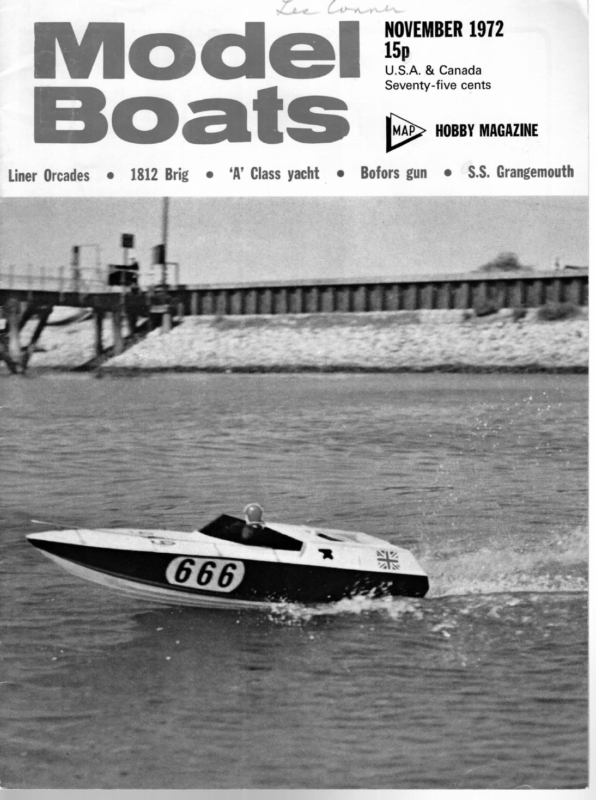
odel Liner Orcades 1812 Brig NOVEMBER 1972 : U.S.A. & Canada Seventy-five cents e ‘A’ Class yacht e Bofors gun e S.S. Grangemouth
NOVEMBER 1972 FORTH (1928). Again little change in style, but the characteristic deck cranes are no longer fitted. The Duckworth and Langmuir books are also valuable reference works. Railway Steamers. Clyde and Other Coastal Steamers. Details of vessels shown in photographs CITY OF LONDON: Aberdeen Steam Navigation Co., bt. 1871, Glasgow. 1086 t. 241-9 x 30-5 x 16:7. GRANGEMOUTH: Details in article. ABERDONIAN: Aberdeen Steam Navigation Co., bt. Glasgow 1909. 1648 t. 264-3 x 36:2 x 18-3. PERTH: Dundee, Perth and London Shipping Co., bt. Dundee 1915. 2208 t. 280-2 x 40-2 x 17:7. HIGHLANDER: Aberdeen, Newcastle and Hull Steam Co. Ltd., bt. Dundee 1916. 243-3 x 34-9 x 15-2. FORTH: Carron Co., Grangemouth, bt. Port Glasgow 1928. 1058t. 240-0 x 36:2 x 16-0. Acknowledgements GRANGEMOUTH: G. E. Langmuir, Esq. 1972 10-rater Championship Hove, September 9/10th The winner, Imshallah, nearest camera, sailing a sister, Countdown. Later, the former was able to borrow the latter’s mast when the winner’s snapped off just above the gooseneck, with two heats to go. Imshallah won in 1971 and was 2nd to her Clapham sister Meshallah in 1970. VERY smoothly run meeting saw a full tournament completed on September 9th/10th with 21 boats, one having dropped out before the race. An inauspicious start was made in heavy rain and a force 6-7 southerly wind which, however, swung to N.W. and moderated before the end of the first heat. One boat was damaged hitting the bank, but managed to effect repairs during lunch. The wind swung between N. and W., giving conditions between a plain reach and a close fetch and keeping skippers on their toes. Twelve heats were sailed by 6 p.m. and resails completed by 7 p.m. Overnight leaders were Imshallah 51, Mustang 47, Odonata 41 (bye taken) and Mr. Rusty 38 (bye taken). Sunday was bright and clear, but cool, with a fresh westerly which backed and veered and occasionally gusted, causing more than one broach with boats carrying spinnakers. All sailing, except two resails which did not affect the top boats, was completed by 5.15 p.m. Chris Dicks sailed faultlessly throughout with spot on trims and some well judged guying. His mast broke with two heats to go, but fortunately Countdown’s mast could be modified to fit and Chris was able to sail his final opponents after Countdown had finished. There was, needless to say, considerable interest in Mustang, a Cracker with raked forward fin, which was 465 well sailed and proved very fast, especially to windward. Her second place, apart from giving great satisfaction to her crew, showed that the design certainly offers the potential for top competition, and her score could have been higher but for an occasional over keen trim. Two other boats which attracted interest were Katch Up, a Fred Shepherd design in its first race, and Vagrant, a 75 in. waterline design which we were told was a stretched out Cracker. The former is an immensely powerful, 13 in. beam flat-floored boat which, if anything, is too powerful, but which seems capable of better performance after further experiment. Vagrant only occasionally got going and seemed slightly heavy for her 1,000 sq. in. sail area; perhaps a better hull/ballast ratio is needed with so long a w.l., though, of course, the longer the hull the more difficult it is to build light yet stiff enough. The change of shape in this class in the last five or six years has been remarkable, and though a pattern is discernible, there may well be a few surprises still to come. It is, after all, the class offering the greatest freedom for experiment. O.O.D. was N. D. Hatfield, and officials Messrs. Dicks, Shaw, Hunt, Guest, Gardner and Long, who are all to be complimented on a well run race, not forgetting Mrs. Colsell and helpers who provided the welcome tea and refreshments.
Below, second-place boat Mustang using the forwardraked fin suggested by John Lewis. Bottom, Vagrant just slides through the water, but is 1,000 sq. in. of sail quite enough? Above, Greenfly gets away as Mini-Ha-Ha retrims. The latter, skippered by young Russell Cooper, lay 5th in the overnight scores. Top right, Stroller, 1969 winner, leads E. L. Wisty, which later took the points by virtue of its windward position. 10-RATER RESULTS 1. 1775 Imshallah C. Dicks Clapham 873 2. 1813 Mustang 3. 1811 Odonata D. Latham R. Seager Fleetwood Clapham 19 76 5. 1803 Countdown 6. 1804 E. L. Wisty D. Knowles B. Garbett R. Cole H. Dovey Birmingham Birmingham Guildford Bournville 64 63 K. Roberts H. Godfrey F, Shattock F. Shepherd G. Clark Birkenhead Guildford M.Y.S.A. Guildford Danson 53 51 503 47 45 4.1737 Mr. Rusty 7. 1754 Stroller 8. 1802 Moppet 9. 1824 10. 1780 11. 1779 12.1821 13. 2000 14. 1812 Electric Warrior Mini-Ha-Ha Sagittarius Katch Up Hollah Marmalade Pudding Overture R. Stollery Guildford 71 554 54 C. Colsell Hove & Brighton 423 15. 1823 Cowal 16. 1809 Firefly 1810 Greenfly 18. 1814 Cyclops J.Gilmour C. Dunklin P. Dunkling G. Hallume Clapham M.Y.S.A. M.Y.S.A. M.Y.S.A. 20. 1727 Scorchy P. Shaw 19. 1672 Golden Dawn 21. 1820 Vagrant C. Hall Gosport P. Rickett M.Y.S.A. 373 35 35 323 28 Hove & Brighton 23 20 1972 Model Maker Trophy Bournville, Sept. 23/24th Host club Bournville were slightly disappointed : at ending up with only six entries from outside the Birmingham area, but part of the idea of rotating the event round the country is to give local skippers who might not travel to other meetings a chance to compete, so that the total of 19 boats was not at all unsatisfactory. As it happened, a good sailing breeze arrived to disperse fog as the meeting started, and remained for the two days of the race, Far left, needle match between Shazzan (father) and Martini (son), 6th and 4th respectively. Left, Copy Cat (5th) sails Binky (2nd). Binky is snore M with a raked-forward in. 466
NOVEMBER 1972 Right, winner Road Runner (far boat) sails third-placer Cheers, deliberately held back a second or two by Brian Garbett to lessen chances of a touch. Bottom, last year’s winner, Phil Bussey, sailed new boat Tara to tie for with Jester (far boat) and was highest-placed visitor. so that the other three or four visitors who 7th had withdrawn could easily have been fitted in. Dennis Lippett, O.0.D., had decided to try for a full tournament and this was accommodated comfort- ably, taking advantage of the wind to sail 12 heats oe Saturday and finishing by about 3 p.m. on Sunay. With the easterly wind (from the narrow ‘knuckle’ end of the lake, that is) there was a small area of foul wind from a couple of tree shadows, and looking at the results one might think that local knowledge had an effect. However, Road Runner came ashore a dozen yards from the start on just about every run, and Binky was sailed by a relative newcomer to the club, so that any apparent advantage was more likely to have been what action to take in the ‘ham’ of the pond, in an almost clear wind, and would have been very slight. As will be seen, apart from the winner, 7 points (out of 85 possible) covered the next seven boats, so that in several instances a single beat could have had a considerable effect on positions. The fleet was very mixed and a few boats seemed ‘as designed’, many having modified fins or leads or skegs, etc. Top boat to an M.M. Plans design was the Golden Archer Jill IJ, and after much measurement on a map it was decided to split the award for the furthest-travelled entrant between the entries from Dovercourt and Brighton. Our thanks go to the officials, etc., who gave up time to make the event successful and enjoyable, not forgetting the ladies whose hot soup, tea, and other refreshments were most welcome. Although the date is not yet fixed, next year’s Pos. No. Name 1 2 3 4 5 1803 1697 1810 1686 1848 if 1714 1814 1847 1812 1553) 1794 1658 Jester Tara Supa Doo Overture Jill II Lady Goldberry Blue Shark 1792 Go Bluebell Il 6 9 10 11 12 13 1800 15 1842 1818 18 1840 1827 16 17 19 1768 Road Runner Binky Cheers Martini Copy Cat Shazzan Kazak Ichthyosaurus Blue Flame White Lady Il race will be again in 1974. at Birkenhead; Skipper Club Owner H. Dovey Bournville H. Dovey Southgate ¥ Birmingham |. Taylor G. Danks Birmingham | Bournville E. Loftus Witty Skippy V. Belleson Stollery Mad Hatter M. Harris K. Atherton B. Garbett M. Dovey K. Butler G. Webb P. Bussey M. Taylor G. Bantock M. Hopkins H. Briggs J.Newman |. Taylor G. Danks G. Griffin E. Loftus V. Belleson R. Noble Bournville Bournville Birmingham Bournville Bournville Design D. Knowles Shepherd Step Two G. Reeves Lewis L. Garbett Gill/Harris M. Dovey __ Harris/Dovey K. Butler Butler Lewis move South Disp. Beam Dr’ght Score 183 14 56 103 103 9 94 103 103 9 103 9 103 93 94 Witty Stable Mabel Shepherd Catweazle Mod. Elusive Bantock Witty G. Archer Mod. Briggs Witty Typhoon 204 14 193 16, 22 154 214 Cleethorpes j Witty Bambi Mod. 4 BF 18 Cleethorpes G. Griffin R. Noble Witty Typhoon Mod. will 18 183 18 18 193 Birmingham G.Webb Hove & Brighton R. Bussey Bournville A. Sinar Dovercourt G. Bantock Bournville 3 M. Hopkins Cleethorpes * H. Briggs Bournville = J. Newman Shepherd Misstake Witty Wasp Mod. it 103 14+ 183 10 94 16 10 11 193 10 4 14 14 16 14 14 73 61 60 59 58 133 14 14 15 123 132 10 55 55 51 49 43 41 37 143 30 21 16 13 14 12 13 37 34 19 15 SINGLE BOFORS (continued from page 460) shown. Glue to base as shown on plan. 12. Guard rail No. 1 — Shaped from 18 §.W.G. wire. Glue to right hand gun carriage at pivot point. 13. Guard rail No. 2 — Made in three parts from 18 S.W.G. wire (see plan). Glue to base behind cabin and seat. 14. Seat — 4 in. x 4 in. x 1/8 in. wood; back rest supports made by bending points of two pins at right angles and glueing into seat. Cross supports from narrow width of 4 in. I.D. fuel tube cut in half and pushed on to pins. Mount seat on wood and glue to cabin floor. 467 15. Sights — 5/16 in. x 1/8 in. x 1/8 in. wood and 16 S.W.G. brass tube. See plan for construction details. Glue wood to cabin top and place bent pin through brass bearings at ‘A’ on breech block. 16. Turntable — Cut from Boots the Chemist ‘365’ shampoo bottle (250 cc. size). Mount on 14 mm. ply base and glue to underside of gun base. 17. Drive Motor — Made from scrap wood and glued to top and underneath gun base. 18. Finishing — Carefully sand and prime. Paint Admiralty grey with matt black barrel, carefully sanding between coats.
MODEL BOATS progress. Let me hasten to add at this point that | am no expert on sails from the professional point of view, but I think I know a good suit of sails when I see them and appreciate the difference that can be made to a boat by changing sails. Several years ago when I was a member of the Greenock model yacht club, a considerable amount of thought, discussion and practical application was given to sails and keels. The Quartet series in the Marblehead class was one outcome and sails in the ‘A’ class was the other; out of this two things emerged. The first was the proportions of jib to mainsail. Up to a point, increasing the jib area in relation to the mainsail made a considerable difference, in fact considerable improvement, to a boat’s performance with very few disadvantages, which could be obviated by careful trimming. This led to the uprating of the capabilities of many boats, but the most significant improvement came when, through the generous assistance of an expert sailmaker in the south of England, some beautifully cut and made sails came our way. This really opened our eyes to the potential in sails and I was asked to produce a boat to take advantage of this development for the 1967 championships. This resulted in Huron which I developed froma line of very successful Scottish boats. Only one was built in Scotland as far as I know, and she proved to be as good as most and better HURON III 59 Ib., 55 in. W.L. ‘A’ CLASS DESIGN BY R. DUNSTER OOKING at the progress of the ‘A’ class yacht through the years shows that with the exception of considerable increase in displacement and length of the hull coupled with a reduction in sail area, no great change has taken place to the basic hull form. What change there has been is mainly confined to the appendages and overhangs, and even they are frequently a rearrangement of previous ideas. It is still open to discussion as to what is the best form for sections, with perhaps at this time a swing towards the well rounded ‘U’ form which is supposed to aid planing — a property which is desirable in models but not seen very often in larger yachts — coupled with good windward performance. The really significant progress, however, has taken place in the last 10 years with the tremendous improvement in the material and design of sails and it is in this field that I think there is the greatest opportunity for _—~ HURON III (TM,,,) R.E. Dunster es 4 designed by copyright of 1152 The Model Maker Plans Service 13-35 Bridge Street, Hemel Hempstead, pe Herts. = SAIL PLAN Se) ye” — eee es, ss ee ae ee 5 = ae ae RWG VANE GEAR PAINT Msc }a53 CE BUILDING ALLOWANCE 3* . 49.0″ ~ aM aq Peek! \ _ +. \ om [At _ 2 2 ee SS —— \ re) = os 45 LBS | ‘ / \ / / — Se — = eee eiae ra ; > } US = f / = Zi SS i. : SS
NOVEMBER than a few — certainly a boat with further potentialities but definitely not a ‘U’ section boat. Huron had her successes and her failures and I brought her mould with me to Australia. Up to recently ‘A’ boats were rather scattered here and thin on the water, but since the first Australian MYA championship for this class in January this year (1972) there has been an upsurge in interest in them. Two Hurons took part and showed that they performed well enough to warrant their building — a further five or six built previously are sailing radio controlled, the long keel with rudder mounted on it being particularly suited to radio controlled boats. Radio control is a popular side of model yachting here in Australia, with its lack of waters suitable for vane steering but ample water suitable for radio. Having made improvements to the original Huron drawings to produce Huron IJ, 1 then took another step and produced Huron III with even more ‘up to date’ features. From these drawings I made two + in. scale half-models and mounted them together for comparison, with the result that I was asked to finalise the design for Huron III. The main areas of development have taken place in the keel and skeg areas. Huron I had a very long keel which always looked far too large to me and I was determined to reduce it in some way without having to alter the 4 FROM STEM —— ——_ | basic hull form drastically in its vicinity and without raising the CG of the lead unduly, the lead in the H.I being low down and right across the bottom of the keel. H.II had-a shortened, raised CG, all lead keel under a hull with slightly snubbed overhangs and a raked skeg and rudder–the advent of, and popularity of, the fairing between keel and skeg or as sometimes called the ‘bustle’ opened another avenue and H.III appeared in the form shown. The loss of keel root length I think is amply made up by the fairing along the underside of the hull between the keel and skeg which will I hope tend to redirect the crossflow in the area aft and at the same time retain directional stability downwind, H.I being particularly good in this respect. The sail plan is substantially the same as Huron I with a ‘medium’ flow worked into the mainsail; too much flow in the sails of a close winded yacht like an ‘A’ boat leads to backwinding by the jib flow and loss of drive from the mainsail as a result. To suit the lighter conditions experienced here in Australia I have also developed a slightly reduced displacement version with a larger sail area which seems to pay off in the conditions prevalent here. FULL-SIZE COPIES OF THE DRAWING BELOW ARE AVAILABLE REF. MM1152 PRICE 75p INC. POST FROM MO MAKER PLANS SERVICE, 13-35 BRIDGE STREET, H HEMPSTEAD, HERTS. NOTE THAT BODY PLAN AND KEEL ARE FULL-SIZE, SHEER AND WATERLINES HALF-SIZE. ¢ ‘ : V4 BM 4 BUTTOCK. ; —— ee LWL BEAM DRAFT SECTONS $75″ (EXTREME 2 25° (ALLOWED 123″ 5.5 WL’s BUTTOCKS SAIL AREA 15900″ DISPLACEMENT 59 0 LBS LEAD 45 LBS QL 51 129″ (ALLOWED 52 085″ ¥2_ SIDING RUDDER POST SECTIONS – 55” wus 1-0″ BUTTOCKS 1-0″ 47] 1972
HAMBURG 1972 international sailing meetings outside U.K. By Joyce Roberts Roger Siollery. CEs will be more of an impression of the Championships held in Hamburg from 12-20 August than an actual report of the racing, one reason being that it was nearly impossible to follow the whole race as one does in England, and so few heats were sailed that a comparison of the different boats was not possible. There were seven English A boats entered, plus John Lewis, sailing Westwind, Fritz Jacobsen’s boat. There were also seven English M’s, plus Ken Jones, sailing Loop-To, the other boat belonging to Fritz. Other countries entered were: Left to right, above, winning M, LoopTo; Peter Pim, Hamburg, and NorWest, all designed by John Lewis and built by Ken Jones; winning A boat Clockwork Orange gets attention from A report on one of the biggest Denmark — five A Class, three M’s. France — Four A Class, eight M’s. Norway — Two A Class. Germany Six A Class, seven M’s. U.S.A. — Three M’s. I think competitors were disappointed that there did not seem to be any new outstanding designs produced by other countries — the newest designs in the A Class were Roger Stollery’s Clockwork Orange, with a wing mast; Peter Pim, the new John Lewis design that had done so well at Gosport; and Westwind, another John Lewis design. Clockwork Orange seemed to find the conditions on the Alster very much to her liking, going well in all wind conditions. In the M Class, the newest design was Bill Perry’s Aida, a lighter weight (16-17 Ib.) version of his two keels in tandem concept. Most of the other M’s had bulb keels and weighed under 20 lb. Racing took place on the Alster, a large lake with beautiful surroundings. The model yachts were frequently overshadowed by a great variety of the larger type of yacht, including Dragons, many of which sailed too close to the models, presumably to try to see what was going on. We raced from pontoons, moored some way out from the shore, the sides of the course being marked by buoys. A pair would be set off from the pontoon, skippers and mates would jump into two motor boats, and race up the lake after the yachts. These would be turned by hand from the motor boat, and tacked to the other side, or guyed. Once the finishing line had been crossed the yachts could be taken into the motor boats. Then on the other pontoon spinnakers could be set, and the boats sent off on the run. Retrimming was done from the motor boats. It can be imagined that a a yacht from a The sailing was appointment at certain skill had to be learnt to deal with bobbing, sometimes moving, motor boat. done in fleets, which caused some disfirst, but competitors soon realised that A CLASS RESULTS Laila II D 51 Fascination Kialgi Dragon V Shenandoah Ahab KU 104 P. Petersen D D F K K K K. J. R. K. C. H. Westwind 55 58 53 896 904 916 Ipsen Petersen Cheret Roberts Hawke Dodd Denmark Denmark Score 13 (2 byes 10 heats) S42 es ieee 4 ¥) pLSd i RE mm 8 oe a DAZ es Ve Ss Denmark V.C/FR. Birkenhead Birkenhead Birkenhead 32 (1 bye 15′(2= |,.. 24 (45, 11 ,, ) 14a) Wea Norway SVAOe SVAOe SVAOe a & al e SOT OTs, 36(T%,, oo) tena 10 = ad) S100 9,9 Edith Struntje Hamburg V Peter Pim G 139 J. Lewis N 14 G 125 G 135 G 138 G. Karlsen H. Themer F. Jacobsen Gebr. Pollahn Mersey Beat Katja Dragon Ill Isis Die Valkyrie Kubernetes D 54 D 56 F52 F 59 K 878 K 898 F. Clausen Denmark 28 11 heats L. Brandt C. Lagarde M. Sourmail B. Perry H. Briggs Denmark Y.C.F.R. ¥:G.F.R. Birkenhead Cleethorpes 30 7 10 32 28 “ioe: LO ves 190 5 1Ote%) AA sa Clockwork Orange K 921 R. Stollery Guildford Norwest Kari Never Mind Bumble Bee Sagitta K 915 ; N12 G 102 G 130 G 137 K. Jones Birkenhead Birkenhead At (e-,; 38 39 10>. 10 Fs Norway 18 Lk G. Kullick K. Jacobsen SVOAe SVOAe 294 253 10°55 11 L.S.V. 474 25 10 4th 15 3rd 17 2nd Tae) J. Karlsen G. Schulz Final Posn. 10 ee 5 6th 9 5th 19 – 1st
NOVEMBER 1972 M CLASS 1219 bi2 L. Brandt Denmark 35 (1 me 9 heats) Blue Peter Marne D7 F125 J. Petersen D. Lagarde Denmark France 21 (1 5 (1 Re) Gisi-s ea Mamon Ball~ ac J. Patoux France Nts en J. Desban France GSAS Papageno K 1651 C. Sager Poole DOA i oo Sam Gamgee Cachucha Loop-To K 1753 K 1797 G 187 H. Briggs K. Roberts K. Jones Cleethorpes Birkenhead Birkenhead DNA Shalt S05 ima Lie. Bs ea) mn op 9555, 3°87 3°33 19 24 5th 1st US 2115 G. Bersuch M.P.M.Y.C. Beet 9a) 3°55 17 6th Hein Muck Hexe II G 174 G179 H. Christensen G. Kullick SVAOe SVAOe SVAOe 49S | A= SF 3:44 20 4th Neptun G 190 J. Kullick SVAOe 20 ‘(—3,– oe Black & White D6 P. Petersen Denmark 29 9 heats 22 2nd le Regent F 86 F133 F181 F194 C. Largarde K 1619 K 1736 K 1795 R. Cheret B. Carle J. Duman France France France France 16 7th J. Stokes Ss, oe Sr.5 K 1835 W. Perry Gr 21 3rd 14 8th 8 10th Thumper Roamer Pointer Aida H. Dodd US US 2203 Fletenkieker Korl Daddeblu Trimmy G 178 G 184 G 186 day 38 34 18 L Eee Lene the other one. had a bye, so the top boats in this fleet had to be taken resail turned out to be still 23 HAMBURG G125 _ G135 G138 final of the Marbleheads. In the A Class there were a varying number of byes taken and heats sailed, but it was easier to decide on the top three places in each fleet, although for the Neptune Trophy percentages had to be work out, and Hamburg won by the narrowest of Saturday afternoon and all day Sunday saw the finals of both Championships. The wind gradually strengthened, Gens NEPTUNE TROPHY Struntje Hamburg V Peter Pim 35 19 36 ze 90 9 heats Le 9% a 27 3:33 1st A BIRKENHEAD 896 915 916 Shenandoah Norwest KU 104 outstanding, five boats from each fleet were put in the margins. +5 SVAOe L.S.V. By Friday night, nine heats had been sailed in each fleet, but fleet 1 had a bye in it, and some boats had not on percentages, and because a ae Sa 9.71% aes 30 15 22 SVAOe 3°22 2 7 18 8 W. Herzog G. Schulz K. Jacobsen a a0 Gute. Baers Fae a ride. ae hen half’a d were eb separately, half oo are , 27 39 greater part of the day, or taking trips in the motor boats, day one class, then ap C.M.Y.C. M.P.M.Y.C. either to act as mates for other skippers, or just to see what the conditions were like. Any potentially interesting race would be preceded by a queue of competitors trying a a 8 Birkenhead apres) pee ac. i E. Salika St. Ubaniae rims was going to be very slow. Only two pairs could be on the lake at once, because of a limited number of alf St 31 (- Birkenhead Fleetwood Poole motor boats, and it took time taking a pair out to the pontoons, and bringing them back. Boats had to be trimmed on the pontoon, there was no wind on the shore. Skippers and mates soon got used to sitting around forthe 32 38 10 heats 10 ,, a = 24 94 94 29 3:24 2nd 2:75 3rd DENMARK D51 D55 D 56 Laila III Fascination Katja 13 34 30 77 8 heats ae gS — 28 actos Ken Roberts trims on the pontoon — note the tilt; Koken Danish A boats — spot the difference!; Howard Dodd with Thumper and (would it be?) M.Y R.A.A. sec. Bud Salika going out to do battle in the ‘M event. 475 [ore 9th F190 F. Jacobsen Bae 13 F197 G 180 France 4-37 Le Richelieu Dragon IV Flipper Sirius M. Sourmail Posi- Scores tion Yser Suunschien F176 Final Av.
NOVEMBER became twisted after being run over by a motor boat. and A boats became more difficult to manage. Clockwork Orange achieved a straight fast run, planing into the far I think everyone enjoyed their holiday, and all returned very impressed with Hamburg and its spacious town pontoon _as the motor boat could not catch her. Fortunately, Roger Stollery was able to repair damage to the keel, and he achieved scores of 2, 5, 5=19in the planning. Naturally, the bright sun helped with these impressions. It was unfortunate that there were really too many boats competing; over 50 boats were just too many on this lake with the type of sailing that was held. It would even have been a struggle at Fleetwood to sail so many boats in a week. However, we were all very grateful final. Peter Pim was second with ei rs 3, 5=47 As will be noted, the Pollahns could pet get their runs in the final. Third was Struntje, 3, 5, 0=15. In the Marblehead finals only seven heats were ere a result of having to the Germans for giving us the opportunity to meet so too many boats in this event. The final result depended on Cachucha’s resail with Loop-To. This turned out to be an easy windward win for Ken Jones, Cachucha being unable to beat to windward as her skeg and keel had MORE ‘READERS WRITE.. Dear In my article on Cochin in September Model Boats | raised what could become a fiercely controversial subject. Mr. Sheward’s letter in Readers Write in October Mode/ Boats shows that this could happen. So let me here and now state that | have no intention of starting the ‘Keel Row’ all over again, | am enthusiastic about the idea chiefly from a purely experimental point of view, By fitting a centre board case, and the 10r is the only one in which that can be in one for a boat, still is, which occurring particular — and was, and in the | attended events and championships where | saw skippers with alternate keels wondering which one to use — but, once having decided which one, to the it was not best of my knowledge changed throughout the event. | agree that the rules in general, but not specifically, discourage this practice and we here in Australia sail under the same rules as the M.Y.A., with small local adjustmenis. | pointed out in a parallel in changing keels and changing one some fierce arguments concerning swapping, but dif- or another Before | came to Australia keels of ‘identical appearance’ fering weights. | remember tion to filter in. There is not much difficulty in obtaining keels, having two is not much trouble. atten previous letter of mine that the rules are viewed here rather more meticulously than | had experience of in the U.K., and as President of the Australian Model Yachting Association | would not dream of turning up for a race with a collection of keels and change them as the weather varied. moments and see what happens _instantly. This, from a designing point of view, is invaluable as one does not have to wait ages for scraps of informa- made many model yachtsmen from other countries, and we hope it is es the first of many International meetings that we .” Sir, done legally, one can change keels ‘M’ keel probably class 1972 in if you are surprised and wondering how-—it’s easy, with | consider that there sails. is a slight | would consider changing sails, not primarily from the size point. of view, but cut, flow and proportion, championships have shown us how to do this—how many ‘average’ types even change up or down once in the course of a club race? Unless the game has changed radically in the U.K. since | left, my experience both here and there is that there is a marked reluctance to change suits at all; the reason, | think, is not that the sails are not available (sometimes they are not) but that boat very ITH the exception of cutters, warships of less than twenty guns were referred to as sloops-of-war; the largest of these was ship rigged and frigate built. In the wars at the end of the eighteenth and early nineteenth centuries the smaller sloops were built in large numbers, often armed with sixteen 32-pounder carronades and each know how their suit or combina- which enables the bulk of the users to have easy, vice-free sailing within their capabilities that boat respects surely and will the the which art win remainder to have consistently, then when will tuned have Canberra in_ been all pro- R. E. Dunster American Man-of-War Brig of 1812 two 6-pounder cannons and with dimensions of around 100 ft. on the deck and 30 ft. 6 in. in the beam. In rig they were either ships with three masts or brigs with Drawn by P. E. King two. Originally, a brigantine came from the Mediterranean, where it was a small lateen-rigged vessel mainly intended for rowing. Brigantines appeared in the North towards the end of the seventeenth century where they also had oars but a very different rig. It was two-masted with an ordinary square-rigged foremast and mainmast with a square mainsail. This was later changed for a gaff-sail with a boom at its foot. Another type of craft developed in the North which was similar to the brigantine; this was a two-masted type called a snow. It was initially square rigged on both masts but later a gaff-sail appeared on a small mast passing up close to the mast and fixed under the top. This mast was sometimes called the snowmast. Steel (1794) described a snow as ‘the largest twomasted vessel, extremely convenient for navigation. The sails on the fore and main masts are similar to those on the same mast in a ship, the braces on the mainmast leading forward; besides which, there is a small mast, close behind the mainmast, that carries a_trysail, resembling the mizen of a ship. This mast, called the trysail mast, is fixed in a step of wood on the deck, and the head is fixed by an iron clamp to the aftside of the main-top. Vessels in the Navy, that resemble snows, people frequently not the inclination to go into great detail of this nature. If designers can produce a_ boat which is e ually, if not more, impor- — gressed. tant. The ts oe in the ‘A’ class few sails with tion of suits of sails, since this requires a lot of tuning time and it is only the really dedicated among us that do this, Let’s face it, the bulk of people who enjoy sailing and racing model yachts do not have the time and have a rope-horse, that sets up abaft the mast with dead-eyes and a laniard, to which the trysail is bent, by hanks and seizings, similar to the trysail of a snow. A Hermaphrodite is a vessel so constructed as to be, occasionally, a snow, and sometimes a brig. It has therefore two mainsails; a boom mainsail, when a brig; and a square mainsail when a snow; and a maintopsail larger than the foresail. Sometimes the boom mainsail is bent to the mainmast as a brig; or on a trysail mast as a snow.’ Although some confusion exists it seems that the brig and the snow became less distinct in later years and evolved into the man-of-war brig. Many of the Americans favoured the snow rig which was easier to handle since the mast itself usually had woldings which might impede the working of the sails. The after main shroud was served from the mast-head to the dead-eye, to prevent its being chafed by the main boom and the gaff. The after-backstay was fitted with a tackle so that it could be slackened when the mainsail jibed. The true brig carried no mainyard but had a cross-jack-yard (Steel, 1794). 477