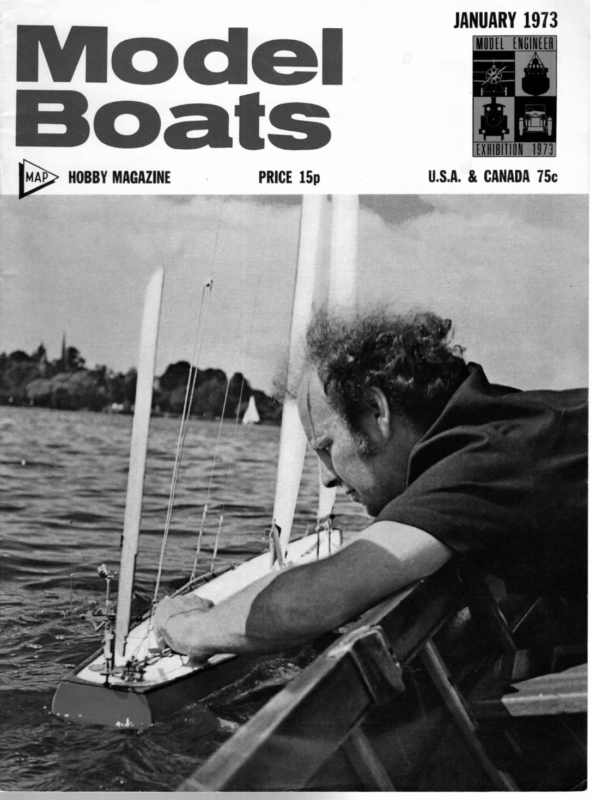
- In the Tideway
- METRICATION IN THE ‘A’ CLASS
- MIDLAND DISTRICT ‘A’ CLASS CHAMPIONSHIPS
- Tale of Four Witches By 1. G. Cornish
- U.S. MARBLEHEAD CHAMPIONSHIPS
- NAVIGA YACHTING CHAMPIONSHIPS

JANUARY 1973 HOBBY MAGAZINE U.S.A. & CANADA 75c
JANUARY 1973 In the Tideway between the A.M.Y.A. and the much _ older M.Y.R.A.A., which should help matters along inter- nationally. We have an established world body, the L.Y.R.U., which can only afford to recognise one national authority, so that liaison between two groups in any country is commonsense. We hope one day to see a flourishing British R/C yacht association working basically independently but under the aegis of the M.Y.A. This is not so far from the formula that brought peace between the radio and non-radio members of the M.P.B.A., with, it will be agreed, considerable benefit all round. World Multi-Racing 1974 The picture shows the last of the three simplified guns drawn by M. E. Blatch, the sketches for which appear on page 27. We hope that warship modellers have found the drawings of these complicated ordnance pieces helpful. Keighley & District Model Engineering Society is off to an immediate start in testing reaction to the projected World Multi Racing Endurance Championship provisionally booked for August/September 1974. Any intending entrant or association requiring details should write to K. Parkin, 48 Park Road, Bingley, Yorkshire, as soon as possible, giving brief E can’t remember a time when so much forward planning was taking place in so many aspects of model boating. Much of it is early stage, some committee level, but one way and another, the whole scene seems to be abubble, and not only in Britain. This can only be a sign of health and expansion, but we sense rather more — we believe that model boating is entering the next major phase of its development, that international activity is going to increase tremendously (and world wide) in the next few years, and that the steady growth in the number of participants evident recently is going to accelerate. The key to this may well be in the remark of a details of entrant and, if possible, likely radio fre- quency. Until the Society receives such information, they cannot evaluate the feasibility of going ahead with preparations. Keighley, pronounced Keithley, is situated in the Aire Valley at the junction of the Rivers Worth and Aire in the West Riding of Yorkshire, adjoining the Lancashire boundary. It is set beween the heavy industrial area and the Yorkshire Dales, amidst undulating moors, the best known bystander at the San Francisco pool, reported in the local club’s newsletter, to the effect that he had being Ilkley Moor, made ballad ‘On Ilkla Moor b’aht ’at’. famous by the The town has a population of 60,000, its chief never seen people so relaxed and so enjoying their industry is general engineering and within the Borough boundary is Haworth, home of the tragic Bronte family, which is served by a privately owned, standard gauge steam railway, and in addition to the Corporation Museum, in which there is the original Wankel Engine, there is a private Veteran hobby as the modellers there. As mentioned last month, there is in general slowly increasing leisure time, and there is a preparedness to spend more on hobbies. Most important, a definite kick-back against the modern ready-made, prepacked, built in obsolescence trend is beginning; no clearer evidence of this can be found than the enormous increase in the number of live steam locomotive models being constructed, or the thousands of D.LY. full size boat builders. People are rediscovering the need to use their hands and their minds, and in the constantly moving web of behavioural influences and inter-relating factors, model boating appears to be one of the growth points. Car Museum. Redcar Tarn is a moorland lake situated 941 feet above sea level, of approximately six acres with vertical stone walls. The average depth is 2 ft. 6in. and it is about 14 miles from the centre of Keighley. The Society hopes to be able to pay a percentage of non-European overseas competitors’ expenses if they are the official entrant of that country. If you want information about the people running it, M.P.B.A. President Frank Bradbury says: “There could not be anyone more pleased than I that the U.S. R/C Yachts World Multi-Racing Championship has come _ to Keighley, not because I am an Englishman and a Northerner but for the sake of both Mike Varley We see from the A.M.Y.A. autumn newsletter (20 duplicated A4 pages!) that the number of currently registered R/C yachts in the association is 464. Largest class is still the Santa Barbara one-design at 104, but rapidly catching up now is Marblehead with 91. The 36 in. (limited to 600 sq. in. in the States) lies fourth at 48, 10R fifth at 45, A Class tenth with 6. Since the S/B is basically a 10R, and and Keith Parkin. These officials of Keighley Model Engineering Society are, in most people’s estimation, the most hard-working and the best organisers of a Model Boat regatta yet come across; they are virtually unflappable (for overseas readers this means that nothing seems to panic them). I know, as well as many more people who have met Mike and Keith, that the World Championship will be a very enjoyable affair and memorable for years to come. It is obvious also that Alec Midwinter of the Leeds club will be on P.A. for the same reasons. ‘If the organisation is anything comparable to their “Mini Power Boat Marathons” or “Northern M.P.B.A. Multi-Racing Championships” then nothing the third placer (E.C. 12 with 83) similar, clearly this size is proving the most popular, though since the S/B and the EC12 can be bought as advanced kits requiring relatively little work, this must obviously be a consideration. The introduction of an M in similar form no doubt accounts for the rapidly growing number in this class, and it will be interest- ing to see if the easier portability of this class has an impact. will be found wanting.’ Nice to see that a ‘dialogue’ has been established 11
MODEL BOATS METRICATION IN THE ‘A’ CLASS /D Min.= —— +-4 5 – and if the cube root is below that required, the difference A DUTCH reader, Mr. J. van Santen, writing to us on yacht design, sent in the chart opposite, which will be of interest to yachtsmen generally. It shows the A Class formula expressed in graphic form, in metric figures. The variables of fresh water displacement, sail area, and waterline length are shown, and knowing any two of these factors, the third can rapidly be read off. The ‘penalty-free’ displacement area lies between the A max. and A min. lines; the I.w.l. range shown is from 130 to 146 cm. (approx. 52 — 574 ins.). The remaining three straight lines relate the sail area square root to the displacement cube root, or driving force to resistance ratio, and it will be clear that this ratio must be at its maximum for the minimum penalty-free displace- ment. The fact that the figures are metric will not prove an obstacle to enthusiasts more used to Imperial measure, Conversion is very simple, viz. Centimetres to inches, multiply by Inches to centimetres, _,, 3, Sq. cm. to sq. ins., Pr » Sq. ins. to sq. cm. i », Cu. cm. to cu. in. aa ;, Cu. in. to cu. cm. st Kg. to lbs. Lbs. to kg. 0-3937 2°5399 0°1550 64516 0:0610 », 16°3866 >. » » metrically converted boats to help in visualising typical figures. L.w.1.(cm.) SA (sq. cm.) «/SA D (kg.) aN Emperor Mini A Clockwork Orange 137-2 10100 139-7 100-5 23-6 10000 136-0 100 88 140-0 81 * * 25:6 28:7 29-5 25-5 25:25 * For the benefit of newcomers, the A Class rule, established in 1924, consists of one main and five sub- sidiary equations which between them tie up the speedaffecting variables of a design in such a way that while the designer has quite considerable freedom, any gain he makes in one direction is penalised in another. How successfully it does this is evidenced by the variety of shapes and sizes of boats designed to the class over 48 years, none of which has had any real all-round superiority over its contemporaries, yet there has been steady development. There have been some sudden steps forward — the late Admiral Turner’s first heavyweights, improved sail design and materials, vane gear, and so on — but even today there is no general agreement on ideal dimensions or whether, for example, a heavy boat is a better bet than a light or medium weight one. The basic rule is: L+VS -. 4 LxvVS is deducted from the actual cube root used in the main formula, and means either adjusting LWL length or, more usually, losing sail area. The maximum displacement: 3 LWL VD Max.= —— +1-0 5 — is not so severe a measure, but since the figure derived from the above is the maximum which can be used in the main formula, any weight over the maximum allowable is likely to be disadvantageous. The graphs supplied by Mr. van Santen provide all the above information in seconds, and will indicate alternatives or variations virtually at a glance, compared with a couple of hours of ‘cut and try’ mathematics. Other penalties are incurred in the three remaining formulae, the most complex of which is the quarter beam length. A yacht’s speed is related to its waterline length, or ‘sailing length’, and it is possible to produce a hull so shaped that on heeling, this length is quite dramatically increased by the immersion of the overhangs at each end. To control this, a line is drawn on the quarter beam buttock (i.e. the buttock line half way between centre line and point of maximum beam) parallel to and one tenth beam up from the I.w.]., and the length of this line is measured. The q.b.1. allowed is expressed as a percentage of the I.w.1. thus — 2°2046 0°4536 Mr. van Santen, who favours A boats slightly under average displacement and whose interesting A design we shall be publishing shortly, gives some examples of Highlander D displacement in cubic inches (weight of complete yacht in lbs. x 27-0, for salt water, or x 27-7 for fresh water) This is fairly straightforward, but there is a minimum displacement restriction: 3 LWL => 12xX3V/ D Q.B.L.=100—1/ L.W.L. Any excess is halved and the final figure added to L in the main formula. Draught is limited to a maximum of: L.W.L. x 16+3°5 (ins.) and any excess is multiplied by 3 and added to ‘the rating’ – the 39-37 figure in the main formula. In practice, an extra inch of draught could cost something like 200 sq. ins. of sail area, not a very good exchange! The sixth measurement is freeboard, averaged from measurements taken at the centre and at the fore and aft I.w.]. endings. Minimum allowed is 3 VD x +28-+1 (ins.) and deficit is added to the 39-37 rating. There are other minor restrictions and a limit to height of rig — 85-3 ins. above deck — and height of foretriangle, 64 ins. The rule also lays down that measurements shall be expressed in inches, sq. and cu. inches, and pounds avoirdupois, but of course one can work in metric and convert back. To a beginner, especially a non-maths-minded one, this all looks frightfully complicated, but it is all simple arithmetic and taking a few minutes to think about it helps one to realise what factors affect the speed of a yacht and the relative importance of each factor. In the A Class the main key is load waterline length coupled with displacement, which together determine sail area; in fact any two of these factors determine the third, and the remaining parts of the rule simple prevent the designer poe securing advantage by over-stepping reasonable imits. A very comprehensive survey of the rule and L is load waterline in inches its practical application appears in Priest and Lewis’ “Model Racing Yachts’ published by M.A.P. Ltd. S Sail area in sq. ins. 20
oa 9500+ ie 8500 75900 F- ve [~~ ey | Dee q 7000 A Ne 9000 }- 5 6900F a9 2. 2B a IS 14 eee 15 6 ee eT < Beg we za RO, rN & st XK \e 10000 100 ey S es Pe: : C 11000 4? iS KAY. L+VSA|, LxVSA IOxA - an 4 oe RAK 110 sooo? % Fad cm ae) 1973 JANUARY VSAl ay ae heen I7 [8 19 20 2 22 23 24 25 26 27 28 293031 3233 Dkg
THE Birmingham Club made a special effort to interest as many ‘A’ Class skippers as possible in this final big race of the season. Consequently there was a good entry of 14 boats from all over the country, which must have been very satisfying for the Club. The weather, however, did not produce the beautiful October sunshine that had been prevalent lately, although in amongst the rain there were some strong winds, of a reaching kind however. The open race held on the previous day had had a good beat and a run, we understood. Racing started soon after 10 a.m., the start being delayed for a few minutes as Ken Roberts arrived just on 10. The scoring was 2 from the Clubhouse, 3 the other way. Starting was a bit difficult as the wind eddied in the corner and boats tended to drop off into the corner at first. If a skipper over-trimmed to keep out of that corner a gust further up the lake would take his yacht right across into the deep bay, and lack of wind in there made retrimming very difficult. A few boats carried reaching spinnakers at first, but did not find them very successful. Mick Harris, sailing Spinaway, used a Genoa jib for running up the lake. After a couple of heats had been sailed it looked as if the boats that were going well in the conditions were Geoff Sheward’s Sheralee, and Eric Carter’s Geronimo. At lunch time Sheralee had 20/20, Geronimo 17/20, Spinaway 15/20, and Kubernetes 13/20. Geronimo had taken 5 out of Campari, and 5 out of Shenandoah. After lunch the wind had changed direction slightly, not MIDLAND DISTRICT ‘A’ CLASS CHAMPIONSHIPS = —_= — baedler -_ Bee SACO) SSIS” FOND) RESULTS The Sheralee G. Sheward Y.M. 6m. O.A. K917 55 (+R) Geronimo E. Carter Y.M. 6m. O.A. K934 46 Lewis (67-0) ‘ Spinaway M. Harris Bournville K919 44 Meir (61:7) Shenandoah K. Roberts Birkenhead K896 42 Pe (62-2) Campari H. Dovey Bournville 918 42 Lewis Philippa D. Priestley Fleetwood 789 41 Daniels (58-2) (Jill) Kraken K. Armour Leeds & Brad. 924 33 Lewis (Challenge) Kubernetes H. Briggs Cleethorpes 898 30 Lewis (79-5) Alberta A. Sinar Bournville 930 27 Lewis Confusion D. Armitage Birkenhead 802 22 Priest Rashein B.J.G. R. Spenser B. Garbett Leeds & Brad. Birmingham 848 851 19 19 Daniels Lewis G. Foster Birkenhead 933 12 Leeds & Brad. 923 9 Rowena Rufus . S. Armour (62:0) (Boreas) quite such a reach. Geronimo and Sheralee were still sailing well, Geoff only losing 2 to Spinaway on a disqualification. The other boats that were now fighting for 3rd and 4th places were Spinaway, Campari and Shenandoah. Campari got 5 from Shenandoah, but only 3 from Spinaway. The two Joe Meir designs did not meet until Heat 12; Shenandoah was ahead on the run, Spinaway had choice on the beat and just had the advantage up the lake, the finish being very close indeed. In the last heat Campari sailed Spinaway, Campari got the 3; Geronimo was beaten by Rowena both ways, and The Sheralee was beaten by Shenandoah both ways. It was now about 4.30, and darkness was beginning to fall. A few resails had to be taken, and so it emerged that Campari and Shenandoah were tying for 4th place. It was decided to do one sail off, tossing for berth. Campari had choice, and the two yachts touched. In ever-increasing darkness 2 more resails were taken until in a much lighter wind Shenandoah took the lead. It was very dark by the time these two boats came off the lake, and it must have been a bit frustrating for the other competitors waiting for the prizegiving. The Sheralee only dropped 7 points throughout the day, obviously this Lewis Continued on page 30 Top, winner and third place boat meet on the run. looks like quite a mix-up — all that empty bank, too! Left,
JANUARY Tale of Four Witches | 1973 Brigantine ‘Wind Witch’ from the original sail plan y 1. G. Cornish aw ie is not very often a model yachtsman can say that his first experience of model sailing was in square rig, but I am happy to say that this was how I began. My first ship way back in 1947 was the Wind Witch, loaned to me by a friend, a mere 12 ins. of proprietary length and loftier sail-plan easily outsailed the older pair, particularly now that the lighter winds of summer had arrived. Simultaneously, studding sails burst forth on all three ships. While sailing Water Witch I was busy building a further and final addition to the little fleet named Wave Witch, a pretty 14 in. topsail schooner; of all of them she was my favourite. She was a fast steady little sailer and the easiest of all to handle. hull re-rigged from Bermudan sloop to Brig. She was a beautiful little sailer, steady and fast for her size, but in the icy winds of the winter a brute to put about and trim, ten minutes of finger numbing nail-splitting work. A winter’s sailing with Wind Witch roused my enthusiasm and in the spring I built the Water Witch, a 16 in. three masted barquentine, a copy of the real Water Witch, one of the last British coastal traders in All my experience of these little boats went into her and she was good enough for the late Morgan Giles, well-known boat-builder, to award her a diploma at a local model making exhibition. sail. A lot of lessons and ideas I had learnt from Wind Witch went into the new barquentine, including steering All this took place a long time ago, yet the memory of white sails scudding over sunlit waters, of crisp winter mornings with not a ripple on the water, the boats gear and better braces. The two little square riggers sailing in company brought forth pond-side comments from many old drifting silently above their own reflections, is still clear. salts and several welcome gifts in the form of fishing The wheel has turned full circle, my own son now enthusiastically sails his own schooner and I have started building a new fleet of square riggers, starting with Wind Witch II. twine for rigging. By the summer the duo became a trio; a friend joined us with a 16 in. brigantine and promptly named her Sea Witch. The new boat with her greater U.S. MARBLEHEAD CHAMPIONSHIPS EWS comes from Wm. A. Full of the U.S. Marblehead Class Championships held on October 7/8 at Mill Pond (Mill Pond M.Y.C.) Port Washington, Long Island, New York. wind moderated and shifted to S.W., the only reasonably steady and reliable quarter at this lake, and the rain stopped. One entrant had been forced to withdraw on Saturday evening, so sailing was with 10 competitors with two byes. Visitors found lack of local knowledge something of a handicap, since the lake has its share of wind vagaries, and in the conditions the heavier boats with reduced rig thrived. All boats used variations of break-back vanes. One boat sank in the last heat, but the pool is shallow and salvage was not. difficult. Mill Pond Commodore, Al Strickland, was a considerate and efficient host, and as in this country, the ladies did their stuff with excellent and much appreciated luncheons. Results were 1. Steve Urbaniak (Mill Pond) Bersuch designed/built 20 pdr., 36 pts. 2. George Bersuch (M.P.) own design/build as above, 34. 3. Fred Frey (M.P.) Witty design, 30. Wm. A. Full (Marblehead M.Y.C.), Stollery Mad Hatter, 29. 5. A. Strickland (M.P.) 27. 6. F. Drake (Salisbury) 18. 7. D. Panzig (M.P.) 16. 8. D. Blossom (M.P.) 14. 9. J. Rose (Detroit) 10. 10. E. Salika (Buffalo) 4. A north-easterly gale greeted competitors on the Saturday morning; this was piling water westward down Long Island Sound to levels 3-4ft. above normal, and since the Mill Pond is a brackish pool with sluices adjacent to the Sound, it too was the same amount above normal with the bank walkways and starting positions etc. nowhere to be seen. The morning was spent running excellent films of the recent Hamburg meeting taken by Eugene Salika (Chicago), National M.Y.R.A.A. secretary. After lunch wind and water subsided enough to allow three heats to be sailed with the eleven entrants, and skippers then adjourned for the Association’s A.G.M. Among other things it was voted to abandon the M Class 1 in. garboard radius requirement and allow metal keels (as now in U.K. etc.) but no restrictions were placed on height of rig. Sunday morning start at 10 o’clock saw a strong and gusty N.W. wind and rain, but during the morning the 29
MODEL BOATS Simple Plastic Kit Conversion by John Henderson as sketched to provide necessary stabilising fins. One method of making a working rudder is shown. The rest is simply ensuring that the hull joints are watertight and the addition of Plasticine inside on the hull floor to bring the model to its approximate waterline. Plasticine laid centrall Tee in hull Aes Pieces cut from old wings WyHis conversion of an Airfix 1/600 scale Bis- marck can obviously be applied to similar size plastic models, and is a cheap and simple way of getting additional pleasure from what were intended as static models. A piece of scrap sprue from a kit is cut into an F form and cemented through two holes in the hull bottom to provide a rail on which a Mabuchi submarine power unit can be slid. Pieces of sheet plastic, from old wings, etc., are cemented ae Old tailplane Wheel and stub of axle from 1/32 mini AP Scrap plastic sprue, insert through hull | —— ts as submar jabuchi i motor unit MIDLAND ‘A’ CLASS CHAMPIONSHIP (continued from page 28) design yacht is very good in reaching winds. Geronimo, another Lewis design, also enjoyed the reaching winds, and had local help from Denis Lippet. Spinaway and Shenandoah again showed that there is not a great deal of difference in the sailing capabilities of the two designs. Birmingham are to be congratulated on the smooth running of the race, and completing 13 heats was a great effort. Speaking as a visitor from Birkenhead I always feel very welcome at Birmingham, and on this occasion must thank Dave Knowles for waiting for us to pack up and leave the lakeside (and for guiding us to the Motorway). As usual at the open races the Canteen Ladies did a grand job, keeping up a non-stop supply of hot tea and coffee in the wet and cold conditions. Joyce Roberts NAVIGA YACHTING CHAMPIONSHIPS FS bi-annual (8th) European Naviga Charpionshipsgsuccesstul, apparently. There were one or two sharpies, for free-sailing (D) and R/C (F5) yachts was held at Portoroz on the Yugoslav coast from July 24-30, and there were 62 competitors from 11 countries. The absence of any British entrants puzzles and disappoints our Continental friends; the next one, in 1974, will be in Vienna, so perhaps we shall have one or two prepared to participate then? a Classes sailed in both categories were M, 10, and X, the last being unrestricted except for the $+ sq. m. sail area (about 775 sq. ins.). A knockout system was used, with finals for about one third of each class. Some contestants felt that this method did not produce a true result, especially since light winds prevailed for most of the meeting (so light that at times anemometers failed to revolve) and it was therefore possible for a good contestant to be knocked out by fluky draughts favouring his opponent. However, no system can cope with every eventuality, and part of any sport is shrugging off bad breaks. The wind strength must have been frustrating for those inland skippers who had concentrated on models for reasonably heavy weather. The most successful design, as in Sweden two years ago, appears. to be Roger Stollery’s March Hare. There was little new in design or gadgetry, the only unusual models being some Italian boats of only about 6 ins. beam with very deep fins; they were not particularly one of which placed 3rd in DM. Photographs, etc. indicate that while Europeans can build beautifully, their designs still seem to lack the knowledge of the important fundamentals; no amount of ingenious gadgetry can cure basic design faults. No doubt increasing competition and lessons learned from successful boats will adjust this in due course, and in the meantime it must be said that their best are very good. There was this time a noticeable improvement in the performances of some of the eastern countries who have only recently come into yachting, most marked in freesailing where they comprised most of the entrants (48 out of 62) and took all the top places except for one Italian. In R/C, 9 of 36 competitors were easterners, top place being 4th in 10R. Top three in each event were: DM. 1. Biraghi (Italy); 2. Jakelic (Yugo.); 3. Schulze (E. Germ.). DX 1. Vonoczki (Hung.); 2. Petkov (Bulg.); 3. Letonja (Yugo.). D10r. 1. Kristov (Bulg.); 2. Jakelic (Yugo.); 3. Vonoczki (Hung.). FSM. 1. Topp (W. Germ.); 2. Mohnkern (W. Germ.); 3. Thyen (W. Germ.). F5X. 1. Topp (W. Germ.); 2. Maurer (Aust.); 3. Oberleitner (Aust.); F510r. 1. Thyen (W. Germ.); 2. Ivanoff (Sweden); 3. Topp (W. Germ.). Countries taking part included Austria, Bulgaria, Czechoslovakia, East Germany, France, Hungary, Italy, Poland, Sweden, West Germany and Yugoslavia. 30