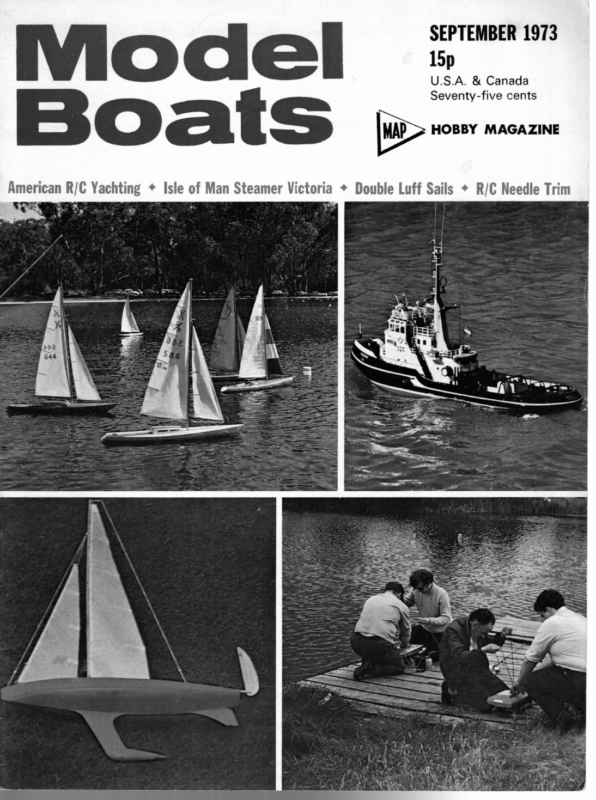
- R/C YACHTING IN THE U.S.A. Bob Jeffries recently visited and competed in California
- Making a Spinnaker An extra sail for the 36in. Gosling or similar size yacht
- DOUBLE LUFF SAILS by A. B. Whiteley
- Round the Regattas

SEPTEMBER 1973 : odel U.S.A. & Canada Seventy-five cents American R/C Yachting + Isle of Man Steamer Victoria + Double Luff Sails « R/C Needle Trim ceekt Te
Bob Jeffries recently visited and competed in California R/C YACHTING IN THE U.S.A. if HAVE for long been interested in what is going on in the U.S.A. concerning R/C Model Yachting, and I have read with envy in several American publications the extent to which it has ‘caught on’. Now not content with reading about it, I decided this year I must see for myself, and a long-standing invitation from an old friend in California was finally accepted. I could write much of my _ experiences —the fantastic T.W.A. flight over the Pole, the three thousand miles of motoring I did in California and Nevada, the friendly reception I received everywhere I went, and so on, but I must confine my writing to R/C yachting matters. My host in America was Col. L. R. Bartlett, a keen R/C yachtsman himself, and known through the model yachting movement in America as ‘Bart’. Bart has for many years been interested in model engineering generally. His interest has run the full course, and has covered model aircraft, power boats, and model engineering generally. His interest for several years has concentrated on model yachting, firstly vane control, and more recently radio control. He now sails the well known Santa Barbara onedesign class manufactured by Vortex Model Engineering Co. of Santa Barbara, California, and he is an enthusiastic member of the San Francisco Model Yacht Club. On my arrival, I found Bart had purchased one of the new Soling-M now being marketed by Vortex. This is a scale model yacht built to the ‘M’ class specification and is a small replica of the full size 27 foot Soling three-man-crew boat, the boat that won its class in the 1972 Olympics at Kiel, Germany. He -had completed the assembly of the boat, and I was able to spend some time with him in installing the radio equipment, and a proportional sail winch that I had designed for him, and which I had intended he should fit in his Santa Barbara. I found he had entered this boat in the 4th Annual Spring Regatta being held that coming weekend in San Diego by the San Diego ‘Argonauts’ Club. I also 364 found he had nominated me as Skipper! We only had time to check out briefly the boat’s trim before starting the long run to San Diego. I must digress for a moment to say the 550 mile run down the 101 Freeway was made in nine hours running time, an average of over 60 m.p.h. This says a lot for their wonderful motorways throughout California. We booked in on a prearranged booking at the ‘Dana Inn Motel’ on Mission Bay and only a few yards from the Argonauts’ boating lake. On arrival we immediately met George Dornas, the principal of Victor Models, who are marketing very successfully a small, inexpensive 36/600 class R/C yacht, the Tahoe. George sailed one of these boats in the Regatta in the 36/600 class. That evening we a very enjoyable dinner with George and_ his wife. We arrived at the lake early on the Saturday morning, intending to put in some practice with the new Soling, before the Regatta started. I found, however, that so many wanted to meet this man from England who was to sail with them, I only had about ten minutes before the Race Director Mario Singleton (we would call him the Officer of the Day here) called all the boats off the water so that the Regatta could get under way. The San Diego Argonauts are an enthusiastic band of skippers, and they sail various classes which include the little 36/600, the ‘M’, the Santa Barbara, or S/B, the West Coast 12 metre, and the Regatta One-design. We have the equivalents in our 36R and M, and the S/B roughly compares with our 10R. We have no alternative to the latter two classes. They approximate roughly to our ‘Q’ (RA) class. On counting up the entries, I found there were no fewer than seventy-three boats entered. They told me it was the biggest entry they had ever had. And surely the biggest R/C model yacht regatta anywhere in the world! The yachts sailed in their own class, and points counted towards the final score to find the outright
SEPTEMBER 1973 winner. All yachts sailed the same number of races. The biggest entry was for the ‘M’ class, followed by the S/B. It was interesting to see so many of our Editor’s designed Starlet sailing. Many had been modified to bring the overall length up to 36 in., and so make them conform to rating. Mario Singleton had some nice things to say about me over the public address equipment, and I was surprised to find so many who had read my articles in Model Boats and Radio Control Models. Incidentally, I found that Mario’s wife came from Swanage, Dorset. Small world! In my racing Bart’s new Soling, I was thrilled to _win the first heat, and came third in the second heat. I don’t know if it was competition nerves, or just better skippers, as I dropped to fourth in the next heat and fifth in my last heat. I was given nice mementoes for my first and third places. I shall long treasure these as a reminder of my visit. They sail eight boats per race, so I was well satisfied with my performance, and that of the new Soling. I could write a lot about the Argonauts regatta organisation, but a few points are worth recording. Firstly the course. This is laid out to the internationally recognised Olympic layout. Skippers are allowed to walk the bank towards each mark. They reason that, in full size practice, the skippers are there, and do not have to rely on eyesight at a distance, and there was no trouble in boats masking the mark, as so often happens here. Their racing rules are those of the A.M.Y.A. (American Model Yachting Association). Basically these are the same as ours (which are based on full size practice anyway). They are not so severe over infringements. They say, and rightly so, this is done to encourage the beginners. Nobody is disqualified. The winner gets one point, the second two points, and so on. Any obvious infringement incurs a penalty of one or two points added to the offender’s total. Failure to start or finish, the offender gets two points added to the score he would have had in coming last. The winner is the one with the lowest score. Over the whole two days, I only saw two instances where the incidents caused a protest, and these were of a minor character. The organisation and smooth running of this event was largely due to the foresight of the Argonauts race committee. All entries had to be in at least seven days before the event (all frequencies had to be quoted). Printed race schedules were issued to all skippers before the commencement of racing. One knew which frequency to use, and not once did I Seven boats beating towards the weather mark — San Diego again. Sand and palm trees and an awful lot of boats — 73 to be exact at the San Diego Argonauts Lake. hear of any frequency clashes, in spite of the number of yachts involved. The Americans are fortunate in that they have in addition to the 27 M/C band the 72 M/C and 6 metre bands, roughly three times the frequency bands we are allowed. The race schedules not only give the list of competitors in each heat, but the names of competitors not sailing in that event, who are to act as Start/Finish Judge and Windward and Leeward Marker Judges. During the regatta, I had the opportunity of meeting and discussing model yachting matters with many of the skippers. I had the opportunity of meeting Don Prough, the President of the A.M.Y.A. and the Secretary, Chuck Black, and many prominent members of the model yachting fraternity in America. As many of my readers already know, there are two associations in America catering for the model yachtsman, the M.Y.R.A.A., the Model Yacht Racing Association of America, and the A.M.Y.A., the American Model Yachting Association. The M.Y.R.A.A. has been in existence for many years, and caters for the vane sailers. I was told that they appeared to take so little interest in radio control that a small band of enthusiasts started a rival organisation for the radio enthusiast. This has been successful beyond their expectations. Now the M.Y.R.A.A. appears to want to at least amalgamate with the lusty newcomer. The A.M.Y.A. wants none of this, and the problem is further complicated in that the I.M.Y.R.U., the International Model Yacht Racing Union, can only by its constitution recognise one association in each country. Only time will solve this one. I well know of the scheme to start a similar separate organisation here. Fortunately our M.Y.A. has awakened to the radio interest, and now takes a much more active interest. In view of the mileage involved, we had to leave the Argonauts by mid afternoon on the Sunday, and before I left I was asked to say a few words over the P.A. I was able to thank the organisers for the efficient way they had run their regatta, and the enjoyment I had had in sailing with them. I concluded by conveying to them the best wishes of my local club, the New Forest R/C M.Y.C. From the performance of the Soling-M that I had sailed in this meeting, I decided I would obtain one and bring it back to England with me. We made Santa Barbara on the Sunday evening, and after an overnight stop in one of their excellent motels, I went to see Vortex Model Engineering on the Monday morning. The President of the company, John Converse, made me most welcome and after a discussion, showed me around his very well equipped factory, where I saw S/B’s and the Soling-M’s being manufactured. The factory is very well self- 365
MODEL BOATS Department, and was especially impressed over the care that went into the adjustment of their Sail Control Units. These are dual units enabling both sails to be adjusted, and also trimming of the jib to its best setting. When complete every unit is tested on a test rig and must pass a pull of 70 in./Ibs., far in excess of anything it might be called on to do. In view of the power developed, a nylon shear pin is fitted. Should anything in the rigging jam, this pin breaks, and it is only a matter of a minute to replace it. The S/B hulls are made in a variety of colours, but the Soling-M is only available at present in white. A variety of sail colours is however available, and as my previous boats have usually been green, I chose that colour. The kit was packed in two cartons. One contained the keel, and the other the rest of the parts. We took the keel with us, and arranged for the rest to be sent to my friend’s home in Northern California by carrier. It is worth mentioning that we left Santa Barbara midday Monday, and the carton arrived five hundred miles away on the Thursday morning. British Rail please note. Regarding the transporting of the kit to England, this will follow in its due time, as will my experiences in building and sailing the model. I mentioned earlier of my meeting with George Dornas, of Victor Models, who make the little 36/600 Tahoe kit. I had the opportunity of examining one of these, and whilst not in the same class as the Soling, it was very good value for money. The hull, deck, keel, hatch and rudder are all in vacuum moulded plastic. The very complete instructions make it a very suitable beginner’s model. I had planned to bring back with me one of these also, but I was concerned over the weight of my baggage, and the cost of excess weight. I sadly had to leave it behind. Victor Models also make a simple sail winch for this model. f Back in Northern California, I had the pleasure of meeting John Malone, a member of the San Francisco Model Yacht Club, and current S/B class champion. I was able to see many of his home movies on model yachting matters in America. John has only taken to R/C yachting for the past year or so, but has the knack of really getting the best out of his boat, and sailing it to its best performance. I first saw his S/B sailing on a lake near my friend’s home, and had the pleasure of sailing it myself. Incidentally, while seeing John Malone’s movies, I also saw some colour movies that Bart took on his visit to this country in 1969, when he saw the ‘Q’ class championship at Gosport. It was funny to see myself with my ‘Q’ boat Electra V, and many well-known English model yacht skippers. Chas. Brazier was O.0.D. of that event, and it was nice to see again that beard that used to adorn his chin! No visit to Northern California would have been complete without a visit to the San Francisco Model Yacht Club, at Spreckles Lake in the Golden Gate Park in San Francisco. The club has been established for many years, and receives a lot of help from the civic authorities. Their clubhouse has to be seen- a substantial brick building adjoining the lake, wellequipped with kitchen, toilets, permanent test tank for measuring models, and a large boat store with a wide variety of model yachts from the little 36 in. up to the ‘A’ monsters. The San Francisco club has a power boat section, scale models and yachts both vane and radio. The radio section mostly sail the S/B boats, but several ‘M’ and 36in. were evident. Normally radio and vane sail alternate Sundays, but on the Saturday I went, there was a power boat event up to noon, after which there was an informal club event with about eight of the S/B class sailing. John Malone was sail- ing his bright red S/B, and won every race he sailed. He let me sail it, and I managed to come second. Bart Bartlett had his S/B sailing, but somehow or other, it just could not catch John. It just goes to show that a good boat is no help without a really good skipper, and John Malone is not 1973 champion by accident. Between the various sailing events, I motored a total of 3,000 miles during my stay. On one sightseeing trip to the Muir Woods in Marin Country over the fabulous Golden Gate Bridge, we saw some model gliding going on. We stopped, and watched for a while. They just hand launched off the hillside, and thereafter soared until the batteries ran down. Looked all too simple, but the gliders, or really slope soarers, were well equipped, and had flaps or spoilers. These were necessary to get them to come down! On the return from that particular trip, we called in on Bill Hymes at Sausalito. Bill lives in a wonderful home literally built on the cliffside, and overlooking San Francisco Bay. He does a lot of sailing in the bay on his full size yacht, but his hobby is his well equipped workshop, and the models he has built range from a model cabin cruiser with a four cylinder petrol engine designed by the late Edgar Westbury of Model Engineer fame, radio controlled of course, to a scale model coal-fired locomotive to L.B.S.C. design, and a scale model of an old time tugboat. Steam driven and eventually also radio controlled. The hull for this model is entirely made to scale using teak as in the prototype. All planks are screwed with literally hundreds and hundreds of small bronze wood screws. What I found so interesting was that he is plugging the head of every screw with a tiny teak peg, as done in full size. He has already spent some months on the hull, and it will Continued on page 376 Race 366 Director, Mario Singleton at the control van at San Diego regatta; note loudspeaker and sunshade. the —s contained, making the majority of the components that go to making the kits. I saw the moulds where the hulls and decks were made, and rows of hulls awaiting finishing. All the tools used in the production were made in their small but well equipped tool-room. Upstairs, I saw the sail loft where they make their own sails, and several prototype boats made during the development of the Soling. Back downstairs I saw the Test and Inspection
SEPTEMBER 1373 Making a Spinnaker An extra sail for the 36in. Gosling or similar size yacht flared bow is naturally harder to push under. Unfortunately, coarse bows slow the model on other points of sailing, especially when the water is choppy, so that, like everything else, a compromise has to be reached in hull design. The bow-depressing effect of a spinnaker can be re- duced by cutting it and flying it so that part of the force it exerts acts vertically, i.e. it lifts. This is achieved by curving the top third in quite sharply and allowing the foot to sit well forward so that air can escape more easily beneath the sail. The degree of curve and how far forward the foot is set are part of the art of making and using spinnakers. Most commonly used spinnakers are of the two-panel type, that is two separate shaped panels joined on the centre line and with reinforcing at the three corners to accept eyelets for the rigging lines. Joining the panels is a Transparent polythene is not the easiest of subjects to photograph; we had to screw it up to make sure it would be clearly seen. fy toes a majority of racing skippers buy their normal sails from an expert sailmaker, most make their own spinnakers. For the absolute novice, a spinnaker is a sail set ahead of the mast, roughly athwartship, for sailing downwind. Often these sails are very large and so made that when filled by the wind they justify the name ‘balloon’ spinnakers. At the other extreme, quite small ‘flat? spinnakers are used in heavy weather; in between there is an infinite variety of sizes and degrees of fullness. Since they are in effect bags of wind, it is equally as important as the fore and aft sails that they are airproof. However, they are usually rolled or folded and stuffed in the skipper’s pocket for the beat, bent on for the run, then repocketed for the next beat, which is a hard life for a sail. The material now used for most of them is polythene sheeting, in various thicknesses from the very thin, as used by dry cleaners, for light-weather spinnakers where it is essential that a breath of wind can lift them and fill them, to the thicker material used for large food bags. Beyond this, dinghy nylon or hot-rolled terylene is used, for strong winds. The spinnaker is set by hooking to the mast at the sail head (the maximum height can be limited, depending on the specific class rules), hooking the tack to the end of a spinnaker boom and hooking the clew to controlling lines on the opposite side of the yacht. Which lower corner is the tack and which the clew depends on which side the spinnaker boom is rigged! Control is limited to moving either or both lower corners fore and aft. As can be imagined, there is enormous power in a spinnaker (try holding a large sheet of polythene in a breeze) and the centre of effort is naturally fairly high, perhaps a third of the height of the sail above deck. Since the centre of resistance of the boat is low — below water level — it follows that the spinnaker produces a bowdown couple, tending to force the bow under water. This is why hull designs tend to incorporate as much reserve buoyancy at the bow as they can; a blunt or heavily- slight problem, since if a sewn seam is used, tears can easily start from any of the needle holes. The recommended method is to heat seal the joint, using either a sharpened hot soldering iron and running it over the material, cutting and joining both panels at the same time, or by clamping the panels between two pieces of metal, leaving 1/8 in. or so protruding and melting the protruding edges together by passing a match along. Either method takes a little practice to get the right heat and/or speed. an ‘average’ spinnaker for When considering making the Gosling prototype, we happened to see some information on a new self-adhesive tape called Arno Pool Patch. This is a stretchable tape made for repairing inflatable plastic items like children’s paddling pools, water NOT TO SCALE 105″ CURVE IN TOP THIRD JOIN 3 toys, balls, etc.; it in fact blows up with the repaired item. Well, it if sticks that well to plastics and is obviously waterproof, why not try it for joining the panels of a medium-weight spinnaker? A transparent sail is difficult to photograph, but the result of our first attempt is shown. While not perhaps suitable for a really lightweight or multi-panel spinnaker, it seems entirely satisfactory for normal working. The tape adds a little to the weight, of course, but it also provides a strong and apparently permanent joint. It is also excellent for patching any sail, reinforcing spinnakers, etc. Produced by part of the Scholl organisation, 54 yds. by ? in. (enough for 3-5 spinnakers) costs 45p. To make a sail, cut two panels approximately as sketched, unroll a length of tape and hold it flat and straight, with weights. Carefully stick the centre edge of one panel halfway over the tape for a few inches, repeat with the other panel, weight over the stuck part, work a few more inches, etc. An assistant can be a boon, but it isn’t difficult. Fold the tape along its centre when completed and reinforce the corners as shown. Rig as outlined above, in conjunction with the Gosling drawing and practise with the boat. Even if you sail alone, it will adda new dimension to your sailing. 377
MODEL BOATS JDOUBLE luff sails with a wide vertical pocket through which the mast is threaded have been used for some time, particularly on Marbleheads. Although improved performances resulting from their better aerodynamic shape and elimination of eddies between the sail and mast have not been convincingly demonstrated by competition results, such sails still have their advocates and if well made look very attractive. Double luff sails are often sketched on plans, many of them by the late Stan Witty, but \®) EDDIES RS) NORMAL SAIL p> GAP MASTPe = SINGLE THICKNESS» = a \ 3/8″ – 1/2″ OVERLAP \ these sketches are often incomplete and may give a DOUBLE LUFF SAIL POCKET WALLS by DOUBLE LUFF SAILS .,.. newcomer to this type of sail considerable food for thought. Three problems not found with conventional sails have to be solved. 1. The construction of the sail itself. 2. The attachment of shrouds and forestay to the 3. Whiteley each suit of sails, or it can be clamped to the mast and positioned as required for more than one suit. In either case the bracket must be strong and firmly attached as it takes a considerable strain. This bracket can incorporate a screw adjuster to tension both shrouds simultaneously, thus eliminating separate turn-buckles which are expensive and relatively heavy. See Figs. 4, 5 and 6. mast. The sail attachments, particularly at the tack (the corner nearest the gooseneck). In order to achieve a good aerodynamic shape for the sail a wide pocket is desirable, extending to between a quarter and a third of the total sail foot. This enables the sail to take up the shape of an aerofoil with a smooth transition from the mast to the rear part of the sail. 3. Tack attachment In order for the sail to set properly and maintain its aerofoil shape, for all sail settings between close hauled and running free, the double luff pocket must be able to rotate relative to the mast and to take up its correct shape on either tack, i.e. the sail must be able to curve on either side of the boom. At the same time, the luff must be capable of being tensioned. To satisfy these conflicting requirements, it is necessary to provide a lower attachment point that is movable but which can transmit the various forces from the sail to the mast in a controlled manner. The most elegant solution I know is due, I think, to Stollery, but I have not seen it published. It 1. Construction of the sail The sail is best made in two parts, the pocket and the single thickness rear of the sail being cut separately from dinghy terylene sailcloth, using a small soldering iron to seal the cut edges. This enables the weave to be vertical for the pocket and run parallel to the leach for the rear of the sail. I have found by trial and error that it is simpler to glue the two pieces together using clear Bostik rather than sew the long seam. To stop the seam from unpeeling I have added 14 inches or so of stitching at each end as shown in the sketch, Fig. 2. which shows a sail based on Witty’s ideas with a parallel pocket. Other designers use a tapered pocket with the single thickness rear part of the sail extending virtually to the sail head. In the Witty design the rear part of the sail is shown extending inside the pocket to the head of the sail with a head board attached to it. I have tried this but do not think it really necessary. Also as the head of the sail is quite stiff, an eyelet is adequate in place of a rigid headboard for the attachment of the halliard. The sails are made without any built-in flow, this being achieved by suitable tensioning of the sail clew when the sail is in use. uses a short inclined strut between a pivot point on the rear of the mast and an attachment point on the sail at the junction of the luff pocket and the rear part of the sail. The pivot on the mast incorporates a tiny thrust block which enables the strut to transmit the luff tension to the mast as well as allow the sail to swing and rotate in a controlled manner. The strut HEAD CUT-OUT FOR SHROUD ATTACHMENT 2. Attachment of shrouds and forestay In order to attach the shrouds and forestay to the mast, a cut-out must be provided in the front of the double luff pocket at the appropriate height. However, it will be found that if the shrouds are attached directly to the mast, they will foul the sail in all but a close-hauled setting unless the cut-out extends a long way back into the pocket. This is undesirable. as any tension in the luff will cause the cut-out to open and spoil the set of the sails. The alternative is to fix a small forward projecting bracket to the front of the mast and attach the shrouds etc. to it. Such a bracket may be permanently attached io the mast, in which case a separate mast will be required for DIRECTION OF WEAVE FIG.2 FIG.3 APPROX. 3/8″ GLUED SEAM TACK | | } 4″ APPROX, WITTY TYPE PARALLEL POCKET 380 4″ APPROX. TAPERED POCKET
”SAIL SET FOR 3/16″ RUNNING / SHROUD; THREADED oy CLAMPING BAND a 18 WG BRASS ROD 3 ary : | : TUFNOL OR PTFE THRUST | pee t BLOCK GROOVED TO FIT INSIDE HINGE AND EPOXIED TO MAST »| ye” KNURLED —— NUT TUFNOL ~~) BRASS TUBE AND Mele KEYED EPOXIED AL.BRACKET FORESTAY AND/OR JIB HALLIARD TO MAST POP-RIVETED TO MAST y ss BRAZED TO BOLTS on 3 6BA 16 SWG STAINLESS WIRE HINGE SHROUD FIG.5 FIG.4 PIVOT AND THRUST BLOCK DETAIL FIG.8 Hise} | CURES | POCKET | ee ee] ee | are Pa SEE DETAIL baal STRUT 3/16″ OR 1/4″ DIA. AL. TUBE FIG.7- GENERAL | | | ARRANGEMENT OF STRUT TACK FITTING ROUNDED TO ROTATE | | | | | | i an _- AGAINST THRUST BLOCK a | | TOP OF STRUT | | | | | SLOT | / of EASY FIT ON WIRE HINGE BOOM | persis FLOW ADJUSTMENT EYEON = CORD AND MAST / ATTACHMENT BOWSIE 2 FIG.9 STRUT TOP DETAIL decreed that the foot of double luff sails must be measured from the front of the mast when calcu- is contained within the luff pocket and is quite unobtrusive in use. A cord with bowsie adjustment is also required as shown to prevent the outer end of the strut from lifting. Other details should be clear from the sketches. This device is slightly fiddling to get right but once the correct relative tensions in the sail halliard and the cord restraining the strut have been found, the arrangement is quite stable and only lating sail area and this may outweigh some or any gain from the extra efficiency of this type of sail. I apologise if I have published other people’s pet ideas but as a relative newcomer to model yacht construction I have found that many accepted current ideas have not been published even in the excellent series by Griffin published in 1970 and 1971 rarely comes adrift when sailing. I hope that these notes will take some of the uncertainties out of double luff sail construction. Note, however, that a recent M.Y.A. ruling has in Model Boats and it is only too easy to waste time, effort and money on clumsy and/or obsolete designs and fittings. number of prisoners, and the squadron returned to repairs were once again necessary. Further raids followed and one, with heavy Lancaster bombers in September, did serious damage to the foredeck and In September 1943 the Royal Navy sent six midget submarines, or X-Craft, against the Tirpitz, Scharn- to protect her. TIRPITZ from page 378 anchor gear. The ship was moved to Sandesund near Tromso and a Luftwaffe fighter squadron assigned Norway. horst and Lutzow. The latter two ships were not at their expected anchorage and the attack was concentrated on Tirpitz. Only two of the submarines got The final attack came on November 12th, 1944. Lancaster bombers carrying special bombs designed for use against naval targets caught her without fighter cover, the fighters were protecting their own airfield believing the raid was directed against them, and pressed home their attack under ideal conditions. Several bombs hit the ship but it was a near miss that did the trick. Exploding in the sandbank along- through to the battleship, the others being lost from a variety of causes on the way. Charges were laid under the Tirpitz by X-6 and X-7 and in due course exploded. The damage to the ship was severe, although externally she appeared little the worse for the attack. One of the turbines had been lifted from its bed, and C Turret had been knocked off its roller path. The Tirpitz needed extensive and _ difficult repair before she could become a front-line ship side Tirpitz, the force of the bomb turned the ship right over, trapping most of her crew below decks. Although some were later saved by cutting through the plating of the upturned hull, nearly 1,400 men perished with the great ship. The standard colour scheme for German ships was light grey up to main deck level and a very light grey above. Funnel cap on Tirpitz was not painted black. Decks as indicated were planked and others dark grey. 1Sinch gun barrels were black. Waterline again. Now it was the turn of the Fleet Air Arm and the R.A.F. to try and put an end to the major naval threat to the Allies in Europe. Almost as soon as repairs had been completed, in April 1944, she was attacked by Fleet Air Arm Martlets and no fewer than 15 hits were scored, albeit with small bombs. Damage and casualties were severe and very dark grey. Next Month: British 381 Destroyers of World War I.
mn MODEL BOATS ROUND… the REGATTAS be declared on the total points scored on both days. ‘A’ Class Team Championships — Gosport Seven Clubs entered for this Championship which was the first of its kind, The teams, consisting of two boats from each Club, came from Birmingham, Bournville, Clapham, Fleetwood, Guildford, Y.M.6m.0.A. and Gosport. Held at Gosport on June 16th-17th, the Committee of the host Club were determined to make the event a success, although the entry was somewhat small according to some standards. . The first pairs were started on Saturday morning 16th June by the ‘Round the World’ yachtsman, Sir Alec Rose who was introduced by Alderman V. E. J. Neal, a Vice-President of the Gosport Club. Sir Alec was naturally very interested in the vane steering gear as it was the first time he had seen it in operation on a model yacht. He was also very impressed by the size of the ‘A’ Class and the standard of workmanship that went into the building and rigging of them. , Under the rules and conditions governing all M.Y.A. Team Championships the sailing is arranged so that there are at least 12, but not more than 15 hours of racing exclusive of meal breaks, to be sailed in two parts. With an entry of seven teams, the first part of the Championship consisted of seven heats, each team having a bye in turn and the first must be completed before a start is made on the second part. ‘ The weather was fine and warm with a good top suit breeze from the S.E., one of the best directions on the Gosport lake, and the skippers took full advantage of it, with a beat down and a run back with multi-coloured balloon spinnakers set. Three heats and all outstanding resails were completed when a break for lunch was taken. It was too early to say which team was leading but to anyone watching, Bournville seemed to be having the better of the argument. Racing was resumed just after 1.30 p.m., and the remaining four heats of part one of the starting schedule were completed in just under two hours which was good fast sailing from both ends of the lake. Part two was started immediately and two heats were completed when a short break was taken for tea. The rate of sailing had slowed down owing to several pairs having to go back to the start for resails at both ends. On resuming, the wind was still S.E. but noticeably lighter. With the idea in mind that it was possible the wind may continue to drop, the O.0.D. decided to do one more heat and all outstanding resails of which there were quite a number. The last resail was completed in almost a flat calm, leaving the three remaining heats to be sailed next day, and a start was ordered for 9.30 a.m. During the afternoon the most successful teams seemed to be Bournville, Birmingham and Gosport, and on checking the competitors’ score cards with the score sheet the scores for the day were:— Bournville 63; Birmingham 56; Gosport 524; Fleetwood 464; Clapham 35; Y.M.6m.0.A. 32; and Guildford 30 points. The weather on Sunday morming was dry with a thin layer of low cloud giving a promise of a clearance for sunshine later. The wind after the overnight calm had veered to the S.W.—a good fresh top suit breeze. It was obvious that parts one and two of the Championship would be finished well within the specified time with only three heats of the second part to be done. The O.O.D. decided to start a second round of the first part of the schedule, consisting of seven heats with the bye in each heat. If all seven heats were completed a result would 382 If not, the result would be declared on the points scored at the end of parts one and two only. A start was made sharp on 9.30 and the remaining three heats were completed just after 11 o’clock. The three heats carried a possible aggregate of 30 points for each team. When the scores were checked it was found that there had been a remarkable reversal of fortunes. The total scores for parts one and two were:— Bournville 79; Fleetwood 653; Gosport 644; Birmingham 63; Clapham 51; Y¥.M.6m.0.A. 49; Guildford 48. Bournville still held on to the lead by scoring 16 points out of the possible 30, Fleetwood came from fourth to second by scoring 19 points, Birmingham by scoring only seven points for the three heats dropped from second to fourth. The other four teams maintained their overnight positions, Guildford making the second highest score of 18 points. The Championship was continued by starting on the seven heats of the first part of the schedule in which each team had a bye in turn. The windward choices on the competitors’ score cards were reversed. Two heats were completed before a short break for lunch at 12.30. The remaining five heats were finished with all outstanding resails just after five o’clock and while the competitors were enjoying a well-earned tea, the O.O.D. and Scorer were busy making up the score sheet and checking the competitors’ score cards. Final scores:— Bournville 99; Clapham 98; Fleetwood 9743; Gosport 944; Birmingham 85; Y.M.6m.O.A. 83; Guildford 73 points; a remarkable finish to the first National ‘A’ Class Team Championship. The difference of 44 points between the first four clubs shows the high standard and keen competition by the skippers. round The feature of the seven heats of the second was the remarkable come-back by the Clapham team. The two skippers between them scored 47 points out of a possible 60, which brought them to within one point of the Bournville total, and from fifth place to second to take the prizes for the runners-up. Revolution scored 26 and Emperor 21 points. The teams and detailed scores are as follows: pts. 1. Bournville (K.876 Kami-Sama ( K.937 Spartacus H. Dovey D. Lippett 57 42 )99 ) 2.Clapham C. Dicks R. Seager 62 36 ) 98 ) (K.939 Revolution ( K.877 Emperor 3. Fleetwood ( K.789 Phillipa ( K.945 Long Shot D. Priestley 414 ) 974 J. Major 56 ) 4. Gosport (K.875 Zerlina ( K.935 Silhouette R. Fogaty 434) 944 R. Gardner 51) 5. Birham (K.936 Moonraker IV P. West ( K.930 Alberta _K. Butler 6. Y.M.6m. O.A. 7. Guildford 53 32 ) 85 ) (K.940 Aubade ( K.934 Geronimo N. Hatfield 48 E. Carter 35 ) 83 ) (K.921 Clockwork ( Orange ( K.941 Ricochet R. Stollery P. Bussey ) 73 ) 44 29 Introduced by the Vice-Commodore of the Gosport Club, Mr. R. Gardner, Mrs. N. D. Hatfield kindly presented the trophy and prizes to the winning Bournville team and to the Clapham team who came second. The trophy, presented to the Model Yachting Associa-
SEPTEMBER minute heats and the winners were: uon by the Gosport Model Yacht Club for competition in ‘A’ Class National Team Championships, was a half block scale model mounted on a polished base board of the ‘J’ class yacht Endeavour I, built and designed by Camper and Nicholsons of Gosport in 1934 as a challenger for the ‘America’s’ Cup. There were a number of first season yachts among the competitors, Revolution being the most _ successful. Designed and built by Chris Dicks, she is a light weight with a long hull, narrow in the beam and a long waterline and a fin and bulb keel, Another, Long Shot, designed by Fred Shepherd, also put up a good performance. In comparison with Revolution, she is heavier and has a shorter hull and waterline, also with a bulb and fin keel, and there is no doubt that the moderate sailing conditions suited both of them. There was some speculation, however, how they would perform in what is known among model yachtsmen as a typical ‘Fleetwood Blow’. This was the first ‘A’ Class National Team Championship and although the entry was small according to some standards, there is no doubt it was a very successful Bennett, racing in the 3.5 -— our Report on North Birmingham Open Day Meeting, 1st July 1973 Twenty-three entries from five clubs entered a nonNaviga event on a hot sunny day with light variable winds gusting at times. : The steering event attracted 21 entries for the Perry’s Cup, which was won by Fred Goff, the M.B.P.A. area secretary, his first steering win ever (he’s tried hard enough). Well done Fred. Second and third places were taken by the father and son pair, A. Shaw and Son. The course was an obstacle course of five hazards, maximum score in two minutes to count. Figure 8 Speed. The first notable feature was how close the times on this course are to known Naviga performers, e.g. T. Cann in brilliant form winning (again) in 18.5 secs. His current Naviga record time is 18.6. Other competitors 10 PENDENNIS CASTLE from page 369 with known times this year will verify the close proximity of their times on this figure eight course. ; The course, 110 yds. in length, is completed in figure eight form, crossing over in the middle giving one left and one right turn at each end buoy. Total travelling distance approx. 220 yds. plus turns, about the same as Naviga. Summary. Following on the record-breaking Records Day this day’s open event has given a boost to the North Birmingham Club’s morale with increased entries over last year’s event. Steering: 1 F, Goff, N.B., 38 pts.; 2 (run off) A. Shaw Jr., N.B., 32; 3 A. Shaw Sr., N.B., 32 (21 entries). Figure 8 Speed, 0-33 cc.: 1 G. Heward (24 cc.), N.B., 27.8 secs.; 2 (run off) D. Sims, Cov., 31.0; 3 I. Smith, Cov., 31.0 (12 entries), 34-5 cc.; 1 M. Varah, Leic., 21.0; 2 V. Hadley, N.B., 25.0; 3 A. Shaw Sr., N.B., 25.9 (five entries). Over 5 cc.: 1 T. Cann, Leic., 18.5; 2 A. Shaw, N.B., 20.5; 3 R. Williams, Wolvy., 21.9 (16 entries). the rails do not come out as successfully as with the When dry the two lots of windows were glued to the sides of ‘A’ deck and a weight stood on top to keep them to the sheer of the hull. Later these sides were reinforced with backing blocks and deck beams. Tourist public rooms extending aft of the ‘A’ deck windows were added in solid blocks. To save time which would be taken in painting the public rooms, they were faced with good quality white paper. Doors and windows were drawn in coloured ink on thin celluloid and glued on separately. The smaller details of the tourist ‘A’ deck were added at this stage as the Prom deck covers this area completely. Wooden panelled glass screens on either side of the tourist games deck were made by ruling celluloid with the panels in brown ink. An improved method was used for the construction of the five-bar rails, of which several feet were required. Fig. 3 shows the method used. Cygnets. As can be seen, one club had rather a good day! May This, the Southend Club’s Silver Jubilee regatta, started at 11.30 a.m. in scorching “weather which lasted until the prizegiving at 8.00 p.m. The first event was electric steering, which was won by Jack May of the Maidstone club, who used his very well known Nippy, powered by a Volkswagen motor, and nicads. Many of the spectators present throughout the day commented on the smooth, quiet power of the electric models. The premier event was I.C. steering, and in this, the best supported class, competition was very close with John Bennett just getting first place over Cygnets clubmate John Cundell by a mere one point. Steering was followed by Concours, this being won by Ted Gillies of the host club, who showed his tug model built from a Model Maker plan. The final events of the day were multi racing in three some very exciting 0-3.5cc., Ist John Saunders, we extend our thanks to all those who supported regatta and hope to see you all again in 1974. Southend Radio Open — 1st July 1973 saw Mr. Southend. The officials were:- O0.0.D., W. E. Long; Starters, H. W. Francis and A. Fogaty; Scorer, W. Poole; Umpires, G. Matthews and E, Brown. These 2nd 6.5 cc., Ist John Bennett, Cygnets; 2nd _ _Moore, Cygnets. 6.5 cc.+, Ist R. Newman; 2nd R. Wilkinson, event. classes, Cygnets; 1973 former method. After the rails had been cut from the frame I painted them with the rapid drying spray paint. The upper bar was painted brown to represent the wooden capping. I discovered that in order to make a secure job of the fixing the lower bar must be glued to the deck rather than fixing them with a spot on the bottom of each stanchion. The best adhesive for this job is Dunlop’s Thixofix contact adhesive. This type is not as stringy as other makes, yet is just as_ strong. Tweezers were necessary for this delicate operation. It was easier and more convenient to attach the rails in lengths of about four inches. When ‘A’ deck is complete the Prom deck may be added in the thin finished plywood. Public rooms and the remainder of the superstructure were added in similar manner to ‘A’ deck. The edges of the various decks were lined with thin strips of white paper, also the vertical strips extending upwards to the davits. The standing parts of the davits were made from thin Bristol board, while the sliding parts were made of wire. There is no simple way of making the 14 lifeboats. On my model I carved them individually out of the solid and covered them in a paper cover painted to represent canvas. In future I would be inclined to make one boat every two or three days until the model was well advanced and ready to take them. A wooden frame was made about four inches square with two 1/16 inch strips glued down opposite sides. I bound the horizontal bars on the frame using 40 s.w.g. tinned copper wire. Suppliers are listed in popular radio or electronics magazines. It was important to finish off the binding with the vertical bars. The verticals were then painted with Bakers soldering fluid, and just a spot of solder on a hot iron run quickly down the verticals. The iron will run smoothly along the verticals only, as these are lying uppermost. If the frame is bound with the verticals underneath and the iron run _ horizontally Continued overleaf 383