- In the Tideway
- SAIL FOIL A simple but exciting little sailing hydrofoil which will certainly prove a crowd-puller By F. MACCLAY
- KIA KIA A 54in. w.l|. 53.7Ib. design which won the last Australian ‘A’ Class Championship By D. V. Billing
- 1974 MARBLEHEAD NATIONAL TEAM CHAMPIONSHIP Witton Lakes, Birmingham April 13-14
- MOONRAKER A two-part article on building the first all-British Marblehead kit, marketed for radio control by Nylet Ltd.
- R/C YACHTING IN BRITAIN Now that radio yachts are ‘off the ground’ in Britain, M.Y.A. Radio Secretary Norman Hatfield feels that a look back is instructive.
- Sail-in at Holme Pierrepoint By Mike Harris, Midiand District Councillor, tells something of the real frostbiter experienced.
- GENIE Part 6 of Vic Smeed’s ultra-simple Marblehead class yacht for vane or radio-control sailing.

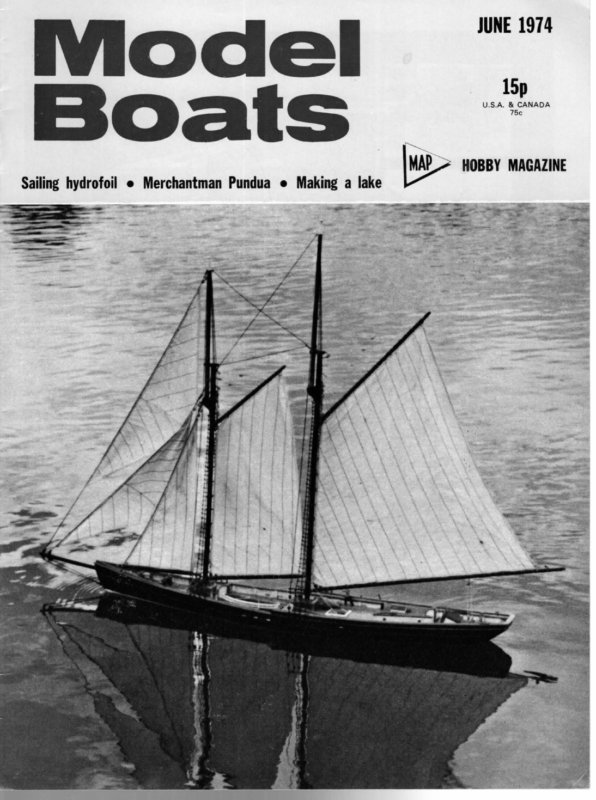
JUNE 1974 Boats Sailing hydrofoil e Merchantman Pundua e Making a lake ORO esis gakeeiew 15p 5c
JUNE Power Scene In the The absence of Philip Connolly’s articles, for which we apologise, is due to very bad luck on Philip’s part. Having arranged for all his models, radio, engines, etc., to be shipped out with some furniture, etc., he flew off to Australia in November. Now, in May, his shipped effects have only (hopefully) just Tideway left U.K. and will not arrive till June. This has left him unable to pursue half-completed projects, but he will be back in our pages as soon as possible. Skeletons in Your Cupboard? The New Zealand Model Marine Association newsletter Prop Shaft has an amusing paragraph in the current issue which gets down to the bones of club activities, four bones in fact. Wishbones, who spend all their time wishing someone else would do the work. een a who do all the talking but little else. Knucklebones, who anyone else tries to do. knock everything that Backbones, who get under the load and do the work. Which are you? On this basis, we suppose that most junior members are cheekbones, and the flash member with the beads is a hipbone? The one character that club officers appreciate is the one who grabs other members and gets them to help. The collarbone? Club Notes Manchester R.C.M.C.’s regatta at Heaton Park on June 30, will start at 11 a.m. with a speed steering event (3 mins. on a clover leaf course) no entries for which will be accepted after 11 a.m. It will be followed by multi-racing (34, 64, and 35cc, 5 or 10 min. heats depending on numbers) and entries for these races will close at 12 noon. M.P.B.A. rules on conduct apply, and noise and fuel rules will be enforced. Offshore races — Port Talbot Endurance June 2 and Offshore Aug. 18 (entries N. Morris, 17 Eagle St., Port Talbot, Glam.) Thames Estuary Offshore (Canvey Island) June 16 and Canvey Island Endurance Sept. 8 (entries A. Smith, Arkela, Thisselt Rd., Canvey Island, Essex). All events pre-entry. The Dovercourt 1800 30 min. multi race, Sept. 29, 1974 had all vacancies filled in mid-March; a waiting list has been opened in case of cancellations. Mid-Essex R/C Functional and Novelty regatta planned for Sept. 1 has had to be changed to Sept. 15. All other details as arranged. New City M.S. hydroplane regatta scheduled for July 7 has been withdrawn to avoid clashing with other regattas on that date. Scale sailing shipowners are reminded of two meetings, Thames Shiplovers on June 2 (Round Pond, Kensington Gardens) and Hove M.S.S. July 14 (Hove Lagoon). Dutch reader A. Ros of the Haagse Modelboat Club mentions that the Jason model which appeared on page 37 of our January issue, photographed at St, Albans, is his model, and it is in fact a fire monitor, not a tug as captioned. A Victoria member, A. Broad, 1a Church Road, Shortlands, Bromley, Kent, recently obtained from Christies a semi-scale T.B.D. named Spitfire, built in 1910, and attempts to trace the model’s origin have met with no success. If any readers have any recollection of this boat, Mr. Broad would like to hear from them. Stollery Strikes Again There was little doubt that the boat which caused ihe most stir at the Marblehead Team Champion- ships was Major B, sailed by Alex Austin (below). This was in effect the first public appearance of a boat to Roger Stollery’s Blood Axe design, and it certainly seems that Roger has once again pulled one out of the hat. On the first day of the Champs, Alex dropped three runs (from his own errors, he cheerfully admitted) and one beat, when the boat ran aground, and with this sort of potential, we should be hearing quite a bit more about this new design.
MODEL BOATS SAIL FOIL A simple but exciting little sailing hydrofoil which will certainly prove a crowd-puller By F. MACCLAY together. So over Christmas I plans for such a model as a detail of full-size hydrofoils. The hull is of a hard-chine covered by a layer of 1/32nd drew myself up some trial only, without the construction in balsa, ply; the same applies to the beam and floats, but these could be softwood instead. The foils are those used earlier, but modified to suit my own yacht design and lift required. The front foil has a 5° forward lift and is fixed to the hull, the rear foils are adjustable. I BEGAN taking an interest in hydrofoils some six months ago, not in sailing, but the possibility of a hydrofoil driven under electric power, and I had from _ the information obtained some detailed Amateur Yacht Research Society with regards to foil sections and characteristics. In this book, ‘Sailing Hydrofoils’, are letters, drawing, details, etc., of fullsize yachts with foils and foils as stabilisers. A hull 37 in. long was made, to be driven by an electric motor as a test bed for foils, and after some time spent in trials on different foil configurations I was satisfied that such a boat was possible, but the motor used was not of sufficient power to overcome the drag of the foils, together with the full weight of the boat, which was of the order of 5b. The problem was, therefore, to overcome the weight of the accumulators, which left me with the solution to design a boat without this equipment, i.e. Sail Towing tests were carried out, and found to be satisfactory with good stability, so work proceeded in the making of sails and mast, etc. for trial runs. At the lake, following more towing tests, the rear foils were adjusted to allow the front foil to lift first. Then it was a matter of waiting for the wind; when it did come, the boat moved forward and in doing so the front foil lifted the the rear foils increase their rear lifts. Once the hull is acceleration is unbelievable, hull clear. At this point angle of attack and the clear of the water, the by comparison with being hull-borne. Further runs were carried out to reduce the angle of attack and increase the ‘take-off’ speed; the rear foils at 2° lift were found satisfactory on this model. The foils are made from 4 in. thick ply, with a width of 14 in. The section of foil used is a flat underside with the top curved to an arc of a circle; care is needed in the work on the leading edges. The angle of inclination to the water is 40°, as seen from the front. The rear foils were glued and pinned to the main supports. Foil. The front foils could be used as a rudder by pivoting the main support vertically through the I must admit I knew very little about the sailing of yachts but thought of making a hull, sail and foils The model appears to travel best on reaching courses, or perhaps it’s easier to catch it with a camera then! Centre bottom picture shows a catamaran development. 206
JUNE 1974 SAIL FOIL EMoxclay. Model Moker ets 1s-s58rdge SORE neiSScomes as tom up most fo pont 20″ ‘Stay i { t This section mot yeqd bat vm for and, | 3″ rast 29″ eraline Boles MEE ym D2 Sore plen-VO” BG Be Same section V8″ Base wath 1/32″ ply. ‘i coverad Foila | \/2″ wide XS” i/g”thcinens age IE unt entencing Rae MR Front Foie moy be veed ce rudder, cA] 1 Full-size copies of this drawing, reference MM1185, are available price 40p including VAT and post from Model Maker Plans Service, P.O. Box 35, Hemel Hempstead, Herts HP1 1EE. Length is 25ins. hull, and linking to a servo. The lower extensions of the rear struts were left on the model for use as a stand, only, and should be removed or replaced. Under foil-borne conditions in a breeze the hull clears the water by approximately 2in., depending on the speed, and the height varies according to speed, but once foil-borne the wind required is less than that required for the ‘take-off’. Foil-borne speed was measured on one occasion at approx. 8ft./sec. Details can be seen on the drawing taken from the model after completion. JUNE REGATTAS 2. SR ORC 8/9 SR SP RC RC 8 9 SR RC 16 RC 16 RC 23 RC 23 23 Liverpool M.P.B.C. Walton Hall Park, 11.00 a.m. SR SR Stg. MR. Tyneside Two-Day: Saturday, Paddy Freemans Park, Heaton. SR and Nom. Sunday, Tynemouth Park. SR. Nom. SP, including Tynemouth Scale Trophy. Glasgow South S.S. Scale Demo: MR. Sheffield S.M.S. Crooks Valley Dam, 11.00 a.m. MR 24-min. le Mans. Pre-entry: M. Battison, 23 2 RC 9 RC 2 SR RC and over 6 c.c. MR if time. 2 MR (L. Fish Trophy). 8 (Sat.) RC Birkenhead M.Y.&P.B.C. Gautby Road, 11.00 a.m. NATIONAL RECORDS DAY. Witton Lakes, Bir- mingham. 9 Leeds M.B.C. Roundhay Park, 11.00 a.m. MR. Three classes. 30-min. heats. 30p per boat. Entry full. Cleethorpes M.P.B.C. Sidney Park, 11.00 a.m. SR. RC Edinburgh M.P.B.C. Stg. Sp. 0-24 ¢.c., 24-5 c.c., over POWER – MIDLANDS Red House Park, Birmingham, | 1.00 a.m. NATION- AL SPEED FINALS. Coventry R.C.C. Wyken Pool, 11.00 a.m. MR. 33 c.c. and over 34 c.c. 20p per event. Carnival Day Sponsored by Local Authority. Etherow M.B.C. Country Park, Compstall, Nr. Romiley, Cheshire. Electric, Steam and Sail only. Featherstone M.P.B.C. Purston Park, 11.00 a.m. SR. Stg. Special Award for electrics. Sp. up to 6 c.c. RC Manchester R.C.M.C. Heaton Park, 11.00 a.m. Stg. Sp. MR. Hobart Street, Sheffield. 9 16 POWER- NORTH 9 Stg. MR RC POWER-SOUTH Bromley M.P.B.C. Riverside Gardens, Orpington, 11.00 a.m. SR. Stg. R/C. Scale. (Scale to include hard chine and round bilge.) 20p. Welwyn Garden City S.M.E. Stanborough Lakes, 10.30 a.m. Scale and Functional. 25p all day. Stevenage M.A.&M.S. Fairland Valley Lakes, 10.00 a.m. MR. 3.5 c.c. Spark Ignition and Electric. PART SOUTHERN MR. ELIMINATORS. Watford M.M.C. Victoria Park, SR RC Knockout, Scale Stg. No fee. 11.00 a.m. Stg. Mid-Essex B.M. Doctor’s Pond, Gt. Dunmow, 1|1.00 a.m. Scale (all types). 20p all day. (Continued on page 209 ) S’ese: 207
MODEL BOATS A 54in. w.l|. 53.7Ib. design which won the last Australian ‘A’ Class Championship By D. V. Billing Photographs show Kia Kia in company with the Mar- blehead Turi, featured month. last Copies of the drawing below are available, reference MM1186, price 75p including Model Maker VAT and Plans post, Service, from P.O. Box 35, Hemel Hempstead, Herts HP1 1EE. Sheer and waterlines are half size, body plan and lead fullsize. vatory and were found over the year to have an average strength of 6-9m.p.h. and a maximum average of 20-23m.p.h With this in mind a boat to suit medium to light conditions was envisaged. As I did not want a heavyweight boat a displacement of 52-54 1b. was decided on, this to give a boat rpurs design was started just after the Australian attempt at the America’s Cup in 1971. I was bitten by the bug to design another boat to the A class rule. My first thought was to consider the conditions under which the boat would be sailing. The wind speeds were obtained from Sydney’s weather obser-— c Poe | Sie 82 8RT532 ae S528 Bede KIA-KIA_ ett eee LD (a)
JUNE of 54in. LWL and sail area around 1,600 sq.in. 1974 14 1b to displacement. Looking at previous designs and at photos of other yachts it was realised that to obtain a V sectioned The hull is balanced to the volumetric dispiacement method and tumblehome has been incorporated hull draft and maximum LWL beam on the mid A wedge shaped keel of all lead design and small lateral area was decided on, as with the fence on the hull, once the boat is moving a long keel of large lateral area will not be necessary. With a wedge shape, lead is taken to the bottom of the keel where it is required. The base of the keel is shaped slightly upwards towards the bow to prevent drag if the bow is pushed down when carrying a spinnaker. When constructing the boat, to balance the hull on the bow and a longer run aft you cannot keep maximum section. So maximum beam was placed at section 6 and maximum hull draft was placed at section 44. Also the LOA was made slightly shorter than average to reduce hull building weight. As the basic lines evolved it could be seen that the run would be fairly flat; would this create some – trouble with cross-flow from around the keel when the boat is well heeled going to windward? If the cross-flow could be made to flow back along the hull, a condition could be envisaged and likened to the hull sliding down the face of a wave and thus possibly increase boat speed. What could be done to do this, a fence or ventral spine between keel and rudder skeg? A fence line was started approximately 2in. below the hull at the keel and curved up to join the profile just before the waterline ending. Looking at the section view it could be seen a big increase in wetted area would be made, and this would be detrimental in light conditions. How could this space be filled in and still maintain its efficiency? Straight lines were drawn from each _ horizontal waterline to where the fence line bisected it. These lines were then projected up on to the other views and what a surprise, instead of giving a Vee section a soft reverse curve evolved. Was this the answer? When the hull is looked at, at say an angle of heel of 15°-20°, a gutter or channel effect can be seen from the keel root tapering out at the waterline ending. Will this prevent cross-flow and assist in windward performance? Only sailing will tell. Inci- dentally, this filling in under the hull adds approx. to give correct balance. correct waterline is often a tedious process, so a method of keel construction is used which I have employed for the past six years in the M and 10R classes. At the top of the lead a slot is cast along it to take a 3 in. thick ply tongue. This tongue is formed into the hull and is taken up to the deck beams, making a solidly locked construction which takes any twist action from the keel of the hull skin. When the hull is being balanced for its WL plane all fittings and mast are positioned; thus all-up weight can be taken and the keel weight can be corrected to give the desired overall design weight. With a pin through the lead and the ply tongue, correct WL balance can be obtained by moving the keel backward or forward if required. The sailplan has been kept to moderate proportions with actual lengths of foot of jib and mainsail being kept similar. This allows easier sail trimming when sailing under reaching conditions. I would appreciate any constructive remarks or comments from anyone who builds this boat as this is the only way that all good and bad features of a design can be evaluated. Hydroplanes in France Part Two By J. M. Piednoir The author cleaning up between his winning runs at Ceske. Relationship to Buddha is team-mates’ imagination, he says! His advice to beginners — B1 involves less mechanical work, and models are faster, A3 are harder to build but the engines are less temperamental. NHE most important point toward easy increased speed for our models was found by theoretical calculations. At first I had the idea that if the model is perfectly tangential to the circle when at speed, then it must have minimum drag (being an active aeromodeller, I am very aware of drag . .). This led me to try to calculate the angle the bridle should rake back to compensate for the curvature imposed on the line by the combination of aerodynamic drag and centrifugal force. The angle is fairly easily derived by calculation (see below). In the process I wanted to estimate the power used for moving the line, bridle, and model respectively. I was shocked to find the high drag of the line and bridle. The diameter of the latter being free (‘sufficiently strong’ says the rule book) I decided to go to as small as possible. The numbers tend to say that 1/100 mm. (one hundredth!) less on the bridle is good for 0.7 kilometre per hour (in B1). This was proved by a test made with my motor and propeller on Murov’s model which gave 206 km/h, the same as with his own motor and prop. The point is that his bridle is made of 0.5mm. cable and mine of 0.3 and 0.35mm. wire. My calculations predict a 14 km/h difference. A second proof was when Messrs Morin and Varlet changed their bridles from 1.6 mm. nylon cable to 0.6 mm. steel wire which gave them an 8-10 km/h increase (predicted 7 km/h). I should like to see the rules impose a minimum on the bridle diameter (same as main line would be fine) because if people realise what sort of advantage a small diameter is, we will see a lot of bridle breakage. I am an electronics engineer and my hobbies include 211
JUNE 197 1974 MARBLEHEAD NATIONAL TEAM CHAMPIONSHIP Witton Lakes, Birmingham April 13-14 Left, scene at the leeward end with Alex Austin and Harry Briggs about to start. Below, top two boats racing, winner Des Daly nearest camera. ae was conspicuous by its absence. At 10.00 a.m. on the Saturday the first pair were sent off by Mr. J. A. Lewis and hard, fast racing continued until approximately 1.00 p.m. when lunch was declared. A pattern was already evolving and the leader board read as follows:- Hove 47, Guildford 45, Bournville 44, Southampton 37, Clapham 36, Wickstead 35. When racing recommenced afier lunch the northeaster was still blowing as strong as at the start and the racing was as close and fast. By now, of course, the skippers had achieved their correct trim, but the occasional couple of degree shift in wind caught them and some guying was required to get over the line. An unevenaul aftc;noon was hau bv neariy everybody, and the leader board at the end of the day was as follows: :- Hove 83, Bournville 79, Southampton 75, Guildford 68, Norfolk 65. Clapham had slipped a little from lunchtime and was in at 59. ihe social gathering on the Saturday evening was attended by fifty or so skippers, mates, Birmingham club members and their respective families. It started at a local public house, from which, by courtesy of Max Bygraves’ ‘Singalongamax’ and a large coach it was clear that we were going to finish somewhat earlier than was expected, so a hasty phone call requested Mr. J. A. Lewis to come to the pondside for the prizegiving at 2.30 p.m. The Club wishes to thank all those who entered the championship and the officers who organised and ran it. 1974 MARBLEHEAD TEAM CHAMPIONSHIP Hamster Hove Bournville Foxtrot Uncle Shazzan Sweep 1831 D. Daly 1661 C. Colsell 1800 W. Dovey 1923 M. C. G. J. M. A. M. J. R. E. C. J. Harris Edmonson Wyeth Harrod Haines Austin Godfrey Hyde Seager Carter Holden Beattie Southampton Black Rabbit White Rabbit Blue Slipper Norfolk Eastern Promise Major B Guildford Boris the Bold Mindbender Clapham Aeolus Hiawatha Wickstead Mustard Pot || cae Birmingham Capella 1736 1538 1592 1868 1962 1959 1776 1811 1851 1920 1804 Dovercourt 1753 R. Cathmore 1917 C. Williams Cleethorpes Top Road Runner Sam Gamgee Wagwun Lady Luck Bilbo Baggins scorers:- D. Daly 66 . Austin 63 z> A STRONG north-east wind heralded the start of this year’s Team National being held at Bir44% mingham for the third time in its four-year existence, Ten teams came to the Midlands to do ‘battle’ for the somewhat unusual trophy. The clubs were mainly from the South, and the Northern District we were transported to a boatyard at some distance where the evening was to be continued in the club room. This room just happened to be floating and was originally a canal narrow boat fitted out with a bar. The intention was to potter down the Stratford on Avon canal for several miles turn round and potter back — drinking all the time! However, as the ‘driver’ was new to the game we had rather an eventful journey; going aground on several occasions was the least of the troubles! The evening finished off with another dose of ‘Singalongamax’ with Eric Carter and Dick Seager singing marvellously and leading the ‘choir’ in the singsong. Sunday was reasonably bright and sunny and uneventful. The wind had remained in the same direction and freshened a little. Sunglasses were put on early especially those with the ‘thick’ heads and everyone continued as they did on Saturday. With only six boards to do and the strength of the wind 213 Haines 62 1803 D. Knowles 1916 R 1794 H. Noble Briggs 66 121 55 59445 56 93444 58 43 495 62 63 oq 30 36 93 57 37 88 51 29 70 41 31 54 23 20 50 30 1 2 3 4 “=6 = =5 a 7 8 9 10
| MODEL BOATS MOONRAKER A two-part article on building the first all-British Marblehead kit, marketed for radio control by Nylet Ltd. A hus growth of interest in R/C yachting has brought the situation where for the first time a British manufacturer has taken the plunge and put on the market a kit for a Marblehead class yacht; in turn, the availability of a kit will increase activity and interest, so for all concerned this must be a beneficial situation. We are not forgetting that a couple of years ago Klug kits were imported from Germany, but these cost rather more than most people could reasonably afford — we have heard, incidentally, that the latest German M sells, ready to sail, at the equivalent of £450, which is beyond the average boater! Nylet Ltd. are offering their Moonraker as a basic kit for £33, plus an extra £1 for chromed instead of brass fittings if required, and a small amount extra for timber parts which some builders may have difficulty in obtaining locally. A de luxe kit containing these parts plus extra sails, etc., is offered at £45. Our review model was built from the basic kit, from, in fact, one of the first examples, and there have been a number of small improvements in later kits, notably in regard to fuller instructions and more detailed sketches, etc. Thus in going through the building procedure we may cover ground already adequately covered; on the other hand, those who have never tackled a yacht before may find a little amplification helpful. Much of the procedure applies to other glass hull shells as well, of course. The basic kit received contained glass hull and keel bulb halves, melamine deck, mast, booms, all fittings, wire and cord, etc., and finished sails. It is, by the way, available with the hull moulded in white or one of several colours. What was not included was timber for inwales, fin, and rudder; these items can now be included for a small extra charge. In some places it is possible to buy offcuts of $ and {in. marine ply and 48 in. lengths of + x +in. spruce, but if in doubt, our advice is to have them with the kit. The builder also supplies lead, in sheet or shot form, and adhesives, paint, etc. First steps are all straightforward, simply clamping a 48 in. length of + x }in. spruce inwale strip in place inside each side, using clothes pegs, bulldog clips, and the like, and adjusting the curve of the timber to a fair curve for the sheerline, ensuring that both sides are matched. This can best be achieved by resting straight scraps of thin wood across the spruce strips and checking that they are all parallel when viewed from ahead or astern. The top line is then pencilled in and the strips epoxied in place using the pencil line as a guide. Use of full-length strips is important; trying to get a fair curve with a joined length is not easy. When set, a second } x 4+ in. strip is epoxied to the first each side to make an inwale + x 3 in. A block is shaped to fit the bow; the instructions sug214 gest 3in. ply for this but a piece of 4in. hardwood is really adequate. Similarly a piece is cut to fit across the stern (in both cases large enough to connect the inwales) and these pieces are epoxied in. When set, the surplus hull shell is reduced to inwale level. Since this is about }+in. at the deepest point, we used a fine-tooth saw and then filed the remainder, finishing with glasspaper on a piece of 3in. wide timber long enough to span the hull. This rubs down the inwales and glass to a straight line athwartship to provide a fair seating for the deck. Use a fine file to take off any moulding flash along the hull centre-line and the hull is_ practically complete. Cut the ply fin to shape and plane and sand to a streamline section. To plane a flat piece of ply a bench holdfast is the ideal, but two G-cramps used to clamp the ply to the bench edge, with the area to be planed overhanging, is satisfactory, or you can clamp the ply between two lengths of say 1 x 1} in. batten, using screws ‘outside’ the ply, and grip the lower batten in a vice. Mark the fin position on the hull centre-line and cut the slot. G.r.p. can be easily cut with a broken fine-tooth hacksaw blade, and the cut can be started simply by scratching backwards and forwards with the end tooth of the broken blade. File to a reasonable fit for the fin, and epoxy the fin in place. Make sure that it is absolutely vertical. When dry, cut a centre deck beam about $ x jin. from ply or hard timber, such that the beam at that point will be 10} in. Epoxy this in place snug against the back edge of the tongue of the fin inside the hull and leave to set. We did not stick it to the fin at this point, but waited till the beam was firm, then introduced a smear of epoxy and drilled for a }in. brass screw through the beam into the fin, again checking fin alignment. Two further deck beams are epoxied in and a scrap of glass cloth resined or epoxied along each side of the fin/floor joint. Check that the beams and fin top are all flush with the inwales and the hull is ready to receive the deck. A piece of Formica type laminate is supplied roughly deck shaped, and a hatch outline is heavily scored on this. The hatch can be cut using the same broken hacksaw technique; presumably the size fits a particular make of seal-tight food box, but we could not find one exactly fitting. The nearest was an Addis box approx. 9 x Sin., about jin. longer than the marked hatch, which in fact allowed the corners to be radiused to a snug fit on the Addis box when enlarging the hatch. Now, eyebolts are positioned at the extremes of the deck for the forestay and backstay, and we suggest that the holes for these are marked and drilled
JUNE Opposite, the 1974 prototype Moonraker. Cross a Sailplane I! with a Typhoon and you would have quite a similar design. Right, fitting the inwales with the help of bulldog clips and clothes pegs. Far right, Nylet offer the fittings separately; stamp to them for list. Bottom, the hull and deck ready for joining. (on a centre-line drawn with reference to the hatch) in positions where the stem and stern blocks occur. The deck can then be temporarily and lightly screwed in place through these holes and a clamp fitted through the hatch on to the centre beam to hold the laminate down to the sheer curve. It is then easy to mark accurately the deck outline, remove, saw and file, replace, file, etc., to get an exact fit. Trying to shape the deck to the hull when it is glued on is likely to scratch the hull surface badly, especially towards the stern where there is a fair amount of tumblehome. Cutting and fitting the deck is the heaviest work in building the yacht; on the other hand, no painting or varnishing is needed with this material. Before fitting the deck, seal the wood parts with a couple of coats of paint or varnish, and bolt on the deck the fore and aft eyebolts, the jib rack, and the mast step. Offer the deck in place and mark where any of the protruding bolts come against woodwork (e.g. the rear mast step bolt and the fin top). Drill clearance for the bolts (and counter-drill for nut clearance) then epoxy the deck in position, using a slow epoxy and lots of rubber bands, etc. Short strips of Sellotape stretched over the gunwale joint at intervals help hold everything firm. When set clean up the joint with care. The rudder is cut and shaped from }in. ply and drilled for the brass rod provided, which is then epoxied in. Straight drilling is called for — ours was a 24in. deep hole and there is not much spare wood each side. A stub of tube is provided which fits inside the rudder tube and has to be carefully cut into two small pieces, to be soldered or epoxied inside the ends of the rudder tube once its length is correct. The tiller can be above deck or below; if the latter, it needs to be high in the hull to reduce seepage and the tube will need bracing with a block, etc., epoxied in. Obviously it would be better to sort this out be- fore fitting the deck. If the tube is to come through the deck, a long drill is needed to stand a reasonable chance of accuracy. It is better to drill a close-fitting hole in the hull and a larger one in the deck. A lin. square of deck material can then be drilled to fit over the top end of the tube and epoxied over the larger hole while the rudder is inserted and lined up carefully with the fin, as well as in profile. In this way accuracy is assured. Of course, you can try a straight-through hole first, and if it is out, enlarge the one in the deck to follow this method. In the kit are two half-shells in g.r.p. for the keel ballast. If these enclosed solid lead, the weight would be about 1141b. The instructions indicate that about 8 lb. of lead will be needed, in the form of chopped lead or lead shot, the exact weight being arrived at by weighing boat, rig, and radio and subtracting from the total displacement of 17 lb. The approximate weights suggested are boat 431b., radio complete 31b., rig 11b., bulb 81b., which totals 16}1b. We seem to have saved 3 1b. on the boat and the same on the radio, so we have squeezed 94 1b. of lead in the bulb and still come out at 1641b., giving a margin for heavier batteries if necessary. It is doubtful if much more lead than this could be jammed in the bulb without going to casting or having solid blocks which could be shaped to occupy most of the space. Actually, packing the shell halves is a bit fiddly having in mind that a neat close-fitting surface is needed in each half to mount to the fin. From experience, we advise sticking the lead bits as work proceeds, and long slivers pack in best. We recommend spreading the job over several evenings, both to spare the soreness from using tinsnips and also to allow the adhesive to set in the various layers. The de luxe way of doing it would perhaps be to epoxy the halves together, then shape the slot and epoxy the empty bulb to the fin. If the tip of the bulb — say the aft 2 in. — was then sawn off, alternate doses of polyester resin and pre-weighed lead shot could be poured in. Any spare space could be filled with a wood plug and/or Isopon. Whatever method is adopted, a couple of brass rods or long thin brass screws should be passed through holes drilled through shells and fin, as extra security. A touch of Isopon or similar filler is now needed to fill any spaces, where fin meets hull or bulb, and the fin and rudder can be painted. A rub over with car rubbing compound or metal polish, followed by waxing, completes the hull ready for fitting out and rigging. (To be continued)
i MODEL BOATS R/C YACHTING IN BRITAIN Now that radio yachts are ‘off the ground’ in Britain, M.Y.A. Radio Secretary Norman Hatfield feels that a look back is instructive. RA Class yachts at Poole a year or two ago, Poole was one of the pioneer clubs in the sport. ORE than a year has now elapsed since the M.Y.A., at its A.G.M. in November, 1972. adopted, in addition to the ‘Q’ Class (now ‘RA’), all the free sailing classes — 10 Rater, Marblehead, 6 Metre and 36 in. Restricted — for use with radio control. It may, therefore, be of interest to readers of Model Boats to learn something of the history of the development of radio control in model yachting in this country and also what progress has been made during the past year or so. As long ago as 1953, a report appeared in the February issue of the M.Y.A. News (No. 36) under the heading ‘Remote Control’ and I quote the following extract: ‘Since our last issue was published, we have learnt that two boats under R/C have successfully sailed a race at Poole round marks without coming to shore (vide “The Model Maker’). This may well be a landmark in British model yachting. The equipment used costs some £25 and controls only two, or possibly three, boats at a time, the suggestion being that clubs should buy communal sets, the receivers being transferred from each pair of boats to the next pair to race. It seems unlikely that R/C can become popular on these lines, or seriously compete with sailing in the normal and traditional way. Skippers (if we know them) will each want their own set with which to practise and tune-up and there are not many of them who can run to that price. We are assured that there is no other known system that will permit even two boats to race together; since there is only one wave-length allowed by law, with more transmitters signals meant for one boat would affect the others. Moreover, if it is impossible to have more than two or perhaps three boats on the water at once, it would take all day to sail a race with eight or nine entries and for three-quarters of the time each boat would be idle on the bank.’ Well, things have progressed much further since then, although it is still not practicable to sail more than six boats together. It was not long afterwards that various people started to put pressure on the M.Y.A. to adopt a new class or classes for R/C, together with a set of racing rules. During 1955 there was quite a lot of correspondence in the M.Y.A. News about this subject, sparked off by a long letter from one of the pioneers of R/C, Lt.-Col. C. E. Bowden. The late H. B. Tucker, a well-known designer, editor of the pre-war Marine Models and a prolific writer on model yachting mat22 2 ters, took up the subject and followed progress with keen interest until his death in 1961. Some enthusiastic members of the I.R.C.M.S. added their strength to the small group of pioneers at Poole and regular racing was organised at Poole, Gosport and at the Rick Pond, Hampton Court, for ‘A’ Class boats fitted with radio. Contrary to the opinion of many at the time, and since, for that matter, the M.Y.A. was not disinterested, but patiently followed developments from the side-lines and waited for some definite proposals before rushing headlong into something it did not fully understand. It became apparent that there was a considerable potential for R/C and the whole future of the M.Y.A. could be profoundly affected if it did not take the initiative. So, a representative from the the I.R.C.M.S., Mr. G. Carrington-Wood, was invited to attend Council Meetings and, eventually, in 1957 he and his colleagues produced a set of racing rules based on the R.Y.A. Racing Rules currently in force. These were ‘rubber stamped’ by the M.Y.A. and the cost of printing was shared between the two organisations. These rules were, in the main, the same as those used today, except that they have been amended twice to keep them in line with the R.Y.A. Rules. Mr. Charles Brazier, Vice-Commodore of the Gosport M.Y.C., produced a most useful appendix to the rules, which explained them in simple terms for the benefit of newcomers to the sport. An up-to-date version would, I am sure, be welcomed by many people coming into the sport or even by those who feel they would benefit from an expert’s interpretation. Having launched the rules, the M.Y.A. in 1959 then considered a proposal by Mr. H. E. Andrews to adopt a new rating rule for ‘A’ Class boats converted to radio control. This consisted of the second part of L.W.L. x S.A. _ 15 the ‘A’ Class formula: 1234/D The rule was aimed at preserving as much of the ‘A’ Class rule as possible, while simplifying the task of measurers and owners who were thinking of con- version. It was intended to rate boats which had, at some time, held a valid ‘A’ Class certificate. A new boat built to the rule had first to qualify for an ‘A’ Class certificate and be given an ‘A’ Class number. So, precisely how the objective of simplification was
JUNE supposed to be achieved is obscure, to say the least! The class was known as the‘Q’Class and the rule was adopted at the 1959 A.G.M. for a trial period of two years, pending the production and acceptance of an exclusive R/C class rule. Adoption of the ‘Q’ Class involved the institution of a National Championship, a trophy. a Registrar and Measurement Certificates incorporating the rating rules. At the 1961 A.G.M., the agenda contained proposals for the adoption of three R/C classes, ‘R’, ‘S’ and 5.5 Metre. These proposals were, however, withdrawn by the proposers, the Midland District Committee, as they had not had sufficient time to develop their ideas. So the arguments and counter-arguments about a new class or classes continued for another two years. Meanwhile, the ‘Q’ Class was given permanent ‘life’ and then, in February 1964, the Poole M.Y.C. proposed a new class which they called the ‘R’ Class. The rule was simple and contained the following restrictions: L.W.L. L.O.A. L.W.L. Beam Disp. Draught Actual Sail Area: Max. 50 in. Min. 46 in. Max. 65in. Min. 1.1 x L.W.L. Max. 12in. Min. 10.5 in. Max. 30 1b. Min. 22 1b. Max. 12 in. 50,000 EWE. The rule was adopted at the 1964 A.G.M., but only four boats were registered in 1965, all from Poole M.Y.C. and none have been built since. Why this class failed is a mystery. The measurements were reasonable, though the boat was too long to fit into the boot of most cars, and the rule allowed a fair scope for designers. I think the reason it failed was that it was introduced too early, in spite of the pressure to adopt it. The truth was that the number of people actively engaged in R/C model yachting throughout the country was very small indeed. The majority owned ‘Q’ Class boats at Poole, Gosport and Y.M.6m.0.A. and there were only about a couple of dozen anyway. The only other club with any R/C interest was Birmingham, where the number of enthusiasts was not more than half-a-dozen and there was no interest whatsoever North of the Midlands. The ‘Q’ Class owners obviously preferred their own boats, equipment was expensive, heavy and none too reliable, so after all the hullabaloo, it is hardly surprising that there were no takers for the ‘R’ Class. The demand for it had all been in the mind. Perhaps it would have stood a better chance of survival if it had been introduced in 1972 or 1973, although it is doubtful if the ‘R’ Class could ever have competed for popularity with the ‘M’ and 10 Rater Classes. From 1965 to 1971, there were no material developments, but during this six-year period there was a gradual improvement in radio gear. This was the dawn of miniaturisation, resulting in reduction of weight. Control was more positive and reliable and the standard of rigging and sailing greatly improved. Reliable equipment began to appear on the market at reasonable cost, although sail winches could not be obtained commercially, nor can they at the present time. At the 1971 A.G.M., Gosport M.Y.C. proposed alterations to the ‘Q’ Class Rating Rules, which abolished the necessity for boats to rate also as ‘A’ Class. Certain amendments were also made to the racing rules. January, 1972, marks the time from which it can really be said that R/C started to get on the move. 1974 At the International Boat Show at Earls Court, R/C model yachts were featured by Flotilla Models Ltd., a new and small company in the Midlands. They advertised to the effect that they were introducing the new sport of racing radio-controlled model yachts in Britain, which was a pretty bold claim to start with! At the Earls Court Pool, with the aid of a wind machine, they demonstrated three models imported from Germany and built by the firm of Klug. They were a 36 in. ‘K’ Class Bora, an ‘M’ Class Ghibli, and a 64in. ketch, Monsoon. Prices ranged from £55 for the 36in. kit to £248 for the ketch, with the ‘M’ Class Ghibli at £130, all less radio. They employed MacGregor 2-Channel R/C sets which, with transmitter, receiver, batteries, charger, rudder servo and crystals, retailed for £52. A Klug proportional sail winch was an extra £39, or £29 for progressive action. So, if you fancied the ‘M’, the total bill for a completed yacht was £221, which was far more than most people were prepared to pay. In fact, sales hardly materialised and with the Lom rise in German prices and the revaluation of the Deut- schmark against Sterling by over 20 per cent, the company was forced to cease trading. However, the sport gained valuable free publicity from this venture. The boats were well designed and finished, the gear was reliable, although the winch was not all it might have been. The demonstrations on the Pool were impressive and attracted great public interest, especially when the boats were raced by members of the British Olympic Yachting Team. The yachting press splashed it all in their columns and Yachts & Yachting stirred things up by ending their article with ill-informed comments on bad feeling between R/C and Vane enthusiasts, which was promptly repudiated by the M.Y.A. But since Flotilla Models claimed they were introducing a new sport, one could have assumed there were no R/C model yachtsmen in the country anyway, so how could there have been any animosity! As a direct result of all this publicity, the Sports Council showed interest in our activities for the first time and extended an invitation to the M.Y.A. to participate in the London Dinghy Exhibition at Crystal Palace the following March. Their idea was to carry out the same exercise by staging demonstrations on the swimming pool, but their plans were somewhat frustrated, because the fan that Flotilla Models had used was not available, so a static display was arranged instead. This was a very fine effort indeed and was well supported by local clubs. The amount of interest displayed by the general public was very encouraging. Many of them, of course, were knowledgeable dinghy sailors and yachtsmen and the M.Y.A. members who manned the stand throughout the weekend were kept busy answering intelligent questions. It was also during 1972 that we first heard of a proposed visit to this country by a party of American and Canadian model yachtsmen in 1974. The Metro Marine Modellers of Toronto had generously offered to the I.M.Y.R.U. a new cup known as the ‘Canada Cup’ for R/C competition in the 10 Rater Class. In 1970, a new body had been formed in America called ‘The American Model Yachting Association’, (A.M.Y.A.), which is in no way connected with the long-established ‘Model Yacht Racing Association of America’ (M.Y.R.A.A.), the one and only body in America recognised by the I.M.Y.R.U. The essential differences between the two Associations can be summarised as follows: the A.M.Y.A. is governed by 223
mn MODEL BOATS ‘Directors’ who are concerned with the marketing of model yachts built to American proprietary and onedesigns. Advertising and regatta sponsorship are accepted from the manufacturers. It is exclusively interested in promoting radio-controlled model yachts and does not appear very concerned with the age ing and building to open class rules from scratch. The objects of the M.Y.R.A.A., on the other hand, are to encourage the designing, building, free sailing and radio control of all the I.M.Y.R.U. Classes and its own National Classes and, unlike the A.M.Y.A., it has no vested interests. It seems unlikely that the two organisations will come together, at least in the foreseeable future. Each serves its own purpose and many American model yachtsmen are members of both Associations. The classes recognised by the A.M.Y.A. and the number of follows: yachts registered in each class are as Marblehead 50/800 (including the ‘Soling M’, a scaled down version of the I.M.Y.R.U. ‘Soling’ Class) Santa Barbara One-Design, which rates as a 10 Rater East Coast 12 Metre 36/600 10 Rater 45 Star Open Class Regatta One-Design West Coast 12 Metre ‘A’ Class *X’ Class Half-Metre 322 179 124 103 55 33 30 25 23 17 6 6 923 The statistics are as at the end of 1973, when the total membership of the A.M.Y.A. was 791. The organisation of the proposed visit to England was to be undertaken jointly by the A.M.Y.A. and the Canadian M.Y.A. It was not, however, until mid1973 that any firm proposals were received by the M.Y.A. After lengthy correspondence with the Chairman of the joint American and Canadian Regatta Committee, Mr. Dennis A. Eason, it was agreed that the visit should be postponed until August, 1975, when the venue will be Gosport. In the meantime, at the 1972 A.G.M. of t*e M.Y.A.. a motion by the Poole M.Y.C. that all cfficially recognised M.Y.A. classes be adopted as R/C classes was passed. It was agreed that the same rating rules would apply as for the free sailing classes and that yachts would carry the same class marks, except that they would be prefixed by the letter ‘R’. This new ruling implied that the ‘Q’ Class would become the ‘RA’ Class; it no longer uses its modified formula but instead boats have to conform to the full ‘A’ Class formula. So we had the long-desired break-through at last and with the M.Y.A. in full control of all free sail- ing and R/C Classes. Another important development in 1972 and 1973 was the rapid growth of a 42in. class, the Star C, promoted by Model Boats in December, 1971. The M.Y.A. was very aware of the fact that this little model was attracting many newcomers to radio control and it was therefore decided to start a register of owners. Each new owner wa: cent a cony of the M.Y.A. Address List, together with a duplicated sheet giving information about radio control. The object of the exercise was to recruit Star C 224 owners to clubs and to put them in touch with others living in the same locality, so that they might form a new club. Over 250 hulls have been sold and nearly half this number appear on the M.Y.A. register. As a direct result, one new club has been formed at Cardiff and one is in course of formation. However, in recent months, information has fallen off, either because not so many boats are being built or people have forgotten to send me the names and addresses of new owners. It was the intention, as soon as sufficient numbers justified it, to give the class M.Y.A. recognition, but when the matter was raised at the last M.Y.A. Council Meeting, Mr. Smeed, the Editor, said that he felt official recognition required careful thought now that both the 36in. Restricted and Marblehead Classes were recognised as R/C classes. Mr. Smeed reported that, to date, only 54 registered numbers have been issued by Model Boats. It would seem that few Star C owners are interested in racing but, on the other hand, quite a number of owners have progressed to the ‘M’ and 10 Rater Classes and no doubt the Star C will continue to be a good source of recruitment to the sport. The M.Y.A. has gained more valuable publicity from participation in the 1973 and 1974 London Dinghy Exhibitions at Crystal Palace. A fan was provided by the Sports Council in 1973 and demon- strations of racing round buoys were given by mixed classes on the diving pool on the first day. On the Sunday morning, four ‘RA’ Class gave some excellent demonstrations of racing on the main swimming pool before a very large crowd and a photograph appeared in the Daily Telegraph the following day. On the 23rd and 24th March this year, the Sports Council hired two fans but only managed to reserve one hour each day on the pool from 1-2 p.m. In spite of the short time available, eight Marbleheads from various clubs sailed a series of races. Four-boat races were attempted, but unfortunately some radio interference was experienced and the number of boats racing at any time had to be reduced to three. A number of well-known dinghy helmsmen were invited to take a turn at the controls, much to the amusement of the large crowd of onlookers and it was surprising how quickly they adapted themselves to racing the boats round a very restricted course. They experienced no difficulty in manoeuvring the boats at close quarters and demonstrated remarkable skill and quick thinking when tacking to round the marks. So enthusiastic were they, that it was suggested that an event might be organised especially for their benefit at a suitable venue later in the year and it is hoped that it may be possible to arrange this. Many inquiries were again made at the M.Y.A.’s static display, organised for the third year running by the M.Y.A. Publicity Officer, Roger Stollery. His stand with photographs and facts about the sport is a really fine effort and certainly an eye-catcher. The new ‘RM’ Moonraker, which is now being marketed by Nylet Ltd, was on display in both kit form with fittings and the finished boat. This is the second attempt on the part of a British company to massproduce a recognised class of R/C model yachts, only this time it is an all-British product, well designed and built, finished to a high standard and at a most reasonable price. This venture is to be highly commended and deserves every success. I understand that at least 25 boats have been sold already. If all goes well with the Moonraker, future plans will include the production of a 10 Rater and, later, an ‘RA’. The company also intend to market a radio
JUNE gear, complete with winch. While on the subject of Exhibitions, mention must also be made of the M.Y.A.’s participation for the first time in the Sports Council’s Welsh Dinghy Exhibition at Cardiff in November last, which was reported in the January issue of Model Boats. The M.Y.A. Stand was again the work of Roger Stollery, who also organised the R/C demonstrations. As a direct result of this Exhibition, the South Wales M.Y.C. was formed. Also in November, M.Y.A. clubs in the Midlands took part in the West Midlands Sports Counci] Exhibition with 15 boats on display and a continuous showing of colour slides of model yachting. Unfortunately, no fan was available to provide wind on the pool, so the windows were opened to let in the breeze from the M6! The latest development for R/C in the M.Y.A. is the formation of a Radio Control Committee, which was proposed by the New Forest R/C M.Y.C. at the A.G.M. last November. At its January meeting, the M.Y.A. Council decided that, for this year, the Committee should consist of four members plus the R/C Secretary, who would act as Chairman. Mr. M. A. Jackson of the Warrington Model Club was nomi- nated as one of the members and it was decided that the New Forest R/C M.Y.C. be invited to nominate another, which proved to be Mr. C. R. Jeffries. The remaining two vacancies were invited from the three clubs Gosport, Poole and Y.M.6m.O.A., and Mr. F. Walker and Mr. C. E. Brazier were nominated. The Committee met for the first time on the 16th March at the Polytechnic of Central London, Regent Street. Before dealing with items on the agenda, the Secretary reported upon the strength of R/C clubs and the R/C fleet. Figures provided by the respective Class Registrars showed that there are 30 ‘RA’, 35 ‘RM’ but, as yet, no registered R10 Raters. However, the register maintained by the Secretary indicated that there are considerably more boats in commission, spread over 20 clubs, of which two are not yet affiliated. It is therefore apparent that many owners are lax in not having their boats measured and registered. The known fleet consists of the 30 or more ‘RA’ Class mentioned above, plus 21 R10-R, 72 RM, 2 R36 and also 94 Star ‘C’ and 9 ‘Open’ Class. The first task of the Committee was to consider two motions on the A.G.M. agenda relating to R/C, which had been left in abeyance for the Committee to deal with. These motions, both proposed by the New Forest R/C M.Y.C., and their relative amendments concerned (a) the movement of transmitters and (b) the method of scoring. The New Forest Club had decided, after experience with allowing skippers to move about freely with their transmitters, to withdraw their motion. In the meantime, Poole M.Y.C. had proposed fresh amendments to the existing racing tules, which dealt more fully with transm‘tters and the method of scoring. These amendments were carefully considered by the Committee and unanimous agreement was reached in the form of a trial set of amendments that have been adopted for the coming season and they will be reviewed by the Committee in the light of experience in time for them to appear as firm proposals on the agenda of the 1974 A.G.M. If any club or individual requires a copy of the amendments, I should be pleased to send a copy on receipt of a s.a. envelope. My address is 26 Shanklin Drive, Westcliff-on-Sea, Essex SSO 9XU. Arrangements for the ‘Canada Cup’ and_ the ‘A.M.Y.A. Cup’ competitions at Gosport in 1975 were discussed in some detail. It is evident that entries for the ‘RM’ Class ‘A.M.Y.A. Cup’ will have to be 19 strictly limited in order to ensure that every competitor enjoys as much sailing time as possible in the two days allowed. The ‘Canada Cup’ for 10 Raters, however, is not likely to attract a large entry. The Committee then considered various other matters brought to their attention by the Secretary. In order to determine the policy of the M.Y.A. in the foreseeable future, the Committee’s view was sought as to the desirability of introducing a new Class. The Committee were unanimous in agreeing that the existing M.Y.A. Classes are perfectly adequate and that there is no necessity to introduce more, even on the grounds of allowing more development. It is felt that the 10 Rater Class already provides sufficient scope for this. The Secretary said that he had been requested to seek the Committee’s view in regard to a boat that could operate on only one frequency. It was agreed that this is adequately covered in the rules, where it is strongly recommended that all yachts should have a selection of three frequencies, that a minimum of two frequencies is expected and that, should a competitor have only one frequency and it is impossible to avoid a clash in a particular race, then he would be disqualified from that race. Apparently, such cases have occurred and competitors have accepted this ruling without protest. While on the subject of frequencies, Mr. Jeffries proposed that a joint application should be made by the M.Y.A., M.P.B.A. and S.M.A.E. to the G.P.O. for an additional channel, an extension of the 27 MHz band or one or two spot frequencies. Subsequent inquiries, however, have indicated that such an application would be firmly declined because other wavebands are already fully utilised, particularly by the Army, Police, Doctors, etc. There is no doubt that this poses quite a problem for the future; obviously with the increase in the number of R/C model boat and model aircraft enthusiasts, there is greater likelihood of interference. This problem has already arisen where model aircraft are operating in the vicinity of R/C sailing. Another problem is the rather wide divergence in the accuracy of some commercial transmitters and receivers, some makes being worse than others, with the result that interference can arise when a number of yachts attempt to sail together in a race. These are problems for the future and efforts will no doubt be made to solve them somehow. The Committee adopted as standard a set of Race Schedules that have been well thought out and carefully prepared by Mr. Frank Walker of Poole M.Y.C. The Schedules provide for six to 24 boat races and complete sets may be obtained from me of 7Sp per set, post free. Model yachting in this at a price country and, indeed, throughout the world, has been precluded from developing more than it has due to the lack of suitable sailing waters. Radio control, however, has opened up the possibility of using stretches of water that would not be suitable for free sailing. Mr. Jackson drew the attention of the Committee to the contents of paragraph 80 of the Water Resources Act, which deals with the provision of recreational facilities at reservoirs and other inland waters throughout Britain. He said that, with effect from the Ist April last, all inland water will come under the jurisdiction of various River Authorities and this may provide the opportunity for the opening up of suitable sailing waters that, hitherto, have been banned for model yachting. He is a member of the N.W. Regional Sports Council and hopes he may be able to influence proposals to ensure that more sailing waters will be 225
Ne ey MODEL BOATS made available in the future. He said that the N.W. Regional Sports Council, unlike the Central Office and to the few men who experimented to give us the equipment we enjoy using today. What the future holds for the Sport is, of course, uncertain. Much depends on whether or not it will have sufficient appeal to the younger generation, although it is fairly safe to assume that, even in the Space Age, people will still find relaxation in sailing, be it model or full-size. We shall no doubt continue to see an im- in London, recognises that model yachting is a Sport. If any club, or group of enthusiasts considering the formation of a club, experiences difficulties about obtaining permission to use a suitable water, they are advised to get in touch with me and I will convey their problem to Mr. Jackson, who may be able to help or give useful advice. This article has attempted to deal with the history provement in smaller and lighter, In conclusion, I hope that this article will provide useful information for newcomers to the Sport and bring others, already experienced, news of what the M.Y.A. is doing on their behalf. The M.Y.A. is ready and willing to serve the interests of all model yachtsmen, it only asks for their support and co- and development of Radio Control solely within the M.Y.A. and does not take into account the years prior to 1953, the commencement of my review, when much pioneering work was carried out by lone radio enthusiasts. This is apt to be forgotten because the history of their work has never been set down. Nevertheless, a tribute should be paid to this work S.S. RESOLUTE equipment, even more accurate and reliable. operation. By R. C. Plenty If you had holidayed on the Broads at any time from 1903 to 1968, you may have seen the Resolute, with her spindly funnel, laden with trippers for a day up the Bure or Yare from Yarmouth. You may still see her, for she is now at Brundall, shabby but not too decrepit, in the care of the Veteran Steamship Society, who hope to have her at work again soon. Above, drilling She was built in 1903 by Edwards of Millwall, London, and has been on the Norfolk and Suffolk rivers ever since. She is 73 ft. long and has a gross tonnage of 71; her most obvious characteristic is that she is double-ended, having a prow, a screw and a rudder at each end. Indeed she is practically symmetrical, there being a wheel and a telegraph at each end of the upper deck, Each wheel operates the rudder at the opposite end, the set of gear not in use being antique, awesome loo (not now usable, since the bye-laws forbid the discharge of raw sewage); one saloon has a bar, with a tea urn with its own steam supply from the boiler. It is the engine room that is the heart of the matter for me; it contains a fine compound condensing engine by Plentys of Newbury, the cylinders rah § 10 in. and 20 in. x 14 in. stroke. This takes steam at 120 lb. from the coal-fired Scotch boiler. There is a propeller shaft coupled to each end of the engine, and both propellers are driven at al] times that the ship is under way, there being no provision for disconnecting the leading one. There is also an attractive we think by Robey, with an a post and ws. pinned in mid position. The symmetry continues below deck, for the central engine room has a saloon either side of it, each with its steam generating set, framed vertical engine. deck plates with ratchet drill. Below, getting the generator engine aboard. open- Society members have done much already, mainly in the engine room and on the deck; the engines are basically sound and clean (though the odd knock may show up when we get it under steam): the boiler needs retubing, and new smokebox doors have been made but not fitted. Bad spots are being cut out of the deck and made good: planking has been lifted in places by rust and this has had to be removed and the steel beneath replaced. We work on her the first week-end of most months, and other week-ends, and would always welcome new faces, and hands. If anyone feels like joining us, write to Mr. Richard Castle, 8 High Stile, Dunmow, Essex. 226
JUNE 1974 On Sunday, March 10th a ‘sail in’ was organised by the M.D.C. to try and demonstrate to the management of the National Water Sports Centre, Holme Pierrepoint, that model yachting is a sport and not just a hobby. The idea for the ‘sail in’ had been generated at the M.D.C. A.G.M., which had been held at Holme Pierrepoint in February. Midland District Secretary Brian Bull sent posters and literature to all clubs who might be interested in supporting the event, and Mike Harris, the M.D.C. Coun- Sail-in at after the Editor had kindly slipped a few lines into Model Boats announcing the event. Maps and directions plenty of helm to keep her on the lee bank. After running down at a brisk walking pace for about 100 yards the wind suddenly veered and gusted. The 10R put her nose up and started to plane like Holme Pierrepoint By Mike cillor, suddenly had a boom in his “daily postal delivery were sent to all interested parties. It was interesting to note that many people who wrote a bullet. The author also then found how difficult it is to run in thigh waders. After about 200 metres of hard running it becomes hard to breathe and the effects of smoking are brought home. At one stage he thought of removing his waders and running in socks, but when he stopped to remove them the boat caught him up. Abandoning this ploy he ‘raced?’ on. At the other end comments of ‘fool’, ‘idiot’ and ‘If he doesn’t make it he’ll take it home in a bucket’ were passed. After negotiating the heaving pontoons he managed to field his boat by lying over the edge of a pontoon grabbing the boat with one hand and holding on with the other. After lying there for about five minutes in a state of collapse he recovered enough to send the boat off to windward. The wave formation was very curious, th waves were not very high but they were long. To windward a IOR could slip through the waves without too much disturbance but in the troughs she would be supported by water from bow to stern. Consequently speed through the water seemed very high all the time. It was also necessary to keep as close to the wind as possible because of a noticeable difference when two 10R’s sailed the lake to windward. Because of its greater width the higher boat was about 150 ft. farther up the lake on its turn than the 10R which had sailed slightly freer to get boat speed. in for details were ‘uncommitted’ model yachtsmen, i.e. not members of affiliated clubs. There was also a letter from the Leicester Model Yacht Club who are now applying for affiliation to the M.Y.A. This Club sails R/C ‘M’ Class of a variety of designs. Support was also promised from outside the C. from clubs in the Eastern, Southern and Northern districts. The ‘Watersports Centre consists of a 2000 metre Olympic rowing course, a water skiing course with slalom and a jump, an angling pool which was sponsored by Woolworths and a Country Park with Nature Trail Area. The administration block has a self-service restaurant, three bars and a smack bar. There are changing rooms and showers plus a training gymnasium for the super fit. The original idea was for the last 500 metres of the rowing course to be pontooned off, making a lake 500 metres by 150 metres, roughly twice the size of Fleetwood. When the M.D.C. meeting had been held, the wind had been an 11 knot westerly wind straight down the lake, perfect! But came the 10th March . The day dawned with snow not settling, but definitely snow, and to such wifely encouragement as ‘you must be stark raving mad’ the author and mate set off to rendezvous with Bournville Commodore Harold Dovey for the trip to Nottingham. On arrival at Holme Pierrepoint it was evident that conditions were slightly different from what they had been in February. It had stopped snowing but the 2000 metre lake was a mass of rollers and breaking waves. According to the anemometers on the weather tower the wind was 15 gusting 20 knots easterly and the forecast was 20 gusting 25 knots later in the day. The pontoons across the lake were pitching up and down about 4 ft. The gap had not been completely closed but it was promised to be done by 12 o’clock. The first arrivals had been Walter Grint of Norwich with a clubmate bringing with them 2 ‘M’ Class. The one boat was Walter’s modified bulb keel Foxtrot type Norfolk Lass and the other was a beautifully built Witty Kingfin. To have come to give the event support from such a distance deserves special mention. By 11 a.m. cars were rolling down the causeway to the bottom end of the lake in a steady stream. To sail down the course was impractical as the pontoon gap had still not been closed so it was decided to sail across the lake on a hard reaching course. First two hardy souls into the water were, on my left, from Bradford, weighing 12 lb.. 36R Pijama, a boat brilliantly painted in red, white and blue stripes, owner Tom Armour, and, on my right. from Bournville, weighing 11 lb., 36R Jagermeister, a boat designed, built and owned by Martin Dovey, both boats carrying minute sail area. The two 36R’s hammered across the lake, arriving at the other side slightly before their owners, they not realising how long it takes to run 200 metres in thigh waders. Having given the trim to the other sailors more boats were sailing in no time. At about 12.00 a.m. the weather became appalling, hard driving rain and a 20 knot easterly wind. Strangely it seemed to deter no-one, boats were still planing from side to side of the lake. About 20-30 yachts of all classes were sailing. At this time the writer had been practisine long guying to windward by walking his 10R Krakatoa down the course and beating back. On arriving at the windward end he had set his boat on a run giving Harris, Midiand District Councillor, tells something of the real frostbiter experienced. The Leicester R/C contingent had some very well built R.M.’s with them, to the M.B. Plan Service Sailplane design, and one much modified China Boy, which was very quick. The rigging on the radio boats was very simple and no one seemed to be too overpowered in the hard winds. The Leicester club members are keen to obtain the use of a two-part hull moulding for a Stollery type ‘M’ Class design. If anyone can help they would be pleased to hear from them. At about 1.00 p.m. a 50 metre section of the dividing pontoon broke from its anchors in the bed of the lake due to the wind strength, so it was impossible to sai! down the full 500 metres course. This deterred no one and boats of all classes continued to sail. In fact there were only two collisions between yachts all day, and of those only one pair stayed locked together. John Beatty of the Birmingham Club went out in a rubber boat to part them, only discovering whilst under way that the inflatable had not been blown up quite hard enough. He returned to the beach somewhat wetter than when he left it. Altogether 47 yachts of all Classes attended the ‘sail in’, which was very gratifying for the M.D.C. To receive support for the event from people who were prepared to travel and sail in terrible weather was tremendous. The British Canoe Squad were at Holme Pierrepoint on a training weekend. Not one canoe touched the water on the Sunday of the ‘sail in’. It was too rough. No wonder we are also-rans at Olympic levels of canoeing. There were 13 clubs represented on the 10th March and it is hoped to try and run another ‘sail in’ in the summer with, it is hoped, better weather conditions. If the Sports Council can be persuaded to provide a facility for model yachting at Holme Pierrepoint on a permanent basis (and there is land and water which could be utilised) the sport of model yachting will take a big step forward. Finally to all those who attended on the 10th, thanks, you are the enthusiasts of which a sport is made. 227
mI MODEL BOATS GENIE Part 6 of Vic Smeed’s ultra-simple Marblehead class yacht for vane or radio-control sailing. Drawings for this 50 in. model are all full-size (except sail plan) and show all construction detail and fittings. Full-size copies (two sheets) available, MM1175, price £1.10 including V.A.T. and post, from Model Maker Plans Service, P.O. Box 35, Bridge Street, Hemel Hempstead, Herts HP1 1EE. ‘HE yacht is now at a stage where it can be rigged up for the first time, whereupon its size, which you’ve grown used to while working on the hull, will make a fresh impact on you, especially if you try to carry it round indoors while fully rigged! Slide the mast through the deck slide and engage its heel on the mast step. Measure the distance from the bow and adjust to match the drawing; where the mast position is shown as proved just about right on the prototype. Adjust the engagement in the step until the mast is vertical (compare with the after edge of the fin) and does not lean forward or aft. Tie a length of rigging cord, about 4ft., to the backstay eyes, i.e. one end to each eye, and fit the working rig topmast to the mast. Make up several little hooks from stainless wire, 18 or 20g. Slip one over the free end of the cord on the spool, then tie a second to the end. Hook this into the after hole of the jumper strut, and hook the free-sliding one into the 4ft. length already secured to the boat. Double the spool back and cut off with about a foot of cord doubled back; unhook and fit a bowsie to the main cord and make the double end off to the bowsie, with the sliding hook in the loop. Replace on the boat and slide the bowsie to take up the slack. The doubled length of about a foot allows for the longer topmast of the high rig (an extra 14in. requiring 7in. on the doubled bit) and the stay can be taken up enough to fit the masthead direct to the mast for using a small suit. For radio a single eye at the stern will allow a one-piece backstay with enough doubled to meet the requirements, and this is in effect what is used for a forestay on either version. With both fore and backstay fitted the bowsies can be hove reasonably taut and the verticality of the mast checked again. Next come the shrouds, of about 22-24g. stainless wire. Make a small loop at the top end and bend the free end back round the wire in a loop. Drop over the shroud attachment at the mast top, extend a turnbuckle or bottle-screw to about } length, hook in after hole of chainplate and cut and make off shroud. after checking that mast is vertical when holes but tightly enough not to disengage itself if the sail flaps. For other fittings, the types of hook needed at tack and clew should be self-evident. Now a kicking strap is needed, to stop the boom lifting more than a controlled amount. This can be cord and bowsie, but a wire adjusted by a turn- buckle is much more reliable. The lower end hooks into an eye on the mast immediately above the slide; the upper end can be hooked into a hole in the underside of the boom, or more conveniently attached permanently to an eye or V-hook secured to the boom. For transport with a ‘permanent’ gooseneck, the kicking strap can be unhooked and the boom folded up to the mast, secured with a rubber band. With the fitting shown on the drawing, the boom is simply detached — provided you check that you have it with you when setting out for the lake, this is convenient. i ml! a wiewed from ahead or astern. Repeat for opposite shroud. Now when the turnbuckles are tightened the whole mast will be fully braced, and you should able to sack the turnbuckles off enough to unshrowds. Mark the port shroud with a dab headboard of the sail. Slip the mainboom in place and hook the sail to the jumper strut and tack hook. The sail clew (aft corner) needs a hook permanently fitted which will engage in one of the holes in the boom end, loosely enough to make it easy to change Similarly, the jib boom drawn is detachable, the sail tack hooking to a wire eye (or hook) on the front of the post. This eye also receives the hook of the jibstay, which is a bowsied cord the top end of which hooks into a hole drilled in the foreside of the mast immediately below the shroud attachment. The luff (front edge) of the sail hooks to this (with small dressmakers’ hooks) but an alternative is to have the stay threaded through the hem on the sail luff. In this case a bowsie is fitted to the My so that you always replace it on the { tEiel red giterastive to turmbuckles. to save expense gessitle te ese megime cord with a bowsie and Gee Gee eto three oF four inches of each feet Gs is ose wery much second best # _ees = { a* | = Gee Gtiees acess oo the plan. make up bees’ coed and book which anchors the bodies commer} of the maumsail and atmuker cord we bowsie and book. to the top of the stay. 228
JUNE In either case, a short bowsied cord is fitted to the eyelet in the head of the jib, and this is hooked into the ring of the top stay hook. It could go into another hole drilled in the mast just a fraction below that for the stay hook, but it is just as easy to use the ring of the one hook. It is essential when sailing that the jibstay is set up absolutely taut and that the jib luff is also taut. When sailing the prototype Genie recently we knocked the masthead on an overhanging branch; this sprung the mast and caused the backstay bowsie to jump enough to slacken it. Unnoticed, (careless!) the effect was to allow the mast to bow forward slightly and slacken the jibstay, and the boat wandered off, never really getting sail- ing and swinging 40 or more degrees off course. On retrieval and setting things up tight, sailing was restored. So we have the jibstay hooked to the post eye and the mast, the jib tack hooked to the post and its head hooked in the top jibstay hook. The clew is hooked, as the main, through one of the holes in the free end of the boom, and is adjusted by moving the hook to other holes to match the mainsail. The lighter the wind, the more flow needed in the sails, i.e. the clew hooks are moved forward as the wind drops and aft as it strengthens. The Roberts jib fitting (used on the prototype to save time) differs in that the post is separate from the pivot and both are adjustable fore and aft. Thus the jibstay and jib tack hook to the post, and the boom, attached to the pivot, can be moved to adjust sail flow. Having the boom pivot an inch or two behind the tack alters the geometry for synchronous sheeting, so that if this fitting is used, it is essential to check boom angles for any initial trim. The difference in angle of the sail feet is not likely to be very noticeable with the small movement of the single main bowsie in a retrim, provided the sails are parallel when first trimmed. As with the main boom, a kicking strap is required; because of the low height of the tack end .and the angle of the boom, it is mechanically less at an advantage, but it can still prevent the boom from lifting without introducing friction. In order to be able to remove the whole of the rig for transport, the sheets must be detachable or it will be impossible to take off the booms. The sheets on the booms, therefore, terminate in hooks which engage in small rings tied to the ends of the sheeting lines on the deck, whether R/C or vane. Even with synchronous sheeting, it is this cord slides the main bowsie, which is basically a ring bowsie but is normally large and easily grasped; plastic screw caps from a variety of containers are usually used, and a thick-walled one will give easier locking. That on the prototype is the cap from a 140z. tube of duplicator ink. Three 1/16in. holes are needed, drilled radially, two at about 90° to each other to fit on the jackline and the third about 90° further — the tension on a ring should always be ‘over-centre’ in order to lever the bowsie round for maximum grip on the jackline. Into the third hole go two lengths of cord (or the doubled end of a long length) to be knotted securely inside. The free ends pass towards the stern, turn through an eye, and thence forward to the centrally mounted sheeting eyes, one to the main and one to the jib. A tiny wire ring, or stainless key ring, now has to be knotted on to each end, and the set-up should be such that with the main bowsie hard forward, each wire ring is hard against its sheeting eye. It is possible to tie the rings off reasonable accurately, or re-knot inside the bowsie if necessary — in any event, the boom bowsies will adjust for any small discrepancy. Hook the boom sheets to the main sheet rings: their length should be such that the booms are held virtually central or with only a degree or two of swing with the main bowsie forward. Tip the model bow down, or take it out into the breeze, and check what happens when the main bowsie is slid rearwards. The sails should ease out, remaining parallel, till the main boom touches the shroud on one side. For a radio boat, the sail winch does the job of the main bowsie, but otherwise the arrangement is identical. We now only need the vane gear (or radio installation) and the boat is ready to sail, so we will discuss these next month. Incidentally, several reports have reached us of builders sailing Genies and delighted, possibly even slightly surprised, at the performance. One had a little trouble over official measurement, because of the built-in bumper; the rules state that in effect the bumper must overhang, so be sure that your waterline is exactly as per drawing, i.e. no further forward than shown, at the bow. The stern is not really so critical. necessary to have at least one of the sheets adjustable on its boom, so that the relationship between the two booms may be varied. It is in fact easier to have both sheet attachment points movable, so each boom requires a jackline, which is a bowsied cord, beneath each. It is necessary to use a bowsie so that the jackline can be kept tight, otherwise the ring bowsie which moves along the jackline will slip. To the ring bowsie is attached the end of the sheet, and this can either go direct to the ring on the deckline or passed through an eye on the boom. The eye on each boom must be the same distance from its appropriate pivot point or movement of the main line will not produce equal movement of the booms, hence the remark on geometry earlier. Fitting the ring bowsie between an eye and the pivot means that load is imposed parallel with the jackline, giving the maximum locking action to the ring bowsie. Turning to the ‘deck end’ of the main sheeting system, a bowsied cord is run fore and aft and on 1974 Lower part of port shroud with turn- buckle (leftand right-hand threads). Note hook passed inward for safety In collisions, etc. 229