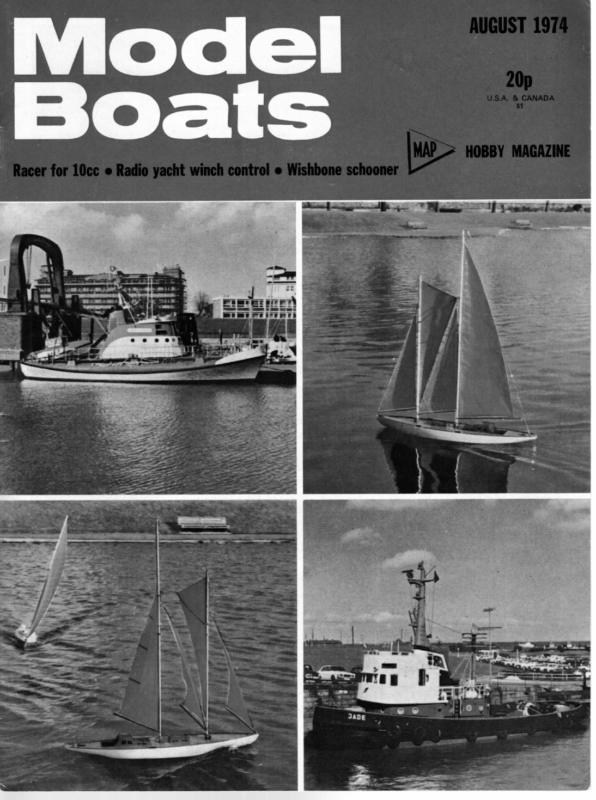
- Wishbone schooner Argus A 55 in. R/C model enlarged and modified from plan MM405 By B. P. FLYNN of Co. Dublin
- INTRODUCING…
- 1974 MODEL MAKER TROPHY Hove, June 8/9 Rain and very variable winds did not detract from a very enjoyable race Reported by the O.0.D. Roger Stollery who also took the pictures
- LIGHTFOOT A 57 in. w.l|. 43.9 Ib. ‘A’ class design by G. K. Collyer (Accompanying notes based on correspondence over the past months with the designer)
- GENIE Part 8. We don’t usually write up a boat which came over halfway down in a race, but builders may learn something!
- 1974 10-rater Championships Fleetwood, May 25-27 Report compiled from notes by 0O.O.D. Derek Priestley with additions by Joyce Roberts.
- Round the Regattas

Wishbone schooner Argus A 55 in. R/C model enlarged and modified from plan MM405 By B. P. FLYNN of Co. Dublin HIS model is Argus, a wishbone schooner scaled up from H. E. Andrew’s plan as published by M.A.P. The plan was modified slightly to facilitate the installation of radio gear. The modifications are as follows: 1. The plan was redrawn to increase the overall length from 30 inches to 50 inches. 2. The spacings between sections were stretched out to give a final l.o.a. of 55 inches. si fo sail plan was ‘blown up’ to accommodate the new .0.a. 4. The underwater sections were modified to take a bulb and fin instead of the original full keel. This was done to obtain more windward power and thus avoid the necessity to take off sail in rising wind conditions. 5. A prognathous bulb with a fin raked aft from bulb to garboard was debated and finally decided upon when 10-raters with similar arrangements came upon the scene (Mr. John Lewis has a lot more courage than this writer!). Schooner sail plans result in a tendency to head up in irons when used with bulb and fin arrangements. However, a fin as described above moves the centre of lateral resistance aft to counteract this tendency. Construction was straightforward after these changes, using the traditional plank-on-frame method. The writer is an unrepentant belt-and-braces builder and the result was a rather heavy craft of 15 Ib., including all fittings, radio, batteries, winch (a diabolical collection of gears and microswitches), masts, etc. The new calculated displacement was almost 37 lb. and a 22-lb bulb was cast accordingly. The bulb was finally screwed in place after ‘tank trials’ in the bath, by kind permission of the writer’s wife. The schooner now draws almost 14 inches of water as against 7 or 8 inches on the scale plan and this results in a tremendous increase in windward power. Sailing is straightforward. Synchronous sheeting is em- ployed by attaching three of the four sheets to a single endless cable on the winch drum which is housed in the main cabin. The cable is fed out through a hole in the cabin bulkhead just above the deckline and around a pulley at the bow and back down to the winch drum. The main sheet is attached to a separate cable which winds onto a section of the drum of proportionately larger diameter. This latter cable is fed out aft of the main cabin and around a pulley in the stern and back to the winch drum. Thus, all sails are controlled by one channel and the system works surprisingly well when you consider that the wishbone sheet has to run all the way down the main mast to the cable without snagging anywhere. The schooner is fast, very closewinded and responsive to the helm and has a very realistic appearance as can be seen from the photographs. There is plenty of power available and it has not been necessary as yet to take off any sail. There is still a slight tendency to head up to wind in heavy conditions and the yacht would probably benefit from a larger jib on a bowsprit. All in all the conversion to a larger size with radio control has been well worth while and Mr. Andrew’s beautiful plan is to be recommended to anyone who would like something a little different from the conventional Marblehead, for weekend sailing. As a word of advice, all fittings and rigging should be kept very simple as it takes time to prepare and rig this model at the water’s edge. Photographs on this opposite, page and as well as on our cover, show what an attractive model has Mr. from resulted Flynn’s work. The proper flow or either side. curve wishbone is the spar _ which double holds in position the clew of the ‘upside down’ sail and allows the sail to adopt its
1974 AUGUST INTRODUCING… PLN HIS is a new feature which we hope will appeal to readers who are often curious about the men (or even women) behind the names. We hope to deal each month with two people — competitors, officials, contributors, etc. — whose names crop up from time to time on the model scene. There was reluctance to be the first featured, but the Editor’s decision is final! It will take some time to get round to everyone, and the order of appearance has no significance. If readers like to suggest people for future inclusion, well and good, we’ll do our best, but if you feel you should be asked and haven’t yet been, have patience — there is no point in our carrying two or three years’ stock. Note that the Editor feels at liberty to add bits overlooked by subjects, and he writes the notes, so it isn’t a big brag by the subject! JOHN CUNDELL lives in Strood, Kent, with his wife Judith and 5-year-old son David, both no strangers to regattas. In his 30s, he is a project engineer at Imperial Paper Mills, Gravesend, part of Reed International. Prior to 1966 he worked in the Research & Development Dept. of Reed at Aylesford Paper Mills, and started modelling in 1959 with Reed M.E.C., his first interests being controlline and single-channel radio aircraft and 1/32 rail and slot cars. In 1960 he built his first boat, an E.D. Hunter- powered Moonglow, a sort of glass flattie with a cabin cruiser top, fitted with Triang S/C radio. Helping in the formation of the Cygnets Club in 1961, he was assistant secretary 1963-7 and has been secretary since *67; he is Competition Secretary of the M.P.B.A. and a member of the International Sub-Committee and is currently laying the groundwork for the F classes at the 1975 Naviga Championships, in England. Having wona first major modelling success as Southern Area Slot Car Champion in 1960, John spent about five years in the wilderness on boats, his success in this field not starting till 1966, since when he has achieved an impressive 145 places in competitions. R/C Steering was the main interest 1966-72, but for the past couple of years he has concentrated more on multi-racing. Represented England in F3V in Bulgaria 69 and Ostend °71, and in F3V and FSR15 in Czechoslovakia in ’73; will be one of our team in the World MR Championship, classes B & C, at Keighley in August. In national events, was 3rd in 1968 R/C steering, Ist in 69, 2nd in ’70, and Ist in’72, and also won the Model Boats Pairs Trophy in ’68. Other activities include photography, reading, wine and beer making, and writing a bi-monthly column in sister magazine RCM which has broadened his interests to all types of R/C boats, including electric and scale. £4 : MIKE HARRIS (he prefers ‘Mike’ to ‘Mick’) is a systems co-ordinator in an engineering concern — basically O & M and trouble-shooting for the directors — having tried life as a shipwright, unqualified teacher, full-time youth worker, and production and planning engineer in a fork-lift truck firm. He lives in Birmingham, and his wife, Janet, and 18-month-old son are regularly seen at sailing meetings. Mike is in his early 30s and past activities include badminton, music (from way out to way up — he used to play bass guitar in a pop group he ran), racing in 505s and a Thai Mk. IV catamaran, and building dinghies. He started modelling in 1956 and his first yacht was a pre-war Turner A boat; he belongs to Bournville, Birmingham, and Ym6 clubs. Competition successes have been numerous — in the top six of the A Championships since 1971, winner of 10R championships three times, including ’73 and °74, twice 6m championships winner and three consecutive 36R championships. MM Trophy 1972, all Midland District events over the past six years, Northern District A Class °74, and Birkenhead Parks Cup (As) °72 and ’73. He is Midland District Councillor in the M.Y.A. and secretary of Bournville M.Y.P.B.C. Between sailing (and he is one of the keenest skippers in the country) Mike dabbles with stereo, thinks about R/C, tries to keep his house from falling down, is establishing a tape link with Durban M.Y.C., and keeps an exchange of ideas flowing with what he terms ‘Cracker International’ at Leeds. He dislikes people who accept logical advice and do the opposite, M.Y.A. critics who do not realise they are the M.Y.A., Cracker critics, and yachts in clubhouses with dust on their decks. Likes include: wife, son (especially trying a 1 lb. hammer), friends, wind of almost any strength, beer, and good food. One day would like to write a book, not necessarily on model yachting. . . . 313
1974 MODEL MAKER TROPHY Hove, June 8/9 Rain and very variable winds did not detract from a very enjoyable race Reported by the O.0.D. Roger Stollery who also took the pictures WENTY boats started this race in 15-20 m.p.h. SW-W wind which gives a run and beat on the Lagoon. The weather was overcast with heavy rain and one boat had to drop out as its deck-stepped mast had bent beyond repair; another did not come to the line. The first board was sailed very tentatively with only a few spinnakers flying and most skippers found themselves with too much sail in the increasing wind. So began a pattern that would continue throughout the race and slow the racing right down, for no sooner had they changed down than the wind lightened to a top suit breeze and veered to NW, giving one long starboard tack, and many boats were bobbing lifelessly around in their 3rd and 4th suits. Then the wind steadied to 2nd suit, the sun came out and the race really started getting under way. By mid-afternoon the racing was very even with the less experienced settling down to the conditions. Twelve out of the 18 heats were completed on the Saturday and Dick Seager had taken the lead by dropping only two points; Alex Austin had the same score of 48 but had had only one bye, then came Tony Gill with 41, and Desmond Daly and Harold Dovey with 36 each. Sunday started hopefully in bright sunshine and a top or 2nd suit breeze, now from NW, giving a long leg beat Above, left, from Dovercourt came Doug Pratt with his Pterodacty! de- sign Allegro. bove, right, John _ Buttigieg journeyed over from the Isle of Wight with his 16 Ib. Exocet, here moving nicely downwind. Left, two views of Major B, the winner, on the far left with a very nicely shaped ‘big bag’ up and, near left, in view of the just-visible (Greek influenced?) decor, eyes down for a 3. 314
AUGUST Two shka, views of 19374 Varoom- travelling well downwind and demonstrating an excellent windward trim. Below left, Harold Dovey showing the proper way to stand for tacking with a pole; note how far ahead of the boat his feet are positioned. Below right, second-place boat Aeolus about to take 3 points from Hipster. on starboard tack. It did not take long for clouds to take over most of the sky and the wind began swinging continuously, making skippers change the spinnaker boom from one side to the other and then back. Progress was slow as this indecision about the correct gybe did not help anyone. Nor did the change in strength, as it lightened so much that tall rigs appeared, only to overpower the boats just before lunch. The speed at which the wind changed caught one boat of a resailing pair in a tall rig when it should have been in 2nd suit. At lunch the wind strengthened to 15-25 m.p.h., and all the boats were back in 3rd suit. Some spectacular runs were done by the experts: Des Daly clocked 68 secs. over the 200-yard course with a beautifully-judged run. However, for the next heat the wind had dropped to a light breeze and everyone was bobbing slowly around again, so a further break was necessary for the change to a tall rig wind which held in strength but varied in direction constantly until the end. At the end, two resails decided the first four places. Des Daly beat Tony Gill downwind to gain 3rd place with 68 points. Dick Seager and Alex Austin had 72 points each and the result of the downwind resail would decide the race. The wind was very light and dropping all the time and swinging between reach and run. Spinnakers were abandoned after two further resails, as the wind had come abeam. As they set off a third time the wind swung immediately aft and the two boats with considerably different trims went to opposite banks. At halfway Dick was ahead on the weather bank and with a good breeze from behind: Alex, in the best position, came ashore first just beyond the bay, made two retrims and crossed the line just ahead of Dick, to the applause of lightning, a clap of thunder, and cheers from the crowd. One thing that everyone learned was the shortcoming of their gear and rigging. Dave Warren turned up with an interesting shaped boat made by cutting and sewing sheets of plywood but rigged it with a substantial 3-inch dural deck-stepped mast which collapsed in the first strong gusts and forced him to retire. Kai Ipsen broke three such masts in the stronger winds of the ‘A’ champs. last year, so perhaps this will be a warning to any others contemplating a deck-stepped mast. The fact that it is done in full-size sailing doesn’t mean it is any good. A lot of time was spent fiddling with rigging and particularly spinnaker gear and it is hoped that many will have gone away to devise more simply adjusted systems and rigging that can be operated more quickly. One cannot alter the frustration of a changing wind, but one can change one’s ability to react to it. One other point of handling that quite a few skippers have not yet grasped is turning by pole. The common fault was to stand too far behind the boat as it came in and to stab it round in a most awkward fashion. If one stands far enough ahead of the boat and follows up by bending the knees as it leaves the pole then the boat practically turns itself. What about the boats? Well, Tony Gill’s boat was probably the fastest there. It is a most interesting boat of 315
MODEL BOATS his own design, being only 9 inches beam and fine ended and now weighing only 14 lb. While it appeared to carry its sail well for that weight it did suffer from being slightly off wind when the wind died and this lost Tony his two beats. Downwind it was very slippery and capable of beating all except those who could push their boats harder. Dick Seager’s Aeolus never ceases to amaze me downwind as it is a powerful boat around 18 lb. and 10-inch beam and goes very well indeed. It is a warped plane design that the late Uffa Fox would have liked, where the flattest section is on the transom. To windward it is very consistent and performs as one would expect of a boat of this stability. Alex Austin’s Major B has been well enough described in the June Model Boats, but few know that both the boats described above were an influence on its design. It showed great potential downwind, particularly in waves, as the high bow and big flare allow it to be driven very hard. To windward it maintained consistency well overpressed and under canvassed to lose only one beat (to Tony Gill). Alex must be congratulated because all the top boats were very good and it was a question of who was going to make least mistakes. It is a creditable achievement to get 87 per cent in such company when you are only 17 years old. Perhaps Vic could tell us whether this is a record? (Yes, for the MM Trophy, almost certainly for a post-war major race — Ed.) Des Daly’s performance downwind must be included because throughout the race Des pressed his boat to the limit to lose only one run (to Dick Seager). Des’ 16-Ib. Hamster is a flyer downwind but Des’ technique and skill donwwind is well worth watching. I must mention Vic Smeed’s Genie for several reasons. Firstly because Vic has continuously under-written this design in his recent articles. I think it is the best boat that he has designed and it is worthy of note not just because of its novel construction. At this race it went very fast indeed downwind and could be pressed quite hard. To windward once or twice it showed the ability to beat its round bilged rivals and I am sure Vic would agree that the fact that Genie was not placed higher is to do with his inexperience as a skipper and a slight technical hitch with his vane gear. NORTHERN ELECTRICS (from opposite page) the motor is supposed to be 6 volts at each end, his firstround score being 33.5 secs. The afternoon heats saw an improvement on my first by 1/5th sec. to record a best of 32.6 secs. Ken’s second heat was most spectacular, as in one jump his boat leaped ahead, dived, surfaced and then developed a mind of its own with Ken trying his best to control it, finally being brought home with slower times. To finalise, I think the times were slow compared with the more established electric men owing to, perhaps, inexperience with all-out speed problems. With the current (no fun intended) problems which are besetting I/C boats, noise, fuel, etc., it is, perhaps, becoming a fact that electrics can compete with I/C boats. It also proves a point that the sooner people get rid of the old idea that electrics bear no relation to I/C boats, the better I am sure it would be. Electric boaters are put off by the lack of information where to obtain the batteries and motors, etc., as I was before I bought my Sea Ram. The 23 k. class thet bes been mentioned above would, for the average electric boater running a Sea Wasp or M7, prove to be Quite tewardine For the same price as a quality 34 cc., s=p 208 ome could have a fast 2} kg. boat suitable for Spest, steering aod multi and have no starting problems. ace all those interested in electrics? There is no Se wits aos oe 316 There were several comments on the raison d’etre of this race from the lakeside. Is it for novices? Was the ey too small and should it have been run on just one ay? Excluding national champions does not make all the rest novices and if this is what this race is for, then perhaps consideration should be given to excluding anyone placed Ist, 2nd or 3rd in any National or the first three scores in a Team National and past winners! Undoubtedly, if this race had been run on one day there would have been more entries, but such an entry would have been quite disastrous run on this particular Sunday. If one believes that you get better by practising then two days gives double the sailing time and if they are novices then this must help to improve their sailing. In this race it was nice to see the lower placed boats getting the hang of the conditions towards the end of the race. Alan Whiteley, for instance, quadrupled his score from 4 to 20 on the Sunday. As well as the usual prizes, Model Boats give a special prize for the furthest travelled and this was won by the 5th-placed skipper, Harold Dovey from Bournville. The prize for the Ist Model Maker design was won by Chris Jackson sailing his White Rabbit OQ Jumper. I would personally like to thank the officials from the Hove Club and their wives for helping to make this race possible, and especially Ernie Hunt and his wife for the enjoyable barbecue on the Saturday evening. Posn. No. 1 1962 2 3 1811 1831 6 1905 4 5 Name Major B 1822 1800 Varoomshka Shazzan 7 8 9 10 11 1842 1960 1841 1750 1863 Kazak Allegro Jumper Hipster Xerxes =13 =13 15 16 1776 1939 1945 1877 Mind Bender’ Genie Python Haretoday- 12 17 18 1633 1894 1653 goontomorro Diplodocus Club Seager Daly Clapham Hove Gill Dovey Exocet Superwasp Skipper Austin Aeolus Hamster Sat.* Total Guildford 48 72 «68 25 454 254 324 Guildford Bournville 41 36 Southgate Dovercourt Clapham Hove Danson 26 33 Zi 25 31 Hyde Smeed Cranfield Drangfield Clapham Guildford Dovercourt Guildford 4 18 18 16 Whiteley Welwyn Buttigieg Taylor Pratt Jackson Guest Larraman Smith Warren Ryde Hove Danson * Some boats had taken O, 1, or 2 byes at this 74 48 36 4 63 65 86534 443 434 ae 40 38 (| 29 26 23 20 point. 194 For those interested in obtaining nicads they should contact either Rod Burman, 28 Manor Leeze, Egham, Surrey, or E. Wills, 31/33 Princess Road, Glossop, Derbyshire. Ken Foster and myself would like to thank Rod Burman and Martin Harvey for their help and assistance in our venture into electrics. The following table shows information that would help interested persons to decide on equipment. It shows that while Sea Wasps are very fast, other much cheaper power plants are competitive. Motor Sea Wasp 12V Sea Wasp 6V Sea Pup M.7 12V M.7 6V VW. Fan Motor Decaperm Special Hectaperm Special 805 Prop. Noof Typical scores and times for Approx. Total Size P35 P30 P35 P35 P30 P40 P30 P35 P30 Nicads 16 8 8 14 6 16 8 14 6 Navigasteering 45 secs. 141 pts. 54secs. 139 pts. 54secs. 139 pts. 48secs. 140pts. 60secs. 138pts. 50 secs. 140 pts. 65 secs. 137 pts. 56secs. 138 pts. 75secs. 135pts. Cost £49 £34 £30 £29 £15 £27 £18 £29 £12 Nicads will give an approximate time on the water of between 4 and 6 minutes, dependent on the propeller used. The recharging of cells can be as fast as 10 minutes.
MODEL BOATS LIGHTFOOT A 57 in. w.l|. 43.9 Ib. ‘A’ class design by G. K. Collyer (Accompanying notes based on correspondence over the past months with the designer) PERE is, in some quarters at least, a feeling that A Class yachts are tending to become too large and heavy for the skippers’ comfort in sailing. A contributory factor in this is undoubtedly the displacement penalty which is built into the rule, which, for those unfamiliar with it, is so framed that there are maximum and minimum displacement limits for any given load waterline. As examples :— L.W.L. Min.D(lb.) Max.D Min. Sail (sq. in.) Max. Sail 54 52 61 1580 1670 56 58 be allowed for this specific design if the displacement penalty was to be waived. The allowed area shown is 1520 1450 1610 1540 weight. mainsail 584.64 sq. in., foretriangle x.85 544.00, total 1128.64. Without the penalty, main is 734.26 and foretriangle x.85 If one wishes to design a lightweight boat, however, a penalty is incurred in the form of a reduction in sail area. Taking the 54 in. w.l. figures, at 52 lb. sail allowed is 1580. At 45 1b. sail is 1420, at 40 ib. 1280, and at 35 1b. only 1120. 571.2, total 1305.46. the inc. Box lines 67 72 If a design exceeds the maximum displacement, it may not increase sail area above the limit maximum, so there is little apparent advantage in increasing Drawing above shows the increase in sail area which would Full-size copies of MM1192 price 60p Plans Service, P.O. 1EE. Note that all 58 62 drawing below are available ref. VAT and post from Model Maker 35, Hemel Hempstead, Herts HP1 are drawn half-size and sailplan The designer of the accompanying yacht, although regarding himself as something of an onlooker in 4 size. L.o.a. is 77 in., w.l. beam 15.45, draught 12.40. WxTERNATIONN. “A CLASS MODEL YACHT be ru. me wae 318
AUGUST model yachting, worked on full-size design for many years, and having known from a young man Maldon Heckstall-Smith, the originator of the A rule, feels that he may well have advocated modernising the A more up-to-date outlook would, he is sure, meet the needs of modern model sailors; the rule was, after all, drawn up at a time when displacement was the fashion, and excellent though the basic rule is, looking at it in the light of progress is a necessity rule by eliminating the displacement clause. from time to time. Light displacement and small sail area seem to be the trend in offshore design today; the R.O.R.C. and the I.O.R. rules, basically similar to the A, have worked well without displacement penalties. The A rule is better for models because no girth measurements are taken at the ends of the boat; these have the effect of pinching in the ends, whereas the quarter-beam measurement and prohibition of hollows of the A rule is likely to produce a more eye-sweet design with moderate overhangs against the short ones arising from girth measurement. With an A boat, it is simple to arrive at the displacement by weighing the boat, but this is impractical in full-size. In offshore rules, instead of taking the weight of the boats, an alternative is employed by taking the cube root of the product of beam and depth. The greatest beam is taken approximately halfway between l.w.l. and deck, and it is advantageous to make this as great as possible. The result is a wineglass section with heavy tumblehome above the point of measurement, and a high turn of bilge. For models, taking L&D could provide measurers with a difficult job (the depth measurements are taken at points inside the hull) but an A class boat designed with I.O.R. features all the 1974 same might give a good account of herself. Following a trend in modern design is not a real need for model yachtsmen, of course — model designers. can be proud of what they have done. As an example, they introduced the fin keel, with separate skeg and vertical rudder stock, more than fifty years ago! There is one omission which has been made in the current A rule regretted by a number of enthusiasts. The old rule book included under Limits and Penalties, (f) ‘No hollows are allowed in the surface of the hull between the l.w.l. and the sheer line. Stem and stern profiles must be fair and easy curves’. This seems easy to understand. The present rule book says ‘Any yacht having notches or hollows in the profile, intended to reduce, or having the effect of reducing the length for measurement, shall be refused a certificate’. The retention of the original with the latter would avoid an area of controversy which has not yet fully developed. The design shown here is a move towards light displacement and the opportunity has been taken to show an additional sailplan of what area would be allowed without the displacement penalty. However, the hull should be easily driven by a small (permitted) sail area and, an important point with lightweights, will gather way quickly in moderate puffs of wind. Removal, or at least reduction, of the displace- ment penalty, in addition to making a more up-to- date and livelier boat, would be a generally popular move in that it should bring down the size and weight of boats in the class, easing their transport and handling; on the other hand, the increase in performance, especially off the wind, might well make sailing physically harder by the necessity of moving faster to keep up with the yachts! J. Gore and a little nostalgia with the story of a model built from an early ‘Model Maker’ plan. THORNYCROFT M.T.B. WENTY years ago, in August 1954, the magazine Model Maker produced an article describing plan number MM 337 for a Thornycroft M.T.B. The gentleman responsible for the drawing was a certain V. E. Smeed, and the design proved to be an instant success. At least one manufacturer was sufficiently interested as to offer a complete timber pack and fittings set which, by all accounts, sold well at the time. Ten years later, another firm produceda glass fibre hull for the boat. This serves to show the sustained interest in the plan, and also the change of trend in modelling techniques! The drawing has been in steady demand over all these years and remains a perennial, appearing as it does in the current issue of M.A.P. Plans Handbook. Among the first wave of modellers drawn by the rugged purposeful air that surrounds these craft was my father. 319
GENIE Part 8. We don’t usually write up a boat which came over halfway down in a race, but buildlearn may ers something! Genie not hanging about going downwind. Note level attitude and smooth wake; boat is slight a_ in actually wave-trough. (Photo R. P. Stollery.) A NUMBER of readers have asked about the racing performance of this simple design, a question hard to answer previously since the boat had not been seriously raced. Now it has — see the MM Trophy report, elsewhere in this issue — so comment on the lessons learned will, we hope, be of interest. Several points emerged, but firstly it is perhaps as well to assure builders that they have nothing to worry about! The Editor freely admits that his actual racing experience with vane yachts is by no means as extensive as he would like (his burgee is the blue and yellow international flag D, which means ‘Keep clear of me, I am manoeuvring with difficulty’), and points were lost — thrown away on occasions — by errors in skippering. That said, it is also reasonable to say that the boat itself has the potential to do well, a claim agreed by several experienced skippers who have sailed, or seen sailing, other examples. Overall, Genie won the majority of her runs and those she lost were for obvious reasons, usually the skipper. When the wind was swinging and the boat came ashore, the retrims tended to be too severe; more experience in racing the boat should mean that she will be quite a tough challenge off the wind. To windward, performance was disappointing and puzzling. As one official said, she was either sailing well or not at all. The only times she did what was expected (and desirable!) were when she was in third suit; in top suit she kept hanging in the wind or would sail on one tack but not on the other. It was felt that the tremendous gusts which attended the beginning of the race had had some effect, since everything had stretched and adjustments were, therefore, limited, for example, the kicking straps could not be hardened as much as the weather demanded. Moral, sail the boat in hard conditions before entering it in a race, to pre-stretch all the wire loops and cordage. Once new wires, etc., had been fitted so that full adjustments could be made, there was an improvement, and the yacht was being beaten by feet rather than yards though, it must be confessed, quite a few feet in some instances! A bigger improvement was effected by changing the vane feather to the slightly larger spare carried, and this could have been the major problem. So belay the size suggested in our last issue (14 in. by 2} in. which, when cut to an elliptical top, gives about 34 sq. in.) and fit one at least a third as large again, 18 in. by 3 in. basic, checking that it clears the split part of the backstay. The small feather seems to work adequately in light airs, and in 336 strong wind with smaller sails, but in a limit top-suit breeze even the slightly bigger spare was insufficient. This was compounded bya ‘sticky spot’ on the vane mechanism, the self-tack movement sticking at 20 deg. and requiring some force to get through to its proper position. Again, obviously, thoroughly testing in all wind strengths should pinpoint such problems before getting to the stage of racing. The too-small feather had less serious effects on the run, since the spinnaker tended to keep the boat running straight and the vane had less work to do. On the general credit side, the boat stood up to the hammering of sailing in strong winds and heavy tain without any structural problem, except for the stretching mentioned. By rigging the foot of the spinnaker fairly well forward the boat showed no desperate tendency to submarine, despite its fine bow, and it planed quite steadily once the kicking straps could be hardened right down to keep the head of the mainsail from ahead of the mast. (If the twist in the upper part of the sail allows the top of the sail to set ahead of the mast, a rhythmic rolling occurs.) The bow did submerge a couple of times in gusts when the boat had taken on about a gallon of water, which most of the yachts did in the rougher spells, but it kept going straight and re-emerged as the gust passed. Most of the water finds its way in through the mast slide, the hatch having been taped when it was seen how much water was washing over boats having a pre-race warm-up. When the boat was sailing properly to windward, its speed through the water matched most of the boats, as far as could be judged. There were certainly two or three which seemed faster but they were established boats sailed by experienced skippers and, with us flounde1ing round for a trim, the difference could obviously appear much more marked than it might actually be. The usual criticism of chine boats is that they lose a little in windward sailing, ce it was unfortunate that no firm conclusions could be rawn. Finally, it became even clearer that a knowledge of the theory of sailing is no substitute for practice, especially when things aren’t behaving as they should. When, some weeks earlier, several well-known skippers were persuading the Editor that he should sail Genie in this race, it was pointed out that the prize-list included an award for the top MM design; it was also mentioned that Hove were adding a small prize for the lowest-placed competitor. ‘Just think,’ said one of the aces, “You could get both prizes with the same boat.’ To which we can only say we tried, Chris, we tried!
AUGUST 1974 1974 10-rater Championships WENTY-FIVE boats were entered from 11 clubs, and the race started at 11 a.m. with a welcome from the Mayor and Mayoress of the new Wyre D.C., Councillor and Mrs. B. MacGregor. The Mayor started the first pair — in fact he went on and started most of the first board! — and before leaving presented a bottle of sherry to add to the prize list. The weather at the start was bright and sunny, and with a light N.E. wind which gave a run out and beat back, in top suit, but with the wind coming under the bridge, sailing was rather difficult. At lunchtime, however, the wind freshened and backed north-westerly, giving excellent sailing; it remained in this general Fleetwood, May 25-27 Report compiled from notes by 0O.O.D. Derek Priestley with additions by Joyce direction but with varying strength for the rest of the weekend, which pleased most skippers. The exception was Eric Berthier with L’Hirondelle, the Roberts. most unusual boat seen at Fleetwood for some time, of very light construction and with two fins, each with a lead bulb, set either side at 45 degrees to the hull. The skipper had little or no joy keeping the boat on course, especially to windward. clear from this. No one boat or skipper was outstanding and variations from heat to heat were amazing, with no one apparently able to find a constant winning trim. Crackers were numerous, all with different keel shapes and positions, no one of which appearing the complete answer, the skipper being the major factor. Krakatoa has a very light Keith Armour shell, Boost is much more robust and has a totally different fin. No new design appeared that looked as though it might rival Cracker ; the newest boat, Vagabond, was quite old-fashioned in concept, and with an old conventional keel and a displacement of over 30 Ib. Nine heats were sailed by 6 p.m., and outstanding re- sails by 6.30 p.m. Top boats were Boost, 38; Imshallah, 35 (B); Scimitar, 35 (B), and Mustang, 32. A buffet dance was held in Cleveleys during the evening. Sunday morning was cloudy with a little rain and a light top suit wind; L’Hirondelle had a new vane fitted and was hoping for better things. Four heats and resails in the morning, a working lunch for the official protest committee with two protests to consider (both rejected), and six heats during the afternoon saw Krakatoa in the lead was obviously outclassed. Prizes were presented by the Mayor, who commented on the high standards of sailing and organisation. His final presentation was the bottle of sherry, to the skipper of L’ with 76 but a bye to come; the boats hard on his heels had all had their byes and stood: Boost and Imshallah 71 each, Hirondelle, for his excellent sportsmanship under conditions and luck that were, to say the least, in no way encouraging. A vote of thanks to the Mayor and Mayoress O. O. D. Derek Priestley, and all officials, and Mrs. Mackarel and the ladies who provided lunches and refreshments throughout the week-end, brought the 1974 Scimitar 70, Mustang 65 and Odonata 63. An outstanding performance was by non-competitor, Fleetwood ex-Commodore Ted Latham, who disqualified five boats one after the other at the point of first poleoff, and remained dry . . . L’Hirondelle had picked up 2 points for a run. During the evening most of the participants descended on an unsuspecting Mrs. Dave Latham, who responded nobly, and an enjoyable party ensued. 10R Championship to a close. Brighter weather and a stronger wind which had shifted enough to allow a one-leg beat, caused some skippers to reduce sail at the start of Monday’s sailing, and with these conditions and only six heats to sail there was little danger of the race not being finished. Three heats were sailed before lunch and the top positions were: Boost 88, Imshallah and Krakatoa both 86, Scimitar 85, Mustang 82, and Odonata 74, all having taken their byes. Heat 23 was quiet but keen; in Heat 24 Odonata and Countdown collided, the former being unlucky enough to break a mast. Despite hasty repairs, only 2nd suit could be carried on the shortened mast. With one heat to go the scores were: Boost 93, Imshallah and Krakatoa 91, Scimitar 85, Mustang 82, Odonata 74 plus a resail, and Avenger 74. The final heat saw Walter Jones sailing Boost off to a good start against Peter Maskell and Scimitar, Walter needing all five points for a certain win and three for a possible sail-off; alas for him, Scimitar crossed the line first. Imshallah took the three off Electric Warrior and Krakatoa three off Odonata, so that the top positions still depended on the results of the runs. Boost collected her two and on 95 could still win if Imshallah and Krakatoa dropped their runs; Jmshallah saw Electric Warrior streak away and finished on 94. The very last run would, there- fore, be the decider and this was a real cliff-hanger. Three starts, three collisions, Odonata breaks a shroud, rush to the clubhouse for a spare and eventually a clean start and Krakatoa makes the line first to total 96. How close and exciting a week-end it had been will be 337 10-RATER NATIONAL CHAMPIONSHIP 1974 Final Positions Pos. Ist 2nd 3rd 4th — No. Boat 1838 Krakatoa 1862 Boost =—-:1775_Imshallah 1828 Scimitar Skipper M.J. Harris W.H.Jones C.A.E.Dicks P. Maskell 5th 6th 7th 1813 Mustang 1776 Avenger 1868 Cu Copper D. Latham C, Colsell 10th llth 12th 13th 1811 1850 1803 1855 1816 14th 1848 Captain 8th 1824 Electric Warrior Odonata Candida Countdown Force 10 Sabre H. Dovey K.E. Roberts Birkenh’d R.G.Seager Clapham J. Beaty Birm’ham D.Knowles’ Birm’ham G.Hallums M.Y.S.A. S. Armour Leeds/ Bradford 15th Scarlett 1857 Blackbeard |. Taylor K. Armour 16th 1804 RedAlert VV. Bellerson 17th 1758 Jondon Hiccup Club Bournville Birkenh’d Clapham Leeds/ Bradford Fleetwood Hove/Btn. Bournville J. Bush Design Lewis/Cracker Lewis/Cracker Dicks/Shallah 88 86 Lewis/Cracker Lewis/Cracker 76 O.D. 74 O.D. 79 74 71 70 68 61 Southgate 60 Leeds/ Bradford Birm’ham Leeds/ Bradford 57 56 54 Hove/Btn. 52 18th 1851 19th 1888 Vagabond P. Ricketts M.Y.S.A. 40 20th 1761 Joseph S. Rawnsley 2st 22nd 23rd 24th 25th 1823 1842 1778 1859 1863 J. Gilmour FF. Shattock J. Wheeldon C. Williams E. Berthier _Leeds/ Bradford Clapham TMM.Y.S.A. M.Y.S.A. D’court Not’gham 36 32 28 25 24 2 CowalLass Moonbeam Pisces Abracadabra L’Hirondelle D. Daly Pts. 96 95 94 Dicks/Shallah O.D. Dicks/Shallah Dicks/Shallah Lewis/Cracker Lewis/Cracker O.D. O.D. Dicks/Shallah Witty/Stroller Mod/Stollery R’About Stephens/ N. York Lewis/Cracker O.D. F. Shepherd F. Shepherd Lewis/Cracker O.D.
MODEL BOATS Round the Regattas The Thames Shiplovers and Ship Model Society Annual Rally of Ship Models—2nd June, 1974 FRESH breeze from the south-west gave good sailing weather for both sail and powered vessels, and the total entry of over 50 models was a little up on last year. Some well-known vessels, a delight to see again, were accompanied by some excellent new models to stress the objective of the Rally — the building of scale working models of real ships. The overall standard of the models continues to be set higher each year which made the exacting task of judging pleasurably difficult (I am assured) by Mr. Arthur L. Tucker, Mr. John L. Bowen (Editor and Deputy Editor of the Model Shipwright journal), and Mr. W. O. B. Majer (Marine Archaeologist and Founder Member of the Society). Following the established successful pattern of earlier years, the vessels were presented to the judges at the pond side and then launched to demonstrate their sailing qualities. Each model was awarded points for Accuracy, Craftsmanship, Sailing qualities and Appearance on the water. The sailing contests held in the afternoon gave pleasure to the crowd of spectators, despite the threat of rain, and to the contestants. The courses were well sailed in that special competitive spirit of scale model makers, linked to the enjoyment that the graceful lines of sailing vessels and the scaled power wakes of steam and electric vessels give to owners and enthusiasts alike. The Square Riggers and Fore and Aft vessels were enthusiastically sailed with considerable accuracy — although I did hear an odd comment with regard to ‘fluke winds’. The increased popularity of radio-controlled sailing vessels made it necessary to run two contest heats for this event to overcome the clashing of frequency colours and cater for the number of ships entered. The power-driven craft evenf was well attended this year and the accuracy with which stated times were attained added great interest in the performance of these fine models. Ten barges competed in the “Thames Barge Sailing Trophy’ match and here some fine sailing was accomplished on a long course across the pond and back. Some said that a ‘wind-operated homing magnet’ was being used by at least one able skipper. A special word for our visitors, Ron Newton from Barrow, Max Davey from Hove, and all those from Wales, Bristol and Northumberland. Thanks to them, the hard-pressed judges, whose shrewd assessments can only spur us all to greater accuracy, and to the stewards who ‘galloped’ undeterred around the pond to marshal the very co-operative contestants to both the judging area and sailing contest starting points — the day was most enjoyable — it appeared chaotic but ran smoothly, with goodnatured enthusiasm. Our thanks also go to the Royal Parks Department for again permitting us to hold our Rally in this fine setting, and last, but by no means least, to Mrs. A. L. Tucker who is the designer and sculptor of the beautiful miniature figure of a shipwright in action for the new “Model Shipwright Trophy’, for kindly consenting to present the 2nd Lord of the South, A. K. Williams, Hove. Class Il: Fore & Aft Rig —1st Mary, S. Bunker, Southwick; 2nd /bex, M. Davey, Hove. Class Ill: Unconventional and Experimental Craft — 1st B.W.70 D. Jacques, Barrow-in-Furness; 2nd Wideawake, N. C. Huggett Ruislip. Class IV: Thames Barge — 1st Emma, A. J. Whitten. Hornchurch; 2nd Gira/da, P. Humphreys, London. Class V: Powered Vessels — 1st Margham Abbey, J. Scourfield, Port Talbot; 2nd Cerviéa, B. J. Fleet, Bristol. Sailing Contest Awards: The ‘Thames Barge Challenge Trophy’ — 1st Emma, A. J. Whitten, Hornchurch; 2nd Gira/da, P. Humphreys, London. The ‘Jubilee Trophy’: square riggers — 1st Arie/, D. Jacques, Barrow- in-Furness; 2nd Waterwitch, J. Mayger, Tadworth. Fore and Aft — 1st Flying Falcon, A. K. Williams, Hove; 2nd A Dinghy, C. Doe, Kingston-on-Thames. Fishing Craft — Charles & William, P. M. Wood, London. Radio Control (sail): Heat | — 1st Edna, R. G. Smith, Hillingdon; 2nd Flying Cloud, S. Johnson, Ampthill. Heat Il — 1st Sea Horse, W. Whidborne, Powered Vessels 1st Cerv/a, B. J. Fleet, Bristol; 2nd Wideawake, N. C. Huggett, Ruislip. Midland District 10R Champs. On May 5, the Midland District 10R Championship was held at Witton Lakes. The event attracted nine boats from five clubs. The wind was moderate and the direction was variable from north to east. This gave a one leg beat to windward and a_ broad spinnaker run to, leeward, to those who were brave enough to carry one. The first four boards took us point the race was in complete control. sailing Sabre. Candida won the beat but Sabre took the run. The scores at this point were Blackbeard 33 points, Krakatoa 27 points, Sabre and Candida 26 points. This gave a sail-off for third place. It was decided to sail to the rules, two beats and one run. Candida took leeward for the first beat. The boats were level for a while but Candida pulled ahead. Unfortunately Sabre ran aground just before the line. The boats were carried to the start again and this time Candida crossed the line first. Back again for the next beat. Candida came from windward but never looked like winning. Sabre sailed high and fast to take the beat. So third place depended on the run. Sabre won the toss and took windward. Two resaiis later Sabre took the run and third place. Keith and Tom Armour sailing Blackbeard sailed consistently weil and deserved Krakatoa was to win. Mike Harris second, Sally Armour sailing sailing Sabre was third and John Beattie was fourth. It should be noted that both Krakatoa and Candida sailed well after lunch Armour. but lacked the awards to the worthy winners. See you all again in 1975-G.B. 3rd 1816 Sabre Mrs. Merit Awards: 6th 1804 Red 2nd 4th 5th 338 Armour behind but Keith continued to sail consistently well. J. Beattie had not dropped a point till he met Sally Armour Class |: Square Rigged Ships — 1st Waterwitch, J. Mayger, Tadworth; to lunch. At this Sally was leading with 18, Keith was second with 17; the rest of the fleet trailed with Harold Dovey with 11 and the rest not in double figures. After lunch the picture began to change. Keith sailed Sally and took 5 points and the lead. Krakatoa sailed by M. Harris and Candida sailed by J. Beattie began to pick up points. As the race continued Sally began to fall 1st 1857 Blackbeard The Thames Trophy — Waterwitch, J. Mayger, Tadworth. The Model Shipwright Trophy — Hainan Junk, A. J. Brown, Caterham. Barrow-in-Furness; 2nd Elsie, G. Marsh, Slough. th 8th Sth 1838 1850 1868 1859 1601 1861 Krakatoa Harris consistency Armour of P33 Leeds 26 Bournville Birmingham Bournville Abracadabra Dovercourt Pegasus Flipper Bellerson Williams Atherton Warren oints Leeds Candida Beattie C.U. Copper Dovey Alert Keith Birmingham Bournville Wicksteed 27 26 19 8 13 11 7