- In the Tideway
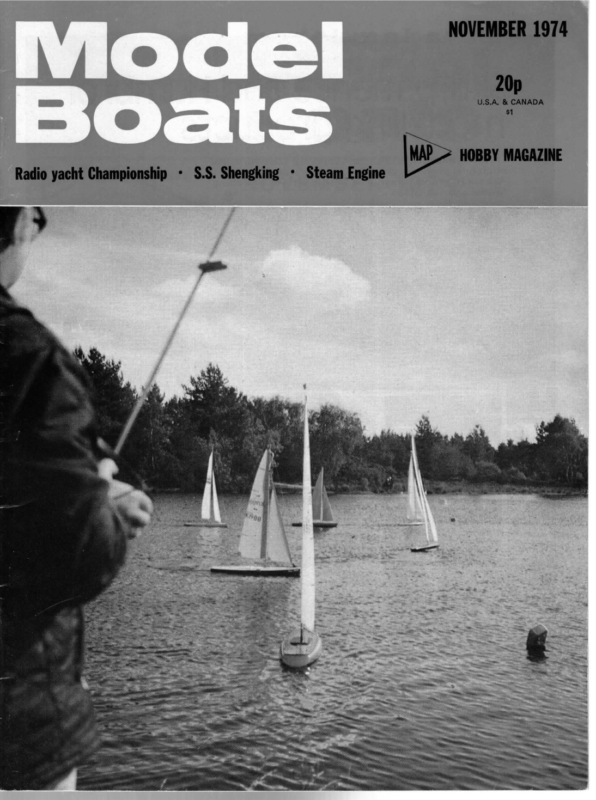
- The first M.Y.A. RM National Championship run by Guildford M.Y.C. at Elstead September 21/22. REPORT BY ROGER STOLLERY
- ‘Round Hulls’ in Wood A slightly different way to build a modern shape of Marblehead tried by the Editor.
- 1974 36in. Restricted Championships Report by Chris Jackson Photos by Chris Williams
- R/C MODEL YACHT RACING AT FLEETWOOD George Burgess contributes a pre-championship report

NOVEMBER 1974 In the Tideway Photo shows some of the 86 models shown at an exhibition in Athens by the Modelling Union of Greece, which proved very successful. Picture from the Union President, Mr. P. A. Vafiadachi. County, which was basically Teesside but now takes in surrounding areas and extends as far as the North Yorkshire Moors National Park. Anyone anxious to know more is asked to send an s.a.e. to L. B. Anderson, 32 Woodley Grove, Ormesby, Middlesbrough, Cleveland TS7 9HY. On Friday, Sept. 27, 27 model yachtsmen met in Benfleet, Essex, to form the Basildon & District Model Yachting Club. Applications had been received from 49 enthusiasts looking for a club in this area. The founder members include the current ‘RA’ class champion and three former members of the Southend M.Y.C., with many years of practical experience, down to members who do not yet have boats. Such notables as Norman Hatfield (Club Commodore), Steve Rix, Jim Belton and Geoffrey LaVerne are members and some have already undertaken to give lectures during the winter season, two such being ‘Radio Installations’ and ‘Racing Rules’, the latter being important as the call W HO would have thought, even three or four years ago, that 1974 would see a record entry of 29 yachts in the 36in. Restricted Championships? This class was virtually written off at the end of the 1960s, hving languished for years; it was often a struggle to raise six or seven boats for a Nationals. The last time Clapham saw a National Championship was in 1958, when 11 36R from four clubs competed, but what a different picture this time. club will race strictly to the M.Y.A. rules with no There is a lot more in these little boats than many people remember. They are not as fast as other classes (length alone sees to that) and with the beam and draught restrictions, can be ‘overbalanced’ quite easily by trying to carry too much sail. The pace of racing is inevitably slightly slower, and the boats are physically light to handle. It adds up to racing in more relaxed and less tiring conditions while not diminishing the skill required or limiting the development potential. In other words, it’s enjoyable and it’s fun, which is why ‘local’ rules. The primary racing class will be ‘RMs’ but no boats will be discouraged. There will be an active Junior section for those under 16 years of age. The club does not yet have a sailing water but negotiations are in progress. For details of membership please apply to J. A. E. Belton, 55 Rushbottom Lane, Benfleet, Essex. In the West Country, Bridgwater D.M.B.C. has been formed with 18 members covering power, sail, and scale, using a half-mile stretch of the River Huntspill. Details from the Sec., R. E. Draper, 6 Walk, Bridgwater, Somerset, tel. Bridgwater i most of us are modellers in the first place. Then, too, three or four years ago a two-day R/C Marblehead Championship with 27 entries would have seemed a pipedream. What, one wonders, will be happening in this type of racing in another three or four years? We have only started to scratch the surface of development in radio sailing. Most effort has gone into evolving functional and reliable equipment, but now attention is being turned to specific boat design. The following note from Norman Hatfield, M.Y.A. R/C Secretary, gives some idea of what 1974 has seen. 5222. A club, too, up in Orkney, catering for all types of models and with a boat section having a brand new 500 yard diameter boating pool to use. Our information from the Press Sec., Capt. A. E. Kerr, Craigsefield House, St. Ola, Orkney, Scotland. West Cumberland Radio Modellers, now two years old, is mixed, with aircraft only just outweighing boats. Three displays have been given for charities, etc. and boats operated range from small R/C sport through multi-racers to scale electrics and R/C M & 36R yachts. New members welcome; gen. sec. is M. R. Ford, 43 Derwent Bank, Seaton, Workington, Cumbria, or boating sec. M. Robinson, 2 Church Terrace, Growth of Radio Control in the M.Y.A. This year has seen a rapid growth in the number of enthusiasts taking up the sport of radio controlled model yacht racing. Four new clubs have been formed this season at Cardiff, Cleveland, Leicester and Reading, and there is another Club in course of formation at Basildon, Essex, which will include the Southendon-Sea area. Altogether, there are now 23 clubs actively engaged in this branch of the sport out of a total of 47 clubs affiliated to the Association. If any newcomers to the sport are looking for a Club in their district or wish to form a new Club, they should write to the Radio Control Secretary of the M.Y.A., who may be able to put them in touch with a Club or other enthusiasts who may live near them. His address is:- Mr. N. D. Hatfield, 26 Shanklin Drive, Wescliff-on-Sea, 0702 44389. Clubs Essex SSO 9XU. Tel. Harrington, Workington. Danson M.Y.C. has started regular Sunday radio sailing at Thamesmead and dates in the near future are Nov. 3 and 17, Dec. 1 and 22, start 10.30. The northern end of the lake is now used, courtesy G.L.C., and wellies are needed as the water is not quite deep enough for an M at the bank. Access by Yarnton Way (turn left at small roundabout after leaving elevated roundabout), first left into Hartstock Drive. Potential members welcome at lakeside or ring R. R. Potts at 01-850 6805. No. Giving point to the preceding paragraph are notes from clubs, which show a preponderance of R/C sailing news. First is the new Cleveland R.C.M.Y.C., now affiliated to the M.Y.A., covering Cleveland Leeds & Bradford M.Y.C. have arranged a demonstration of R/C yachts on their water at Larkfield Tarn, Rawdon, on Nov. 10, from 12 noon till about 3.30. There will probably be about 10 boats, mostly from Fleetwood, but anyone else who cares to bring a yacht or just come to watch would be welcome. Light 467 refreshments will be laid on. Any queries, phone the hon. sec, P. Maskell, at Pudsey 66880.
Ne eee aS! TEs The first M.Y.A. RM National Championship run by Guildford M.Y.C. at Elstead September 21/22. REPORT BY ROGER STOLLERY HESTEAD sight Moat before: has large never experienced numbers of such skippers a were there well before the start: the atmosphere was buzz- ing with expectation: boats were being rigged and tried out: the ‘Nationals’ excitement had really come to the quiet picturesque Moat. 26 of the 27 entries turned out on the Saturday to be greeted by 0-10 m.p.h. SW winds of a very fluky nature. At this sheltered spot, this wind comes first from one side of the trees and then from the other, and boats can be sailing in the same line but on different tacks. Six boats raced at a time and each skipper had 6 races in a total schedule of 27, at the end of which he had sailed every other competitor. The intention was to complete one schedule each day to give everyone 12 races. However, by mid morning, the weather deteriorated, umbrellas, souwesters and oilskins appeared, and many weird and wonderful transmitter protectors were hastily constructed. This did not have a beneficial effect on speed of the racing and although better weather eventually brightened up everyone’s hopes, only 22 of the 27 heats were completed by the end of the day. The racing was close and the standard of sailing remarkably high considering how long RMs have been racing. At the end of the first day, David Andrews from Leicester was in the lead with 66, David Waugh was 2nd with 56 and three skippers, James Douglas, John Cleave and Bob Jeffries, were tying for 3rd place. In the evening skippers were invited to a get-together held in a local pub. Sunday started with a statement of intent by OOD Norman’s tall rigged Tucker Duck. Before the prize-giving a special race took place as an American, Mike Flinsch, visiting this country, challenged the winners to race. Mike was sailing ‘a Boomer design, popular in the AMYA. This is a boat of 17-18 lbs displacement, 11?” beam and a vast 8” wide transom. The keel has no bulb but the lead is all at the bottom and the rig was short, about 65” hoist with a very big jib area. This race was watched with great interest as many wanted to see how this boat would perform. This was truly a historic occasion, as not only was this the first RM Nationals, but it was also, albeit al fresco, the first international RM race in this country. Mike got a cracking start but lost out on the next two off wind legs where he was passed by the other three boats. During the course of the racing there were some vicious gusts of around 20 m.p.h. and everyone had difficulty controlling their boats, especially the Boomer which showed to be very unbalanced and never seemed -to get going. David Waugh won this 2 lap race by a leg from John Cleave and David Andrews with the American a leg behind them. It did seem a bit unfair since the others had had all the weekend to practise! Margaret Smeed presented the magnificent new Model Boats Trophy together with the six prizes and consolation prize provided by the M.Y.A. The Guild- ford Club suggested that an RM championship should be run in 1974 and we were delighted to have had the opportunity to run it. We were lucky to have had so much backing from the RA skippers acting as judges, and lots of vane skippers to help organise and run the race, wives willing to make and serve refreshments and Joe Stokes to take overall command. Joe Stokes to try to complete the two schedules: the weather was kinder with a brisk NW gusting up to 20 m.p.h. by the end of the afternoon. Greater emphasis was put on calling up the boats and the skippers responded marvellously to complete by mid afternoon. One heat was resailed after a protest about interference and the result of this resail gave the championship to David Waugh from the New Forest with 132 points. He was sailing Capriole, a boat to his own design, and was 2 points ahead of David Andrews sailing Teazle, a Witty Typhoon. Third was John Cleave of the New Forest with 120 points sailing Knut, a German Ghibli design, and fourth was Neil Charman from Danson with 118 points sailing Red Admiral, a Priest Bewitched. Norman Hatfield sailing Troll and Bob Jeff- find on vane boats, 320-480, except for John Cleave, who had much more area in the mainsail, no doubt to gain a bit more downwind speed. Bob Jeffries used a rotating arm winch while all the others were drum winches. David Waugh’s winch was a cone shape giving a quicker pull with the sails out and a finer adjust- a good start, just as he had done throughout the championship, but he was not able to match the speed of had a decent flag; the winner and Norman Curtis had the best examples. When it has to be seen at 100 yards it needs to be big. ries sailing Electra X, an American Soling design, tied for Sth place with 104 points. In the sail off, Bob got 468 What are the lessons to be learnt from this race? Boats first – the first six were all different designs and their displacements were 15-21-20-23-24-18. Bob Jeftries and Neil Charman both used low rigs throughout the race; all the others were around the 85 max. hoist. Only John Cleave changed to a lower rig for the increase in windspeed. Most jib areas were as you would ment and more power with the sails in. Only a few
NOVEMBER 1974 The racing — six boats can be raced at one time provided no split frequencies are used. There were some accidental touches not affecting the boats’ speed or direction, in the calm area where boats had no way on nor had their sails full. The OOD had to stick to the MYA rules but felt that in future, no penalty should be incurred if in the opinion of the judges neither boat suffered deflecton. He also feels that the transmitter should be checked on a monitor when the boat is measured and the frequency recorded on the certificate. No doubt the use of a transmitter pound would further help to prevent stray signals from ruining the racing. Boats at a distance were difficult to identify by judges and competitors trying to communicate. “The red hulled boat has an overlap”. . . but there were 3 red hulled boats. . . the numbers are small at that distance. . . and even if they were bigger you can’t say 2013, 2031, 2032 quickly enough, The answer could be a standard flag of the frequency colour that is obtained from the control point before you go on the water, rather like the colour pegs used for the transmitter. A small dinghy flag would be ideal; all boats would need to be fitted with a 3/16” socket. A coloured streamer would be an alternative. Then you could refer to blue or red without confusion. Results 1. 1936 Capriole D. New Forest 132 2. 2018 Teazle D. Andrews Waugh Leicester 139 3. 1948 Knut J. New 120 4. 1961 Red Admiral N. Charman Danson 118 5. 1010 Troll N. Hatfield Y.M.6 104 1901 Electra X 1988 Puss in 1969 9. Cleave Forest C. Jeffries New Forest 104 J. Douglas Guildford 100 Early Bird R. Potts Danson 100 2929 Cygnet |. Harrison Leicester 98 10. 1968 Frantic N. Curtis Guildford 88 11. 1992 Pabri D. Robinson New Forest 86 12. 1680 Endora D. Priestley Fleetwood 78 2013 2931 Cyclops Moonraker Ill B. Brook A. Abel Fleetwood Guildford 78 78 15. 1982 Kung Fu H. 16. 1902 Claire 17. 1996 Blue 18. 19. 1981 1985 Beta Mellow Yellow G. Burgess G. Taylor 7. Boots de Moon LuneJ. IIl G. Wilde Fleetwood 76 Robertson New Forest 72 Coombs New Forest 66 Fleetwood Guildford 62 58 20. 1716 Limey M. Colyer Leicester 50 21. 1997 Honey Il A. Pidgeon Cleethorpes 48 22. 2017 Mac | S., Colyer Leicester 40 23. 2020 Pirate Red H. Cleethorpes 28 24. 1984 Icarus S. Ward Fleetwood 18 25. 2032 David T N. Thomas S. Retd. 2028 Bambicham Briggs Scratched 1999 Jim Wales 6 Heading shows a quintet heading for the start line; note unusual ‘all-jib’ una rig of Pabri, quite efficient in light airs. Top, this page, winner Capriole is original design but admits slight Sailplane influence, uses home-built fittings from homely odds and ends. Above, two swing-arm users were Cyclops (Basil Brook, perhaps better known as a power man) and David T, a China Boy up from South Wales. All skippers said they’d learned a lot. Below, winch inside or out? Three typical entrants.
MODEL BOATS [HE fully-rounded hull evolved by Roger Stollery some years ago stems from the use of glass fibre for model yacht hulls, since an elliptical monocoque form is the most Either efficient you way can to have use g.r.p. immense strength for the same weight as a wood hull, or you can have equiva- lent strength for a considerable reduction in weight. Reduction in hull weight allows either more weight to be transferred to the lead, giving a stiffer boat able to carry its sail better, or, retaining the same degree of stiffness, a lighter boat al- together. Too stiff a boat may decrease sailing performance, since a yacht needs a certain amount of heel for maximum windward speed, so the tendency has been for boats of this type to be lighter. Performance-wise, _ this philosophy has had a considerable effect in, especially, the Marblehead class, evident when one compares the designs of ten or twelve years ago with was rare about those of today, Then, it to encounter an M under 201lb. average whereas displacement now is the probably about 17 lb. and there have been some excellent designs of about 133-141b. Some of this reduction is, Of course, attributable to the almost universal use of the bulb keel, which gives a greater righting moment for the same weight, but the bulb was an integral part of the functional design concept of the first ‘round’ boats. Other designers also exploited the possibilities of light weight and bulb keels, many using conventional decks on thin glass shells, which is naturally structurally less efficient though producing a yacht of more traditional appearance and one in which rigging and fittings can be more nearly conventional. The advantages of the round hull are purely structural; when made in g.r.p. the weight-saving is a benefit affecting design but the turtle deck by itself appears to confer no noticeable bonus in reducing windage and hence leeway or anything of that nature. Thus there is little point in building such a hull conventionally in wood, since the weight saving is likely to be lost and no other advantage gained sufficient to offset the complexity that wood construction of the shape entails. There were — and are — nevertheless builders who were sufficiently attracted by the modern image to want to build in wood, and some three years ago we set out to produce a compromise design having as parameters (a) the 472
NOVEMBER 1974 ‘Round Hulls’ in Wood A slightly different way to build a modern shape of Marblehead tried by the Editor. heavily rounded deck-edge (b) the advantages of light construction (c) straightforward construction involving no moulding, etc., and basically a woodworking job. The intention was to complete the boat and ensure that its performance was satisfactory, then run a series of step-by-step articles on the method of construction. However, in three years (shortage of time is our usual problem) design philosophy changes and it seems doubtful that the original boat will be completed; we want to make a couple of mods which would not be easy to incorporate at this stage. The method of construction is probably of interest, nevertheless, and since it had progressed far enough to be proved, a description may give one or two ideas to builders contemplating a new boat. With the exception of the backbone, transom, deck, and fin and skeg, everything is balsa, and soft balsa at that, skinned with glass fibre tissue and resin. The cross-section drawing shows the basic concept, in which the top of the hull is cut from balsa block thick enough to allow the sheerline to be carved and still leave 2in. minimum thickness; the design, with this in mind, limits the depth of curve of the sheer to in. so that the main pieces can be cut from 1 in. thick block. It needed three 1 x 3 x 36 in. blocks, which cost quite a bit less three years ago! The hull bulkheads were cut from } in. balsa with flat sides and the top shaped to locate in the block Pictures opposite show, first, the bulkheads or shadows fitted basic deck the place on in frame, which is sawn from 1 in. soft block balsa and is 1} in. wide for most of its length. The stepped join in the block can be seen under the third bulkhead from the stern, Second, the backbone was_ laminated over a tracing from the plan, pressure being applied by skewing the screws in the guide blocks and using bulldog clips and, at each end, clothes pegs. Third, the backbone, slotted for fin and skeg, was glued to the bulkheads and chiselled to bulkhead contours (see section over- leaf). Fourth, the two sheets of been here’ have balsa tin. applied to each side and the in are planks of couple first place. These are edge-glued and also cemented to each bulkhead. This page, top, planking well advanced; note that the backbone is planked over as work alternate proceeds, planks on Centre bevelled. being sides right, ‘the sides and deck are here carved to shape and. the fin and skeg slots cut through. The bottom picture shows the hull the other way up at this stage. Slots in the appropriate bulkheads assist in aligning fin and skeg, fitting of which is the next step. 473
MODEL BOATS ‘frame’. The flat sides allow two laminations of +in. sheet to be fitted each side, leaving only the bottom of the hull to be planked; the sides and top are carved and sanded to shape, not a difficult job with the very soft balsa used. A backbone was laminated from three lengths of vs in. X #in. pine (some rather nice planed laths at a D.I.Y, shop) actually over the plan, using screwed blocks to locate the laths and, by angling the screws slightly in the outside blocks, to apply a little pressure on the laminations while the glue set. This backbone was then slotted (drill, saw, knife or chisel) to pass the fin and skeg, then glued in the bulkhead slots and chamfered to fair in with the bulkheads. It would be possible simply to cement the two } in. side laminations in place touching the building board all along and the full 3 in. depth (width) of the sheet balsa, carving the surplus away later. We plotted the shapes, however, since the top edge of the inner Complete body plan of model, above, shows curves which can be accommodated by this method, seen in section below. DECK lamination gives a guide for cutting the sheerline + along the blocks when the hull is eventually lifted from the board. Less wasteful, too! Planking was carried out with jin. balsa, slicing 4-#5 in. strips from sheet, and when dry the bottom half of the hull was trimmed and rough sanded to shape. It was then lifted from the board and the centres of the bulkheads removed (an Abrafile type saw is excellent for this) and the interior generally cleaned up. Patches of thin glass cloth (tissue would do) were then applied inside, each piece fitting one half of the hull between bulkheads and running from the backbone round to the top block. This stiffens the planked area, fillets all the joints, greatly increasing the strength, and, of course, waterproofs at least most of the interior. With the hull thus toughened the sheerline was sawn and the deck edges carved and sanded to their rounded shape, Fin and skeg were cut and fitted, using } in. ply; we later incorporated some carbon fibre Ly 22a” SHEET strands in the glass sheathing of the fin to stiffen and strengthen it. This material is easy to obtain (Bondaglass Ltd., for example) and not expensive in the small quantities we need, but it does have a noticeable effect in making components stiffer and stronger. A glass fillet inside and a short stay glued to the undersurface of the block each side secures the fin; the bulkheads in way of both fin and skeg were in fact left in to assist in accurate alignment, to be cut away at a later stage. The exterior could now be sanded to finish and a layer of tissue and resin applied. A narrow 7s in. ply deck, overlapping the block inner edge by ? in. and curved at stem and stern, was cut ready to glue on after contemplating such items as shroud attachments, etc., inside the hull, and this could either be supported by a kingplank type fore and aft member or short deckbeams. The former method was in favour when we last worked on the boat. Rubbing down of the exterior surface is a bit tedious with this method, but we had reached a stage where a coat of polyurethane was the next job, to show up any remaining irregularities. We’d even cast the lead. The complete hull, fin, skeg, deck, etc., weighs just over 3 lb. Looking at it now, the bow seems a bit shallow and there is perhaps more fin area than is necessary, although — well, if we ever finish it we’ll tell you how it goes. Structurally it worked out quite happily, through not the quickest method of building, perhaps. Someone is urging that we incorporate the mods in the drawing as Mk. II so that he can mould it as a twopart glass shell, which sounds attractive, except we’ve got another boat to build first…. Two more views of the hull, this time with fin and skeg fitted, most of the bulkheads cut away and, though not visible, the glass tissue applied internally. The handle in the fin top was a silly mistake as it was too far forward and got in the way of the mast slide, so had to be altered. Weight with deck, etc., compares well with all-glass equivalent; it seems as strong and is more rigid. 474
MODEL BOATS 1974 36in. Restricted Championships Report by Chris Jackson Photos by Chris Williams A RECORD entry of 29 boats, bright sunshine and a strong south-westerly breeze combined to make a fine sight at the start of this year’s championship. Two late withdrawals meant that each boat had four byes in the round, still leaving plenty of sailing for a variety of boats, ranging from Walter Jones’ venerable Ariel to Bill Dicks’ brand new Realistic. The O.0.D., Dick Seager, announced his intention to sail a complete round over the two days, with the entry arranged in two divisions so that a halt could be called if progress was slow, leaving a six-boat final. Mr. Tim Harley, of the Lambeth Council Recreation Dept., started the first pairs at 10.30 a.m., with the wind giving a true beat one way and a spinnaker run back. The strong wind allowed the starter to force the pace with 14 boats on the water on many occasions, the little 36-inch boats ploughing upwind on second suits in a steady stream. The runs back were equally exciting, skippers all using balloon spinnakers to obtain maximum speed, and risking the broaching which overcame several boats near the line, converting a certain two points to disaster. Heat 6 was completed in two halves, whilst the other skippers and mates had their lunch in the clubhouse, many taking advantage of the hot soup, sandwiches and tea provided by the ladies, a service maintained throughout the two days. After lunch the wind moderated and veered and backed rapidly between south and west, giving the starter and skippers problems in deciding the best tack to make headway down the pond. Wally Jones lost a beat, caught on the wrong tack and coming straight across the lake, while his opponent used the same wind shift to head up over the line. Michele Smeed, sailing Vic’s published design Gosling, was very unlucky to be disqualified for using a pole to retrim on the run, instead of stopping the boat, when well ahead of Arie/ and in general this boat, like the Marblehead Genie, stood up well to windward and was very fast downwind all day, comparing favourably with the specialised expert designs. Both this and Alan Whiteley’s entry, to the same plan, were sailing well all weekend and can be strongly recommended to people looking for a simple-to- build boat. The first day saw the wind gradually lighten and following a sudden heavy storm Heat 16 had to be abandoned as darkness and flat calm descended, those boats on the water agreeing to restart on the Sunday. Sunday morning brought almost ideal conditions for 36-inch sailing, the wind steady force 3 westerly, giving maximum speed without the waves stopping the hulls as on the previous morning. After a short break, whilst we listened to an item on Radio London about the race, a broadcast which attracted a number of visitors during the day, racing continued with a very high standard of sailing by all entrants, allowing completion of Heat 24 before lunch. At this point the wind began to drop and come out of the north-west, making life more difficult, but at least providing the lighter conditions more suited to some of the boats. In the very light conditions local knowledge becomes very useful in avoiding the wind shadow behind trees and the clubhouse, and the last heat sailed saw many boats becalmed and helpless, while their opponent sailed through on their own private wind puff. A halt was called at 3.15 p.m. and necessary resails done. The second boat, Wally Jones’ Ariel, had two byes to come so could not possibly catch Bill Dicks’ score and Top, Realistic sails Jagermeister; note the difference in size of spinnakers. Centre, Phoenix placed 6th; sailing Anval in picture. Bottom, Realistic, again sailing Pyjarmours. Compare the size of the sails with the top photo. 480
NOVEMBER 1974 the results were declared on a percentage basis to allow for the byes not taken. The protest committee was not needed at all during the event and everyone competing accepted the officials’ de- cisions without complaint. In reading the results it needs pointing out that several boats were entered by younger skippers, including Roger Clark, Andrew Steadman, Tom Armour, James Pinner and Michele Smeed, and although assisted in some cases by experienced mates they were actively involved in the trimming of their boats. oon — = = PWR —_ OL -_ NN ON BO = OL SL Le No rep) SZ Hard luck stories included Harry Briggs travelling all the way from Cleethorpes and only missing sixth place after a recount, whereas Gordon Griffin had gear trouble all day Saturday. Others included Harry Godfrey losing the run by inches to the winner, a decision he accepted with commendable restraint, only to see his son take the points in the next heat against the same boat. The final results are detailed below: ~ ANOAPWNH—-»6 qesy Jay onsieay owen asddinis weyde|9 qni3 xiua0ud unyoessdsex uul4 AaxoI,\ Jodwiny| ajppng sBBiig “H JojAe | *| psojplinyd ayiAuunog spee7 peayuariig sadioyjaa|9 ajeByinos 9}09 “Y Avnog “W ANOW II “¢ ajjlAusnog P4sOjpyINS ulasny “Vv uosia}jog “A INOW *S ‘SII sauor ‘MM syoId “M jeauy weydej9 weydejd weyde|9 ajeByinos apAH neiddeg “y snpijsoidAig aryeds Joysiowiaber yoyooy Auueddny Jayeqj ajdoag ajding sanowJelAd Je1g Bunooys sauor ‘g Jouuld “¢ INOW *L ja1ueq “DS uosueqg sp9e7 weydel9 Addog Aaya! ddeuy “A neddn ‘qd Jojiuuer alyoe|g JOYJUe, YUld POOM “gd A9}9uNYM “V ayIAuinog ‘VOowg Wa pssws “WW UYU) uewpeals ‘Vv sadioyjea|D ajeByinos UuAMIaM [48d MOjj9A eYS Enid Aasjpod “Wi iBiuy »se1g dneos SLL OZL SLL SLL SLL SLL SLL SLL SLL OcL OZL SLL SLL SLL SLL SLL O71 SLL SLL SLL SLL SLL GLL SLL SLL SZL OZL alqissog uosueq ynoo198A0q PAOJPIINS uosueq PAOJPJINS PsospyINS Aa4jpoD *H eID “Y SUIBIIIIM “D Aony Aoing JoBbiy 10/514 660L LLLL OLOL c80L v9OL S60L 6LOL LLOL QLLL cle 6c8 OOLL 6OLL ELLL L80L L60L O?LL S80L LLLL O90L 690L L60L SOLL 6801 860L ve? 6LLL “ON THES uO a SI 9 9°67 v’0e LGEe G’9E G9E 0’0v 00}4 807 8’Sr Lov S LV L8v 96 v’0S G?S 00°eS G°9S G’9S VLG 9°79 £9 L’99 00°49 9°L8 €’€6 3U99 48g NN Ow Top, Chris Dicks sailed. his father’s boat. Design had an ‘anti-dive’ knuckle moulded in the bow, Bloodaxe style, but it didn’t stop it standing on its nose in a gust on the Saturday. Tigger, the prototype Gosling, was very happy in the fresh winds but dropped ten places on Sunday simply through not having a bigger suit of sails. Centre, O. O. D. Dick Seager makes sure Wally Jones’ jib is filled on his Ariel, which is over 40 years old. Bottom, Xasperachun sailing the eventual winner; note water compared with top picture. 481
NOVEMBER 1974 R/C MODEL YACHT RACING A*’ the racing season nears the end, it is perhaps appropriate at this stage to publish an account of the results of a season of R/C yacht racing in the North of England. Most model yacht skippers know by experience, or hearsay, about the types of weather which may be met at Fleet- AT FLEETWOOD wood; these range from flat calm to full gales. For instance, on one day of the ‘A’ Class 1973 Championships, the wind George Burgess force reached 59.8 m.p.h. contributes a pre-championship report When the R/C yacht racing section was formed in Novem- ber 1973 there was a nucleus of two members. As a result of publicity printed in “Tideway’ the editorial column of Model Boats, the Club has had a fairly large influx of enthusiasts wishing to take part in this new form of racing. At the time of writing there are 20 R/C Ms, five RIORs and one RA. Membership has come from all sections of R/C sport, in- cluding aircraft. So far, this 1974 season, five Saturday meetings and two Sunday Open meetings have been held. The first three Satur- proved to be a full-time job for the O.O.D. and assistant. Most of the models were found wanting in many respects, and a summary of model basic requirements will be found further with boats over-canvassed, unable to change tack or round the buoys. When three heats had been completed, it was found that only six boats were left fit to sail. At which point the lunch break was taken. A decision to take the two top boats from each division was taken, so as to get a reasonable method of deciding the placing for the four prizes on offer. The race was finally won by Dave Andrews of the Leicester M.Y.C. who sailed right through the whole series of races in a brilliant display of how to sail a R/C yacht in rough weather. In this context it may be of interest to all R/C skippers, and those contemplating entering into the sport, that all the four finalists sailed boats with Vee-section hulls. The flatties had a very poor day, the main trouble being the inability to change tack and to get round the buoys. The Open race, held on 4th August, found Fleetwood with much better weather conditions, a moderate breeze from N.W. giving a beat, a reach and a run. All 12 boats entered managed to keep sailing and the fleet was again divided into two fleets, the experienced skippers in Division | and the less experienced and novices in Division 2. The Division 1 racing was completely dominated by two members of the Bolton-Bury Model Club, Squire Kay and Ernie Atherton, both sailing a new Squire Kay design Marblehead. Division 2 required a sail-off between George Taylor, Guildford Club, sailing a Fred Shepherd boat, Mellow Yellow, and Jack Turner from Rhos-on-Sea sailing a C. Dicks Pterodactyl, resulting in Mellow Yellow qualifying for the final place in a four-boat sail-off. Again, in the heats of this race S. Kay and E. Atherton demonstrated howto sail R/C models. When the two met each other in a heat both started with no more than one boat-length separating them, and this pattern continued throughout each of the two round heats. If one skipper made a slight mistake the other skipper at once nipped in to take the lead. This was R/C racing at its very best, and the writer offers his sincere congratulations to both skippers for providing such an exciting spectacle. The race was finally won by Squire Kay, one point behind was Ernie Atherton, third was Bob Askew, sailing a Prerodactyl; 491 wn down this article. The two days of racing on Saturday, 8th and Sunday, 9th June found Fleetwood in a typical westerly blow. In the Saturday race nine boats entered for the event, but by the completion of heat 3 there were only two boats fit to sail, the rest having to retire due to defects ranging from broken stays to water in the radio. The race was abandoned to allow skippers to effect repairs in time for the Open event of Sunday, 9th. 12 boats entered for the Open on the 9th, including three skippers from Leicester M.Y.C. The wind was, if anything, stronger than on the Saturday. A lot of skippers, being novices to yacht racing, did not appreciate the need to be able to reduce sail area to suit the conditions. To give the competitors the maximum of sailing heats, the fleet was divided into two fleets of six each. As racing proceeded, a chaotic situation developed, breakdowns and radio failure occurred, together sets of crystals. The boats must be fully waterproofed. The radio equipment must be completely shielded from water. & results of heats, sorting out clashes of frequency, etc., Wh _ day meetings found Fleetwood in benign moods, with wind strengths around 5-10 m.p.h., for which the race organisers were very thankful, as the task of controlling racing, giving a running commentary on racing rules, awarding penalty points, explaining why the penalty was awarded, scoring the of note about this boat was that the boat was sailing its first race with sails that had only been received on that morning, a highly creditable performance. Fourth was George Taylor, with Mellow Yellow. This is a one-off Fred Shepherd design which shows potential. One feels that George would be the first to agree that the boat requires re-rigging and new sails before we know just what the model can really do. Arising from the experiences when sailing R/C models at Fleetwood, a pattern emerged which showed the need for all radio control skippers to carry out certain actions to their models to make them fully competitive; these are: All radios must be proportional and possess at least two All models should be fitted with a spade rudder, the generally accepted size is about 7 in. long by 2.5 in. wide, the rudder pillar should be placed about one-third back from the leading edge, giving 33% before and 66% behind the rudder pillar. Skippers should possess at least four sets of sails. A. A high aspect ratio sail set (A1). B. Three sets of medium aspect sails, BI, B2, B3, each set reducing 10% from the largest size BI. Most model plans carry details of the sail dimensions as designed. 6 All skippers should practise starts between buoys, giving phieceecres a one-minute countdown, races can be lost ere. 7 All fittings and rigging must be very strong. The Squire Kay design Marblehead. Squire Kay is very well known in the North as a very expert model aircraft builder and pilot. He is also an expert racing dinghy sailor. The Kay model was originally designed to have a l.o.a. of about 54 inches and carrying around 1,200 sq. in. of sail. In this guise the boat could sail rings round the conventional 10R, such as Red Herring, etc. In order to compete in the R/M class the transom was cut back to 50 in. l.o.a. and I.w.1. of 50 in., and sail area was reduced to a moderately-high aspect ratio of 800 measured inches. The basic design follows racing dinghy practice with fine entry, flared bows, a beam of 13 in. and a transom of about 6 in. width, spade rudder, fin, and lead bulb keel, 18 in. from waterline; weight with radio equipment is around 19 lb. Sailing qualities are excellent, pointing very high and sailing fast on the beat. Under suitable conditions, it will plane on a reach and shows very little tendency to dive when running. Sid Ward, a Fleetwood member, is now in possession of a boat of. this design, and with a sail plan designed by the writer and made by Walter Jones, the model can compete with Squire’s boat on equal terms. Sails. The Kay boat is fitted with Kay design sails, using 54-oz. terylene cloth. As Squire had no previous knowledge of making model yacht sails, he turned to dinghy practice in sail-making. A feature of his sails, apart from built-in flow, is that the material is not stitched — the luff, tabling and batten holders are stuck together with Evo-Stik. Yes, I agree with your probable comments on this matter, but the fact remains that the idea works. I know, because I have just made three new sets of smaller sails and all the lot are stuck together. The bond appears to be resistant to both fresh and salt water. So budding sail designers need no longer be inhibited by the very tricky and tedious stitching method. However, for the average skipper, the best way is still to get your sails made by an expert sail maker. Finally, as this article is written before the RM Championship at Guildford, the results of our many hours of practice will not be known until after publication date, so I close with the wish to see many more skippers turning to Radio-Control eo racing, and don’t kid yourself, it isn’t as easy as it ooks.