- RIO A simple, quickly built 10-rater for radio control with a surprising performance By G. W. Dowling
- BOW FENDER FOR MODEL YACHTS A neat idea from G. White

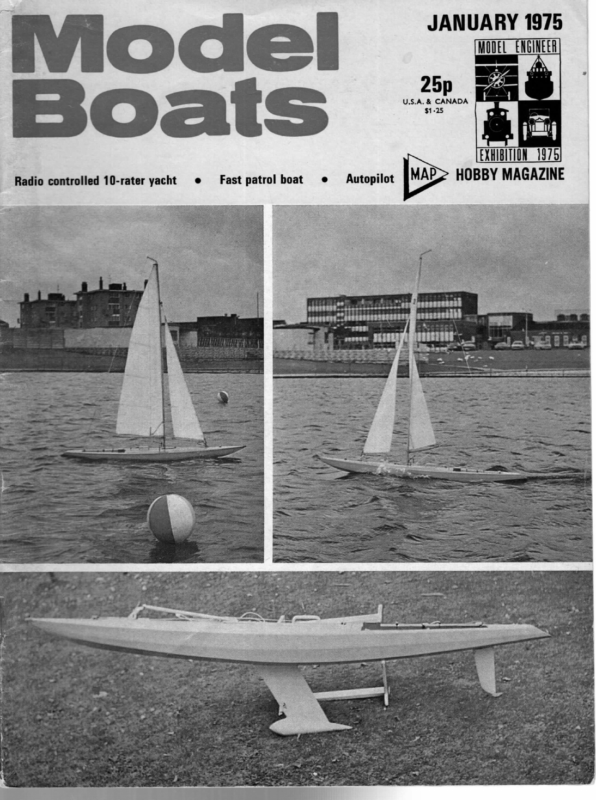
JANUARY 1975 Radio controlled 10-rater yacht e Fast patrol boat e gheneene ic25-.-2225-5-<88F greerzaeai eeseneed leadeaegeategaaart graseateihl - - “Seat Visca VMN CIB ISRY a. mead a Sedtabmeee: =
JANUARY 1975 Left photograph shows two two metal-type cowl vents installed on a part-finished Clyde paddler. Right, deck detail on this Algerine class minesweeper (non-working) includes in picture three paper-type ventilators 1; in. high. or what have you. Don’t leave tedious jobs like this to the end, start early on in the model timetable. Picking up and leaving to dry etc. is then no problem as it can be sandwiched in between other jobs. These sorts of “pick-up and putdown jobs” should always be done in conjunction with other work—it stops you being premature and spoiling generation. When a sufficient thickness has been built up it can be sanded smooth and any roughness smoothed out with filler. When you are satisfied use a razor blade or sharp knife to slit it as shown in Fig. 9 and carefully spring it off the former. It can then be glued on to a piece of dowel suitably turned at the end. Again the joint can be smoothed over with filler. If you’ve got this far you can paint it but remember with components of this type make a couple of spare Firstly make a former by fair means or foul, of the shape of the inside of the selected cowl. Pieces of dowel glued together and carved, judiciously blended with Isopon and then cleaned up is a good bet. Now finish this off with as good a surface as possible, paint, dope, shellac things. The next step is to make the surface “unstickable” with the use of wax polish or by rubbing well with a candle. A start can now be made on building up the actual ventilator. Usually gummed strip is used but owing to the complex double curvature this would not be flexible enough. I used tissue paper cut into strips only about + in.-} in. wide. Try putting the first layer on dry—you probably won’t succeed but try. Next glue (I used PVA) on strips followed by more strips even to the third ones and select the best for your model—this is the only Fun can be had by experimenting with the various ways of wrapping on the strips—those with a St. Johns’ way to a Gold Medal, which is perhaps why I haven’t Ambulance certificate will have it made here. got one. TIMING MECHANISMS (continue from page 16) Ideas such as an underwater rotor, like a speed log, switching off after so many revs, or a lathe-type half-nut dropped over a fine worm on the prop-shaft, are in the realm of possibility but not really practical, and a separate mechanism accurate in time, positive in operation and easily resettable seems the best answer. These qualities can be provided by clockwork or electric timers, the former being lighter but of limited power, and either still leaves the actual stopping of the engine to be decided Or a rotary pointer, as on a camera timer but larger, could make an electrical contact on return to zero, switching in a solenoid-operated cut-off. The pointer could be electrically driven through a small govt.-surplus gearbox (ex gas meter etc) and calibrated on a clock-type dial, thus making a thumb-operated contact plate possible. There are advantages in an electric timer, since there is no possibility of jerking the boat on release, or losing or forgetting the pin; on the other hand, it would be necessary to ensure that the operating battery was at the right output level, as a new battery would drive the upon. One Czech aircraft competitor, a year or two ago, actually had a steel rod shoot out into the prop; it was positive, but perhaps a shade drastic for a boat! timer fast and a flat one slow. RIO = (continued from 20) adequate power when connected direct to the rudder. an old rig that I had instead of making new. Also the lead bulb weighs 14 Ib. instead of 154 Ib. as The proportional winch is home-made using a Monoperm designed. This again is because I had a keel of that motor. Rio planes easily and goes well to windward. In races so far this season against other R1ORs and RAs she has more than held her own. Some readers may consider that chine boats are weight, and to make a new one would have taken up valuable time. However, I am so pleased with the way in which Rio performs that I do not think it will be changed. This loss in weight has shortened the designed L.W.L. which when measured was 59.3 in., giving a inferior both in performance and appearance to conven- tional round bilge hulls. That was my view. Having built slight bonus in sail area. and sailed Rio, I am not so sure. I use Horizon two function radio. The servos have 19 il
—= in MODEL BOATS HE 1974 season started in a disastrous fashion for me. The RIOR that I had designed and built during the winter was unorthodox in concept and proved to be a complete flop. Different sail-plans were tried, including S a una rig, and different weights of keel, but all to no avail. She was a failure. By this time June had arrived, and I realised that if I was to do any sailing during the season, a new boat would have to be built quickly. Having studied the construction details of Vic Smeed’s Marblehead Genie, which was being featured in Model Boats at the time, it appeared that this method using }+ in. ply and fibreglass could be adapted to my needs to produce a light RIOR in the minimum building time. Radio controlled sailing yachts have certain disadvantages when compared with their vane sisters. They have to carry the weight of the radio gear, which if it is to be of adequate power and have batteries of sufficient capacity for a day’s racing will, complete with watertight box, weigh between 2 Ib. and 3 Ib., and although the motor and batteries can be kept low in the hull, the extra weight pss that there is less lead in the keel, and so stability suffers. RIO A simple, quickly built 10-rater for radio control with a surprising performance By G. W. Dowling R/C yachts do not carry spinnakers off the wind. They therefore have to be light in weight with sufficient sail area for planing performance downwind, but also be stiff enough to carry the same amount of sail to windward. I therefore decided that a light boat of 60 in. L.W.L. would have sufficient sail area to plane easily, whilst a slight increase in beam over that normally employed, i together with as high a ballast ratio as possible, would give the necessary stiffness. It was to help obtain a good ballast ratio that again the construction method used in Genie appealed to me, because it produces a light hull to help compensate for the weight of the radio gear it has to carry, and so more lead can be put on the keel. Construction only differed slightly from Genie. Rio’s sections are V’d at the keel and not flat, therefore the two bottom planks have to be lapped. Also a longitudinal shadow was used between section O and the stemhead to lap the planks onto while the glue was setting. It was also found easier to butt joint the planks from section O forward rather than lap them. The deck is cambered forward, but flat aft where the radio box sits in the deck. To compensate for the weight of the radio gear, which is situated aft of the centre of buoyancy, the lead keel was moved forward so that its centre of gravity is about 4 in. forward of the centre of buoyancy. The sailplan I have used is of fairly low aspect ratio with double luff mainsail. A higher sailplan may be of advantage, but as explained, I was in a hurry, so I used (continued on previous page ) 20
JANUARY 1975 q : Full-size copies of the drawing below (sheer and waterlines half-size, body plan full-size) are available, ref. MM 1197, price 70p. inc. VAT and post, from Model Maker Plans Service, P.O. Box 35, Hemel Hempstead, Herts HP1 1EE. R10 Gesignes copyright of DETAILS A by 6. DOWLING 1197 Maker Plans Service The12-25Model Bridge Street. Hemel Hempstead Herts LOA 75.75) MAX BEAM 12-1 ORAFT 16" LEAD 15-Sibs 60" Lwe wea DISPLACEMENT € al is fr 26ibs Ve 59 ft 1250 SAIL AREA } oot “@ 2 1] 7 AS BUILT Cs so-7 DISPLACE MENT 24:Sibs pe 16 ibs LEAD RADIO GEAR 2-75ibs HULL 6 25ibs & FITTINGS MAST, SAILS & BOOM 1 = Sits "37 21
JANUARY 1975 OUR Fast Patrol Boats of a type similar to the German Type 148 were built for the Malaysian Navy during 1972, the names being Kapal Diraja Perdana, KD Serang, KD Ganas, and KD Ganyang. These boats have clean, unsophisticated lines and a look of power borne out by the armament which they carry. This comprises a 57 mm gun for’d, 40 mm gun aft and two missile launchers midships, with associated fire control radar. Power is provided by four diesel engines driving four propellers. Steering is achieved by twin rudders. The hull is of round bilge form, with deep sharp entry at the bows changing to a flat run above the propellers at the stern. A centre line skeg is fitted, running from midships. In order to work in the bow flare, a knuckle runs to a point just for’d of the bridge, but is softened by rounding it off. A spray chine is fitted above the waterline, sloping down slightly as it runs aft to fade out under the bridge. At the bow, the rail is of solid pipe construction only as far as the first stanchion. Also, there is a second bull ring above the ring through which the anchor stock passes. Round each gun is a shell-case “‘basket’”, made of expanded metal mesh. On the bridge top is a wind break made from clear Perspex. On each side aft, is a bearing sight with fixed binoculars. The mast yardarms carry the wind speed indicator on FAST PATROL BOAT French-built boats for the Malaysian Navy, similar to those supplied to Israel and Greece. Full-size copies of the drawing opposite are available, ref. MM 1198, price 60p inc. V.A.T. and post, from.Model Maker Plans Service, P.O. Box 35, Hemel Hempstead, Herts HP1 1EE. At zyin.- 1ft., length is approx. 29ins. and beam 43in., scale displacement just under 2lbs. Note no model structure is included on the drawing. the port side of the aft deck house are four built-in ready use lockers, for 40 mm ammunition. Each side of the Gemini craft are two sockets for a portable davit used for launching it. The fuel stowage contains two jerry cans which are jettisonable. Particulars of the boats are: Length OA 154.2 ft. Beam 23.0 ft. Draught 5.9 ft. Displacement 234 to 265 tons. Speed 35.5 kts. Diesel Engines the lower one, and wind direction indicator on the upper one. The engine room vents are open at the aft end with the sides closed off to exclude any spray from entering. On 12,000 hp. 4 shafts, 2 rudders. Information from Official Brochure and Janes Fighting Ships. BOW FENDER FOR MODEL YACHTS A neat idea from G. White His just built my first racing yacht I joined the local club. The first thing I noticed was the many different types of bow fenders, and most of them spoilt the lines of the boats. As I didn’t fancy a tennis ball stuck on the bow of my 10 rater, I gave the problem some thought, and decided that it might be possible to cast one in rubber. I had recently used a silicone rubber bathtub caulk in the house, and this seemed just the material for the job, so I went ahead and made a fender as follows. I took a tracing of the bow of my boat, traced this onto a block of balsa and then drew in the outer line, Fig 1. I then dug out the shape of the fender, Fig 2, using a sharp half-round chisel, smoothed the surface using glasspaper, then lightly greased the surface. A piece of stainless steel wire was bent to form the midway shape of the fender, Fig 3. The mould was half filled with rubber, and the wire placed in (Fig. 3), then the other half of the mould was filled. (When filling the mould, squeeze the tube and move around the mould layering the rubber, the layers will eventually blend into one). It was then left in the mould to set, and then gently eased out from the wire ends. (Leave to set for one week). To stop the fender dropping over the bow, I squeezed a layer of rubber along the top edge at the bow point, Fig. 4. This will blend in quite well. A better way of casting would be to make a pattern of the fender from balsa, and make a plaster cast, using the split box method. Silicone rubber is a Dow Corning product, obtainable from builders’ merchants, and is white in colour. S/STEEL WIRE 3 4