- Descriptio1975 M CHAMPS MEMBERS OF TWELVE CLUBS COMPETED AT DOVERCOURT IN EASTER’S SNOW, SLEET, AND RAIN. IT WAS A GOOD RACE, NEVERTHELESS
- An eight foot model CATAMARAN BY DEREK W. NORFOLK, A.R.I.B.A.
- MODEL YACHTING ASSOCIATION — R/C NEWS Radio Control Secretary Norman Hatfield writes about the recent and forthcoming events of 1975.
- Basildon M.Y.C.
- M.Y.A. ‘A’ Class Rules Alterations which rulebook owners may care to note pending ultimate reprinting of the section
- Round the Regattasn of contents

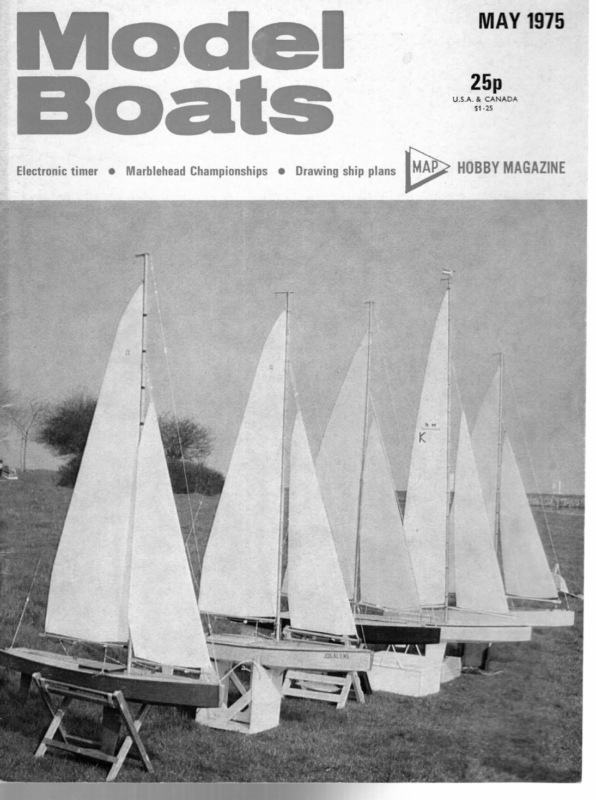
MAY 1975 Boats HOBBY MAGAZINE Drawing ship plans LENO ei nictricaiiamonieinsigiancs ienabewenccensy @ & CANADA $1-25 cme Marblehead Championships Saecmpenniamnans © ies Electronic timer * U.S.A.
ll MODEL BOATS MEMBERS OF TWELVE CLUBS COMPETED AT DOVERCOURT IN EASTER’S SNOW, SLEET, AND RAIN. IT WAS A GOOD RACE, NEVERTHELESS [. would only be necessary to mention Easter 1975 to any British reader for him to know just what is meant. This was probably the coldest championship ever; although Dovercourt escaped the snow which blanketed most of the country on Good Friday, the race started on the Saturday morning in near zero temperatures, with sleet showers on and off all day and a tricky reaching wind that brought frustration to many skippers. Sunday was marginally less cold but with the same wind till right at the end, when it swung to give a good beat and run. Thirteen heats were sailed on Saturday and twelve on Sunday, leaving only four to complete the full 30-boat tournament on Monday, when a further very slight im- provement in weather and wind occurred. The sodden ground at each end of the lake soon turned to a morass, causing some slipping and sliding as crews telephoned to say that travelling conditions from their area were so bad that they had had to turn back. Despite it all, it was a cheerful and successful meeting. Good organisation, conscientious (if frozen) officials, and co-operative competitors made it so, and probably never have the ladies’ efforts been so appreciated, with their never-ending flow of hot soup, coffee, pasties and sausage rolls etc. tea, hot For most of the race the wind was quite likely to swing from a close to a broad reach, making spinnakers a gamble, especially as there was a noticeable fan effect from the road opposite the lake’s centre; in view of the distance from the water of the nearest bungalows, the strength of this effect was surprising. The wind’s change was only most people liberally with mud. Those staying in caravans once really enough to change the scoring on Saturday, and it then swung back, so that some boats were apparently beating for 2 and running for 3. attempt to keep some circulation appeared carried their boats to and from the water and coating and chalets got little relief from the cold and wet, and several pairs of household gloves were seen in use in an in sore and frozen hands. Racing secretary Clive Colsell re-wrote the schedule immediately before the event when three entries Last year’s winner, to get the Roger Stollery’s Blood measure fairly quickly and Axe, was simply sailing from one end to the other and back. At times it would change course by four or five points as it Heading shows 3rd and 7th boats Major B and White Knight II (dark sail). Starter Dick Gow and _ assistant 0.0.D. Jim Belton look for more customers. Left, the Bantock design Poppycock; hull shape, enormous draught, and articulated rudder are three noticeable points of this very promising boat. Near left, the other new design was Imagination, Chris Dicks’ latest, sailed by Brian Jones, who found it just wasn’t his week-end. Light winds and boats of under 14 Ib. are a bad combination! Opposite, top, Major B shows the Battle Axe shape against a more conventional new boat, lan Taylor’s Luncheon Vulture; they are in the background of the right-hand picture, where Allegro and Annie’s Axe have caught them up. 226
MAY 1875 hit the fan, causing a notable burst of acceleration by the skipper on the opposite bank, but invariably it resumed its heading and reached the line without a re-trim. Most of the other boats came ashore at least once per board, and most skippers were trying a new trim in every heat. Roger, while dropping a board now and then (he scored 86 per cent) went into an early lead and maintained it to the end. A little slower to get the hang of it, perhaps, were Mike Harris and Alex Austin, who improved steadily, particu- larly on the Sunday, to finish second and third, both with Blood Axes. Mike, in his first major race since switching to this design, was for a long time the only boat really in a position to challenge for leadership. The fourth Blood Axe in the race was sailed by the designer’s sister, Anne’ and her husband Chris Hart (really only just back from their honeymoon) into sixth place; again, this boat dropped points early on but then settled. Tied for fourth were Graham Bantock, with one of the very few new boats present, and the Carter/Colsell com- bination with a Pterodactyl; Graham’s boat won the sail-off. As the picture shows, this is an interesting design with a very fine bow and a remarkably deep and narrow fin, and it produces an unusual vertical feather of water at the bow when travelling fast, which may well lead to some minor alteration. Something of a surprise to many was the seventh place boat, a White Rabbit sailed by Mike and Harry Godfrey, with what must have been the Below, top left, Orinocho sails Kiltie; both boats tied for 10th place. Top right, Chris Hart releases Annie’s Axe (6th) against Mariarty (8th) while Clive Colsell and Mike Godfrey stand by and Anne has a quiet shiver. Bottom left, the winner sailing Bilbo Baggins, another boat which had an off week-end. Right, Poppycock and Sir Prancelot. Behind, Hiawatha risks a spinnaker. 227 i
ai MODEL BOATS Roger Stollery seemed to be first off in most heats which may account for his checking trim while others chat. On the other hand, he did win! Gordon Griffin, near camera, holds the latest Griffin marathon name—boat is called And they Laughed at Kristopher Kolumbus ! 1. 2 3. 4 5. 6. 7. 8 9. 10. 12. 14. smallest rig present. This boat quietly collected points at a steady if unspectacular rate to give Mike his highest placing yet in a national, with what was probably the oldest boat of the fleet. 16. 17. 18. 20. Apart from being a Blood Axe clean sweep, and an excellent result for the Guildford club, the 1975 Championship will undoubtedly be remembered for its bitingly cold conditions (the coldest Easter since records began) which, nevertheless, failed to dampen the spirits of either officials or crews. How Chris Dicks and Wally Jones, basking in South African sunshine, must have been chuckling! 22. 24. 25. 27. 28. 29. 30. TIMER (continued from opposite page) *R. Stollery M. Harris RESULTS 1977 Blood Axe 2122 Axtung *A. Austin 1962 Major B G. Bantock 2089 Poppycock *E. Carter 1851 Hiawatha *C. Hart 2117 Annie’s Axe *M. Godfrey 1598 White Knight II D. Latham 2012 Mariarty I. Taylor 2090 Luncheon Vulture __D. Priestley 2016 Orinocho R. Walsh 2088 Kiltie G. Keeley 1694 Fidrella V. Bellerson 1827 Blue Flame G. Clark 1915 Tijuana Mrs. D. Griffin 2076 Kolumbus R. Noble 2075 Lady Brenda A. Geeson 2008 Dideridoo J. Hyde 1775 Pterodactyl C. Daniels 2038 Thrashing Machine J. Rayner 2026 Now We Are 5 J. Gilmour 1821 Bernice R. Etheridge 2120 Quid Non D. Pratt 1960 Allegro D. Cathmoir 2078 Tom Bombadil B. Jones 2121 Imagination H. Briggs 1794 Bilbo Baggins C. Williams 2006 Jinjili M. Peppiatt 2011 Australopithecus K. Wiseman 1911 Sir Prancelot S. Marr 2087 08 Roobarb * Hold membership of Guildford M.Y.C. 125 115 108 95 95 83 80 79 78 75 75 73 73 72 a2 69 67 64 64 63 63 62 62 60 58 58 51 48 45 43 Max shaft coupling had been purchased, mounting the relay and R2 remotely. Timing Range. An individual boat is unlikely to require the full range available, so if the unit is to be permanently installed, it may be an advantage to reduce the range of timing and make the control much finer. Increase the value of R1 until the minimum setting of R2 gives a running time slightly less than the shortest time required. Then choose a value for R2 which, at maximum setting, gives a time slightly greater than the longest time required. Non-electric Boats. For a spark-ignition engine, a much smaller relay can be used, the contacts being wired into the ignition circuit. Other forms of propulsion may be controlled if the relay is replaced by a solenoid operated valve in the fuel or steam line. The solenoid should be chosen or constructed bearing in mind the same limitations which apply to the relay coil. To allow the engine to run continuously during starting and testing, wire an on/off type switch as shown at S3 in Fig. 1. This will energise the output device until the model is ready for release. When S1 & 2 are held down prior to release, S3 can be switched off without the engine stopping, and the timer then operates as described when the model is released. Construction. The prototype was built ona piece of 0.1 in. matrix Veroboard as shown in Figs 2 & 3, the layout of the components being shown in Fig. 2 and the insulation breaks required in the copper strips shown in Fig. 3. Cut these breaks before starting to solder components in place. Check the positioning of the integrated circuit carefully before soldering, as it is extremely difficult to unsolder all eight pins at once. If desired, an 8-pin D.L.L. socket can be used to hold the I.C. Connect the relay, switches, supplies and R2 using stranded P.V.C. covered wire. Testing. Fit a pointer knob and card scale to R2 and connect the unit to its supply. The relay should energise when S82 is operated, and release when S2 is released. When SI is opened, nothing should happen, but on re- leasing S1 the relay should operate for a time and then release. The operate time should be adjustable using R2. With the aid of a stop-watch, the scale on R2 can be calibrated. The installation depends very much on the individual model, but a waterproof box is well worth while. The prototype was enclosed in a plastic box in which a Rip- CLUB NOTES oe, Annual Rally/Regatta of Barrow S.M.S. is on May 18 at Barrow Park Lake, from 10 a.m. Covers square rig, fore and aft, and racing yachts, R/C scale and racing yachts, power scale, R/C, SR, Sp, and Stg. Full details S.A.E., R. Newton, 86 Schneider Road, Barrow in Furness, Cumbria. Stevenage M.M.S. has been so swamped with entries that no more can be accepted for any of the meetings planned for the rest of the year. Sorry! Radio control yacht meeting, informal, for any R/C sailing type, with informal races for all classes present, will be held by Hove and Brighton M.Y.C. at Hove Lagoon on June 8. Corrections to Fleetwood power regattas—May 11, M/R, 0-34, 34-64, 64-35 c.c. Same on Aug. 24. Oct. 12 one class only, FSR 35. All 12 noon start, last entries 11 a.m., 80dB noise limit. Highgate and Southgate Model Yacht Clubs are associating to promote all classes of model yacht racing on Highgate Pond (off Millfield Lane, N6) where organised racing has been carried on for 122 years. It is an excellent water for R/C yachts—even if it is sometimes a little frustrating for vane sailors. A “‘sail in” will be held on June 8th with, if enough boats can be organised, a specific race for RMs. Highgate have an excellent clubhouse and good facilities. Southgate are keeping 36R racing going at Broomfield Park (home of the 36 Team Race) and are hoping for some R/C 36s on the water soon. Details (S.A.E.) please from Ian Taylor, 66 Wood- side Park Road, London, N12 8RY or ring 01 445 6079. Kingston Model Club marine section now has two private lakes, one for scale and electric and the other for speed. Members went to Keighley last year and expect to be at Welwyn. Prospective members contact P.R.O., M. Stokes, 53 Wyndham Road, Kingston upon Thames, Surrey, (01-549 2887). 228
MODEL BOATS i all started with a casual remark of mine suggesting we build an eight foot cat to get the speed record for the length of the lagoon at Hove. The next thing that happened was that my friend Peter Shaw phoned to say he had made a plaster plug for the hulls and then we were started on the project. It wasn’t long before he had a mould made and had taken out two hulls. I drew up a layout making the boat 4 ft. overall width, with a centre section 5 in. wide and 3 in. deep to take the mast and the necessary deck fittings and to house the radio equipment inside. The centre section is made of 3 and 4 mm. ply strong in torsion to resist the twist of the two hulls, which is a noticeable failing with full-size eight foot model ATAMARAN catamarans. The cross tubes are of 1 in. dia. thin gauge light alloy securely fixed with blocks and screws to the centre section. The tubes were bent cold by hand in a vice to a large radius, with the ends plugged with corks to prevent internal corrosion. The ends of the tubes are attached to the hulls with light alloy angles and screws. We decided to have a central fin 4 in. wide of cast aluminium, with a lead bulb, to compensate for the lack of a live crew. Partially balanced rudders are used, connected to a tiller arm above the hull deck. An Ackerman type geometry for the rudders was achieved by connecting the tiller arms to a V-shaped arm under the aft end of the centre section. The shaft of the V arm is passed up through the deck of the centre section and is connected to the servo (below deck) with a link and two arms. The rig is fairly standard, using a mast head jib and a pocket luff main with a top suit area of about 1600 sq. in. ss 234 BY DEREK W. NORFOLK, A.R.1.B.A. j
MAY 1975 We use Sprengbrook radio equipment, but the winch I made up using a Richard Monoperm motor and two Meccano gears to make a total reduction gear of 180 to 1. We had trouble with one motor which played havoc with the radio and we had to replace it with another. We were surprised how stable the boat was with a fairly generous sail area and a total displacement of about 30 Ib. We tested the overturning moment by pulling horizontally from the top of the shrouds and found that 11 lb. was required to lift a hull. As with full-size craft, tacking wants a little practice, and we find that the best method is to ease slightly off the wind to gain speed and then bring her round slowly at first and don’t apply full rudder until she is nearly round. It is advisable to leave enough room to go astern, with reverse rudder, if one doesn’t make it! The difficulty of a capsize will, I hope, be taken care of by an electrical device which is now fitted to the boat, but has not yet been properly tested on the water. The device will let the sheet out about 4 in. at a given angle of heel, and then by bringing the boat momentarily head to wind, return springs will re-set the mechanism as it was before. 235
MODEL BOATS MODEL YACHTING ASSOCIATION — R/€ NEWS and Conway-Jones demonstrated how it should be done by their winning combination. The capacity crowd of spectators showed their appreciation of the handling skills required by applauding whenever a helmsman made a good start, was quick in tacking or made a perfect rounding of a mark. The large number of enquiries received afterwards as to where and when R/C racing can Radio Control Secretary Norman Hatfield writes about the recent and forthcoming events of 1975. be seen, proved how attractive the sport can be to spec- tators and many people congratulated us on the high standard of the boats and sailing. This year we suffered no radio interference, which had troubled us in previous years. ete I last wrote in these pages in June, 1974, R/C Model Yachting has taken several leaps forward in public recognition of the sport. Instead of having to struggle to publicise it as a sport deserving serious attention, approaches from interested ‘“‘outside” parties are now being made to us. The first important breakthrough occurred in October last, when the M.Y.A. was admitted to the Central Council for Physical Recreation, Outdoor Pursuits Division, and this has given us the status we have been seeking for many years. The practical value to Clubs is that it gives them the right to appeal, through the M.Y.A., against either the threat of loss of a sailing water or the refusal of permission to use a suitable water. It is also possible that financial assistance could be granted to a Club in difficulties, if it can prove it has a deserving case. RMs at Queen Mary’s On the weekend of 30th/31st August, the Guildford and Reading Clubs have been invited by the Queen Mary Sailing Club, Ashford to stage an Open Race for “RM’’s on their sailing water. The Club has kindly offered to provide all the necessary facilities, including use of their excellent Clubhouse, a rescue dinghy and table and chairs for the O.0.D. and Race Committee. In addition, the Club will present a piece of silver plate as Ist prize and also lesser prizes. The entry fee will be £1 per boat and entries should be sent to Roger Stollery, Secretary of Guildford M.Y.C. The Q.M.S.C. is on the A308 from Kingston to Staines. August International Entries for the big International Races at Gosport from 3rd/9th August are now complete and the final numbers Crystal Palace The M.Y.A. was again well represented at the London Dinghy Exhibition at Crystal Palace over the weekend of 22nd/23rd March, organised by the R.Y.A. and the Sports Council, on which the C.C.P.R. is represented. As in previous years, our Publicity Secretary, Roger Stollery, was responsible for setting up the M.Y.A. Stand on which were displayed examples of an “A” Class, 10 Rater, ‘‘M”’ and “36” Restricted Class, together with three “RM”’s. The “live” demonstrations on the swimming pool on both days were an unqualified success, with six “RM”’’s from the Basildon, Danson, Guildford and Reading Clubs showing the crowd how well these boats can perform, even in a restricted area with “artificial” wind from two large fans. Sunday’s demonstration are 61 “RM” and 40 “R10r”’, with 30 “RM’’s and 14 *“R10r”’s_ from overseas. Countries represent ed are Canada, France, Germany, Holland, Japan, Sweden, South Africa and the U.S.A. The M.Y.A. is represent ed by 16 Clubs. Arrangements for the week’s regatta are now well advanced and the event, which has the largest total entry of any race ever staged by the M.Y.A., should prove well worth watching by those who can spare the time for a trip to Gosport. It will also be the largest and most representative gathering of International Model Yachtsmen ever seen in this country and will undoubted ly result in more publicity for the sport, especially as plans ay been made to televise it by both the B.B.C. and I.T.A. was the highlight of the weekend, when a series of four races and a final were sailed with well-known dinghy helmsmen at the controls. Those taking part were Keith Musto (‘Flying Dutchman’’), Alan Curran (“Scorpion”’), Hugh Bourn (“505”), John Conway-Jones (“Firefly & R/C on TV While on the subject of T.V., B.B.C.2 will be presenting in May a series of 10 programmes entitled ‘“Leisure— Model World”, which will feature various branches of modelling, including Model Yachting. Times of showing will be 6.40-7.05, so at peak viewing times it should have the greatest impact. R/C model yachting will be shown mentary was Clapham M.Y.C. on 26th March, when seven members of the Basildon and Danson Clubs took part. David Jones, a member of the Gosport Club, who is a B.B.C. Solo”), Donald Forbes (National “12” & “Fireball’’), Nigel Hacking (R.Y.A. Secretary), Bob Bond (R.Y.A. Training Manager) and Peter Cook (Editor “Yachts & Yachting”). The demonstrations were introduced by Frank Jennings, M.Y.A. Chairman and the racing comgiven by Eric Twiname, a on programme 5. Filming of R/C racing took place at well-known authority on the racing rules. All the helmsmen showed remarkable ability at the controls considering they had little, if any, experience with models and obviously they cameraman, took close-up film of the sailing with a camera mounted on his ‘A’ Class and we await the were able to apply racing tactics and the rules almost as second nature, thus enabling them to concentrate almost results with much interest. It should give the impressio n entirely on sailing the boats. Keith Musto displayed quite extraordinary handling skill, especially in his of actually being on board the models. starts, which were exactly as per the book—-sailing full-and-bye R/C Rules Now that the revised R/C Racing Rules are in circu- on starboard and hitting the line close to the windward mark exactly on the starting signal. He proved to be the outright winner of the series, with Messrs. Curran, Hacking and Bond 2nd, 3rd & 4th respectively. Miss Alix Cowie, Regional Officer of the Sports Council, presented two attractively wrapped boxes as prizes which, when opened, proved to be bottles of beer, much to the amusement of the spectators. Finally, a demonstration of Team Racing with two boats in each team showed how interesting this form of racing can be and Messrs. Musto lation, we await the result of the first season’s use of them by the Clubs and it would be helpful if Club Secretaries would let me know if they experience problems in applying them or if they have any suggestions to offer for improvement. The rules may seem to be un- necessarily complicated to the beginner, but they are not really so difficult to understand as they may seem at first sight. It must be borne in mind that they are designed to cover as many “‘incidents” and “situations” as possible. 236
MAY 1975 THIS relatively recently formed club is going from strength to strength with over 40 members and regular sailing and racing on Sunday mornings. Their first full racing season was due to start off with an open race on Easter Sunday, and winter meetings have consisted of lectures etc. on fittings, rigging, radio, winches, racing rules, etc. With no other model yacht clubs in the area, a large proportion of members are building their first-ever yachts; of the club’s original roll-call, only four had previously sailed models, and of the present membership, only seven have prior experience, the rest being primarily model fliers, power boaters, and dinghy sailors. This possibly accounts for the number of Genies in the club; the five on the cover will shortly be joined by at least three more, and there are four Moonrakers, three other RMs, and at least another five on the stocks. A. B. Ott, club P.R.O., mentions that waters in use are at Coal House Fort moat and East Tilbury, and that Basildon Council propose to issue a licence to use water in Northlands Park; the club may form several fleets using different waters to increase sailing time per frequency and widen competition in the club. Affiliation to the M.Y.A. and attachment to the Eastern District have completed the goals originally set, and members now hope to make their mark on the model yachting scene. M.Y.A. ‘A’ Class Rules The boats on the cover, with notes from Basildon M.Y.C. David Mayne, club vice-commodore (and a top man in National 12s and Albacores, incidentally) sent some comments on the club’s experiences with their Genies. They prove very fast in all but very light or very heavy weather. In light winds they tend to stick in dead patches, and in heavy weather they will not tack quickly, even after all sorts of experiments with rudder shapes, sizes, and positions. Widening the fin a fraction is to be tried. In heavy weather, when reaching or running there is a nosediving tendency which, however, does not appear to slow the boat or cause control loss. To windward, David’s own Genie has shown itself able to outpoint and outfoot Norman Hatfield’s Duck, suggesting that it should prove competitive over a wide range of conditions. All the boats, incidentally, use = in. dural deck-stepped masts which so far have given no trouble, even in very strong wind. central position and measuring the overlap. The jib boom shall not extend aft of the front of the mast. Battens are not restricted in a jib set in this way. Alterations which rulebook owners may care to note pending ultimate reprinting of the section CONTINUING the notification of rule changes, the A rules have some slight alterations but, while these apply for M.Y.A. events this season, there may be a further change following an I.M.Y.R.U. meeting later in the year. This is one reason why a reprint at this stage is inadvisable. The alterations are: Page 2, Section 2, Units of Measurement, add ‘‘Yachts shall be measured in fresh water”. Page 4, Section 3, para. j(i), Batten Limits, delete ‘‘and they shall be equally spaced” and substitute “dividing the leech into 5 approximately equal parts’’. Para. j(ii) is reworded “‘The greatest extension of the headboard from the after side of the mast is 0.98 inch’’. Para. juiii) is reworded ‘*The roach of the mainsail measured at right angles to a straight line from the forward bottom corner of the headboard to the clew shall not exceed 4 in. The leech between the after end of the upper batten and the after corner of the headboard and between the after end of the lower batten and the clew shall not project more than 0.4 in. aft of the straight line between these points’’. Page 5, Section 3, add para. (m) ““HEADSAILS. The area of headsail set in the fore triangle is not measured. (i) The roach of a jib set on a boom shall not project more than 2 in. behind the front of the mast. This is to be measured by rotating the boom and sail as it is set to approximately the Another view of the 8ft. catamaran from the preceding pages. The smooth movement is deceptive — speed is considerable. 237 (ii) Genoa jibs may extend beyond the line restricting roach but they shall not measure more than twice J on the foot. No boom is allowed along the foot, nor any battens or other stiffening”’. Page 6, Section 4, para. (d) (reaching or genoa jibs) is deleted. Page 7, Section 5, Sails bounded by curved edges, delete “The roach of a jib is not measured” and delete “There is no restriction on the length of jib battens’’.
MAY 1975 Se ees R OUND THE REGATTAS Frostbite at the Rick Pond Twelve RM entries turned up for a Danson-run R/C “frostbite’’ meeting on Dec. 28 at the Rick Pond. Wind was Force 6 gusting to 7, with white horses all the way down the pond. Most boats didn’t have a small enough suit of sails, and O.0.D. Russell Potts didn’t have a small enough suit of schedules. Of the 12 entrants two didn’t start, three didn’t score and two fell by the wayside. Only five were still racing at the end, three of them Leicester boats (out of four from this club), all of whom made a reasonable job ofgetting round the course. David Andrews sailed nearly perfectly with his totally sortedout boat under control almost to the end, when he lost it in a gust in the last heat and had to make two attempts to round the last buoy. Norman Hatfield also did well and the two of them were convincingly ahead of the rest. Top three were :— 1. 2. 3. Teazle Troll Limey D. Andrews N. D. Hatfield M. Colyer Leicester Basildon Leicester 58 50 36 Metropolitan and Southern District Individual 10R Championship Held at the Rick Pond on Sunday, 9th March 1975. By courtesy of Y.M.6m.0.A., and South London M.Y.C., waterless Danson M.Y.C. were able to organise the above event on a cold, cloudy but fortunately not windless day. There were 13 boats entered from seven clubs and as a “reward” for their efforts in organising the event Danson took Ist and 2nd places, Roy Griffin’s Ist place being his first major success with his 10 rater. The two top boats are to the same Dick Seager design, both being from the designer’s mould, Dick being present in the unusual capacity of Mate to the runner-up. 245 Ie
MODEL BOATS Three RMs sailing at the Rick Pond on Dec, 28th. Those with small enough sails were in an advantag eous position. Centre boat Troll placed second. The day’s racing started at 10.15, after tea in the Y.M.6m.0.A. clubhouse, with a light breeze which gave a close reach out and a broad reach back, more or less. The wind tended to strengthen as the day went on, but never settled to allow for a true run and beat. Various sizes and shapes of spinnakers were flown on the down-wind leg with varying degrees of success, there being only a few occasions when spinnake rs could be carried for the whole length of the pond. The Lewis Cracker design were sailing quickly with little apparent wake due to their long sailing length, but in common with most of the boats sailing were under-canvasse d for the majority of the day. The 0.0.D., John Slatter, cut the lunch hour to 40 minutes and the skippers , mates and officials adjourned for a warm up in the clubhouse and further cups of tea, the wonderful facilities available in the Y.M.6m.O. being much appreciated in the bitter boat, Mr. Rusty, is a typical two piece Stollery g.r.p. design. The four Lewis Cracker variants were in g.r.p., Captain Scarlet is a one off in balsa to the skipper’s own weather. design and was I think, the longest boat present; she did, however, seem to be underpowered in the wind which When racing resumed the result was still very much in doubt, due partly to the bye caused by the 13 boat reached only occasionally the maximum of the forecast Force 3. The winner and second place boats were built in parallel by their skippers, who thank Dick for the use of his mould and for his advice during and after their building. The scorer, Russell Potts, a radio man at heart, did a good job as scorer. Regrettably our young starter entry. The O.0.D. advised that we would aim to finish at 4.30 and then complete resails necessar y for deciding the top four places. In the event all but the last heat was sailed and this was followed by five resails to decide the destiny of the three prizes; on his last resail Roy Griffin gained the one point advantage that gave him the Trophy. Notes on the boats :—Black Opal, Munin, and Katchup was unwell for part of the day so the “bye” skippers very kindly stepped into the breach to keep the racing were wooden “‘one-offs’’. Avenger (ex Tommy Knott) is going. A good day’s sailing was had by all, the prizes duly presented and the visitors managed to pack their boats in time to avoid being locked in when the park closed from Chris Dicks’ mould, Athene is a beautiful ly built wooden version of the same Dicks design. The oldest Position *11 12 13 Reg. No. 1860 2001 1885 1855 1838 1854 1846 1737 2 3 4 *5 6 7 *8 Skipper C. R. Griffin G. W. Clark J. Hollams G. Hollams J. Wheildon T. Gurr A. Larraman M. Godfrey Boat Tenafly Odyssey Isotope Force 10 Krakatoa Appletree Black Opal Mr. Rusty Designer Club Seager Seager Lewis Lewis Lewis Lewis Witty Stollery Points Danson Danson MYSA MYSA London MYSA Danson Guildford 39 38 36 35 34 31 28 21 = 1841 = R. Pinner 1821 Athene C. Parkins Dicks Katchup Shepherd 1776 1848 1743 E. Carter I. Taylor W. Jupp * Boats have been National champions Avenger Captain Scarlet Munin Midland M_ Championship, reported by the Midland District Secretary. A rather wet dismal day heralded the start of the season for the Midland District and their first event for Marbleheads at Wicksteed on 9th March. Twelve entries turned up at the pondside, seven from Wickstee d, two from Cleethorpes, one from Bournville and two from Birmingham. The race start was rescheduled for 11.00 a.m. to allow the late arrivals to get rigged. The wind was good and a swinging direction from the northwest round to the west. Racing was close all morning and when lunch was taken the top five positions were as follows :—joint leaders Shazzan and Jester, with five points behind, equal second, L.O. Sailor and Pepperpot, closely followed one point behind by Lady Brenda. After lunch racing commenced again, with more 1 2 3 4 5 6 7 8 9 10 Ta | 12 Shazzan Jester Pepperpot L.O. Sailor Kristopher Kolumbus Mustard Pot Lady Brenda Bodge Up Bay Rum Watcha Mcallit Honey II Banyan South London 20 London 20 YM6m0A Southgate South London 16 15 13 water round the pool than there was in it but everyone was happy—cold but happy. The wind was the same, so was the rain. Harold Dovey and Graham Webb con- tinued to fight it out all through the afterno on and Charlie Holden was close behind all the way. The remainder of the field was spread right out. By the end Harold and Graham had drawn away from Charlie and the rest of the boats and a glance at the results will show how everyone finished. Thank you to all the skippers for braving the conditions, and also thank you to Wicksteed for putting the event on. Footnote—It took me an hour to travel from one side of Market Harborough to the other. Whilst stationary, one of the locals said that he had not seen so much water in the town for 20 years… . Harold Dovey Graham Webb Charlie Holden Bill Greene Dot Griffin A. Holden Roy Noble Bill Smith Ted Croxford A. Gotts Dennys Warren Bill – 246 Dicks Own Littlejohn Bournville Birmingham Wicksteed Birmingham Cleethorpes Wicksteed Cleethorpes Wicksteed Wicksteed Wicksteed Wicksteed Wicksteed 48 47 41 37 33 25 24 23 16 15 13 8