- In the Tideway Twenty-five continuous years
- RADIO CONTROL YACHT RACING TACTICS Working to Windward by Larry and Niel Goodrich, Central Park MYC
- CAIR ANDROS A 63 in. glass fibre model of a possible full-size ketch-rigged cruiser Part Three (conclusion) BY JOHN GIFFORD
- Round the Regattas including some late ones held over from the last issue

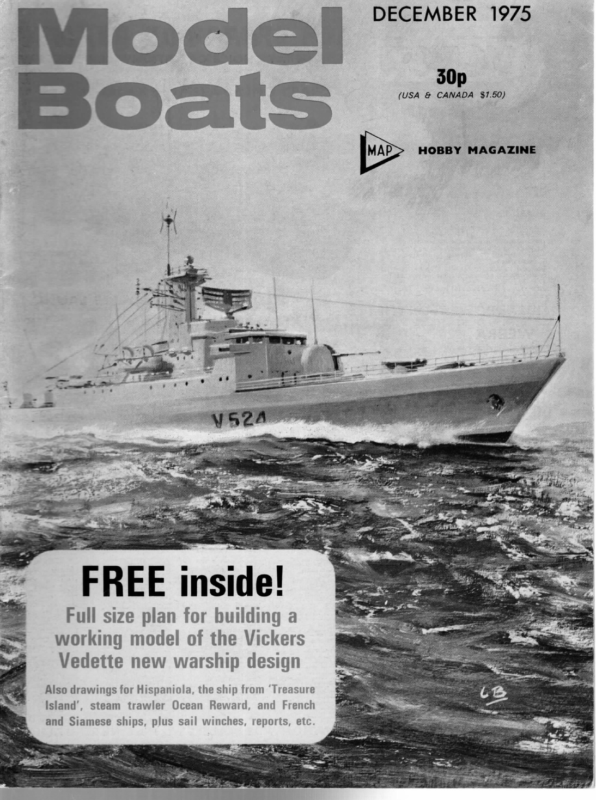
30p (USA & CANADA $1.50) HOBBY MAGAZINE > FREE inside! Full size plan for building a working model of the Vickers Vedette new warship design Also drawings for Hispaniola, the ship from ‘Treasure Island’, steam trawler Ocean Reward, and French and Siamese ships, plus sail winches, reports, etc.
DECEMBER Tt issue marks the 25th anniversary of Model Maker & Model Boats, which first appeared in December 1950 and has continued regular monthly publication since, only missing an issue during the six-week printing strike in 1959 and, alas, one during the “three-day week” period of 1974. Originally published under the simple title Model Maker, the magazine resulted from the amalgamation of Model Mechanic and Model Cars, and was edited jointly by Geoffrey Deason and Lawrence Sparey, though the latter left the company soon after launching the new title, to be replaced by Dickie Laidlaw-Dickson. Other staff members in the early days included George Cull and Maurice Brett, and the managing editor was the late D. A. Russell. The magazine in those days catered for all branches of modelling except aircraft, which were adequately covered in the sole sister publication, Aero Modeller. In early 1952 the company, Model Aeronautical Press Ltd., changed management and its activities were moved under one roof at Watford. Shortly after, the present editor (then perhaps best known for a series of aircraft designs) joined the company and the nautical content began to increase — over 25 designs published in 1954 as against only 3 in 1951. Early in 1954 Geoffrey Deason left the company for an interesting Foreign Office job, leaving D.J.L-D as editor and V. E. Smeed as assistant. As it happened, the model world was ready for more model boating material and, by a coincidence, in December 1954 we published the first practical article on electric car racing, which was also to enjoy a period of enormous popularity. Thus the magazine tended to concentrate on boats and cars, and its circulation showed a steady upward movement. At the beginning of 1959 the present editor took the chair, and two years later the old title of Model Cars was brought back into prominence, to prepare for a separation of cars from Model Maker. In 1960 we had launched Radio Control Models, and the experience had indicated that a separate car magazine might be viable. The separation duly took place, but not until 1964; this left Model Maker with virtually only model boats, so to accustom readers, and the trade, to the new arrangement, the cover bore the title Model Maker & Model Boats, the latter being gradually brought up and the former faded back until by late 1965 Model Boats was established. Two other notable occurrences in 1965 were the compulsory purchase of our offices in Watford (for a car park to be built) and our consequent removal to our present address, and the purchase of the Percival Marshall model interests, notably Model Engineer and Model Railway News (now Model Railways). With the aviation interest becoming outweighed, the company changed its name to Model & Allied Publications Ltd. in 1968. New magazines — Scale Models, Military Modelling etc. — have been introduced, and some existing ones acquired — Photography, Movie Maker, and so on. In passing, it is of interest to remark that Model Boats is still the only publicly-availably monthly all model yacht/ MODEL ENGINEER EXHIBITION In little over a month from publication of this issue, the doors will be opening on the 45th Model Engineer Exhibition. This year looks like being a vintage one, with an excellent entry in the locomotive, road vehicle, and tool classes, and 70 plus ships etc. in various categories, as well as a record military entry. Some new faces among trade stands appear, and demonstrations of brazing and silver soldering, spray painting, and period ship construction are among those promised. Once again the pool will be in use for boating demonstrations (pity the physical characteristics preclude the use of fans for R/C yachts) and there will be concentrated 1975 In the Tideway Twenty-five continuous years power boat publication in the world, and that no other model boating monthly has survived so long. H. B. Tucker’s pre-war Model Yachtsman ran for five years, becoming Marine Models for a further six; it appeared very briefly after the war. Ships & Ship Models ran for nearly nine pre-war years and also re-appeared for a time after the war, before being re-absorbed into Mode/ Engineer. The longest runner is the bi-monthly 24-page French Modele Reduit de Bateau, now in its 33rd year and up to issue No. 186 Since 1949, an Aero Modeller Annual had been produced, and it became clear that a need existed for modelling books. A modest programme was initiated in 1955, building up over the years and augmented considerably in 1965 by the Marshall book range and again in 1972 by the acquisition of the Fountain Press photographic titles, to a point where it was deemed desirable to transfer all books, in 1974, to a new company, Argus Books Ltd., quite independent of MAP. Full size plans of models featured in Aero Modeller began to be made available during the last war, and this service expanded to cover new magazines as they appeared; it has also grown to a considerable size, offering thousands of drawings which are sold to most countries in the world. From the original single-sheet list of what was available, the present range requires four separate and quite substantial catalogues. In twenty-five years, then, Model Maker has seen considerable changes in its own background as well as in the model world it serves. When it started, radio was in its infancy (remember trying to get a 1-8 milliamp drop witha Hivac XFGI1 soft valve ?) and weranan article in December 1953 explaining what transistors were and wondering whether they would eventually replace glass valves. Many racing yachts still had Braine gear fitted from new; power boats were mostly big and powered by home-built fourstroke engines. There was virtually no model boat trade, apart from a very few kits and fittings, and, from memory, the MPBA and the MYA each numbered about 300 enthusiasts. In these and other areas, in public and behind the scenes, we like to feel we’ve helped things along and, hopefully, will continue to do so. activity on, particularly, Jan Ist, 3rd and 10th, when combined MPBA clubs should be in full strength, and Jan 5th, when 30 Cambridge club members will use the pool all day. In the evenings, individual clubs will operate, but there is still the chance for clubs and individuals to have a run on some of the days; they would be most welcome, and it’s a good opportunity to keep in practice under pleasant conditions in mid-winter. Please get in touch with the Editor. Advance bookings can be made, which saves a little on cost and also avoids queueing at busy times. For details of this and other aspects of the Exhibition see the advertisement in this issue.
MODEL BOATS RADIO CONTROL YACHT RACING TACT ICS Working to Windward by Larry and Niel Goodrich, Central Park MYC watching the telltale on your mast, the catspaws on the pond, the leaves in the trees and the other boats. You will probably spot some dead spots to avoid later and you may d an area near a wall where you can get a nice lift, denen begin practising the start and working to windward, The Windward Leg Me R/C skippers consistently lose races without really understanding why, and others consistently win without really being able to explain why. The losers probably do not know (or remem ber to use) good tactics, and the winners are probably intuit ively using good tactics but may have trouble articulating why they did what they did. We win a few and lose many, but we usually understand why. Maybe that qualifies us to write this elementary piece on windward tactics. We claim no particular expertise — this is simply what we have learned over a number of years in dinghy racing and have adapted for R/C model yacht racing. We hope this will encourage others to write about their favourite tactics, because strategy is a very important part of R/C racing and too little has been writte n about it. A tactic is simply a method of taking advantage of any situation or rule to help you win. Some skippers look down on tactics, particularly those involv ing rights-of-way rules, as if it were somehow unsportsma nlike to use them to your advantage. Rights-of-way rules are a necessary convention in fleet racing, and using them to your advantage is no more unfair than planning a car trip to encounter as few stop signs as possible, Preparation for the Race Quite a few skippers unwittingly lose races even before the racing starts by failing to come to the pond prepared. (That happens in vane racing as well, but there are more things to here to, windward tactics ? Starting tactics (deserving of a long article by themselves) are virtua lly all designed to get you in a favourable position to work to windward, and so we feel an understanding of windw ard tactics should come before a study of starting tactics. Many skippers believe that working to windward is the most important part of fleet racing. The straight line distance from the start to the windw ard mark may be only one-third of the distance of the whole course. However, since you cannot sail the windward leg as the crow flies, the distance your boat has to travel, tacking back and forth, and the time spent on the windw ard leg, will be much greater than on any other leg, perhaps as much as half the race. Getting to the windward mark at or near the head of the pack is a very important part of winning, particularly in one lap heats and steady winds which reduce your chances of catching up. We start with some simple geometry and then add some real situation complications. Since you cannot sail much closer to the wind than 45 degree s, we find it helpful to think of the starboard and port tacks as the sides of a right angle with the wind direction bisect ing the angle, as shown in Fig. 1. If the first mark is direct ly to windward of the centre of the starting line, you can see that neither tack is ‘favoured’ in the sense that it will get you closer to the mark than the other. However, in practi ce, when you start, the first mark is seldom directly to windw ard for any one of severa sO you can prepare your yacht as much as possib le in has shifted since it was placed or the race committee deliberately tried to favour port tack to discourage the and water conditions advance. Check all your equipment the night before and use a checklist to make sure you take everything along. Get on the water early so you can tune up for the local conditions, preferably match-racing with a friend with a fast boat. Learn as much as possible about the other skippers so you can rank them roughly and so you can later keep an eye on the good ones and keep out of the way of the hackers. Watching local skippers tune up may give you some clues about local wind peculia rities and preferred courses. Try to sail the whole course at least once and the windward leg several times so you can make preliminary judgments about the best lines to take. When racing away from our home club, we assume we will be at a disadvantage of at least two places even with these preparations. Without them, you will be racing under a severe handicap. In the pit area, look for some high groun d ora bench you can stand on so you can sight down on, as well as across, the water to give you a better perspective. You cannot use tactics effectively unless you keep in a position to see as well as possible what is going on. Above all, keep concentrating 2a will be a windward leg. Since the start comes before the windward leg, why do we begin with, and limit ourselves prepare for in R/C racing.) Try to find out beforehand about the site and the prevailing wind _ Almost without exception, the first leg of an R/C course on the wind, its direction, speed and tenden cy to shift, by 652 l reasons: the race committee set it poorly, the wind tendency of skippers to bunch up on the starboard tack. Thus, most of the time one tack is favour ed, and you should learn to spot which one and by about how much it is favoured. In most conditions, you can do this simply by sailing across the starting line on each tack, noting which tack seems to head you closer to the first mark. That leads to the basic tactic of windw ard work : always try to take (or be on) the tack which at the moment will head you closer to the mark. The import ance of this may not be intuitively obvious, partic ularly if you focus only on the simple geometry of a zig-zag course upwind. In Fig. 2, it is quite apparent on paper that the distan ce to be travelled by boat A is exactly the same as the distan ces for boats B & C, and that will be true on the race course if the wind is steady and does not shift during the leg, which is rarely the case. Boat A has followed the rule by taking the long starboard tack first, which will get it closer to the mark, and will have the following advantages: (i) when it finishes that long tack, Boat A will be closer to the mark and in a much better position to determine exactly when to tack onto port to fetch the mark, and (ii) if the wind shifts against Boat A
DECEMBER 1975 the favoured tack, never strike out on your own on the on its first tack (so that port becomes favoured), it can immediately tack onto port. Conversely, boat B, having taken the short unfavoured port tack first, will have a very difficult time trying to decide when to go over onto the starboard tack to make the mark and suffers the risk of at least three bad consequences: (i) going too far on port and overstanding the mark and thus taking a longer course than necessary, (ii) tacking too soon which will require an extra tack to fetch the mark, or (iii) suffering an adverse wind shift on the long starboard tack so that Boat B will end other tack in the hope of finding a different wind — the odds are too much against you. To make life more complicated, one tactic will often come in conflict with another and you will be faced with a choice of which one to use under the circumstances For example, many courses are sailed counterclockwise so that you have to take the windward mark to port, in which case it is desirable to have your last tack on starboard so that you have the right-of-way near the mark. But in Fig. 2 we have shown the favoured boat A course ending up with a short port tack to the mark. There is no simple answer, but we normally take the favoured tack first on the theory that we will worry farther up on the leg about approaching the mark. If congestion then appears to be developing near the mark, you can often plan your last few tacks so that you up sailing both tacks as and when they were not favoured. Another variation of the rule is: tack immediately on being ‘headed’ but always stay with a ‘lift’. This has its basis in the fact that the wind often shifts to a significant degree during a leg in open waters and the effect of these shifts can be magnified on a pond which has obstructions around it. When the wind shifts against you and youcan no longer point as high as you could, i.e. you are ‘headed’, at the same time a boat on the other tack will get a ‘lift’ and will be able to point higher. Many skippers do not seem to realize this, but is quite easy to visualize if you keep the right angle concept in mind. As the wind shifts to starboard, think of the whole angle tilting in that direction and you will see that the port tack line drops away from the mark while the starboard tack line lifts toward the mark. That is what actually happens when there is a true wind shift; but, in practice, it is extremely hard to distinguish between a true windshift and a change in windspeed, particularly when you are standing on the shore many yards from the wind acting on your yacht. As everyone knows, you can point higher as the wind speed increases (and in the puffs) and you have to bear off in the lulls. Thus if you find you cannot point as high as before it may be because of lower windspeed or a windshift (including a deflection off an obstruction), and you have to decide that it is a windshift before trying to tack to find a lift on the other side. It helps to study the boats on the other tack approach the mark on starboard. Immediately after the start you must make sure you have clear air and that you have your boat moving as fast as possible. Then you work into your favoured course if you are free to do so. You will have to bear off to give right-ofway and take some detours, but try to stay on the favoured course as much of the time as possible. before making your decision. Another basic rule is to take as few tacks as possible. The act of tacking necessarily slows your boat, first from the braking action of your rudder and the hull reversing direction and then from the loss of driving force in the sails until they fill again. In Fig. 2, boat C travels the same distance as the other two boats; but, if you assume it loses two boat lengths on each extra tack, you can see why it will be a poor third at the mark. How much your own boat will lose on a tack will depend on its design, how efficiently you tack it, and the wind and water conditions. Keep in mind that in open class racing (as distinguished from one-design racing) there may be great variations among the boats in the speed with which they can tack and recover. If your boat is on the slow side to tack, try to keep out of tacking duels with more manoeuvrable boats. So far we have dealt pretty much with the ideal course to be sailed without coming to grips with the very real complications encountered in fleet racing. Often you will find that you simply are not in a position to take the ideal course you had planned — you get a bad start and find yourself badly backwinded by the lead boats. In that case, you have to sail the best course you can under the circumstances until you are free to get back onto your preferred course. If you are backwinded badly, you have to get out from under it because even the fastest boat has little chance of sailing through it. If you have room to take a short tack to clear your air and then come quickly back to the favoured tack, that may be your best bet; but, before any tack, make sure you will not be tacking into a worse position. You may also be able to clear your air by easing off and trying to foot to leeward towards clear air, hoping to work back up to windward on the puffs. If you have no room to do either, you may have to stay with the pack until one of the lead boats tacks. If the lead boats are clearly on If you are lucky enough to get out ahead, you will have to decide whether to ‘cover’ any boats behind or to simply try to make a run for the mark without regard to them. Keep in mind that in open class racing the boats may vary widely in their performance characteristics. Therefore, if you have a fast boat to windward which is sluggish in tacking, your best bet may be to forget covering and go for the mark. Conversely, if you have a highly manoeuvrable boat, you may find it very easy to cover. In that case, you will have to decide which boat or boats to try to cover and that should be determined by which boats are close behind which you cannot afford to lose to. (If you are in a series race, cover the nearest boat which has a chance to beat you in the series.) If the leg is relatively long and the winds shifty, there is a very big risk that a boat not covered will get a lucky wind and beat you to the mark. Covering basically involves staying on the same tack to windward of the a boat and staying between it and the windward 653 mark. Usually you cover rather closely at the beginning of the leg and more loosely as you get nearer the mark. Your object is to try to keep in the same basic wind pattern as the covered boat to try to prevent it from getting the advantage of a puff or windshift by itself. Be careful not to get so preoccupied with the covered boat that you let other boats get (continued on page 661) STARTING LINE IS
CAIR ANDROS A 63 in. glass fibre model of a possible full-size ketch-rigged cruiser Part Three (conclusion) BY JOHN GIFFORD TS bare shell of Cair Andros, shown in the last issue, comprises the starting point of this article. Deck fittings are the next requirement and these fall into two categories, those affecting the functioning of the boat, largely home-made, and those of a decorat ive nature, which were mostly bought. Considering the functionals from the stem aft, we come to the fore stay and jib boom mount which is a bit of a failure in practice and will be replaced with the one drawn when I can put this typewriter away. The fault lies in the fact that the jib boom and kicking strap pivots are not on One axis and that the axes they are on are not parallel to the forestay. This results in a kicker that tightens itself as the boom swings out. Either the kicker starts off floppy, which is useless, or the boom doesn’t get very far out or one is forever fiddling with tension which is the solutio n adopted pro tem. The mast steps work fine, strips of Tufnol with a line of holes down the middle for the foot peg. Attachments for the standing rigging are equally simple, multiholed stainless strips pivoted on the chainpl ates provide adjustment. Not on for racing, but here it is adequate and cheaper than bottlescrews. The sheeting system is a bit of an experim ent. Sick of sticking horses, I have fitted inverted V sheets set up double on to ring bowsies sliding on deck mounte d jacklines, see sketch for elucidation. All the leaders for this system are made from one eighth alloy rod died four BA and screwed into the deck sockets provided (see part two). Now for the pretties. Anchor, binnacle, ensign, flagstaff, vents, winches and windlass are plastic and the only trouble was finding the right ones. The wheel is an evil chrome plated travesty and will have to go as soon asI can replace it. I might even make one. The lifelines are not fitted in the photos as these were taken on the initial outing and were deemed a little fragile for such cavortings, see below. They do, however, exist, and are more of the ubiquitous eighth alloy rod, cross-drilled and threaded with nylon covered multi-strand stainles s. This wire is very good gear, it comes from fishing shops and looks just like yacht rigging in miniature. Strong too. For further detail on fittings refer to the sketch sheet and photos. And so to the rig. Same old problem, we want it to look right for scale and still drive the boat efficient ly. Once more Val Derret, a sailmaker by trade, is most useful in the brain Top photo shows model ready for trials, photos I, 2 & 3 at left the various deck fittings etc. Function al ones are shown in the drawing opposite. 656
DECEMBER picking department and we arrived at a seven-eighth ketch with jumpers and triatic stay. We also decided to try bendy masts. This is a device lifted from the full size small boat sailor, for we must remember that however large the above. All mast attachments are alloy rod screwed four BA into suitably tapped holes and locked with epoxy glue. Sellotaped jackstays are not really on for scale use, so they are led zig-zag in and out of pairs of holes in the trailing edge of the mast. The kicking straps are controlled prototypes we work from, our craft are indeed the smallest of boats. The principle is this: in cutting the sail fullness is built in. Much of this takes the form of a curved luff held straight by the mast. If matters are so arranged that heavy rig loading by levers as shown in the drawings. This is another pinch from the dinghies and a nice way to do the job, instant adjustment. Small tackles are provided on the booms to act as clew outhauls. A lick of paint and that’s it, we’ve got a boat. There remains the minor matter of steering it. Being as how times is hard and I don’t understand black boxes, radio is out, for the time being at least, so vane gear it’s got to be. The conventional type, however would look a causes the mast to curve forward between gooseneck and truck, the fullness will be taken from the sail and hence the power reduced just as the boat is about to be overwhelmed. Getting this to happen at the right loading is of course a bit tricky; it’s all a matter of initial stiffness, rigging tension and, most important, kicker tension, but the effort is probably worth it if it works as well as it does on racing dinghies. It will be some time before we know for sure how well this works, as the required dirty weather has not as yet showed up, but we have at least established that it does not little off on a scale type model, as the vane would be out of proportion. An adaptation once more of full size practice is the solution adopted, wherein a relatively tiny vane acts as a switch for a servo which does the work of turning the rudder. The servo is easy. A horizontally-pivoted vane hung over the transom will remain central while it is true to the water flow; let it adopt an angle of attack, however, and it is off to port or starboard as the case may be. The force generated is fall down and drives the boat no worse than usual. The support of the rather soft mast sections used means rather more standing rigging than usual, as seen in the rig diagram; this is all made of the nylon covered wire mentioned BOOM SPAR 800M DIMENSIONS END\ AFT ~\ 8. MOUNT POP RIVETED g <9 a ~ TO MAST \ 3 lL ~~ sowsie SLIDES ON JACK LINE TO At : KICKER Py! T f PULL LEVER TO EN SHEET SA JIB BOOM MAIN BOOM ) MIZZEN ¥ SYSTEM TAKES LEADS | ON \ " 3g \ \ DECK FORE | a nniano JACKSTAY STAY | CAP ARALDITED INTO SLOTTED MAST HEAD HEEL JB TAPPED 4BA IN SCREWED WIRE JACKSTAY WOVEN DOWN vase ; / AND 36° 49° 60° SPREADERS 32° 8° FOOT ROACH ai" 16k” — 53 43° s7 45° 16? 2° 4", \$ STEERING GEAR | SUPPORTIVE HOPE STRUCTURE FROM OF THIS HAS BEEN DIAGRAM CLARIFYING THE IN FUNCTIONS \\ ~ \ \ (CG \ | | [TM WIND VANE \\ WIND \ \ TILLER TRAVERSE WITH ro SX 1 ) SWIVEL ALLOWS EPOXY TILLER LINE PULLE —U.J. SWINGING SPRINKLE TO WITHOUT AFFECTING 3” LONG DECK AND WITH VENTS TASTE KICKER LEVERS CONTROLLED BY SOWSIE / / / 657 VANE IN \ WATER \ ROTAT \ PULLEY | OTHERS VANE IS AEROFOILED TO REOUCE STALLING | EACH TO FUNCTION MAIN WINCHES ALLOWS ELEMENT JUMPERS ON 7 LEACH 45” MAIN MIZZEN TM | r)8 LONG “ TRUCK TO ‘ LUFF THE yg’-. ALLOY 13° DIMENSIONS ANCHORAGES ALL MAST FITTINGS FROM . ou ELIMINATED / 4° Ss | ; 4 HEEL TO SPREADERS MAST SHEETING SYSTEM, ALL SAILS ge a STEMHEAD 16" 17° TUBE MIZZEN \ rm" TUBE " " IN OF 3g yy , SAIL Co BACKSTAY BOOM MAIN MAST Ya AFT AND DOTTED ARRANGEMENT SS SHEET 1975
MODEL BOATS Photo4 (left) shows the unusual steering gear, in which the vane and servo rudder ‘lean’ instead of turn. Other pictures convey attractive appearance; note depth of trough below. a model almost as large as itself had humorous aspects. They may be right but at the time the jest escaped us. Having caught our runaway we fooled about for an hour or so with vane and sheeting and went home well pleased with ourselves. It’s a great moment when a year’s headaches and blisters are shown not to be a complete waste of time. Further trials under less euphoric conditions showed that the beginner’s luck had been working overtime and that the initial success was due to counterbalanced errors rather than good trim, and some of these are still being lhe pa down. Some boats are not finished until they die of old age. A number of lessons have so far been learned in this development work. Firstly, and largely, the funny vane gear is a lot harder to use than the normal type and were it not for my much desired scale appearance I would be tempted not to bother. Secondly, a ketch can be temperamental downwind with the mizzen assisting into existence any potential broach. Plans are afoot to try a sloop rig seven foot mast, same area. The boat seems quite stiff enough and comparison should be interesting. Then of course there’s the baby ‘‘A”’ boat, probably not competitive, but nice and portable. Now there’s a thought. . . considerable and increases with speed, a fortuitous bonus. The spindle of this swinging vane carries a drum with tiller lines to do the work. So much for the power source. The wind vane is normal except for being horizontally pivoted for reasons of mechanics. The tricky bit is joining them. The water vane’s incidence is altered by a lever whose centre of rotation crosses those of the vane and incidence pivots at the same point and dead square to each other. The motion comes to the lever from the wind vane through a push rod and bell crank. Photo 4 and the sketches are probably more use than further words. Practical note, the system is if anything too powerful, and the water vane has been cut down and elastic damping introduced to tame it. Much better now, but experiments continue and the last word is some way off yet. For each pudding there comes a time of proof and this one came on a delightful spring afternoon with a steady force two breeze and a flat blue sea. A numerous party boarded the MV Odin and chugged off to find a clear bit of sea. When we felt that we had room for manoeuvre we hove to and, having set Cair Andros for a close reach in our lee, let go. Instant ecstasy all round, she set off for the horizon in nearly the desired direction at about three knots. When the cheering and leaping about had subsided it was realised that her ladyship was headed for Her Majesty’s Dockyard, Portland, and would arrive in about ten minutes. Steps would have to be taken a bit swiftish, so the dinghy was sent in pursuit. Witnesses inform me that the sight of a motorised cockleshell containing two agitated men chasing 6 metre Championship, Witton Lakes, Birmingham Sailing finished at 4 pm and the final placings are shown below. A very good day’s sailing was had by all and the This event was organised by the Birmingham MYC and was held on Sunday, Sth October, 1975, with 7 boats entered, 3 from Bournville and 4 from the Birmingham club. Racing started at 9.30 am under fresh wind conditions which fortunately lasted all day. Most yachts were in top suit rig and the wind varied from west to south-west; the scoring was 2 out and 3 back. By lunch time 8 heats had been sailed and the three leading boats were Omega with 33 points, Treble Chance with 26, and Omo with 24. event ran very smoothly. Prizes were presented by Mrs Heather Geeson and thanks are due to Dave Knowles and Brian Jones for being efficient starters, and to Bob Beatty for organising starting schedules and scoring. Omega Omo Treble Chance Don Jon Oberon Helvig Elvira 658 821 811 818 231 807 441 812 V. Bellerson J. Allen I. Cooke W. Green A.Geeson B. Bull P. Salt Birmingham 55 Birmingham 41 Bournville 39 Birmingham 27 Bournville 23 Birmingham Bournville 16 9 1 2 3 4 5 6 7
DECEMBER 1975 good workaday plugs ranging from 42p (standard) to 48p (R/C). Those shown are long reach idle bar type. : , Something different for discerning readers are 6 x 6in tiles featuring an aircraft carrier or a barge, in two different finishes at £2.00 and £2.50. Beautifully produced, they come with a printed ‘commentary’ explaining the artist’s approach. Would make nice trophies, mounted on wood. Also available Impresa type medallions, copper or white metal (centre picture), again with interesting commentary, £5 plus 50p for chain if required. All from Wild Hawthorn Press, Stonypath, Dunsyre, Lanark, Scotland. We’ve always regretted have to buy a pint or so of two-part polyurethane paint for a relatively small model. Humbrol’s Epoxycote avoids this necessity, since it is a totally fuel-proof epoxy finish, tack free in four hours and flexible, non-scratch and non-chip under normal conditions. Can be colour-mixed, brushed or thinned and sprayed; two coats are normal, over a clear cellulose dope, and it can be gently rubbed down to produce a superb finish. Fine on glass hulls, applied direct, after first wiping the surface thoroughly with cellulose thinners. Do not use it over previously painted surfaces. A 100 millilitre tin, plus hardener, would cover a couple of average models, so at around £1 it is not exactly expensive. Recommended. shadow and hope to foot fast enough to get slightly ahead to leeward and then try to work back upwind on the puffs. (Check your local rules to determine to what extent, if any, the windward boat can fall off toward you. Whether permitted or not, most skippers will try to hinder you from getting ahead to leeward by dropping down on you. Ifthat is not permitted, protest loudly and you may be able to embarrass him into holding his course.) R/C RACING TACTICS (continued from page 653) out ahead. You may have to break off one cover to apply a cover to a stray on the other tack. Almost by definition, covering is not the most efficient way to get to the windward mark, particularly if you get into tacking duels witha boat trying to break the cover, and so it involves giving up some speed for the safety of keeping a challenger in check. When you do cover, bear in mind that, if you cover so closely that you backwind the other boat badly, it will have to tack and you will have to follow, perhaps onto the unfavoured tack. So leave him enough free air if he is on the favoured tack. If you are the covered skipper, you may find it very hard to break the cover if your boat is not superior in tacking, and you may simply have to content yourself with sailing the best course you can until some other boat challenges and your opponent goes off to cover it. You can try to fake a tack, but this takes some practice and should only be tried after you have taken several real tacks and have been promptly covered on each. It is best to try it slightly before the other skipper would normally expect you to tack. You simply come up into the wind with moderate rudder so that you coast upwind (but not through the eye of the wind) and then bear off onto the original tack. If the other skipper falls for your fake, his boat will wheel over on to the other tack and the cover will be broken. If he decides to resume the cover, he will have to tack again, at which point you can tack again, forcing him to take his third tack to your one tack and one fake. If your fake is unsuccessful, you will have lost considerable distance. The counter to a fake tack is for the covering skipper to be very alert and to refrain from tacking until he is sure the covered boat has committed itself to the other tack. If you are ahead and slightly to leeward of an overtaking boat. you can usually keep him from passing you to windward by ‘luffing’ him up, i.e. heading your boat up into the wind to keep him from passing. The windward boat has to keep clear, but check your local rules carefully to see if you have to give some warning of this manoeuvre and precisely how long you can keep it up. This is a pretty tricky manoeuvre which requires precise timing and near perfect visibility. much harder than in dinghy racing. Before you try it make sure your boat is as manoeuvrable as the overtaking boat or otherwise he may recover faster and slip around over you. Conversely, if you are the skipper of a slow-to-manoeuvre overtaking boat, approach a highly manoeuvrable leeward boat with extreme care because if ‘you cannot get out of the way of the luff in time you can be protested and penalised. In that case, trying to pass to leeward may be the better part of valour — you simply ease -off the sheets, head down enough to miss most of the wind Rounding the windward mark is another critical part of the race. Remember to try to hit it on starboard tack if it is to be rounded to port. (Starboard tack is not nearly so important if the buoy is to be taken to starboard, since the port tack boats can simply go a little high on the mark and get around quickly.) If your last tack is quite short, youcan cut it quite close; but, otherwise, it is safer to ‘overstand’ it a little since you can always ease off and drop down on it as you get closer and more confident of making it. If you find you have tacked too soon and cannot fetch the mark, do not try to pinch right away but try to get your boat footing well and try to work higher on the puffs. You may find that you can get close enough to luff up at the last moment and coast around the mark. If not, take a short tack at the last moment so you can tack again around the mark and bear off onto the reach. Try to keep as much boat speed around the mark as possible by planning to take it in a reasonably smooth sweep. (If there is a lot of congestion at the mark, you may just have to settle for getting around the mark in any way you can.) If another boat is on your tail, work a little out and up to keep it from getting your wind but do not go so far that you end up on a dead run while other boats pass under you on a fast reach. We have talked a lot about individual tactics in an effort to explain how and why they work, but all of us have to keep in mind that getting to the first mark quickly is the object and that means a lot of concentration on keeping the boat sailing at maximum speed and pointing as high as possible. Individual tactics come into play at various times on the course and can help you do better in the races, but they will not help much if you neglect to keep your boat performing at its maximum throughout the race. Now that we have got you way out ahead of the pack, you are on your own until others write about the tactics of reaching and running and getting good starts. If you want to read more about tactics,.why not write the editor? Maybe, now that we have broken the ice, he can press others into service. If you would like to comment to us on this article or to suggest other tactics, we would be glad to hear from you but we cannot promise to acknowledge or reply to every letter. Larry & Neil Goodrich, 295 Henry Street, Brooklyn Heights, New York 11201, USA. 661
MODEL BOATS Round the Regattas including some late ones held over from the last issue A good turn-out of assorted R/C yachts made the Andover club’s first sail-in a great success. Manchester Open, Heaton Park, 29th June The events consisted of speed steering, over the ‘cloverleaf’ course, followed by heats of multi-racing, each of 20 minutes’ duration. The day started off sunny, with a cool breeze, but by lunchtime the sun got through the haze, and the afternoon was really hot. Wives and families of the competitors took advantage of this, and sat up on the banking at the eastern end of the lake, which forms a natural terrace, from where they could view the proceedings, or sunbathe, whichever their desire may be. There was a good turnout, with 48 contestants taking part, coming from Bradford, Leeds, Sheffield and Liverpool, to mention a few places. The first series of races went off nicely, at a reasonable pace, without too much ‘regimentation’, this being the speed steering and everyone helped the Comp. Sec., Peter Kirk, by getting down on the starting apron with engines warmed up and primed, so that ‘starting time’ was cut The Birkenhead Open Hydroplane Regatta Held on 13th July, this was again lacking in support from our Southern friends but nevertheless a completely successful and enjoyable day resulted. The running conditions. were ideal for the competitors, and the warm sunny day, together with the well cut grassy surrounds of the lake, enabled many spectators to enjoy family picnics. We were: pleased to have Tom Dalziel and Dave Scarnell from the: Midlands with us, this being Tom’s first Regatta appearance this season, but his boat Naiad rewarded him with two creditable runs in ‘B’ class, though Dave’s 10cc boat was suffering in the engine department. A new name now appears in the flash steam list of competitors, and for our Southern flash friends, take note, for Bob Kirtley of South Shields treated us to three promising runs with his boat Pisces — 31-96, 37-88 and 39-34 mph, and to record three: complete runs was a very creditable performance. Class *B’ (15cc) with five entrants also provided a most interesting event, for two of the entries were powered with the new Clement-Jones engines. The first round lead was held by Tom Dalziel with his boat Naiad, and the second round by Tom Clement with his new boat Jay-Cee at 63-52 mph. The third round commenced with a run of 63-92 mph, by Jimmy Jones with his boat Sea-Jay, leaving Tom to find that extra -5 mph. Excitement was high as Tom launched his boat, resulting in the timekeepers clocking and announcing exactly the same time as Jimmy, most extraordinary for two engines from the same mould. Class ‘C’ (10cc), normally well supported, had only three entries, and after the first round of three no runs, Dr English from Sheffield took the lead with his new Rossi powered Srag in the second round, at the very moderate speed of 35-51 mph, Dave Scarnell as previously stated having motor trouble. The third round commenced with both Doc English and Dave retiring, so, bravely, Ethel Jones of the home club stepped in with a speed of 49:17 mph to win the class prize. Class ‘A’ (30cc) saw the ‘heavyweights’ in action, and was a duel between IC and flash steam. Tom Clement with his 30cc booster-ported He// Cat gave a spectacular display, with runs of 55-28 and 56-82 mph together with a final no run. Bob Kirtley as mentioned earlier did well with his challenge, and although bearing the pain of to the minimum, rarely more than a minute. With the exception of two competitors, whom I do not propose to mention by name, all the boats kept within the 80db limit, plus 4db, and the two people concerned withdrew their boats, at the request of the noise-meter official. Our old enemy, weed, played a few tricks, when the course was extended for the multi-racing, with dead fronds floating up as the boats moved into the eastern end of the lake. This had more effect on the deep-draught boats, as the ‘flatties’ can almost sail on wet grass. A number of the usual things happened during the races, with one or two boats emulating either aeroplanes or submarines, and also one little girl we know managed to fall in the lake. Taken all round, with the excellent weather, and the relaxed and friendly atmosphere which prevailed. everyone appeared to have enjoyed the day’s racing. Speed Steering Ist 2nd 3rd Dave Wooley A. Brooks G. Brooks Alec Clegg Multi-racing Liverpool } 57 points Sheffield Sheffield Manchester 49 points tying with 46 points Sheffield Halifax Bradford 34:3 lars 28-3 laps 28-1 laps Sheffield Halifax Leeds 48-3 laps 45-4 laps 45-3 laps Under 6°55cc Ist Ken Hole 2nd P. Rawlinson 3rd Len Barton Over 6-55cc Ist G. Brooks 2nd 3rd P. Rawlinson R. Brown burnt arms, singed eyebrows etc, left for home in the NE a happy but tired man. A final word of thanks from the Birkenhead Hydro Section to all our visitors and our own Dave Wooley and his radio boys who worked so hard with their efficient timekeeping and work in erecting the compound etc, not forgetting our two ladies, Hetty and Anne, for their excellent work in the canteen and for generously presenting the prizes. One point which did crop up, was the use of nitrated fuels. As no stipulation was written into the pre-entry forms, the organisers had to let pass the fact that the Ist and 3rd boats were using additives to the fuel. Therefore, in future, any open competitions run by the Manchester Radio-controlled Models Club, which states to being to MPBA Regulations, will mean all competitors will have to use straight fuels, i.e., containing no oxygenating additives. ND RM Championship On 22nd June the first Northern District RM Championships were held at Fleetwood MY &PB Club with twenty- 662
DECEMBER Final Position Boat Voom 2 3 4 Clover 1..G, Pugwash 6 Lezsez 8 Sonnet II] Quick Brew Firefly IV 5 7 10 11 Honey Skipper D. Andrews Sea Horse Sea Horse Sea Horse L. Hardy Sea Horse W. Winstanley R. Askew A. Roberts Loop Two Sea Horse Sea Horse C. Strath Sea Horse A. E. Pidgeon Blackmonk E. Nuttall Clevelander L. B. Anderson 13 Bluebottle K. Jones 17 18 19 Genie O Luneda Hi Fi Kango 12 14 15 16 20 Big T Sea Star Strongbow Endora Design Bloodaxe B. Willetts S.Kay P. D. Metcalf S. Finch S. Dodd W. Windsor E. Kenyon R. Mackerall J Turner D. Priestley boats taking part from six clubs. Racing commenced at 11.15 am with a light north-easterly wind, sailing an anticlockwise triangular course with six boat races. In the first race, due to a misunderstanding, Squire Kay of the Bolton Club had to change his frequency at the last minute and in doing so did not secure his winch correctly; this meant that on the last leg of the course when he tried to retrim his sails nothing happened and from leading all the way finished in fourth place. As this turned out it cost him the championship. Dave Andrews of Leicester with his immaculately turned out Bloodaxe, Voom, sailed consistently throughout, dropping only ten points to take the trophy back to Leicester. When the schedule of twenty races had been completed it was found that there was a tie for second place between S. Kay and B. Willetts of the Bolton Club with a total of 62 points; however, Squire Kay had already dismantled his boat and gave second place to Barry Willetts. It is interesting to note the finishing positions of the Bolton Club who, with one exception, were all sailing Sea Horses. This is a fairly new design of boat by S. Kay and examples took 2nd, 3rd, 4th, 6th, 8th, 10th and 12th places. The skippers of three boats are all new to the sport and in some instances had had very little racing experience. During the season the scale section of the Fleetwood Club has arranged displays of scale models in conjunction with the radio controlled yacht events and this has proved a great success not only in gaining new members but bringing the general public into closer contact with the club activities. 30-minute Multi-racing Regatta, 20th July, Heaton Park At 8.30 am on Sunday, 20th July, the heavens opened up and there was a torrential downpour. What a prospect for our Open Multi event. The interest in the racing was such that the pre-entry list closed at the beginning of June, with a total of 65 entries. Even the ‘weathermen’ couldn’t promise much, and by the forecast, one needed wet-suit, overcoat, or bikini, to be sure. By 9.30 it eased off, and slowly but surely the sun broke through, and apart from one or two little showers, the day was warm and dry. This time Manchester had visitors from North, South, East and West, some of them newcomers to the Manchester scene; to them we extend our thanks, hoping to see them again next year, and also the ‘regulars’ without whom our events would not be the same. Due to the prolonged warm, dry weather we had been enjoying here, the weed at the western end of Heaton Park lake had been creeping slowly across, and although weedkiller had been put down it had not entirely obliterated this scourge of the boating lakes. Therefore a modified course was adopted, being ‘L’ shaped, with the vertical leg parallel to the starting apron. This made for a smaller course, but there were no complaints, so it must have Club Leicester Points 66 Bolton Bolton Bolton Klug Cleethorpes Bolton Genie Cleveland March Hare Cleveland Loop Two Birkenhead Own design Loop Two Bewitched Genie Longbow Pterodactyl Longbow 1975 62 62 60 58 54 48 Fleetwood Bolton Bolton 46 46 40 Bolton 28 Bolton Birkenhead Fleetwood 30 26 24 Fleetwood Fleetwood Fleetwood Fleetwood 38 34 16 8 6 Nil been acceptable. A few boats did get weeded up, but in the main the sailing was excellent, and some good racing took place, with the winner, Peter Rawlinson from Halifax, clocking up 102-4 laps in the 30 minutes. Of the 65 original entries, five or six failed to arrive (and who could blame them with the inclement weather in the morning) but a few optimistic enthusiasts came on spec, and the number taking part finished up at 63. Eleven heats were run, with between five and eight boats per heat, giving five and a half hours’ solid racing, allowing 10 minutes between each heat. Thrills and spills were the order of the day, nothing too serious, apart from one unlucky driver whose boat capsized, and before it could be rescued, sank to the bottom. This was Ken Foster, from Liverpool. After he had tried to locate the submerged boat ‘El Presidente’ Frank Bradbury went out in the rescue dinghy during the interval, and did a grand salvage job, assisted by the Club Chairman Frank Lamb. Later on, in fact, in the last heat, Frank lost the tuned pipe off his own boat. I think he can say ‘goodbye’ to that as our lake has a foot deep layer of mud at the bottom. The club wishes to thank all those taking part, making for a great day’s sailing, and an entertaining afternoon for the spectators gathered round the lakeside. — J.H.F. Class I up to 6-S5cce Ist P. Rawlinson 3rd D. M. Stewart ist 2nd J. Wilkie A. Arbon 2nd G. A. Pexton Class II over 6:55 laps 3rd E. Wells Manchester Leeds Manchester Telford New Town Telford New Town Oldham 102-4 laps 80-0 laps 77-3 laps 90-1 laps 87-3 laps 85-4 laps Leicester MBC Stg. and MR, 14 Sept. This was the final ‘open’ event of the season for the Leicester Club and attracted entries from far afield. The Kingfishers contingent arrived in a mini-bus with all the necessary equipment, including crates of liquid refreshment! They were very welcome and featured amongst the prizewinners. The weather was unkind, with heavy rain at the start, and conditions underfoot left a lot to be desired; neverthe- less the event had started by 10.00 am with 21 entries for Naviga Steering. For many this was their first attempt. The home club took the first three places: Ist R. Smith; 2nd M. Hillman and 3rd N. Varah. Two classes of multi races were run during the afternoon, by which time the rain had ceased, although conditions were still unpleasant..31 entries in the up to 34cc class were run in 4 heats, using some split frequencies, without any troubles. The course was a fairly large M shape, laid out to avoid shallow water, although some boats did manage to run aground on the mud. During the season the level of water at Wanlip has fallen between 8-10 feet. 663
PdUTjp‘f[MOISLG—vi)soy1urJWE“Yl]&e®N}9g7"ARdHw,|f=n0ha[XtO4pc8omy ‘HS9punUy[ad}ILzUIeYMOyIjA,spMO]p0dsi&NoaU0‘1B¢JsoBu}WCelTn“bL}1nSNuABx[Wr.d/17J0VkoYPON9bqQS]qD-‘v4df“Tg{[M94YujweU—s[Y:jn9aOidE1IMB¥}]tMJsLS¢r.Avyaoy“hNWIf|CvUpiVDUa8oLOT.TLSmJ4IWAudGO‘f9sOyR}[NSJol_u1qrxuIYyzpVIesMSeaTgAY]qUnOiPU‘YM[esJNotZvEFdSAE10J3“P2A4tY} UToy}SpleM *}SI[PAeCYSNeA YIMSYCL6TS[PUOHEN s—xo{UyA_LUasIC}E[YNSDl‘bRp1JruOze9M‘iSudrnY0yFA¢—ENu¥pUo}3o}y:rBJasPeMiI“SOH]Dvfy9d1lwYgU“ApwAa*‘AoiuO10WRiGBws9euL4UeyN}Z]uLYDUsR;TIaIjNS*JQD0O3I(B3douDM0Tedxrqldo3UgP-o]zYpSUrXq)‘O‘dRjIQ91YPIi}uaJ}L—PvO9d]MJrO4yv)ZAyMSWTzQJ)pPyQ‘[l)s]DRJBv119[gBDN¥4A,}B.VlUdpajS1OxI]Ye0eM}sWU3Y[YBi]nnM}W0DB‘aAT09oV8uy4PUSPZK)INT.3qETuOdSLMd]Y1pEsxCwSJUmo.Y‘9UYQTNOLOIs‘]}DyHo,J¥JR[sS"u{Iasl“dIJelRfebgOWB*“pBO[g‘LA|rDyJAwUe~[Mi1pNY9n0De]nipDj3oBgnSjU‘YSvr0PII9MsW}rjaA8P2-d4UaN-lSuW4JrVOyMeOqu}}GBgPDYJ}] OI3“s_OoGOAZLI]0}p4dPe9¢nyU[J1,SM”TqpiNgaBm‘IP')aQdIsRDL]J“OFVuvWA9/46p]7Dl“jUqTYO-S9BIgBPUDLaSiJ0.MN"S13ZunD“}LsT‘y‘SffpNtIjaJgroaynosldieRoYTIyqggDl9r4}s]DeqBiOIpABue0SUrslnO‘juANeogy,Mpzy“y,a‘qIduUaSN8isEjJ.P}1f[Y“yToynaHwoOpgo8OéFeLXp]ItDuAsrd2BiSU4N} S M L O g €SIT89 ““‘L"'fTA£yNsPWHSUAhlYHBIyISODM BeoApy2dnonNSuvlSYrguIyUgpaosM1u]|rqIQ O8b9c9€Fyos %L£ZC “"‘WwVNVfPen°POoRIMXO PWAIusPrIpEyUoNnssJpI]rOaue3y 0po9c1IJouyes ‘g[duis "yeoq *AIJUDAOZ l‘so“$reufL1yp NeT¥8pErUWI~1xOSBh‘o9saqij ¥99 X*ISOBI
DECEMBER Dovercourt Power Club? Attempts are being made to re-form a model power boat club at Dovercourt, with the help of the yacht club. Nine multi enthusiasts so far, but scale etc. welcome. Contact R. Bliss, 8 Beryl Road, Tollgate, Dovercourt, Essex CO12 4RE. Andover R/C Yachts The Andover and District M.B.C. held its first radio controlled model yacht ‘Sail In’ at the Foxcote Lakes, Charlton, on Sunday 7th September. After several days of weed clearing by members of the Andover Club the event was held on a fairly clear stretch of water in very light wind conditions. A total of 31 yachts were entered in three sections, these being split into R10r’s, Marbleheads and non-class boats ranging from Star C’s to a Graupner Collie. Mr N. Curtis was OOD, assisted by Mr J. Stokes, who controlled the meeting in an excellent manner. A triangular course was laid out and the boats sailed with all buoys to starboard; a total of 26 races was run, allowing equal number of races per class. There were six entrants in the 10 Rater class, the first three places being taken by Nylet Pacemakers. In the Marblehead event there were 19 entrants each sailing four races; at the end of the day a sail-off was required to determine first place between A. Abel and N. Oxlade. The prizes were presented by Mr R. L. Nicholson, Chairman of the Andover Waterborne Association. Mr A. Abel took 1st place in both the 10 Rater and Marblehead classes, and also received the F. C. Swatton memorial shield. Second place in the 10 Rater went to N. Curtis and in the Marblehead class 2nd was N. Oxlade, 3rd N. Allen, 4th J. Curtis. The overall loser, J. Robertson, was presented with a hand-carved wooden spoon made by Mr F. Cox, an Andover Club Member. The Chairman thanked the OOD and all the visitors for attending and making the event a success. as ‘M’ Class Team Championship, Birkenhead, Sept. There were only 5 teams entered for the 1975 ‘M’ Team Championship, a disappointing number, but understandable after a busy later part of the season, two weeks at Fleetwood followed by a week at Gosport, then the National 10 Rater championships in September, probably too many races for most people. Racing commenced at 2 pm. Practising had been in strong wind conditions, but by the afternoon the wind was not quite as strong, resulting in a variety of rigs, from tall tops to 2nds. It had also gone round to be more of a reach from the houses; the gaps between these always make for difficult sailing. The 2nd heat took place in top suit conditions, the 3rd heat in very gusty squalls, and spinnakers were not needed. For the rest of the afternoon the strength of the wind developed into some sort of pattern, very strong gusts fading out to mere puffs, then swiftly back up again. It made it difficult for skippers to get a consistent trim on the boat, but it also meant that no team was leaping ahead ; in most cases one boat in the team would be going well, and the other one struggling. The leading boat by the end of the day was J/lusion, sailed by Chris lower top suits. Orinoco was being sailed very high into the wind, and Robert got the beat out of Red One and Illusion by sailing the courses in one leg, while his opponents tacked. However, the wind was moving round gradually and by the time Orinoco sailed Paddington Bear these tactics did not pay off and Orinoco broke tack at the start of the beat, and did not recover the lost ground. L. O. Sailor did the same thing in the next heat. In fact Ken Roberts found conditions near ideal for Paddington, and he finished top boat on Sunday’s round, 34/40. It was only on the runs that Ken had trouble; big spinnakers tended to make the boat broach, smaller ones did not give enough speed. Chris Dicks, however, could not win many beats on the Sunday, but was very fast on the runs, and ended with 21/40. Derek Priestley got 27, Robert Walsh 26. No-one was certain about the winning team until the scores had been checked. The difference in the winds on the two days made for a difference in the scoring for most boats, although the Fleetwood team had similar scores on both days, Orinoco 25 and 26, Sir Prancelot 25 and 27. Red One had 25 on both days also, Jester had 24 and 23. Illusion, however, came down from 33 to 21, and Paddington Bear up from 13 to 34. One gallant couple, Mr and Mrs Griffin, did not get any points on Sunday, but remained cheerful throughout the day. The OOD Ken Jones praised all those who took part in the race for their good, fair sailing. He said the standard was very high, even on the first day when conditions were rather difficult. All the officials did a good job, and of course the Canteen Ladies kept everyone well nourished. The Fleetwood Team won by a narrow margin, 103 points. They were the most consistent team. 2nd was Birkenhead with 97, coming up rapidly through the fleet once Paddington Bear got going. 3rd was Southgate with 90, Chris Dicks having the top score of the weekend with 54 points. It was not an outstanding race, and coming at the end of a long season perhaps it was a bit of an anti-climax. It was, as mentioned, a shame that more teams did not take part, especially as a few more had indicated earlier on in Round I 25 Round 2 26 Total 51 13 25 : 16 33 Cleethorpes R. Stollery Adams I. Taylor C. Dicks Witty Shepherd C. Dicks 24 13 15 34 25 20 21 23 16 8 47 50 36 54 47 29 23 Cleethorpes Witty 11 0 11 Skipper R. Walsh D. Priestley K. Roberts P. Roberts I. Taylor C. Dicks V. Bellerson D. Knowles R. Noble Club Fleetwood Fleetwood Birkenhead Birkenhead Kristopher Kolumbus Mrs Griffin And They Laughed at Dicks. Chris had not lost any beats, and only runs to Sir Prancelot, And They Laughed, Paddington Bear, and a dead heat with Jester. Team mate Ian Taylor had only managed 16 in the peculiar winds, so Southgate had 49/80. Fleetwood managed 50, both team members getting 25. Red One for Birkenhead also got 25, the final heat against Illusion losing Peter Roberts 5 points. Team mate Ken Roberts sailing Paddington Bear only got 13, not managing to get his son’s Bloodaxe to perform at all well in a reaching strong wind. Dave Knowles also had problems with L. O. Sailor, getting 13 points, team mate Vic Bellerson got 24. Cleethorpes had 26 points. Sunday morning brought sunny weather, with a straight light wind. Most boats now carried tall rigs, which were all right for beating, but the wind still tended to have gusty patches and there was a fair amount of broaching on the runs. In the first two heats both Paddington Bear and Sir Prancelot got maximum points, Red One dropped 3 to Jester, and Illusion dropped 5 to Sir Prancelot. Orinoco also dropped 3 to Jester. By Heat 3 the wind had freshened, and some of the skippers changed down to Designer Shepherd Boat Orinoco Sir Prancelot Paddington Bear Red One Luncheon Vulture Illusion Jester L. O. Sailor Lady Brenda 1975 C. Dicks Southgate Southgate Birmingham Birmimgham 665 25 27 52 103 97 90 76 34
ce MODEL BOATS the year that they would be entering. Birkenhead winds day. Luncheon Vulture obviously preferred the conditions proved as unpredictable as ever, I seem to remembe r a previous occasion when gale force winds were forecast — and occurred everywhere except Gautby Road. It was apparently a very windy weekend, but the direction of the at Fleetwood, ///usion seemed to go better in the reaching conditions of Saturday, but her running speed and direction could not be faulted. Other top boats had been seen before, and other new boats need seeing again before any judgement can be made. wind on Saturday prevented the Birkenhead Lake getting muchof it. In spite of it being the end of the season, there were a few boats competing that had not been seen at previous National events during the year, including the latest Stollery Bloodaxe to be completed. I think this was the fastest beating boat on the beat-run of Sunday, but Ken Roberts could not get it to perform at all well on Satur- It seems a pity that there is no permanent shield or similar trophy to be presented at the end of the Championship. It has been running for a few years now, and a permanent trophy should be presented to the winning team each year. Derek and Robert were presente d with a small wooden ball and chain each — there seemed to be some mystery as to the donor of these objects! — J.R. » Introducing.... DICK SEAGER, who has a wife, Elizabeth, a 20-yearold son and a nine-year-old daughter, was conscripted 1948/50 into the Army and trained as a radar op. After training he was posted to the Canal Zone and on arrival appointed regimental car- penter (RAHAA), a penknife. He started model yachting innocent ly enough in 1965, building a sharpie for his son, who then wanted a big boat like the men at Clapham, and picked an A out of MM Plans Handbook. Dick built a Bewitched instead, after reading ‘Model Racing Yachts’: the lad eventually lost interest, so Clapham club got his father, Since then he has built four Ms (three own design), three 10Rs (two o/d) and his current o/d A boat, all by kind permiss ion of his wife ... Always interested in photography, Dick’s main hobby now is attempted to mess up other people’s scorecar ds. He being issued with one almost toothless saw, one hammer, and one screwdriver (for the use of). Lots of sandpaper, though! Later he received a full kit of tools and travelled up and down the zone building stage sets for Army shows. Spoiled this holiday by breaking a leg playing football. Always interested in woodwor k, he is now has enjoyed success in three very exciting MM Trophy races, one Ist and two 2nds, has won the MSDM title, and with a little help from Chris Dicks, has won national and district M team events. Has had 3rds and 4ths in national 10R and M races, and hopes to get first one day. Although his A design was not fully tuned in time for many 1975 events, it is showing promise and we expect it to offer tough an expert at antique restoration and polishin g, and has worked in many famous country houses. He once madea four-poster bed for a state-room, embodying posts from the Royal Pavilion at Brighton. During the war Dick was evacuated to Haslemer e, where he became senior scout in the local group and where he was forever whittling aircraft models (between cut fingers) with competition next year. Dick is a member of Clapham and, recently, YM 6m OA, and an out-of-town member of Hove and Brighton. Still in his mid-40s, his cheerful presence and time yet. LES SENIOR, is in his mid-20s, one of our still-abachelor modellers (at pre- sent), and is an keen sailing can be anticipated for a long running. In the last ten years he has over 150 Ist, 2nds, or 3rds, 19 Ist and 13 2nds or 3rds in 1974 alone. Won the Huddersfield Club Trophy 8 times in the last 9 years and the Caledonian Steering Trophy (Glasgow) three times. He industrial chemist in the textile world, being an Associate of the Society of Dyers and Colourists as well as Associate of the Textile Institutz: is now a member of Ossett & Horbury and also holds the position of Vice-chairman of the Yorkshire MPBA. Was a British team member in the Czechoslovakian European Champs. and at Welwyn, where he won the silver medal in Class F3E. He has held both F3E and F3V British records as an expert in both colour and uses glass fibre hulls which he moulds himself. It will be seen that, like his brother Colin, Les is a keen competito r. Leslie’s interests extend beyond functional boats, and he chemistry and textile chemistry he is responsible for all technical processes in a dye- has recently completed a scale tug. Future projects may well include a R/C helicopter and a Sin gauge steam locomotive, the latter since he enjoys passenger hauling with 34 works. He started modelling in 1963 with a Sea Commander and soon began to appear in the prize lists, mainly or Sin g. engines. He is also keen on photography, hi-fi, and slightly off-beat humour. in R/C steering but also in multi, R/C speed, and straight The Secretary writes... . will be committed to paper further north, over the border in Ontario. This trip effectively prevents my attendance at the R/C Conference, the first one that I have missed so far. Also to be missed will be the first of probably many S/R con- Jim King comments from America Pi kae writing my piece for the last issue and clearing up some bits and pieces from Naviga ’75 and some office work, I temporarily abandoned ship and took to the air. A British Airways 707, in fact, for a family visit to the land of the almighty dollar. Thus it comes about that some of these words are being written in Virginia while others Two more merry men from the modelling scene ferences, and although too late to say so in advance, perhaps this is an appropriate time to say that I wish the meeting well. Of all the branches of our hobby this one, perhaps, the oldest part, needs new thoughts and an injection of fresh enthusiasm, both on the domestic scene and in international competition. I feel this can be ob- 666