- A “Wee Six” from New Zealand 1946 6- metre design built recently by D.N. Frost
- MULTI TALK Kevin Musson puts the current multi-racing scene in perspective, reviewing 1975
- 1975 MODEL MAKER TROPHY
- PACEMAKER First impressions of Nylet’s kit for an RIOR
- Round the Regattas

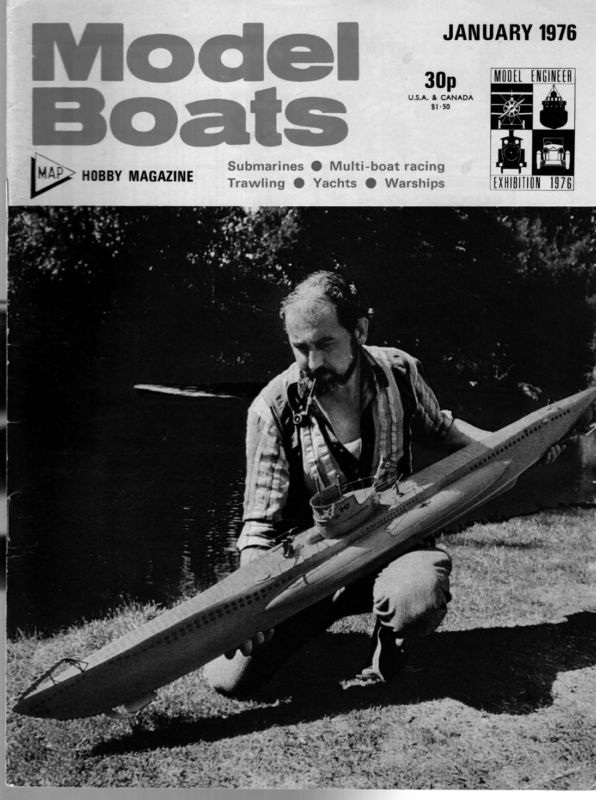
JANUARY 1976 30p U.S.A. & CANADA $1-50 Submarines @ Multi-boat racing Trawling @ Yachts @ Warships —_(OUEL Encinen
Ee MODEL BOATS A “Wee Six” from New Zealand Breer leg We fi = 44 A 1946 6- OME eighteen months ago I complet ed a 6m Class racing keeler of 1946 vintage and although an old design I consider it is still an attractive yacht. I found it an extremely interesting model to build and as the construction was a little different to the usual racing yacht methods I thought perhaps some details may be of interest. Having had an ambition to build a yacht with laminated frames and planked hull I decided that Kiltie would be just the job. The original design, published in ‘Popular Mechani cs’ in 1946, called for conventional ‘bread and butter’ construc- tion but I commenced by drawing up the station patterns and reducing the overall size by the thicknes s of the planking plus the thickness of the laminated frames, (a total of approximately in). Moulds were then cut from +4in thick timber, nailed flat to a building board and five white pine laminations, each approx. zin thick and }in wide, were glued together and nailed in position around the moulds. Frames Nos. 1-4, 6-9, and 11-13 had plywood ‘floors’ added to the bottom of the solid moulds and became part of the frames (see photos). When dry, the tre desi frames were cleaned up and sanded and set upside down on the building board. Fore and aft keels were fitted and on blocks fitted between frames 6 and 9 to accept the fin keel. Planking was commenced using 4in wide x fsin thick kauri planks which were shaped where necessa ry then edge glued and screwed to all frames (photo 2). The width of planks was reduced as the keel area was reached to negotiate the small radii in that area (photo 2). With the planking completed, the next step was to cast the lead keel which was done according to plan in a plaster mould. Imagine my disgust when I found the lead weighed 32Ibs and the class weight for the yacht was from 19]bs to 25lbs. Convinced that there was an error somewh ere I set about reducing the weight of lead to 19lbs then before fitting to the hull, a packing block was necessary between the lead and the hull to compensate for the lead I had removed (photo 2). When the hull was test floated (photo 3) the LWL was exactly where it should have been. Before adding the mahogany ply deck, the rudder post was fitted and provision made for R/C steering (photo 4) Photo No. 2, below left, shows construct ional method prepared as a display, presumably for a local exhibition. It’s clubs could well copy. Bottom right is Photo an idea that 4, showing the under-deck tiller for R/C. een 16
JANUARY 1976 Heading pictures opposite are numbers 6 and 7. A 6m afloat looks very like a small A Class yacht; it is much more sedate to sail, and for this reason may very well make a comeback to the model yachting scene. One factor against it is a rule which seems extremely complex at first glance. Photos at right are numbers I, 5 and 3 respectively. (Radio on rudder only has now been fitted). Oregon Pine mast and spars are used and all fittings are hand made from stainless steel sheet. Shroud Jines are from stranded control-line model aircraft wire and sails are red terylene full size sail cloth. Braine type steering was used originally, as per plan, until proportional radio was fitted. A sail winch is planned in the near future. Kiltie was built for fun sailing as there is no competitive yachting here at the time of writing. Although the construction is somewhat involved the end result has been worth it and she has received much favourable comment. ERHAPS an apt title for this particular article would be .. . ‘so you think youarea multi-racer ?? Anyone who has read Ian Boyle’s article, ‘When one man’s hobby is another man’s sport’, in the May edition of ‘Model Boats’ and can honestly say that this is a good portrait of himself, is indeed a true multiman. Yes, we are certainly a dedicated breed — how many other modellers could say they had got up at 4 o’clock on a cold Sunday morning, having packed the car the previous night, to travel half the length of the country to compete in a regatta? A multi-racer is prepared to spend a great deal of money on petrol to get to his destination, on glow fuel (it is not unusual to consume over one gallon at a single meeting) and he is probably running three boats, which is a very costly operation in itself. If this does not apply to you then perhaps you are one of the modellers who are causing a great deal of concern at present. The 1975 racing season has virtually drawn to a close and it is all over bar the shouting, and this year we seem to have plenty of that. The true multiman is concerned about the vast numbers of beginners, many with the latest equipment, appearing on the multi and speed scene. Through lack of experience they are damaging boats or, even worse (damage is repairable), the experts are finding it difficult to get their entries accepted at some regattas due to this increased interest. This in fact happened to me on a couple of occasions last season, and in one case I wrote four months prior to the event only to be told that all places were filled for the rest of the season. Most regattas are pre-entry these days; they have to be due to the large amount of paper work and organisation that needs to be done if the event is to run smoothly on the day. Commercialisation is one of the main reasons for this sudden popularity. Top Sailing is done on a pond of two acres area used by the Nelson Society of Modellers of which I am a member. Vital Statistics of Ki/tie: (Photo 7) LOA 654in Beam: 114in Draught: Height of mast above deck: Sail area: Weight: Radio: din 6ft lin 1115 sq in 27\|bs 2 function Futaba with FPS-3 servos MULTI TALK Kevin Musson puts the current multi-racing scene in perspective, reviewing 1975 class hulls and engines are now readily available to anyone (who can afford them). Unfortunately these people are jumping in at the deep end without first gaining the necessary experience. Individuals and organisers are realising that action must be taken now if we are toimprove on the present situation. One suggestion is that we should introduce some form of grading system. While this could be a good idea I feel it is only a short term solution to the problem. While a system such as this would work quite adequately for the coming season, what will happen at the end of next season when supposedly a number of the beginners have graduated to the ‘expert’ class? Once again we will be faced with more interested modellers then the average regatta can accom- modate. During my travels last season it was obvious that many of the boats were just not competitive and were not even designed for multi-racing. This was very true of the smaller events I visited, and in some cases it was members of the local club just ‘having a go’ at something new. A typical case is the beginner who enters a semi-scale cabin
1975 MODEL MAKER TROPHY Wit rather a crowded season, it seemed possible that the remarkable thing was the very low incidence of touches. this race would not be fitted in in 1975, but Clapham __A typical but particularly trying instance was Ian ‘Vulture’ MYC volunteered to stage it as a one-day event late in the Taylor, whose boat took 1 hr and-10 mins to get from one season, and arranged for it to be held in lieu of one oftheir end of this quite short lake to the other! club races on October 19th, a day on which the Long Pond As the morning wore on the puffs became more frequent had already been booked with Lambeth Council. and at one stage the fleet was able to sail quite briskly over As is usually the case for this race when held as a one day half the lake, only to become becalmed in the clubhouse function, a very heavy entry was received, no fewer than 31 half. At times there could be twenty or more yachts within boats, so there was little chance of getting right through the a few yards of the finishing line yet still there were very few card, even under ideal conditions. However, Clapham touches and only one or two that warranted a resail. With arranged with the Council for sole use of the lake up till only half a dozen heats sailed by about 4 pm, some out6 pm, when it would be nearly dark, and with an early start standing resails, and byes on the cards, it was extremely anticipated sailing a substantial number of heats. difficult to pinpoint which of perhaps a dozen boats was The day dawned flat calm, chilly, and misty, and though leading, and results were going to have to be taken on a the start was delayed till 9.30, there was little evidence of _ percentage-of-possible-score basis (for those unfamiliar, 5 any wind. A few puffs, generally northerly but getting points are at stake in each heat, so a boat which has had a round to easterly, occasionally moved the boats, but on the bye, in an uncompleted race, has a possible score 5 less than whole it was a slow and frustrating business, with boats other boats which have not reached their bye by the end of sometimes sailing on the reciprocal of the intended course; racing). Normally at Clapham, racing finishes at 4, and at this time several members of Clapham power boat club arrived and expected to run. The circumstances were explained to them, and Lambeth Council’s letter booking the pond till 6 pm was shown to them, but they would not accept the 6 o’clock time, as they had not been officially notified though they said they would not run till 5. At 5 o’clock the yachts were half-way through the 7th heat, with the prospect of completing 8 by 6 o’clock. However, the power boats went on the water and two yachts were soon damaged, one severely. The offending power boat had cut, but was retrieved by one of the club wading out to use a tennis ball cast by a fishing rod — in the middle of a couple of dozen yachts — and immediately restarted and put back in the water. Under these circumstances the race was terminated. An enquiry by the MPBA into the matter is due to take place, so the subject is in effect sub judice, and we propose to add no further comment at this stage. On calculating scores, it was found that two boats were tying for first place. This would normally be resolved by a sail-off, but one of the two boats had already been damaged, and with an increased number of power boats now on the pond, it was not felt feasible to try to sail off, so for the first time the MM Trophy will bear joint winners’ names. Prizes were awarded down to sixth place, with the customary MM Trophy additional awards for the furthest- travelled entrant (from Cleethorpes on this occasion) and Top, when sailing was at its best, but note how later boats are closing on the earlier ones. Left, above, ten minutes after the start the first boats had travelled perhaps 30 yards! Below, the two near boats have quite a breeze, but will be becalmed in 10 yards. Quite a headache for OOD Chris Dicks. 20
JANUARY 1976 This notice was prominently displayed twenty feet from where the power boaters started operations. ‘Reasonable casual use’ hardly includes using yachts as marker buoys! The third paragraph is interesting. the highest-placed boat to a published MM Plans Service design, which went to Alf Larraman sailing a Skippy. Despite the frustrations of so many boards becoming drifting matches, skippers had remained cheerful and optimistic, with much badinage flying about; the weather could not be helped. Divisional sailing would have offered no advantage, and the OOD’s decision to press on with the whole fleet and declare a result on whatever number of heats had been managed was generally agreed to be the only possible one. Perhaps next year, when the race will be held at Dovercourt pond, we shall see a spot more wind! Position 1= a 3 4 5 6= 6= 8 9 10 11 12 Boat Gollum Allegro Bilbo Baggins Luncheon Vulture Hiawatha Holly Bush Xerxes Honey II And They Laughed at Kristopher Kolumbus Pisces Black Arrow Hot Chocolate Skippy 13 14= Bernice 16 Tijuana 14= 2= 21= 21= Slipper IT No Imagination Lorandus Vulture W. Bell T. Leverton M. Peppiatt 24 23— 25= 27 28 Spanner Makari S. Sawyer 29 Copper Crystal 31 Pepper Pot 30 27/40 23/35 26/40 22/35 Stollery Pinner Witty Stollery Witty Stollery Stollery — C. Daniels 21/35 22/37 23/40 18/35 18/35 18/37 19/40 16/37 17/40 — 16/40 Taylor 14/35 —_ B. Draye R. Noble C. Clarke G. Hallums C. Williams W. Johnston 27/40 28/40 — . Clark Lady Brenda Aries IT Chunky Poppsy 2 Force 9 Gurr —_ R, Pinner A. Dransfield D. Warren C. Daniels 23/32 — R. Griffin J. Gilmour J. Slatter Taylor Witty D. Griffin G. Prior A. Whiteley Force 13 30/35 29/37 Dicks A, Larraman D. Warren Hare Today Goon Tomorrow Topsy Thrashing Machine Score 30/35 Dicks Briggs D. Pratt H. Briggs I. Taylor E. Carter T. Gurr 17 18 19= 19= Designer Seager Skipper P. Dunkling — Dicks 67.5 67.5 65.7 65 62.86 60 59.4 57.5 51.4 51.4 48.6 47.5 43.2 42.5 42.5 40 12/40 11/40 8/40 — C. Holden 71.87 70 17/40 13/35 Witty —_ — G. Soesan 85.7 78.38 14/35 14/40 14/40 12/38 Stollery Hallums Bantock vA 85.7 6/40 40 40 37.14 35 35 31.5 30 27.5 20 15 the wind changed rapidly. Sometimes the 45° close fetch was a beat with guying from about the middle of the lee bank. At other times the same trim would get one well up 1975 Southern District ‘M’ Team Championships (run by Guildford at Hove) Oct 12 A variable light wind greeted the early arrivals to the Lagoon, and its north-easterly direction raised the usual moan. This wind blows over the South Downs and the on the weather bank. As the race progressed, it became clear that Guildford’s two Bloodaxes were gradually drawing away from the other teams. They went on to win comfortably with Alex Austin and Roger Stollery finishing with identical scores of 63. This was not the top individual score as Chris Dicks scored 67 and underlined once again that there is no town before it gets to the lake and provides a source of power that is totally unreliable in strength and direction. In practice and the first couple of heats tall rigs were sported, but it was obvious that the gusts were increasing in strength. Working rigs and second suits were being used by substitute for light weight on the reach. Only a few resails mid morning because although the wind was generally light, 6-8 mph, the gusts were in the order of 15-20 mph and were necessary at the end to separate Clapham and Danson into 2nd and 3rd places. getting longer in duration, and it did not pay to be over- canvassed for such long periods. With 9 teams competing and 18 heats to complete the pace of the race had to be The 18 heats were completed after only 64 hours sailing and this reflects the keenness of the skippers and officials alike, and the perfect sailing conditions. half an hour was taken for lunch. 2. Clapham forced on by the O.0.D. Harry Godfrey and his keen officials. Resails other than those that could be completed easily within the board were left until the end, and only 1. Guildford The wind helped the speed of both the race and the boats. Downwind, with 135° on the vane and no spinnakers, the sailing was most exciting with vicious gusts blasting the boats up on to a plane or down into a broach. Quite sizeable waves were created by those prolonged gusts and the 3 leading scorers with their tall flared bows were able to press their boats comfortably without slowing down. Others went just as fast until their decks were awash and then slowed down just that little bit that makes all the difference. However, with this wind everyone was going well although a lot of retrims were required at times when 3. Danson 4, Southgate 5. Hove 6. MYSA 7, London 8. Poole 9. Welwyn 21 R. Stollery A. Austin __C. Dicks M. Peppiatt R. Griffin A. Larraman I. Taylor C. Daniels C. Colsell D. Daly P. Dunkling G. Hallums T. Gurr G. Soegan D. House A. House A. Whitely S. Sawyer 1977 1962 2111 2211 1717 1883 2090 2038 1851 2151 1838 2223 2158 1882 2142 1538 2138 1906 Bloodaxe Major B Illusion Lorandus Vulture Skippy Xerxes Luncheon Vulture 63 63 67 32 392 50 43 Thrashing Machine 434 Hiawatha 38 46 Hamster Gollum 50 253 Chunky Holly Bush Copper Crystal Cloud Nine White Rabbit Black Arrow Makar 1 36 264 30 32 31 4 126 99 391 2 861 . 84 751 “ 624 S 62 35
JANUARY 1976 PACEMAKER First impressions of Nylet’s kit for an RIOR synthetic sail materials; both these factors led to improved sailing efficiency and tilted the rule’s balance in favour of much longer boats with smaller measured sail area. A waterline length of 36in was quite normal in the 1930s, and 45in was quite daring in the immediate post-war period. In the *50s it went to 54-55in, and now 60-65in is normal. The rule basically relates the two main speed factors, waterline length and sail area, so that more of one means less of the other. The longer a boat is, the greater its potential speed, and obviously the greater its sail area the faster it should travel. We are in the position of having longer, narrower, and much lighter boats than the A class, carrying slightly less sail area but sailing noticeably faster. This appeals to a number of fit and enthusiastic vane skippers, but racing a modern ‘10’ in anything of a blow is physically quite demanding and this is possibly one reason why this class is only ticking over nowadays. The physical bit does not of course apply to radio sailing, and here almost certainly one attraction is that the class is relatively free from restriction and thus can encourage experiment. Apart from the length, transport is less ofa problem with a boat of, say, 25lbs compared with an A of 50 or 60lbs, so that it appeals to a skipper who wants something bigger than an RM but not too heavy, NE to the Marblehead class yacht, the 10-rater has rapidly established itself as the second most popular for radio. The rating rule under which it is categorised goes back as far as 1878, though occasional alterations have updated the rule and quite obviously present-day boats are vastly different from those of nearly a century ago. It is probably true to say that no other class was quite so greatly affected by the introduction of vane gear and Size of hull is apparent from picture above, for which we borrowed Suzan from our advertising department. Right, fittings etc. Radial jib mount (left foreground) bolts to conventional jib rack; pendulum-looking device right of centre is single receinine bolt for detachable in. and the boats have a long, lean grace that many find aesthetically pleasing. Some RM enthusiasts have mixed feelings about the RIOR, wondering whether the superior speed of the bigger boats will make RM owners dissatisfied, but in most cases a club member would be likely to have one boat in each class and transfer his radio according to which class was on the club programme. A fillip to the class must be given by the introduction by Nylet Ltd., of a kit for a competitive 10-rater, the Pacemaker. This is a modern boat with a 624in waterline
Ms ea MODEL BOATS (1590mm) which allows 1200 sq ins of sail. We have a sample of this kit which we will be building on a step-bystep basis; our initial reaction is very favourable, and having seen the prototype and one or two other finished examples sailing, we have no hesitation in recommending it. It is certainly the biggest model yacht ever kitted in Britain, with an overall hull length of about 78ins, but this need not deter anyone, since it is no more difficult to construct than smaller models and features a detachable fin and lead, so that transport is no great problem. One of the difficulties with a kit for a boat of a class measuring the waterline is that slight individual variations (in, for example, deck beam lengths) can produce a hull which, if built to a standard weight, can vary on the waterline by a couple of inches. With Pacemaker, the waterline endings are marked at an early stage and the boat is built to that waterline by varying the weight. It would, we think, have helped if somewhere in the instructions a general indication of an approximate weight had been given. Weighing the hull, deck, fittings etc, and adding the lead (a weight for which is given) suggests, with radio, a total of between 24 and 251b, which is a fairly normal weight for the class at present. This one criticism apart, first inspection, and the initial steps of construction which we have had time for, indicate that the makers have learned from their experience with the highly popular Moonraker Marblehead kit. Naturally the first impression is of the size of the hull (they always look much bigger indoors!) followed by the mast and spar material (anodised tubing) which is packed with three long lengths of timber for the inwales and deck beams. The piece of 4in ply for the fin, and the mahogany sheet for the laminated rudder, are fairly self-evident, as is the moulded glass-fibre deck, but the plain sheet of glass-fibre is bound to raise a mental query until the drawings and instructions are studied; it is used to make a box into which the top of the detachable fin fits. Fittings appear very complete, and we were pleased to see a lightweight but practical-looking jib pivot. The mast is deck-stepped, much as the Moonraker, with a nylon heelpiece and similar gooseneck and attachments to the earlier model. Bowsies and sheeting pulleys are included; there are in fact getting on for 50 bits and pieces for rigging and fittings, plus of course a finished working top suit of sails. Other bits of timber (for bow block, rudder mounting etc.), glass matt for matting in the fin box, wire and rigging cord, and much more detailed instructions and drawings than were supplied with the early Moonraker kits make Pacemaker very complete. All that’s needed is adhesive and resin, and the lead. The kit provides a grp half-bulb and instructions for using this to make a plaster mould. Alternatively, at an extra charge, ready cast lead half-bulbs can be supplied by Nylet Ltd. We shall be running photos and comment as our model progresses. Fifteen of the I8 entrants in the Moon- raker one design re- gatta run by Reading MYC on behalf of the kit manufacturers, Nylet Ltd. A very successful and enjoyable day. Scottish M Class Championships, 21st Sept. ’75 This event, held at Knightswood Park, Glasgow, attracted the good response of 18 yachts, from a wide variety of Scottish Clubs. No visitors came up from England to enjoy the day of strong top suit S.W. wind and sunshine, ideal conditions which enabled the OOD to complete the schedule in the day. The wind gave a beat to windward with a short leg near the line if the boat was sailed free, whereas a skipper choosing a tighter line risked a gust pushing the boat up to the windward bank of the hour-glass shaped pond. The top boats included two Prerodactyl designs, and modified Foxtrots featuring bulb keels, in this form looking remarkably like Witty Typhoons. Only one turtledeck hull disturbed the otherwise conventional deck fleet, and the winner Hughie Shields sailed a wood planked boat of 18/19Ib displacement featuring a fairly high freeboard, and deep 16in keel. The first and second boats opened up a gap at the top in the points, but there followed a bunch of close scores. confirming the close racing all day. Top six were: H. Shields, Greenock 76pts.; R. Mathison, EP MYC 7Ipts.; D. Cowie, Paisley 56; B. Stevenson, Greenock 52; B. Cowan, Glasgow 49: C. Jackson, Greenock 48. 6 metre Midland District Championship, Bournville, 21st September Nine yachts turned up at the lakeside for this event which is normally a Bournville (6)/Birmingham (3) battle. The wind came in from the west (Bristol Road end — for those that know the lake) but was of varying strength although the warm sunshine through most of the day made it rather pleasant, especially as all those taking part were in a happy 40
JANUARY and jovial mood — not a mutter, or a moan, about a red or even a blue flag being waved. It was one of those days when inconsistency was the rule. Some skippers started badly in the morning and then did quite well in the afternoon session and vice versa with other skippers. Racing started at 10.30 am and went quite well up until the lunch break. The usual resails occurred but the Guildford and the New Forest. There was also a strong entry from Reading. J. Wilds (OOD) and N. Curtis (Sec. of the meeting) presented the 18 contestants with a 6-boat schedule of 18 races. Racing commenced at 10.30 am and continued until 4 pm, with a break for lunch during which an invitation race for Pacemakers was held. This was won by N. Curtis with Tony Abel second. Whilst the RM racing was in progress the competing boats were judged for the ‘Concours d’elegance’ by Mr F. Parsons, managing director of Nylet Ltd., and by Tony Abel, designer of the Moonraker. Until the very last race the result was in the balance, with Jim Hill leading Maurice Smerin by 2 points. Maurice won this last race by less than a length from Jimmy and so they finished with equal points. In the sail-off Jim made a slow start and Maurice Smerin led all the way to the finishing line. The silver trophy donated by Nylet Ltd. was presented to Maurice Smerin by Valerie Abel, wife of the designer, with other prizes for the next seven places. Waterproof transmitter covers were awarded for the two boats judged outstanding in the ‘Concours d’elegance’; these were G. Kirkpatrick’s Tricolour and M. Smerin’s Snoopy IT. So ended a very enjoyable, though bitterly cold, day. attitude of the skippers was that they were there to enjoy themselves. Lunch time scores were: Blue Ice 21 Heather Oberon 10 12 Omega Exit (Possible 25) 13 12 Elvira (Possible 20) (Possible 20) (Possible 20) (Possible 25) 10 Treble Chance DonJon (Possible 25) 9 7 Helvig (Possible 25) (Possible 20) 6 (Possible 20) After lunch Blue Ice had a change in fortunes and only gained 3 points all afternoon. Oberon also changed her fortunes and gained a maximum in the afternoon. Exit and nha carried on as before, collecting a few and dropping a few. As the above boats were the only ones who stood to be in the prizes, it was only a matter of time to find out the placings — but no! — Oberon finished with 27 and had last bye and the nail-biting wait, Omega finished with 26 — and it came to pass that there were other battles to perform — Blue Ice had 24, with another sail, and Exit had 22, also with another sail. Unfortunately, Blue Ice failed to gain any points and Exit only gained the run — to continue the saga, Blue Ice and Exit now tied with 24, so a sail off (2 Beats and Run) was enacted and Exit came out tops. Ian Cooke sailing Treble Chance obviously did not have any porridge for breakfast, judging by his position anyway, and Bill Green with DonJon wished he had stayed at work that morning. Final scores as follows: 1 Oberon A. Geeson V. Bellerson J. Stowe Birmingham Bournville 3 Blue Ice P. Norriss Bournville 5 Heather R. Etheridge Bournville 2 3 6 7 8 9 Omega Exit Helvig Elvira Treble Chance DonJon B. Bull P. Salt I. Cooke W. Green Bournville Results: 1 2 M. Smerin J. Hill Guildford New Forest 4 Thorne Reading 7 Rogers Reading 3 5 6 Stocks Soper G. Kirkpatrick (18 entries). Reading Reading Guildford Manx MABC The Manx Model Aero and Boat Club held their 3rd Annual National Model Offshore race on Sunday, 14th September, in the Isle of Man. The venue for the race was to have been Douglas Bay, but rough seas on the morning of the race made it necessary to use our alternative venue the Mooragh Lake, Ramsey — a salt water lake at the north of the Island. Race control and the two chase boats had to be moved from Douglas, which meant that racing did not commence until 1.00 pm, in conditions which made for very interesting racing. Waters were rough and choppy, chase boat wash from the banks increasing this as the afternoon progressed. Class A (up to 6.5 cc) was run first. Entries were low, and the six laps of the course — being a total distance of some 4 miles — proved too much for the entries and a barrier seemed to appear on Lap 4. First out was Barry Hooper (Isle of Man) with his Opus 40, HP 40 rear, craft. Things were going smoothly until the beginning of Lap 5, when radio failed, leaving the model going in tight circles at full speed. Good handling of the chase boat saved this model 27 points 26 points 24 points (after sail off) 24 points (after sail off) 23 points Birmingham Bournville Bournville Birmingham 1976 19 points 14 points 12 points 11 points Nylet ‘Moonraker’ Regatta On Sunday, 12th October, at their Woodley Lake, the Reading MYC successfully held what we think may be the first one-design open meeting for RM yachts. Competitors came from many clubs, including Basildon, Cardiff, MANX RESULTS | Class A (up to 6°Scc) Ist 2nd 3rd Class B (6°55-10cc) Ist 2nd 3rd B. Hooper D. Corris B. Hooper M. Bontoft G. Atkinson D. Hanbury 4th B. Hooper Sth J. McCarten 6th M. Buss Three Minute run over shortened Course Ist D. Cooper 2nd B. Hooper 3rd D. Hanbury 4th W. Bumpus Concours D’Elegance Joint win by: “ oe a 1OM 10M IOM 4 laps | Buoy 4 laps 4 Buoy 4 laps Fleetwood [OM Porthcaw! 6 mins 55 secs 8 mins 57 secs 9 mins 46 secs 10 mins 39 secs I IOM IOM 10 mins 56 secs 17 mins 19 secs 19 mins 7 secs Porthcaw! IOM Sea Lion Rossi 61 Spearfish HB 61 IOM Spearfish HP 61 Porthcawl 15 mins 25 secs 11 mins 29 secs Sea Lion HP 61 Porthcawl, South Wales Manx Team Trophy (Team of 2 Manx entrants) Won by: B. Hooper J. McCarten Fastest Time of the Day and Winner of Offshore Challenge Trophy M. Bontoft (Fleetwood) Manx Challenge Trophy (For Manx Championship over 8 events) (Presented by B. Hooper) D. Corris 41 Sea Commander OS20 Manxman HB20 Opus 40 HP40 Rear Tiburon Rossi 61 Seaking Webra 61 Sealion HP 61 Spearfish HB 61 Huntsman HB 61 Huntsman Merco 61