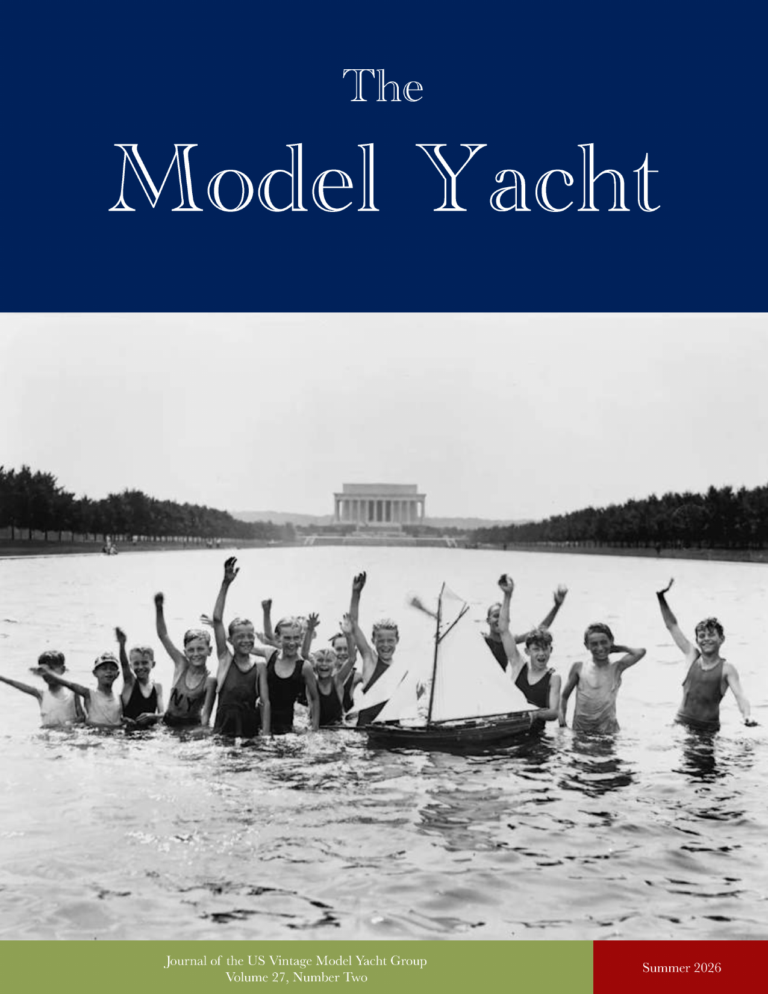
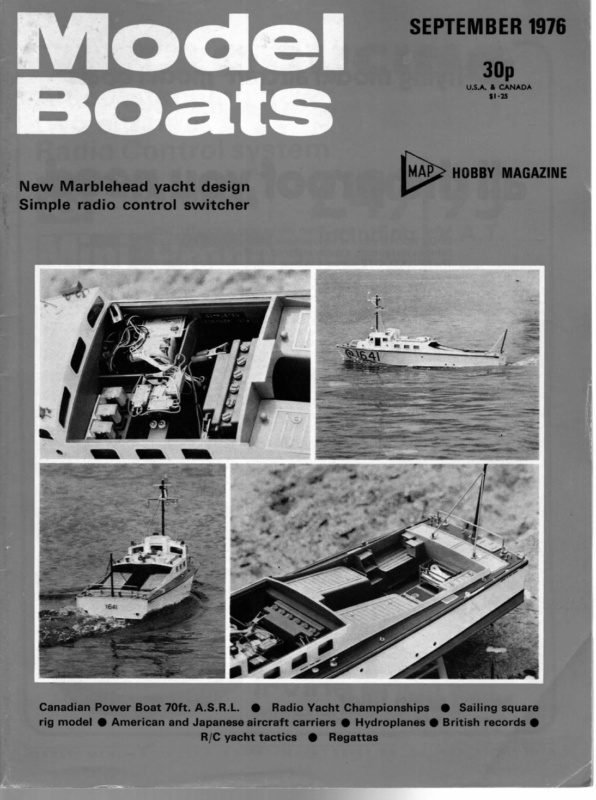
- 1976 RM Championship, Fleetwood, June 19/20 Report by George Burgess Photos by the Editor
- Introducing.. Two more faces put to names in the model game
- TARROO USHTEY A modern Marblehead with an unusual method of construction Part One By Jon Hudson
- 1976 Model Maker Trophy Dovercourt, July 3-4
- Starting Tactics A two-part guide to getting a radio yacht off to the best possible start By Larry and Niel Goodrich Central Park M.Y.C., New York
- Round the Regattas

MODEL BOATS 1976 RM Championship, Fleetwood, June 19/20 Report by George Burgess ) Photos by the Editor ff HEN it was learned that Fleetwood would be the venue for the RM Championship in 1976, it was with some trepidation that preparations for the event were initiated. By great good fortune, Peter Bryon, a skipper with extensive experience in most classes of dinghy racing, as well as skippering ocean racers, agreed to act as OOD for the event. A working committee was formed which allotted various tasks to be performed in advance of the closing date, 22nd May. Various forecasts of the probable number of entries were being made, which varied from 25 up to 80 boats. These forecasts filled the writer with mixed feelings, mainly apprehensive. It was feared that we might be overwhelmed by sheer weight of numbers. The receipt of 41 entry forms from Clive Colsell allayed to some extent most of these fears. It is perhaps not generally realised what an immense amount of work is required to stage a big RM event. Only work of a general type such as frequency boards, pennants and race-boards, TX compound, storage equipment, etc, can be prepared prior to the receipt of the race entry forms. In the 19 days left before the race starts, frequency allocations, race schedules, and race cards have to be prepared, racing numbers allotted, racing regulations formulated, buoy judge schedules prepared, master Scoring Lists plotted and other paper work designed and printed, regulations posted to skippers, prizes to be selected, paid for, and transported etc. The OOD in his report has suggested amendments to the rules, which, if approved by the MYA General Council, would go some way towards alleviating the pressure which builds up over the last few days in the run-up to the start of the regatta. On Friday 18th June, skippers were starting to arrive, in weather conditions which were truly appalling. Black skies, monsoon type rain, no wind; conditions could not have been worse. To try and practise sailing was virtually impossible, as with the wind coming off the land in irregular light puffs, no one could assess what the sailing conditions would be like for the regatta start. When the race officials appeared on the scene at 7.00am on the 19th, it was at once evident that we would get good sailing weather. The depression had moved away, leaving a westerly wind, speed about 8mph, and the promise of a fine sunny day. The morale of everyone rose to a point of cautious optimism. After the OOD’s briefing at 8.00am TXs were impounded and the first race made ready, so that His Worship The Mayor (Wyre District Council) was able to blow the start whistle promptly at 9.00am. All the yachts were able to sail using top working suits, waves being about 3 inches in height and wind west, 5-8mph. Heat 1 Race 1 saw the first appearance of Squire Kay in a National Regatta, sailing Seahorse MKII TC2. The boat, beautifully turned out, set the pattern for most of the following races. Making a good start, TC2 tacked round Buoy 1, claiming priority on starboard tack, and from then on, each buoy was rounded with a minimum of fuss, leaving TC2 a very clear winner. The same pattern continued, with the top skippers, using good sailing tactics and superior speed, rapidly setting the pace for other skippers to follow, David Waugh, Barry Jackson, John Cleave, Dave Andrews, Paul Metcalf (15 years), Eric Nuttall and Derek Stevenson all showing at the top of the score board. In Heat 2 Race 2 disaster struck TC2. In an increasing wind the boat went out of control at the first buoy and failed to finish; this mishap played a major part in the final result. The trouble was a loose rudder. With the increase in wind strength, the waves were beginning to build up and it was at this stage that inattention to waterproofing radio equipment began to rear its ugly head. Heading shows one of the things that made a difference as His | drives hard for the line as the start signal goes. Other boats are out of position, largely due to lack of manoeuvrability in the wind and waves. Left, top: Eskimo attracted attention; below: TC2 lost its chance when the rudder loosened. 310
SEPTEMBER 193976 Right, Pugwash came 4th and is a Seahorse. Contrast the hull bottom with that of the Squiblet below; this one is Oops, which withdrew. Nettle Rash to be sailed by Chris Dicks was a victim. This to me was a great disappointment, as I would have liked to see this designer sailing his own design against the boats of six other designer-skippers. During the first heats a new design sailed by Dave Hollom began to attract the attention of the more knowledgeable skippers. Eskimo is the second of a Tribal Class ‘RM’ the prototype being named Ashanti. With a wide beam (11-8 inches) deep fin and a slightly veed hull, Eskimo displayed an ability to carry a lot of sail in the freshening conditions, beating well and showing surprising speed when reaching and running. A number of these hulls are on order. I feel that it would make a change if the owners of these new boats would name them in the manner of the Tribal Class Destroyers. Apache, Sioux, Comanche, Cossack, Afridi, Waziri, Pathan, Ghurka, Zulu and Maori, are names which spring at once to mind. By the time Heat 6 Race 6 had ended the time was approaching 7.00pm and at this point the OOD decided to call a halt to the day’s racing, partly to allow skippers to Teacher’s Pet made some spectacular speeds on these legs, but suffered the penalty on the beat. The Editor made the comment, a few issues back, that a boat which heels past 45° is unable to steer well, because at that angle, the rudder becomes an elevator, and either lifts or depresses the stern So ‘“‘what is gained on the swings is lost on the roundabout”’. The leader position was changing about rapidly with His 1 holding on, but Kalamari, Pugwash, Ax-em, E Ecky A tighter start, if anything a shade too tight for the second and third boats over. Note all these have smaller sail suits and are sailing more upright, under better control. Thump, TC2, Red Hot and Teacher’s Pet were all breathing down Derek’s neck. With time beginning to run out, the OOD gave instruc- repair and test their boats and to allow time for skippers and families to prepare for the evening get-together at the tions at the end of Heat 10 Race 2, that there would be no more postponements of races due to faults on boats or radios. This decision had a vital effect on the outcome of the race. The skipper of Kalamari, Barry Jackson, found North Euston Hotel. At the end of the day, all the expected skippers were high up on the score board. Teacher’s Pet, Kalamari, TC2, Pugwash, Ax-em, and, surprisingly, His 1. Derek Stevenson had even surprised himself by sailing so well. Conditions really suited His / — plus good handling, of course. On Sunday, the officials’ day again starting at 7.00am, found very different conditions. Preceded by a few light showers of rain, the skies cleared and the sun came out, but the wind had increased in strength, with speeds of 15-18mph, gusting to 22mph. Wave height increased throughout the day from 6 inches to over 12 inches. Second suits of sails were, where possible, hurriedly fitted, and when sailing commenced at 9.30am the moment of truth arrived. Most skippers had prepared for the possibility that “Fleetwood weather’ might be met. Those who didn’t found themselves over-canvassed and with insufficient rudder leverage, and had great difficulty in tacking or gybing. Those skippers who came prepared with suitable sail rigs and water-proofed radios started to inch their way up the score board. Rather surprisingly Teacher’s Pet and Whizz Bang continued to sail with a lot of sail area aloft. This policy paid off on the reach and the run. The first and second boats, His | (top), a Squiblet, and Ax-em, a Blood Axe. Both taut craft, and above all waterproof! 511
MODEL BOATS Fashions in decks shown right, top Sunshine II, third Margo, both carrying superstructure, contrasted with, bottom, Asterix, well sailed by junior P. Norman. Second boat, in the fancy stand, is poo Rides Again, which already had one life as the vane boat Noddy. his sail winch had gone u/s, so chose to sail with the sails in the running position. In consequence, Ka/amari, sailing in a 3-boat race, could not beat to windward, so had to make a large number of tacks to get round the buoys. The result was that Kalamari ran out of time when about 15 yards from the finish, scoring nil points. Further experience will prove to Barry that in such conditions, asymmetric sail settings will pay off, i.e. set the jib to the beat position, and set the mainsail to the reach position. The loss of these 8 points ensured that after all resails were completed, His J and Ax-em tied for first place, and Kalamari and Pugwash tied for third place. Both sets of boats were required to sail a sudden death round. Kalamari and Pugwash had a very good race, Kalamari winning by about five yards to take 3rd place. In the sail off for Ist place between His /] and Ax-ema rather unfortunate incident took place. The situation, described in some detail, was that both boats made a good start and His J took up port tack with Ax-em on the same tack to leeward. His /, on port tack, sailed on until nearly at right angles to buoy 1. The boat was then put on starboard tack and sailed for the buoy in a reaching condition. Ax-em, which had weathered slightly on His /, also turned to starboard tack. His / was approaching buoy 1 but could be seen to be sailing rather wide. Ax-em, reaching at high speed, failed to establish overlap before four boat lengths. Both Derek and the OOD called ‘“‘no overlap”’. Ax-em, observing that His / was sailing wide, attempted to round the buoy on the inside, while His / at that point had not yet started to round the buoy. Ax-em then hit the stern of His / and was disqualified. There was some comment as to why His / failed to complete the course. The cause was found to be a displaced rudder due to the collision, making the boat unable to tack. Eric Nuttall and David Waugh tossed up for 7th place and Eric won. In conclusion, I can only hope that skippers enjoyed the regatta. We made some mistakes, but we really tried to make the 1976 RM Championship Regatta a success. Only the competitors can say whether we succeeded. The following acknowledgments are made to all those who did so much to help us. N. D. Hatfield, Vice President Whizz Bang sported a deep breakwater and very neat fittings. It’s another Squiblet. Centre, Red Hot also showed neat and tidy fittings but carries more on deck than the very clean Kalamari (bottom). 512
SEPTEMBER 1976 Boats really moved changing from reach to run at the far buoy. This is Whizz Bang – note dry after deck due to breakwater. MYA, Gosport MYC, William and Irene Windsor, the ladies of the canteen, Alan Youd, Roland Whiting, Bill and Richard Winstanley, Syd Ward, the junior members of the Fleetwood MY & PBC, Alan Prescott, D. R. Priestley, and the two people without whose aid the regatta could not have been started, OOD Peter Bryon and his wife Joan Bryon. RM NATIONAL CHAMPIONSHIPS 1976 Results Reg Place No 1 2 3 4 5 6 7 9 11 12 13 14 17 19 21 22 23 24 Yacht’s Name Owner Club 2281 His I D. Stevenson Basildon 2160 Pugwash P. Metcalf Bolton 2278 Ax-Em 2219 Kalamari 2070 2301 {2262 | 2059 {2057 Red Hot ‘TC.2 E ‘Ecky’ Thump Teacher’s Pet Pabri II 12102 Bloodhound 2277 Whizz Bang 2035 Frantica D. Andrews B. Jackson N. Charman S. Kay E. Nuttall D. Waugh D. Robinson R. Wild N. Hatfield J. Curtis 1596 Jayess L. Thompson (2330 Verve J. Mountain 1593 Noddy Rides Again A. Ott 2103 Blood Orange {2296 Asterix (1948 Knut (1997 Honey II | 2134 Clevelander 1985 Mellow Yellow Leicester Bolton Danson Bolton Cleveland New Forest New Forest Woodley Basildon Woodley 86 84 76 66 66 Mrs I, Windsor L. Anderson Fleetwood Cleveland Guildford E. Reynolds-Forbes New Forest 2351 Squiblet O. Lee Mrs E. Andrews 100 98 92 92 86 Birkenhead New Forest 2240 Margo 2018 Teazle 106 102 102 70 68 68 Woodley G. Taylor 106 New Forest Birmingham Basildon N. Curtis P. Norman J. Cleave Pts Leicester Basildon 68 60 60 58 50 48 46 25 2361 26 27 2294 Devastation 2133 Katarina 28 30 (2274 (2275 {2273 (2126 32 {2308 | 2358 34 2016 35 2132 36 2112 37 2359 Unplaced 2316 2317 2355 Eskimo Leeds & Bradford Fleetwood 44 42 Atalantis IT Repellant Iresta Ormesby Boy Nettle Rash Reflect M. Oxlade A. Oxlade N. Oxlade J. Soper T. D. E. G. C, B. Woodley Woodley Woodley Woodley 30 30 26 26 Lambda Banger Oop’s S. Colyer M. Colyer R. Walsh Leicester Leicester Fleetwood T. Jones Bolton Yimkin Midnight Oil Sunshine II Maggie Jane Non-starter 2224 VI Introducing.. BILL ISARD, in his middle twenties, is one of our most successful multi-racers; he met his fiancée (and now regular lapscorer!) Ann Bennett through European Championships in Czechoslovakia. He represented GB in South Africa in 1971, having won two of the eliminator races at Keighley, and has had numerous Ists, 2nds and 3rdsin national individual and team events since then, as well as being European gold medallist in FSR15 in 1971 New Forest Fleetwood Fleetwood Cleveland Birkenhead Fleetwood 32 18 18 16 14 12 10 Two more faces put to » names in the model game time to get around to meetings and collect some awards. GEORGE CLARK, in _ his middle forties and usually accompanied by wife Joan and 10 and 8 year old sons, is an exdraughtsman/engineer now a senior engineer with a firm of heating, ventilating, and air conditioning consultants. He, too, has experience of car building, since he built an Austin 7 Special for his first car. Has also been involved in car rallying and motor race marshalling, as well as having a long-term interest in the Scouts, not only as one himself but as a Cubmaster and Scoutmaster. Did National Service in the RAF, ending as a Pilot Officer radar His modelling started at the age of 9 with a Thames barge, moved for a brief spell to aircraft, back to sail with o/d 36in and 50in sharpies, then a Maree III to clubmate Bert Wilcock’s design. First successes at racing came with Fuller Priestley Low Anderson Dicks Helas Cleveland JCBs to landscape the garden, but they have still found and holding the 10cc endurance record. Keen on stamp-collecting, model railways, ice skating, supervisor. M. Butler Mrs K. Anderson tropical fish, and hot rod racing (he built a Mini saloon from all spare parts!) Bill started boating at the age of 12 with a Taplin Twin-powered cabin cruiser, and includes South London, Clapham, Bexley and Cygnets in his clubs. He is in business with his father, making grand excavations for the building industry with JCB mechanical diggers; he also did a grand job for model boaters at the lake at Darenth, using one of the diggers to remove an island. Other business outlets include poodle clipping and glass fibre work. For the last two years Bill has been involved in building a home for Ann and himself, including using one of the model boating, on the trip to the : D. Hollom a grp Witty Wasp (one of eight in Danson club, since following by batches of Bambis, Typhoons and Skippies) and grp contact with Ray Blick led George into sailmaking — he made those for the Warlord championship winner. First club was MYSA about 1954; has been a Danson member for about 20 years and sec for, he says, too long. Also joined Y M6 about 10 years ago and took on sec’s job there when no-one else would. Well remembers the terrible duo, Dicks and Stollery, chasing their boats as schoolboys in short trousers. George also had a spell as MYA Sec at the difficult time when the Constitution was revised and the 10r rules reformulated, and appreciates better than most the amount of work put in by MYA officials. Successes include 4th National M 1971, 2nd MM Trophy 1970 and 4th 1976, 2nd M & S 10r 1975, Ist M&S Team 10r (with Eric Carter).1973 and 2nd 1974, and most Danson and YM6 M and 10r trophies — sons are now sailing 36R and were 2nd and 3rd in 1975 National, with alittle helpful mating. Current fleet includes 2 36R (Dicks), 2M (Witty & Stollery), a 10r and an A (both Seager designed), and the Clark caravan (following earlier interest in car touring and camping) is a frequent sight at races. 513
a MODEL BOATS TARROO USHTEY possess, tenon saw, coping saw, hacksaw, Surform, sharp knife, screwdriver, and hand drill. All the materials required are obtainable from a model shop or DIY shop. The method of construction used is an updated hybrid of two methods described by Roy Griffin in Model Racing Yacht Construction, an MAP book costing £1-75 plus postage and packing and well worth buying. The first operation is to trace the hull outline, including fin, skeg, king plank, backbone, and if so desired a handle, A modern Marblehead with an unusual method of construction Part One By Jon Hudson on to a FLAT sheet of in marine grade plywood 4ft 6in x 2in. The excess wood between supporting struts is removed with a coping saw and the whole outside edge ‘“‘surformed”’ smooth (Fig. 1). The backbone from A-B and C-D is If the name puzzles you, it is that of a legendary Manx water bull, of which the local people in past ages went in fear. We understand that the nearest translation comes out as “nondescript creature”, which hardly applies to this smart-looking design! HEN I undercut by ;;in to allow for planking. The fin was surformed to the desired section, and the skeg also, its thickness being reduced to #;in. This method ensures the fin and skeg are correctly aligned providing the sheet of ply is not warped. The unshaded area a-a was surformed to a width of +;in at the edge to facilitate planking the fine bow. recently moved from the Isle of Man to Bedford, I was not able to participate in my favourite sport of dinghy racing, so I decided to widen my interest in model yachting to a competitive sphere with Wickstead MY & PBC Club. Rather than buy a proven glass fibre hull I decided to design and build a boat based on the recent developments in both model and full size design, of which Il am a keen follower. The design has had a reasonable success with four firsts and a second in the five club races completed at the time of writing. This, of course, does not mean that this is anywhere near the ultimate in hull development — neither buying a Blood Axe or an orange box is an instant passport to success. The boat was designed with heavy wind conditions in mind, as I am of the opinion that skipper skill and temperament are of greater importance in light air. The salient features of the design, light weight coupled with high ballast ratio and the bow knuckle, contribute to a good heavy weather performance. The bow sections are extremely fine, with the water line being almost a straight line from the bow to section five, and are of U section throughout. Recent experiences with models have shown this arrangement to be beneficial for windward work. The aft sections, while flat, are also reasonably fine at the stern. The freeboard, especially amidships, is a little greater than most recent designs, but this reserve of buoyancy will be useful in keeping the decks dry downwind in a blow, although its presence is possibly a sign of the designer’s relative inexperience with model design. The bow knuckle is not new, having been seen on the latest very successful designs by Messrs Dicks and Stollery. Anyone who witnessed that 1975 World Championships at Fleetwood will not doubt its effectiveness. The raked forward keel came about by accident rather than design. The original design had a vertical keel, but subsequent trials showed that the CG of the lead was a little too far aft. During the Midland District Team Championships I picked the boat up rather too violently by the keel and the internal supporting beams failed, leaving large cracks in the hull and the keel swinging fifteen degrees either side of the vertical. The boat completed the meeting covered with rolls of insulating tape and usually half full of water, which did not help performance. This disaster produced no sympathy from other competitors, but only misinformed comment that this was a new innovation of the self-aligning always-vertical keel, but possibly infringing Rule 4c (movable or shifting ballast). The new keel arrangement put the CG in the right place, and if Paul Elvstrom is to be believed, can improve windward performance. A moderate draught was chosen as Wickstead pond is only 15in deep and the boat at present will just float in the average family bath for initial trials! Any reader who fears that a 15lb boat with a 11-7lb lead can only be built by a glass fibre expert may rest assured that this is not the case. The prototype was built on the floor of my bed sitter, using tools which most people Fig. | The bow blocks and transom are cut from the ply to the plan shapes, allowing +;in all round for the thickness of the planking. The notches are to accept the inwale (Fig.2). At this stage a drain hole may be drilled in the transom if so desired. Check that when the transom is in position the overall length of the backbone does not exceed 5O}in. Check that the bow blocks and transom are at 90° to the centre line before gluing with Cascamite or Aerolite 306. An epoxy glue could also be used, this will cut down building time, but increases the cost. It is advisable to decide whether a keel or deck stepped mast is to be used at this stage. I strongly recommend using a keel stepped mast and will explain why in a later article. A plate of 20 gauge aluminium 3in < fin was cut and tin holes drilled on }in centres. This is epoxied to the backbone between b-b (Fig. 1). A mast gate is made at deck level by cutting out the plywood kingplank above the mast step and gluing two pieces of spruce in position (Fig. 3), to take 4in OD mast tube. Fig. 2 Recess 3s" wide Yq" deep Two reinforcing pieces are cut from the ply and glued either side of the strut above the rudder skeg. A 3in hole is then drilled and the -%in ID tube may be epoxied in place. The frames are cut from the remaining plywood. These are undercut jin all round to allow for the planking. Notches are cut at deck level on all frames to accommodate the tin square spruce inwales (Fig. 4). A block of wood 4in x lin x 2in is then screwed in position on each frame as shown. The wide slot is then cut in the frame; this 516
SEPTEMBER 1976 the hard turn of the bilge to the bow. The planks were butt glued to one another and to the bow and transom using balsa cement. This is not as strong as the glues previously mentioned, but it is relatively cheap and quick drying. While the glue is drying, hold the planks into position with adhesive tape, map pins and clothes pegs. After about eight planks each side have been glued into position it will be found that the planks will not sit on the frames properly because of the double curvature put in them, so Aluminium plate ooo eS Fin locates on the backbone. A vertical saw cut is then made from the slot to the base of the frame. This enables the frames to be easily removed from the planked hull in two halves. Frames 1-9 are then set up onto the building board of blockboard 4ft x 6in = #in, five inches apart. It is essential to ensure that the centreline of the frames are in line and that the frames are all square to the centreline of the building board. The backbone can now be located in the slots in the frames. Note that frame 5 has to be built specially, to accommodate the wider mast gate. The inwales are lengths of spruce 4ft 6ins long and }in square. These are located in the frames and glued at the bow and now start planking from the sheer strake. The space between the two lines of planking is filled by shorter preshaped planks known as stealers. This method is not normally considered good practice but as the hull is to be covered with tissue it is quite quick and acceptable. The prototype was planked in a weekend. However, the planks had been cut and joined beforehand. When planking is completed remove the hull and shadows from the building board ready to fit the ribs. The ribs on the prototype were made from newspaper strips rolled into tubes and soaked in Cascamite. These are laid inside the hull at five inch intervals. A less messy and probably stronger alternative would be to use glass fibre tape or strips of glass fibre chopped strand mat, stippled with resin. The hull was now sanded down using a medium/ coarse dry sandpaper, followed by medium/fine. Any cracks or indentations are filled with Polyfilla cellulose filler, which is very easy to sand. It is not waterproof, but as it is covered by the final coating and paint it is well Fig4. Detail of shadow screwed to building board _*/e slot for back bone transom and taped into position while the glue dries. Any overhang at bow and stern may be cut off when the glue dries. The hull was planked using 4in balsa wood; before becoming alarmed, read on! Planks were cut 4in wide from. 36in x 4in lengths, which means they have to be joined. Contrary to recommended practice, I prefer to start planking from the garboard strake. The first two planks on either side were cut tin wide to accommodate Saw cut " to split.—_ % notches vafor inwales. Backing block . l vit 2 J neg pt COPIES OF THE DRAWING BELOW ARE AVAILABLE REF. MM 1221 FROM MODEL MAKER PLANS SERVICE X 35, HEMEL HEMPSTEAD, HE RTS HPI IEE, PRICE 85P INC. VAT AND POSTAGE. NOTE THAT NO STRUCTURAL DETAIL IS GIVEN ON THE DRAWING. im),
i smooth hull has been produced sand with 400 grade wet and dry and re-paint. Then, when this is dry sand with 600 grade wet and dry and in a dust free atmosphere apply the final coat. Should any insects with suicidal tendencies land on the wet paint allow them to complete their writhing death throes before picking off with tweezers. Leave the hull for at least seventy-two hours to dry harden and then polish with burnishing cream or T-cut. The prototype had two layers of tissue and eight coats of paint, thinly applied and then almost rubbed away. This can provide a super- lative finish but does take time — don’t rush. The deck edge was scraped of paint runs, then the deck was sanded and given two coats of enamel. The hull should now weigh 2lbs to 2lbs. protected. The fin and skeg are also sanded. The shadows are now removed from the hull, after the backing blocks have been removed and the shadows split. Longitudinal stiffeners may be fitted on the flat after sections. By accident I discovered that “‘Joy” balsa wood filler did not set to a reasonably soft texture as I expected, but sets rock hard. In view of this I did not use it to fill the outside of the hull, but squeezed runs of it onto the inside of the hull, where it set into a solid stiffener. The inside of the hull was given several coats of paint to waterproof it. The deck beams were then fitted. These were cut from 4in square spruce and served two purposes. The first to provide strengthening beams to distribute the strain of the rig and keel about the whole hull. Two pieces of wood 4ins x din x fin are glued against the planking up against the inwales to take the screws from the shroud chain plates. The general arrangement of deck beams is shown in fig. 5. The second purpose of deck beams is to provide a base for screwing down the various deck fittings. A oe is glued adjacent to the transom to take the vane pintle. The deck was made from #;in balsa wood. The deck has no structural value; its only purpose is to keep water out of the hull. Alternatively it could be made from jin (0-8mm) ply or thin plastic laminate which has the advan- tage of not requiring painting. Before gluing the deck into position with Cascamite, Aerolite or epoxy, MAKE A NOTE OF THE POSITIONS OF THE DECK BEAMS. I subsequently lost this information and it took much brain racking and drilling many holes in wrong places before I found the position of the beams to screw down the deck fittings. The next job, coating and finishing the hull with model aircraft tissue, was the most tedious part and required the most hard work and patience. Glassfibre tissue is easier to apply and provides a stronger hull, but is much heavier. I would not recommend just painting the balsa, as a scratch will result in the soaking up of a good deal of water and the hull may not be strong enough to withstand an accidental collision. The first layer of tissue was applied using cellulose dope. The tissue should be applied in small areas rather than as one large sheet, to try to avoid ripples, and the dope should be stippled rather than brushed on. Also apply one layer to the deck, which may be fitted in one piece. The second layer on the hull was applied using paint instead of dope. A one-can polyurethane was used throughout painting and has provided an eminently smooth finish. The hull once smoothly sanded balsa, is now probably a mess with the coating not at all smooth but with ripples and creases everywhere. Fear not, the work now begins as these have to be sanded out and any gaps or hollows resulting from too vigorous sanding filled with ‘“‘Plastic Padding”’, elastic type, or similar waterproof filler. Start with a coarse wet and dry paper (120 grade). Do not try to rush this job by removing all the ripples at once but reduce thema little at a time and paint between each sanding. When at last a Fig .6. The rudder was made from a piece of plywood Surformed to section and of maximum thickness in. This was epoxied and screwed to a 10in length of #,in OD brass tube. It was painted and positioned using a brass pintle (Fig. 6) screwed into the bottom of the skeg. The next job is to mould the lead. The methods of moulding or building up a lead bulb are described both in Roy Griffin’s “Model Racing Yacht Construction” (available from MAP, £1-75 plus postage and packing) and in Vic Smeed’s articles in Model Boats (early 1974) on building his Genie design. Both the works describe the methods with more clarity than I could and if a builder is in any doubt of the techniques I recommend reading these works. I cheated by using a lead of the right weight from a previous boat! The weight of the lead may vary between 11 and 12lbs, depending on the size of the locating slot moulded into it and will allow for variation of hull and fitting weight. The required weight of lead is of course found by adding together the weight of hull, fittings, rigging, mast and sails and subtracting from 15lbs. If the model is to be sailed on salt water allow a displacement of 15lbs 60zs to allow for the greater density of salt water. The lead is located on the fin with a bolt, preferably stainless steel. Any join line between fin and lead is filled with “Plastic Padding”. This is sanded smooth and the lead is then painted. The final job is to fit the bow bumper. This is made from cork or rubber and shaped to the bow section. It is glued on with impact adhesive and sanded and painted. The hull is now complete. The particular method of construction has proved to be an excellent method of building a hull of light weight without resorting to glassfibre construction; it is entirely practical and has stood up well to racing, but +;in balsa would not be suitable without the internal stiffening and finishing treatment described. As the late Uffa Fox said “Weight is only useful to the designers of steam’rollers”’, and the weight is comparable to the latest hulls used by Messrs Stollery and Dicks. The impact strength is a little below that of glassfibre but the hull is stiffer. I think this is important, expecially in heavy weather, and it certainly is the subject of much expensive research in dinghy classes. However, the major point is that an incompetent woodworker (such as I) can produce a competition hull with the minimum of tools on a kitchen table (or bed-sit floor). Next month I will describe the fittings needed and in- clude some notes on masts, sails and tuning. 518
SEPTEMBER 1976 Model Maker Trophy “WENTY-ONE boats assembled at Dovercourt for the 1976 Model Maker Trophy, started at lunch-time on Saturday, 3rd July in a pleasant north-easterly breeze and warm sunshine. OOD Stan Pepper of Nelson Gardens MYC aimed to sail the complete tournament but reserved the right to declare a result on heats sailed by 4pm on Sunday. For a time on Sunday morning when the wind fell very light, virtually to flat calm at one point, it looked as if about 15 heats would be the limit, but the wind came back up again from the same corner and some brisk sailing was possible. There were possibly no surprises in the sailing with the exception of the winner. The top boats in general started to go ahead after the first four or five heats and although there was the usual chopping and changing of the front runners (only 10 points covered the first ten boats at the finish) the feeling that Bilbo Baggins was likely to win began to come through. Alas, a disastrous spell of only 3 out of heats 14, 15, 16 occurred while Hai Karate, a new boat, was obviously settling down and made the possible 25 out of her last five heats to draw level. There was also a tie between two Danson boats for 5th and a three-way tie for 8th, though the last need not be resolved since prizes went down to 6th. Top, Hai Karate is a development of John Buttigieg’s earlier Exocet. Seen on the crucial tie-break run against Bilbo Baggins in the second picture and, top right, sailing Blue Shark. Second right, Bilbo Baggins leads Fenlander, third is Banana Blush, 3rd place tite sailing Poppycock. Bottom, fourth placer Tijuana and Naughty ulture. 1976
MODEL BOATS Far boat is Xerxes, which placed fifth, near one is Green Vein Below, far boat here is 6th-placed Skippy, sailing Masai. Sail num- bers show that over 450 Marbleheads have been registered in the last two years! The OOD employed the accepted two beat/one run tiebreaker, and B.B. was unlucky in picking up a plastic bag and losing the first beat; the officials treated this as “the rub of the green’’, to borrow a golfing term. Karate then lost the second beat, so it was all on the run, which went to the Isle of Wight boat. Both top boats were designed by their skippers, in third place came a Blood Axe, fourth another Stollery design (Blood Axe’s grandfather!), fifth the same Skippy as won the prize last year for top-placed MM design, and sixth another Skippy. The rest of the fleet was equally a typical assortment of o.d.s., glass hulls, wood ones, etc, with one common denominator in that every boat was fin and bulb. Thanks are due to the OOD and to Doug Pratt and Messrs Olley, Cann and Pugh etc for the work put in, as well as the ladies who cheerfully kept the tea and sand- wiches etc flowing all day. 1. 2382 Hai Karate J. Buttigieg Ryde 73+ 2. 1794 Bilbo Baggins H. Briggs Cleethorpes 73 3. 2211 Banana Blush C. Williams Basildon 70 4. 1915 Tijuana G. Clark Danson 69 5. 1863 6. 1717 Xerxes Skippy A. Larraman R. Griffin Danson Danson 66+ 66 7. 2090, Luncheon Vulture, 64; 8. 2089, Poppycock, 63; 2368, Green Vein, 63; 2390, Ood’s Ood, 63; 11. 1659, Blue Shark, 61; 12. 1469, Apache, 44; 13. 2282, Molly Blobs, 43; 14. 2379, Fenlander, 39; 15.2214, Poppsy II, 33; 16.1960, Allegro,32; 17.2067,K. Kolumbus, 31; 18. 1906, Makar, 30; 19. 2380, Masai, 26; 20. 2267, Naughty Vulture, 21; and 21. 2233, No Imagination, 18. Derek Priestley’s visit to South Africa The following day a radio control RM Class race took place. 8 RM yachts took part and six boat racing was held. Derek sailed every yacht in turn and thoroughly enjoyed South African model yachtsmen were really pleased to welcome Derek Priestley to South Africa during his short holiday in May. He was met in Johannesburg by Keith Mackey, Vice President of the Model Yachting Association of South Africa, together with Bill van Zyl from the Transvaal Model Yachting Association executive. The following day he attended a club meeting of the East Rand Model Boat Club and sailed different RM yachts belonging to members. He was able to give a lot of advice and help to the skippers which will be of benefit in time to himself. sauseze and chips! In his speech of welcome Keith Gerson stated that it was an honour to entertain the Commodore of Fleetwood Model Yacht and Power Boat Club and the first time a visting model yachtsman had been able to present the prizes to our club members. Derek in his reply stated how much he was enjoying the hospitality and remarked on the wonderful facilities available for model yachtsmen in Durban. said he felt the standard of was pointed out to him that there were a lot of new Marbleheads being built for next year’s second SA Marblehead Championships, when Wally Jones will be defending his title and Chris Dicks will be challenging him. Derek stated that he hoped that he might be coming out himself to race and that other top English skippers were showing interest. It is hoped that this 4-day Regatta come. He then motored with friends to Durban for a week’s stay and a welcoming party was held at the home of the MYASA President Keith Gerson where he met officials of the Durban Model Yacht Club. On the Saturday a vane race was organized and 8 Marbleheads came to the line, Derek sailing Garth Thompson’s Prerodactyl, Will to Win. race was sailed in tricky conditions in a light south westerly wind giving a reach and fetch course. Derek ran out the winner with 26 points, seven points ahead of Robbie Coulon sailing his J//usion. On the Saturday night the Durban Club held their @mmue! prize-giving and Derek was introduced to a typical South Afmican party called a ‘Braai’ where everyone Stamds arownd an open fire and cooks his own steak, Afterwards he sailing in the radio control section was higher in comparison to English standards than the vane yachts he saw. It will attract the top skippers from overseas who, together with the best in South Africa, will undoubtedly make for one of the finest ‘M’ Class Championships ever to be held. M. Colam. THE BOAT ON THE COVER This Thornycroft Range Safety Launch was photographed at Lake Rotorua, in the thermal district of New Zealand, by its builder, John Heald. Built from MM plan No. 412, the colour scheme is based on the cover picture of 1641 on April 1969 Model Boats, and the model won a local concours award in 1975. Power is two Mabuchi 85s (like Orbit 805s) running on 12v, and McGregor 1+1 radio is fitted. The N.Z. M.M.A. has introduced two classes of scale judging, incidentally, Class 1 for absolute scale models and Class 2 which is judged at a distance of 10ft., the latter to encourage younger or less experienced modellers. 522
Ie e ||| MODEL BOATS Starting Tactics A two-part guide to getting a radio yacht off to the best possible start By Larry and Niel Goodrich Central Park M.Y.C., New York 1, Keone otherwise good skippers have trouble getting A good start involves three basic elements: (1) good position, (2) good timing and (3) good speed. good starts, and the explanation may be that they tend to “clutch up” in the tension of the pre-start count- Good position means simply that, when you cross the line, you are in a good position to work to windward as down and forget, or do not understand, the basics of starting tactics. The mail in response to our article on you have planned. windward tactics (‘Working to Windward’’, December, 1975) was so appreciative that we are prompted to make a few suggestions to make the starting process easier for the average skipper. Although the start seems shrouded in mystery, on analysis it turns out to be one of the easiest parts of the R/C course. (And the only part where the novice gets a fairly even break!) By definition, nobody is ahead of want to. Conversely, a bad position may have you severely blanketed by windward boats, subject to being luffed up by a close leeward boat, and/or unable to tack to the side of the course you feel is best. (Naturally, this example does not exhaust the list of all the potential disadvantages of a bad position at the start.) Good timing is a rather obvious concept — you want anyone else. Superior boat speed does not count until to cross the line just after the starting signal. However, after the start. The rules at the start are much simpler than those that come into play later. And the tactics and timing can be worked out calmly in advance. Thus, in theory, starting should be simple, and we hope to demon- the penalty for being early is very severe — you must recross the line and give right-of-way to all the others. If you get squeezed in the pack, it may take you an agonizing long time to clear to recross. Thus, it is prudent to plan to be a fraction late instead of being too aggressive in your timing. Although it is obvious that it is important to start any race with good speed, many skippers seem not to understand that good boat speed can very often compensat e strate that it is. The excitement of the countdown is such that there is strong tendency for all of us to tense up and to forget the obvious. For example, to forget that a perfectly timed Start is often not even a good start. The crowd may applaud the perfectly timed start, but you get no points for not-so-good timing and not-so-good position. With for crossing the starting line first, and a perfectly timed good speed you may be able to slip past a slower starter start which leads you in a bad position, hopelessly blanketed, is a very poor start indeed. In fact, a poor start is often an insurmountable handicap, leaving you in dirty air at the back of the pack, forcing you to tack and then to work your way laboriously up through the fleet. On the other hand, a less than perfect start — a good start — usually will leave you up in front in clear air with room to manoeuvre and with only several boats to overtake over the rest of the course. The disadvantage of the poor start may so far outweigh the advantage of the perfect start that the average skipper should probably concentrate his efforts on avoiding poor ahead of you, even sail right through his lee. With good speed you can maintain the crucial manoeuverability you need to work through the traffic. The key to maintaini ng boat speed at the start is to keep your sails pulling and to make your manoeuvres as smooth as possible so that you do not stall out. Of course, in a steady breeze you do not need full boat speed as you jockey about to kill time, and many skippers in an effort to avoid getting too far away from the line will let their sails luff and keep just enough headway to be able to avoid the traffic in a leisurely way. It is only in the last few seconds, when you make your final drive for the line, that you have to try to achieve full boat speed. Which boats actually got the good starts often cannot starts and should strive for nothing better than getting good starts consistently. (Perfect starts result from a combination of skill and luck, and they should come along in fair share in due course.) In tightly contested regattas, consistency is often the key to winning. How many times have we seen a skipper with consistent seconds and thirds win over other skippers with several brilliant firsts coupled with some disastrous finishes? Consistency in getting good starts may be even more important than consistency on any other part of the course. A few skippers thrive on catch-up racing, but most prefer to be up front in clear air with room to manoeuvre and to set their own course, while keeping pressure on those behind. It also means that you have clear wind, right-of-way if you need it, and room to tack if you be determined until after a minute or so when the fleet has spread out to windward. By then, the blanketed boats will have dropped back, and the boats with clear air and the favoured tack will have pulled ahead. In studying starting tactics, it is a good idea to watch a series of starts until the leaders are established up the windward leg and then think back to how and where they started to determine why they are out ahead. It is, of course, easy to understand that a good start requires good position, timing and speed, but it is devilishly hard in the tense countdown to keep all that in mind and to execute your objectives calmly. Here are two 534
SEPTEMBER 1976 Opposite, another group of yachts see-sawing up to the line at the RM Championship. Starboard start buoy is visible near mast of left-hand yacht. suggestions to alleviate this problem we all face: (1) practise your timing beforehand and (2) plan your position options well in advance, in both cases by yourself at a leisurely pace during the warm-up before the racing begins for the day. Both projects can be fun and relaxing, in contrast to the unnecessary tension you may build up if you aimlessly mill around below the starting line in the traffic. To start, some skippers like to hang just below the line in a semi-stalled state until a few seconds before the start, when they sheet in and drive for the line. That is a typical dinghy tactic often used in enormous fleets where it may be necessary, but we feel that is very risky for the average skipper in model yachting, where the fleet seldom ex- ceeds 12 boats. The risks are that you may not have enough manoeuvrability to give right-of-way to another boat (incurring a stupid foul before the race) and you may have too little room to accelerate up to good boat speed or to slow down if you are early. We much prefer timing the start in the traditional way. First, you choose the spot where you would like to cross the starting line, which we deal with below. Then, starting at the chosen spot on the line, you sail away from the line for, say, 12 seconds, tack or gybe smoothly (noting the time it takes to complete this manoevre and to recover), and then return on your highest point back to your chosen spot on the line (noting the time on the way back). Your figures might look like this: 12 seconds out, 4 seconds to tack and 16 seconds back for a total of 32 seconds. Now you know that, if you repeat this loop 32 seconds before the signal, you should get back to the line at the signal. (Knowing the time for each of the parts of the loop will help you to compensate if you run into traffic.) Tne actual time you use for the loop does not matter much — many skippers would consider a 32 second loop too long. Just find a loop time that you feel comfortable with for the conditions of the day and practise it. Whatever size and shape of loop you use, it is essential that your heading on the way back is such that you can make the spot you have chosen on the line without pinching or dropping off too much. Timing the start in this way takes considerable practice, and you must force yourself to do this before every regatta. Your timing will get rusty from one weekend to the next and wind conditions are never precisely the same. We have left for last the problem of choosing the spot to cross the line because the concept is a little more complex and hard to visualize. An understanding of it must be built up from some theory and examples. Position may not be everything in the start, but without good position you will always be in trouble, boxed outside one a marks, caught in a tie-up of several boats, and so orth. Obviously, you want a spot which will allow you to take the shortest course, if there is one. That is just as true in a horse race around an oval track — every rider would prefer the inside post position, or at least to get to the inside rail as quickly as possible, to take the shortest course. In a model yacht race, there is the equivalent of the inside post position and the rail, but it is hard to visualize because there is no rail and the windward leg is not an oval but a zig-zag course. Like the jockey, you must keep an eye out for the shortest course and that means trying to start as far to windward as possible or at least to get into a position so you can take the favoured tack to windward as soon as possible. (The latter is a windward tactic explained in our prior article.) Keep that idea in dee as we proceed to take a look at the starting line itself. Cc How good are you at analysing starting situations ? Test yourself on the following questions: (1) Is there a favoured end to the line? If so which and why ? (2) Which two boats seem to have pretty good positions and why ? (3) What can Boat C do to improve his position? (4) What disadvantages does Boat A have? (5) Why is Boat E in trouble? If youdo not know some of the answers, the text may help. Here in North America the length of the line is normally set up to be roughly equal to the combined lengths of the boats in the heat, say 8 RMs for a total about 33 feet. At first glance, that looks pretty long and there seems to be an almost infinite number of approaches and spots to cross. However, remember that boats racing to windward can only sail at about 45 degrees off the wind and so must cross the line at a considerable slant, which greatly cuts down the area in which to manoeuvre. Still, as you look at the line there are many possible places to cross it. How do you choose the spot? There is no easy answer but there are some general guidelines to make the choices easier. First, since you will be in traffic, you normally want to approach the line on starboard tack so you will have right-of-way. That establishes your slant from starboard to port in your final dash for the spot you have chosen but not the spot itself. If you can find a spot on the line which is to windward of the other spots, naturally you want to head for that. Race Committees try to set the starting line square to the wind (or lightly favouring port tack to discourage too many from starting on starboard tack), but in practice the line is seldom perpendicular to the wind so that one end is normally closer to the wind. Not too well understood is the proposition that on many courses if the line is only 10 degrees off the perpendicular, one end of the line may be as much as two full boat lengths closer to the wind than the other! (If you have trouble seeing this, try plotting it on graph paper.) Starting from the windward end can give you an enormous advantage when you consider how hard it is to work that much to windward of another boat after the start. (to be continued) Good starters have to be able to analyse starting situations quickly as they develop. How quick are you with these? (1) Which end is favoured? (2) Which two boats have pretty good position if they are not early? (3) What should Boat A do? (4) What are the advantages and disadvantages of Boat E’s start? Not all good skippers would come to precisely the same conclusions because they might give different weight to the relevant factors, but presumably all would consider the relevant factors. 4, ce) Q 535
MODEL BOATS Round the Regattas Left, more boats at the Leeds scale regatta mentioned last month. Opposite, contestants and prizes at the Manx offshore. Leicester MBC Speed, 25th April, Wanlip Park the skippers seemed to lack practice in making good The first meeting held by the Leicester Club for the 1976 starts. The winner, Geoff Reynolds, was the exception , getting away in the lead in all his events. His yacht is a 60in extended March Hare with an LWL of 57in. The next 3 season attracted an entry of 43 boats, mainly from the host club as well as Lincoln, Birmingham, Walthamstow and Coventry. A very, very rough, windy day had to be contended with, bringing the following results: 1 kg Electric 24 kg Electric Unlimited Electric FIV 23 FIV 34 FIV 5 FIV 15 No attempt D. Harvey R. Smith D. Harvey A, Shaw R. Smith V. Hadley R. Smith K. Musson 4 entries N. Varah V. Hadley R. Varah D. Harvey WT LC WT NB LC NB Le LN LC NB LC WT yachts were Lewis modified Crackers — all from the Transvaal. Fifth was the Red Herring — Scimitar sailed by Brian Franklin from Cape Town. A feature of the day was the remarkable lack of radio problems. 28.4 secs. 29.9 secs. 27.9 secs. 28.4 secs. 28.4 23.2 secs. 24.5 24.8 Entries Scimitar Shirley Vela Bara Andeon Joy Rene II . 23.3 secs. 19.0 secs, 20.4 21.0 Rizi was seen with some very close finishes. As the first National Championships everyone was pleased with the day’s racing. The only criticism was that Score 44 18 10 52 (3rd) 48 54 (2nd) 62 (Ist) H. Bouch Transvaal Cracker (modified) 32 F. Hardy Transvaal Own Design 16 RM Championship. Firstly, the weather. It was expected that in May in the Transvaal that the race would take place in light drifting conditions. Instead, as with the 1OR race, the wind held for the two days of the race and averaged between 10 and 15 mph. It was bitterly cold and overcast and competitors might have stepped out of the scene of Fleetwood in 1973 that some of the South Africans will always remember! The fresh wind suited the skippers from Natal and they were soon into their stride. Throughout a hard-fought duel took place between the eventual winner Brian Rich and Keith Gerson from Durban, with only a few points separating them all the Racing took place on a dam situated halfway between of the Model Yachting Association of South Africa. OOD for the 1ORs was MYASA President Keith Gerson, assisted by Jake Simons, both from the Durban Model Yacht Club. After a briefing by the OOD 4 Boat races were sailed. However, two yachts entered from the Cape did not appear and this meant that in some races only three yachts sailed. The course — a triangle and a sausage with a beat to the finish — was laid giving a tricky beat from the start to the windward mark. A run/reach followed and then a reach, then a beat. Contrary to all predictions a good wind of between 10 to 15 mph blew all day and marvellous racing Design Red Herring (Lewis) Cracker (modified) Santa Barbara Cracker (modified) Cracker (modified) Cracker (modified) Own Design There were some terrific surprises in this first SA National SA National RIOR Championship Model Yachting Association who were the hosts to the Ist SA National RIOR and RM championships on behalf Province Cape Cape Cape Transvaal Transvaal Transvaal Transvaal SA National RM Championship Welsh Open Model Power Regatta, 16th May Total of 70 entries — multi boat racing at Tredegar House, Newport, Gwent. Class 0-33 — Ist P. Harding (Swansea) 39-4 laps; 2nd D. Russell (Gwent) 38-5 laps; 3rd D. Woolgrove (Minehead) 35-4 laps. 34—6-55 — Ist G. Jones (Cwmbran) 47-4 laps; 2nd R. Watts (Highgate) 47-2 laps; 3rd D. Hughes (Swansea) 44-3 laps. 6-56-3-5cc— Ist P. Harding (Swansea) 46-4 laps; 2nd T. Johnston (Highgate) 41-5 laps; 3rd A. Beor (Swansea) 41-5 laps. Johannesburg and Pretoria on the site of a quarry. Ina valley, and lying along the prevailing wind, it was judged the best venue for the Championships by the Transvaal Skipper B. Franklin F. Ripp R. Morsbach R. Reynolds W. van Zyl K. Mackey‘ G,. Reynolds time. Eventually it was penalty points which decided the result, with Keith Gerson throwing away his opportunity to win in his last heat by fouling the first mark while in the lead. Brian Rich made certain of a fine victory by winning his last race convincingly, to win by only 2 points. Geoff Mundy of Durban, also sailing a Rip Tide, came home 3rd only another 2 points behind. He was extremely consistent and did not incur any penalty points. The first Transvaal yacht to finish was Roy Reynolds in 4th place, 4 points behind Geoff Mundy. As can be seen from the scores, the first 5 yachts finished within 10 points. Jake Simons from Durban, who is the skipper of a Flying Fifteen keeler, carried out his duties as OOD very well and his decisions were accepted without question, there being not a single protest. In thanking the Transvaal Model Yachting Association for such a first class Regatta, Keith Gerson said the Natal Association would be looking forward in keen anticipation to next year’s SA Nationals which would be held in Durban, 536
SEPTEMBER Entries Baby Kay Rip Tide II Cutlass Skipper I. Mitchell Province Natal B. Franklin Cape D.K. Gerson Design March Hare Score Kingsmere, 13th June Natal Rip Tide 114 (2nd) (mod) March Hare March Hare 76 Retired 108 Memories of ‘D’ Day were revived during the mode! boat regatta heldat Wimbledon Common’s Rushmere Pond om 13th June, organised by the local Kingsmere MPBC and March Hare Typhoon II Ali F. Ripp R. Reynolds Cape Transvaal Melsberg W. van Zyl Transvaal March Hare 94 Cape 8 Bugs Bunny Ray Bell Shark BB. Rich Four Winds’ R. Cockerall N. Rumsey R.Morsbach Spreadeagle K. Mackey René II G. Reynolds N. Smithers Greblis Sabalutu Too Pagen II Natal Natal Cape March Hare Cormorant March Hare March Hare M. Silberg Transvaal March Hare G. Mundy P. Allanson Natal Natal 116 (Ist) 96 4 38 Transvaal March Hare 86 Transvaal Transvaal March Hare Own Design 72 20 Rip Tide Hammer 112 (3) 06 Leicester Open Multi, 23rd May Fine, sunny weather, ideal boating conditions, and a continental atmosphere, with several tents and caravans lining the side of the improved pool at Wanlip Park, provided the ideal setting for the club’s first big event of the season. Twelve boat, 30 minute races with 123 entries set a few problems for Competitions Secretary Ray Varah, but by the end of the day everyone went home happy, perhaps with the odd exception, mainly due to a very minimal amount of radio problems. Some competitors started arriving the evening before the event; particularly noticeable were the Firmin family from Bournemouth with their petrol monsters. A Class; 45 Starters Ist D. Hicks 2nd N. Christian 3rd J. Osborne B Class; 43 Starters Stevenage Leicester Ipswich 57.5 laps 55.0 laps 53.1 laps Ist N. Varah Leicester 71.0 laps 3rd_—s A. Southwell Coventry 69.3 laps 2nd_ =F. Martin C Class; 35 Starters Ist S. Guthrie 2nd_ B. Davey 3rd_—s«K. Rees 1376 Swindon 70.3 laps Stevenage 72.2 laps Telford 70.0 laps Ipswich 72.1 laps Manx Model Aero and Boat Club Offshore ’76 The MMABC Offshore ’76 event, held in Douglas Bay on 30th May despite terrible weather conditions attracted quite a large entry both from local and mainland enthu- siasts, including last year’s winner, Mr Bontoft from Fleetwood. But it was local modeller, Dave Corris of Douglas who took the honours in this highly competitive event which was the premier event of the season for the Manx enthusiasts. He achieved the fastest time of the day of 4 minutes 8 seconds with his Sealion OPS powered model, this being 15 seconds ahead of the second place man, Michael Bontoft. As all the entries in the event were in the 10cc class, it was decided to subdivide this class into two sections which effectively grouped the OPS and Rossi motors together and the other less powerful motors in their own group, either group of course being eligible for the fastest time of the day award. Mr Clifford Irving, MHK and president of the club, kindly presented the prizes at the end of the event. Once again our thanks must go to our sponsors — Messrs supported by a number of visiting clubs, including Berrylands, Portsmouth and the Maritime Scale Association. ‘Bank Holiday’ type crowds were treated to a most interesting display of radio controlled model boating. One of the highlights of the afternoon was a first class demonstration of multiple control put on by the Berrylands Club depicting a war-time beach landing. A 1/24th scale model (6ft long) of a tank landing craft (as used in the ‘D Day’ landings on the Normandy beaches) carrying three assault vehicles made a perfect simulated attack on the Rushmere beach. Launching an amphibious vehicle on the way, the tank landing craft “hit the beach’’, lowered the bow ramp and released the two remaining vehicles. Together they waded the shallows and reached land. One, a Churchill ‘ARK’ (a bridge laying vehicle) complete with working bridge, then crawled along the beach to a “‘prepared shellhole” where it proceeded to bridge the gap. The other vehicle, an armoured personnel carrier, impressively climbed the cliffs. The tank landing craft meanwhile cruised just off shore, accompanied by the amphibious vehicle it had launched earlier whilst approaching the beach. Mission completed, the landing craft again landed on the beach, all vehicles were driven aboard, the ramp was raised and to hearty cheers and clapping from a appreciative crowd it put to sea and continued its voyage. Two R/C Steering competitions were held during the day and these attracted 32 entries for No. 1 and 33 for No. 2. Many interesting and beautifully made models participated, ranging from ocean tugs, fishing boats and launches to corvettes, destroyers, and other naval vessels. There were many experimental boats on view and one in particular, a model of an American “‘Cigar’’ ship, was also a competition winner. An unusual and exciting variation of buoy (as used to mark out a steering course) was introduced by Ray Cattle Chairman of the Kingsmere Club, namely ‘working’ model mines! Complete in every detail (even down to their menacing ‘working’ horns) these were moored at suitable points around the course. Any ship hitting a mine ‘fired’ a flash bulb mounted in the top of the mine. The effect was quite terrifying and most lifelike! The ship in question of pines took no further part in the competition. Presumed sunk! Heatwave weather had brought out large crowds and many amusing incidents occurred during the regatta. A pony joined in at one stage, obviously enjoying the cool water, and the tide wave that hit the regatta side of the pond when ten thousand Brownies (or so it seemed) plunged in for a paddle on the far side had to be seen to be believed Allin all a great time was had by all and one can look forward to the next Kingsmere regatta, on Sunday, 5th September. Many new projects are under way and should prove most entertaining. Veron, Rip-Max, Racing Models, Micromold and the two local model shops, Island Model Supplies and Nod’s for Rods, for their very generous sponsorship, which totalled over £50 worth of modelling equipment, and which helped to make the event so successful. Fastest time of the day — D. Corris, I.O.M., 4mins. 8secs. Group 1 1. D. Corris Sealion, OPS 10cc 4mins 2. M. Bontoft Tiburon, Rossi 10cc 4mins 3. Mr Bontoft Tiburon, Rossi 10cc 4mins Group 2 1. J. MacCarten Coronet, HB 10cc 4mins 2. B. Bumpus Screwdriver, HP 10cc 4mins 3. N. Quirk Sea King, HP 10cc Smins 4. T. Hannah Bermudan Princess, Webra 10cc 7mins 8secs 23secs 35secs 32secs 5lsecs 12secs 16secs 537
el lr ! lrDet—TM MODEL BOATS Regatta results were as follows: Steering course No. 1: 1st Ray Cattle (Kingsmere) Puffer; 2nd Colin Gross (Berrylands) American 1858 ‘Cigar’ Ship; 3rd Steve Kirby (Berrylands) ‘Flower’ class Corvette. Steering course No, 2: \st D. Careless (Portsmouth) Oceanic (tug); 2nd D. Ramsden (Portsmouth) Setter (tug); re pe Andrews (Maritime Scale Association) Landing member in the other one; his score was overwhelmingly the highest individual score of the day At raft. F3E Junior 1. P. Palmer 2. R. Palmer F3E Senior 1. D. Wooley 2. J. Bennett 3. R. Smith 4. J. Cundell 5. A. C. Shaw 6. D. Martyr 7. F. Gill F3V Junior 1. P. Palmer 2. R. Palmer 3. M. Hillman 4, M. Lister 5. N. Varah F3V Senior 1. J. Bennett 2. R. Smith 3. J. Cundell at short notice obtained alternative water at a disused gravel pit at Ringwood, Hants Eight teams of three boats from six clubs competed, and aschedule was used to enable all teams to meet all other teams once; a total of 28 races was called for. The event started at exactly 10am and racing continued without a Guildford First 190 points New Forest Second 176 points J. Clark D. Waugh D. Robinson New Forest Third 148 points A. Oxlade N. Cooney M. Oxlade Woodley Fourth 142 points B. Askell T. Reece L. Thompson Poole Fifth 132 points M. Stocks G. Thorne J. Cohen Woodley Sixth 128 points S. Todd R. Harrowell T. Brown Andover Seventh 82 points D. Swatton D. Voss D. Brown Andover Eighth 24 points J. Foster J. Ayles R. Gerrie As the sailing water was being used for the first time, the local club did not have the usual advantage of knowing local conditions, so it was fair for all. Mention should be made of R. Gerrie of the New Forest club, who won six out of his seven races, and came second to a fellow club Bob Jeffries congratulated the Pilot Finals, Redhouse Park, Sandwell, West Midlands, 18th July, 1976 Metropolitan and Southern District RM Team Championship The New Forest MYC was the venue for the first ever Metropolitan and Southern District Team Championship for RM class radio controlled yachts. This was held on Sunday, 4th July. Due to the abnormal drought being experienced in the south, Setley Lake, the home water for the host club, was so short of water as to make sailing impossible. The club N., Curtis J. Curtis J. Wild conclusion, Guildford team, Norman Curtis. Bottles of wine were presented to the winning team and also to the runners up. At the conclusion of the event, those fortunate skippers who had brought their bathing trunks enjoyed a swim, as a fitting end to a hot, tiring, but thoroughly enjoyable day. The Kingsmere Club Scale Trophy: Bill Nunn, Club Treasurer — HMS Caesar (Destroyer). Prizes were presented by Mrs Ray Cattle. break until the complete schedule had been completed at around 5.30pm. The weather was hot and sunny, with hardly any wind to commence, but fortunately it freshened as the day progressed, and the light breezes gave some very entertaining sailing. The OOD, Bob Jeffries, Commodore of the host club, called the skippers together at the start and explained that although the event would be run to MYA rules, there would be some relaxation, for example, if a competitor was on Starboard and had to give way to a fellow team skipper on Port, there would not be the usual penalty. Due to the light winds prevailing, the three minute rule was the downfall of many skippers. Time and time again the leading boat would hesitate from crossing the finishing line to ensure his fellow team members had time to get in, but would not allow the opposition time to complete within the three minutes. The result was an outstanding win for the team from Guildford, with the host club, New Forest, taking second and third places. The full results were as follows: the winners, and presented the trophy to the leader of the 4, F. Gill 5. D. Martyr 6. R. Thompson 7. F. Goff 8. B. Colley 9. D. Palmer 10. A. C. Shaw 137.6 134.6 South South 62.4secs 62.6 ,, 140.82 North 46.9 ,, = 132.4 131 130 Midlands South Midlands 68.0 ,, T3188 64.5 ,, 4 4 y6 139.8 128 126 137.6 136.8 135.2 134 South 89.0 ,, 59.8 ,, 12 South South 51525 66.0 ,, 2 - Midlands 54.0 ,, North Midlands Midlands 140.86 137.4 136.4 46.2 ,, 62:5"53 675i, - South South 89.4 ,, 70.4 ,, 128 128 Midlands Midlands South Midlands 60.6 ,, 4 56.8 ,, 58.9 ,, 10 10 16:0" ;; 63.9 ,, 110 South 70.0 ,, 13. R. Varah 107 Midlands 98.4 ,, 14. T. Lister 109 97 5 South Midlands South 11. N. Thompson 12. G. Bradwell 2 18 North 122 63.6 ,, 4 56.8 ,, 133 126 - South 120 132 131 509) Clear Midlands Midlands #4156 5 S320 4 8 15 26 26 23 36 Fleetwood RMs An Open RM Race was held at Fleetwood on Sunday, 4th July, when 28 boats took part in a good day’s sailing, although the wind could have been a little stronger. The Officer of the Day was Alan Prescott, ably assisted by Peter Bryon, Bill Winstanley and Master Winstanley. Our Commodore, Derek Priestley, was also around to keep everyone on their toes regarding racing rules. The race was run in two Divisions of 14 boats, the final consisting of the top three boats in each Division doing four laps of the course. The finalists in the order they finished were: 1. E. Nuttall E-Ecky-Thump Cleveland 2. B. Jackson Kalamari Ashton 3. D. Latham Honey II Fleetwood 4. P. Metcalf Pugwash Bolton 5. D. Hollom Eskimo Leeds & Bradford 6. T. Jones VI Ashton A prize was also presented by our President, Mr W. Windsor, to the best junior sailor of the day, Master J. Andrews from Leicester, with Teazle. The racing started more or less on time, 11.15am, and a fast pace was kept up. The OOD and his team did very well to get through 28 races by 6.00 (5 boats each race). I would like to thank all the competitors for coming and hope they enjoyed the day as much as we did and we hope to see them all again many more times. Lam sorry to announce the retirement of our R/C Sailing Secretary, George Burgess, due to ill health. I am sure a vote of thanks from all for the good work he has done in the past would not be out of place and I hope that I will be able to follow in his footsteps. E. S. Low 11 Evesham Ave, Penwortham, Nr Preston, Lancs R.C. Yachts Section, Fleetwood MYPBC. 538