- 1976 BRITISH OPEN and INTERNATIONAL ‘A’ CLASS CHAMPIONSHIPS Gosport, August 1st—8th
- TARROO USHTEY Marblehead design, Part Two Jon Hudson discusses rig and fittings and ways of improving sail and spinnaker efficiency
- Round the Regattas
- Starting Tactics Part two of an article of R/C yacht starts simplified. By Larry and Niel Goodrich, Central Park MYC, New York

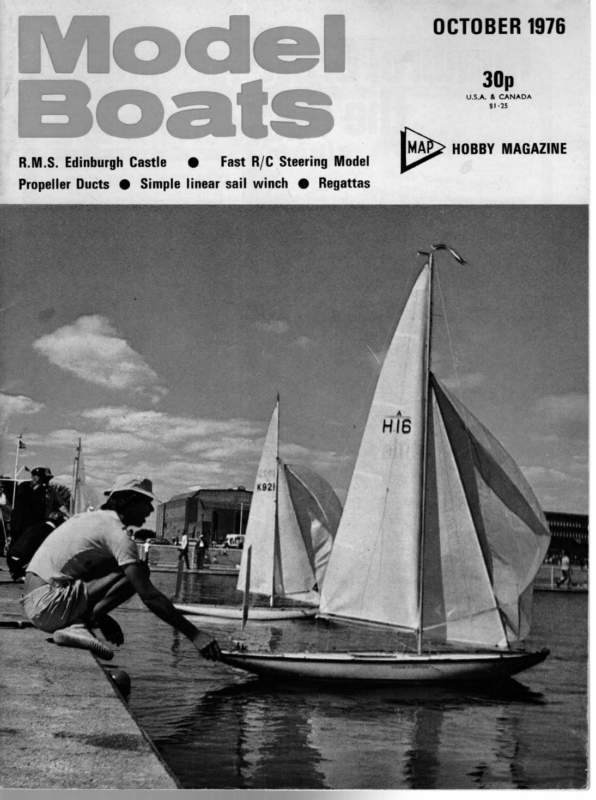
OCTOBER 1976 30p U.S.A. & CANADA $1-25 R.M.S. Edinburgh Castle @ Fast R/C Steering Model Propeller Ducts @ Simple linear sail winch @ Regattas HOBBY MAGAZINE
MODEL BOATS 1976 BRITISH OPEN and INTERNATIONAL ‘A’ CLASS CHAMPIONSHIPS Gosport, August 1st—8th Pe largest entry ever at Gosport, 42 yachts, assembled for the 1976 Championship. The fleet included three French, two Dutch, and one Scottish boat, but none of the ‘regulars’ from Germany, Belgium, etc. There were half a dozen brand new boats, though the first few names in the results were established yachts with successful records. Warm and sunny weather lasted the whole week, winds were reasonable, and so were skippers; this was undoubtedly one of the most good-humoured A Championships for some years. Under a vote taken at the 1974 AGM, MYA policy is that divisonal sailing must occur if the number of entries for an event on a particular water exceeds a certain number, and in the case of Gosport week the number is 40. The race committee was therefore bound to sail in two halves, with finalists from each half moving into a final. It would seem, however, that there was some confusion when this vote was taken, a lot of yachtsmen not being clear as to what it would really mean, and there was certainly a chorus of dismay beforehand. In the end, the OOD and the Race Committee Chairman, with the unanimous support of the entrants, decided to sail as much of a full tournament as could be got through by 4 pm on the Friday; it turned out that 34 heats were sailed by all boats without any great pressure, compared with the 20 that would have been the lot of three-quarters of the fleet divisionally. No doubt there will be further discussion on the policy (designed very reasonably to take the onus of decision off theOOD) at future MYA meetings. During the winter, the local authority had re-concreted most of the lake surround, making it much easier for crews, and we understand that this work will be completed next winter. It is interesting to note that when the old wooden catwalk was replaced (14 years ago?) it was intended to remove a bump in the north shore of the lake, but it is still there, and claimed its usual toll this year. Also new since the last A Champs is an extension six feet upwards of the windbreak round the swimming pool which blankets a third of the site, and with northerly winds for some of the time, this windbreak undoubtedly affected results. The first pair were started by the Mayor of Gosport at 10 am on Sunday and the wind, which had been variable NW, was already backing to westerly and freshening to 8-10 mph, giving run out and beat back conditions, albeit tricky sailing, since the wind varied in direction continually. Each fleet sailed within itself, and seven heats were got through by 6 o’clock, including an hour’s lunch break. Soon in the lead were Revolution and Fairy Nuf, with Spinaway and Aegir close behind. On Monday similar wind conditions prevailed, slightly stronger, gusts of up to 15 mph being recorded. The fleets sailed each other, and again seven heats were completed. Revolution and Spinaway maintained a lead, but Big Brother, Clockwork Orange and Havana Womble began to close up, while neither Aegir or Fairy Nuf had a very good day. Some boats having had their byes confuse the scores slightly at this point. The area forecast for Tuesday was northerly, force 1-2, % 576
OCTOBER 1976 Anti-clockwise from heading picture: Clockwork Orange leads Dandy, morning warm-up in light wind, Twist shows her new-style transom, Roger Cole walks off Morgan le Fay but Bobcat is already ahead, CWO and MyA behind the ‘bump’ (CWO took the points), the only chine boat, Deficience Mentale, Rustickins, an Orange Peel with a Lewis-type lead, and Zephyr, a new Lewis design. (Photos courtesy Fred Shepherd.) and the fleets were out individually. Slightly better wind than expected, roughly averaging NW2 and strengthening a little after lunch, allowed A division to sail five heats and B, in the afternoon, six. Wednesday’s forecast was also northerly, force 1-3 and B sailed six in the morning and A six in the afternoon; for A’s last two the wind backed suddenly and freshened to give a good beat and run, to the relief of those who found reaching past the swimming pool something of a problem! By this time the Orange, being sailed with total concentration by young Alex Austin, had gone into the lead and Revolution had dropped back. Big Brother and Spinaway were still keeping up the pressure, however, and coming up with some wily sailing was Black Tarquin, which seemed to cope better with the fluky reaching conditions than some of the younger and longer boats. On Thursday all the yachts were out, with A to sail three and B two to bring everyone level and all byes out of the way. The light northerly, even north easterly, wind persisted, but only for the first two heats; it then moved to westerly, as far as SW at times, giving a quartering run out and a leg, or sometimes a leg and a bit back, which some skippers sailed on fixed vanes and others unlocked. With the wind on the light side, six heats were sailed by A and five by B. Orange was going like a train, losing only one run of five, and by the end of the day was 7 points ahead of Revolution, which had also had a splendid day, dropping only two points out of 30. Longshot had made its possible 25 to move up to 3rd, 11 behind the leader, while Spinaway had dropped a few to lie 4th. Big Brother had not enjoyed its day, scoring only nine and being challenged by Morgan le Fay, moving steadily up. So to the last day, which again started with a light northerly but worked round to a variable SSW, giving a broad reach out and a close one back. The OOD announced that four heats would be sailed, and with the Orange continuing to collect points, there was soon no doubt as to the winner. Revolution again had a bad day, allowing Longshot and Spinaway to slip past and Big Brother to draw level, resulting in a sail-off for 4th place, the only sail-off needed to determine the top twelve places. Under the experienced OOD and Assistant, Ken Jones and Roy Gardner, the race went very smoothly, aided by halfa dozen stalwarts from the Gosport club as starters, marshals, line judge, and scorer, and a back-room team doing the arithmetic. It was on the hot side to be in the Soe canteen, but a never-failing supply of drinks and eats was provided by the hard-working team of ladies. The dinner/prizegiving was a pleasant, if warm, occasion, with unofficial cabaret by Southgate’s Titania, and thanks are due to the local Conservative Club for again opening their doors each evening to sailing visitors. Also on the social side, there were a mayoral reception on Monday and achildren’s party Thursday, and a couple of speciallyarranged tours of HMS Victory, all much appreciated. Design-wise, a lot of people left muttering about 40Ib. A boats, though the top boats were a complete mixture. Clockwork Orange is 36lb., 564in., Longshot 54lb. 57in., Spinaway 61lb. 58in., Revolution and BB 48 1b.57 in., and Morgan le Fay is another Orange. Seventh to eleventh were all about 50lb. plus (65 in one case), twelfth another Revolution, and thirteenth were Roulette at about 42lIb., Fairy Nuf, a Super Peel (that’s an Orange with a normal deck) and Maverick, 52lbs. on 57ins. The results indicate S77
Pos. 1 2 3 4A 4B 6 7 8 9 10 11 12 13 16 17 18 19 20 Reg. No. Boat K921 Clockwork Orange K945 Longshot K919 Spinaway K939 Revolution K984 Big Brother K944 PGi ye Le Fay K698 Black Tarquin K974 Havana Womble K977 Dandy K962 Apollo K1001 _— Digitalis K950 Executioner K971 Roulette K961 Maverick K992 Fairy Nuf KS29 Glenfiddoch K875 Zerlina K929 Anita H16 22 K895 K960 K982 24 K980 26 23 FS1 Yellow Boomerang Aegir The Streak My ‘A’ Mimi Skipper 22 18 26 R. Cole Guildford 25 C. Dicks M. J. Harris W. Jones R. Seager H. Dovey YM6m OA Southgate Scotland Gosport Gosport W. Jupp C, Colsell A. A. Day South London Hove & Brighton Gosport 26 15 18 J. Hoogewerff M. Lahure Zephyr D. Bush K941 K966 Ricochet Invicta 31 32 K959 K876 Piggy Malone Kami-Sama 34 35 36 K994 K833 K999 K995 Zircon Bobcat Afrit Rustickins K803 K967 F80 Tuppence Icarus Defi 30 33 38 39 40 41 K934._— K787 H29 F69 K831 Geronimo C. C, Williams Gosport Bournville Birmingham Eastbourne Holland France Birkenhead Harwich & Dovercourt 22 17 12 19 Mon Tues 53 42 ST 57 55 49 47 52 48 42 35 39 42 41 46 38 40 37 84 68 85 78 76 66 67 59 64 68 464 49 55 61 58 52 514 52 46 38 42 51 49 50 33 32 28 24 43 53 46 42 Wed. Thurs. 101 88 97 124 113 110 Fri. 77 71 68 654 65 884 92 87 87 86 82 834 76 142 128 126 125 125 119 115 113 112 110 984 98 97 97 97 95 904 90 64 66 65 76 81 77 85 85 82 66 79 89 98 117 107 87 105 94 77 79 103 98 103 80 100 664 67 76 59 75 61 88 70 58 50 80 62 75 Leeds & Bradford 13 42 54 64 Si ot eee 71 74 J. Hyde G. Larraman Clapham Danson 17 17 24 32 43 45 55 50 65 61 73 73 C. Thompson A. Lamb Leeds & Bradford Fleetwood 15 9 26 20 43 38 54 43 59 57 69 68 S. Ashford P. Humber V. E. Smeed D. Hardwicke Gosport Eastbourne Guildford Bournville 10 6 4 15 19 19 13 21 26 284 19 34 45 354 34 46 55 434 50 | 63 604 57 37 Gj Famondson & southampton Colleen Dawn A. &T.Schollar Arthur L. J. G. Hoogewerff Viborg Trilby Birkenhead Clapham Bournville 29 23 A. E. Carter I. Taylor H. A. Shields A. Fogarty V. Knapp . A. West D. Lippett D. Knowles R. J. Burton K990 27 Mandator Clapham Bournville 19 21 15 21 18 18 pa | 23 29 22 15 15 K. Roberts K926 Sun. Guildford Fleetwood Leeds & Bradford Twist 25 Club A. Austin D. Priestley K. Armour A. Durand N. James B. Maguire J. H. Dodd O. Cognard Gosport Holland France Fleetwood Birkenhead Birkenhead France 8 13 14 10 6 11 5 3 a9 19 42 18 10 20 9 9 ae 39 51 214 18 23 16 18 57 64 59 61 364 23 26 18 30 experienced. There seems general agreement that some recent designs have been a shade too extreme. Ken Roberts’ Twist had had a couple of feet sawn off the stern and a transom fitted; it sailed better. Bob Burton’s Roulette had a new longer and shallower fin, to make it a little less stiff and directionally more stable. The Hoogewerffs had left 67 31 28 32 494 42 40 39 39 & Bradford last year’s new boats at home, not yet sorted out, and brought Yellow Boomerang and a new Jill type, Arthur L. Top new design was Dennis Lippett’s long, fine-ended 52lb. Digitalis; Zephyr, a new Lewis 45 pounder, shows promise and will be good when a few details are ironed out. According to onlookers, the same applies to A/rit, at 41#lbs. The French boats were a Jill and a Highlander, and Deficience Mentale, a tubby chine boat which had a surprising turn of speed in either direction when on a (please turn to page 596) Below left, Wally Jones and Black Tarquin size up the wind with, right, J. Hoogerwerff and behind, Sally Armour doing the same. On the seat are Keith Mackey (South Africa) and Horace Boussy (France). Right, new sail shape with ‘droop-boom’ gains a few free inches for Revolution, here sailing Spinaway; note taped patch over collision damage. 578 72 474 37 N.B. Because of byes and unequal heats sailed by the two divisions Tues/Wed, scores are only strictly comparable from Thurs on Neptune Trophy (teams of three from one club) 1. Bournville 3354; 2. Guildford 318; 3. Clapham 3 11; 4. Gosport 2903; 5. sds 269; 6. Fleetwood 238; 7. Birkenhead 234; 8. France 1684 a continuing trend to lighter boats, and certainly the light boats in this race showed that they could hold their own with the heavyweights under most of the conditions ae
OCTOBER 1976 TARROO USHTEY GOOSENECK! |*—— 548″0.D. MAST TUBE KICKING STRAP Marblehead design, Part Two DECK _ == nN Jon Hudson discusses rig and fittings and ways of improving D IG.1 SECTIONAL ARRANGEMENT QF MAST HEEL sail and spinnaker efficiency ae TING N model yacht competition today, having a well finished hull is no passport to success, even for an ‘expert’, if the rig and fittings are not of a high standard of efficiency. | earn MAST STEP ON KEEL aad I hope the following notes may be of some value to a skipper wishing to improve on his boat. The often most neglected part of a model yacht’s rig is the mast. At club meetings one sees yachts with poorly fitting and creased sails because the mast is bending. While model yacht hull design is in many instances ahead of full sized practice, the rig control is not. Model yachts are, in the main, cut with a curved luff to provide shape, and have no shaping panels cut into the sail, and therefore the sail cannot accommodate much mast bend before the sail shape is ruined, and creases appear. Dinghy masts, which are meant to bend, set sails cut in such a way that in heavy weather, the mast will automatically bend fore and aft to flatten the sail, and by bending sideways opens the leach and spills wind from the top of sail. The bendy mast is used because there is no time to reef and unreef in top competition racing; the bending mast will automatically reduce the rig’s power. In model yachting we are able to change sails readily, so there is no need for these complications and for maximum efficiency, a stiff, straight mast is essential. Unlike the dinghy sailor we do not use the same sails in five knots of wind The chain plates should be positioned between lin. to 13in. behind the mast. If they were square with the mast, they would offer no fore and aft support, and it would be impossible to keep the jib luff taut without the back stay being too tight and bending the mast. If the mast now bows forward between the hounds and deck level, this is easily cured by fitting spreaders at between half and twothirds the distance from deck to the hounds. These should be arranged to deflect the shrouds forward as in figure 2(a). The angle at which the spreaders are bent aft will control the stiffness of the mast. The now deflected shrouds naturally want to be straight, and so try to pull the middle of the mast back, thereby stiffening it. Many models lose power because the mast bows to windward between hounds and deck. The spreaders cure this by forcing the rigging outwards, and therefore push the middle of the mast inwards (Figure 2b). The {sideways p as in thirty knots! When we change sails, it is advantageous to change the mast at the same time. There is no point in carrying around several feet of unused mast which only contributes excess weight and windage, producing drag and less stability. Figure 1 shows a method of accomplishing a change of mast, and at the same time providing a firm base for the mast. The method is only applicable to a keel stepped mast. The keel stepped mast is more efficient than the deck stepped mast because it is so much easier to keep it stiff and straight. The various lengths of mast are stepped by sliding them over the spigot. Ideally this should be machined to a clearance fit in aluminium, but if facilities are not available, dowel will have to suffice. The pin at the bottom locates tightly into the mast step. This must be a firm fit, as 1/16in. movement here will be nearly din. at mast top in a tall rig. Similarly, the mast must be firmly fixed at deck level, using either an aluminium or stainless steel slide or a piece of tin. ply with a 3in. hole in it, firmly screwed into place. The area where the mast passes FIG. 2a. / Hl /I STRAIGHT SHROUD rH -—-NO SPREADER ea Ay | SHROUD WITH SPREADER AFT VIEW OF SPREADERS through the deck should be taped up, as water will find a way in if it is blowing hard. ARRANGEMENT OF SPREADERS. 593
Rs eee MODEL BOATS PmQm = PjQ) — PmRm = PjRj of this system are the ease of setting up, and because the sheet and guy are permanently attached to the boat, once a setting is found, it does not have to be altered to take down the spinnaker. Also one does not have to carry FIG.3. “S. ELASTIC »