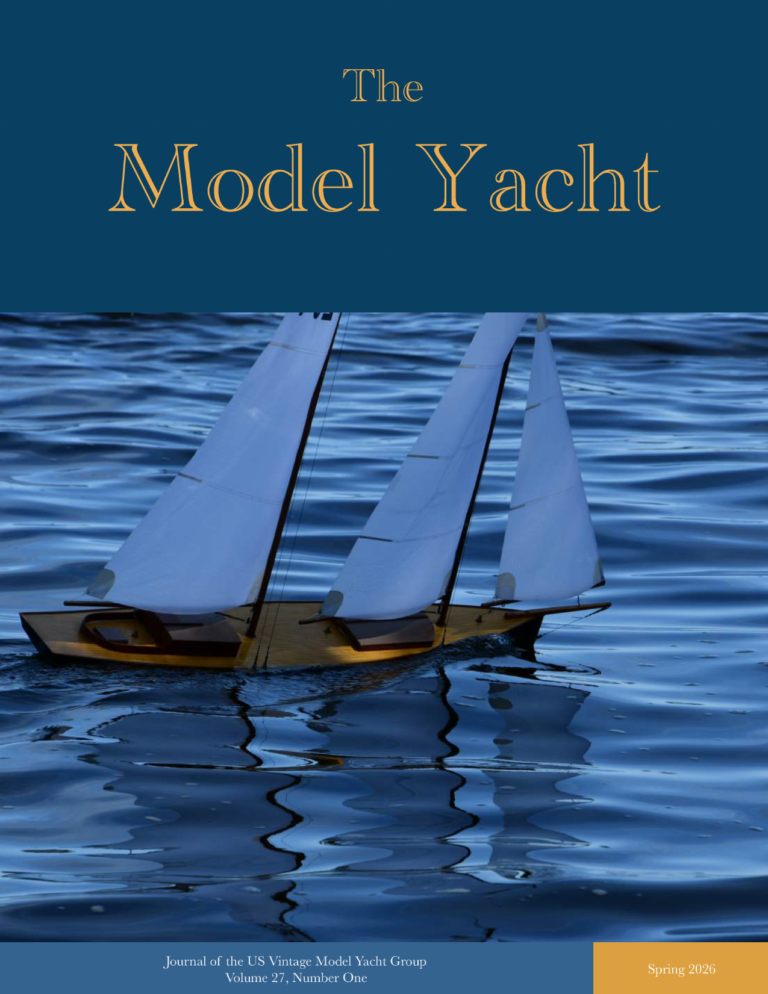
- BILL VAN DIEREN describes construction of KOKANEE a “‘light’’ air Marblehead for radio-control Part One Hull and deck
- Readers Write….
- ROUND THE REGATTAS
- ‘LOG BOOK’ by our MYA Correspondent

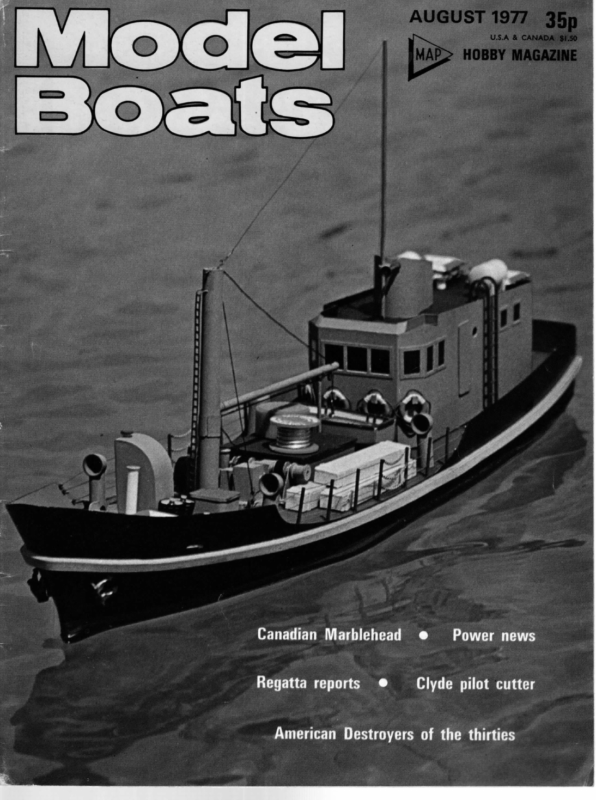
Canadian Marblehead @ Regatta reports Clyde pilot cutter ©@ Power news American Destroyers of the thirties
BILL VAN DIEREN describes construction of KOKANEE a “‘light’’ air Marblehead for radio-control Part One Hull and deck stern tend to lift, in heeling, but at that heel the speed is such that the hull lowers in its own trough. bie» article was originally published in the club newsletter of the Vancouver Model Yacht Club, to assist new members in fitting-out of a grp Marblehead yacht. The Kokanee was designed as a light air radio- controlled Marblehead. There may be a lot of questions regarding some of the features, however, it has been proven to be difficult to beat in wind conditions in the range of 1-8 mph. Two Kokanees are finished at the moment and were entered in a regatta in Seattle on 2nd April, 1977. The 13-5lb. model was 2nd, and the 151b. model came 3rd in wind conditions varying from 10-15 mph. There is no doubt in my mind that the more conventional boats, eg, Sailplane, Moonraker, Blood-Axe, Madhatter, etc. are superior from 8 mph wind strength and up. However, our wind conditions are usually light on the west coast. Some data on the boat; it is double ended, where the forward half is identical to the aft half. The circular arc principle was applied without any compromise. The centre of the hull is a true half circle and the rocker is part of a circle. The following was aimed for and achieved: (a) the fore and aft buoyancy does not change if the boat heels, which prevents digging in. The bow and FIG.1. | | BASELINE = WATERLINE at _ oN) BASE | BOARD | ] Plug constructed from 68 pieces of Zin timber, shaped as per dimensions in table I and figure I. (b) Trim changes only very little in varying winds from 1-8 mph, because of even buoyancy distribution. (c) The centre of lateral resistance with fin at ‘B’ position and not including the rudder is on the hull centrelines, as well as centre of gravity of hull and centre of gravity of ballast, which provides for easy trimming of the boat. (d) The wetted area is considerably reduced from more common designs. Hull construction The plug was made in an unusual manner, We used 3in thick planed planks and cut out 68 pieces to fit the crosssections of the hull, as the shape of each piece could be calculated and then drawn onto the plank, Table 1. The pieces were glued together and only a little sanding was required to obtain the proper shape. The plug must be finished as smooth as possible, as any blemishes will be faithfully reproduced in the mould. There is only one sure way; many coats of paint rubbed down with wet-and-dry paper, followed by polishing to an acceptable gloss. The subsequent method of producing a mould and hull is described in detail in ‘A Clot’s Guide to GRP Hulls’, Model Boats, December 1976, page 714. The hull should be trimmed with a razor blade saw as closely as possible to the deck line. This line can be inscribed on the plug before laying-up the mould, hence providing an accurate trim-line for every hull produced. After saw-trimming, sand the excess away.
August 1977 429 Place waxed paper in the mould and fit the trimmed hull inside. Make sure the mould is fully protected by waxed paper before proceeding any further. Lb» 50-1875″ (3n6″) — a ae 3-75″ + @mast—= Deck framing One thing should be mentioned at this point: all wood-towood glueing is done with ordinary white glue; all woodto fibreglass joints are made with a mixture of milled fibreglass fibre and resin. This should be mixed to a thick paste — Fi oS a 08 ——— >) —— | iat 9.25″ 4 2″ ee sj 5% ol | aan aa tS ate – ee 4″ ———— -— 2 ss ima| = = E Z consistency. The estimated quantity required of this mixture should be thoroughly mixed withcatalyst hardener before use. Apply this mixture generously and wipe excess off after glueing. The deck framing should now be installed according to figure 2. Make and install items according to the numerical order shown. The hull should be removed from the mould after items 1 to 9 are installed and should be placed in the ne | DESCRIPTION MATERIAL N* | DESCRIPTION MATERIAL boatstand forease of work, figure 3. Take a straight piece of 1 |BOWPIECE 1/4″ PLY WOOD 8 | HATCH BEAM ¥8″*1/8″ SPRUCE wood 1lin. long and tape ‘240’ sandpaper on this. Sand 2 | STERNPIECE 1° —:—— ¥) Sse as iat, ttle the top flat, so that no wood projects above the edges of the 3 |OUTER GUNWALE 3/8″*V/8″SPRUCE ‘10 | INNER GUNWALE rere [11 | KING PLANK ¥6’x3/16″SPRUCE fibreglass. The deck can be marked out with a sanding or 4 |MAST SUPPORT BEAM | 34″x3/16″SPRUCE 5 | STIFFENERS W6″*4″PLYWOOD | 12 | HATCH BEAMS 3/8″1/8″— – — cutting allowance of tin. The following are quite suitable 6 |HATCH BEAM V2″*1/8″SPRUCE [13 | —-— —- — —— ——-.— 9 ren oesa —-— —-— 114] CHAIN PLATE SUPPORTS| 1/4″PLYWOOD wooden decks: 15 | GUSSETS 1/2″ 1/8″ SPRUCE (a) 1 millimeter plywood; DECK FRAMING ARRANGEMENT (b) +;in plywood, which can be painted or used as a FIG.2. base for planking. The wooden deck can be glued on after the winch Mast step and chain-plates The arrangement drawing shows in detail the parts. As you supports, servo supports and fin are installed. can see, all parts are bolted through the deck. The chainSmall openings may be cut out for the hatches. However, plates should be mounted parallel with the centre-line of be sure that enough trim allowance is left. The next items to be installed are the fin and winch the boat, as this allows the mast and rigging to be moved without having to re-adjust the rigging. For example, a supports, as well as radio-component supports. However, the mast step and chain-plates can be made, and these boat has weather helm, which must be corrected by moving the mast forward. The best is to try this by tin or one-hole details are described next. 1 3 ty 6) @ 5») @®WM © OO FULL SIZE COPIES OF THE DRAWING BELOW ARE AVAILABLE REFERENCE MM1236 PRICE £1.00 INCLUDING POST AND VAT FROM MODEL MAKER PLANS SERVICE, PO BOX 35, HEMEL HEMPSTEAD, HERTS HPI IEE. OKANEE Vancouver Mode! Yacht drawn by ‘Bill van Dieren copyright of Club The Model Maker Plans Service 18-35 Bridge Street, Hemel Hempstead, Herts. QaTA LOA. — 505″ LWL — 49-6″ at ibs OGPLACEMENT 49-0 2135s —— -—— 48-0″ at t2ibs, —— –—— BEAM— 10° ORAFT — 16″ at 15its ————— 159% GSibs —— -.——— 15:78 “bt 1216s ——— -—_—_ DISPL— a = 15ibs b= 195ibs ¢ = I2ibs CLR to CE — 10% LWL SCALE — FULL SIZE SCALE — 1/2 FULL SIZE vad as hia ons }-€ MAST ‘8 — MM 1236
430 Model Boats TABLE | Dimensions for forming plug, based on use ot #in timber. Refer to figure 1. All dimensions in inches. Radius E Sections 25 24-25 0:75 0-753 5 4-995 23°5 0-759 4-982 22°75 0:772 4-959 at 0-786 4-928 21-25 0-806 4-888 20-5 0-831 4-839 25°75 26°5 27°25 28 28°75 3/4″ CONSTRUCTION 2″ PLYWOOD 2″ FOAM 29°5 19-75 0-86 4-78 NOTE ay 0:°893 4-714 18-25 0-931 4-638 17°5 0-973 4-554 16°75 1-02 4°46 aay 1-072 4-357 15°25 1°128 4-246 14-5 1:19 4-125 13-75 1:253 3-995 aT 1-322 3-856 12-25 1-396 3-709 11-5 1-474 3°55 10-75 1-557 3-386 ay 1-644 3°21 9-25 1-737 3-027 8-5 1-833 2°834 7:75 1-934 2°631 7 \ 2-04 2:42 6°25 2°15 2:2 5°5 i 2-265 1-97 4°75 2°385 1-73 4 \ 2°5 1-482 3°25 2-638 1:22 25 2°77 0-957 1°75 2°91 0-681 1 3-052 0-395 0-25 3°2 0-1 30:25 TURN STAND UPSIDE DOWN FOR SEAT >) i CARRYING Se OPENING i FOAM | Vag as ~~ Bottom | * Oe FOR {. ) : To. 1/ _/ 31°75 INDICATES DIMENSION ‘KOKANEE’ 32°5 /|\BOTTOM JOP HULL eee Fahne | bw ]3″ >——— 33°25 | 34 14”. FIG.3. BOAT STAND 34°75 increments, so the mast is moved forward one hole as well as the upper and lower shrouds. As the chain-plates are parallel with the mast, the shrouds do not require readjustment. In light air, boats tend to have lee helm, which can be corrected by moving the mast aft. This should also be done in tin or one-hole increments. The mast should be moved as wind conditions change during a day of sailing. Light air may be encountered in the morning, and the boat may be trimmed with the mast aft. As the wind strength increases during the day, the boat will develop weather helm and the mast should be moved forward. The above explains the reasons for the large number of holes that are required for the mast step and the chain-plates. (to be continued) 35°5 36°25 37 37°75 38°5 39-25 40 40-75 41-5 : *1/8″6 HOLES WTOP PLATE ONLY 1 x 3/32″ HOLES oF OR 282/56 SOUS 42°25 2 | FWD 43 43-75 ~SBOTTOM PLATES 1/32″ BRASS i 9 «1/16″6 HOLES \ \ 2 x3/32″6 HOLES FOR 2 x 2/5 2/56 BOLTS ; © MAST AS SHOWN ON PLAN i. S. a : v2>~ ~~ @UPPER SHROUDS 1/32″ BRASS- 9 45-25 46 Sy ¢ LOWER ~ SHROUDS BOOT 44-5 EDGE OF DECK 46:75 47°5 48-25 49 FIG.4. MAST STEP & CHAIN PLATES ARRANGEMENT & DETAILS 49-75
August 1977 449 Therefore, the speed of a sailing yacht is reduced as the square of the cosine of the angle of heel. Readers Write…. MORE ON SIMPLE STEAM Dear Sir, I read with interest in recent editions of Model Boats the various comments on simple RC steamers and felt a few points were worth raising as they may help others to have a go. The types of steam units considered so far are, on the one hand, the inexpensive Mamod oscillators, with their small power output, and on the other hand the more expensive and powerful single and multi-cylinder units of Stuart Turner and Saito. However, for some time now I have been using a unit for which I have nothing but praise, but seems to have somehow escaped the attention of most boaters in this country. The unit I refer to is the Wilesco Marine steam engine, type D52, of German origin, obtainable by mail order from H. H. A. Sanders (Midlands) Ltd, priced at about £15. The Marine unit consists of a single cylinder, double-acting slide valve engine of in stroke by unknown bore as I have never bothered to strip it down, although it is believed to be quite small at around tin. This engine is reversible by having a slot and stop on the eccentric, thus modifying the timing to suit rotation in either direction, so you have to be careful when starting up to see that it’s awning and ornamental funnel. Length appears to be about two feet in both cases. I am sure there are plenty of modellers that are lone wolves like me and search through every page of your magazine for information or help on a new project so if you wish to use any point in this letter for publication please go ahead. Kevin Savory YACHT SPEED v HEEL Dear Sir, While reading through some back issues of Model Boats, 1 came across a fine article by John Lewis, dealing with ‘A’ Class stability. At the end of this article, Mr Lewis relates wind pressure, velocity and angle of heel (which compensates for sail area). He does not mention the way he does this, and I wonder if he related the force directly to the reduction of the sail area (Force a cos 0, where cos @= angle of heel). Thus, the diagram shows how this appears to be an obvious supposition where at any angle @, the perpendicular sail area—A cos 0, so that it would seem sail force (hence boat speed), decreases directly as the cosine of the angle to heel. running in the right direction. A lubricator is mounted on the side of the valve body and power take off is by pulley for paddles or shaft for propeller. Supplied with the engine