- LOGBOOK The latest on the sailing scene from our Model Yacht Association Correspondent
- A PRACTICAL GOOSENECK by Graham Bantock

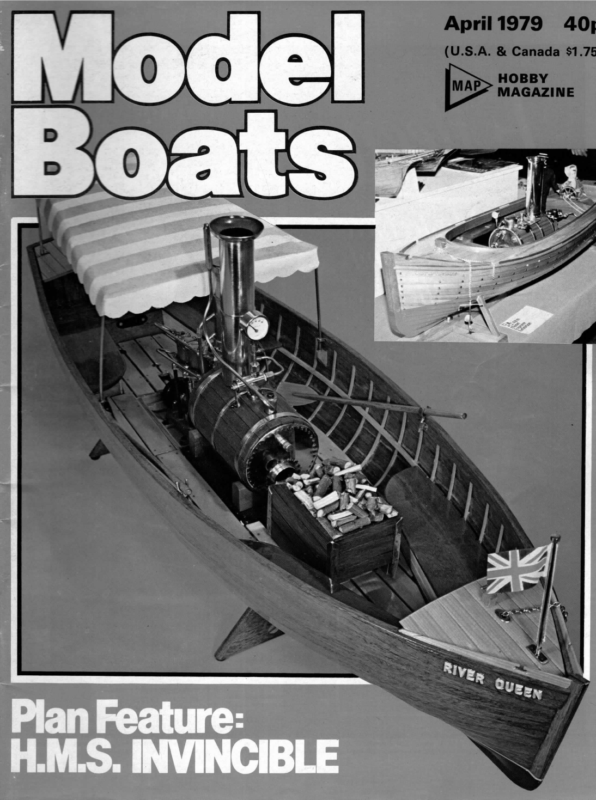
H.M.S. INVINCIBLE
The latest on the sailing 7f7/SILIITSL Spy > scene from our Model SS Yacht Association a rt Bee the poor weather, there was virtually 100 per cent turn-out for the MYA Council Meeting at the end of January and a great deal of detail work was got through. Much of this was administrative and, as can happen, of little news value; some of the items will already have passed (London Dinghy Exhibition, Olympic Fund R/C race against top full-size skippers at Grafham Water, entries for MYA/Naviga meeting at Fleetwood, for example) and some occupied a fair amount of discussion time for what ultimately seems a simple decision. Short points are as follows. The Model Maker Trophy (vane Ms) will be held at Birkenhead as a one-day event on April 29th (entries direct to Birkenhead sec., J. A. Browne, 7 Roxburgh Ave., Birkenhead, Merseyside L42 6QD). The Little Portugal Cup (vane As) will be at Gosport on July 1st (normal entry procedure). The new Hereford club has been attached to the South Western District. New address for Derek Priestley, Fleetwood Commodore, is 100 Hatfield Ave., Fleetwood, Lancs., (Fleetwood 79764); for Fleet- wood national events the entry date will remain at six weeks ahead of the races. A new NW club is Crosby RCMYC, secretary J. E. Gibson, 2a Manor Road, Great Crosby, Liverpool. A great deal of time was spent on the definition of rule 33.3 in the radio sailing rules, it being open to different interpretations. Elvstrom and other authorities’ interpretations were considered, but even then no clear picture emerged. The rule relates to contact between yachts racing; 33.2 states that both yachts shall be disqualified or penalised unless one retires or exonerates herself by accepting a prescribed penalty, or one or both enter(s) a protest. Rule 33.3 says that the OOD can waive these requirements if satisfied that the contact was minor and unavoidable. To the writer, this means that the OOD can simply say ‘Sail on’ and dismiss the incident, but according to the experts a disqualification or penalty must be suffered by one of the yachts or, under 33.2, both of them. The eventual Council ruling effectively gives the OOD discretion to ignore a slight touch when boats drift into contact due to lack of wind, but requires him to apply a penalty in accordance with 33.2 at all other times. This seems to be an area where models must differ slightly from manned craft, since it seems acceptable in light conditions for a crew to push themselves clear of another yacht; there was a fam- ous case some years ago of a crewtrying to pull another yacht into actual contact so that they could legally demand a disqualification on the dubious grounds that the other (windward) yacht had failed to keep clear. Without a crew, a model cannot be prevented from drifting into contact when it has no steerage way, but unless either yacht is materially prejudiced it seems only common sense to overlook a touch which causes no entanglement or gives no advantage to any boat in the race. Another radio rule, this time under Management of Races and therefore able to be amended, is 4.16b, concerning the immediate announcement and award of a penalty when the OOD/judges see(s) it occur, and it was pointed out that there are occasions when it could be grossly unfair, and in contradiction of other rules, to apply this. The Council agreed with the case put forward and this rule will no doubt be the subject of a motion to the next AGM. In the meantime, Council recommends suspension of 4.16b only, for the 1979 season. A proposal was made that some form of recognition be given to 246 Correspondent the little 575 class, now very numerous and growing rapidly. The MYA Constitution charges the Association with the promotion of model yacht construction and racing, but lays down no size limitations. It was therefore recommended that a 575 association be formed with a view to affiliation to the MYA, and owners may in consequence care to write to the manufacturers, who are propos- ing to take steps in this matter. Several clubs intimated that they would be happy to welcome 575s and provide an occasional race for them. It was felt that the average owners were not committed model yachtsmen but obviously showed interest, and dialogue between them and clubs must be of mutual benefit. Time was also spent in discussing the increasing demand for an internationally acceptable one-design R/C class; this is something that the IMYRU is keen to see and which appeals to many MYA members and many potential MYA members. A small committee was set up to produce concrete proposals for the May Council meeting, on the lines, perhaps, of an invitation to designers to submit practical designs and suggestions. Full details of this inter- esting development will be circulated as soon as a decision is reached, so that, hopefully, it will be possible to include the information in this column in the July issue, published in June. Radio Racing Rules The suggestion by Roy Stevens for simplified R/C racing rules in the January issue obviously sparked off a fair amount of discussion. Some of the most detailed comments came from David Skelton, sailing secretary of Decoy MYC at Newton Abbot. Dave writes: “In reply to the comments about rules in the January 1979 issue, | would like to defend the present rules which, to my mind and | am sure to many others, are the better set. It seems to me that your correspondent’s club has problems in knowing which rules to use in which circumstances; having sailed against members at the club in the RM class | think I see this as the main problem. For instance, many people seem to think that when their yacht is on a starboard tack they have the right to sail anywhere that they wish; they seem to grow invisible horns and get their heads down. This is only one example of bloody-mindedness which can cause problems. The suggestion that the MYA rules are used ‘Because they are used in full-sized sailing’, is not true. | am sure that the MYA would not take them on in such a manner. | don’t know exactly how long the so-called ‘full-sized boys’ have been sailing to these rules and, may | say, developing them to their present state, but | am sure that they have developed them to create the fairest sailing possible. So really what is suggested is that the experienced sailors of old are wrong and that a much less experienced group know better. Now for the definitions given: 1. When ona roughly parallel course a boat’s bow is in front of another, ahead rules. To my mind this rule can but create havoc and unfair sailing for several reasons: (i) There is no definite point at which a boat is clearly ahead, when the word ‘roughly’ is used. This can only cause many heated arguments. (Continued on page 251) Model Boats
A PRACTICAL /tis probably the chore of making goosenecks that has led to the common adoption of mast stepping above the boom. The advan- tages of having a mainboom attached to each mast in storing GOOSENECK © and transporting achieved if this by sails can be relatively easy design is used. Graham Bantock A bottle-screw for the kicking strap can be obtained at most model shops or direct from advertisers in this magazine. PROFILE. 1. Bend insert piece of wire — use 18 2. gauge stainless steel. Make secondary bends. 3. 4. __ fF _ F_PLAN. . 5. Bend main boom attachment from 16 gauge stainless steel wire. Drill main boom to accept above piece which is sprung in place. Drill holes in mast at correct spacing to receive insert piece. Thread thin nylon cord through two of the holes and attach to the corresponding loops in 1, 6. the insert piece. Pull it into place. Push main boom attachment piece into place and spring into boom. Cut off cord. 7. Repeat at lowest hole using kicking strap attachment wire. ee 8. PROFILE. : x Fit luff downhaul using remaining wire loops. (These can be dispensed with when using pocket luff sails.) 9. 5/32” HOLES. Fill forward end of main boom with epoxy resin (may not be necessary). This unit can also be used with ‘Nylet’ mast section if the tracking is removed from the section below the luff of the mainsail. r 7 —» — 1/16″ 5 ee KICKING STRAP. . PAE 5s aie Be le si6248 Model Boats
Left are two examples of a very large range of powerboat accessories from Marine Hobby Products, a Dutch firm. The trim tabs (only one shown) are hydraulically operated but can also be obtained with bottle-screw fixings. The reversing gearbox for up to 15cc and 15000rpm is mounted on a set of silent blocks. This extensive range also covers couplings, water inlet/outlets, solid and flexi-shafts, out-drive supports, rudders, flywheels, clutches, watercooled cylinder heads, tanks and props, and we understand that a British agent will soon be appointed. The electric powered ABS model Nessy is from Robbe and is for F1E+1 kilo speed and FSRE 23 kilo. Length is 27in by 10in, power by new motors known as Elt-Max 30 and 50. Presto, a Dieter Mack design for Krick is also ABS, 20in by 103in, uses a Mabuchi 540S motor and an 8.4v, 1.2 a/hr nicad pack. LOG BOOK (from page 246) (ii) Luffing may occur during a call by the so-called ahead boat. If this happens the leeward yacht may push its bow ahead in are there to be used to gain advantage over the opposition, notto cause unfair sailing or heated arguments.” comparison to the course for the next mark. 2. When on different courses the boat which is pointing more directly to the next mark is ahead. This rule falls down when on any leg of a course: (i) On a beat, the boat which positions itself to be on starboard at the mark has right of way on any port handed boat whether ahead or not, using the suggested rules. (ii) On areach, it may pay a yacht to head up alittle on its course for greater boat speed and so on, hence when it heads down on other yachts the present rules accommodate for this using windward boat rules. (iii) On a run, some boats find it faster to take out reaches to get to the leeward mark. Again, it would be nigh impossible to see which boat is ahead even at close quarters. 3. When approaching the start or finish line the boat which is more square to the line . . . in effect the boat pointing more directly to the first buoy. Ahead definition. This rule would be harder to judge than any rule in the MYA rules. As most radio competitors seem to line themselves up on the line to see directly down it, they would only see the side of the hull. This would mean it would be nearly impossible to distinguish a heading of a boat exactly. As all the rules suggested seem to rely on these feeble ahead definitions | see no point in proving their inadequacy for the job of promoting fair sailing. If the club has so many difficulties in racing, perhaps they should come to Decoy where we have few problems of rule understanding and a lot of good competitive sailing. | see from the comments that there are many people sailing who do not know when their boat is on starboard or port. lf this is so, why not hold a rule talk by the more experienced members to correct these difficulties? After all we all started the same way. Finally, let me give some food for thought— the rules April 1979 Fleetwood Events Arrangements are going ahead for the MYA — Naviga Open International R/C Yacht Regatta at Fleetwood, July 22nd-27th, which will be followed by the British and Open A Class Championships, July 29th-August 3rd. The Accommodation Secretary is G. Butter, 22 Romney Avenue, Fleetwood, Lancs. (Fleetwood 5117). Applications for caravan space, now being granted by the local Corporation for an area close to the lake (actually just the other side of the water used for pleasure boats) should be sent to D. J. Rose, 48 Laidleys Walk, Fleetwood, Lancs. (Fleetwood 4348). The attention of overseas competitors is drawn particularly to the necessity of advising requirements for caravan space. A 24-hour vane race is being run from 10.30am on August 26th to 10.30am the following day. A similar event was held last year and provided valuable experience; this year the race is open, to conventional MYA rules, on an individual basis but with a rule modification to allow up to four crew members per boat. Consideration is being given to the nomination of a back-up boat in the event of a major failure. Sponsorship is being provided by the Abbey National Building Society (after 24 hours, skippers may have the ‘Abbey habit’?!) and a large entry from all over the country is the hope. There are no entry fees and there are attractive prizes. Closing date for entries will be two weeks before the event; if, hopefully, there are sufficient entries, two divisions may be sailed, giving additional breaks in sailing during the 24 hours. There will be a 24-hour canteen service with hot meals and Derek Priestley will be OOD. Last year’s event showed that this is something really different, so note it in your diary now or, better, send your entry to the Hon. Secretary of the Vane Yachting Section, N. D. James, 9 Derbyshire Avenue, Garstang, Lancs. 251