
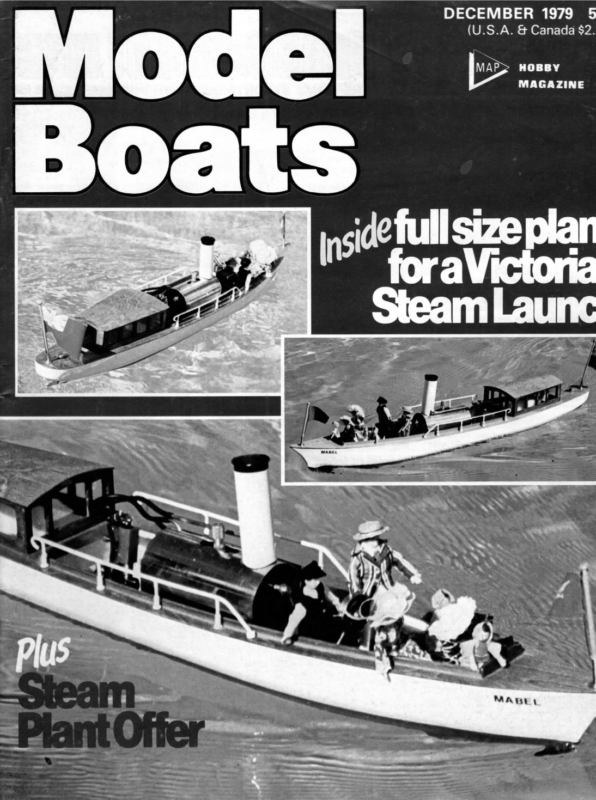
- A Faster 575 Mike Kemp spills the beans on what makes his Duplex 575 yacht faster than most of the opposition
- LOGBOOK From Our MYA Correspondent

DECEMBER 1979 5 (U.S.A. & Canada $2. MAPS HOBBY MAGAZINE Tat ern ad ‘de fullsize plan
ters and a growing Marblehead to support, consequently my modelling is based A Faster Mike Kemp spills on M.C.C.— Minimum Cost and Complication. Both terms fit this little yacht very well, as it is inexpensive, less radio, and simple to build. The first steps to building the beans on what are easy: they should lead you to your model shop to buy one, then take you back home. Open the box carefully, you can later use it to transport the boat, read the makes his Duplex 575 yacht faster instructions carefully, identify the parts and read the instructions again. At this than most of the point you should think about what modifications, if any, you are going to make and HIS ARTICLE is the result of the ‘First National Duplex 575 Regatta’; it was the second actually, but the first was blown off! | managed to beat our illustrious Editor in the final, he however, had his revenge by suggesting that | should spill the beans on what makesa fast ‘575’. At that time | wondered, what indeed? Preparation As far as racing is concerned, the only all embracing answer must surely be — preparation. Preparation can make a reasonable success of any trip to the water. There can be few greater pleasures in boating than to arrive at the water’s edge, get the boat out of the car, put it in the water (the boat not the car!) and sail. Meanwhile, others are fighting to rig their yachts — as Servo Mounting The instructions supplied with the kit tell you to bolt the servos in place; as | envisaged removing them at some time and having due regard to the aforementioned accessibility problem, here is my first constructional tip; Fig. 1 illustrates my servo mounting bolt assemblies, made from brass, 8BA screws and a piece of 1/8in square brass rod (as used for slot car chassis). Open up the screwdriver slot in can sail. At least one 575’er has tried his boat in the bath, wind being provided by a hairdryer. 1 screws falling out or turning as you do up the nuts. Use a small dab of five minute epoxy or even contact adhesive to fasten them to the servo mounting crossmember. It may seem like relatively heavy engineering but it is really worth the effort — there is precious little room inside a 575 to manoeuvre tools and fingers and things — and your servos will not fall or even pull out! Fig. 2. Those less skilled at woodwork than |, there cannot be many, or who read Vic way up your average wellies a 575 yacht FIG. With this mounting assembly you can avoid finger problems and mounting It is a good idea at this stage to make a stand for your model. Initially mine was a shoe box with a suitable slot cutin it, later | managed to make a wooden device as in struggling to persuade their engines to run; only to find that there is too little water or too much weed! As long as there is a whisper of wind and the water is half- Currently | have a wife, two young daugh- the screw head to suit the rod used and solder together the correct distance apart to fit your servo lugs. Stand the step ladder blows over in the wind-— or M.C.C. opposition what form your radio installation is to be. Make notes on the instruction sheet to remind you of what to do when. Now cut, trim and dry fit the hull parts together; this especially applies to the servo mounts as once installed it is virtually impossible to gain access to their undersides! Smeed’s article ina recent RCM &E will no doubt use a suitable expanded polystyrene Rudder servo mount uses bolt assembly as per Fig. 1 to allow for subsequent removal for maintenance. SERVO MOUNTING BOLTS carton. Whatever it is, without some means of holding the boat upright you will have problems when you start gluing everything together. FIG. 2 -_ 575 FOLDING STAND BRASS ROD 8BA BRASS SCREW SOFT SOLDER NYLON WEBBING (OR SIMILAR) APPROX. 300 MM DIMENSIONS TO SUIT SERVO LUGS LEGS APPROX. 180 MM LONG Model Boats
Glue For the hull and superstructure (what superstructure?) | used the liquid polystyrene cement. Be sure to follow the kit instructions and be sparing with the cement, the liquid in particular can be disastrous if you get it in the wrong place: or even too much in the right place! One tip, as soon as the glue has been applied and before the parts are settled in their final positions, gently twist or rub them together. Another place where glue is applied is where metal parts are bound to the boom, the mast and in my boat, to the end of the winch arm. In these cases | used the thread supplied in the kit to do the binding. As it was wound on | smeared epoxy over the layers of line — messy, but when ‘warm-cured’ very neat and strong. A hint here is to ‘tweak’ up the very end of the wire component to prevent it pulling out from under the line reinforced epoxy. The final application of ‘glue’ is to hold in the ballast. Even the kit recommended concrete needs holding in, mine fell out when| turned the hull over for painting! If you use lead shot or strip you will need some form of curing liquid adhesive. | recommend one of the ‘laminating’ resins intended for glass fibre work; it can be dribbled or poured into place and will suitably distribute itself. Remember, there is no place in a well-trimmed boat for shifty ballast! Ballast | originally used the sand and cement mix as described in the kit instruction. After having had the boat completely blown over in the first strong winds encountered | resolved to significantly lower the Centre of Gravity. Now was my chance to have a go at lead casting, after all | had a ready made pattern — the concrete. After breaking it up to remove it, | epoxied it back together, filled the cracks and plunged it into a wooden box full of freshly mixed plaster of paris. When the plaster was dry | had to remove the concrete from it: taking my courage in both hands | inverted the mould, gave it a sharp bang on one end and the concrete lump fell out without the switch —it does worry me alittle, but it has plaster cracking. The plaster mould then went into the oven for a short time to dry out. | melted approximately 2lb of old lead replace the crystal through a slot in the receiver poly bag. This is, however, only ¢ drain pipe into an old ladle heated by a small camping stove. The melting process was aided by a blowlamp played on the pipe. Immediately before pouring the lead | used an old spoon to skim off the film of ‘dross’ floating on the lead. Be warned, any dampness in the plaster mould will given me no trouble in over twelve month’s sailing. If | have to change cryst: als then | have to de-rig the boat anc remove the cabin roof and remove anc two or three minute job with my rigging: but more of that anon. Those who have peered into the depths of my hull will have noticed that my sail winch is not quite standard. It strives to improve on the original design whilst retaining the basic principles and a stan- dard kit built Micron metal geared servo. lead to steam being formed the moment you pour the lead; this will make the lead bubble and ‘spit’. Carry out this operation, The basic change is that by ‘adjusting’ the if you dare, in an open, draught free place. Wear substantial shoes, trousers, leather output shaft movement (up to around 170° if desired). This does not give the servo gloves and some safety glasses or, preferably, a full face shield. F/ying molten lead is dangerous. \f like me you are successful, you will have an overweight lump of lead NE544 IC based servo amplifier one can quite easily achieve a greater angle of any more power but does allow the winch arm length to be reduced whilst maintain- ing the full amount of sail movement. This reduction increases the mechanical that is a perfect fit in the keel. This can be trimmed to the correct weight, if you already know it, or left until the yacht is finished and the radio installed. to reduce the friction of the line used for the running rigging; | set about this in two Radio ways. Firstly, | made up some guides of stainless steel wire onto which | fitted Effective radio installation is a must for reliable sailing. Apart from securing the servos the only other things are to ‘showerproof the receiver and battery advantage of the winch slightly, but not by as much as! had hoped! What does help is some PTFE sleeving. The wire, of about 18 or 20 SWG, was chosen in preference to piano wire because the latter is difficult to bend to small radii and it goes rusty. The pack. Mine are individually wrapped in polythene bags with a rubber band holding the bag closed around the emerging wires. The receiver is wedged under the sleeving is the insulation from some PTFE covered wire which you should be able to front of the ‘sail winch’ support and the nicad pack is stuck to the hull with two Components. The second change is the generous strips of ‘servo-tape’. The wiring is SO arranged that the on/off switch also controls a charging plug stuck through the aft cabin roof; | can therefore operate the boat without having to remove the cabin top. You will notice that | have taken no special precautions to waterproof the obtain from an electronic components shop, one variety is marketed by R.S. use of 20Ib breaking strain Braided Dacron sea fishing line, obtainable from some angling suppliers. This is relatively expensive because you have to buy enough to rig a whole fleet of 575’s; but, in my opinion, it is well worth the expense. It is much stronger than the kit supplied line; being braded it does not tend to untwist nor > PTFE covered wire eye, hot-cured-epoxy bound onto end of the winch arm. Inset depicts PTFE covered eyes for sheets instead of drilled holes. Rigttt, on/off switch and charging plug — when in ‘off’ position nicads are linked to polarized plug. December 1979 755
does it get set in any particular shape and itseems to be more slippery than the original line. The best way to cut the stuff is with a hot wire, a solder gun plastic working tip or as a last resort, with a cool soldering iron. The local melting seals the ends and prevents the line from fraying. The winch arm carries a ring of PTFE covered stainless wire bound on as previously described. The Dacron lines run from their anchor point on the front cross member, through the winch ‘eye’ backtoa guide on the front crossmember; they then divide and each goes to its respective cabin roof hole via an individual guide on the centre crossmember. After emerging from the cabin roof they terminate in a loop which is hooked to a fishing tackle spring ring. In this way | can completely separate the below decks rigging from that aloft. The Rigging As | see it, the rigging has two jobs, one to hold up the mast, the other to hold up the sails which are hung on the mast. Consequently | have two completely separate sets of rigging; the ‘running rigging’ and the ‘standing rigging’. The former consists of the sheets attached to the booms, the mainsail and jib uphauls and the sail ‘flow adjusters’. The sheets and uphauls are as per original design except that | have used the Dacron line, the flow adjusters are also of Dacron and consist of loops tied in a piece of line which is threaded through holes drilled vertically through the booms. This line is then joined up to form a continuous large loop allowing infinitely variable adjustment with the friction of its tortuous route preventing slip. This system is simple in operation but is probably no more effective than the ‘hook and hole’ method where the sail is hooked to one of a number of holes drilled through the booms, and which is easier to implement. The standard rigging is not made of either the original line or the Dacron. For this | have used 20Ib breaking strain stainless steel trace line, also courtesy of the angling store but available in rather more convenient lengths. The mast-head ends are simply fastened by means of the crimp sleeves supplied with the line. For neatness and a touch more security | tucked the cut end of the line back into the sleeve before finally crimping it. If the standing rigging is correctly set, sufficient adjustment to accommodate tuning and hull 756 Left, forestay anchorage with Quiklink/fishing swivel, which doubles as a bottlescrew. Note also the jib boom anchorage point, brass strip set into the dummy winch. Middle, hot cured epoxy binding of gooseneck fittings, brass tube used instead of plastic. The nylon monofilament jackstay through 1mm hole drilled in mast can be seen. Top: flow adjuster fishing hook and sheet fittings. movement (the cabin relaxes in hot weather) is available with simple adjusters made from quicklinks and small fishing swivels. The screw threaded adjuster the jib to fold up and wrap itself around the forestay. | have copied the practise on some bigger yachts of having the boom is drilled to allow the trace wire to be attached before its end is crimped. Once the mast position is set and the adjusters locked it only needs the fore-stay to be slackened and released to dismantle the mast for either access to the interior or to allow the boat to be packed into its box. If you think that all this heavy rigging is too much, look atthe photograph headed ‘Log Book’ in June MB (p.356). The boat with another’s mast hooked to its backstay is mine, just look at how the mast is bending — now try and do the same with your 575 and you will realise the loads that can be applied. My rigging didn’t break, will yours? Having got the mast set up we must hang the sails on in such a way as to be effective but easily changed. 25mm) back from the leading end. It is fastened by means of a fishing swivel; suitably unwound, threaded through the holes and then rewound; to a small piece of stainless plate (you could use brass, but plain aluminium would not be strong enough) set into the dummy winch on the foredeck. Other methods of fixing in about the same position should be quite adequate. The Sails | discarded the original idea of loops of line around the mast very early, it was fiddly to fit the mainsail and not particularly secure. | fitted a bit of nylon monofilament to the mast as a jackstay. | drilled a hole of about 1mm dia fore and aft through the mast just above the gooseneck and just below the mast head plate. One end of the piece of nylon was multiple knotted and sealed with the heat gun; the other end was then threaded one way through one of the holes and back through the other so as to run the jackstay down the back face of the mast. It should then be pulled slightly to tension the stay, but not enough to bend the mast, and the ‘free’ end knotted and sealed as previously described. | then fitted three rubber sleeves at intervals down the mast to keep the jackstay against the mast: if you don’t have any such sleeves then you could use some narrow strips of adhesive tape. The jib to boom fitting has been changed to stop the annoying tendency of anchorage point some way (approx Painting After some time sailing, especially after sailing in a pack of 575’s, | decided that | needed some positive ‘visual feedback’ on what my boat was doing and which way it was headed. | decided that as well as having a unique hull colour — specially mixed from Humbrol enamels — | must have some fairly original sail outline. Hence the garish purple and white paint job! It may have got me second in Concours at Coventry, but believe me it was intended to be purely functional. | performed this travesty of elegance using Dylon ‘ColorFun’ fabric paint, this is quite waterproof and gives a fairly dense colour in one coat although you do have to paint both sides of the sail. Tuning Having got this far, one is almost ready to go to your nearest puddle and sail; first, however, there are one or two things to check. a) Ensure that, looking fore and aft, the mast is vertical. b) Viewed from the side, the mast should be either perpendicular to the deck or leaning backwards by two or three degrees. c) Ensure that the tension in all four pieces of standing rigging is approximately equal. You will soon learn to Model Boats
~— d judge this by very lightly pulling them at right angles to their run. Check that both sails move smoothly over their full range of movement, both out and in. | stuck a piece of polythene sheet over the winch servo to prevent the sheets from get- ting e ~— caught on the servo and mounting screws. its Check that the rudder moves quickly and easily and, above all, equally from side to side. | have set mine to get almost the most movement possible — ie when the rudder turns and fouls on the hull. Itcan be argued that this arrangement will increase breaking effect but my yacht does not seem to be seriously affected. Now set the mainsail boom at approx 10° from the boat centreline and the jib boom at about 15°: both of these being with the winch in the ‘sails right in’ position. When you get to the water’s edge check to see if other modellers are working on the same frequency as you. If they are then try to negotiate a suitable change of frequency; if this is not possible then negoti- ate a sharing of time on the water. Then, and only then, switch on your transmitter and your receiver in that order! This will prevent your servos, if the receiver does not really reject all the other commands flying about, from doing all sorts of nasty things. Now place the boat in the water in such a direction that the wind will take it away from the shore. | do not propose to write a treatise on setting a boat up from scratch. What| will say is: observe the way your boat sails, alter one of the sail or rigging settings and observe the way the boat then sails. Vever alter more than one setting at a time or you won’t learn what the various adjustments do to the behaviour of the boat. Perserverence and patience in tuning will be rewarded with a smooth quick sailing boat. Odds and Ends ‘Buoyancy’ is not something that | have built into my boat; however, now that | have a lead keel ballast it sails in a sufficiently upright position not to take in much water, if any. | had no problems of water ingress during that fateful March ‘First National Regatta’ even though | had no more directional control over the boat than anyone else at that meeting. In fact, apart from making sure that the cabin sits properly over the deck moulding, | have no special water resistant sealing around the cabin. | mentioned my overweight lead keel; after completion ofthe boat | trimmed this back with the aid of a large drill bit in a power drill. | drilled out sufficient lead to make the boat sit level in the water with its white boot top just showing above the water. This means that the design waterline is just above the calm water level. In this state my boat tips the scales at around 3lb 100z, the minimum permitted is 3lb 4oz. Finally, a note about radios and interference. | run my aerial up the backstay, which as | previously said is stainless steel, this could normally be expected to create problems because ofthe capacitive effect between the stay and the aerial. Despite this my radio has a range which allows my boat to sail several hundred yards away, in the presence of other radios operating, with no loss of control. | have tried to make sure that not only is my transmitter working on the right frequency but that my receiver is set to receive that frequency. | suspect that many of the people who claim that ‘someone is interfering’ with their sets are suffering from a detuned receiver and not always from someone else’s noisy trans- mitter. Making sure that the aerial is securely fastened above the water level is also important; | remember one boat at Coventry that failed to sail very well with the aerial wrapped around the rudder! | hope this article will persuade a few more of you 575 owners to have a go: 575 racing really is fun. The rules are very simple — basically sail the correct course and don’t sink any other boat! | hope to have the pleasure of seeing more of you at some of the forthcoming 575 regattas, once you have tried one I’m sure that you will be back for more. Kits and Plastic Hulls ‘575’ Ocean Racing Yacht £16.95+70p p&p Airboats for all seasons £19.75+70p p&p Hulls to Vic Smeed Drawings ‘Akron’ 253in ‘Tid Tug’ 20in £5.95+70p p&p £5.75+70p p&p C. Puffer 173in £5.45+70p p&p Including Plans and stand. DUPLEX CRAFT CO. Stand off scale hulls New Quick Build Tid Tug Kit Including Electric Motor @ Mount @ Prop Shaft @ Support @ Vac Formed Hull @ Servo Trays @ Stand @ Tyres @ Fittings @ Printed Sheet Superstructure @ Knife @ Liquid Cement @ Full Size Plans. Can be built and sailed in 40 hours. £17.95+70p p&p. Length 203inches. Trawler 303in, Cargo 29in, WWII Destroyer 30}in, Leander 31in, Ocean Going Tug 32in, Thames Sailing Barge 32in+Leaboards & Rudder £3.25+70p p&p. 37in Oakley L/B £11.95+70p p&p. Scale Hull 67/69 Kirkdale Road, South Wigston, Leicester 0533-786648 884172-771174 a SAE for details 1 oF 2 channel radio. MYA class. MODELCRAFT 5 CROSS ST., BLABY LEICS., ENGLAND TEL. 0533 771397 INLAND WATERWAYS NARROW BOAT KIT Length 33” Beam 3}” The Kit includes pre-moulded hull and superstructure in two parts, plus all Deck fittings in Brass and White Metal, Mahogany Veneer and strip for hatches and decking, plywood for bracing, and fabric for = completion of the Cargo Area. Simple and quick assembly with illustrated full colour instructions for painting. A superbly attractive display model, suitable for conversion to Radio Control. KIT £13.74 P&P 75p — TRADE TERMS AVAILABLE — ACCESS & BARCLAYCARD SHOP OPEN 9-6pm Monday to Saturday. Closed all day Wednesday December 1979 757
Despite light airs, the me Standard of sailing resulted in eight boats Oy oe =, being as close as this during the final leg of a heat at the recent MYA/Naviga International at Fleetwood. From our MYA Correspondent ONGRATULATIONS are in order for John Cleave, who participated in the American Model Yachting Association’s EC12m Championship “over there’ on September 8th and 9th and won it. Cur- to fly direct to Ottawa if possible; Toronto is 300 miles away, along a very busy auto- be recognised as an international onedesign is being voted on postally by Montreal, which is only 13 hours’ drive from Ottawa. Publicity One-Design News A one-design radio yacht has been given MYA recognition (in addition to the EC12). This is an Oliver Lee design, to be known as the 1.5m class, and is a 59in hull carrying 1400sq in of sail. The boat is fast and weatherly and will appeal to racing in January, at Earls Court, and this year a slightly larger pool is to be provided for demonstration. At the same time, the Model Engineer Exhibition is on at Wembley, and a stand has been allocated. This puts a bit of a strain on manpower, but it rently, a Canadian motion that this class IMYRU countries; the result should be known by December 1, in time forthe MYA AGM (see below) but it seems reasonably certain that the motion will be adopted. The MYA is voting in favour, so that with canada and (a reasonably safe assumpion) USA, over one third of available /otes are already behind it. Our spies tell is that a British manufacturer is prepared 0 turn out hulls and decks, and a separate nternational event on a different water is ilready planned by the Canadians, if the ‘lass is adopted, during the “Sail 80” Vorld Championships at Ottawa during he last full week of July. Since John (who s the MYA International Racing Secretary) s the only Englishman to own or have any eal experience of an EC12, to our knowedge, he would appear to be a strong conender to represent us in this race. pail 80 alking of Sail 80, arrangements are proeeding apace. It is hoped to offer ccommodation to all competitors at Carl- on University, which has mixed accom1odation for 500 and could also provide 1eals. But transport may be laid onto take veryone the four or five miles to and from 1e sailing site, which will have marquees 9r boat storage and catering and toilet cilities. There are two irregularly shaped ikes, each about 150 x 100m and open to finds from any direction; July weather is sually hot and humid and one would nagine that winds tend to be light, with a vance of afternoon showers. No doubt 27.095, 2.320, and 27.145, 72.960 27.195, with, for skippers; hulls etc will be available from Oliver. At the moment, no further details have reached your correspondent. Thus from having no one-designs two or three months ago, we now have two, assuming the EC12 goes ahead as expected. Both are 59in long and suitable for skippers with moderate experience upward. There have been rumours of another possibility, only an inch or two shorter. Of course, there is no limit to the number of one-design classes which can be recognised — look at dinghy sailing — but it would be a pity to lose sight of the one overwhelming advantage sought in a one-design, the use of such a boat to attract new skippers by offering them a simple, inexpensive, portable real model yacht. By “real” is meant a boat with excit- ‘ ing all-weather performance, not so simplified as to lose the interest of existing yachtsmen, and large enough to take a winch operating two sails in the normal way. There has never been a better time to introduce such a boat. A pointer to the potential is the success of the little Duplex 575, now numbered in 72.160, amateur ever, introduced vast numbers of new- sence holders, five additional frequenes, 53.1, .2, .3., .4, and .5. There is apparitly a chance of Citizens’ Band interfer1ce in the 27mHz range, but there seems possibility of a loan of Tx/Rxs on 72mHz 34 route, and a better alternative would be thousands. This is an inexpensive sailing model, not too difficult to put together, certainly portable, but not really big enough for serious all-weather racing or to take a conventional winch. It has, how- efinite information on this will follow. Radio frequencies used are 26.995, /.045, from one well-known manufacturer which would eliminate the risk. Air travellers to the meeting are advised comers to the challenge of radio sailing (quite a few are sailing RMs as a result) and the 575 Class Association, introduced by the makers, has now received official MYA recognition. Under its Constitution the Association has a duty to promote and encourage the designing, building and racing of model yachts — it doesn’t specify A class, or RMs, or indeed any detail of class or size. Once again the MYA has been invited to participate in the International Boat Show was managed last year, and it is pretty certain that those who manned the stands then will be keen to do so again. If there are additional volunteers for what is a tir- ing but most enjoyable and valuable contribution to the promotion of model yachting, Roger Stollery would be delighted to have details; this is strictly the case of many hands make light work. Roger last year gave up a week or more of his annual holiday and worked all over Christmas to prepare material for the stands, so even if you can’t spend a day at either show, you might be able to take a little of the load off him beforehand. An 0.0.D.’s Rota? Also on the subject of voluntary effort, it has been suggested that a rota of people qualified to act as Officer of the Day at regattas might produce a more even dis- tribution of the work-load in running races. Attractive though the idea may be in some respects, as a purely personal re- action it would seem that it would only become practical if the expenses of the 0.0.D. were to be met. To expect the next official on the rota to travel to a meeting, spend up to a week working hard (apart from using up holiday time) and to fork out perhaps £100 of his own money for the privilege is really expecting rather a lot. If £100 sounds rather a lot, work out the cost of, say, 2500 mile round trip and a week’s bed and board. No O.0.D. would expect to be paid for doing the job, but why should he be substantially out of pocket? The days when officials could afford to subsidise a regatta are virtually gone, and nowadays not all clubs have one or more local Model Boats
members capable of—or at least confident enough to undertake — running a major specified number of races. Entries go through the Racing Secretary, who would implement any ban imposed by Council. A regatta. In a way, skippers have brought the situation on themselves. The 0.0.D. used to be able to enjoy running a race, knowing that his decisions would be accepted as final and that a good sporting spirit would prevail. This situation still prevails at the majority of meetings, but there have been instances when a skipper would not accept a ruling, which has led to bad feel- ing and spoiled the atmosphere; as a result, fewer people have been prepared to stick their necks out and take on running a race, on the basis that they can encounter enough hassling without vol- unteering for a duty vulnerable to it. It’s an old Service truism that the happy camp (or ship) was the one with the taut discipline. The lines were drawn and if you stepped outside — whap! It was the same for everyone; if there is black and white there is no grey to argue about. (The food was always better on those camps, too!) An 0.0.D. who lays it on the line and says “Yes” or “No” (and not “Maybe”) always creates a happier race. If he is going by the preliminary warning could be issued. Not very attractive proposition, but why a should the pleasure of the majority be spoiled by one unreasonable individual? The existence of such a mechanism would in itself prove a deterrent and add to the power, and hence confidence, of the trio indeed. A similar trio on the radio side – is Dave Hollom, Barry Jackson, and Squire Kay; Dave has just added the 1979 R10R Championship to his list of wins. Apart from practice and preparation, all these skippers show total concentration and single-mindedness when racing, and they are excellent sportsmen. They might raise a query in doubtful circumstances, but when all the competitors know where they stand arguments are rare. To have such consistent winners entered in a race might be thought to dismay other competitors, but fortunately they have all shown that they can be beaten at times, and to be a skipper that blacklisting them and refusing entry in a on a cold, wet day! 1979 AGM The AGM is at Aston University, Birming, ham, on December 1st at 11am. Most roac travellers will probably arrive via the M6 Winners Once again the order of finishing in the A Class Championship was Roger Stollery, Chris Dicks, and Alex Austin, a formidable accept an official’s ruling without argu- Persistent arguers — fortunately not very when you’re trailing the fleet in a club race 0.0.D. More people able but at present reluctant to take on the job might then come forward, which must be to everyone’s ultimate benefit. book he knows he will have the full backing of the MYA Council if necessary, but common — could best be dealt with by scores off one or other of them bring: enormous satisfaction. Like golfers, al skippers have had occasions when ever) touch was exactly right, and are eve optimistic that that touch will return tc coincide with an off day for all the opposi tion. Like golf, however, only those in con: stant practice can seize the opportunity when it comes, an encouraging though’ ment. DETAILED WARSHIP PLANS so turn south at Spaghetti Junction on tc the A38(M), stay in the left-hand lane anc filter off at the first major junction. You car see the university, which is a big square – building with a mast on each corner of the roof. You come to the fire station; take the left-hand turn immediately behind this and 200 yards along you should find the university car park. It is understood tha’ the meeting is to be in the Byng Kendrick suite in the main building. Travellers by train will arrive at New Street and should walk straight ahead tc the escalators, turn left at the top, straight out to Corporation Street and keep going straight along the street (it’s all pedestrian subways etc.) and the university should be visible; there are in fact signs directing pedestrians to it. Make it Legal… Scale Drawings by: A & A Plans, T.V. get your R/C licence! Verlag, Paul Webb, Friedrick Prasky. All Conway Books supplied; “Ensign” Nos. 1-8; Arms & Armour Books. Badger Airbrushes; assorted limewood strip and sheet. Send S.A.E. for list. Just in case some newcomers to the hobby are not aware, operation of radio control equipment requires a‘licence. This costs £2.80, but it covers a five-year period, so at 56p per year, the licensing fee SAMBROOK MARINE (PLANS) 84-86 Broad Street, Teddington, Middlesex. Tel: 01 ical can’t be described as expensive. Licence application forms are obtainable from: The Home Office, Radio Regulatory Dept., Waterloo Bridge House, Waterloo Road, London, S.E.1. Ui A lb SOT ages Specialists in: Radio Controlled Models, Kits, nck Bavbecdetns BOAT KITS e (MODELS) COME AND BROWSE THROUGH OUR NEW RANGE OF PERIOD SHIP KITS & FITTINGS BY AERO- | PICCOLA, COREL, MANTUA, BIL- TIMBER Marine Ply and 4, 6, 8, Modav ‘fittings Stratos 10ba nuts and bolts Lesro Plastic and Brass MRH Prop Shafts 4 & 2 ba Stidwell BOAT PROPS SHG Radio Active Nylon PBM and Glass HB Merco i Irvine 40 & 20 Veco Meteor and many more MANIFOLDS All types including an exclusive flexible manifold for use with 3.5cc to 10cc LINGS, ARK, etc. and stocks of tim- Aero Kits Nor Star Graupner Mahogany, Spruce etc. ADHESIVES Schluter ENGINES of Modelling Tools. Trapper Webra ber such as Lime, Walnut, Beech, EDs AMPS OPENING HOURS Mon, Tues, Thurs, Sat . 9am-6pm Wednesday ……….. 9am-1pm ue — late eed misctials 9am-a Filled R/C Whip Aerials Oliver Lee’s Mk. Ill OS, HP, OPS engines. Stidwell Stainless and Ali. W/C pipes and ED pipes. of all types and a wide range % : ACCESS @ HOBBYCARD AND QUAD FINANCE @ BARCLAYCARD Pk 5 cont cael/ RD., HORNCHURCH, ESSEX Tel: Hornchurch 40016 | Sh December 1979 Nylet Yachts Graupner MFA Midas Sie Mi Mir Mae en San an Nae Me Mla Wee Whe Mh Se ae Mon tan 785