- ALL POINTS
- TEST BENCH
- MailBoat
- LOGBOOK A new One-Design featuring a novel rig, Fleet systems, Club news|
- MARBLEHEAD SUNDAY Peter Maskell aims a lighthearted shot across the bows of Marblehead yachts, in an endeavour to promote the sailing of other classes — in particular the 10 Rater.
- A NEAT SHROUD HOOK Walter Grint describes his neat and efficient method of fastening shroud lines to rigging hooks

March 1980 50p (U.S.A. & Canada $2.25) MAG HOBBY MAGAZINE
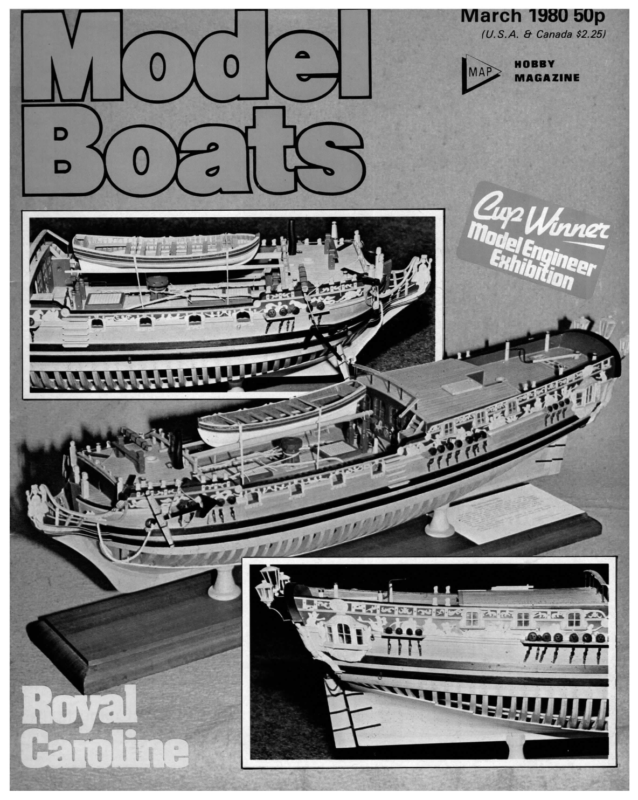
Walton’s This month’s cover is graced by J.ofB. 1749, the superbly modelled Royal Yacht ionship Royal Caroline, winner of the Champ 1980 Model Cup for Sailing Ship classes at theThe model is Engineer Exhibition in January. ngs based built to a scale of jin to 1ft from drawi Maritime on the original draft in the National the Museum. Frames and planking below pearwales are of unpainted lime, work aboveareis basedand on the deck sycamore. The carvings Architectura those illustrated in Chapman’s modei also Navalis (1761) and are in box. TheShip Model shared first place in the 2nd Competition at the National Maritime Museum in December ‘79. Propwash on page 178 generally discusses or two models. the exhibition and depicts one ing However, the full report, includ results, will appear next month. * * * Society and Club News al Cardiff are Model boaters residing in Centr Angelina invited to contact Colin Smith, 155(tele phone Street, Butetown, Docks, Cardiff a club in form Cardiff 374680), who is trying to model boats is that area. Anyone interested in nt welcome; however the main interest at preses. is live steam and fast electric powered model * * * MYC it was At the recent AGM of the Solent R/C ts, toadda decided, in response to many reques scale section to the club’s activities. This in no of the club way will affect the primary objecoftsthe RM class which are the sailing and racing of yacht. of the full club remains at £4.00 Membership per annum). per annum (scale section onlyat£3.00 the well known The sailing water remains n Setley Lake in the New Forest. The scale sectio of the will operate at times differing fromdethose all types of radio yachts. The section will inclu the boats, power or sail, butin line with terms of ssion, the club’s lease with the Forestry Commi the use of internal combustion engines is strictly forbidden. The club has accepted with regret the resigna- since the tion of Eric Shaw, Secretary/Treasurernted W. R. formation of the club, and has appoi Down, (Bob) Mathew of ‘High Topps’, Sandy as Lymington, (telephone Brockenhurst 3013) club, to the new Secretary/Treasurer of the full whom application for membership should be made. * * * new Tynemouth Model Boat Club also has a tone Secretary, namely S. Purvis, 11 Holys Avenue, Newsham Farm, Blyth, Northumberland. * * * n has The Off-Shore Model Racing Associatio elected as advised that Peter Allen has beenurer for the Chairman and Mrs L. Baldry Treas spon1980 season. Secretary, to whom all corre J. Hug- dence should be addressed is Michael 150 MYA‘s Marblehead demonstration at the Boat Show created much interest. (Large fans supplied the wind.) Photo, Ray Brigden. ‘gan, 76 Heron Wood Road, Aldershot, Hants, GU12 4BH. * * * a for The Society of Model Shipwrights’atregatt Stockwell 1980 is as follows: Sunday 8th Juneey, Kent— no College, Rochester Avenue, Broml ic powered boats— fee 75p per boat— maximum naval, two entries per person. Classes, scale scale merchant, stand-off and kits — juniors welcome. * * * Woodspring Model Sailing Club will be holding the following regattas in 1980: Portishead, RA Nationals 12/13th July Bristol Chew Magna 27th July Cheddar Cheese RM 12th October Cheddar Cheese RM, Axbridge 28th September Bowman RM Portishead, Bristol R10r Further information may be obtained from Neil Rothwell, 20 Newcheltenham Road,).Kingswood, Bristol, (telephone Bristol 615497 The National Model Museum Project al After several years of planning, the Nation Model Museum Trust are now going aheadtowith be the establishment of the Museum aiming 1981. open to the public — at least in part — inbeyon d The art of model building goes back the the Pharaohs and the early Sumerians. From ta, sixteenth century onwards clocks, automa to a and miniature fire arms were developed high degree. In this country today there are over one thousand clubs devoted to model building rcial and over a dozen successful comme magazines dedicated to model building. Nowhere is there a comprehensive collection where examples of all forms of model building are accessible to the public. No. The NMM Trust, a registered charity — over 273669 — was formed to fill this gap and forplans two years the Trustees have discussed sted with a great number of people and intere ds’ of the companies. A group known as ‘Frien National Model Museum has been formegd and the an inner committee is co-ordinatincollecdevelopment of the project. Several large as tions have already been promised as well individual items of considerable interest and value. The plan is to establish the museum at an easily accessible site and several locations are at this moment under discussion. and It is possible to open the museum in 1981 necestherefore the trustees need to raise the approsary money to acquire and renovate the priate property over the next two years. exhibits will represent various categories The pracof models and model buildings, historical, t, ships, tical, military, railways—all sizes— aircraf l. general engineering and architectura ical section will include mechanical The histor toys, firearms in miniature, furniture and pottery, puppetry and theatre. ng will Test equipment and employment trainiwill be be included in the practical section. There visiting fully equipped workshops whereskills. The craftsmen can demonstrate their workshops will also be available to club members as will a reference library. be a lake for model boats and areas There will or for flying all types of aircraft and an outdo e a play model railway. The grounds will includ area for children, restaurant and a shop. Workshops will assist clubs and societies, where possible, by producing special parts and will be the venue for participatory skill courses. SAS S anoOI NS EE TEST BENCH New Products the Not many new items have appeared during ded last month or so, due of course to the exten ing Christmas holiday and manufacturers prepar for the New Year trade shows. It might be opportune in the space available therefore, toof reinforce the criteria surrounding inclusion products in the Test Bench columns. We endeavour to only mention items which a visual occasions where an item does not need value of inspection for us to assess the potential the have been inspected by our staff, except on rare bringing it to your attention. Please note word inspect. We can only report on what,we see, and it is not always possible, of course to a long determine whether that product will have life or if, for instance, itis a kit, how well it will go together. Obviously, our much more detailed kit reviews supply the latter. We are always pleased to receive information/samples of new products, and will conto tinue to bring what we think are useful items our readers’ attention. * * * e of Graham J. Bantock has forwarded a samplorathis Groovy extruded. mast section incorp The ing an internal luff groove, for model yachts. Model Boats
section is as per diagram and is reproduced full size. Diameter is 14.5mm, wall thickness 0.7mm, slot 1.8mm wide, internal groove 7mm by 4mm, weight 110 grams/metre (1.2 0z/foot, material HE30 (a hard aluminium/silicon/magnesium/ manganese alloy). The Groovy mast section has been developed to combine the benefits of the luff groove sail to mast attachment method with those of a mast stepped through the deck. ‘Aerofoil’ mast sections create turbulence detrimental to performance if they fail to rotate freely and, when pivoted on deck, have to be unnecessarily heavy to provide adequate stiffness. Because the Groovy section can be stepped through the deck in the conventional manner a stiffer mastis obtained for a given weight and diameter. The pressure losses which occur through the gap when the mainsail is attached to the mast by rings or hooks are eliminated thus improving the effectiveness of the rig as a whole. If you choose to use more than one suit of sails with a single mast you will find that sail changing becomes a simple, quick and hazard-free procedure. A Class skippers need have no more nightmares about sail changing. A companion section is available from Oliver J. Lee and is 16.5mm diameter. The smaller section fits snugly inside the larger to enable construction of tapered masts or to allow the larger section to be permamently or temporarily joined. The smaller section can be joined using a modified length of 16 gauge 3in OD alloy tube. Bantock Groovy mast section. Most sails fitted with luff ropes will fit the new sections. However, any necessary modifications to these or existing sails can be undertaken. Bantock sails fitted with luff ropes incorporate a flexible nylon tape which enables the sail to hinge at the back of the mast giving a smooth section at all sheeting angles. Each order for tubing is accompanied by a sheet detailing an easy-to-make gooseneck, masthead fitting, boom, outhaul etc. Prices range from £1.60 for a one metre length of standard finish to £3.50 for 2.5 metres. All lengths are also available in silver finish and the 2.5 metre length can further be obtained in gold or black finish at extra cost. Address is 30 Winstree Road, Burnham-on-Crouch, Essex, CMO 8ET, (telephone 0621 783890) for further details and postage rates. * * * Three new machine tools have recently been launched by Cowells, namely a Wetstone Grinder, a Linisher/Grinder and a new version of the 90 lathe, now known as the 10-200B Lathe. All these units were in use on Cowells stand at the Model Engineer Exhibition and dis- play the now accepted quality and robustness that we have come to expect. The Linisher/Grinder and the Lathe are probably of most use to boat modellers. The former is based on the motor of an 8in grinder and this very useful tool combines a 6in grinder wheel and an 800mm x 50mm linisher. It accepts standard linisher belts which are available in a wide range of grades making the machine ideal for both rough and fine finishing of wood and metal. During 1979, Cowells worked closely with the Technical Advisory Service of the Design Council on the restyling of the motorised version of their lathe and the success of the operation can be judged from the photograph. Some of the improvements made, such as the heavy aluminium casting incorporating the motor compartment, switchbox, surface plate, tool trays and swarf tray can be seen — also the faceplate and hard and soft centres are now supplied as standard equipment. Other improvements, of which some are the results of feedback from users, are the new cam type belt tensioner and the larger handwheels, a very useful and adaptable machine for which a large range of accessories are available. Further details from Cowells’ stockists or P. T. Milliken, Cowell New Cowells 10-200B lathe. Engineering Ltd., 95/101 Norwich, (telephone 0603 614521). Oak Street, Readers’ Letters From the Continent Dear Sir, It would be interesting to know how many readers followthe European ship modelling scene by reading the French and German equivalents of Model! Boats. | took out a trial subscription to Schiffsmodel/ \ast spring and have been impressed by the variety and high standard of projects described. Lately, there has been a working model Voith-Schneider propeller, a steam-driven Mississippi sternwheeler and an account of a North German enthusiast’s encounter with the Stuart ‘Triple’. He was rather surprised to receive just a set of castings through the post but built the engine and, fitted it into a large tug model complete with radio control and live steam starting valve to overcome the dead-centre problem. There was alsoa beautiful scale working model of a hydraulic deck crane, although this belonged more to model engineering than model boat construction in my opinion. The French magazine Modéle Réduit du Bateau appears bi-monthly and not surprisingly shows a difference of approach. As the value of our Pound makes these mags a bit expensive, | only pick up V.A.B. now and then, but earlier this year there was a nice electrically-propelled Rhone pusher tug and an (unfortunately hyper-critical) account of the ship and boat section of the last Model Engineer Exhibition. Nevertheless it is refreshing to read about other countries’ methods and viewpoints, especially as British vessels are frequently chosen as the subject matter. One wonders therefore if Britons working in Europe with BAOR or companies are active in their local club. Perhaps they might be able to send the odd report or photograph of exhibitions or meetings for us to savour back home. Although we are not short of hobby materials and their manufacturers here, access to European sources has brought a wealth of tools, kits and power plant to modellers in these Islands and that can’t be bad. Europeis fun—can we hear more about it please, Editor? Do any other readers have similar views? M. T. Knowles Caption Contest y capti year’s subscription, was E. A. Rust-D’Eye of Downham Market, Norfolk, with “This way for England?” March 1980
Te A new One-Design featuring a novel rig Fleet systems Club news| om From our MYA zeae SN SEEN SESSA SAARI SAAN REMARKABLE rig has been designed the mast top movfrom the hull centreline, has led to the introduction of a simple kit model which is just reaching the shops f. There are no jib fittings, shrouds, backstay, forestay, jumpers, spreaders, bottle-screws etc, just two bowsies, a simple screw adjuster, and about six simple wire bits. The mast is bent by a bowsie-adjusted strainer which, interestingly, has the opposite effect to a conventional kicking strap, since it must be tightened to increase flow in the leach. g. Time required to rig or derig, 5 seconds; time to change sail on the same mast, 2 mins. To rig, the mast heel is simply slipped into position and rotated 180°, engaging a wire key in a guide slot, and A by Eric Nuttall, MYA Radio Sec, and and which looks almost certain to become a really popular one-design for radio racing. More than two dozen pre-production models are sailing and have aroused con- siderable enthusiasm. Apart from sharing the view that a smallish, simple one-design boat is needed, Eric’s starting points were that the cost in time and/or money to build a conventional yacht is off-putting to a newcomer, largely because of the rigging and the fitting out, and that a special sail winch demanding a fair amount of power adds weight, complexity, and cost. There are no easy production methods for the fittings needed for the conventional Bermuda rig, and some engineering knowledge or skill is needed to build a boat, or even complete one from a kit. If the rigging could be dispensed with, a major part of the cost would be reduced, and there could be further advantages in the time taken to rig and derig, or change sails, ata race meeting. By using aunarig, sail cost is also virtually halved, though a una rig can be subject to broaching and some standing rigging is usually required to set specially cut sails on bendy masts for optimum performance. The ingenious rig evolved answers all of these points, and more. Its advantages are: a. Nostanding rigging at all. A bend is introduced in the mast by the application of a force greater than the wind can over- come, therefore obviating the need for standing rigging to prevent bending and, as a bonus, removing the requirement for extra hull reinforcement. b. Thesailcan be cut from one piece of cloth. c. The centreline of the mast pivot passes through the CG of the rig, which is therefore mechanically balanced. d. There is approximately 25% of the sail area forward (or to windward) of the mast pivot centreline, providing a degree of dynamic balance; experiments have shown that the forward part of a sail contributes proportionately far more than the after part, and the 25/75 ratio is about right, requiring the minimum effort to sheet in the sail. Anormal servo is entirely adequate for the near 750 sq in of the sail used inthe one-design application. e. 156 The boom lifts as it moves away ing aft. the sheet connected. Ingenuity is also displayed in the sheet. With the boom out at 90° for running, the extended servo arm is also at 90°. In the absence of shrouds, the boom could pull the servo arm further than intended, but in the sheetis a Barry Jackson type four-hole bowsie, the sheet cord being in two pieces, each end hitched to the bowsie as sketched. With this system, adjustment can be made by moving the bowsie along the cord or by pulling one ofthe tails of the cords through. The sheet leads through a wire horse, and the bowsie is positioned to provide a stop against the horse at the fully out position, while the other part of the sheet is adjusted to set the boom in the close-hauled position at the other end of the servo travel. On the foreside of the horse the sheet terminates in a hook which slips over the wire kicking strap, located by a loop ina wire entwined in the kicking strap and capable of adjustment. The sail is of the pocket luff type and has a luff tensioner (bowsie) and clew adjuster (spiral wire Sailing trials with a 36in hull clamp). have shown that with a 500 ma/h nicad cell (6v instead of 4.8) some three to four hours of sailing can be enjoyed before the power supply flags, indicating that the load on the standard servo used for sheeting is indeed light. It is this hull (by Dave Hollom) which is being kitted by Sealplan with the rig, giving a boat which from box to water takes little more than half an hour’s work. Correspondent A pair of these boats—Mickey Finn isthe name -— appeared on trade day at the Earls Court Boat Show, and showed remarkable acceleration, speed, and manoeuvrability under the fans on the tank there. In fact they outperformed the Marbleheads, although on open water a reasonable RM will have the legs of them. There is no doubt that they meet the main criteria for an introductory one-design, and we expect to see hundreds of them over the next year or two. Races have already been scheduled by some clubs! A full kit review will be appearing very shortly. Blush Dept. We managed a classic in the January issue. The ex-Basildon, ex-Channels International club is now known as Chelmsford RYC, not Cheltenham, as slipped through. Radio Methods Des Fairbank, Hon Sec of Durban MYPBC, wrote to tell us of the fleet system used highly successfully by his club all last sea- son; a considerable recommendation is that skippers from both ends of the spectrum have stated approval and satisfaction, and it is also felt that the overall standard of sailing has improved. For open events, with a variety of skippers of unknown ability, a series of seeding races are held. The first step is to decide, from the number of boats, the number of fleets and number in each fleet. As an example, with a 32-boat entry, four fleets of eight boats would be suitable, though other combinations can be used. A draw places each boat in a fleet, and each fleet races; only the finishing positions are needed. The first four races (ie, one for each fleet) are followed by promotion/ relegation races between the bottom four of one fleet and the top four of the next, which means three races in our example, with only the top four of A fleet and the bottom four of D fleet not participating. The top four in each p/r race move into the fleet above and further rounds are sailed in the same way. Atop skipper drawn in D fleet should thus move to C after the first round, B after the second, and A after the third. To allow for more than four top boats being drawn in D, an extra round is desirable, so for 32 boats 28 races are needed to achieve accurate division on merit; most boats will have sailed 8 races and everyone at least 4. For club races, seeding should be possible and these preliminary races will not therefore be necessary. Once the fieets are established, a similar system is used, except that each fleet sails two scoring races followed by nonscoring promotion/relegation races as before, based on each boat’s total score in the previous two races. Thus a four-fleet Model Boats
SEMI – BALANCED YACHT RIG. wiRE Mast TO May Be Cut EASE SAIL HOOK PosivTion of Mast Berore InoucING BEND. A-centesiine of Pivor. 2 CHANGING. FISHING Line. Back STAY = ONE for EACH SAIL. WIRE HOOK CENTRt of Geavity APPLYING LOAD IN TENSION TO 3 on4 HOLES Bowsit TO RELIEVE ON PRESSURE FRONT ELEVATION FRONT BOOM- ELEVATION WITH WITH BOOM AT CLEW(iowee aer APT CENTRELINE AFT CENTRELINE Comneg oF SAL ADJUSTER \\\ BOOM AT 90° 10 Fore 45°TO Forez \ OF YACHT. OF YACHT. KICKING STRAP. § wie SWEET EVE wive om. TO PASS Tueo’ KEYWAY SETTING UP-DIMENSION. ADJUSTABLE REINFORCING TUBE. INITIAL ATTACH SHEET TO KICKING STRAP. Wy 5X2 IN DECK BEARING LAY DECK —_1 ___ _ WOODEN PLUG. EPOKIED IN PLACE G Orn Re, CETEQNEN “MICKEY FINN” ‘TM— END PIVOT – EPOKIED INTO END OF MAST RIG ASSEMBLY SIDE ELEVATION WITH BOOM AT SO* TO Fore & APT CENTRELINE OF YACHT. “ SEMI- BALANCED YACHT Ria. OTHER TYPE of RIG. Boru WeELep AT Same ANGLE. round consists of eight scoring races and three p/r races. At the end of three rounds a boat will have sailed six scoring races and the results will be based on each boat’s best five scores. More rounds can, of course, be sailed, but the discard of the lowest score remains. This is based on the system outlined in the 1977/80 IYRU and RYA rules, appendix 5. Scoring is 1st 0, 2nd 3, 3rd 5.7, 4th 8, 5th 10, 6th 11.7, 7th and above, finishing posi- tion plus 6. Failure to finish scores maximum in heat plus 2, failure to start max plus 6, disqualification max plus 1. First place in B fleet scores as for 9th, first in C as for 17th, etc. Durban club feel that adoption of this system is the biggest step forward they have taken in R/C sailing, and would be happy to explain any queries. Des’ address is D. J. Fairbank, 52 Kew Avenue, Westville, 3630, South Africa. Dovercourt New sec of the Dovercourt MYPBC is Chris Jackson, 81 Nipsells Chase, Maylandsea, Chelmsford, Essex, who will be pleased to provide information and help to any interested modellers who care to write, or telephone him at Maldon 740149 during evenings. Chris is personally running March 1980 gma SS 4 HOLE BOWSIE, ADJUST FWD PART OF SHEET TO PROVIDE STOP AGAINST SHEET HORSE WITH RUDDER SERVO TM~ BOOM AT 90° (RUNNING POS.) ADJUST AFT PART OF SHEET TO PLAN VIEW SET BOOM IN CLOSE HAULED POS. about 15 races at Dovercourt lake during the season, covering 36R, M, 10R and RM. Open races include the Belton Cup (M) on May 11 and one for RMs on Oct 26. The club will also host the District Championships for RM team (June 1), 10r (July 20) and M (Sept 7). Things should be humming this year at Dovercourt! – RADIO INSTALLATION other boats to qualify. Foreign challengers so far are N. Bennell, M. Louis and R. Doorey from Australia and John Cleave from England. Entry deadline is Aug 1. The Mini-America’s Cup, for EC12m yachts, will be taking place Sept. 10—14 at Fort Adams Cove, Newport, Rhode Island, a week before the America’s Cup series. The name has now been sanctioned by the New York Yacht Club and an innovation this year will be the Newport Mayor’s Cup Race, between the top three defenders and top three challengers next to the individual defender and challenger, to be sailed on Sun Sep 14, the day of the Cup series, to make up a full day of sailing which, incidentally, takes place in front of a vast crowd of knowledgeable yachting Foreign enthusiasts. Mini-America’s Cup challenger eliminators are scheduled for Sept 13, the two preceding days being devoted to selection of the US defending yacht from a total of 15 which themselves will have had to sail against John Cleave has sportingly offered his second boat to any English skipper who will be there, for a sail-off for the right to represent England. 157
= OOKING forward to next Sunday? Good. A chance to show the rest of the model yachting fraternity that last week’s results were not really representative of the boat’s potential, or your own skill? Fine. But, just for a moment, let’s analyse just how much enjoyment you got from AY ND SU AD HE LE RB MA of bows the s acros shot ed Peter Maskell aims a lightheart promote the sailing of other Marblehead yachts, in an endeavour tothe 10 Rater. classes — in particular last week’s Marblehead-racing. Remember last Saturday night? The laughs you had packing the boat, five suits of sails, two fins and bulbs and associated gear into the car, and the hasty reorganisation when the wife and kids decided that they would be coming after all. Reminisce about that pleasant Sunday morning drive, unable to change gear properly because of the second-suit mast that kept slipping down between the seats, and how the youngest enjoyed being sick all over the newArig. Never mind, asthe wife said, at least it didn’t spoil his new jeans. Cheer up; there at last. Wife, kids and dog disappeared into the clubhouse, whilst you looked at the wind and tried to decide which fin was needed, and which rig to use. Well, at the time it was a gentle A rig breeze, and how were you to know that it would be blowing 18 knots by lunchtime, or, for that matter, that you would not be having any lunch as you’d be far too busy changing sails, masts and jib-fittings. Ah, you say, but all this was incidental to the actual sailing, wasn’t it. Just a few minor inconveniences to be overcome in order that you could enjoy your sport. Hmmm. Alright then, let’s consider the day’s sport. How you wished you’d chosen the deeper fin going to windward; How fast the boat was travelling downwind, underwater; How the rudder waved frantically to you in the gusts, and how many races did you miss whilst changing sails, masts and jib-fittings? Or, in the case of you vane enthusiasts, how many resails did this result in, as the sun sank slowly in the west, and the wife was giving you a gentle reminder that the automatic timer had the joint done to perfection thirty minutes ago, and there you were, eighty miles away, and at least two more resails to take, plus the daunting prospect of that return journey. Worst of all, the certain knowledge that it was going to take more than a box of chocolates to put things right this time, and it would probably be Thursday before normal relations were resumed. An exaggeration? Perhaps; but who can deny that they have not suffered at least some of the above? Now | want you to consider an even less edifying prospect. | know of one top competitor who, not content with keeping all this misery to himself, has, for the last two years, been infecting his son. So what, | can hear you saying, and why doesn’t he get to the point? O.K. here it is. This competitor is not entirely happy with the performance 158 of his boat in the light stuff, and has decided that he will design a boat just for these conditions, with an alternative choice of fins and bulbs, should the weather forecast prove unreliable. Now, whatever father has, son has to have as well (a very democratic dad, this), and as many races in the North allow entry on the day, the full complement goes like this. Boats (4), Fins (4), Sails on masts (21 suits), and enough bottlescrews etc to start a chandlery. Wife, dog and other kids have to be temporarily omitted until the Ford Transcontinental and 40ft trailer are delivered. Whilst this gentleman was relating these plans to me, he was actually laughing at the prospect. | was not, although he may have mistaken my sickly grin for one of amusement, but | can assure him that | was making a mental note to sell my Marblehead now, while a Alright then, those of you who agree with me (if any), let’s look around for another class to sail. What about a 36in Restricted? Well, where they get the restricted bit from, | don’t know, as just about everything except the physical dimensions is as wide open as a pub door, and besides, such a small boat has even worse sailing characteristics than an ‘M’. An‘A’ Class then? ‘A’ Class yachts come in anincreasing variety of shapes, weights and dimensions, but they all have one thing in common. They are slow. Or at least slower than 10 Raters, or even some Marbleheads. Their popularity is due to two factors. Firstly, there are a lot of races for ‘A’ Class, and secondly, their appearance has not been altered too much over the years. That is, until market still exists, and concentrate on another class entirely. | suspect that those who want to compete with him will follow the gentleman’s lead as far as their pockets will allow them, but| also suspect that there will be many others like myself who will drop out now. Even if | could afford this lunacy, | reckon that Marbleheads are difficult enough to sail and transport, without adding to the complications. beating to windward | Above, Barry Jackson’s Eclipse event at © in a strong blow at the MYA/ laviga Fleetwood last year. Right, a Lewis Pulsar swiftly — meeting. . moving through the swell at thebysame Dave Hollom. \= ~~ Photos Model Boats
recently. Itis ironic, that at a time when the Royal Navy is phasing out aircraft carriers, model yachting is giving them a new lease of life. What are we left with then? One- designs? Well, yes, they are surely going to play an increasing partin our sport, and A NEAT SHROUD HOOK Walter Grint describes his neat and efficient method of fastening shroud lines to rigging hooks not before time, but what about one of those long, slim boats tucked away at the Shroud wire back of the clubhouse? Brush the dust off the sails, and you’ll find that they are 10 3 Raters. Remember 10 Raters? Good. Now take one out of the clubhouse, wash it Hold down down, set the gear, and point it up the lake. iy 1:70 mm Note how it sails in a straight line, how the have a Marblehead luffing up to wind, and, above all, how fast it is. Note that there are unlikely to be more than three suits of sails, that no alternative fin and bulb would put it out of rating, and once g aia extra length resists the gusts that would Spring the mast position is found, that the jibfitting need not be moved again. Ever. Enjoying yourself? Good. Now put it back in the clubhouse, before the owner arrives for his annual trip up and down the lake, and set about getting one of your own. There are two very good designs in the MAP Plans Handbook. (Cracker and Synergy have both proved their merit and are available in hull form.) There are also not a problem. It does seem that once a class starts to ; decline, it is difficult to revive it, and a ‘chicken and egg’ situation develops. Nip here Clubs discontinue their 10 Rater races due at same to small entries, and immediately skippers time are reluctant to build new boats, or, even maintain their present ones. This shortsighted policy has been ruinous to a class once supported by some designers and skippers, almost to the exclusion of all others. R/C skippers have not beenslowto Hold ! Vise recognise the qualities of 10 Raters and surely the vane enthusiasts are not going to allow the demise of the swiftest and most graceful class of model yacht. The continued success of the class is the tion. It seeks to provide two additional Shroud Hook The following tip may be of some use to major 10 Rater events on the calendar, modellers. aim of the newly-formed 10 Rater Associa- and, through its memberships, encourage clubs to include more 10 Rater events. One additional race per club, per year, would substantially improve the situation, and encourage the building of new boats. The winter evenings are now with us, and with them come the time and opportunity to plan and build for next season. In a fresh breeze the 10 Rater provides a spectacle which no other class can equal. You could be the creator of that spectacle. * * * Footnote: Further details of the 10 Rater Association can be had from Brian Barber, 243 Gibson Lane, pol es Leeds. Tel: 0532 866011. March 1980 : | Pull here several others available from their respective manufacturers, so that availability is A lot of model yachtsmen having made a nice job of their boat, seem to have trou- ble in finding a neat and efficient means of fastening the wire shroud lines to their hooks. The resulting efforts are often untidy and dangerous to handlers. The following method was passed on to me many years ago, and has never let me down. First wind a piece of shroud wire around the shank end of a 1.70mm drill mounted in a lathe chuck or wheelbrace the reverse way round. To get a grip, | usually tuck the end of the wire in between the chuck jaws. Turn very slowly until a small spring 3/8 inch long is formed. This is then neatly trimmed of excess wire. Slide this spring onto the shroud wire followed by the hook or eye. Allowing approximately 3 inches of wire, bend it around the hook, and put the end back through the spring. The spring is then pushed down close to the hook and heldin position, while the wire end is bent over its top rim, and brought down and passed up through the spring again. Hold the hookin a vice, take hold of the wire end in a pair of pliers, and gently pull. At the same time squeeze the wire coming down the outside of the spring with a pair of flat nosed pliers, to make it lay neatly against the body of the spring. Trim off excess end of wire to top of spring. This method gives a very strong and professional finish to shrouds and kicking straps etc. 159