- Logbook Model Yachting Association News.
- Sail World Championships 80 Reported by Tim Fuller

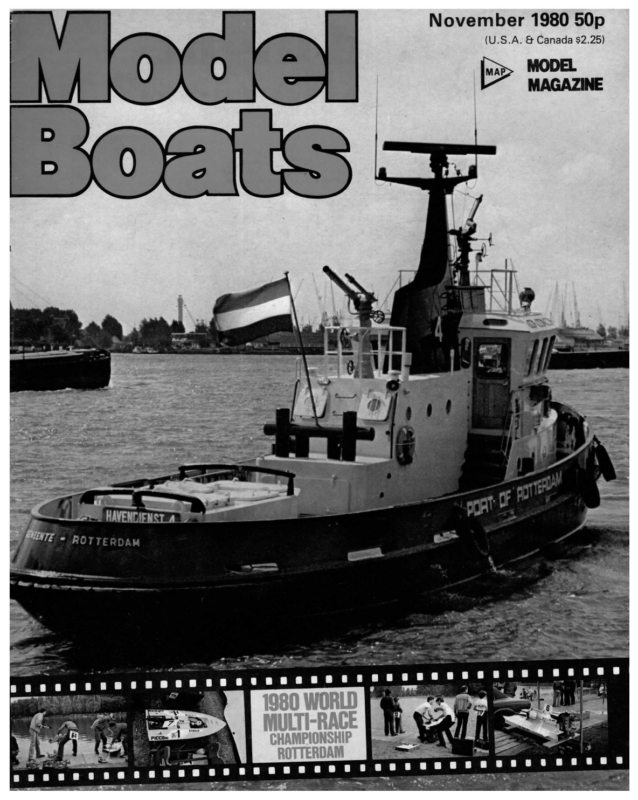
November 1980 50p (U.S.A. & Canada $2.25) Be MAGAZINE eupeugouacuagneae eseaeeeene
Mainsail luff foot agar leach roach foot 65.5min., 67in max. 20.5 min., 22in max. 2iin max. lin max. battens max. 4 equi. spaced, 5in max. headboard same material as sail, 14in max. Jib luff foot leach leach roach foot battens 52.5 min., 54 max. 17.5 min., 19 max. 49.05 min., 50.55 max. 1 max. 1 max. max. 2 equi. spaced, 2in max. Storm main 51-54 x 50-53 x 20.5-22, 1in Storm jib roaches 45-46.5 x 42.5-44 x 16.-17, lin roaches Among the prohibitions are permanently bent booms, rotating masts, alteration of a manufacturered hull by sawing or cutting, double luff sails, and mechanical/electronic control of standing rigging, boom vangs (what we call kicking straps) and travellers. The rudder, which fits into a notch in the full keel, is controlled in height and length, and there are other assorted points, mostly minor. Only one section is really unclear — ‘Deck — Deck to be constructed in accordance with sound construction practices. Deck line at mast step to be a fair and continuous curve” — both halves of which are pretty meaningless as they stand. Sail 80 The World Championships at Ottawa were, candidly, something of a disappointment. Despite procedures having been hammered out with the IMYRU Board over the preceeding months, it proved quite a different ball game when the event arrived; to travel to Canada for a week’s sailing with 70 boats on two widely separated sites and to get only twelve races — which is all the majority of skippers got — is almost unbelievable. And those races were against the same group of opponents each time. The EC12s were luckier; they had the smallest number of boats and exclusive use of the second lake, and they able ancillary functions. them for the other classes, nor has there been did sail a full schedule. Actually, the programme Such a questionnaire will be tried for the first time in the immediate future, to resolve the venue for the 1982 Championships, a decision on which will be made in November, which will give eighteen months or soto get it organised if a May date is envisaged; the French have in mind Dunkirk, which had a successful meeting at Easter this year, so they too may bethinking of an early season date. The Naviga R/C Yacht Championships are being held in Belgium in 1982, and these are usually in August, making the case for an early date stronger. Less is known about the Danes at present, except that they sail quite frequently against Swedes and Germans and thus have a degree of international experience; apart from vane As, we haven’t seen much of them at previous internationals. The difficulty with an early-season international, in which some limit on entries is inevitable, is selection. Taking results from the previous season could eliminate any superior boat any apparent need for them. However, the EC12m is a new class to most countries and also breaks new ground in being the first international one-design adopted, so a central point of liaison may have advantages. New ground was also broken with the circumstances of the GM itself, which followed a dinner and began at 9.15 when the tables were cleared. The fact that the meeting was closed at precisely midnight indicates that participants kept to the point to get through the business in such reasonable time. lists 70 official entries, total, only 12 of which were EC12s, one from England, 8 from USA and 3 from Canada. The programme, in fact, carried three photos of yachts, all EC12s. All boats were measured during Friday, Saturday and Sunday (racing didn’t start until the Monday) and a ten hour wait for measurement was not uncommon. National certified rating certificates “weren’t worth the paper they were written on”, and Chris Dicks (the IMYRU Rating Rules Officer and the least likely person to be even a millimetre out) was forced to cut down his sails and change his sail numbers. All teams subscribed to a formal protest on Sunday about the method of sailing to be imposed, and Barry Jackson stayed up much of built over the winter, and the only compromise is probably to give sufficient notice for intending builders to advance their plans and to run-selection races late in the previous season. However, this is a problem to be solved by individual countries and is a digression. The City of Nepean, where the Canadian racing took place, has generously provided a trophy, the Nepean Heritage Cup, for EC12m world championships. An American suggestion that the class might need a Class Secretary resulted in a request to the MYRAA to name a Liaison Officer. Class secretaries, in model yachting, are American practice, but the IMYRU does not have November 1980 The EC12m A copy of the rating rules has been gratefully received following the comment in September’s log book. Summarising it, a standard hull from an approved manufacturer must be used; there are five such listed in North America, but others may be proposed as the need arises. Apparently some earlier hulls wandered a bit, being up to 3in overlength. Dimensions were tightened up in January, 1978 and instead of a maximum beam of 11.5in (plus or minus 3in) a table of deck-edge measurements at 5in stations with a plus or minus iin tolerance is now given. Basic figures are: Length o.a. Lwl Draught 58in min., 60in max. 42in min., 43in max. 8.75in max. Max beam at deck Displacement max. Mast height above deck 11.19in plus or minus iin. 26.5Ib (or 43in w.I. if lighter) 72in, wood or aluminium only Jib stay attachment max. 59in the night to write out a full schedule, both exercises a total waste of time. Sailing started on Monday, with two races an hour at the fastest, and ended with not even one schedule completed. Tuesday started with RM skippers, having double checked, turning up at the lake and rigging up to finish the first schedule, only to be told they should be at a lake several miles away. This was followed by most of the officials simply pulling out. It was that sort of week… It is understood that the Canadian MYA had dropped out of the organisation build-up some time before the event, and it was unfortunate that the OOD, Alex Farmer, suffered a (luckily mild) heart attack at the beginning of the week. The load was thrown almost completely on to two people who decided that their only course was to run the meeting as planned, an understandable decision but unfortunate in that the planning was unsatisfactory in the first place. 693
Two Stollery Lollipops at the ‘A’ Class Championship, Gunslinger and K1055, Wokanido. = Everyone sailed on Wednesday afternoon, and once again the wind was very variable. A fleet sailed on Thursday morning and B Fleet in the afternoon. The westerly wind was quite strong in the morning, but fairly variable in direction. Dick Seager and Roy Gardner were quite successful, but Keith Armour only got 7 points. The wind was lighter in the afternoon, but if anything more flukey. There were three heats left for Friday, and the Championship was still undecided — /p/ Tombi was in the lead, but Daddy Long Pig was one of the boats to be sailed, and Gunslinger was also up at the top. There was very little wind for the first hour, the first ss n 1980 British Open and International ‘A’ Class Championships Thirty four boats were entered for the 1980 Championships, but only thirty-three started on Saturday afternoon. Many of the well known skippers were missing, including previous winners Chris Dicks (in Canada for Sail 80) and Roger Stollery who had decided not to try and regain his trophy. However there were plenty of Lollipop designs, and it seemed possible that they would come high up the fleet. The boats were divided into two fleets, both sailing on Saturday and Sunday, having half days on Monday and Tuesday and Thursday. The International would be sailed on Wednesday morning. By the end of Sunday fortunes had changed dramatically, the wind had changed direction during the two days, and varied in strength, but it always had some weight in it. On the first day Venceremos had 20/20, and Long Pig 3/20. By Sunday’s close Daddy Long Pig had 38/55, no points dropped during the day. The leader at this stage was /p/ Tombi, a Lollipop, with 45, Venceremos had 41, time during the week that the lake had looked so flat. These conditions did not suit some of the top boats, and Keith Armour and Martin Jew gradually saw their hopes of a prize disappear, no points came their way during the last three heats. Walter Jones however held on to his lead, despite the illness of his mate, so for the third year in succession a Lollipop was the winner ofthe ‘A’ Class championships. The win proved most popular, no one begrudged Walter his success. It will be noticed how many of Stollery’s Lollipop designs were in the race, and how well most of them did. The new design of Ken Butler’s and Bill Sykes looked very promising. Another point to note is how the weights of ‘A’ boats have come down during the past few years, all the new designs are comparatively lightweight. The Gosport club ran the race very well, and the new arrangement that allowed competitors to officiate did not meet with any opposition. Now to see if there will be any new designs to worry the Lollipop owners next year. Winners Wing & Wing Hans Hoogerwefe Holland Monday and Tuesday saw heat sailing, it was very hot and there were one or two Johnny Cup W. Jones England 24 runs 25 beats disputes, the size of spinnakers being questioned, and there was some pond side measur- International K. Armour/M. Jew England Daddy Long Pig ing. By now it was difficult to compare scores as some yachts had taken two byes, and Neptune Trophy Birkenhead A Team W. Jones 120 some had not had any. Nevertheless an English boat had to be entered in the Interna- P. Mustill 94 tional on Wednesday, and Daddy Long Pig sailed by Keith Armour and Martin Jew M. Roberts 744 M. Harris 973 emerged with the best percentage. Fleetwood There was a strong easterly wind on Wednesday morning, and 2 rounds were sailed, Daddy Long Pig ending up the winner with 29 points, Do//y Dot from Holland finished second with 26. J. Rose G, Reeves lpi Tombi, Venceremos, Clockwork Orange Results Pos. 1: 2. 3; 4. 5, 6. as 8. 9. 10. +1. 12. 13. Club Design App. wt. Total Fleet A. E. Carter YM 6M OA Stollery Lollipop 36lb 111 B R. Seager Clapham K. Armour/M. Jew Leeds & Bradford Venceremos Wokanido Condor Mene Tekel Peres Finnatik Daddy Long Pig 23. 24. 25. 26. R. Gardner G. Bantock G. Wyeth Fo Kong J. Beatoux Dolly Dot Tinkerbell 11 Mivwi Birkenhead Bournville Gosport Chelmsford Gosport Butlery/Sykes Stollery Lollipop Stollery Lollipop Bantock Stollery Lollipop A 99 A 101 101 100 A B B 36Ib 36Ib 863 853 A B 394Ib – 843 82 A B 364Ib 79 Stollery Lollipop Gosport Fleetwood B 1053 943 94 Leeds & Bradford T. Claxton N. James 36lb 42\b 36lb B 36Ib 36Ib – Fleetwood Gosport 36lb 106 Stollery Lollipop Stollery Lollipop France G. Reeves R. Baker 40lb 120 = Harris Stollery Lollipop Holland Birkenhead 36lb Stollery Long Pig Fleetwood Fleetwood |, J. Hoogerwefe P. Mustill F. Percival Stollery Lollipop Stollery Lollipop Stollery Lollipop Lewis Admiral Dicks Mod. Revolution 403ib 36Ib – 36lb B A A A 87 B 853 A V. Knapp Gosport Stollery Lollipop Double D Clockwork Orange H. Dovey M. Roberts Bournville Birkenhead Dovey/Stollery Stollery C.O. 40lb 36lb Red Admiral Kaneeth K. Jones B. Anderson Birkenhead Newcastle Lewis Admiral Stollery Lollipop. 394Ib – G. Clark H. Shields Danson Scotland Hardwicke Shields 363Ib 49lb 42\b 48 G. Bush Leeds & Bradford Lewis Trident 39}Ib 45 A T. & A. Schollar J. Brandt Gosport Denmark 45 403 A B Crakl D. Hardwicke Blue Admiral Trident R. Piercy W. Maguire Green Salame Queen B. Hewitt 30. Bush Baby 32. 33. Colleen Down Maria 81? Invicta A. Larriman Birkenhead Birkenhead Birkenhead Gosport Clapham Hardwicke Lewis Admiral Lewis Bantock Meirs Sparticus Littlejohn ~ = 973 96} Blue Fin Blue Shark Lairshesis 31; Ken Butler J. Bush/M. Harris J. Rose 27. 28. 29. Walter Jones Zonda JR. Pieces of Eight Ellymay 19 300} Name 17. 8 21. 22. 2804 Gunslinger Ipi Tombi Razamataz Albatross 20. 963 863 Boat 14. 15. 16. Tots Trophy 288} 394Ib 393Ib – 60lb – 79 B B 754 743 A B 72 66 A B 57 54 B A 62 62 A A A 44 B ” Joyce November 1980 Roberts 713
The high aspect sails were a Canadian idea to catch the more direct currents of air found higher off the water. It did however make the boat rather tender and was not too successful. WORLD CHAMPIONSHIPS Se Se et a ee te ss we Ea Reported by Tim Fuller pes AIL 80 took place just outside of Ottawa in and Canada who were used to sailing in these Canada with seven countries competing conditions and had built lightweight boats with rights, and knew exactly how to get the best out from USA, Canada, UK, France, South Africa and narrow beam, deep fins and ‘big bellied’ sails, right position at the right time with full sailing Australia. The racing took place between two and all up weights of 123Ib+ (Il was told) — it of his boat, a very worthy winner. In second place was Terry Allen from the States, again a lakes at Brewer Park and Andrew Hayden Park, would be interesting to see these types of boat very high standard of sailing, well used to light whilst accommodation had been arranged for sail entrants at Carlton University. winds, as was Francois Foussard of France who came third. Francois, as usual, had his yacht in average English weather, perhaps at All boats were measured most thoroughly by Fleetwood, where | am sure their light weight and bendy masts would get them into a lot of Philip Tillman and his team on the two days trouble and that the English boats would sail adjustment to jib kicking straps, backstay etc. before racing started, and all radio equipment through. Tadashi Kato of Japan came fourth with a very was checked by a mobile electronic workshop included one French, one Japanese, four UK, four USA and two Canadian boats. Once again light winds prevailed on the final day’s sailing and it was rather unfortunate that the judges had a much better view of the racing than the skippers and this led to decisions being made about disputes that skippers were unsighted on, and provided by Hewlett Packard, who also moni- tored all frequencies during the racing. Initially, all the entrants were divided into set fleets and had to qualify during two days of racing in order to get into the finals on the last day ofsailing. It was thought by all countries that However, the final 12 RM _ boats packed with servos and winches to give fine beamy 163lb boat made from balsa planking. The Japanese bought the winning Canadian yacht which they obviously hope to copy and sail to success in the 1982 worlds, best of luck to them. John Cleave was the only non-USA or Canadian skipper to sail in the EC12 class, and picked (a) two or probably three days sailing over a 10 led to disqualification on no less than ten occa- up his new boat to sail in the event when he day period was not sufficient; (b) that everyone sions, and this of course made a great deal of arrived. Not only was the boat delayed in transit should have the opportunity to sail everyone difference to the final positions, except that is for but else, and (c) that qualification during a world the first two skippers. Blaire Van Koughnett of fraught times, John sailed well to win in his championship should not be required. However, Canada sailed superbly and won five of his class. | have not heard the results of the EC12 the Canadians were quite adamant in their for- seven final races, he had the ability to be in the mini-America’s cup which | believe he has sailed mat for the event, and it went through as they also arrived damaged and after some in, | hope he has also won this. (Ed. He has!) had planned. There will however be guide lines Squire Kay sailed his usual consistent self, set down for future world championships | am with his K9 liking the conditions, and he won the sure, and host countries will be expected to stick R10R worlds for the second time running, enabling England to come home with two out of three of the world championship prizes. There is a chance that the next worlds might be in the UK and perhaps we can return to both RM and R10R champions. | would doubt that the EC12 will have any following in the UK. to these minimum requirements, so that all countries will know in advance exactly what to expect at a world championship. Apart from one afternoon, the winds were mostly light, and very much favoured the USA Suen —_- Left, Terry Allen of America came 2nd in RMs with a modified Toad, a very fast light wind boat which was sailed very well. Above, Barry Jackson had bad luck and suffered some strange decisions from the judges to finish 11th in the gold fleet. Right, an American R10R with spinnaker flying, looked very good and brought applause from the crowd when first hoisted, but the result was disappointing. There did not seem to be any worthwhile increase of speed, and the boat had to zig-zag to keep the spinnaker full of wind.