
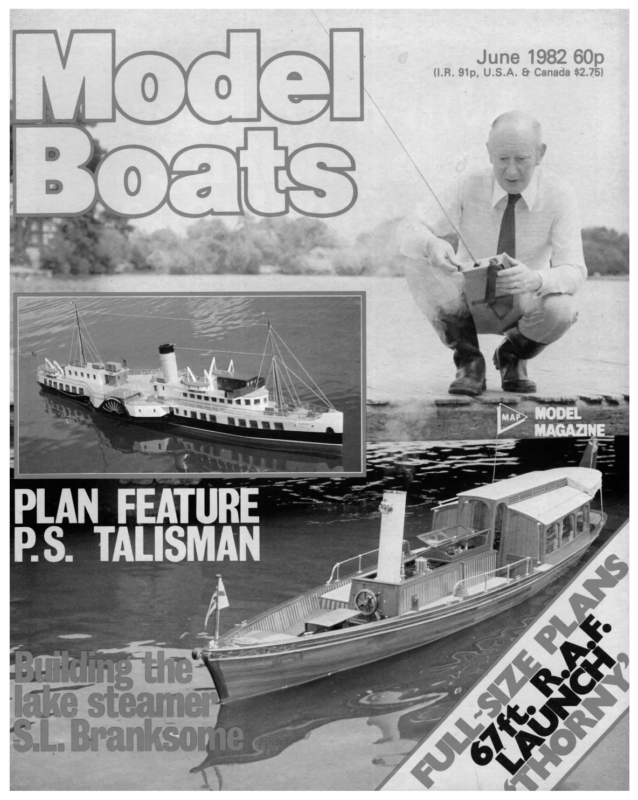
- WHAT’S WRONG WITH THE SWING RIG? Roger Stollery comments on the proposed IMYRU rules for the International M Class
- DUPLEX 575 The popularity of the 575 yacht is creating headaches for 0.0.D.’s where frequency clashes occur. Derek Stevenson describes his solution.
- Logbook Model Yachting Association News.
- Kit Bag AQUAFOIL Jack Barnard reviews the unique aerofoil sail yacht by Aqualine

2 60p June 198 (I1.R. 91p, U.S.A. & Canada $2.75) N A M S I L A PS. T
rig is achieved by a %,in. diameter section at the bottom of the mast. When sailing to windward the swing rig looks quite normal and itis only when freed off that it looks as if the jib is being set ona spinnaker boom coming out to windward, as if by magic, to balance the mainsail. There are three areas where the swing rig has special qualities that make it a real delight: building, setting up and handling. Building WHAT’S WRONG WITH THE SWING RIG? Construction is made easier because there are less parts to make. On the deck the only fitting is the sheet lead! There is no need for shroud plates, or fittings that need to be moved along the deck to suit the differing boom lengths of alternative rigs. The sheet lead is at the bow so that the sheet is led to the winch quite naturally without having to be changed in direction. The bow is higher also and removes the need for a pillar while still allowing a horizontal pull. On the rig itself there is no standing rigging, bottlescrews or spreaders. Just think of the time to be saved in not putting rigging on all those rigs! Finally, this simplicity not only makes it quicker and easier to build, but also makes it less expensive. Setting up Roger Stollery comments on the proposed IMYRU rules for the International M Class One of the aims of this design was to allow the boat to be raced bya very enthusiastic eight year old. Each rig is set up on its own mast and spars and to rig the boat all that has to be done is to insert the mast and hook up the sheet! After that there is only one adjustment necessary to trim the rig for the particular weather conditions. This adjustment is on the jib halyard and it controls the leech tensions of both sails because of the balanced interaction of jib and main. This particular quality of being able to leave the sail set up accurately is a real joy but may be difficult to understand if you haven’t actually experienced it. There is no chance of holding up the racing for rig changing with this rig! HE IMYRU rules committee has for the last eighteen months been ruminating on the Marblehead rules and has at last published their proposals. Of the original half dozen major alterations suggested in the preliminary questionnaire only one has survived popular opinion. However, along with the discarding of the simple 2in. roach restriction for a complete set of formulae measuring the sail width, there are a load of petty restrictions totally alien to the freedom and progressive spirit of model yachting, the intention of the original rulemakers and the reality of 50 years of the most successful international class of all time. One of the proposals is a new rule introduced deliberately to prohibit the ‘swing’ rig. The ‘what’ you may say? The ‘swing’ rig is a descendant of the earliest known rigs some thousands of years old, described in the Egyptian tombs. Like those rigs it has a yard at the bottom of the sails to balance the forces ofthe rig either side of the mast. The sails of the ‘swing’ rig are triangular, identical in every way to a traditional rig, except that on a Marblehead the ratio ofjib to main is a bit less than the normal 300/500. What makes this rig different is merely how these sails are set and it is this difference that gives the rig its unique qualities. The rig was developed on the RM Pickaxe early in 1978 and has become progressively simpler in design as the early preconceptions of problems disappeared with experience. It has since been used on a dozen other boats ranging from a 12in. Choppa to John Cleave’s 28ft. Bembridge Redwing. The latest development on the new RM design Axis epitomises the idea of simplicity. Like other swing rigs it has a yard at the bottom that replaces the mainboom for supporting the mainsail. This yard projects forward of the mast and the jib, set on a normal boom, is attached to its forward end, with the pivot point about 20 per cent back from the tack. There is one small bearing stop on the mast to resist the yard’s tendency to rise up the mast, and the adjustment of leech tension is achieved by adjusting the jib halyard. There is a jib sheet which allows adjustment of the slot between jib and main, which is normally adjusted only forfine tuning: therefore only one sheet is needed to control the angle of the rig. Unlike previous rigs, the Ax/s rig has no standing rigging: the mast is cantilevered from the hull and the stability of the 314 Handling When sailing, the load on the sheet is very much less than on a conventional rig because the forces from the jib are partly balancing those from the mainsail: as a result the batteries last much longer and don’t need changing so often. When the wind is blowing hard the the centre rig improves the handling of the boat downwind because of effort always remains in a constant position close by the mast; the gybing ‘blow’ is softened as the jib slows up thetravel of the mainsail once it is past the centreline. The sails are always pulling at their best and on a quartering run you don’t have to steer a wiggly course to get the jib goosewinged. From the performance point of view this rig is comparable with a traditional set up. After several seasons with the Pickaxe my experience is that it is a competitive rig and produces a very similar performance to the traditional. Some argue that it doesn’t quite produce as good results all round, and at club level certainly it hasn’t yet come out on top of four years results. In tougher competition Pickaxe finished a quarter of the way down the fleet in the 1981 RM Nationals and this was consistent with the club results relative to other club members racing there. The point to be made here is that while the swing rig gives a good performance, this rig does not perform outstandingly enough to outclass anything and cannot in any way be thought of as posing a threat to the stability of the class. If the reason for proposing a ban on the swing rig is fear of some devastating sailing potential then it is misguided. The most basic Marblehead rule controls the sail area and however hard anyone tries, this one factor dictates a fair result however you hang the cloth up. To me the swing rig is the most enthralling, delightful and amazing device | have ever played with in my 20 years in the sport and | would gladly sacrifice a few points to enjoy its beautiful mechanism. So now you know what it is they want to ban! | hope everyone who sails ‘M’s will find out more about these far reaching proposals and take the necessary action. Apart from the procedural aspect affecting MYA members’ ability to have some say in these proposed rule changes, there are several important issues at stake here. | always thought that the ‘M’ rule was a simple rule with fixed restrictions Model Boats
controlling important factors. So why do away with fixed roach and replace it with a complex formula? The brief from the IMYRU to the The one thing that | had hoped would have been tackled is the question of the readability of the numbers. There is room for im- rules committee was to “return to the intended simplicity of the original rule.’ How come that complex things like trim tabs and any amount of electronic gear are acceptable, but simple things like the with the question of exotic materials. swing right and double luff sails are not? How can the new rule proposal two possibly mean anything when the intent is not clearly stated and one is left wondering whether complex or simple is intended? It may have escaped the committee’s notice, but the present rule already allows permanently bent masts and spars, and clearly states how to measure any Curve at the luff from these or straight masts bent for racing. The fact that some skippers ignore this rule should surely be no reason to legalise their action by imposing a complex measurement system on everyone? What is the point of making an issue out of batten spacing when modern sail materials set without them? As the area cannot be affected by the spacing, what is the point? provement here and this should be a subject for discussion along | believe that the Marblehead is a true development class within simple restrictions and that the maximum amount of freedom should be allowed. After all it is supposed to be fun, and in a world of increasing restriction our sport should give us all a chance to express ourselves freely. In the past the M rules have allowed this freedom and the elements have decided for us what is best: restriction of length and area have ensured that whatever we do, very close racing always results. Don’t let us fall into the trap of our full size counterparts: their rules are so complicated they need the constant use of a computer and tend to encourage the bad habits by handicapping or banning any truly progressive features. This leads to a poor breed, vulnerable to the elements as was so clearly demonstrated in the 1979 Fastnet disaster. DUPLEX 57: The popularity of the 575 yacht is creating headaches for 0.0.D.’s where frequency clashes occur. Derek Stevenson describes his solution. AVING been OOD at a number of 575 regattas, | know the frustration of both skippers and OODs when it comes to frequency clashes. From the skipper’s point of view it means de-rigging and losing his sail settings, and from the OOD’s point of view, stick them to the underneath of the servo mounts forming two rails between the mounts, Fig. 1. Taking the bottom half of your plastic box, cut a slot in the sides for the servo leads and aerial to enter. Now stick this part of your box to the plastic rails. the skipper has only one set of crystals, Space it equally between the two servo mounts. Next job is to cut the hole to gain when in fact he has more. | have therefore access to the inside of the yacht. This is cut put pen to paper and hope | can make life in the cockpit of the superstructure. Cut the hole on the left-hand, looking towards the bow side of the cockpit, or to be more exact, time lost while this is done or being told that easier for everybody by explaining how | overcame this problem. Firstly, what do you plastic box with a Rx will fit, require? A small the portside. The hole should be of a size to lift-off lid into which the accept your rubber blanking plug. With this done you now place the top on your box, maximum Futaba servo box height is excellent. 1%,in. A A crystal socket, obtainable from some model shops and with the superstructure in place, mark the centre of the hole you have just cut onto mately 1in. diameter, from a motor acces- the top of your plastic box. This is the position for your crystal socket. Drill two holes using a %,in. drill in the position sory shop, marked, to accept the solder terminals of or electronic suppliers, a duff crystal, 6in. wire flex, a rubber blanking plug approxiand a length of %in. x ‘in. plastic strip similar to that in the 575 kit. Now let us get down to the nitty gritty. Cut your plastic strip into two 4′,in. lengths. Spacing them approximately 2in. apart your socket. Stick the crystal socket to the top of the box with cement, making sure not to get it on the terminals. Now for the tricky bit. With a junior hacksaw cut the case of your duff crystal away from the base and remove the crystal which is supported on two wires. Trim the wires back to approximately Ygin., and solder a 2′,in. length of flex to each wire. In the top of crystal case drill a %,in. hole for the wire flex to pass through, and using epoxy adhesive stick the case back onto the base allowing time to set, Fig. 2. If you do not have a duff crystal you can solder the ends of the flex onto copper or brass wire which fits the crystal socket. Make sure that these are insulated from each other. Now the only job left to do is solder the other end of the flex to the crystal socket. That is all there is to it. All that remains is to stick your receiver into the base of the plastic box with servo tape, insert servo, power leads and crystal plug into receiver, tape on lid with sticky tape, insert crystal into socket and make sure that everything is working correctly. Now you will not mind if the OOD asks you to change frequency. All it entails is removing the rubber plug in the cockpit, changing crystals, replacing plug, and you are ready to go. Two minutes’s work and no Mll er pean SUE mounts Plastic strip June 1982 settings lost. Deck Figaw fF f Fy Happy sailing, and | except to see you all with easy crystal-changing facilities. — X-tal Ld X-tal case Flex Solder [ Glue 315
In places the rules are not absolutely clearcut, for example with regard to the deck, but since the yacht starts with a manufactured hull, width dimensions are laid down and no alteration to the hull involving sawing or cutting is allowed, and the sail/rig is closely specified, it should not be possible to depart far from the overall concept. The following is a summary of the rules, slightly abbreviated but not materially affected: Hulls must conform to the Morgan Plug style as designated hereunder. (The Jones’ moulding conforms, incidentally). Deck must be constructed in accordance with —————— -” Model Yachti ————— sound construction practices. Deck line at mast a step to be a fair and continuous Curve. Australian R/C Nationals A seven-day meeting over the New Year attracted 60 entries (55 actually sailed) in the three classes at Melbourne, where, despite a reputation for fickle weather, they enjoyed temperatures in the high 70s and 10-15 knot winds varying from S.E. to S.W. The entries came American East Coast 12 Metre A L.O.A. — minimum 58in., maximum 60in. Transom — size and shape optional. Waterline length — 42-43 in. inclusive, measured in fresh water. Beam — sheer curve ‘‘one-designTM sail boat by previous USA National kit by Dumas Champion Buddy Black At 5in. beam is 2.33; 10in., 4.18; 15in., 6.12; 20in., 7.81; 25in., 9.32; 30in., 10.50; 35in., 11.19: 40in., 11.07; 45in., 9.95; 50in., 7.82; boats and drove the round trip of some 2,500 55in., 5.33. Rubbing strips up to ,in. thick may be added at the sheer, not included in maximum beam. miles. Since next year’s (the 21st) will be in Perth there are going to be similar mileages averaged by other competitors, unless they fly Draft — this was 8.75in. maximum but this did not correspond with standard hull moulding. Chris Jackson advises that figure has been In RM there were 64 7-8 boat heats sailed over three days with 26 starters, in R10R 32 5-6 boat heats in two days, 13 starters, and in RA 32 6- altered to correspond. Mast — maximum height 72in. from deck including jumper strut, materials wood or aluminium. Rotating masts prohibited. Booms — permanently bent or curved booms boats in two days, 16 starters. The winning boats were all fairly orthodox, though at mostly the lighter end of the ranges, sailed by skippers with RM winner was S McElwee (Tasmania) with 13 points (possible 10%), 2. G. Fish, 3. A. Fish. In R10R A. Fish (N.S.W.) won with 12%, (possible 7), 2. M. Fletcher, 3. G. Fish. Top RA skipper was P. Cox (Victoria) 111/; (possible 7//,), 2. P.McElwee, 3. G. Kiernan. Most Britons have little conception of Australian distances, but to begin to get some idea, imagine driving from London to Edinburgh and back, then again to Edinburgh and back to London before actually arriving at the regatta, with the prospect of the same distance waiting to be covered when the racing is finished, and on roads which, while less crowded, are not always of motorway standard. That’s roughly what the Western Australia entrants did, and even allowing for the different mental attitude to distances in that vast country, such keeness is pretty impressive. G.R.P. Hulls Two or three designs previously available as full kits from Nylet, and two or three new ones, are now available as hull only, or hull and moulded deck, or with deck, R/C hatch, fin and rudder and, in some instances, lead bulb, from Tony Abel, Highnoon, Petersfinger Road, Salisbury, Wilts. (Tel. 0722-24677). Hulls are red, yellow, blue or orange and decks and fins white, and the choice includes Moonraker RM (hull and drawings only, £12), Cha/lenger Mk. 3 RM (hull, dwgs., deck, hatch, fin and rudder £30 but available separately), Cypher RM (as before but with lead £39), Scimitar R10OR (as before, with lead £42), Reflections, Triffid R1OR (ditto, £43) and a40lb. RA (hull, dwgs. £25, deck and hatch (£10). A stamped addressed envelope to Tony will bring fuller details. Both Scimitar and Reflections have been runner-up in national champienships, incidentally. EC12m There have been one or two enquiries about the 324 as on beam allowed at each station. from all over Australia (well, nearly!): the Western Australian enthusiasts built a trailer to take eight successful past records. measurements follows. Bow (station O) defined as the point at which the outboard sheerlines intersect. Stations measured from O (in ins.), tolerance of plus in. prohibited, materials wood, aluminium or grp. full rules for the EC 12 one-design class. Basically the class requires a grp hull from an approved manufacturer, and in Britain this is E. L. Jones (8 Marline Avenue, Bromborough, Cheshire) who supplies a copy of the rules with each hull as a matter of course. there are one or two grandfather clauses to allow for boats built, usually, before 1978, when both control over the mould and the rules themselves were tightened up. Some of these earlier hulls were two or three inches longer and the rule then gave maximum beam as 11)/in. plus or minus ‘in., so it was possible to have a 58in. x 11in. hull sailing against one of 62in. x 12in., though displacement (26lb.) and sail dimensions were strictly laid down, so the bigger boat would have no more sail area and, presumably, a shorter waterline. A proposition was received by the ILM Y.R.U. from an individual (which meant it could not therefore be dealt with officially) to the effect that the Union should drop the EC12 as an international one-design; this was from an American, and reflects the anxiety that has been expressed in the U.S.A. that international adoption could mean alteration to the rules. Nothing could be further from the intention, which has always been to leave any modification which might be thought necessary to the body responsible for the rules in the first place. Most of the class is in the U.S.A., so they have the experience of sailing these yachts and are keen to maintain the rules in a form that will require no alteration to existing boats. In fact there have been one or two minor amendments in the last couple of months, the two most important of which are deletion of any reference to displacement (I.w.|. must be between 42 and 43 in.) and the prohibition of mixed sails, i.e., you either sail in working or storm rig, not with the jib from one suit and the main from the other, which was previously allowed Running rigging — allowed to be controlled electronically or mechanically — main sheet, jib sheet, jib tensioner (trim), jib twitcher. Allowed but manually adjusted only — kicking straps, travellers. Standing rigging — height of jibstay attachment to mast maximum 59in. above deck. Electronic/mechanical adjustment of jib stay, shrouds, jumper stay and backstay not allowed during a race (heat). Rudder — bottom shall not extend below keel, nor shall any portion of the rudder extend more than 3.5in. aft of the keel, or above the notch formed in the keel into which the rudder fits. Optional — loosefooted mainsails, jackline main luff attachment (but no double luff), enclosed jib clubs, radial jib fittings, storm sails. Sails — maximum allowable triangle dimension taken with mainsail hoisted on mast and rig in place on boat with foot and luff tensions sufficient to remove all wrinkles. Measurements cloth to cloth (i.e. overall) not including area within slotted mast or boom. Mainsail Jib Storm main Storm jib Min. foot 20.5 17.5 20.5 16 Max. Min. Max. luff 67. 54 54 46.5 luff 655 625 51 45 foot 22 19 22 17 Leach Leach Leach Foot Battens & max. min. roach roach max. length 4 at 5in. 1 2.25 — — 50.55 49.05 1 53 44 50 425 1 1 1 1 1 2 at 2in. Headboards and clew and tack gussets must be same material as sail (main headboard not to exceed 1.25in. at base, measured perpendicular Model Boats
conduct their initial trimming without distraction and well-meant advice. sufficiently for a letter to be written. A case in registered number, size and position, thatis all, as What is often not realised is that performance can deteriorate gradually over a period of time 2 far as is known. Although the class now has a and, world championship, the basic aim is still a boat imperceptible in its progress, so that one gets used to it and doesn’t notice. One of the main to the mast). Storm jib stay attachment to mast maximum 5Q9in. above deck. Other than a rule on the class mark and for sport sailing rather than hot competition and the intention is that all boats should be as similar as possible; this is something that should be kept in mind by measurers, especially if akeen skipper should endeavour to exploit any doubt or silence in the rule, Inevitably some boats will sail better than like brakes wear on the car, it is almost factors in this is stretch in the mast stays and shrouds, normally resulting in the masthead gradually creeping forward. A mast set with, say, 1\)in. rake at the head, which was the position found to give liveliest performance initially, can slowly become nearer upright, losing the edge off others, because of the quality of fitting out, the set the of the sails and general tuning, but the potential performance should be similar for all yachts in the Perhaps, too, the new cordage for the sheets has stretched a fraction, enough to make a degree or class, given care and attention to these points. so difference in the close-hauled position. sailing performance over the season. jib Of course, a good skipper would probably notice or his main is back-winded, has only himself to blame. Sailing ability — the exact boom such tiny details, or perhaps that he can no longer settings for a particular course, when to tack, and investigate the possible reasons. Someone who loses ground because his sticks, hold a regular sailing opponent on a beat and will However, all so on — Can be acquired with practice, though it boats will comes easier to some than to others. session to sharpen up performance and the fact that your yacht seemed to be doing all right at the end of last season doesn’t necessarily mean that The cost of getting a 12m on the water couldbe as low as £40, plus radio, for the man who makes respond to an early-season tuning all his own fittings and sails, but even if all the bits it will go as well as it could when regular racing and pieces are bought, the total could still be far restarts. less than is paid for many RMs. In the current Model Yachting Newsletter Chris Jackson mentions that several are known to be under When a yacht is felt to be at its peak it is worth making a short record of salient features. Closehauled boom positions could be marked on the him (5 Crofton Court, Cypress Road, South Norwood, London SE25 4BB) with a view to aget- deck, but factors such as transom to masthead distance should be noted on, say a piece of paper clipped to the rating certificate, so that it doesn’t together later in the year; he makes the tentative get lost. A straight-edge held to the mast will suggestion that the week-end of the 6m Cham- enable any bow to be measured and noted, but pionship at Witton until the sails have ‘settled’ this may vary a little. Mast centre-line position at deck level and even the neutral and extreme tiller positions (if an construction and hopes that owners will write to Spaghetti (Birmingham, Junction), October not far from 2/3 might be possible. The lake is large enough to have an informal radio race interfering with cheerful in one the 6m vane atmosphere corner without racing and the associated with this meeting could be just the thing to encourage less above-deck tiller) can be lightly marked on deck; the tiller marks can at least tell you if the tiller has slipped a little if, for example, the yacht doesn’t seem to turn one way as tightly as it used to. Clew competitively minded skippers. outhaul positions in different wind strengths are worth a note — it is surprising how many factors Tuning can be noted rather than trusting to memory for Everyone knows that when a new yacht is completed, a sailing session is required for initial tuning, preferably followed by a couple more in different weather conditions to check that the repeatable settings, and it makes aperiodic check simple, rather than losing a crucial race because some small variation in trim had crept in points which might be improved; this can be done yachtsmen informed of M.Y.A. matters, whether and good; adjustments can be made if it doesn’t. views, yet from the support it gets — or rather the There is much more to be learnt in sailing against lack of it — it must appear that way at times. It another boat than can be established by solo sailing, although, of course, the very first outing is to useful genuine Some people prefer to intention for it to be a vehicle for one person’s seems as though the only way to get a reaction is publish or a controversial not) which NORTH SEA 38 Modern inshore Seiner/Trawler, Length 38” + 11” Beam //,” to 1ft. scale. Grp. hull, deck, w/house, hatches, etc. in your choice of colours. Realistic, all weather craft of quality & character for just £32 + £2.50 p&p. SAE for full details to: BOATS & MODELS, 8 ELMCLOSE, LINGWOOD, NORWICH, NORFOLK, NR13 4TQ. June 1982 obviously they do not see the desirability of contributing something which, however slight, would be of interest to other people. Like, for example, the pros and cons of Mylar sails or where you can buy Kevlar to make a 100z. RM hull. The late H. B. Tucker, who produced The Mode/ Yachtsman (later Marine Models) from 1928 to 1939, used to conduct furious correspondence with himself in its pages under a variety of aliases and pen-names, setting out both sides of an argument in succeeding issues. Presumably this was because, as now, yachting enthusiasts were keen to read about their sport but unprepared to put pen to paper to further it. Complaints of little yachting material published lead directly to the question where is it to come from? Obviously, better than the practising participants, where who, apparently, absence of are written too busy criticising material to the have time to provide any. Those Marblehead Proposals It is probably fair to say that the appearance of the complete revised rule proposals for the Mand RM classes in these pages brought them to the attention of considerably more enthusiasts than might otherwise have had the chance to study them before their opinions had to be expressed; it’s nice to feel useful sometimes! Inevitably, a high-pitched buzz has arisen in clubrooms up and down the country (and, doubtless, other countries too) with, it seems, sail measurement the biggest bone. One is tempted to say ‘So what’s new?’ Measuring sails has been the biggest cause of disagreement in the rule for several years, and the proposed system basically swaps the roach measurement (which has proved controversial) for irrespective of mast bends and the like, which doesn’t seem unreasonable. However, whatever rules were proposed would be bound to cause they belong to a club or not, it was never the alone. frequency with which verbal quotes are made, is evidence that people do read the column, but Log Book Although this column seeks to keep model yacht of known performance. If your boat should point as high or outrun the ‘trial horse’, all well if though all from experienced yachtsmen who, so to speak, had scaled the peak and rather forgotten how it looked from the bottom, This, and the two simple limit measurements which effectively control the amount of cloth in the sail, to a large extent by simply sailing against another even racing, which brought observations from several countries (not always to this address!) unnoticed. trim obtained holds in all wind strengths. Then one or twoinformal or clubraces will show up any point was the comment on the possibility of Class opinion may stir (whether someone discussion and disagreement, and pleasing everyone is not even a remote possibility. There was quite a row when the M rule was first introduced (it got to be quitea slanging match) but to get anywhere at all there has to come a time when ‘What would you like it to be?’ must change to ‘This is what it will be’, or asin this case, ‘Is this what the majority of you want?’ ABCO (U.K) ITD. *””* 25 MENDIP CRESCENT, WALSHAW PARK, BURY, GTR. MANCHESTER. BL8 1Q2Z. GOOD VALUE IN GLASSFIBRE MODEL BOAT HULLS Photo’s coming soon of our New Releases which include… M.V. AFRIC STAR. Large 60 x 9 Cargo Ship (bulb bow) perfect for steam or electric power. Supplied complete with a FREE, FULLY DE- TAILED FUNNEL, and super plan by MAP £28.50 + £4.50 part carriage. EGRET CABIN CRUISER — Lovely little Cabin Cruiser for electric power with simply constructed cabin to give an easy model for the beginner or younger modeller. Complete with plan by MAP only £8.50 + £1.50 part carriage. Coming soon: A FANTASTIC BATTLESHIP HULL. H.M.S. WARSPITE. With full plans and turrets, 60 inches of sheer beauty. For these and other hulls in our constantly expanding range, send 50p postal order for our illustrated lists and we will include a voucher for £1 off the purchase price of any hull. KEEP WATCHING OUR ADS FOR MORE UNUSUAL MODEL HULLS TO COME! Remittance with order please. Dealers, write for Discount Lists. 325
nearest timber available in aseasoned form When finished the hull was rubbed down to to the teak and walnut used on the original accept the second layer of planking. Branksome. grain the same rate as the mahogany. These nails At this stage | inserted ,in. x 6mm strips The keel was cut from a very old plank of fine copper nails which would then rub down at mahogany donated by my brother-in-law. The keel was made in three sections. A rebate was then run both sides to accept the double layer of planking that | managed to find at Maritime Models of of marine ply into the hull, dividing up the existing 18 frames giving Greenwich. a total of 38 The second layer of planks were put on frames as mentioned before. Before the second layer plank for plank and nail for nail as per the of seasoned original as near as humanly possible. As mahogany was applied, a careful study was the copper nails were soft, each hole had to was to be used on the hull as mentioned made earlier. This was then glued and screwed to varying shades of timbers on the original be drilled half the depth of the length of the the inner keel. Branksome of the photographs could be so that the nail in order to get them into the frames. reproduced on the Approximately 4,500 nails were used on Now came the rather laborious job of model. Planking commenced with the boat dividing up the frames prior to planking. For now in an upright position and each plank the first layer of planking | used 2mm ~x were then spent rubbing down the hull at was 10mm lime, this task was carried out with this stage. waterproof the hull inverted over the building board. planking and, very difficult to obtain, soft to glue the for frames, the first using layer of E cai SCTTECECEC CC EECCEEECEEE TCE EE! Next month — The carving and varnishing and preparation of the boiler. CELTECTECECELECECEEEEEE S383, CG dermere ere Steamboat Museum e lin CESSES Ss 3335 ssasIassagI SSS~CEEETECETECEECECECECE ee secured this second layer of planking. Three days Comparison between the model and the original ‘Branksome’ can now be made SIBIIs during the season (Easter until October) Ae WINDERMERE STEAMBOAT MUSEUM, RAYRIGG ROAD, WINDERMERE LELEREEEREREEET AAS SAA SAA AAA AIA SII III IAAT PIIIIIIIIIISII ITTAIT SSIS SAS AS TA ASA SSS asa AT SASSS SSSS SEMI-SCALE, ONE DESIGN, OFF-SHORE CRUISER/RACER KIT | £38.95 AQUAFOIL INC. VAT | INVITES AMATEUR CRAFTSMEN AND HOBBYISTS to apply for a special membership category FINISHED BOAT INCL. RADIO, VAT, P&P HANDWORKER MEMBERSHIP This new membership category has been established £98 especially for those who practise a craft for the love of it, but without earning a living from it, and who expect the same standard ofcraftsmanship from others as they set OAL – 32″ Beam – 11″ Draft – 7″ themselves. If your attitude to your hobby fits this description, you should use the coupon below to send for details of | | To: Membership Secretary The Guild of Master Craftsmen 170 High Street, Lewes, East Sussex BN7 1YE PAYMENT: Please send details of Handworker Membership Name last, a production model yacht that has the of a modern ocean racer, with characteristics smooth lines and wedge-shaped coach roof, offering a combination of classic good looks and extremely high performance. We have incorBm porated our latest design technology and many hours of research and testing, into her two, high aspect ratio, semi-balanced, rigid < aerofoil sails (operated by one standard servo) which perform very efficiently. The hull, decks, cockpit hatch, and rudder are beautifully moulded to precision: uniformity, in high gloss yellow and tinted white 1 oz. glass-fibre, which in combination with coloured sails makes her extremely attractive. The servos are , installed on the cockpit floor, below a weather sealed hatch, yet above waterline. Every model/is sold direct from the factory and is issued witha sail number and builder's certificate. Sail into the eighties with this up and coming class. At Displ. 8\/, lbs. Handworker membership benefits. | | Cheques/P.0. : payable to AQUALINE 80, to c/o 6 * Sutton Avenue, Chellaston, Derby. If unsatisfied, a refund will be made if the goods are re- turned within two weeks in good condition, less P&P (Kits Only) KIT CONTENTS (Almost ready to sail) hull and deck bonded together, cast keel rudder assembly. cockpit hatch, built-up aerofoil sails, sails and rudder pivots, plan and instructions, most of the hardware 328 FOR 2 CHANNEL RADIO CONTROL . ~ SEND SAE FOR DETAILS Model Boats
AQUA OIL Jack Barnard reviews the unique aerofoil sail yacht by Aqualine ANY HAVE tried it, some with a degree of success, others reporting failure, but no manufacturer, to our knowledge, has before produced a model yacht using rigid aerofoils in place of conventional sails. Our first introduction to this particular offering was probably the same as that of many readers, via the manufacturers’ advertisement. We were intrigued. It was quite obviously a very attractive boat, but would those aerofoils, using conventional sheeting techniques, produce the necessary aerodynamic forces at varying windspeeds to produce the required power for speed and manoeuvrability? Our limited knowledge of aerodynamics made us very sceptical. Angles of attack, aerofoil section to suit varying airspeeds, stalling angles, etc. all sprang to mind. The answer — build one and see! We did. Aquafoil is a very attractive model sailing yacht. Its overall length is 32in., beam 11in., draught 7in., displacement 8',|b. Itis available in either kit form or ready-to-go complete with radio control system. Our review model is the kit version which includes g.r.p. hull and decks ready bonded, rudder, lead keel and sails, or rather, aerofoils. Building The kit went together fast and easily. A couple of evening’s work and it was ready to go. No problems were encountered during construction, and the instructions and diagrams were very easy to follow. All components of the kit were of excellent quality; the hull and deck are moulded in high gloss yellow and white g.r.p. Sail pivot tubes are ready bonded in position. The keel is a one-piece lead moulding. Building instructions are of the step-bystep type, very easy to follow, and should produce no problems to even the most raw beginner. Aclear diagram gives full details of the radio installation (a servo tray is ready-built into the cockpit), and fixing of sheeting lines. It is interesting to note that the method of sheeting control is conventional. A single standard servo fitted with an extended servo arm provides ample power, as the aerofoil pivots are placed near the balance point of the aerofoil, Left, the aerofoil sails before covering with Solarfilm. Below, hull, cockpit cover and rudder as they came out of the box. 340 Model Boats
providing one does not ‘fight the wind’, i.e. when changing course ‘into the wind’ from ‘down-wind’ turn the boat first and then adjust the sails, otherwise a severe strain is oe placed on the sail servo. Sailing One point worthy of note is the speed at which this boat can be readied for the water, i.e., slot in the aerofoils, connect the sheeting lines, switch on the radio and she is ready to go. The weather conditions were ideal for its first outing; a steady breeze of around 8-10 mph. The wind was, however, blowing onshore, and we were introduced to the prominent characteristics of the Aquafo// as we attempted to launch it — at any angle less than 30° to the wind it returned like a boomerang, but astern! At 45° to the wind, however, it went away at a good speed. We handed the Tx to a clubmate and dashed back to the car for a camera. A second clubmate then took control. Both agreed it was a real ‘fun boat’ but requireda rather different sailing technique to a yacht with conventional sails. For best performance a 45° tack is advisable and turns ‘through the wind’ should be carried out as sharply as possible. The boat ‘loses way’ quickly at any angle less than 30° to the wind; (the critical angle would, of course, vary with wind speed) and if turned too slowly comes to a dead stop heading directly into wind, and drifts astern. One of our club members (Cambridge), Sid Hamon, and experienced yachtsman, quickly mastered the correct sailing techniques and put on quite a show — thoroughly enjoying himself, showing us how to ‘goose wing’ the sails when going downwind and had the Aquafo// moving at a fair speed. There is no doubt that the rigid sails work : ; : ‘ wet tered “ im tally Suit breeae: very Under these conditions the boat handles well, but we would emphasise the fact that be a the sailing technique is one which may little more difficult to master than that of a : : | : : ee - Top, radio installation: note the series — to the servo with throw doubling sheave anc " Oe ania method of attaching the sheeting lines. This photograph. underside view of hull showing rudder and lead keel. design racing class — ideally suited to those strong wind conditions, which keep and not attempt to sail in windspeeds of __ pretty yacht. Lots of fun on the water,and —_— the model with conventional sails locked safely in the car boot! we could see the emergence ofa new oneless than 8-10 mph until the correct technique has been mastered. In conclusion, an excellent kit for a very THE HEGNER UNIVERSAL SAWS (U.K.) LTD. 12',p stamp details to: 36 Great Eastern Road, Hockley, Essex SS5 4BX. Southend-on-Sea (0702) 205669 meaner: TESTS It takes the hard work out of saw-cutting! 50mm wood — 10mm steel — Brass — Plastic — Rubber, etc. Straight, winding or internal cutting with ease and MAXIMUM SAFETY. Not to be compared with a standard Fret saw Demonstrations at Model Craft and Country Show, Stoneleigh, Kenilworth on Hampshire, 29th May - 2nd June. 22nd, 23rd May and at the Wessex Craft Show, Braemore House, Fordinbridge, June 1982 *x GREATER LONDON AREA THE WORLD'S FIRST UNIVERSAL PRECISION SAWS! MODEL LIFE-BOAT HELD BY THE CLAPHAM AND BATTERSEA x BRANCH R.N.L.I. on 30th August, 1982 at 10.30 a.m. AT LONG POND — CLAPHAM COMMON TROPHIES - PRIZES TO BE WON RESCUE BOAT DISPLAY * SOUVENIR STAND HAVE A GREAT DAY OUT - BRING ALL THE FAMILY G.L.C. HORSE SHOW AND ZOO, ALSO ON COMMON CAFETERIA * TOILETS * CAR PARK NEARBY Entry Forms - S.A.E. to: Fi 39 JEDBURGH STREET, LONDON SW1 1 50A * SCA LE H. P ’ RALLY AND REGATTA yacht with conventional sails, and a beginner would be advised to pick his day * 341