- Logbook — Model Yachting Association News — A general update column covering association matters, opinions, and commentary on model boating and insurance issues.
- Straight Running — Don Hewitt — A preview of the upcoming season, regattas, venues, and international events along with notes on participation and new club formation.
- Model Yachting Association News — An editorial discussion highlighting concerns about the MYA’s focus on racing versus broader appeal to casual and recreational model yachtsmen.
- Who Built It? — An examination of scale competition rules questioning whether entrants should be required to have built their own models in Stand Off Scale classes.
- What Is It? — A critique of scale modelling rules noting the surprising absence of a requirement that models must represent real full-size vessels.

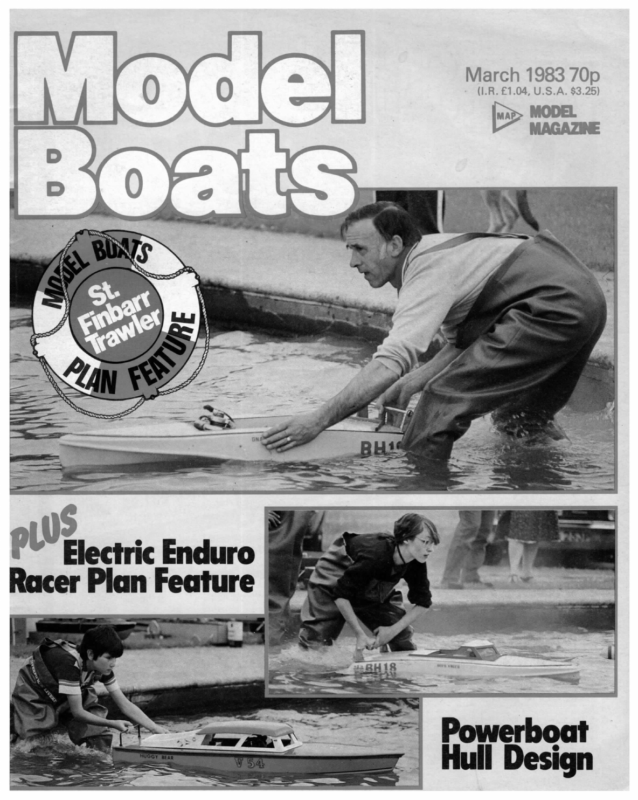
odel March 1983 70p (I.R. £1.04, U.S.A. $3.25) ‘ Ae Sg oy a eee Coad > MODEL
all enjoyed ourselves, and the event was won by Don Timmis’ team. GBOOK That’s all for this month, remember if you have you want mentioning please do not anything hesitate to write and let me know. | will include it if | possibly can. Remember nothing is too con- Model Yachting Association News troversial for me to write about, remember salt scale. | even dared to think that only water modellers with insurance should be allowed to operate at MPBA regattas — after all if a non- MPBA member turns up with a CMB 90 inside an MR boat and has an accident on your lake, your insurance wilf cover his stupidity, won’t it? Straight running by Don Hewitt Spring daffodils bloom, spring lamps spring, and a young person’s fancies turn to thoughts of boating, and to help these fancies along, the MPBA Regatta list will be published. Looking down this regatta list and picking out the symbol S/R may give an impression of ‘The mixture as before,’ but take a closer look and you will find a number of changes, and not only inthe entrance fees. One big change is in the venue of The Grand, just about the oldest regatta on the list and for many years held at Victoria Park in North London, more recently it has alternated between Victoria and Welwyn, but this year it goes to St. Albans, difficulties which have prevented this move inthe past having, been ironed out; should be well worth the journe to y take part! A further changeis in the usually shared (S/R and R/C) Regatta by the Bromley Club, this is now for S/R only, witha full programme of events. Others to note are the Inter Area, as yet no venue set, and of course the S/R_ Nationals, in Birmingham. The other regattas scheduled throughout the country have many new twists planned for old events. 1983 sees again the World Championships, this time to be held in the town of Stara Zagora in Bulgaria, from July 4to 11. These Championships will be run to NAVIGA rules, which are quite a bit different to our own but from reports received from those who have taken part in other years, it would appear that “a good time was had by all”’ both in the boating and entertainments sections. I’m not sure what the national drink of Bulgaria is, but I’m sure it will be reported to me toward the end of July. The venue is quite a few miles away; and obviously costly to get to, but Stu Robinson who is better known for his Hydros, is proving a most efficient travel agent. The overall effort of raising a team for all the events is in the hands of the MPBA’s International Secretary who also doubles as the Editor of this magazine , whilst Tony Willett, the Southern Area S/R Rep is doing his thing on behalf of S/R For those who live within striking distance of Harlow in Essex there is news of the forming of a new club devoted to S/R and which will be known as the Harlow Straight Running MPBC. The manto contact for membership details etc. is Eric Allen at 41 Ladyshot, Harlow, Essex CM20 3EL and by the time these notes are published the club should be affiliated to the MPBA. Various people have raised the question of 2ligibility to enter in regattas shown on the MPBA ist. The position as | see it is that the MPBA being an association of clubs, promotes the regattas isted for the benefit of the individual member hrough the medium of various clubs. and the only way to be eligible to enter is to be a member of an affiliated club. If you are a lone boater and eel that you want to join in the fun, then the local ‘lub is the place to start. Don’t know where to ontact them? A letter to the General Secretary, ireg Metcalf at 36 Broadmeads, Ware, Herts., vill get the information, but don’t forget the SAE. Vlarch 1983 LAST month the success of the Pugwash Trophy for 36in. Restricted model yachts was mentioned. and this time itis interesting to note the emphasis on the 36R class on the MYA stand at the Model Engineer Exhibition and the apparent response of visitors to it. From conversations it became clear that there are several unaffiliated clubs with fleets of a dozen or more R36R models, as well as one or two with RMs. The common thread from members of these clubs is “We sail for fun and are not interested in serious racing.”’ One visitor went further with a telling comment to the effect that his group sailed for fun, the MYA appearedto otfer them very little, and why should they pay to Support a race-orientated minority of model yachtsmen, which is what the MYA represents to them? This man puts his finger right on the spot, and has this correspondent’s full agreement. Exactly the same situation has arisen in the past in other national modelling bodies, e.g., aeromodelling and power boating; 30 years ago the question, “What does the SMAE offer us?” was asked of the writer in SE England and 20 years it was “What does the MPBA offer us?” in NE England. Ask a keen competition enthusiast and he will burble on about “Competition improving the breed and the spin-off benefitting models all the way down the line” but the polite answer to this is “Rubbish.” The only things that improve models for the average modeller are those that make them cheaper and/or more fun, full Stop. lf you think that carbon fibre and kevlar, or the enormous increase in power (noise and expense) of model engines, or variable incidence tailplanes or mylar sails, to take random examples, have made models easier/cheaper/more enjoyable, then you are firmly lined up with the other one per cent who do. The other 99 per cent could live without them and in fact prefer to do so. The trouble is that the keenest enthusiasts, always the ones most heavily into almost A section of the MYA SYY Eng Exhibjs + tion, class, received an e stand at the recent Model which emphasised f aging resp the R36R from visitors. contests, are the most vociferous and tend to get elected to area and national bodies. As a result such bodies become unrepresentative of the people they are supposed to be speaking for and the bodies become totally distorted. You can read about this in other spheres in your national news- paper. What is beginning to happen in the MYA — and has happened to other associations in the past — is known as voting with the feet. Infact the overall membership has not dropped significantly (though the number of registered boats has) butat a time of considerable growth of interest in sailing models, membership is not rising. In other words, recruitment is no more than keeping pace with losses from death or disillusionment. There are two points which might cause reflection; in fact there are many, but two which are particularly revealing. The first is that over the last Six or seven years 95 per cent of the MYA Council’s time has been taken up with the dis- cussion of rules or the application of rules, and rules have taken up the major part of AGM time. What are they for? Racing, or course. Not what can be done to encourage more people into a delightful hobby and help them to build and sail boats, form clubs etc., etc. The second point is that if a kitora plan is produced for a racing yacht, sales are never exactly Spectacular. Make the kit or plan for a sport sail- ing model, however. particularly a modest sized and comparatively inexpensive one. and hundreds are sold. The inference must be that for every keen racing skipper there are considerable numbers of model yachting enthusiasts whose interests do not extend to formal racing. Nor does this apply only to non-MYA members, for as has been mentioned before, one of the most illumin- ating aspects of the 1981 (Manchester) AGM was the number of club representatives who stood up 157
“members. This, of course, is always likely to in happen an Scale event in 1982, | overheard a com- ment to the effect that the Stand Off Scale (SOS) class was only for models not good enough to enter the Exact Scale class. At the time this idea was dismissed as a cynical failure of understanding however, like many apparently insignifi- _ membership was members who ju another for the k Possibly anannt registration certifi cant things it wouldn’t go away, so out came the MPBA rule book in an attempt to refute this idea. national meetings? The concern is tha and thought about it the more | could, not exactly club member will decide that he is pay much for what he gets; there are already who bend things slightly and only affiliate tho second class image ing for localboats and full, det tificates for yachts intendedto race a go on Much to my amazement the more | read the rules agree with, but understand the basis for this unchecked or unquestioned the members who intend to race outside the club. __ Rather than printing new rules every few months, would not money be better spent on providing subsidised parts and materials to members willing to make up a couple of small ree-sailing yachts to a standard, yachty-looking design to be lent to youngsters for a day’s racing in the local park or, where possible, seafront lake? le of the Marcie lightweight RM design August?980) by George L. Snyder of Ambler, P vania. Plank on frame, Mylar sails by Chuck & Futaba radio, Probar sail unit, alt came out within ounce or two of designed displacement. A great light air performer, says George, but broaches rather easily in stronger, gusty conditions, so we ve suggested trying a trim change to slightly stern down. and said that their members were only interested in informal club races — the “bash round the buoys or even ‘bumper car events’ as they have been slightly derisively termed. And why shouldn’t they enjoy this sort of sailing? _ While racing is the obvious target for sailing models, there are degrees of involvement, and it is this fact that at presentis notrecognised. While rating and racing rules are essential, they are not, however, the be-all and end-all for the average club member. To the keen racing enthusiast, they appear to be, and to the potential newrecruit they appear to be, too, with the result that he may well be frightened off, or at least ask himself “What has the MYA to offer me?’ A majority of clubs avoid participation in national or even district events, being quite happy with racing among themselves, with perhaps an occasional friendly against a neighbouring club, and some members of some of these are beginning to question the return they get from their affiliation fees. There are clubs which have never affiliated because there seemed no good reason to do so, and it becomes more and more difficult to find reasons sufficiently convincing to persuade them. At the time of the Festival of Britain {older readers will remember it!) a very clever remark was made to the effect that the average model aircraft club was like the Skylon— one prominent member with a minimum of support. Model yacht clubs aren’t perhaps quite like that, but quite a few consist of two or three keen skippers who dash about ail over the place competing in various races while the main body of the membership is content to turn up and sail at the club water or, at a pinch, drive a few miles to have a sail on the nearest rival club’s lake. It is these people who provide the bulk of the Association’s finance, through affiliation and registration fees, which catching the bug, especially if there we four such days in a season. The races wold attract enormous interest, and the annual Guildford day is very enjoyable, despite the mixed fleets and mixed age groups. And/or what about producing a fev weards or photomontages for display, with models and local details, in public libraries, building society windows and the like? We should be aiming forincreasing numbers of average model yachtsmen|rather than decreasing numbers of ace skippers, surely? Anyone out suggest there with any opinions or European Marblehead Cha This meeting, mentioned previo ahead. ft is for vane Marbieheads and will take place on the model yacht lake in the Recreation- park Spaarnwoude, near Amsterdam, August 2327 1983 under IMYRU rules and sailing instructions. Organisers are VZ78 and NMJV, address for correspondence Dunanstraat 32, Hoofddorp, — Holland. More information when received. Club Water Our remarks about lack of response to requests for details of clubs’ waters etc. touched at least one club official. Any more? Rugeley Power Station Model Ciub has been in . existence about six years and affiliated to the MYA for three years. Our club water is located inside the perimeter of Rugeley Power Station. The pool is rectangular, about 200 yards long and 120 yards wide, gently sloping to an average depth of 5ft. with concrete steps at the unchi ig area and grassy banks along three sides andtrees — on the fourth. There is a large car park within 50 yards of the water and toilet facilities in the Sports and Social Club. We sail every Sunday morning, all year round, plus Wednesday evenings in the summer. Our main interest is RM racing but almost everyone in the club has power or scale models as well. Visitors are always welcome; however, because the pool is within the Power Station grounds they MUST let me knowin advance to arrange entry on to the site. To find us from the M6 take junction 11 on to the A460 signposted Cannock. In Cannock stay on A460 and follow signs for Rugeley. At the from the bridge. (Sec. LD. Edwards, 3St. Aidan’s might be suggested that that 10 per centis, effec- Road, West Chadsmoor, Cannock. Steffs.. Tel tively, being subsidised by the rest of the club 054 357 9217). 158 and let’s all hear about them. But, insults that some correspondents seem to indulge in. quality of the model is assessed is what to do if the entrant didn’t actually build the model. In the Exact Scale class the rules are quite clear, “Entrants must have constructed their own boat” (rule 5A(7)), but no such rule appears for the SOS about ten per cent of the membership, and it effort and expense goes into rule-changing, race Editor remember that | am writing without any conscious. malice so can we avoid the personal could be considerable publicity and a lot of organisation etc. which only seem to matter to priorities right?» An enormous amount of time, feelings and/or ideas then please write to the Who built it? roundabout in Rugeley turn right, and 300 yards ahead turn left at the railway bridge on to the A513 signposted Armitage. The Power Station entrance is approx. two miles along on the feft leads to a simple question — “Have we got our Now what follows is my personal thoughts and ideas on this subject, which | am sure some people will disagree with. If you have any strong With a club member acting as mate, drawinglots _ for boats and dividing races into age groups there An ILST attending the fourth National R/C isati perhaps not t Perhaps it is One thorny problem in scale events where the class. | suppose an argument for this situation could be that in SOS the emphasis is upon steering and the quality of the model doesn’t really matter too much. Admittedly, almost 77 per cent of the marks in SOS are gained on the sailing course and the remaining 23 per cent are on the water marks awarded by the three Stand Off (SO) Judges. These judges divide their marks equally between Appearance on the water (realistic waterline and speed), Manoeuvring (smooth control) and General Impression (building quality, finish and detail). The first two items are very much in the hands of the person controlling the model; in other words it doesn’t really matter if the entrant built the model or not as it shouldn’t affect these points. However, the General Impression score depends entirely upon the appearance of the model in which case the skill involved in its construction cannot be ignored. Now since the General Impression score only accounts for 7.7 per cent of the total it might not seem too important, but at every Championship the results have been so close in this class that the loss of even one per cent would make a significant difference to the final results. An argument for not including a ‘builder of the model’ rule in the SOS class may be that it allows people without the skill, patience or time to build their own models to enter a competition class. Ignoring the insult to the people who have made a considerable effort to develop their skills, the logic of this omission escapes me totally. If the Exact and Kit classes apply the rule that the entrant must have built the model, yes this rule applies to the Kit class — see rule 5A(11) which states “Kit class boats must be built by the ‘ then why should SOS be different. entrant Let’s be consistent about it and either have a ‘builder of the model” rule for all the classes or allow people to take credit for what they can acquire rather than create for themselves. What is it? Reading through the scale rules produces a surprising revelation, nowhere does it say that the models must be based upon a real full size vessel. tt would be difficult in the Exact Scale class, with the thorough static judging entailed, to get away Model Boats