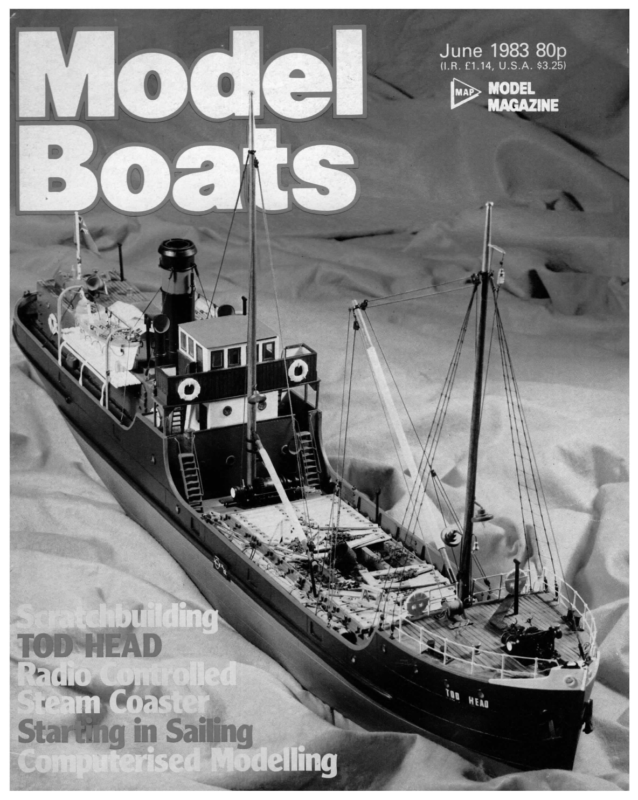
- Sequoia A 36in. Bermuda Ketch for two channel radio control Designed by Richard Willams
- STARTING IN SAILING By popular demand the ex-Model Boats Editor returns to cover the basics of model sailing – both sports and competitive in a short series.
- Logbook Model Yachting Association News.

June 1983 80p (LR. £1.14, U.S.A. $3.25) > MAGAZINE
———= aus «=~ aed == ees § Sy = ae | ee —— = (Sige es 7 — = Sat ———o ——a, a ,;-— r Se pe E ——an — A 36in. Bermuda Ketch for two — channel radio control Designed by Richard Willams Sequoia is a 36in. Bermudan ketch designed for radio control. Overall length 38in. Length between perpendiculars 36in. Beam Qin. Draught 7′,in. Minimum freeboard 234in. : All-up weight 12Ib, 3/,Ib of which is lead on the keel. Construction is bread and butter, built up from %in. Californian redwood planks, hence the name. Decks, cabin and cockpit in in. marine ply. Radio control is by MRC two channel set. One channel controls the rudder servo, the other servo operating the sail winch reversing switch. The sails are professionally made by Graham Bantock of Burnham on Crouch. Total sail area 326sq.in. Fores’l 104 Main 154 Mizzen 68 Hull planks were glued with Cascamite. All other joints, including redwood rudderblade to stainless steel rudder post, with Araldite. All items except the radio equipment were designed specificially for this boat. The two figures in the cockpit, helmsman and crew were carved from redwood, the helmsman being gimballed through the boss of the wheel to remain upright when the boat is sailing heeled. 3 Plans for Sequoia are available asa four sheet set. Sheet 1 full size lines and body plan (length 36 9in. beam); Sheet 2 (illustrated) general arrangement of hull and sections; Sheet sails spars and rigging details; Sheet 4 control box, cockpit and cabin roof details. Please quote Plan MM1 343, price code L, £7.25 plus 60p post and packing, from Model Boats Plans Service, Wolsey House, Wolsey Road, Hemel Hempstead, Herts., HP2 4SS. MM/13: 308 Model Boats
Smooth but accommodating lines, plus cabin and cockpit details give this ketch an attractively different appearance. The sails are the author’s home-made suit and not the commercial Bantock set fitted later. sketching and drawing lines | found | was drawing the same shape again and again. That had to be what | was looking for. Sequoia is a 36in. Bermudan ketch, with a beam of Yin. and an all-up weight of 12Ib, 3, of which are in the lead on the keel. Construction is bread and butter, the hull planks being of Californian Redwood, hence the name Sequo/a. The deck is 3mm marine ply, as is most of the superstructure. Access to the interior of the hull is gained by removing the cabin roof aft of the mast and lifting out the cockpit assembly. The boat is water-tight up to the cockpit coaming level, and up to the cabin roof level WONDER if there are any ex-full-size sailors like me for whom the fascination of sail is irresistible, who would like to sail a model but find the racing classes do not have quite the charm of their full-size sisters. | must confess, with apologies to racing skippers, that the extreme hull shapes and sail plans of the racing machines do not excite me. | have given a lot of thought to the type of sailing boat | would like to build and sail. She must be easily transported. She must look like a full size yacht. She must be well balanced, stiff and handy. After weeks of forward. The cockpit assembly is in one piece with the cabin door and part of the aft cabin bulkhead, and is watertight. It fits snugly over the false coamings to assist as far as possible in keeping the interior dry. The two crew members are also carved from redwood. The helmsmanhas feet of lead and is ‘gimballed’ through the boss of the wheel so that he remains upright when the boatis heeled. Cascamite was used for gluing the hull planks, and rapid setting Araldite for all the other glued joints. The redwood rudder a June 1983 eo blade for example is glued to the silver steel rudder post with Araldite. The guardrail stanchions are made from for the split pins, using a jig to form the hole lower wire. The guardrails themselves are of fine shirring elastic, which obligingly reverts to the shortest distance between two points after having been bumped! Below decks, the radio is a two-channel MRC set, one servo acting directly on the rudder post by means of an actuating rod. This rod can be disconnected outside the water-tight seal for removal of the control box from the boat. The other servo is con- nected to the winch operating switch. The home-made sheet winch is powered by a 6v motor. The motor shaft is sleeved to take a Meccano worm gear, meshing witha spur gear on a in. diameter rod which forms the winch drum. The motor bed/ winch frame is in aluminium. The length of the winch rope matches exactly the maximum travel of the sheets, from the fully close-hauled position to squared right off. The reason for this is to prevent slack when the sheets have reached the squared off position. (If the winch is allowed to over-run it merely starts to rewind). A rubber tension cord, fastened to the rear corners of the control box, is connected to the ‘free’ end of the winch rope at the point where the three Left: cabin roof removed and cockpit (below). giving excellent access for control box and sheeting. 309
Sheet winch + Sheet winch switch _ : Receiver sheets are attached. This keeps a slight tension on the winch rope at all times to prevent any possibility of slackness at the battery | *— To winch motor : the winch rope, dividing off the lower half of the battery/winch compartment. This is to prevent the sheets from becoming entangled if the sails do not immediately free off when the sheets are slackened. Both compartments of the control box have watertight covers with ‘windows,’ so that the functioning of the equipment can port. The silver steel aerial rod is taken up the aft side of the mast and forms the track to which the luff of the mainsail is hanked. Both masts are stepped on deck with a short spike to locate the foot. winch drum. The three sheets are led from the winch rope through an ‘gin. bore plastic tube set in a wooden ‘shoulder’ to the cabin hatch, and thence through fairleads to the booms. A thin sheet of Perspex or similar transparent material is fitted immediately below Receiver es eeee + cur an lm eel = rs batt ery To ° ba 1 j| Forward Off Brass pin — The foresail sheet is led through fairleads to be hooked onto the boom at a point 8in. from the fulcrum at the forward end. The sheet length is correct for the movement of the boom end from the centreline to the Phen Reverse | ¢|* \— Brass strip D 1/4″ thick perspex / be observed in situ. The aerial is connected by a plug at the control box. An electrical connector set half inside and half outside the cabin roof just aft of the mainmast allows the aerial rod to be removably connected to the receiver, so that the mast can be taken down for trans- Reversing Switch for Sail Sheet Winch ‘Sequoia’ switch can Above: layout of control box. Sheet winchdisplaye d on be seen at bottom left. Below: Sequoia her attractive stand. fully squared off position. The main and mizzen sheets are led through fairleads on the booms at Bin. from the goosenecks and are hooked to adjustable lines on the booms. This enables the mainsail and mizzeton be adjusted relative to the foresail to obtain the best drawing position. The mainsheet is hooked to a tight fixed line on the boom and the mizzen sheet has an elastic outhaul to keep the sheet from sagging in light airs. All the sheethooks are small enough to pass through the fairleads, and are closed to prevent inadvertent unhooking. Two attempts were made at home-made sails, using cotton material, but neither was really successful. They functioned but did not look in keeping with the boat, so | had a suit of sails made professionally. These were made by Graham Bantock of Burnham on Crouch, and they really add the finishing touch to a model with which | am very pleased. On the water Sequoia behaves just as I’d hoped she would. She tacks readily, runs straight, is fast and as stiffasa church. And to my not unbiased eye, she looks pretty too. Model Boats
main’s effectiveness and thus reinforce the effect of the aft CE. The set-up was thus Vic Smeed’s self-correcting (under normal circum- stances) but, of course, for beating only. Reaching and running were less predictable, and except in a really steady breeze tended to be somewhat erratic, so that only A. recent correspondence and onversations there have beena lot of a skilled skipper who really knew his model requests for basic sailing information not necessarily related to the specific racing classes, to the extent that a short series on the subject seems called for. Although the normal approach would be to start at the beginning, several of the enquiries have a common thread, and a surprising one — Braine steering gear. Since this is part of model yachting history, perhaps it is not so bad an idea to start with it, even though it was primarily devised for racing purposes. Relationships Perhaps the essential basic to grasp is that the course a yacht (or other sailing vessel) makes is a matter of the relationship of the sails to the wind. The rudder is an irrelevance, since if it is necessary to use it permanently to maintain a course this isno more than introducing one fault to disguise another. In fact many early models, and some in recent years, had no rudder, either using a full keel (i.e. one that extends over at least half of the hull length) or a fin as in modern models with a fixed skeg mounted — and was lucky! — could guarantee his destination reasonably accurately. First steps to Control A little over a century ago someone (not g a recorded) had the clever idea of gfittin a lead Ful -Ke ler ) Fin and Skeg (Vane) freely-swinging rudder embodyin sed by weight. Long keels were characteri sailing to windward better with a touch of which ‘weather helm,’ a confusing term perhaps should be explained. It originates up from tiller steering, and to put the helm ing the to weather meant (means) push h the tiller towards the direction from whic a boat wind is blowing, the weather side of to being that side currently exposed on tothe it. weather, i.e. with the wind blowing the lee, The opposite or sheltered side is which is much more commonly understood. It will be realised that weather helm actually applies lee rudder, i.e. the rudder Fin and Skeg (Braine) aft (Fig. 1). This immediately plunges us into sail balance and allied factors (Fig. 2). Whatever sailplan is rigged, it will have a centre of effort (CE) which is the single point through which side pressure on the sail(s) acts. The fact that a yacht heels is an indication that side pressure is exerted on the sails, and one effect of this pressure is that the boatis pushed bodily sideways. There is naturally resistance to sideways movement, which is termed lateral resistance, and this force acts in turn through the centre of lateral resistance (CLR). If you put a hull in the water and push it sideways with one finger or a pencil, it is possible to find a point at which the vessel will move sideways without swinging; the CLR will lie on a vertical line passing through this point but, obviously, below water. Now imagine that your finger’s pressure is the sail CE. Clearly there is one position of the CE which will produce steady sideways movement of the hull. Sheet the jibin 3 little harder, or bend on a larger jib, and the CE will move forward, with the result that the bow of the boat will swing away, because the CE is now being applied at a point ahead of the CLR. The whole business of trimming a yacht is really a matter of bringing these two forces into balance. Note that when considering matters such => this it is always taken for granted that the (or «echt is beating, i.e. sailing to windward sailing towards the wind as close to the wand 2s it will lie) unless specifically stated. ssrodynamics are complex and are Sfterent when a yacht is running By popular demand the exModel Boats Editor returns to cover the basics of model sailing both sports and competitive ina short series. spent running or reaching (sailing at 90° to the wind) because in working to windward the yacht has to tack back and forth at an angle of perhaps 40-45° to the wind. The best-trimmed boats will make perhaps 3738°, but will still spend three or four times as long making a distance to windward which they can sail in a direct line off the wind. Thus improvement in windward performance is on the whole of greater importance than on any other course. The ‘old’ way of trimming a yacht was to arrange the CE/CLR relationship so that the CE was a fraction aft, producing a tendency for the boat to ‘gripe,’ or want to turn towards the wind. The jib was brought ina shade further than the main to produce enough force to hold the head off. In a gust, turning into wind would see the mainsail lose its drive at a faster rate than the jib, turning off the wind would increase the CE Main CE Jib action will turn the boat away fromntthe of wind. For windward sailing the amou little weather helm was not very large — as as half to 1/, degrees — and it may be that the result was slightly to speed up the flow of water on the weather side of the keel, thus, by Bernoulli’s law, reducing pressure. In other words, just like an airfoil where the speeding up of the flow results in a vertical lift force, the keel would have a tendency to ‘lift’ the boat sideways. Without ramblings too far, the side pressure on the sails break into two main components, forward and sideways thrust, and the sideways thrust produces leeway, the tendency for the hullis to move sideways so that its actual track downwind of the course on which it is pointing (Fig. 3). The sideways ‘lift’ pro- duced by weather helm opposes leeway, SO that the boat goes more nearly where it is pointing; in other words, leeway is Model Boats
lessened. This is the main purpose of the fin of the average citizen was still some years trim-tabs used on modern racing yachts, both model and full-size. So, when a yacht heels, if it has a free weighted rudder with sail applies rudder to turn the yacht until believed that the force available from a the pressure decreases to normal. Note the use of ‘sail boom’ rather than ‘mainsail boom,’ since later development was to see vane enough weight to would be inadequate: The main reason, however, was that the vane was overcome the buoyancy of the rudder and not effective on the shape of boats then in the force of the waterstream tending to use, and it was not until some 35 years later ‘plow’ the rudder straight, the rudder will that it was realised that substantial altera- fall in the direction of heel. Since the heel is tions in, chiefly, fin and rudder design were to leeward, lee rudder is applied, which is beneficial, at least on the type of hull of the period. It follows that to maintain a straight course, the CE will need to be behind the run when your sail setting is such that the jib is likely to goosewing (i.e. swing out to the opposite side to the main) if the boat George Braine the turn away from the wind produced by George Braine came up with the basic idea of his steering gear, which used the considerable force available in the sails to rudder. This is the trim already familiar to skippers of the time, except that in a gust the yacht will heel more, the rudder will drop further over producing a stronger turn off the wind, and the sail areas/settings will need to be adjusted so that there is a tendency for a gust (as opposed to a steady breeze) to cause the yacht to screw into wind. Given the right sail trim and the right weight of rudder, which would vary according to normal wind strength and severity of gusts, the yacht would be a little better off to windward and possibly much better off ona reach and even on arun. It still needed considerable expertise and familiarity with the apply corrective rudder on the reach and on the run. Note that beating still relied on sail/hull balance (the CE/CLR relationship) turns to leeward, when the jib, hooked to the opposite side of the quadrant and inthe outer half, will modify or even change the rudder position to allow the yacht to resume its course. The quadrant (Fig. 5) is a Y shaped yoke with the fore edge curved as an arc of a circle and about 3-4in. across the horns. The centre from which the arc springs and the automatic gear was only used on the previous ‘problem’ headings. It was a notion simple enough for all skippers to through grasp, and because it used the power of the wind in the sails it was not considered a line is led, but in practice an eye or lead is fitted each side of the deck at an approxi- contraption extra to a normal rig or foreign to the idea of using only wind power. Essentially, (Fig. 4) the gear consists of a tensioned quadrant fitted on the rudder stock (the shaft on which the rudder pivots) to which is led a line from the sail boom in should strictly be a central eye on the deck which the appropriate sheeting mate position which is about where a centre could be. There is adjustment to the line length which makes geometric prelittle pedantic. cision a Braine boats used at least two lines on each boom, one for beating round to reaching, and the other from reaching round to running, known, unsurprisingly, as the beating sheet and the running sheet or running line. Often two running lines were Course -—<—r = = er, reaches). The only time both jib and main should be hooked to the quadrant is on a necessary to allow the vane to work satis- As it happened, around about 1907-8 weighted the gear operated by the jib rather than the main on some headings (reaches and close factorily. CLR, to provide a turn into wind offsetting the such a way that increased pressure on the ahead) found the idea hard to grasp, or fitted for reasons to follow. These lines finished in a form of Z hook so that they could be easily engaged ina hole in the arc of the quadrant and rapidly disengaged and Leeway moved to another hole if necessary. The tail of the quadrant engaged with a tensioning device, basically a rubber band model to apply the technique, but it should also be remembered that in the 1870s there was no pre-packed entertainment and travel, except by railway, was not easy or expected. A yachting enthusiast would perhaps sail the same model on the same lake for ten years or more, so he had every chance to learn all the model's quirks. In passing, it is worth mentioning that the great American yacht designer, Nat Herreshof, actually drew out a vane steering gear in 1875 (similar to the one published in Model Engineer in 1903) but did not get round to using the principle until the 1920s. Clearly, by the publication of a vane in 1903 (and others over the next few years) a lot of model yachtsmen were trying to come up with a steering mechanism more effec- tive and consistent than lead rudders, but for some reason the vane principle did not have the impact which might have been expected. No doubt to some extent, sailing types, who mechanical June 1983 tended (the to be rather non- ss Plan of Braine Steering Gear (diagram only) mechanical-mindedness 317
that the pulleys or leads used for the run- ning lines had to allowthelinestobe slipped in and out, though, of course, they must not be allowed to slip out when in use. Pulley blocks with the sheaves attached to one side and the second side hinged to snap shut were one way of dealing with this; another was a joggled fairlead, Fig. 6. ~~ Drill 6BA or length of cotton-covered elastic fitted with a line and bowsie. Ideally the tensioner should extend rearwards along the modern practice. In such cases the tensioner could be passed through an eye, changing its direction, or a short tensioner could be fitted each side and the tension balanced between them. Neither method is as good as a single tensioner laid out aft. It will be realised that if the mainsail is out to starboard and the boat veers to port, the starboard side of the quadrant must move forward in order for the correct rudder to be applied, and it would be untidy, at least, to have the sheet led direct to the quadrant. Accordingly, the line was led across the hull to the opposite sheet lead, then back across to the far side of the quadrant. The bowsie adjustment on the boom controlled the boom angle irrespec- tive of what happened to the line after it reached the deck. Balance was achieved for differing wind strengths and sail settings by adjusting the distance out from centre of the sheet hook position on the quadrant against the degree of centring force exerted by the tensioner on the quadrant tail. To set up, the sail was eased out (with the yacht held pointing in the required direction) until a tendency to spill the wind was apparent. The boom was then eased back a trifle and the sheet hooked into the quadrant as near centre as possible. A snag now appears — what happens if the yacht gybes and the boom flies across? Clearly the steering gear would be ineffective and the yacht thus out of control. Here enters the second running line (or the jib line mentioned earlier, if fitted). To use the second mainline, itis set up slightly shorter than the first line and hooked well out on the opposite side of the quadrant. Now if the boom flashes over it will immediately put on hard rudder, almost certainly over- coming the sail effect and putting the yacht back on course and, hopefully, returning the boom to its required side. Like all these things, the degree of adjustment will vary with the boat and the weather and only practice and experiment will allow a skipper to achieve the desired results. Parking facilities were provided on the booms for the lines not in use, which meant 318 Lon is seus! ( (LI. ' deck centre-line, which was fine on a 10rater or other hull with a rudder well forward, but not so easy ona 36R, although early 36Rs frequently had a rudder well inboard from the stern compared with aw a Boat modellers can A refinement was to fit 4 pin-rack over the quadrant tail (two strips of brass accept- ing vertical pins) to limit the amount of rudder which could be applied, but how much and when to restrict movement required expert judgement. The basic operation could be sorted out by observation of the boat’s behaviour when a gust hit it and/or when the gust passed. If she comes towards the wind after a gust the sheets need more leverage (outward on the quadrant) and therefore more home micro by letti scaling and design it HEN your eight year old daughter has more computer experience than Dad, then it’s time to do something about it. My chance came during the second term of a teaching course at Huddersfield Polytechnic. For the Supporting Studies part of the course we had to select one topic out of several options, what else could | do but “Computer programming for beginners.” In the space of a few hours our tutor managed to overcome the paralysing state tension at the same time and vice versa. If she turns away when a gust hits, less of shock that hits you when you first sit in tension and more leverage. discovers, continuously refining and add- leverage, turns away when the gust passes, more leverage. More wind, more Sometimes the quadrant was mounted separately from the tiller and a connection made with a bowsied line each side. This enabled a slight bias to be given to the rudder and was frequently the quickest means of retrimming during a race. An alternative was a push-pull rod with a turn- buckle type connector halfway along, again allowing a touch more or less helm to be applied. Finally, the yachts themselves were different and a modern boat is unlikely to perform well with Braine gear, just as Braine boats had to adapt for vane. The typical hull, if not a full-keeler, had a long, relatively shallow fin and a long, shallow skeg and rudder (Fig. 1). This set-up re- quires long-footed, low aspect ratio sails, both for directional and vertical stability. Present day designs with deep, narrow fins and deep, narrow skegs/rudders require short-footed high aspect sails and are likely to be too tender directionally to give good results with a Braine gear. Development, too, has seen a move to much larger jibs in relation to mainsails, with concomitant movement of the mast aft and possible problems in sail balance for this type of steering gear. In other words, to use an old type of steering gear you have to use an old type of yacht, which is not so remarkable, really. If your head is swimming with all this, take courage — next time we'll discuss more fundamental matters! front of the infernal device. We were quickly writing short, simple but nonethe- less workable programs and, as one soon ing to them. To prove our competence we had to produce two suitable programs at the end of the course. Being a novice teacher my first program was based upon the solution of quadratic equations but | was initially at a loss over the second one. In the end | couldn't resist the temptation to create something a little more useful, i.e. connected with my hobby! One regular problem encountered when starting out on a new scale project was the selection ofa suitable model size, you know the sort of thing — will it fit the car, can it carry the desired weight, etc. This appeared to be a suitable project for the neophyte computer programmer within me, so one free afternoon the ‘‘Model Boat Scale Program” was started. After a couple of hours, yes I’m a slow worker but having seen some of my faster colleagues ‘lose’ their almost com- plete programs I'll stick to double checking each stage! it was ready to be released on an unsuspecting world. The program was written in BASIC for a Commodore Pet microcomputer but, since there appear to be several ‘dialects,’ a little explanation of the program seems to be called for. The program can be divided into five discreet parts as follows: (1) Prologue 10 — clear screen command, also occurs in three other positions. 110 — instructions for the use of the Model Boats
behind you, gate and enter closing the gate sign, and follow disregarding the Members Only be the road to the far end of the lake. Should youare LOGBOOK Model Yachting Asngsociation News lubwhich is maki He nice to hear of anewc slow but sure progress in an area which used had no club for to be a thriving one, but which hasgow area, and years. We refer to the Glas ow, the Paisley although Paisley isn't quite Glasg The current M-Y.C. is not far outside the city. g at Barshaw Park, membership is eight, sailinbeen a number of Paisley, and there have potential members enquiries from interested ated to the Scottish recently. The club is affili year’s Scottish MYA. and will take part in this host a couple Championships — in fact they willa prog ramme of of meetings. How about this for promotion for an eight-member club: May 14 Static and sailing display (with Glasgow South SMS) at Agricultural Society Show, Kilmacolm. — static May 24-28 Paisley Festival Week South $.M.S.). display and sailing (with Glas)gow June 11 Scottish M (vane Championship at Barshaw Park. S Jat June 18 Static/sail display (with G.S.S.MQueen's Park, Glasgow. July 9/10 Static/sail display at Royal Naval Base, Rosyth. at August 27 Scottish RM Championship A club which has laid on all these promotional Barshaw Park. ed, and they activities certainly deserves to succe l yachting will do a very good job for Ifmode you are within generally north of the Border. the club, drop a reach and would like details of as Laird, 108 stamp to the secretary, Dougl 5DP. Langton Road, Glasgow G53 one Glasgow used tobea hotbed of activity andwood particular annual event was 4 trip to Fleet lines of a for an autumn week-end (rather oninthe ); 20Britain Week s Wake short or y Bank Holida by coach 30 model yachtsmen used to come down g all day with wives and families for vane sailin ed socialisSaturday and Sunday and concentrat course, used ing the rest of the time. The ladies, of t or Blackpool to disappear to Fleetwood marke and all in all everyone had a marvellous time. Guildford M.Y.C. giving Delighted to have another clubtime it’s directions for finding their water. This g the Guildford, who sail at Ash and will be hostin 1983 RA Championship there in September, so it's worth making a note of how toongetthethere. first During the summer the club sails many Friday evening each month and onwarml y as Sundays, and welcomes newcomersPRO writes: as those with some experience. The g water is The Guildford Model Yacht Club’s sailinpit at Ash a disused but newly landscaped graveloff the main Vale — about three quarters ofa mileTo reach the Guildford-Aldershot road (A323). Arms Public water turn off the A323 at the Dover Ash Vale, House roundabout — signposted first mini Mytchett-Farnborough — and at the shot — roundabout turn left — signposted Alder quarter of a mile into Shawfield Road. About arailw turn after having passed under the nceaytobridge our water right into Youngs Drive. The entra large is on the right hand side throughies. Openmetal the gates marked Willow Park Fisher gatta Calendar 1983 MYA Re t Even Date Nati(L)onal Championship M.Y.A.Cup 28/30 Nyria 29 Plant Cup (L)District Championship 4 ern S. West 5 Eastern District Championship 5 May June 5 5 5 11/12 12 12 12 18 19 19 19 19 19 26 26 26 26 26 26 2/3 July 8 3 3 324 Class Venue d Fleetwoo Gosport Birmingham A tenham Norwich RM Chel lk and RM Norfo (at Dovercourt) Birmingham A MidlandCupDistr(L)ict Championship Poole pes R R10O Taplin es Trophy Cleethor RM Fred A.ParkNational Championship Birminghdam R1OR M.Y. Cup (L) Fleetwoo A MayoralAnchor (L) Bourndsville M Drurydland Trophy (L) Broa ingham RM Broa Cup Builder Finn National Championship MMickey Birm Bournville Mickey ort Gospelan A Portugal hyCup LittleRum Clev d RM Wood Red BoatTrop ley x RM Model s Trophy RM A Finn (L) District ChampionshipRMM Hinds CupSout Met. and Distrhern 36R R ict Championship Northern R1iO oration Trophy (L) Hove eCorp RM hy Whyter Trop RM Tuck Tropt hy(L) RM Open Even S.E. Esse Clapham ad Birkenhe HoveonandKeynBrigeshton Milt ster Leice am Chippenh Fleetwood s and A ship pion NortNorthernhernDistrTeaictm Cham ship Champion msford R36R Chel nal Championship M.A.icsNatio ort Gosp RM Spast Cup Duplex Chiltern Open Event 575 challenged by the Warden just state that you visiting the G.M.Y.C. Fisheries We share the water with Freshwater ers respect and a Windsurfing Club whose memb on the water. We are our sailing course when we r ideal wind normally sail Marbleheads unde giving atrue open, very is r wate the as tions condi have few we ely tunat Unfor . times all at wind improved being are these but ties facili side water ng the RA hosti is Club the as ly cular parti year this Club The 18. and 17 r embe Sept on nals Natio h mont each of ay Sund third the on sails lly norma and noon after the on and year the ghout throu summer months. evening of the first Friday of the of our sailing any at ome welc very be will ors Visit considering ne anyo with her toget they, and dates any further n obtai can nal, Natio RA the ing enter Pease on Bob — tary Secre our from n matio infor — Ted er Offic PR. our or 4 2623 y erle Camb Gearey on Guildford 61 631. The M.Y.A. rs to have beena slight reaction to There appea r of whether our fairly forceful raising of the mattein right the M.Y.A. is currently headingseem the to have direction. One or two people the M.Y.A., but thought that we were knocking situation this was not at all the intention. The creeping up described exists and has been slowlysimply drew on us for some time; our remarksthe questions attention to it and tried to pose about it? If could, or should, something be doneit benefit the something were to be done, would are (and M.A. and the sport generally? Thereation, both associ always have been) critics of anychanc e for them to in and outside, and here was a in regard to say what they would like to see . members yachting. Among a few hundred M.Y.Aideas worth there must surely be one or two putting forward? The sort of idea which might be possible —nsor,inif impractical, might start a few thought-trai and motion would be to produce a small, cheap to school easily built design which would appeal area and handicraft teachers and run local, have been ultimately a national race. There p has been occasions recently when sponsorshicoming. Not discussed and, indeed, has been forth even all sponsors would be interested, or could be suitable, in a schoolboy project, but it acturers worth a try with adhesive or paint manuf Cup, or some of the national bodies (likestheorMilkmodel etc.), even newspaper group manufacturers or, going for the top, one of the junior TV programmes. free or inexpensive, would be Drawings, other interested available to schools or anyclub show the local people — would one of your their availability youth club or Sea Scouts? — andy as possi ble. The would be made known as widel and materi als mode! would have to be small race A limited to, say, about £1 or even less. large towns would have to be organised in mostregist er) and al requesting one (through a centr the winner(s) would go through to areas nal final. (countries?) and thence to a benatio Naturally the papers, etc., would kept informed throughout. ) Of course, the models would not be (quote there n't ‘What we call model yachts’, but would and ar be a considerable publicity spin-off awakening of interest among many who hadn’ realised what it was all about? sible? If i A pipe-dream? Financially impos a voluntary fore: major advertiser was aware thatraces activel existed to supervise the local realiand se that th promote the scheme he would Model Boat
walk/run/climb of around a mile; all in about haif and hour. Despite all of the incidental keep fit activity the FARNBOROUGH racing was really very close, with the opportunity MYTCHETT for individual little duels to be fought on the way. Quite often boats which had started close together finished close together having exchanged places several times during the one lap race. The ‘local lads’ Dave Adnrews and Tony Drury tended to monopolise the first and second places in all three races; it could have been five but the wind picked up to a point where most were considering changing down a suit; unfortunately the rains also came and it was decided that, fora fun event the fun was rapidly being washed away. The fact that the OOD — Dave Andrews — had the ALDERSHOT winch line on his Heartbeat Cardiac Arrest break during the third race might have convinced him ig that enough was enough! (Only joking Dave). TONGHAM HOG'S BACK HOTEL O10 Two of the three Mikes in the event had some close racing between a very nice planked Kisutch (Mike Weeks) and a blue Seahorse (Mike Kemp), improving their positions in each race: the former going from 5th to 4th to 3rd, the latter 7th, 5thand 4th. The other one, Mike Forster, was suffering badly with some unaccountable radio gear problems; a shame that, as this was Mike’s first time out at such a meeting: still, he went away muttering about having to sell his big dinghy to get a better Marblehead! HOG'S BACK PUTTENHAM & FARNHAM LOCATION OF GUILDFORD M.Y.C. WATER cost would hardly exceed that of a 45 second TV commercial at prime time, including paying finalists’ travelling expenses, and exposures would be prolonged and widespread. No-one would mind printed polythene sails with the sponsor's message or identification, surely? This may all seem rather pie-in-the-sky, but given someone with the time and the contacts to sell the idea (or something similar) it is by no means as far-fetched as might be thought, and it would certainly engender an interest in model sailing, albeit in small sizes at first. How many present M.Y.A. members, one wonders, started with a class racing yacht as their first-ever sailing model? Commercial sponsorship of beginners’ models (mostly aircraft) has gone on for some years in some countries and has no doubt benefited clubs by providing a source of new members. Why not in Britain, with yachts, which equate with gliders in lack of operating expense and are likely to outlast any other form of model? Mike Kemp of the Milton Keynes Model Society reports Leicester Keep Fit Race ‘There's more to model yachting than meets the eye. So says the slogan and so it proved to be for 13 skippers at the Leicester Club’s Welford water on Sunday 27th of March. Picture if you will a reservoir some 900 metres long by about 250 metres across, roughly rectangular in shape with a man-made dam at either end, flanked by trees and bushes on its south side and bushes on the north. In the northeast corner there is a small copse of trees anda spillway out of the north-west corner. The expected prevailing wind should have blown straight down the lake in a roughly easterly direction; but it didn't. it came in straight over the copse. In the four corners of the lake there are some white buoys laid and roughly one third of the way up towerds the copse there are two buoys laid as @ start me biased towards the southern bank and distinctly favouring a port tack start. The weather is clougy accompanied by a light breeze, unlike the week preceding when there have been some very Stromg wands indeed. Such was the setting for amygeniber of model yachting ‘firsts’. This was the first teme thet the Round Welford race had been rum, the first teme that the Milton June 1983 Keynes club have attended an ‘outside’ yachting event, the first event on the Leicester club‘’s summer calendar and the first time that some of the participants have competed outside their own club. After what the were to face, some would not have been surprised if it were the last. It is debatable which was the more difficult racing, that on or off the water. After a few pre-start dramatics caused by the odd wrong crystal fitment and the unfortunate Brian Ladkin ended up in the trees, his account went something like: “I could see this red boat pointing out towards the middle but, no matter how much rudder | put on, | just could not get itto bear away. Then | realised thatthis red boat didn't have any black tape on the deck: it wasn't mine! In the first race John Burditt got his working suited Genie away to a brilliant start only to sail into the ‘hole’ near the first mark and have most of the fleet sail past him — John’s 8th; 8th and 6th fracture of a mast all the boats massed for the start; the countdown tape ran, the signal sounded places are very creditable when viewed in the the lake. At this point the skippers had to make the decision when they felt that the boat could be left on its own while they made a dash away from the start area, through a hedge and along a muddy there were a few aching muscles on Monday and the boats set off ona close hauled port tack up single track path towards the ‘top’ end of the lake. Eventually a position was reached where the boat was in view again and could be trimmed, tacked or whatever else was felt to be necessary before making another dash towards a stile. Unfortunately a large tree had fallen across the path and the stile, so the stile was used to climb up onto the tree trunk and down onto a sloping bank. By now the boat was, if one was lucky, still in view and under control and could be sailed towards the first mark in the shadow of the copse: all the while peering through the trees. As the boat approached the dam the skipper had to negotiate a kissing gate and onto the dam; this was, for most skippers, to be the trickiest part of the course because the wind was blanketed by the copse and swirled by the dam itself. The first mark was left to starboard, as was the second in the southeast corner; there then followed a long broad reach diagonally down the length of the lake. On the land all the previously mentioned obstacles had to be negotiated in reverse, past the start and finish point, along the path over another stile and onto the other end dam. At various intervals it was possible to catch a glimpse of the boat on its way, or not, as the case may be to round the third mark, leaving it to port. The fourth mark was also left to port before beating back to — light of the boats opposing him. Turning to the more physical side of the event morning although newcomer Geoff Whyte announced during the lunch interval that “it certainly blew the cobwebs away, | feel better now than | have for ages’. After the completion of the third race the company gathered around the back of the OOD's car for the prize-giving. First man Tony Drury collected the Round place ‘Welford Trophy’, perhaps it should be called the Round Welly Trophy for it consists of a pair of model boots mounted on a round polished wood plinth; he also chose a set of glasses and a jug so that he could show his wife that he had not just been enjoying himself. Judging by the reaction to the day's racing it looks as if this may be the first of an annual event, although it may be decided to delay the running to a later time when the path which, we were told, runs around between the water and the undergrowth becomes visible; somehow, | think that might take some of the fun out of this ‘keep fit’ event. Final Positions Place Skipper Scores 1 T. Drury 1 2 M. Colyer 3 M. Weeks 4 D. Andrews 4 M. Kemp Tot. Boat #2 #1 3 6 2 11 Sea Urchin 5 4 3 12 Kitsutch 2 1 13 16 Heartbeat Sea Urchin 7 5 16 Seahorse 6 A. Nicholson 6 7 5 18 Heartbeat 7 B. Ladkin 4 3 13 20 Trapper IV 8 J. Burditt 8 8 6 22 Genie 10 9 10 11 7 13 27 33 Challenger Trapper IV 13. 13 13 39 Seahorse 9 G Whyte Colebrook 4 #4 the finish which favoured the ‘up the middle of the lake’ approach. So, the boats had completed a 10 G. figure of eight trip to all four corners of the lake 11 J. 11 B. Somerville 13 13 13 39 Sailplane I/ 11 M. 13_ 13 13 39 Gaucho and the skippers had completed a Russell Forster 325