- Hull Balance & Heel Mechanics (Vic Smeed series III) – Technical discussion of how hull heel alters underwater profile, CLR position, and sail balance.

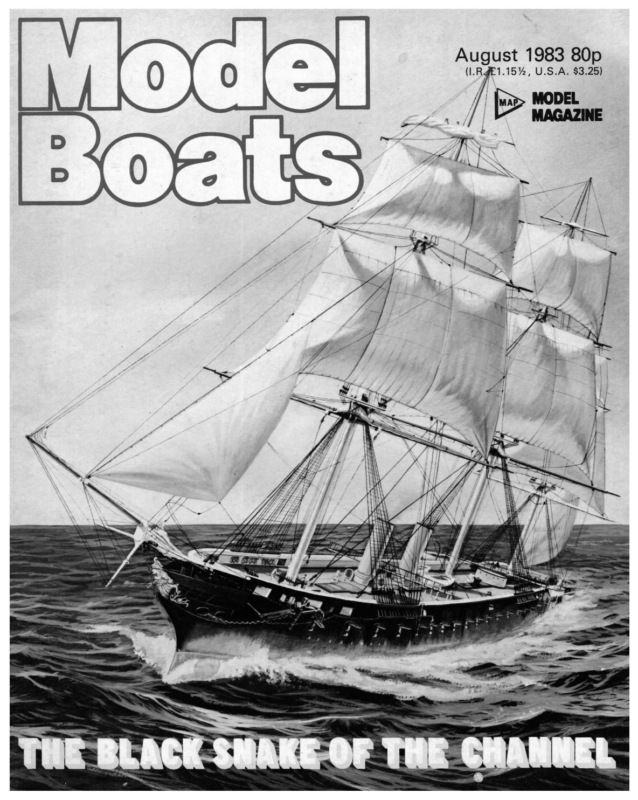
C0) £ August 1983 80p yy ie.15%, U.S.A. $3.25) eS | | MODEL MAGAZINE
the water on the heel exceeded the amount taken out, at one end or the other. One of the major effects of this is to change the underwater profile (Fig. 2) and hence move the centre of lateral resistance of the hull. Since the sail CE has been balanced against the CLR to make the yacht sail straight, the effect of CLR movement is to destroy the sail/hull balance and introduce tendencies to steer away from a straight course. Because of the typical shape of a hull in section (desirable for many other reasons) reasonable balance of the in and out wedges can only be mantained up to a modest degree of heel, typically about 20 deg. Beyond this point the balance of the Vic Smeed’s T IS self-evident that the bigger the sail area of a yacht, the more force or drive will be developed. If two identical hulls are sailed, one with twice the sail area of the other, the yacht with the bigger sails will be much faster, up to the point where the hull is overpowered by having too much sail area for the wind conditions. Note ‘overpowered’ and reflect on it for a moment; it has two connotations, both of which apply in this context. A hull’s power to carry sail (usually abbreviated simply to ‘power’)is affected by its beam, its section (i.e. shape) and, most importantly in the average model, the proportion of its weight carried as ballast and the position of that ballast. Thinking back to what was said last time, it will be realised that the wider the hull (i.e. the greater the beam) the more likelihood there is of difficulty in balancing the in and out wedges; similarly, overall balance limits the shape of the hull sections, so that while beam and section do make a noticeable contribution to power, it is small compared with the effect of the lead and these factors are usually better used more subtly in influencing the sailing angle of the yacht at relatively small angles of heel. The effect of the lead can most easily be thought of as a pendulum, although of course it is the whole centre of gravity and its depth below the centre of buoyancy which is the more accurate concept. For simplicity, however, we will think of the bulb itself, which normally represents something like two thirds of the weight of the entire yacht, and consider as usual the effect of the sails close-hauled for beating. We know that the wind effect on the sail produces a side force and, because of the height of the sail centre of effort above the hull, that this side force heels the yacht over away from the wind direction, influenced by the lateral resistance of the hull in the water opposing rapid sideways motion. Without some force opposing the heel, the yacht would simply blow over until the sails were flat on the water and the heeling force thus ceased. In Part Three Vic Smeed discusses volumes and displacement At a small angle of heel, the lead ballast fixed to the fin will move sideways a small amount (Fig. resistance igs 418 17a) producing a righting angle opposing the heeling force. Ata large angle of heel (Fig. 1b) the sideways movement of the bulb is much greater and the righting couple therefore much stronger. At the same time the heeling force diminishes because the sail C.E. becomes lower and the projected area of the sail (the area that the wind ‘sees’) decreases the further the boat heels. It follows that at some point the increasing righting force and the decreasing heeling force will come into balance and, given ideal conditions of a steady wind and flat water surface, the yacht would stay at the angle of heel at which the opposing forces balance. The correcting couple can be increased by extending the fin so that the lead bulb is carried lower (Fig. 7c) or as an alternative, the same correcting couple can be maintained by using less weight of lead carried lower, thus reducing the overall weight (displacement) of the yacht, but there are limitations on how far it is wise to do this. Last month, in discussing volumetric balance, it was mentioned that an unbalanced hull would be likely to have its stern or (less likely) its bow rise in the water on heeling, because the amount put into Fig. 1 hull begins to deteriorate and steering starts to become erratic; about 30 deg. isa tolerable limit for an otherwise wellhull balanced design. At the other end of the scale, a yacht which floats stiffly upright will not sail well, if at all. In order to set in motion the various forces and balances which allow the yacht to its to slip easily along, it must heel gently sailing angle, which varies from design to design but is usually between 10 and 15 degrees in a breeze of, say, 6-8mph. A yacht with too much ballast, or a moderate amount carried too low, is likely to be too stiff and, although it may heel ina breeze, it will bob upright at the slightest lull and lose the drive from its sails. Deepening the fin to carry the ballast lower may therefore have undesirable effects unless the ballast weight is reduced, and it should only be necessary if the whole yacht is overweight in the first place, when a poundor so saved on the lead will restore the hull to its designed load waterline. Deeper fins can usually be narrower, since only a moderate amount of side area is needed and unless tests have shown the yacht making excessive leeway, the area of a normally shallow fin can be redisposed into the deeper one. In fact, since a high aspect ratio fin is likely to be slightly more efficient, area might be saved. This means less wetted surface area anda potential if small reduction in drag. It is not unknown for some model racing designs to have had the fin shortened and the ballast raised to decrease overall stiffness and allow the boats to settle more comfortably to the requisite sailing angle. In the racing classes, only the Marblehead and 10-rater have unrestricted fin depth internationally, incidentally, though one or two national classes (e.g. the American 36/600 and the French 10/40) are also free of restrictions in this area; the 10/40 does in fact have international recognition but is rarely seen outside France. One other point on fin depth is worth noting, by the way, and that is that the smaller the yacht, the greater the fin depth needs to be. An explanation of this offered some years ago was greeted with a certain amount of derision (though no more tenable theory!) but if proof is needed, acquire one of the little toy yachts widely sold, modify the fin Model Boats
to half the width and twice the depth, and compare the performance. Inevitably, notes of this type are bound to repeat things said before, and apologies are tendered to long-time readers. However, there is still a lack of awareness among recent skippers in respect of changing steering problems would be likely to disappear. In other words, the yacht. will sail at the same speed (possibly a shade TM faster) but under control. This applies to vane or radio boats, by the way. There is, of course, a grey area where the down sails as the wind freshens — possibly they are frightened of placing themselves at a disadvantage by rigging a smaller suit in a race. =~ Fig. 2° Fig. 3 If we transfer the sketches Fig. 7a and b to Fig. 3 we can illustrate the projected area of sail at the two angles of heel (picked at random but around 25 and 45 degrees or so). The wind ‘sees’ the shaded area in each example but in a the yacht is within the limits at which hull balance is. still reasonable. The stronger wind in b has caused the yacht to heel to a point where the volumetric balance has passed the acceptable limit and not only is the boat going to be crankier in steering but the effectiveness of the rudder will be much reduced. Past 45 deg. the rudder is going to lift or depress the stern when applied and will have much less power to influence the direction of the yacht. If the sail rigged on the model were to be reduced to one nearly as small as the wind is gusty and may be too strong for, say, second suit in the gusts but raises doubts just have the edge, because the yacht will as to whether it is advisable to change to rudder application, while overpowering of third suit because the lulls allow the yacht to plug on in second suit. Only experience with a particular boat can allow one to read the larger suit may mean a keep sailing without hard and frequent struggle to get the yacht resettled after every period of projected area shown in b, the wind going to ‘see’ just as much, i.e., the drive is going to be no less, but the yacht will be able to sail at a lesser degree of heel, where these conditions accurately, and whatever is decided luck can play a part should the going to be too concerned, anyway, but a wind steady at the lower or higher strength. hull balance remains adequate and all the still giving pleasant sailing. On balance, though, the smaller suit may PRESTWICH Model Centre, 8 Warwick Street, Prestwich, Nr. Manchester hard blowing. If not racing the skipper is not smaller suit will reduce wear and tear while (To be continued) MIRAGE BARCLAYCARD Tel: 061-773 3915 or 061-7980655 ACCESSORIES Rubber engine mount kit 3.5 to 12cc £7.80 Lowline rubber mount kit 15cc . £10.00 Spare rubbers (4) .20…..0….-.cccccccn. £3.62 Rubber mounting posts (4) ……….. £1.40 Heavy duty flexi shaft complete …… £9.85 Super heavy duty flexi shaft complete £15.95 Ballrace ),” propshaft 7” to 9” long £7.10 Over 9″ plus 30p per inch plus 70p postage. PTFE exhaust joint >” bore ………. . £1.20 PTFE exhaust joint %”” or ¥,” bore PTFE exhaust joint 4″ or ¥,” bore . £1.20 .. £1.43 PTFE exhaust joint 22mm bore ……. £2.25 AMPS Aluminium RACING PROPELLERS 15.15, 18.15, 20.15, 20.18, 20.20, 18.18, 20.25, 22.20 & 22.25 £4.43 each. Stainless steel rudder and tube …… £2.15 Waterproof stainless rudder and tube £3.50 Double sided tiller arm …………….. Large fuel filter ………… ut: Propshaft support skeg ………………… £1.55 2 pint tin fuel tank (7Op postage) …. £3.88 3 pint tin fuel tank (7Op postage) …. £4.14 Polypropylene fuel tanks with centre cut out for tuned pipe ………. £18.00 to £22.00 RM radio box with linkages …………. £5.58 Buoyancy foam (post free) …………… £4.10 Glassfibre compound (7Op postage) £1.74 Engine compartment glazing resin all colours (7Op postage) ……………46…… £2.45 SHG rubber bellows per pair ……:…. £1.44 Rubber couplings all sizes up to 10cc £3.95 August 1983 £4.25 Rubber couplings over 10cc SHG streamlined waterscoop ………….. 65p Spring loaded aerial ……. : if 1.95 Radio hatch cover waterproof type ..£3.45 Radio hatch cover ees release type £3.88 . £1.35 ……….. SHG deck edging strip Webra 12v starter ………….e eee. £26.50 ENGINE SPARES IN STOCK FOR CMB, OPS, O.S., PICCO AND WEBRA. 40p Silicone fuel tube ………… Silicone water tube ……………………….. 7Op Silicone exhaust .” and 5%”, 6” long 9Op Silicone exhaust ¥,” 6” long ………… £1.10 CATALOGUE CATALOGUE U.K. 35p inc. postage. Overseas: £1.00 inc. airmail post. BOATS OMEGA 20 3.5¢e2).a8 OMEGA 406.5cc …… Designed for .80 to .90 engines this boat is the ‘big brother’ of the SIGMA. Like the SIGMA this boat as a very small wetted area which gives a very high top speed but it also has the stability to enable the boat to be raced in very rough water conditions. New style deck and improved moulding techniques makes this the best looking boat we have ever produced £36.00 post free. SIGMA This boat won the 1982 British multi-racing championships in 3.5cc senior and junior classes, scoring more laps than the 6.5cc and 15cc boats! Very stable with a small wetted area which gives a fantastic high top speed Complete with a new style deck which still allows the boat to be built very easily. Hull and deck unjoined £28.00 POST FREE. WATERCOOLED SUPER PIPE eels £23.50 … £25.50 OMEGA 50 6.5cc geared, 10cc £29.00 OMEGA 90 1.500″ ¢.2…0.2.5.t90ce. 31.00 SWIFT WSec cq Saute fessor oooh £35.00 COMET 22cc to 358ce 2.0.0… £35.00 ALPHA 20 3.5cc, 6.5cc ……….. £23.50 MARINE ENGINES Picco 21 Picco 40 …. Picco 90 sadewaee OPS 21 (rear exhaust) ..2..ccccccc. £54.00 OPS 65 with tuned pipe ………… OPS 90 with tuned pipe OS: 4O MRM score sss sstiocn -tesenteeeces £82.00 CMB 90 with tuned pipe £155.00 All engine prices are discount prices All engines are plus £1.50 postage. Stainless steel water-cooled tuned pipes with extra quiet double silencing chamber for over deck use. 15cc size has been developed further and now gives even more power New special .40 pipe for geared 6.5cc engines (one test gave over 1000 rpm more than usual). 3.5cc £22.00; 6.5cc £24.00; 10cc £26.00; 15cc £28.00. UK postage £1.00. Europe postage £2.00. ORDERS BY POST Send cheque or postal orders or phone in your credit card No. We accept Access, Visa and Barclaycard. 25p minimum postage. Allorders over £5.00 post free except where shown Overseas export to any country, write or phone for postal charge OMEGA 50 moe faphe Sls British FSR Multi-racing Champion 1982 with geared .40 engine. Very popular for 60 and .65 engines. £29.00 post free 419
LOGBOOK Model Yachting Association News OTHING immediately earth-shattering emerged from the meeting of the IMYRU Executive Board on May 7, buta lot of routine runof-the mill administrative discussion and decision took place. Items of general interest include an overwhelming postal vote in favour of three items referred to voting in this form by the last General Meeting. These were: (a) Adoption of the Olympic scoring system for radio races. (b) Amendment of IMYRU R/C rules to bring them into line with lYRU rules. (c) Amendment of IMYRU Rule Appendix 1 Clause 1.3 regarding discards in R/C racing. As the Olympic scoring system is incompatible with fleet racing, the EB has ruled that in all future IMYRU events the tournament system will be used. (As an aside, this will go a long way to removing one of the major disappointments of many younger national associations whose members entered a major event for the first time at Dunkirk last year. Many felt that they had had little chance to sail against top names and did not enjoy being stuck in C or D fleet for the entire event). The Racing Rules Officer is drawing up the amendments needed for (b) and will take the opportunity of including any amendments to the competition and racing rules which may be agreed in the near future. The New Zealand nominee for the Rating Rules Committee, by the (sorry, date unknown at moment). The Swedish meeting will be at Lake Ullna, 20km north of Stockholm, August 6-13 (European RM Championship) and the European Vane M Championship in the Recreation Park, Spaarnwoude (Nr. Amsterdam), Holland, is going ahead August 232T. A final draft of the proposed revision of the Marblehead Rating Rules is being sent out by July 31 for a straight yes or no vote by all affiliated countries, to be sent to Rating Rules Officer Chris Dicks by October 31. If the answer overall is yes, the rules will become effective January 1, 1984. In America a ballot is being taken among AMYA members to ascertain whether a majority is in favour of IMYRU affiliation. won his first nationals (although still in his teens he has more sailing experience than most, having interest. Championship at Bournville on March 26/27. The weather was unkind — rain, a cold wind deflected by the trees on the north shore, plus occasional snow and hail on the Saturday, flat calm on Sunday but freshening toa good beat and run and even planing conditions later in the day. The dreaded Martin Roberts from Birkenhead sailed models week in and week out since he could just walk!) beating his father (third) and last year’s winner, Alex Austin (fifth). A battle among junior skippers for top junior resulted in a tie at 14th between Chris Harris (10) and Peter Stollery (nine) with Adam Taylor (13) and Robert Vice (11) not far behind, (Bournville, Guildford, Southgate and Clapham clubs respectively). We understand that Alex Austin derived some consolation by winning the M Championship (Fleetwood, April 30/May 2) and coming fifth in his first RM Championship, (also Fleetwood, May 29/30) which was comfortably won by Norway’s Torvald Klem with, we believe, John Cleave as runner-up, but no actual results or reports have At the time of the meeting Argentina, Brazil, Germany, Hong Kong, Portugal, Spain, Switzerland and USA had not paid 1983 affiliation fees; two of these countries have put in preliminary entries to the European RM Championship in Sweden in August but these entries will be invalid if the countries are not affiliated. Brazil is in a possibly transitory phase at present and in Spain the original club which represented the country has passed on representation to the been received for any of these events. A sad occasion for model yachting is the retirement as a competitor in major races of Wally Jones of Birkenhead, with his inevitable mate, Bill Poole. Wally’s first national championship entry was in 1933 and he has been a regular, successful and most sporting contestant in most of the national events in the intervening 50 years, not to mention district and club races. However, there is a limit to how long one can run after fast Federacion Espanola de Modelismo Naval, Mayor 16, Madrid 13. There isa new West German Club, Greece is considering affiliation, and a Spanish boats, and we gather that Wally and Bill feel that R/C Championships is to be held at Las Palmas RECHARGEABLE BATTERIES NEW SEASON PRICES Sealed Nicad Batteries Heavy Duty with safety vent-rapid charge and ame SS: ; foams HP7 (AA) pencells O.5ANP ……..cc.:ccctecereeteereees HP2 (D) size 4.0Ahr ……..00… HP2 (D) size 1.2Ahr …… HP11 (C) size 1.8Ahr . £3. § Sub ‘C’ size 1.2Ahr … pencells Those who sail 36R vane models again showed were many other items of correspondence dealt with, but the above are the points of most general revision of the 6m rule by England is being progressed in the initial stages. A request has been made that the MYA insert the name of the country in the title, as used by all other countries. There next World Championships. Multi-charger for Snippets their keenness with an entry of 22 in the National There was some further discussion on the last World Championships, including points raised by Mr. J. P. Dole Robb, who has kindly presented four boxes of photographic slides to the IMYRU. Although there have been some enquiries, no application has as yet been received to stage the Charger for up to 4 their logos for publication. New Zealand is possibly to run a Pacific Regional Championship in January 1985. Italy queried the use of mercury for ballasting (strongly disapproved by the EB due to its toxicity). The draft way, is Mr. Fred Marten. PP3 size 110mANTr …………… This is the symbol of the Swiss Model Yacht and Power Federation. Other countries are welcome to forward Forallthose- Fine cutting jobs _ or” sei HP7, HP2, HP11 and PP3 | STARTER KIT BARGAIN: 12 x HP7 pencells plus charger ……… only £1 4.50] Sub ‘C’ packs — all at 1.2Ahr 3 cell 3.6v £4.60; 4 cell 4.8v £6.00; 5 cell 6.0v £7.40; 6 cell 7 2v £8.80. Packs suitable for Tamiya cars. Always send sketch or pack required. Sealed Lead Acids: 6v 6Ahr ………… £9.30 12v 6Ahr 6v 8Ahr DA sac. £15.20 6v 2.6Ahr …. …. £6.50 6v 10Ahr win EVV.6O All prices include VAT. Add 10% for UK p&p or 5% if order value over £20.00. . Quick despatch. SAE for full list and quantity discounts. WYCHFORD ELECTRONICS LTD (Dept. MB) 9 West End, Launton, Bicester, Oxon OX6 ODP. 436 SWANN-MORTON C10 CRAFT BLADES OBTAINABLE FROM MOST GRAPHIC ART SUPPLY STORES Model Boats
there is also limit to how often other competitors three-legged wire spider to which the jib tack is (A on sketch). The clew is clamped can be asked to intervene. Model yachting wil! still enjoy their company, officiating at races, and they will keep in touch by participating in the occasional club race. between the after ends at B and it would seem that the side legs of the spider are adjustable at C so that movement aft of their clamping collars can be clamped at B or made adjustable along the wishbone in the same way as the thwartship spider legs. would pinch the wishbone together and increase the AB measurement, i.e., adjust the sail flow. The jib foot can extend below the boom and there Wishbone Jib-boom An interesting application of a wishbone boom on an RM by J. L. Perard appeared in a photo ina recent copy of the French magazine Adepte. It appears to be a provides see-saw luff tensioning. The front leg of the spider GA could be adjustable (a turnbuckle?) for additional permutations of set and the sheet F attached These comments are conjectural but may spark off a train of thought. Wishbone booms are not is no sideways hindrance to its adopting a perfect set. A pivot hook beneath the spider engages con- piece of very light tube with a new but Mons. Perard’s application offer new advantages. ventionally with a jib rack and the forestay at G may well 1983 MYA Regatta Calendar Date Event Class Venue July Sept. : 2/3 : : Northern Dist. Championship and Northern Team Championship M.Y.A. National Championship 3 3 3 Spastics Cup Open Event 9 Midland District Championship & ae A R36R_ . 575 10R_ Met. & South Dist. Championship 10 Finn Turner Rose Bowl 36R Northern Team Championship & Fred Parkes Trophy ee pees tees Sword Trophy 24 Met. & South Team Championship 24 24 24 Open Event : Woodley Finn A 5 Aug. Yachting Monthly Trophy 7 ~~ Cole Cup 13. Open Event 14 Wyre Trophy 21 RM la ing’s Lynn Fleetwood 11 11 11 1 u Cheddar Cheese RM Northern Dist. Championship & Woodspring Northern Team Championship Open Event RM 27 CT Cup : 29 == Northern Dist. Jnr. Championship 29 _—_—Bilmor Cup RM RM A South Dist. Championshi _Brayford Trophy Belton Memorial Trophy Midland District Championship Model Maker Trophy Ladbrook Trophy Laidlaw Dickson Trophy E Wedetae Leger Meet. (L) Woodhouse Trophy Wellworthy Trophy ra 2 2 ian B owrnen Ont Met & South Dist. Championship Met & South Team Championship & Eastbourne Cup 2 ‘Peter Bryon Memorial Trophy 2 Davison Shield 2 ~~ (L) Parks Cup 8 2 (L) Whirlwind Trophy Sandilands Cup 8/9 M.Y.A. Champions Cup 9 Jack Roberts Trophy 15/16Midland District Championship 16 16 MY.S.A. RA — Woodspring RM Cleveland RM RM R10OR_ M RA _ RA & R10R Lincoin Chelmsford Lincoln Bournville Birkenhead Poole App! pes , 36R Birmingham RA Guildford RM __ Doncaster “Mi Fleetwood RM __ New Forest Birmingham Kings Lynn Gosport : ae Weenie RA __ Poole “M’ Eastborne RM __ Fleetwood “A — Birkenhead RM Leicester 10R “M” Newcastle Birkenhead RM Leicester “A” — Fleetwood “A” — Birmingham Northern District Championship R10R~ Cleveland (L) Elstead Cutter Cheddar Cheese 36R RA & Guildford Woodspring (L) Alice Elizabeth Noble Cup Hereford & 16 16 Birkenhead Birkenhead Gosport 16 A.G.M. Open 22/23M.Y.A. National Championship, Midland District Championship Worcs. 1OR 24/25M.Y.A. National Team Championship “M” 25 _—_ Eastern District Championship R10R_ 25 — Spastics Cup “A Fleetwood RA __ Birkenhead & S. Western Dist. Champicnshig p Rocket Trophy 17/18M.Y.A. National Championship 4g 18 18 Woodspring RIOR _ Birkenhead RA Fleetwood RA Fleetwood Met. 17 __ Lawrence Bow! Mickey Ashton Aug. 14 Bea R10R 31 to M.Y.A. National Championship & 21 A 4 4 11. RM __ Leicester = Nylet Trophy : Bournville SouthWales Gosport Cleethorpes R1OR_ hornhill Trophy Bradford RM A M Trophy ving Trophy 31 Hove & Mickey Leeds & 10 OpenEvent _ 17 —- Met. & South Dist. Championship 17 _— Northern Dist. Championship & vocet Birmingham Brighton 10 __— Northern Dist. Championship + RM 4 4 4 Chelmsford RM __ Gosport Duplex Chiltern MacDonald Trophy 10 : Fleetwood “M” — Cleethorpes R10OR RM __ Dovercourt 6M ___ Bourneville a 175 AN ANENOMETER !!’ ‘17 GIVES AN ACCURATE WIND SPEED READING AT THE TOUCH, OF 4 BUTTON 17! macoLMe ) “AT’S THT, August 1983 (MYUATSr 17 SAY?) 437