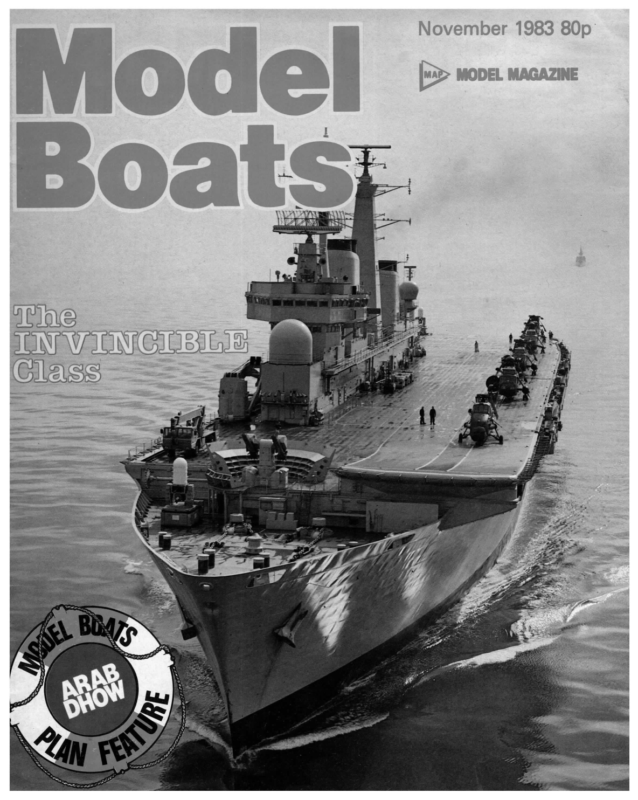
- ROUND the Regattas Duplex 575 Nationals July 24
- STARTING IN SAILING Found an old model yacht in the attic? Vic Smeed looks at the problems of restoration.

November 1983 80p £5 > MODEL MAGAZINE “elae aVINCIEES —— ort le
GA WAS Duplex 575 Nationals July 24 Reported by Mike Kemp places several times during the course of one race , Ultimate winner Mike’s Kemp’s 575 takes a commanding lead right at the start of one of the heats. After a number of 575 meetings have had to be cancelled due to lack of entries it was a pleasant surprise to arrive at Stanford Hall in Leicestershire and find no fewer than 35 entries for the fifth running of the Duplex 575 National Championships. Many of the old faces were present, looking no older than usual, as well asa few newcomers. True, the numbers were not up to the level they were when the 575 association invaded Woburn Abbey but as this year there were no eliminating contests there were more than have been present at the past two Nationals; also held at Stanford Hall. As ever the wind in this delightful spot varied from light to nothing, with the odd gust to considerable accompanied by a lot of water — falling! Baxter, Stan Adcock and Shiela Allcock all streamed in some time later. Defending Champion Barry Allcock had a little radio trouble and was allowed to drop into the second of the three groups of boats. Those unkind enough to think such thoughts might have wondered whether it was a touch of the gamesmanship to avoid Bill until a later race. That would have been a most inaccurate presumption as Barry literally tore his boat apart and replaced the radio receiver whilst race one was taking place: not an easy job with your left thumb in a splint. He had made a pretty lousy attempt at cutting it off with a saw earlier in the week and sailed all day with his sail control thumb disabled! Race 2 saw the second group of yachts on the sides. One gate, which was really a bit narrow for the twelve boat fleets was used as a Start and water and the first upset of the day, the Champ, was beaten into second place by a gentleman virtually unknown outside the Leicester area, Roy Waddington. In fact Roy won the first two of his five races, then went off the boil to score a three, a four and a six. Barry scored another two in his third race and ensured that he was not going to reach above third place. This race also saw the entry to the fray of John, our illustrious Editor; he may have been wowing the ladies in his natty shorts and ‘Humphrey’ headgear, but his sailing left a lot to be desired. In fact John scored more in his first race than he didina whole day’s sailing at Milton Keynes a few weeks before; one good thing though, with that UHF transmitter and its short aerial he did not appear to be fishing like so finish line, the other was a part of the course. many others. Stanford Hall is just about the only venue for 575’s where sailing takes place on a river, therefore one is not only having to contend with the wind but with a current as well. With the strength of the wind prevailing in some of the races the current became a noticeable factor. For once the wind did not come over and around the Stately Home of Lord and Lady Braye and their family, instead it blew in adirection that roughly opposed the current for most of the time and occasionally swung to blow across into the skippers’ faces. Thus all the races were sailed in an anticlockwise direction around a rectangular course with two gates set midway along the longest The Heats Racing got under way just about on time at 10.20am after a brief skippers’ meeting, so brief that if you blinked you might have missed it. The rules for 575 sailing are still very simple although this year it was decided that one discard would be allowed; after the situation which arose last year when the whole issue swung on one race where the defending Champion got hooked up in the middle of the fleet whilst the eventual Champion got clean away. Race 1 set a pattern for the day where two or three skippers were to dominate the proceedings. The first of these three, an upstart from the ‘Pool, Bill Thomas got clean away from one of the old hands, Graham Breeze and the rest of the fleet including such well known names as Poulter, 590 The next race saw the entry of past champion Mike Kemp; although closely chased by Keith Stevenson, Mike made sure of the first of his five race wins. Until the run off, more of that later, the closest anyone came to catching Mike was in race twelve when Graham Breeze got to within a few feet; in race nine Mike succeeded in lapping several of the skippers and nearly catching Malcolm Baxter; and that was inatwolap race! In that same race he was followed home by the two Leggs, Judy and Mike in that order; unfortunately Judy could not sustain that form and was eventually to take 22nd place overall and second of the Ladies places. The light winds meant that provided a skipper got a reasonable start there was a chance of getting a good place, the two comparatively long laps allowed the sailors to make up and lose and there were quite a number of fairly close finishes during the 15 races. Race organisation was quite slick without being too hectic so that between races one had plenty of time to visit the stately house, have some refreshment, play with the children or just sit and barrack the other sailors; or, of course look at the consistently winning boats and try to decide why one’s own didn’t quite seem to go as well. Very few of the craft actually went out of control during the day although there were one or two suspected radio problems and the rescue craft was brought into action a few times. The gentleman manning the rescue boat which was really a canoe spent most of the day sitting in it at the water’s edge or, while the 575’s were not sailing, practising his slalom technique around the marks of the course. His continual presence undoubtedly aided the running of the event enormously. Apart from Mike the most consistent skipper of the day was Keith Stevenson who achieved a complete set of ‘2’s to put him into fourth place overall Lunchtime was enforced after race six when it got very dark and the clouds opened for about half an hour. poor Ron Swinden was still on the water when this happened and got soaked before he could retire to his car, fortunately he was staying overnight in a caravan not far away and could go and get changed while the rest of us just sat and watched the rain beat on the windows. It was to rain again later in the afternoon when the racing proper had cometoanend. It wasatthis point that the organising group of Association Secretary Elaine Middleton and OOD’s, the Adcocks and ‘Marine Boy’ John Favell retired to the secrecy of their frame tent to hatch the final scores. After all the day’s racing it became clear that there was to be a run off for the Championship: with one discard each, Bill Thomas threw away this second place and Mike Kemp threw away one of this firsts to come out equal with three points apiece. The Final As the wind had changed direction it was decided to run the race in the opposite direction and that it would be of three laps duration. The boats were put on the water and the countdown commenced; the gathered mass of other skippers went quiet as the tension mounted. Bill got a beautiful start bang on the signal and set off with Mike some 2ft. behind. Both followed an iuentical course around the marks on the first lap, on the run Bill’s yacht seemed to have the advantage and by the time they had reached the three quarters of a lap it was ten to 15 feet clear. As they Model Boats
turned for the first crossing of the start/finish line gratulated for his continued efforts. There were Mike, who had followed a course closer to the some notable absentees from the day’s proceed- near bank was forced to put in a tack to get far ings, enough out to actually go through the gate. The previous owners used to avidly support the 575 racing calendar, so another obvious, but lesser known, absentee from the proceedings was the lead and as they set off on the downwind leg once again it appeared that all was settled. At the start new of the windward leg Mike started his challenge; it craft. was here that the tactics differed, Bill went into meanwhile able stayed to sail close a to little freer. the bank, risking getting caught in the weed but tacking on every spectators; as Bill and Mike boats the watching crowd was_ hushed. Downwind the little craft went with Bill’s sails goosewinging appeared freely to be stuck, while Mike’s sheets as they arrived at the leeward marks there was only a two or three foot gap between the boats: nowthe turn forthe finish line. Once again Bill tacked early and went off into midstream, that was to be his downfall; the other boat stuck close to the shore and put in some short tacks as the wind shifted and slowly the gap A look along the river bank. Right to left: Elaine Middleton and Gwynneth Adcock; Judy Legg walking towards camera and left: husband Mike Legg. 5th R. Waddington 6th G. Breeze………………. once again drifting downstream; the wind raised WAW=IBe Poulter itself once more and the five year old 575 turned 4 le | Ee bi 18 (6 pele seremes lee Dae to cross the line some ten to 15 feet ahead. So Othe Sinite 575’’s started racing. That over the gathered skippers and families turned for the prizegiving; the trophies were 1S8tS. ANCOCK Adcock special prize was presented to one of the skippers 4th E. Middleton another go; the crowd gasped, was Bil! to have who most often has turned out to support the 5th A. Finnis meeting but has very rarely come anywhere in the 6th C. Thompson top 7th M. covered despite the fact that the purple boat was ee ee ee Ladies’ results 3rd G. well su… The presentations A was 20 na Bye ee Mths SMAUCOCK eda cdesciec i 12th SAlibock…2 and position ee ended one of the most nailbiting races seen since the line and had to tack across the stream to have his os eee oA opened. At the finish Mike could not quite fetch No, twelve 3rd B. Allcock 2nd J. Legg chance? related past Ist M. Kemp……………. handed out by one of the founders, John Favell, another 575 and the 2nd W. Thomas mark once again. At this point it was debatable the of Final results much closer to Bill and gradually overhauled him or behind the traumas Place/Name and passed to leeward before turning for the first prowled up and down the bank following their the again ‘strike back’: how about it Mr. Lesro? small windshift. This time he crossed the line skippers After shown that it is far from dead and could once Mike who was suffering most from the tension, the mastermind months, with price increases and all, the 575 has mid stream to try and make best use of the wind be wonder Duplex business has changed hands and that the little headway although Bill by now hada commanding to bearded where out in the North Sea. We all know that the but in a better position. When the breeze picked as the the time we were enjoying ourselves was some- current; meanwhile Bill was similarly becalmed so obvious was has got himself a post on a stern trawler and at started to drift back down the stream with the up Mike was able to tack and start making a most himself Harvey Middleton. We were told that he wind dropped to virtually nothing and his boat the various group, lan organisers Smith of were Coventry thanked. was con- soh2 ss. eee e ee n eee Re cee 22 _. 26 . 25 Gross 34 3Y Retired s e y a yor” wound Valle class mine- e Easy fuflld Wietorianpaddler sweeping trawler Plan Feature e Building for exhibition display e Pins Warrior and all the regular features ABCO introduce ‘ALISON’ Alison is our lovely model who wants to show you our fantastic new hull. This superb hull is of a 1900’s Steamdrifter/ Trawler, and is strongly moulded in marine quality fibreglass. The hull features the Panama ports and main rubbing strakes (moulded in), and is supplied with a highly detailed FULL SIZE PLAN. This hull is big enough for any type of power plant, petrol, |.C., electric, but is perfect for steam. With masses of wooden deck and superstructure this model is a scratchbuilders dream, without the problems of hull building, and will make a wonderful sight on the water. BUILD A REAL MODEL. The hull is a large 67’ Jong x 15” beam and approx. 10” deep from keel to gunwale. Scale is “ft. Price £65 + £5 p&p Order Ref. A12: (Alison’s phone no. £50)! NEW, NEW, NEW, NEVER BEFORE AVAILABLE. A SCHOONER HULL three-masted Schooner (M. A. James) — 36! “x 81,” scale ¥ “ft. available from end Oct. Perfect for all sail fans. Coming Soon! A WWII Destroyer. A 1950’s cargo boat and a superb WWII Corvette. Keep watching our ADS. Send 50p P.O. or cheque for our illustrated 20-page price list. Please allow 21 days for delivery. Remittance with order please to: ABCO (U.K) ITD. 165 WALMERSLEY ROAD, BURY, GTR. MANCHESTER. BLI 6LL. ABCO BUILDING BETTER MODELS FOR ALL! November 1983 591
improvement was still in the future, spare SIARTING IN SAIL time wes more plentiful despite (usually) Found an old model yacht in the attic? Vic Smeed looks the like — and modelling came into the longer working hours Constructional judging by the continual flow of readers (or others to whom the magazine is suggested?) who have acquired or discovered the remains of an old model. The commonest situation is where just the hull exists and the new owner wishes to restore it to sailing condition and wants advice on sail area, spars, rigging and fittings eta/. Well, firstly there used to be a lot of ready-built models offered commercially. Then there were designs (sometimes to stretch a point!) published in magazines and various publications aimed, frequently at boys. There were, of course, some hundreds of yachts built to class rules, many of which were eventually consigned to the loft. And finally there were at least hundreds which were built by eye. It’s strange how the idea that there isn’t much to designing a sailing model has persisted over at least 60 or 70 years. Of these categories, only perhaps five per cent of ready-built models are likely to have had a performance which would make them worth restoring for the pleasure of sailing them, and much the same applies to tended to require mechanical items to tion, was most likely to appeal, and the felt that a model yacht would be a nice thing to include and, well, if it’s made of wood it’ll float, so anyone that finishes one won’t complain. Class models are likely to be to obsolute rules or classes and will look and perform very differently from what is perceived as a racing model yacht today. Those built by eye? Two or three per cent could be gems, but most are probably useless — their survival could even be a result of their refusal to sail! Many of these could be of scale-ish appearance, the builder perhaps not realising that yachts are influenced by scale effect to a far greater extent than other forms of model. It is hard for anyone younger than, say, their 50s to realise just how much people had to rely on themselves for entertainment in pre World War II days. Even in the late ‘20s and ‘30s, when radio was becoming commonplace, most people did things while listening and a trip to the cinema every two or three weeks didn’t eat far into leisure time. The idea of making things in one’s spare time was normal, and because DIY decorating and house repair/ ‘model yacht’ was ideal — timber, cloth and twine plus a bit of wire and lead, no fuel and no costs inrunning — anda Shamrock and other lot of interestin famous full-size yachts — there could be nothing better. If you’ve wondered why so many towns have ‘model yacht ponds,’ many built in the 19th century and up to about 1936, this may give an inkling. With such a broad base — albeit a public image of ‘toy boats’ — the emergence of clubs and a national association was inevitable, especially as without radio control and commercial i.c. engines the only other modelling interests were steam boats (plus some clockwork and electric) plus rubberpowered aircraft and a very small following for rubber/clockwork cars. There were, of course, model engineers capable of making steam models, sometimes even model railways, almost all O gauge, but these were classed as indoor rather than outdoor activities. The point of this historical reminiscence is to try to show how numerous model sailing boats were between, say, 1910 and 1939, and of how many different shapes and sizes they were. Thus the chances of an easy reference to a source of information are remote indeed, and because major WITHOUT FIN WITH FIN ss H= 75%L \ r— 30/35%L Total 35% 65% e—— 50%H 50%H ——4 Equal 600 i.c. engines, but not very many, and there were a 80%H be bought or specialised ancillaries for opera- published plans. Some we have seen were shockers, obviously drawn because it was MS be same bracket. Something simple, which didn’t at the problems of restoration. ODEL yachts/sailing boats must be among the most durable of models, hobbies simple — fretwork or basic woodwork and aul
changes in model yacht design have taken place in the last 30 or so years, features of more recent models are likely to prove totally unsuitable for incorporation in old boats. Although no check has been kept on the dozens of enquiries received over many years, there common to are many two factors which of them — are unusually shallow draught and the use of bowsprits, both of which suggest a low and longfooted rig, possibly even with two headsails. Neither are common nowadays, although a stub bowsprit might possibly be seen on an unusual 36R design. What so many enquirers fail to realise is that the sailplan was matched to the hull, even if only by guesswork and trial and error, and without making a rough analysis of a particular hull and designing a sailplan Suited to it, it isn’t possible to give mast height and boom lengths etc. The guess- work otherwise involved could lead to considerable disappointment, particularly so if the model in question was gaff-rigged or multi-masted. Is there no guidance restorers? The answer is for would-be not really, but having said that there may be one or two generalisations which might be offered, though with no guarantees! Firstly, mast height. If the hull has no fin projecting below, i.e. it has a bar of lead virtually tacked on the bottom of the hull, it would be inadvisable to make the height of the main hoist (i.e. the head of the mainsail) higher than three-quarters of the hull length. If there is a fin and if this extends below toa depth equal to the hull depth, then the main hoist could probably be equal to the overall length. This assumes a normal beam of 1/5 and 1/7 of overall length. The mast position is probably evident from the hull, as may be an indication of whether a bowsprit was fitted. If the mast is about 30 per cent of the hull length back from the bow it would probably be safe to plan for a jib area of 35 per cent of the total sail area, the jib hoist being 80 per cent of the main hoist. The mainsail area? Well, for absolute safety the foot length should not be more than half of the height, but this may look out of keeping with the hull (particularly one without a fin or with a long, shallow fin) and could proba bly be extended to three-quarters of the height. Irrespective of the shape of the sail leaches (trailing edges) regard them as simple triangles for calculating areas. Now, forgetting all the intermediate bits, consider what might happen when you sail the boat. The aim should be a Straight line at 40-45 degrees to the wind when both Sails are at about five degrees to the centre line of the deck. If the boat persists in turn- ing away from the wind, the centre of effort of the sails is too far forward and the normal cure would be to move the mast aft. If the mast is fixed there are three possible steps involving the sailss(a) Move the jib back as far as possible. (b) Usea smaller jib. (c) If the November 1983 boat did not seem worried by ‘tenderness’ fit a larger mainsail. You could free off the jib a little, but not more than three-f our degrees more than the main — alter the area instead. Obviously, if the yacht keeps turning /nto wind the opposite steps are require d — move jib forward, fit a larger (or even a second) jib or reduce the mainsail. How the boat will behave depends so much on the individual hull shape — its profile, balance , resistance to sideways motion of the ends and so on — that a bit of cut and try is almost inevitable. There is another, more drastic way of dealing with the problem, especially with long, shallow keels, and that is to cut off or add area to the underwater profile to move the hull centre of lateral resistance and thus balance the sail forces. However, since a restoration undertaking is unlikely to favour sawing bits off what js original, alteration to the sails is the most likely course. Up till about 1950 sail material is likely to have been Union Silk, which is another name for Egyptian cotton, a fine, closeweave cotton cloth. A sail has to be air- proof, hence the closeness of the weave is important; some sails were treated with various solutions to seal off the ‘pores.’ Others were no doubt worn-out bed sheets, fine Irish linen or nurse’s veiling (sometimes called nun’s veiling or tarantulle). Modern synthetics are more easily avail- able, but if not using ‘proper’ model sailcloth, check that the weave is practically solid and always cut the sails with the leach lot of bits of old string to fathom out. The notes on Braine steering of two or three months ago might help here. There were quite a lot of fittings involving brass tube; hounds fittings were shrouds and one on the foreside for the jib A deck-mounted mast step was also hoist. fairly standard, a stub of appropriate tube being (usually) silver soldered to a square plate which was screwed or pinned to the deck. Some commercial models also useda stamped brass ‘gammoning iron,’ or two, to secure the bowsprit, and there was often a brass sheet rudder soldered to a wire stock, the stock held to the after edge of the fin with screw-eyes and the wire project ing up through the deck, bent over to engag e ona Saw-tooth or wiggly wire tiller rack. Other models had half wood, half lead rudders , or wood ones with a cast disc of lead pressed into a drilled hole, free-swinging and with no part through the hull. Variations are infinite, of course , and perhaps the most useful part of these notes is that suggesting how to arrive at a sail- plan, though guaranteed as even that universal. cannot helpful piece of advice is to take the model could well be able to offer some guidance Remember, though, that the odds of ending up with a successful sailing model are not too good and your main pleasure is likely to come only restoration. from the actual work Hounds-= tube with screw eyes material. Many early models used simple light brass straps around the mast, booms etc. with brass screw-eyes passed through them into the wooden masts and booms. Sometimes the eyes were then soldered. The gooseneck was frequently two interlinked screw-eyes at 90 degrees, the boom r but tapering such dowel is not all that easy and frequently the grain wanders, so that the mast in particular will not Stay straight. It is better to get a piece of clean, Straight- grained and dry pine and split it with an axe, planing/filing/scraping to desired size. Which is? Ah! Many masts and spars were over-heavy, but for the sort of Depends on size of model 14-4” normal Tube and plate mast step sailplan suggested ¥,