- Kit Bag Pronto Radio 36r yacht reviewed by Derek Stephenson
- Starting In Sail Presents part five of Hobnoblin, a 36R yacht for radio or vane designed by Vic Smeed.

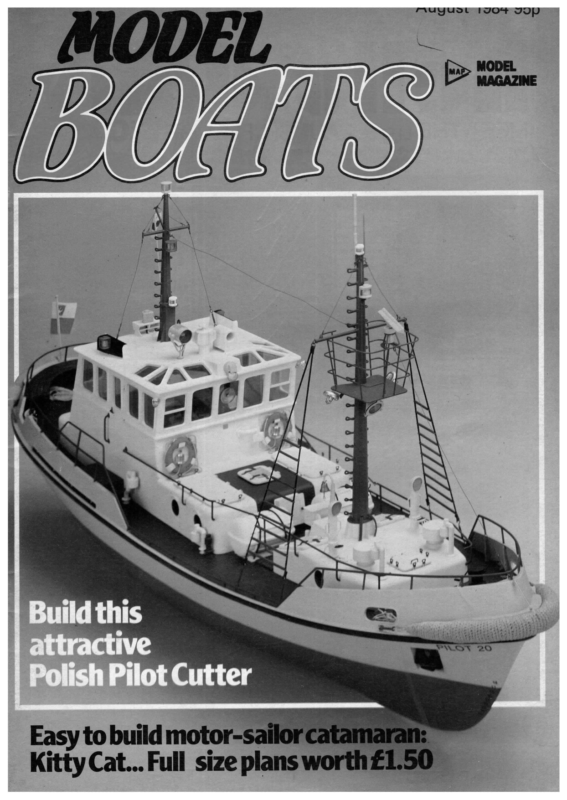
rAUYyUdsL 190% JOP >) B> Bln PL Sa 6 er re PT SOND) EKet Easy to build motor-sailorca Kitty Cat… Full size plans
t was last year after a visit to my favourite water at Setley in the New Forest as a guest of the Solent Club that I decided it was now time to rejoin the fray. It had been for health reasons that I had given up atten- ding regattas in 1977. Hypertension and Valium are not a good mixture for the pressures of competitive sailing. First priority on the building programme was a R.M. and after much discussion with other skippers a design was decided on, purchased and duly built. What not a 36! It was during this building stage that the idea was beginning to form in my mind of building a 36r. This I think had been caused by an upsurge of interest in the yachting world to revive this class. The first National Championship for R36r had been held at Chelmsford with an entry of 13. Also there had been an excellent turnout of vane 36r at the Pugwash regatta at Clapham; in alla growing interest again in this class of yacht. Now let us consider what this size of yacht has to offer. It is easy to transport, is large enough to make sailing interesting and good fun, and it can be reasonably cheap to build. In other words an excellent yacht for the beginner to take his first steps into the world of model yacht sailing. The choice After some discussion with my fellow skipper (the wife) I decided I would build a 36r. I was swayed in this decision by the fact that my wife said she would pay half the cost for my Christmas present, too good an opportunity to miss! After giving her a hug and a kiss I turned my thoughts to the question of deciding which one to build. Decisions, decisions! I looked at plans and available kits, but was unable to decide. It was at this time I visited Norman Hatfield and on telling him that I was thinking of building a 36r was informed that Oliver Lee was introducing a kit and that he would get Oliver to send me drawings and specifications. I found the idea of building a design by Oliver Lee quite exciting as the first competitive yacht I had built had been one of Oliver’s designs, namely the Squiblet, a yacht with which Ihad some success. True to his word the drawing duly arrived and I was hooked. It was all that Norman had said. With drawing in hand I sought the approval of my sponsor and with her agree- ment I phoned Oliver only to be told that he was moving and did not have the kits in stock, but I should be able to obtain a kit from a model shop in his area who were stocking them. Another phone call confirmed that they had them in stock and I was on my way, eager to get started. The kit The kit came in one large cardboard box, containing everything including the mast. The only separate item was the lead keel. On first opening the box I was more than surprised to find that the g.r.p. hull, which was moulded in bright yellow, already had the marine ply deck bonded in position with all holes pre-drilled for fittings. The mast and rudder tubes were bonded in and finished. The blanks for the fin and rudder were cut to profile from solid mahogany and chamfered to an aerofoil section. The mast was in two sections and was of the internal luff groove type. Both jib and mainsail booms were made complete with gooseneck. There was a Bantock working suit of sails, and a complete set of fittings, plus drawing and Model Boats
instructions. It is at this stage you realise how little there is to do to complete your yacht. Starting up The first job was to shape the fin and rudder to the finished section. This only needed a minimum of work with sandpaper to achieve the required shape. When I was satisfied this was correct I made sure that the fin fitted the slot in the hull and located in the notch under the deck. I then checked that the lead keel fitted on the fin and I was then ready to fix the fin into position. But first I taped a sheet of polythene over the deck in case of accidents. Making sure first that everything was in line and correctly positioned, I bonded the fin into place using resin and glass mat, and using Araldite to bond the fin to the deck location. The stock was also Araldited into the rudder which only required varnishing to finish. The keel was next fitted into place as balance adjustments, if necessary, can be made with your winch ni-cads. I fitted the keel at this stage as I wanted to varnish the deck and fin at the same time. Finishing I now came to what was to prove to be the longest job in the completion of my yacht, varnishing of the deck. I gave mine five coats of yacht varnish with alight rub down with wet and dry between coats. This obtaineda first-class finish and added to the appearance of the yacht. I would suggest you do not try to rush this stage. While this was going on I assembled the mast which was in two pieces. These I epoxied together but you can have it as a split mast for easy transport. As I have said before the booms were finished and required no further work. When the varnish was hard the next job was the fitting out of the deck. The fittings supplied consisted of deck eyes, pulleys, tubing for mainsheet tripod, and plate for the fitting of rudder servo. The holes for all these fittings except for the servo plate were pre-drilled and fitting only required bolting through the deck. It was at this stage that I had my only criticism of the kit. A tiller arm was not provided for the rudder and no material was provided for the hatch cover. A small point, but I would have thought they could have been provided in the kit. It only remained now to complete the rigging and install the radio and my pride and joy was ready for launching. I had to agree with Norman it was a pretty boat. Availability The kit is available in two versions. MkI with a two sail sloop rig and Mk2 witha una rig. And if you are not up to building a kit or do not have the time, it can be bought readybuilt and only requires the radio to be fitted. Prices at the time of writing: NK IgG Wccace £85 Mk1 Finished £120 Mk? Kit ……….. £73 Mk2 Finished £96 Lead keel …… £8.00 Manufactured and distributed by Oliver Lee, The Old Maltings Quay, Burnham-onCrouch, Essex. Telephone: Malden (0621) 782305. If you want to make a start in radio controlled yachts this is the one for you. Not only will you have a first-class racing yacht from one of the top designers in this country, but you will quickly be on the water instead of spending hours building. 7 And so the day had arrived for the launching. Not a question of seeing if it sailed because everything Oliver designs sails well, but to see what adjustments were required. To this I must report none. Iam now waiting with interest for the first regatta to compare it with other 36rs, as this is the only true test of a yacht’s performance. I think you will have already gathered that I rate this kit highly and that it can be summed up in one word excellent. It is a first-class kit and is to be recommended fora first-time builder. It is a comprehensive kit and requires very little time and effort to build. In fact Oliver now informs me he is working on an alternative g.r.p. deck and anodised alloy fin keel to save time and labour. This will cut the building time in half. Tee Launching 457 en oat 1 cnr ire ite na rpemneene om ated
here is not a lot to add on the subject of painting the hull except to stress that wet-or-dry carborundum paper cuts very much faster when used with plenty of water, though it’s a messy business. Basically, however, the residue is dry paint dust in water i.e. it should brush or wash off when dry. The best idea is to sit on a box in a corner of the garden with a bucket of water, a sponge and a sheet of wet-and-dry, wearing old clothes or an overall, when you can rub away, sponging frequently, without worries. The first shower of rain will wash the paint dust down to the grass roots harmlessly. Stop rubbing when the nylon weave becomes visible but go over the whole hull every time. Then wash off the hull, allow to dry and apply another coat to start the process over again. Since most of the paint is rubbed away, not a lot of weight is added and patience at this stage is rewarded by an envied finish. Painted decks are currently in vogue and in full-size the paint is usually an anti-slip type, not therefore highly glossy. Whether a modeller chooses a glossy deck or one with, say, an eggshell finishisa matter of personal preference, but if some scale effect is sought, the matt or semi-matt surface is more convincing. A compromise is to use gloss paint and after finishing mask off ‘tread areas’ and paint these matt. A double-texture finish of this sort looks very attractive. If the low cabin top was included narrow windows can be cut from Fablon or similar black film for the sides. The cockpit area should be painted as previously discussed. Deck lining or hatches can be inked in with a ruling pen if desired. Marking the waterline by chocking the hull level and running a pencil round on a block has been detailed frequently, as has masking off and painting the boot-top. Those with a leaning towards snappy colour schemes can no doubt pick up ideas from full-size sailing magazines. Between painting, the mast and fittings can be tackled, if these have not already been made, from the drawings given in the May issue. /Mast and fittings no-one has managed to identify — it is very pale, looks almost like balsa, is as light as pine but stronger, does not go out of shape and is generally excellent for a simple wood mast. It is no doubt one of the exotic ‘new’ timbers but even its source has not yet been established. However, it might be foundina DIY shop or timber yard, orif not, pineis the best choice. The alternative is to laminate a mast from two or three cedar or pine laths, to give a block say % x %in. This dimension should remain at about 17in. from the mast heel and the remainder can be planed to taper down to *,in. square at the heel and a little less at the head, all the taper being on the foreside. The whole can now be planed octagonal and the corners then removed to produce a mast round at the ends but increasing to an oval at about one third height. If laminating a mast in this way, it may be thought worth making it with a slot for the sail luff. This would entail making thecentre lamination say ,in., ending short (in sec- tion) of the side laminations. These would carry ‘/,,in.sq. strips glued along their aft inside corners, sanded after gluing toa whisker under !/,,in. Thus when assembled there will be a pocket with a slit as sketched, Fig. 1 the slit being just wide enough to accept a double thickness of sail material. When the sail is sewn, the luffis hemmed entrapping a cord (of similar fibre to the sail, i.e. synthetic with synthetic etc.) and the hem is later fed into the slot in the mast. Naturally the cord plus hem has to be thick enough not to pull out of the slit, but it must also not be so thick as to cause difficulty in feeding into the slot or prevent free swing of the sail; a cord which is a tightish fit can bias the sail hem which in turn can prevent the perfect sail setting. For a tube or dowel mast a jackline on the after side, with hooks sewn to the sail luff hem, is still the commonest method of securing the mainsail. With a tube a fine (say 28swg) stainless wire can be used, fed in and out in pairs of holes drilled in the mast. Simpler alternatives are to pass the wire or cord right through the mast at the top and bottom, or to secure the ends with eyes engaged over small self-tapping screws, bowing the mast when making off the second end to ensure that the line is taut, then binding at intervals (check the luff hook positions) with plastic insulation tape. A similar method can be used with a wood mast. There are other systems, such as using split pins through the mast and passing the jackline through the eyes, or fitting brass screws or bolts to the mast and soldering the jackline in the head slots, but all of these add bits and present philosophy is what you don’t add doesn’t increase weight. Other methods of securing the mainsail are mast rings or hoops, which are wire rings passed through eyelets in the luff hem and dropped over the mast, or cord lacing ‘sewn’ loosely through eyelets and round the mast in a spiral. Both these systems allow the sail to adjust its position in relation to the mast to the aerodynamically most The mast (53in. total length) accounts for most of the weight of the rig and if thin- Fig. 2 | walled in. aluminium tube can be obtained an ounce or so will be saved. If ”/,,in. or 9mm tube is available this could also save a little while remaining stiff enough to require minimum rigging. Going down to ,,in. or 8mm might mean a spreader or diamond stays to stiffen things, but there is a case for this if scale appearance is desired. Sport sailers may very well settle for a wood mast made from ‘in. dowel, but don’t buy the Shroud Diamond first piece of dowel you see without check- ing around; several types of timber are used for dowelling. Ramin is common but is heavy, better quality dowels are frequently beech, which is also heavy. Birch is better, and pine dowels have recently become more common. Also seen is a timber which so far stay Spreader \ bent back ane Force Fig. 1 Bent forward 7 Shroud Cord Sail .
the luff hem is wide and slips over the mast completely. A small aperture has to be cut to expose the mast at the point where the jibstay and shrouds engage. In any system it is essential that the luffis reasonably taut, so either the head or tack (bottom fore corner) must be secured firmly and the other end provided with an adjustable tensioner, termed an uphaul if attached to the head or a downhaul if secured to the tack. To avoid even the weight of a bowsied cord at the masthead many skippers favour the downhaul. The length of the wire hook at the head (either in the headboard or head eyelet) is arranged so that the tack, when tensioned downward, is in the right position relative to the boom. This isn’t critical to say Y,in., since the main function of the boom has to do with positioning the sail clew (lower aft corner) but if the tack is actually touching the boom when new, any permanent stretch which appears will prevent perfect setting and the head hook will have to be shortened so that the tack just clears the boom when the luff is taut. This is the reason for having a mast extending a couple of inches above the sail head. In the case of an uphaul, the tack is hooked to the boom and any stretch taken in by the uphaul. Without having an ungainly length of mast above the sail head, the uphaul may be too short for easy or accurate adjustment and in many cases is taken through the mast and down the foreside, hooking into the jibstay eye. This then gives an easily-handled adjuster with more than enough movement. It does have one snag — it is probably the fastest-wearing line on the yacht, at the point where it passes through the mast, so would need thought as to how chafe might be reduced. Some form of plastic bell-mouthed bush through the mast is possibly best, or possibly braided wire could be used for the short length passing through the mast. Whatever is used, regular and frequent inspection is essential. Back to the mast itself. In this simple model, a peg heel is used engaging in one of a series of holes in a deck-mounted mast step. Several holes are provided to allow the mast to be moved when trimming, as no two yachts ever seem to require exactly the same trim. The peg is a brass screw driven into the heel of a wood mast or a wood plug in a tube mast (see drawing in May issue) and the screwhead then sawn off. It is worth applying a thread binding at such stress points on wood spars, by the way, just to make sure they will not split in a gust. Just above the screw an eye is needed, wire for a tube mast, or an epoxied screw-eye as an alternative in a wood mast. To fit a wire eye, cut a length of wire and bend the square end. Drill the mast and pass the wire through, engaging the square end, then roll the eye with a pair of round-nosed pliers tight to the mast. A double turn is better than a single, since it cannot then pull open. Before fitting this eye the gooseneck plate should be made and fitted. A piece of ‘/,in. on plan, Above right: att ends af booms Hattened _ Gooseneck plate, kicking strap eye and mast peg. Paxolin is the ideal, but any firm plastic would do, or at a pinch ‘/,in. ply, of good quality, could be used. It should bea snug fit on the mast, which means filing and trying if a shaped wood mast is used. For tube or dowel, drill a trial hole in a piece of scrap timber to check that it will not be a slack fit. If so, drill with a smaller drill and open the hole with a round file till it just pushes on. Epoxy in place with its top face 3in. above the mast end. If the model is to be sailed by vane, drill a ‘,,in. hole each side of the mast for a spinnaker boom pivot pin. A hole edgeways through the foreside into the mast enables a fine screw to be inserted to reinforce the epoxy. Keying surfaces to be epoxied by light sanding or filing is a good habit to acquire. It should be self-evident that everything on the mast should line up; the jackline should run straight up the centre line, the gooseneck should be square and the pivot hole central, the drilled holes for the jibstay, shrouds etc. accurately positioned. Any twist will offset some part of the sail and although it will not prevent the yacht from sailing, it will introduce a difference in performance on one tack compared with the other. The last mast fitting is the jumper strut, shown on the drawing as a length of 3in. tube epoxied through a hole drilled in the mast tip. An alternative is shown in the photographs, using a length of T section aluminium fitted in a split sawn in the mast tip, secured with a bolt and/or epoxy. The aluminium is sawn from old curtain rail and the specky appearance is caused by light corrosion which has been sanded off. This doesn’t affect the function of the part, but in any event a thin coat of paint (even cellulose) is desirable on such aluminium parts to prevent future corrosion, especially if used on salt water. Most tubes seem to resist corrosion longer, possibly due to surface hardening/ polishing as the tubing is drawn, but they do eventually turn grey and dull after a season or two of use. If a thin or wood mast is used and a diamond stay is fitted to stiffen it, a spreader will be needed, Fig. 2. The stay would normally run from just above the gooseneck each side to just above the hounds (jibstay/ shroud point) and the spreader should be about halfway between the anchor points. A length of brass wire, about 12g (‘/;,in.) x 4’,in. long should be epoxied into a hole drilled across the mast and the ends need a notch sawn or filed in. The stays would normally have adjustment for tension, using a small turnbuckle at the bottom end of each, but it is possible to set them up with equal tension by trapping each end under a screwhead and fiddling the screws until the mast is straight. Only very light (28-30g) stainless wire is necessary. It is also possible to use a similar spreader bent backwards to engage the shrouds, at about two thirds shroud height. This can be useful in that as the shrouds are at an angle to the mast, adjusting the bend in the spreader introduces a force fore and aft on the mast at about its centre. Bending the spreader aft pushes the mast centre forward and vice versa, allowing adjustment to the mast curve in order to get the mainsail setting just right. Because the shrouds are set up with a fair amount of tension only small changes in the spreader angle are needed to produce a noticeable effect on the mast. The booms should be ¥,,in. aluminium tube but they could be ‘/,in. or, as suggested on the drawing, as much as *,in., although the last is only suggested if smaller tube is unavailable. Television aerials are a source of smaller diameter tube, especially the redundant 405 line H aerials. One which has been loft mounted rather than externally will usually provide tube in a reasonable condition. Apart from flattening the after ends in a vice and gently bending the jib boom (a little at a time and moving the tube along in the vice as it is bent, to prevent distortion or collapse) most of the work is simply drilling holes and inserting wire eyes. As an alternative to a fishing swivel for the jib hook the method used by the Seahorse RM is worth considering. Like all good notions this is so simple that it raises the query “Does it work”? and it certainly does. It is merely a length of braided fishing line tied round the boom and the long end carried down and tied to the jib rack, leaving the boom swinging on a single line. No weight, free movement and quite adequately strong provided it is changed frequently to circumvent chafing. The mainboom pivot pin needs care to ensure that it does not jam in the boom end. The boom must not only swivel freely from side to side but its aft end should be free to lift and fall without sticking, even though for most of the time the kicking strap will be holding it down. Free movement of the booms is essential, especially in light winds. All that remains is to make and position the deck fittings, fit the radio (if applicable) and rig the yacht, which we will deal with next time. aa —_- advantageous (or so it is said). A further approach is the full pocket luff sail, where Above lett: 7 section jumper strut is an bative to tube shawn
Frequency allocation The Central Park MYC have recently rationalised the frequencies on which members regularly operate, in an ingenious way which we are sure they won’t mind our outlining. Firstly, they are in a unique position since with no R/C model aircraft flying within miles of Central Park they are able to use on their home water several frequencies which cannot be used if sailing elsewhere, but on the other hand 27mHz equipment is now getting difficult to find in the USA and they have allocated only the six ‘solid’ spots. Another half-dozen members could have an exclusive frequency each if they sent to an English mail order house for split 27mHz crystals (about $5 a pair, including post?) but, ignoring the 53mHz ham frequencies, they still have 29 spots on the 72 and 75 bands, or 14 if the aircraft-preferred bands are omitted, i.e. there are 20 available frequencies. New regulations, still six or seven years ahead, will introduce closer splits in the 75 band to give 18 more frequencies; currently there are 12 spots at 40kHz separation, only one of which is aircraft preferred. Members were approached to list frequencies they had available and the choice of frequency on which each has priority was allocated on a points system, i.e., the member with the lowest points total had first choice. The points were a total of three factors: (a) a random lottery 1 to 32 (there are 32 participating skippers), (b) anyone who joined in the last two years automatically gets half the total (16 points) added to his score, and (c) level of activity, or lack of it, could score up to 16; in other words, the more often you sail the lower your points score, the participation level being assessed by three senior members. Ex Chiltern and Guildford member, Douglas Causer, nowin Vancouver, with his Kisutch Marblehead. See ‘From Canada’s West Coast.’ Thus the lowest score could be 1 (first out of the hat, an old member racing regularly) and the highest 64 (last out and a new member who can’t get along to races very often). The member scoring lowest chooses his priority frequency, followed by the next lowest, etc., any tie breaking resolved by tossing a coin. As it is worked out, 14 skippers should never have to change, 10 very rarely and the rest now and then, although there are two 27 spots and seven in 75 where no-one has priority at the moment, according to the chart issued to members, so for the cost of a pair of crystals there is still scope to avoid the inconvenience of an occasional change. Private exchange arrangements between skippers are OK but if permanent are registered. A continually up-dated list is now on show in the clubhouse and an annual review is intended. In the UK we have a dozen spots on 27 and there are a few UHF sets about. The 35 band is strictly aircraft, but there are discussions going on which may lead toa further band in, perhaps 18 months time. Formalising frequency allocations within a club has much to commend it — one immediate point is that a proper record of who sails what would enable a new member to be steered towards under-used frequencies — and the system evolved by Charlie Wahl of Central Park seems a very good way of sorting it out. Many smaller clubs with around a dozen skippers regularly racing already practise something on the lines of unofficial frequency priorities and if it is made official 460 World Championships are a bit like the Olympics, requiring a lot of organisation and logistics nowadays, so that a ‘World’s’ every three or four years is probably as much as can be reasonably expected. Finance and bods to run things are, in an obviously fair way, few would object to investing in a new pair of crystals if it means that they will hardly ever need to change them for club races. European Championships The introduction of regional championships under the auspices of the IMYRU, notably the RM in Sweden and vane Min Holland last year, both staged as European championships, has attracted a little criticism from some quarters. There is a suggestion that if itis an IMYRU event it should be open to all member countries. Reaction to this suggestion appears to be generally anti; after all, there is nothing to stop a North or South American, Asian or Australasian championship being held, when most Europeans would be pleased to hear of it but would not necessarily think they should be allowed to take part. proportionally, more difficult at our end of the scale. Regional events held in the interim years seem a very good idea. It’sa bit like the Commonwealth Games, perhaps, where entry is restricted to certain countries but the event has international standing and any world records which may be made are officially recognised. The IMYRU Board has, in any event, decided to solicit opinion from all member countries on this point. It is really no more than a technicality, since any country could run an international regatta using IMYRU rules without needing union backing and would be free to set what restrictions they wished. The point at issue is really whether a regional championship should have official Union blessing. If it so happened that a majority of countries felt that such events if ‘official’ should be open, a compromise might be for organisers to allocate half a dozen places to competitors from outside the region, though this has the snag that such places might be Model Boats
which may never be reached. A current list of national authorities is included since there have been several changes of officials and, in some cases, representative bodies. MYA R36R National Championship The Guildford MYC will be hosting the R36Rs at their recently enlarged water at Willow Park, Ash, near Guildford, on September 15 and 16. Sailing will start on Saturday afternoon to keep the cost down to one night away from home, but caravans will be permitted to park for a longer period. Last year entry was limited to skippers who had not previously won any nationalthe championship in any MYA class, but at 1983 AGM an argument was put forward and carried that all national championships should be open. (Entries of course must be made through club secretaries to the MYA Racing Secretary by the closing date in August and preferably ahead of this, just in case there is a query Federal, Argentine. (KA) Australia the spirit of last year’s event and to encourage entries from those who might be diffident about competing in an open event. Further details may be obtained from Guildford secretary Bob Pease on Camberley (0276) 26234 or PRO Ted Gearey on Guildford (0483) 61631. From Canada’s West Coast Ex Chiltern and Guildford member Douglas Causer, who now resides in Vancouver, lost no time in getting in touch with the Vancouver MYC and commissioning a Kisutch from Bob Sterne. A description of the boat provides an insight into current practice in this isolated but nevertheless advanced club. The total displacement is 11lb 140z of which 8lb is the lead; the hull, moulded without a gel coat, weighs 120z ex-mould anda Kevlar option weighs only 100z. Beam is 9¥,in. and draught 18in. Deck is Mylar, sails are ‘/.02. Mylar, mast carbon fibre, booms aluminium arrow shafts, fittings cotter pins with backing plates and modified Kwik-links are used for turnbuckles etc. Three-channel radio includes jib trim Date July 1 1 1 781 88 88 14/15 1515 221522 2222 29 Royal Model Yacht Club, Antwerp m. Frans Fierens, MD IR Haesaertslaan, 76, B-2610, Wilrijk, Belgiu R/C os Veleir De ira Brasile Uniao Secretary Jose Edwuardo Vianna, Rua Sao Carlos 1170, Bairro Floresta 9000, (B) Belgium (BL) Brazil (KC) Canada Canadian Model Yachting Association (D) Denmark Dansk Modelbads Union (K) England (F) France (G) Germany (H) Holland (KH) Hong Kong (!) Italy (J) Japan (NZ) New Zealand Porto Alegre-RS-Brazil. R. J. Button, 342 Lorindale Road, Oshawa, Ontario, L1H 6X4, Canada. N. Harvey Hansen, Egelokkevej 51, Toorring, 7400 Herning. Model Yachting Association Roy Gardner, 6 Rowner Close, Rowner, Gosport, Hants. PO13 OLY, England. Federation Francaise De Voile Michel Lahure, 2 Avenue General De Gaulle, 94240, L’’Hay Les Roses, Paris, France. Deutscher Segler Verband Holstein, West Joachim Kullick, Ansgarinsweg 3, 2000 Wedel Germany. Nederlandse Model Zei!l Organisatie (Nemozo) Paul Prior, Straat Van Magelhaens 36, 1 183 HD Amstelveen, Holland. Hong Kong Model Yachting Association R. C. Eastwood, 2 Kelvin Tower, 18 MS Castle Peak Road, New Territories, Hong Kong. Modelvela Italia Ceasare Brusotti VL Masia, 46, 22100 Como Italy. Japan Model Yacht Society (JMYS) Ritsuri Honda, 2-16 Ote-Cho, Takatsuki-Shi, Osaka 569, Japan. New Zealand Model Yachting Association David Watson, 20A Denver Grove, Totara Park, Upper Hutt, New Zealand. Norsk Modellseilforening (N) Norway (P) Portugal Bjorn Nygaard, Oreliveien 12C, Oslo 5, Norway. Associacao Portuguese De Modelos A Vela (KS) Scotland Brandoa, 2700 Amadora, Portugal. Scottish Model Yachting Association (SA) South Africa (E) Spain (S) Sweden (Z) Switzerland (US) USA Joao Figueiredo, URB. Quinta Da Correia, Cel.-G Lote 28-12 DRT R. W. Wishart, 28 London Street, Edinburgh, Scotland. Model Yacht Association of South Africa D. J. Fairbank, 52 Kew Avenue, Westville, 3630, Natal, South Africa. Federacion Espanola De Modelismo Naval Narciso Claudio Ruiz, Sebastian Elcano 19, Sevilla 11, Spain. forbundet (SMSF) Svenska Modellseglar Molndal, Sweden Jan Dejmo, Krokslatts Parkgata 65B, S-431x 38 (ASMB) Bateau De tes Modelis De Suisse tion Associa R. J. Savary, Florissant 12, 1020-Renens, Switzerland. American Model Yachting Association J. A. Davis, PO Box 8, Des Moines, 1A 50301-0008, USA. (servo between main winch and jib) and the lever winch is drilled extensively to reduce weight. Light weight for acceleration in light winds (normal local conditions) is the aim throughout, but the boats are quite tough enough to cope with strong winds should they encounter them. Our thanks to Doug (and to Bob Sterne) for the photos and information. We understand, incidentally, that the Vancouver club is contemplating putting on a major regatta to coincide with ‘Expo 86,’ which celebrates the city’s centenary in 1986. Model Yachting Association Fixtures Class Event RM Red Rum Trophy. RM Spastics Cup. RM Broadlands Trophy. Event. Open RM ship. Championship. ARM JuniorChampion DistrictDistrict Northern South & Met. nship.R Champio Teamship. District & South Met. 36RMM Champion District Northern Fred Parkes RA/R10 Event. Trophy. Open MR36R R nship. Team Champio National MYA ship. Champion District South & Met. RM n Sword Wilkinso R10R Trophy. Nylet RM Trophy. Thornhill 575 Event. Open A Cup. MayoralTrophy. RM Avocet Mickey Finn Northern District Championship. August 1984 Norman D. Lorimer, 129 New World Avenue, Trevall Australia. on the rating certificate). However, to encourage ‘novice’ entries, Guildford club will provide a separate trophy and prize list for novice entrants, in order to maintain rated Australian Model Yachting Association (AMYA) Incorpo yn, Tasmania 72, Venue d Clevelan Gosport BroadsWales South Birkenhead Gosport Danson adHove Birkenhe&pes Cleethor ham Chippen ham Birming d Guildfor New Forest Woodspr Leicestering Chiltern d Fleetwoo Kings EtherowLynn ei mk CA, However, this may be crossing bridges s Member countries and national authoritie Federacion Argentina de Yachting Modelismo Argentina Guillermo Jose Medin, 1208 Hipolito Yrigoyen, 3519 DPTO 4, Capital (A) Event Date Champio MYA National 28/3 August Yachting Cup. nship and Monthly August pes Cup. CleethorCup. Adams 125 ship.and Champion DistrictChampio WesternDistrict S.Northern nship 1212 nship. Champio Team Northern e Bowl. LawrencEvent. 1819 Open s Cup. Cash Register e Yorkshir 1919 l Trophy. Memoria Andrews Event. Open 2526 Trophy. Wyre Event. Open 2626 Event. Open Bilmor 2727 ‘T’ Cup.Cup. Venue Gosport Cleethor &pes Norfolk Norwich Woodspring RA d Clevelan RM ham Birming 36R Hereford RM Leeds & Bradford add Birkenhe MRM Fleetwoo RARA d Fleetwoo Leicester R36R ng & R36R Woodspri Gosport AM/F ad Birkenhe RM Class A RARM 461 A afford the trip as part of a holiday rathe . than those whose skills merit attendance nae ak br a mn aT taken up by indifferent skippers who could r