- Mailbox
- Testbench
- Logbook Model Yachting Association News.
- Starting In Sail Presents part six of Hobnoblin, a 36R yacht for radio or vane designed by Vic Smeed.

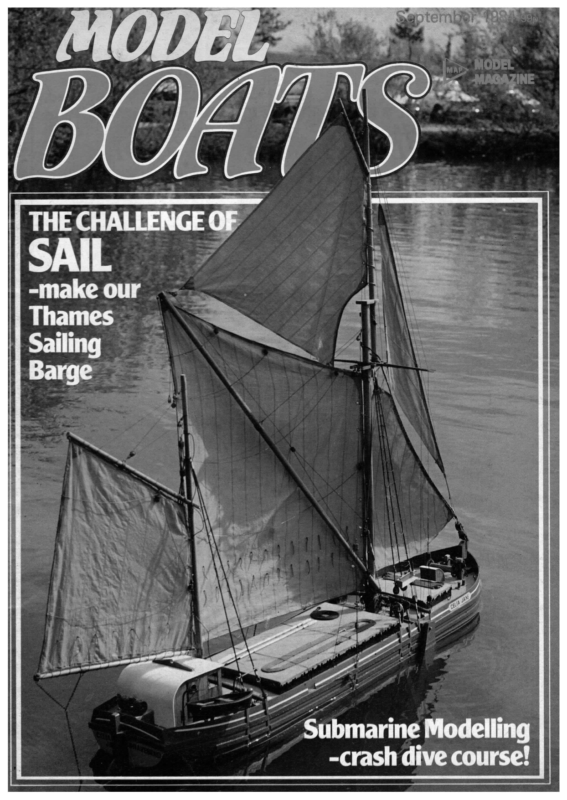
THE CHALLENGE OF SAIL -make our Thames Sailing Submarine Modelling -crash dive course!
the bendable ruler used by draughtsmen to draw curves. Itcan easily be bent to conform to most hull sections and thus transfer the shape to the stand pieces. With sharp changes in section, such a& at the keel, it may be best to copy the section in two stages. If you intend to use foam rubber between the stand and model then you could draw around the outside of the ‘Flexicurve,’ this will allow for This fine version of Darnell’s T class submarine was photographed at Leisure Lakes Waterplane Event at Southport in May by Radio Modeller Editor, David Boddington. The model was constructed by Graham Brown and is capable of submerging either on the planes or by blowing tanks. A pressure chamber is located in the bow and an inflatable bag immersed in the chamber can be pumped up or deflated by a reversible pump so displacing water from the chamber and causing the submarine to rise or fall. Two 540 motors on one speed controller take power from a Yuasa 6 volt battery and the radio is Futaba M. A four channel fail safe device is fitted and the model features siren, noise generator and lights automatically switching on as she surfaces. The exhibition, due to be held in Edinburgh in September, has not attracted sufficient support from the modelling trade to make it viable, and in these circumstances the organisers have had no alternative but to cancel the event. In announcing this, the organisers particularly wish to thank all the clubs, societies and individuals who thusiastically have so en- supported the concept from the start and greatly regret the disappointment that their decision will cause. * * * Model Lifeboat Competition Royal stitution National and Lifeboat encourage In- further interest in it, particularly by young people, the Isle of Wight Lifeboat Board is launching a model lifeboat competition, which it is hoped will appeal to young and old alike, and becoming a continuing annual event. There are three * * * From the Thirties Dear Sir, | thought perhaps the history of the boat pictured adjacent may be of interest to the followers of Logbook in Model! Boats. to include a stand. Some kits at | acquired her a couple of years least supply templates or hull sec- ago from a friend who could not tions so that the builder can choose give me any details of the builder, between a simple building stand or or how he came to possess her. a more elegant display one, but far The boat was inarather sorry state too many seem to ignore this at first, and efforts were made to rather basic requirement. It is not that the actual construction of a simple stand is such hard work, a couple of pieces of chipboard or ply and some wood strips will suffice, the problem can be the accurate matching of the often complex hull sections. Card templates could be used on a ‘cut and try’ basis, which for me at !east seems to end up being lots of restore the original deck which had split in several places. | replaced the deck and apart from that, she is in her original indeed! contact a | suddenly hit on a better, i.e. easier! way of copying the hull shape at any point on the model. This is to use a ‘Flexicurve,’ See ‘From the Thirties’ above. appears cover), and Mr. D. Knowles who would be able to trace the history of the boat if indeed it had been registered. | was delighted to receive from himacopy of the MYA Registration Certificate, dated 21st the on designed by hatch Sam Barge, modified by Mr. Whittaker; club secretary Mr. R. B. Roche. L. Kirby, Cleckheaton, Yorks. * * * From the Forties Dear Sir, | always enjoy your Fighting Fleets in Miniature series, and a friend with whom | correspond in the USA, who has a mutual interest in 1:1200 scale ships, asked me if | could shed any light on whatever happened to the huge stock of wartime 1:1200 Warship Identity Recognition models that were left at a RAF station near Blackpool during mid WWII, he says. | suspect they were probably sold off as surplus after WWII; but if any readers know the fate of these models, | would be pleased to pass the information on, as by all his recollections they were of a very high standard. Alan Crow, Wincanton, Tyne and Wear. On a recent visit to the Championships at Fleetwood, consider- cutting and a very tiring process new model (which state. able interest was shown by the members of that club. She gave a demonstration run after the events were over and performed very well. A club member suggested | Faced with this problem on a To mark the 16th Anniversary of the about 10mm of foam. Glynn Guest, Stoke-on-Trent. September 1933, and built by J. Whittaker of the Bradford Model Yacht Club, and named Destiny, * * * Good service award Dear Sir, | would like to inform you of the excellent after sales service offered by C. E. Systems. | returned an electronic speed controller, which was out of guarantee, for replacement of a damaged relay and it was returned eight days later, at a very modest charge. This quality of service is very rare these days. I. Simpson, Stoke-on-Trent. classes which may be entered by a wide range of modellers. The classes are (a), a model lifeboat built from a commercial kit non-working by juniors; scratchbuilt (b) a model; and (c) a working model complete with power plant and controls, again scratchbuilt. Judging will take place at Ryde on 4th May 1985, followed by an exhibition of entries. Further detailed information can be obtained from J. S. K. Chesterton, 36 Union Street, Ryde, Isle of Wight PO33 2NJ. Mailboat Mail Boat It stands to reason Dear Sir, Modern boat kits can be a pleasure to build but quite often fail September 1984 Marbeth Designs offer an expanding range of modern warship plans in 1:72 and 1:96 scales. The plans are printed dye-line on good quality paper, and typical of the ships included are Type 21 and 42s, Castles, a number of Dutch warships and a Nigerian Meko 360H ship. Marbeth also offer an extensive list of modern weapon drawings in a number of popular scales. Prices range from 5Op for some of the detail fittings sheets to £9.90 for the 1:72 scale Type 22 Boxer. A full list of the range is available by sending a large self addressed stamped envelope to Marbeth Designs at 26 The Park Pale, Tutbury, Burton on Trent, Staffs. DE13 OLB. a * * 485
A ladies’ race at Guildford, a feature of the club’s annual barbecue. The extra hand on the transmitteris not really allowed except in an emergency. Note the stumpy appearance of the R36 in among the RMs and the Model Maker Trophy — Bournville — reported by Mike Harris club’s own-built landing stage, now resited. Photo: Vic Smeed. The result had to be worked out on percentages as not all byes had been taken. However, Adam Taylor was the worthy and youngest? (15 years) winner of the Model Maker Trophy. The O.0.D. presented the prizes, congratulated the competitors on their good sportsmanship and thanked the ‘A’ team for officiating the event with him. The prize for the furthest travelled competitor went to Trevor Beecham of Guildford and the prize for the top boat from a MAP design went to Mark Dicks. This year’s event attracted an entry of fifteen boats from six clubs. Conditions were a light wind swinging between NW and NE, typical Bournville conditions. O.0.D. Mike Harris welcomed the visitors and got the racing under way at 10.15a.m. Racing was slow but keen. One junior skipper showed a high level of sportmanship in that he ‘blue flagged’ himself and reported it to the O.0.D. (well done, son!). Four heats were completed in the morning and after a one hour lunch break racing commenced with the wind a little steadier. As the racing progressed one boat was consistently performing well in the reachy conditions, Kazak sailed by Adam Taylor, not under parental control, was showning how it should be done. Mark Dicks, Last year’s winner, fresh from his 21st Birthday party didn’t seem to be with it for most of the day. Possibly he was * * * Nylet Trophy, RM, 29th April, New Forest This year there were only 16 entries (due to other races on the same day) but skippers sailed 16 races each in two rounds in a gusty 8-l15mph wind. Top four were: asleep. 1. At 5,00 p.m. the racing was halted and the outstanding resails taken. R. Stollery (Guildford), 2. C. Dicks (Clapham), 3. T. Fuller (New Forest), 4. V. Cooney (Guildford). Roger sailed Buzz, to Results Position % Boat Skipper Club Design 1st 80 Kazak A. Taylor Southgate Shepherd 2nd 3rd 4th 5th 65 62.5 60 57.5 Copycat Pepe Vivacity Sula B. Wilde D. Potter D. Rose W. Green Bournville Birkenhead Fleetwood Bournville Butler Creed 6th 54.3 Miss Fortune N. Archer Bournville Stollery 7th 52.5 Eupatoria J. Froude Bournville Stollery 8th 9th 50 47.5 Sir Jasper Banjaxed M. Dicks T. Beecham Clapham Guildford C. Dicks Stollery 10th 10th 12th 42.8 42.8 40 Agamemnon Spindrift Tara P. Somers K. Berry S. Smith Bournville Fleetwood Bournville Shepherd Stollery Shepherd 13th 14th 15th 37.1 35 25.7 Jammy Dodger Imagination Paddington Bear Miss L. Reeves C. Eliot Fleetwood Birkenhead C. Harris Bournville Stollery C. Dicks Stollery his new Bee design of which several are sailing highly successfully. * * * National Vane M Championship, Fleetwood, May 5-7 A full schedule was sailed with 24 entrants (light wind and sun on the Saturday, cool and grey on the Sunday with wind from opposite end freshening to 2nd and 38rd suits, wind moderating somewhat on Monday). Top places: 1. A. Austin Chelmsford Alaxis 89 2. P. Maskell Leeds and Vivacity 82 3. K. Roberts Birkenhead Puddy 78 3. D. Latham Fleetwood R2 78 5.P.Somers Bournville Agamemnon 77 6. M. Roberts Birkenhead Paddington 69 Bradford Bear 7.G. Bantock Chelmsford Heartbeat 69 Graham Bantock had had to make a temporary retirement to ‘glass his boat back together’ following failure to catch it at the end of Sunday’s very fast runs, but was sailing again on Monday. Met. & Southern District RM Championship, Dinton Pastures (Woodley) May 13 Creed Sykes The Officials — O0.0.D. M. J. Harris, Asst. V. L. Bellerson, Starter M. Roberts, Scorer W. Sykes, Caller up |. Taylor. Strong winds and sunshine had 21 entrants planing on the reach as well as (extensively) downwind. Top: 1. T. Fuller (New Forest), 2. A. Austin (Guildford), 3. N. Curtis (Woodley), 4. P. Stollery (Guildford), 5. J. Cleave (Poole), 6. T. Owens (Danson), 7. R. Stollery (Guildford). Both Stollery boats were to the Bee design. Model Yachting Association Fixtures Date Event Class Venue Red Rum Trophy. RM Cleveland 1 Spastics Cup. RM Gosport 7. Northern District Junior Championships. RM Birkenhead July 1 1 1 8 8 8 8 8 < Broadlands Trophy. Open Event. Met. & South District Championship. Met. & South District Team Championship. Northern District Championship. Fred Parkes Trophy. RM RM A RM 36R Open Event RA/R10R 15 Wilkinson Sword RM 15 22 22 22 Nylet Trophy. Thornhill Trophy. Open Event. Mayoral Cup. Yachting Monthly Cup. 14/15 22 28/3 August Met. & South District Championship. Avocet Tropy. MYA National Championship and September 1984 R36R Broads South Wales Gosport Danson & Hove Birkenhead Cleethorpes Chippenham Date Event Class Venue 29 Northern District Championship. Mickey Finn Etherow August 5 Cleethorpes Cup. RA Cleethorpes 12 12 S. Western District Championship. Northern District Championship and RA Norwich Woodspring Lawrence Bowl. 36R RM Cleveland RM July 12 18 Adams Cup. Northern Team Championship. Guildford 19 19 Yorkshire Cash Registers Cup. . R10R RM 575 A Woodspring Leicester Chiltern Fleetwood 19 25 26 26 Andrews Memorial Trophy. Open Event. : Wyre Trophy. Open Event. A Gosport 27 ‘T’ Cup. RM New Forest Kings Lynn 26 27 Open Event. Open Event. Bilmor Cup. RM RM M RA RA R36R M/F & R36R_ A RM Norfolk & Birmingham Hereford Leeds & Bradford Birkenhead Fleetwood Fleetwood Leicester Woodspring Gosport Birkenhead 515
For a 36in. yacht, 28 or 26swg stainless wire is adequate and is fairly easy to handle. When making off to a wire hook, avoid large loops, which will pull into ovals at the first strong gust, thus lengthening. Bend the wire as close to the hook wire radius as possible, then wind the free end at least three times round (Fig. 2) and snip off; squeeze the cut end in a larger pair of pliers to turn the sharp point in a harmless direction. Sharp stubs of wire sticking out at random can inflict unpleasant tears to the hands. O ne of the disadvantages of a deck- stepped mast, unless it plugs firmly into a socket of some sort, is that it is quite difficult to rig single handed, especially when the forestay is attached to the jib boom rather than to an eye on the deck. Someone to hold the mast while you hook up and tension the rigging is a big help. For sailing, if the jib and boom are hooked to the mast, the shrouds connected and the Rotating tag boom then hooked to the jib rack it is not too bad, since the fore and back stays can be added later to what is a self-supporting set-up; to make up the rigging in the first place really requires the yacht to be stood on a stool or table allowing the masthead to be temporarily attached to a ceiling fitting or, perhaps, if you’re not going to bein the way, stood in a doorway with the mast rubber-banded to a pin in the top architrave. Although the photographs show the boat with cord shrouds with ring bowsie adjustment, this was in the nature of an experiment to see if they were satisfactory for the chap who only sails for fun on fine days with little wind. The answer is well, A yes, but wire shrouds with bottlescrews are very much preferred. Bottlescrews, also called turnbuckles although there is a difference, cost something over £1 each and ideally three are needed, one for each shroud and one for the kicking strap. However, it is possible to make suitable adjusters from 6BA lin. screws and some scraps of thin brass. All that are needed are two straps per screw, a short one at the Swivel head and a longer one (to give clearance for ‘spare’ thread) engaging over the nut (Fig. 1). This is a little fiddly to adjust, anda development is to silver solder the bottom strap to the nut and ‘rivet’ over the end of the hook wire (or use the end of a cycle spoke) feeding it through from inside before forming the hook, so that the hook will swivel, allowing the nut and strap to be screwed up and down (Fig. 1a). Metal radio push rods can be used, the clevis end engaging on the shroud plate and the rod formed into an eye (or flattened and drilled) to receive the shroud wire, leaving the threaded part of the rod to screw in or out. One advantage with using one of these is that the pin in the clevis is horizontal, whereas a hook has to be pulled tight to engage it and then slackens. Thus the clevis pin can be removed and replaced to tauten or slacken the shroud without having to strain things to get it back through the hole. Some skippers have found that with a deck-stepped mast they can use fixed length shrouds, hooking them in place with the mast leaning well aft, then pulling the mast upright with the jibstay and/or forestay. The snag here is getting the length exact at the outset, particularly in regard to equality so that the mast is truly vertical from ahead or astern, and it must also be hoped that both shrouds stretch an Clew hook V hook equal amount. Hobnoblin sits quietly on the local canal during the author's tests to assess the suitability of cord shrouds and fittings. Model Boats
Hooks Hooks for this size yacht need not really be heavier than 18swg¢ stainless steel and are not difficult to bend at this gauge witha 4in. pair of round nosed pliers. It is worth passing a file over cut ends to take off sharp jags which can fray cords and it is easier to bend the eye first, followed by the hook part, cutting the wire after the hook is completed. The eye should be closed tight by squeezing gently in flat pliers, and care should be taken to get both curves aligned (Fig. 3) so that the pull is in a straight line. The hook length, or its throat, may need to vary depending on whether it is to engage in an eye or a drilled hole in a plate, the ideal being a hook which is easy to engage but which will not disengage of its own accord. Hooks for lines which are not always tensioned, e.g. sheet hooks, should havea throat a fraction narrower than the diameter of the wire forming the eye in which they engage, so that they click or spring into place and cannot drop out. Clew hooks for the sails must be made to the length needed and should have quite a short return in order that they can easily be fitted in the appropriate hole, but must also be closed up so that they cannot unhook themselves. Easing the downhall on the main or the jibstay will make it easier to hook the clews. The only other form of hook needed on this model is the V-hook, needed for the upper ends of the shrouds, jib-stay and kicking strap. Cord Cord (braided Terylene fishing line of 25lb or so breaking strain) is used for the forestay and backstay, with flat bowsie adjustment. Flat bowsies should be about Yin. thick minimum, */,,in. or so wide and *, to ¥,in. between holes, with the holes not much larger then cord diameter if possible. The cord can be passed through a small flame or touched on a soldering iron to melt the end, rolling it quickly between the fingers to produce a stiff point rather than a blob. Tying off this type of braided line to a hook eye is simply done by tying a single knot (a half hitch) and pulling the first knot up to it. It doesn’t sound secure but it is! Threading ring and flat bowsies are shown in Fig. 4; note that the object is to kink the line on which the bowsie would slide. ‘Proper’ ring and flat bowsies (and bottlescrews) can be obtained from specialist fitting sources such as E. L. Jones, Nylet Ltd., or Graham Bantock. Jibs and jibstays Many modern jibs use a jibstay passed through the luff hem of the sail, each jib of Note offset Closest holes Close-up details of the mast step and cap. each suit having its own stay permanently with the sail. It is, however, still perfectly possible to specify luff hooks on jib, when the jibstay can be rigged on the yacht anda sail change made by simply unhooking and removing the sail and replacing it with the jib from the suit required. Caution is needed here, because in two of the popular classes, M&A (also, of course, RM & RA) the height of the jib hoist is limited to a percentage of the mainsail height, and the hoist is defined as where an extension of the jibstay line cuts the foreside of the mast. This means that the jibstay has to be changed when changing sails. In the 36R and ten rater classes there is no such restriction; changing to a smaller jib on the same stay does, however, mean that the head of the jib is moved further from the mast (Fig. 5) and there is bound to be some influence as a result on the slot effect between jib and mainsail when closehauled. Possibly the increased wind strength causing the change to smaller sails compensates for the widening of the slot, as certainly this observer has never noticed any deleterious effect on performance; if anything, greater September 1984 517
directional stability seems to result. Anyone who has watched 36s plugging determinedly to windward in third or fourth suit with a gap as big as the jib between jib and mast may well agree. So whether you use separate jibstays for each suit or hook the jib to a standing jibstay is a matter of choice. If you want to race you may well use a sectional mast so that superfluous mast above the mainsail hoist of any suit can be unplugged (to reduce heeling/rolling) in which case the jibstay hoist may have to be lowered anyway. Reduction of mast height, or a complete change to a shorter mast, is permissible in all classes except A (and if memory serves, EC12 and 6m). For a sport sailer who may only have one suit of sails, or at most two, this is all fairly academic. One advantage of the classes which are less positive about sail hoists is that itis possible to adjust the jib hoist if the sail itself is a tight fit between tack and hoist, as ours was. A new hole for the jibstay V- hook was just drilled an inch higher, which gave extra room for the jib uphaul. Sail dimensions taken to the eyelet (or base of headboard) can mean an unexpected difference in the length between the actual measurement point and the extreme tip of the sail, depending on which sailmaker made the sails. It doesn’t matter in this case, but it is a little point to bear in mind for jibs for M&A boats. » With the shrouds, jibstay and jib, forestay and backstay in place the mast is firm; the jib has to be there because its clew provides the counterpull to the stay tension on its fore end. The mainboom can be slipped in place and the kicking strap made up and positioned. Again, a ring bowsie had been used on the prototype but if it was going to be raced in all weathers a wire and bottlescrew would be a better arrangement. Some beginners are puzzled by the absence of a restraint at the gooseneck preventing the pivot pin from lifting out, but the pin only allows the boom to swing and there is no vertical force on it; once the sail is in place there is virtually no danger of it becoming disconnected. The head is hooked in place, but a short line tied through the head eye and finishing on a hook is preferable. This line can be tied off at a length which positions the tack (bottom front corner) just clear of the boom when the luff is set up taut, which means that any permanent stretch in the sail can be taken up by shortening the head line. Tautness is essential and is achieved by the downhaul, which is hooked to the tack eye, taken down through the hole provided in the gooseneck plate and either hooked or turned through the bottom mast (kicking strap) eye, being set up with a bowsie. The length is shortish (not much over 2in.) but adequate providing maximum travel is allowed for the bowsie but an alternative is to take the line through the bottom eye and out to one of the shroud plates (or an eye on the deck), the bowsie then being fitted at deck level and providing easier adjustment This completes what could be loosely termed the standing rigging and the running rigging is basically only the sheeting system, which we will come to next time, together with radio and vane installation. The photographs show the prototype afloat with temporary tied-off sheets and wedged rudder, just to check flotation, mast position etc. before completing installation and painting. 518 Mary Reynolds from the Tony Broad of Blackheath with his steam p owered tug Moorcock and Victoriaclub with her electric powered frigate are pictured at the Mayesbrook Straight Running regatta held in May. Straight Running News from Don Hewett First of all a few corrections. Thank you! all my (ex) friends, who took time out to tell me that one metre is not 47in. as shown in my offering in the July issue. I admit that I haven’t been metricated (a painful thing for the older person) but I do know that a metre equals 39.5in., or about 40in. and there I rest my defence. “T’was a printer’s error, M’ Lud.” Further corrections concern the June issue. Due to a bout of flu I was unable to attend the NEC on the 19th of May, but even without me, decisions were made and two of them reversed the information I had passed out. The word now is that under 10’s can affiliate to, and take part in MPBA competitions; and that there will not be an Inter Area this year. The first item will be referred to Section Conferences for discussion and decision as to ifaminimum age is felt desirable for that section’s activities. If you have thoughts on the subject the place to be on the 14th October is the Portland Hotel, Nottingham where the S/R meeting will be held, but if however you cannot make it, drop mea line. I promise it will be read out and considered at the proper time. Tony Willett has sent me a report on the goings on at the Tyneside 2 Day on the 2/3 June. It would appear that boating came a close second to the art of ‘Eat, drink and be merry,’ cups of tea are mentioned frequently together with fish and chip lunches, and a Saturday night dinner and dance — ‘northern hospitality at its best.’ The weather did not appear to be so friendly, with a deluge during the lunch break on Saturday, and a fine drizzle for the early part of Sunday. Weather aside the competition was, as always, of the highest quality, with the events being split slightly in favour of the hosts over the invaders from the south. Who won what was not reported but I do know that the ‘Junior Willetts’ have a good account of themselves, with skills well in advance of their years. The final part of Tony’s report warned of the strength of ‘Northern’ beer, and the generous way it was handed out to the visitors, with the suggestion that it may have been an attempt to nobble, to make Sunday’s targets somewhat indistinct, but allin all a great weekend and one well recommended. There will be another one next year so ‘get your passports ready please.’ On the same Sunday, at Victoria Park, on a cool grey day, Don Reynolds came out on top in the competition for the Vanner Trophy, an MPBA Trophy, but which is vested in the charge of Victoria for an annual event. Having seen Don collect so many trophies and prizes over the last few years, it was of some surprise to me to find that this one would grace his sideboard for only the first time. The Sunday following, Blackheath held their open regatta, and for the 37 entries it was very definitely ‘shirt sleeve order.’ Four islands showing where weed was close to or at the surface meant that the course had to be somewhat adjusted from its usual position so as to pass between two of the larger clumps. All right for Straight Runners, but not so good if you went too far off course. No real trouble found, but with the sunny dry spell at present, marine growth seems to be flourishing all round the country’s ponds which do not havea flow through them. A pleasant day was Model Boats