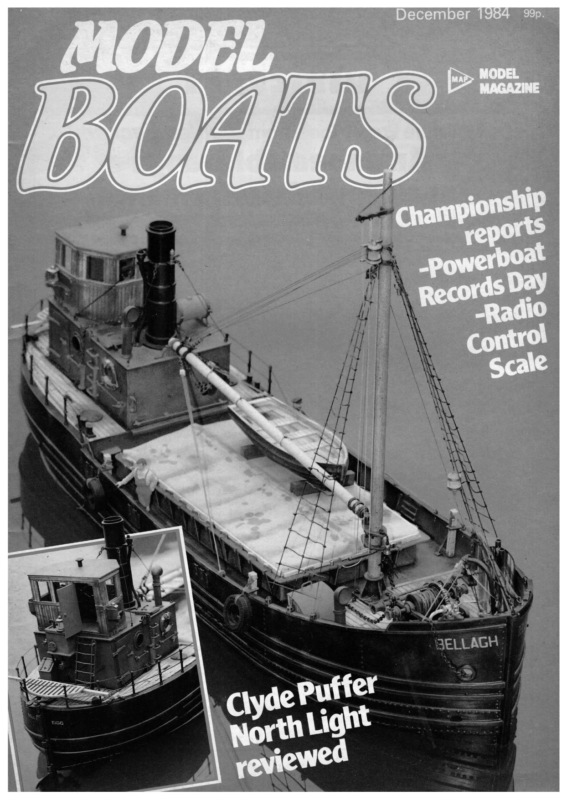
- Starting In Sail presents part nine of Hobnoblin, a 36R yacht for radio or vane designed by Vic Smeed.
- NAVIGA World Model Yacht Championships Chris Jacklson reports on the Vienna meeting in July

he history of model yachting is a story of developments of hull design, sails, keels and fins and, perhaps most important, automatic steering. It is still possible to sail without any steering aid — not even a movable rudder — with a model designed for such sailing, relying on sail trim alone, and a great deal can be learned from experimenting with a yacht of this type. However, trim can be a bit knife-edged off the wind and gusts can play havoc with the intended course. When racing models became more widespread, around the middle of the 19th century, one of the first areas for obvious improvement was maintaining a reasonable heading when running (sailing downwind) or reaching (sailing across wind). Early Days For many years lead-ballasted rudders were used, the amount of ballast being determined by the wind strength, angle of heel and yacht speed. Rudder buoyancy/ ballast/ heel and speed would influence the rudder to a slight angle at which the yacht could be trimmed; any changes in heel or speed altered the rudder angle in the right direction to correct the course deviation arising from the change. It need hardly be said that a skipper had to know his boat, pick the right one from half a dozen or more assorted rudders, and be very aware of what was happening to the wind all the way along the lake. With any such rudder the sail C.E. would have to be positioned slightly aft and/or outboard, giving a tendency to screw up into wind, the slight rudder angle at normal heel keeping the yacht straight. A gust hitting the model would cause it to turn sharply into Top: a Roberts vane with clear Perspex body. Guying tension is adjusted on toothed racks, otherwise design is basically the same as Jones gear. Note vane is deflected to port and is applying starboard rudder. Light tension on tiller fore end prevents collision. Left is Jones M gear and carries a light wire frame through which feather can be biased for snap-over action. which the mainsheet could be hooked. A small forward extension was engaged overa tensioner (a length of rubber, the pull of which could be varied by a cord and bowsie) and operation was thus a matter of balancing centring tension against sheet pull. The rubber passed through an eye beneath the tiller extension and was made off to an eye on deck, i.e. it did not pull on the tiller directly fore and aft but worked by sideways displacement of a taut strip. With a yacht trimmed to sail to windward witha very small amount of helm (i.e. with a slight tendency to turn into wind offset by sail pull on the tiller) a reasonable degree of certainty of direction could be achieved. (Fig. 2). wind and slow suddenly, but it would also initially produce a sudden heel. This would cause the rudder to drop, giving strong helm turning the yacht back away from the wind. As it gathered speed the forces acting on the rudder and sails would once more return to balance and the yacht sail straight. Though Sheet hook =a mainsails, small headsails and long keel (they were nearly all full-keelers, Fig. 1) made them less likely to be disturbed than | | | modern models which rely on vane or radio. A better method was the so-called reversed tiller, where the tiller extended aft —— = this sounds chancy, the low aspect ratio gaff a Lead weight in rudder Fig. 1 Cord and bowsie Fi ig. and was provided with a row of holes into 694 Model Boats 9
Braine Appears Round about 1904-5 George Braine came up with his quadrant steering (see article in M.B. June, 1983) which was a development of the reverse tiller idea relating sail pull to the degree of rudder needed by means of a centre-biased quadrant to which sheets could be hooked at differing points (Fig. 3). and Fisher, though only the last of these, the simplest, is recognisable today, though many vanes incorporate elements from the others. These are all of the ‘break-back’ type, but a different concept, the moving carriage vane, was developed in England after the war. This was more complex but more precise and more reliable in that its selftacking action was controlled by lines from the mainboom. A few such gears are still in use but the break-back is much more common. Understanding Vane Operation The first step to understanding how a vane works is to realise that it will steer a Cord and bowsie Fig.3 NOTE: Sheet crosses to opposite side constant course with relation to the wind. If the wind suddenly swings 90 deg. so will the model. If a large obstacle causes the wind to swirl in a circle, the model will sail in circles until the wind changes. There is another factor, the wind of the yacht’s own motion. If a yacht is sailing into a 15mph wind at 5mph the apparent windspeed on the vane is This was a considerable advance and remained in general use for forty years. George, incidentally, was found nearly blind and living in penury in the 1930’s and the Model Yachtsman, edited by the late H. B. Tucker, opened a fund to which was subscribed over £100 — a year’s wages for an unskilled worker in those days — by grateful modellers. Vane gear was not unknown in this period, but possibly its advantages were not fully appreciated. Nathaniel Herreschoff, the great American full-size designer, mentioned that he had built a vane for model trials in 1875 but did not make full use of the idea until after retirement in the 1920s. In April 1905 a simple vane by C. R. Walker was published in a letter to Model Engineer (Fig. 4) and, although there were subsequent occasional experiments, it was basically this vane (with infinite rather than stepped adjustment) which resurfaced in 1935 on Sam Berge’s Norwegian entry for the A class Championships and caused an almighty row. The point which was siezed on was that the skipper turned the yacht with his pole and then flicked the vane over with the pole: it was of course a non-selftacking, simple mechanism. This, in the opinion of most, was effectively a re-trim and the rules required (as they still do) the yacht to be stopped for retrimming. This point was the only firm one on which objection could be hung, but in fact a lot of experts considered that fitting a vane was an attempt to obtain unmeasured sail area (which shows how well the principle had been grasped!) or were unable to see how a vane could be accommodated with the average low aspect, long boomed sailplane, exactly the same argument which had been raised in 1905 despite the switch to Bermudan rather than gaff sails in the interim. Mr. Walker’s answer then was to use a near-horizontal feather and cut the sail foot to lift the boom end a fraction. Controversy raged and little progress was made over the next three or four years, by which time WW2 had started and British and European model yachting took second place. It was left to American enthusiasts to develop the self-tacking action and refine the gear; several distinct types were evolved by yachtsmen such as Lassel, Ballantyne December 1984 Wire edging Rudder head 20mph. Downwind, same speeds, the apparent wind on the vane will only be 10mph. Thus there is less power from the vane off the wind than on it. What happens when the vane is set at a substantial angle, as for reaching (across wind)? The vane feels the normal windspeed but also, at a widely different angle, the yacht’s created windspeed. There is a resultant between these two forces and the vane feather should be aligned with this; in practice this means setting the angle possibly three or four degrees nearer the stern, as the wind of motion always moves from bow to stern and thus tends to blow the vane aft. Taking a simple non-self-tacking vane, the feather will be friction-clamped to the spindle which itself is pivoted. If the spindle is held still the feather can be turned to any position on it and will remain there due to its friction mount. The spindle has an arm projecting, usually, forward, with a pin engaging in a slotted fore and aft tiller. Any movement of the feather will thus turn the spindle and arm and the arm will move the tiller. If the feather is lined up edge-on to the Another design of vane of great compactness. Selftacking latch is swinging inverted U, top right of body, but vane arm and counterweight arm connection is beneath body. Guying arrangement is by means of arthwartship wire frame (above body) with rubber band deflected sideways by friction loop on frame, as in Jones M gear. wind it will not move, as there is no force on either side, all the time the yacht sails straight. However, if the yacht turns, one side of the feather will feel the wind and it will be blown straight, thus turning the spindle and moving the rudder in the direction required to turn the boat back to its original course in relation to the wind. The further the yacht turns, the greater is the feather area presented and the greater the force it exerts, the more rudder angle is applied and the sharper the turn back on to Spindle al Fig.4 Arrow showing direction of win @a Ti/ / er Giller Vane STEERING GEAR FOR MoDEL Yacuts. course. A well set-up and_ friction-free vane/rudder assembly will respond to a 1 deg. change of course with instantaneous correction, so that the yacht should not turn far off course. In turn this means that harsh rudder and its resultant drag should never come into play, so that a yacht with a good vane/ rudder arrangement will sail not only straighter but faster. 695
In the foregoing the boat speed has been ignored, but setting the vane only in line with the true wind will, as we have seen, produce a further force on the feather as soon as the boat starts to move. This must be allowed for by adjusting the feather, ‘lefthand down a bit’ if it is to port and righthand down if on the starboard. How much to move it is a matter of experience with a specific yacht in various wind strengths, but itis unlikely to be less than 11, or more than 4, degs. A non-self-tacking vane can be set to saila beat, but to change to the opposite tack it would have to be reset. This is unimportant for fun sailing but in racing would cost far too much time, which is whya self-tacking capability is built into a vane gear and it is this which adds all the apparent complication to what is otherwise a simple Since wind is never steady, a vane can oscillate with considerable effect in re ducing boat performance, so a light elastic centring line is fitted, even to the Draper vane, to damp out minor oscillations but without putting a serious load on the mechanism. The force available is small and too strong a centring line would reduce sensitivity and travel. Also, as the yacht is frequently heeled, the weight of the feather and arm must be counterbalanced; by adjusting the balance weight with the boat held heeled in water the buoyancy of the rudder is also taken into account. So even so simple a vane gear as this has illustrated many of the necessary features of any gear. Drill the centre and epoxy onto a piece of brass tube a bare inch long, if possible thickwalled and about %,in. bore. Drill a hexagonal ball-point pen body (or a strip of about ¥,in. square plastic) to fit closely over the tube, then fretsaw a slit along from the hole for about 34in. Cross drill to accept an 8BA or similar small bolt. Slip on the tube and check that tightening the nut on the bolt (gently) closes the slit slightly so that the hole grips the tube just enough to stay put, but still be moved at will. Saw a slit in the end of the arm and gently file to accept, a 3/,,in. balsa vane feather, and drill as tiny a hole as can be managed vertically to take the indicator wire. Epoxy (or solder Fig.6 Feather Blocked tube mechanism. Counterbalance Pinch bolt Simple Vane The simplest of all vanes is that introduced twenty years ago by Geoff Draper, which is no more than two gear wheels, one Hex ball-point pen body on the rudder stock and one engaging with it mounted on a spindle behind (Fig. 5). The Fig. 5 Plastic disc glued to tube Spindle Vane feather Counterbalance Even Simpler A dozen or so years ago a very simple nonself-tacking vane of the writer’s was described and somewhat surprisingly was Arm and gear fixed to tube Tube Spindle second gear has the vane feather mounted on it, by soldering or epoxying a wire arm to the gear, and the feather is aligned to the wind by lifting the gear out of engagement, rotating it to the required position and dropping the gear back into mesh. Obviously the more teeth there are on the gears the more accurately a setting can be made, but even with 72 teeth accuracy subsequently seen in use on one or two club yachts. It is easy to make and costs pence; an even cheaper version is shown here, with suggestions for reducing time to makeif you don’t mind spending perhaps 50p. The basis is a circular disc about 2¥,-3in. diameter. You could adapt the plastic lid of a coffee jar by sawing off the flange, or use Formica or polystyrene sheet, or to save sawing and marking, simply glue together two cheap school protractors (the smallest available) overlapping so that the basic lines coincide. A plain disc will have to be marked in, say 5 degrees intervals all round by scoring and rubbing in paint or similar, or you might get away with pencil or ink lines varnished cannot be closer than 2% deg. In practice the improvement in performance over earlier types of steering is so great that even 24 teeth provide acceptable accuracy for simple over. beforehand) a small stub of brass or a bearing ball in the top of the brass tube. Make a pintle from rod to fit easily in the tube, painting the end and soldering or epoxying into a metal disc or kettlemender’s washer. Make a tiller arm from stiff plastic (file down a toothbrush handle?) and epoxy and/or bolt radially on the disc. Drill the fore end in, say, three places for a bolt to project down into a slotted tiller. Now screw the pintle to the yacht’s deck in sucha position as to engage the yacht tiller, taking care to align everything accurately on the fore and aft line. Drop the disc in place and engage the tiller, then place the arm over the tube and tighten the pinch-bolt slightly. Check that the feather is upright. A refinement would be to solder a washer on the tube so that the vane arm does not work downward and cause the indicator wire to foul the disc. Now models. If gears of different diameters are used — say 2:1 ratio — and the smaller gear is mounted on the rudder, the rudder angular movement will be twice that of the vane feather but at a mechanical disadvantage: the vane would have to exert a lot of force. On the other hand, if the vane is attached to the small gear, rudder movement will be half that of the vane, which should give adequate steering, and the force required from the vane is very much less. (A feather of between four and five times rudder area is usual). This principle is used on more sophisticated vanes by having an adjus- table pin in the pin and slot tiller linkage so that rudder movement can be varied from equal down to about one third of vane movement. The pin might be changed to 3:1 for running, when the vane is at its least powerful, but because of increased boat speed the rudder is more effective. Actual | best ratios are again a matter of experience with individual boats and vane gears. 696 -tacking. Aft gear is lifted, turned The simplest form of vane gear, non-self A single length of shirring elastic tied and dropped back into engagement. centring action. Plastic cap ta port is to front of larger gear provides lightsheeting . Gears are 24 and 48 teeth, sheeting bowsie for synchronous between beat and run. give nine courses either side
Fig. 7 In operation, the gear is unlocked and the whole unit rotated to line up the feather on one tack with the apparent wind. The vane arm pin is adjusted (normally only when setting up initially) so that there is the merest hint of friction from the jamming Feather Counterweight arm Lock Vane arm Disc Spindle (or pintle) tendency mentioned, at the stop position chosen. The vane will now steer the yacht on that course unless it is headed by a wind flirt or turned by pole to the opposite tack. When this happens the vane simply blows across to the other stop and controls the yacht identically on that tack (Fig. 8). Once the settings have been found for best performance, they can be left set and the lock re- wind three or four turns of cored solder on the fore end of the vane arm, place the boat in water and heel it and balance the unit by clipping off bits of solder. Epoxy the remaining solder to the arm and the gear is ready to use. This is a ‘fixed’ gear and is the equivalent of a break-back gear in unbroken or locked condition. In other words, a break-back gear is as simple to use as this very basic gear when locked. The difference, and the apparent complication, is that the vane arm is in two pieces, each pivoted; when locked they are solid and act as our simple vane arm. However, a block is needed rather than our simple hole and pinch bolt because it has to carry the two pivots, so the bit that has to be twisted round to set reaching and running courses is this block, on which are mounted the two vane arm parts, the whole being one single unit when the lock is in place (Fig. 7). Vane body Screwed discs Feather a Two photos of a Jones gear for larger (A and 10r) yachts. Top view clearly shows self-tacking stops on circular segment of studding, with latch engaged (between them) to lock gear. Body lock is at base, engaging in slit in dial; body is always locked when self-tack is in operation. Frame at front is for guying tension and port guy is set in both pictures. The two parts of the vane arm are connected by a pin and slot arrangement and when the lock (or latch) is disconnected, they will pivot freely; note that because of the pin and slot the feather end and the counterweight end both move to the same side, but will stop when the pin reaches the end of the slot or, if the arms are of slightly unequal length, jams. The jamming tendency is progressive, an important point. December 1984 When beating very precise control over the vane is needed, and an angle of about 2832 deg. either side is usually required, certainly never more than, say, 40 deg. Adjustable stops, usually in the form of threaded discs moving along a screwed rod, are therefore fitted, allowing the vane end to move up to say 40 deg. either side, the discs being moved in to restrict the swing angle to that found best for a particular boat. engaged for running, reaching, etc. When the next beat is to be sailed, the gear is simply unlocked and it will operate exactly as before. There is one other major function built into the vane when unlocked, and that is the capability of guying. This is a manoeuvrein which the yacht is put out from the bank and will break tack and return to the same bank rather than sail a full leg to the opposite side. It is set up by an adjustable tensioner, usually a rubber band, so that the yacht is put off with the vane working normally, but as soon as it bobs upright the tensioner will snap the feather across and the yacht will turn. It is possible to gauge how long a guy will be made by reading wind and water conditions and adjusting both the tension and the degree of offset of the elastic accordingly. A matter of skill, judgement and experience, vital factors in all vane sailing. (to be continued) 697
rT: 25th year celebrations of NAVIGA persuaded them to hold a model yacht championship run by the Austrian national authorities in Vienna, and a total of eleven countries sent teams. Full teams were entered by Russia, China, West Germany, Hungary, East Germany, Poland and France with smaller entries from Switzerland, Spain and Great Britain. The site chosen for sailing was the reconstructed Danube river in the city of Vienna and although the landscaping had not been entirely completed, a good riverside walkway provided easy access. A pontoon was firmly moored to the riverbank and the course was laid out with around 300m between the end marker buoys. The first Saturday was taken up with practice and measuring so that after a short welcoming ceremony on the Sunday, racing commenced at around midday ina pleasant breeze and bright sunshine. their existing 10 Rater hulls and no-one R10A Three classes of boats were involved, all radio controlled although the entry form had listed free sailing as well, and the 10 Rater class were first to go. The Chinese boats showed up very well as they were light, short waterline and well sailed by their young team. Against them the Russian Nalewsky sailed a boat that reminded the writer of the Stollery. designs which started the grp revolution uses a Genoa either! Lupart produced another superb boat, and Joseg Urban of Switzerland who sailed only this class had a hull built at home, but closely resembling a Lewis 10 Rater of the Cracker type. This was not competitive in the lighter wind and also suffered a dismantling because of a carelessly made fitting. Walicki of West Germany had a beautifully made hull of most original design moulded in Kevlar, very light and neatly finished. in the U.K. some years ago, and Helmut Lupart of Switzerland produced the first of three similar immaculate yachts to provide stern opposition. DX The weather stayed very similar during the whole of the 10 Rater competition and the results were a very fair reflection of e standard of sailing. The next class to appear was the DX and for the benefit of others like myself, who had not seen the class before, it should be explained that the design is free from exception of sail area which is calculated on actual area of mainsail plus fore triangle area in full. The original intention was to encourage multi hull and other types but only mono Lupart’s winning boat in X class, clearly showing roach of main. hulls appeared in Vienna. Indeed several sailors merely attached different sails to Model Boats 698
It appears that the X class is in fact declining against competition in Europe from the similarly but internationally well-known 10 Rater and entry for this class was the lowest of the meeting. As a result many of the visitors had to watch for three days whilst their travel expenses mounted, or indeed they took time off to visit the many attractions of the city. Helmut Lupart’s M class boat. RM By Thursday midday, it was time for the RM fleet to start racing and the wind had freshened enough to turn the tables on the light-weather only specialist designs. Indeed with an O.0.D. wearing a Fleetwood T-shirt and nice waves coming downstream it was just the weather to make the sole British boat, a Bantock Heartbeat in absolutely standard trim, competitive. The top fleet of eight boats in this class were widely different approaches to the rule, with two Terry Allen Spot designs sailed by the Kollars, Walicki and Dr. Stigler, sailing identical designs, also very light, and the Russian boat of more traditional shape but equally well organised and sailed. Fabiano of France sailed a modified Paul Lucas design and was well pleased with his final place. Lupart struggled with his boat in the stronger wind as it was reluctant to tack, staying head-to-wind for nerve-wracking seconds and losing ground all the time. With relatively few races counting for points after four non-scoring seeding races and no discards, several good boats suffered and notable among these was the Hunter own-design by Klorres of M.Y.C. Berlin, who had one disqualification and a dismasting in his score card. The junior skippers sailed in the main event in all classes and had their own prize list, an excellent idea to encourage younger competitors. I hope I will not offend the host organisation or its willing helpers who provided excellent sailing arrangements and a full social programme if I say that the absence of the majority of the model yacht racing nations mainly because of relatively minor rule differences meant that below the first eight or ten boats the standard dropped below that which could have been expected and one hopes that General view of riverside with control centre, spectator bank, new road bridge in distance. Good weather obvious. December 1984 standardisation of sailing rules at least will make some progress. A simple example of a boat caught ‘port-andstarboard’ on the final beat finishing and being pleased without penalty because his opponent didn’t protest, whereas if he had, the offending boat would have been disqualified, shows to any experienced model yacht competitor the unfortunate arguments that could occur. (Just suppose the offending boat won the championship and the non-protesting boat turned out to be a personal friend or fellow team member). On the class-rule side the situation in which many European RM sailors need two different sets of sails to meet NAVIGA faircurve roach restrictions is obviously unfortunate, the more so when you see the roach on most of the X class boats mainsails which go to the same extreme as IMYRU rules allow. All this expense for alleged aesthetic reasons! To sum up the week I would say that the event was well-organised, had excellent sailing conditions, too many classes, but a friendly exchange between active sailors from a number of countries resulted. Let’s hope that the top boats will travel to Fleetwood in 1986 if the rumoured IMYRU event takes place. Certainly the top six RM’s at Vienna would make the best IMYRU sailors work for their results and provide a very competitive fleet.
ollowing the A class Championships at Gosport a General Meeting of the LM.Y.R.U. was held, with delegates from Belgium, England, France, Scotland,by South Africa and Sweden, Norway proxy and New Zealand by postal vote. Note the date of the meeting — 4.8.84 — outside as in the opinion of more than one the day observer this may well prove to be ofa the I.M.Y.R.U. reached the edge precipice. It certainly has two paths in front, one to be a credible, common-sense and expanding organisation and the other to be a body that thinks the main more complex, interest in that particular bly a class withers. In other spheres possi es new class springs up, but in most spher the life of a competitive model is two or three seasons at most, so exponents are in looking for something else to build; but model yachting the boats are fairly well for developed and can remain competitivewith a much longer period. Mucking about the rules is accordingly much more serious; there are those who would pointa to the virtual demise of the 10 rater as case in point. Let it not be thought that the role of the primary function must be to work towards LM.Y.R.U. is misunderstood, as its rules which are common to all countries: in other words rules are its business. However, there is no point in producing rules that are not understood in all countries by the average model yachtsman. The argument that LY.R.U. rules are understood and, further, are already accurately translated into many Championship was held this year at Guildford’s Ash water. Great variety of designs and Successful R36R le sailing. Won by young Peter Stollery – report next issue. rigs, enjoyab function of the yacht is to meet a four- What is this dreadful stampede towards full-size practice? There are hundreds of unnecessary rules. wide, and enormous amounts of mone inch thick wad of complex and largely This was pointed up in the first item — minutes of the last (1982) meeting at Dunkirk, when Sweden wanted an nd amendment ‘Sweden proposed, Hollanal seconded that the rules of InternatioU: Classes shall be based on the LY.R. measurement instructions in future’ — but the other path was not closed completely since the last item of business was a discussion on this very point, when the meeting agreed that “The LY.R.U. measurement instructions should not necessarily be followed for all classes’. ‘For any class’ would be better wording. The proposal, at Dunkirk, was from the floor, and as often happens in such circumstances, it obviously sounded, on the surface, not a bad idea and it was accordingly accepted by the meeting after a short discussion. Looked at in depth, the effects are horrendous: the Swedish — a ee submission for an up-dated Marblehead rule ran to eight closely-typed foolscap pages (roughly what the radio rules make if typed in the same way) and would have been incomprehensible to 99% of model yachtsmen. Is this what the average skipper wants? 700 thousands of full-size yachtsmen worldy- involved. A miniscule percentage fraction are interested in designing and/or building their own craft — they buy one, a or pay a naval architect to design andthat yard to build one, in the expectation it will meet I.Y.R.U. rules; there is enough money to keep specialists to do the mathematics and a broad enough cross- section of enthusiasts to be able to find those with the skills and interest to become measurers, handicappers, etc. These conditions do not obtain in model Wakefield model aircraft is undoubtedl yachting, or any other model activity. A y an aircraft in its own right, anda sophisticated one, but it does not have to be measured with the complexity and its detail required for a full-size aircraft: , processing is simple and straightforward than, no more difficult or time-comsuming say, an M under the still-current rules. Much the same applies to power model boats and any other form of model. It is d significant, and perhaps only appreciate by modellers who’ve been around for a few years, that as soon as the rule-makers move in on a class of model to make it languages is a big red herring. Certainly both full-size and model yachts float and wind, have sails and are propelled by the each’ but the mentality and approach of the s practitioners are totally different. Is LM.Y.R.U. to cater for model yacht racers who buy their models no expense spared in the same way as other competition sportsmen, or should its attention be directed towards the typical model s yachtsmen who usually build their model and often have a go at designing them? It seems that the way things are likely could to develop the ordinary club memberpice well be ignored, and this is the preci or referred to earlier. Over the last three four years the emphasis seems to have g been mostly, if not all, on top-level racin and not on the encouragement of the inly main body of model yachtsmen. Certa rules for international competition haveysto be drawn up and agreed and, it is alwas said, progress at top level always work its way down and makes things better for all participants, but progress which the involves making the rules governinglex is models themselves much more comp est of the sort which simply turns off inter at the very level at which it is most urgently needed. Perhaps there should be a Class I committee for the aces anda Class II one for those who love model yachting, but don’t want to suffer a dislocated shoulder from carrying the rule book around? If it is thought that a mountain is being made out of a molehill, consider itemh11, the only motion to be voted on, whicfor the related to the updated sailing rulesonly 6m. Under the new Constitution, led to England and Scotland were entit ries with vote since they are the only count any registered 6ms. The proposed rules Model Boats
had been agreed by both countries beforehand and by every owner of a registered 6m and the motion was carried. A formal objection by Sweden was minuted, on the grounds that the presentation and format did not follow I.Y.R.U. measurement instructions. New officers appointed are Rating Rules Officer Jan Dejmo (Sweden) and Publicity Officer Chris Jackson (England). However, the revised Constitution (based on that of the [.Y.R.U.) was adopted and this called for additional appointments to a Permanent Committee, and the full Committee is: President: Neil Bennell O.B.E. (Australia), Chairman: N. D. Hatfield (England), Vice-Chairman: T. Klem (Norway), Gen. Sec./Treasurer: K. Roberts (England), Racing Rules Officer: R. Gardner (England), Rating Rules Officer: J. Dejmo (Sweden), Publicity Officer: C. Jackson (England), Int. At the main meeting the Chairman’s Report summarised major points over the last two years, including the rejection of the proposed Marblehead rule revision (by 13 votes in 129) and, on the other hand, the Appendix to the I.Y.R.U. Racing Rules which was well received and which it is hoped that the LY.R.U. will be publishing as Appendix 11 in their 1985 rulebook. Revised competition rules, rating regulations and vane racing rules have also been approved by the Committee and are being circulated to all countries. This has meant an enormous amount of work for Roy Gardner, whose efforts are much appreciated. The racing system used at the RM European Championship in Sweden has been approved for general use and the S.M.S.F. have generously had enough (English) copies printed for distribution. This is a fleet system for 13-51 yachts and includes up to four ranking races. The new Constitution was prepared, by the Chairman, and as mentioned above, has been approved. The Union is in a stronger position and better financially than it Actual sail feature of which is that only countries with registered yachts in a class may vote on particular matters affecting that class, the secretary invited a breakdown for this year when affiliation fees were forwarded. The accompanying table shows the results from the 14 countries providing details: of those omitted Australia, Canada and Japan have significant numbers, mostly radio 10R and M, though the first two have EC12 fleets too. In the table America seems to have provided round figures and the absence of any vane yachts is an indication that the newly recognised A.M.Y.A. is radio only; there are vane boats in the States but these are registered through the M.Y.R.A.A. Incidentally, the A.M.Y.A. has produced its own revised Marblehead rule and is balloting its members an acceptance. It would be a pity if unilateral modifications of this type lead to further confusion: American entries in future I.M.Y.R.U. events will have to enter yachts conforming to the international rules used has ever been. Other officers’ reports indicated the immense amount of work which goes on unrealised behind the scenes. Hopefully, a degree of finality has now been reached in by the other 21 countries. If the rules are straightforward there should be no problem… most areas of rules which will lighten the RM World Championships in 1986 load borne by officers over the past few years. Most of the revision which has taken place has been related to the considerable growth in radio sailing and it now seems that general agreement has Luff stay Following the drafting and anticipated acceptance of the new Constitution, a new been reached on sailing and general rating and competition rules. Just a note to advise skippers that Fleetwood MYPBC have agreed to stage a World RM Championship in July 1986. OOD will be Derek Priestley and Regatta Secretary Russell Potts. More details later. or rod Distribution of Yachts in IMYRU Countries, 1984 (Note that countries listed are approximately 66% of affiliated countries) VANE A 10R RADIO M 6M 1M A 10R M EC 1M Total 12M BK Mork Rule amendment for A Class at IMYRU meeting clarifies position of double or pocket luff jibs; at no time may they extend outside the foretriangle. This arose from calm conditions when luffrod was on marks but sail relaxed and projected forward of rod. Liaison Officer: J. Cleave (England), Nominated Members: R. Courtney (South Africa), C. Deckx (Belgium) and R. Stollery (England). At a subsequent meeting of the P.C., Committees were appointed as follows: Racing Rules Committee: R. Gardner, J. Cleave (England), D. Fairbank (South Africa), H. Lagneus (Sweden) and F. Marten (New Zealand). Rating Rules Committee: Chairman J. Dejmo, J. P. Dole Robbe (France), I. Hull-Brown (New Zealand), S. Goodwin (U.S.A.), A Moore (Australia), R. Stollery (England), G. Belgium Brazil 3 Denmark England France Holland Italy New Zealand Norway 5 74 i 2 Scotland South Africa Sweden Switzerland 2 4 13 3 14 5 56 44 5 52 18 17 65 50 5 73 48 65 243 163 88 530 285 65 90 122 97 225 3 49 102 55 105 5 38 6 Portugal 13 25 35 1 97 30 £76: 31 6 30 13 U.S.A. TOTAL 49 50 17 30 57 21 96 61 205 18 12 231 40 250 52 50 75 375 146 369 1,726 250 250 750 6 2,848 Thompson (South Africa) and A. Verheus (Holland). December 1984 701