- Kit Bag
- Derek Stevenson reviews Oliver Lee’s Pronto Mk2 with the Una Rig
- Starting In Sail Part Ten – Vic Smeed discusses scaling fctos with regard to sailing prototypes
- International Model Yacht Racing A brief History by Norman Hatfield, Chairman of I.M.Y.R.U.
- Logbook Model Yachting Association News

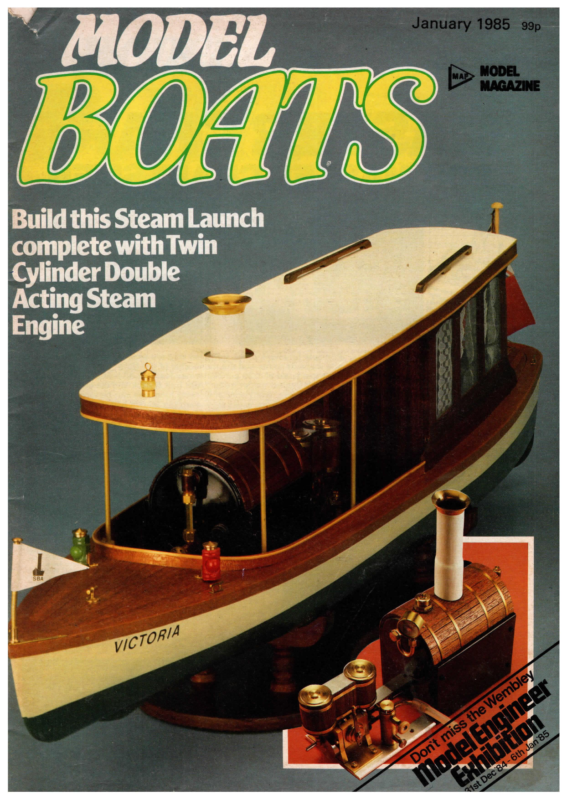
| {ODEL DUA I Build this Steamae ey complete withTwin CylinderDouble Acting Steam Engine =—s_—. _
sheeting angles. This results in a rig that is more pleasing to the eye when being sailed. Having phoned Oliver with my order fora kit, I awaited his advice that it was ready for collection. The day arrived and I duly set out for Burnham. A short walk along the promenade brought me to Oliver’s premises, a compact building with Pronto and Trapper yachts in the window. I was made most welcome by Oliver and following a cup of coffee in the local cafe was shown around his workshop and his method of producing hulls. Very impressed I followed him into another room in which was a huge cabinet which Oliver promptly opened to reveal two fibreglass moulds. The cabinet was controlled to a constant temperature of 68 Assembly I will now describe how I assembled the kit, I say this because I started by positioning and fixing the fin to the hull first and then attaching the keel but Oliver tells me he attaches the keel to the fin first. I found that it was easier to correctly position the fin in the hull without the weight of the keel but this is only my view. If you tackle this stage Oliver’s way you can completely finish the fin and keel assembly before attaching it to the hull. My first job was to cut the slot in the hull for the fin. The position for this was marked and only required cutting out and filing to size. Before I resined the fin into place I located the deck Above: Pronto ona beat clearly showing the curved mast and boom. Pelorizg my building of a Pronto MR. 1 and subsequent kit review in Model Boats (Aug 84), she who shall be obeyed decided that I could buy one for her. As I had just sold her Mickey Finn the argument that I could not afford one did not exist. After much discussion I agreed that I would build her a Pronto Mk2. If you are going to builda boat for your wife make sure it is different to the one you sail as you then have the argument that it is the boat when she beats you. Before I detail the construction of the kit I feel that description of the yacht would bein order. The Pronto Mk. 2 is a yacht that complies to the 36r rules. It has a fibreglass hull and deck and an anodised alloy plate fin. The deck and fin are now included in the Mk. 1 kit. The main difference to the Mk. 1 arises in the rig, the Mk. 2 sports an Una rig designed by Graham Bantock. Most of you will be familiar with this name but to those of you who are not Graham Bantock is one of the leading model sailmakers in the world, sending sails to the far corners of the globe. The Pronto rig differs from the Mickey Finn in that the rig’s axis is vertical producing a basically vertical mast at all Side view showing keel and large rudder. deg. F and all mouldings still in the mould were left in there for 48 hours. As anybody who has tried moulding will know, temperature is most important and fluctuations can produce a bad moulding. Now I know how Oliver produces such high class mouldings. Having made Pronto Mk. 1 I knew what to expect from this kit and was not to be disappointed. The kit was up to the usual Oliver Lee standards. It consisted of a hull and deck moulded in red and white GRP, and anodised alloy fin plate, a 7lb. keel, a rudder cut to profile and chamfered in mahogany and all the required fittings. Also included in the kit was a separate pack which contained the parts for the Una rig and a Bantock working rig sail. Close up of the mast fitting. Radio hatch and sheeting can be seen. pulley in position as this was difficult to reach when the fin was attached. I then made sure that the keel fitted correctly onto the fin and drilled a hole through the keel and fin for a brass woodscrew to secure the keel when finally fitted. When satisfied that everything was correctly lined up I resined the fin into the hull. Next job was to coat the keel with filler and sand to a smooth finish, attach it to the fin and paint. The rudder was then finished and fitted. All that remained to complete the hull was the positioning of the deck fittings in their pre-drilled holes so after very little work and time the hull was ready. I now turned my attention tothe Una rig pack which consisted of a ¥/,in. sq. alloy block, a *%in. tube boom, a groovy mast, a ¥,in. tube for the pivot and a sail. The alloy block, a in. tube boom, a groovy mast, and a \4in. tube for the pivot and a sail. The alloy the Araldite was set the assembly took no time at all using the wire, bowsies and cord supplied. I in fact made a _ slight modification to the pivot tube. The drawing showed the alloy block resting on the top of the bearing tube which was bonded into the hull and protruded approximately Yin. above the deck. I feel I have improved on this by Aralditing a brass plug into the bottom of the bearing tube and a “in. ball cupboard catch into the pivot tube and leaving a ¥,,in. between the bearing tube and alloy block. This gave a much freer Model Boats
wins, no slot to worry about. These features alone make it a yacht that can be recommended for the novice. Sailing performance, the Mk. 1 probably has the edge but there is not a great deal between the two. The main To sum up; the design and quality of the Pronto Mk. 2 is what you would expect from two of our leading designers. It has many advantages over a sloop rig yacht and alsoa performance almost its equal. A beginner wind. does not try to carry too much sail, easy to sail. I say this because in a blow it can be quite hair raising. I have no doubt that the difference is to be found in the downwind performance where the Mk. 2 with its forward mast does tend to dive in a gust of ii il i | it more experienced skippers would find this a challenge and have some very exciting sailing. The mast/boom fitting which drops into a suitable | | “@ BS meee Omire c0ck. action. Final job was the installation of the radio. No problems in this department. I used a lever winch instead of the usual drum type and found that it made for a tidier deck Prices at time of writing: Kit with working rig… £73.00 Lead keel…………ssseseeessesesteseessesensneneenes £8.00 Fr ESET IROE SF CIEE ~ yee isv pends chasadqncesvarconrses £96.00 ES BEI ass pisses haigone fads up ag nomascici.nesuoanows £33.00 esvaaccienss £24.00 rs eed esece Bebe POLIT cere eeces-sesv i f ‘ essere cowsnes £33.00 SEQ ETIIEELES occccsraenteuenstcevesctsterssis as no tension elastic was needed. In kit form SaaS Manufactured and ° i Saasaie distributed by { Oliver ‘! Lee, The Old Maltings Quay, Burnham on Trials Sea, Essex. Tel. Maldon (0621) 782305. So after only a few hours’ work the Pronto Mk 2 was ready for acceptance trials by its new owner. I have to report that she was delighted with its looks and sailing qualities. It was at this point that she inquired as to the whereabouts of a top and storm rig. Another trip to Oliver, a couple of hours’ work and she was happy. If youcould have seen the size of that top suit when assembled on the boat, it was frightening; 900sq. in. in one sail. I must say it had me would find it easy to build and providing he Plenty of room for the R/C equipment and the top view shows the clean uninterrupted deck area. worried. So how“does the Mk. 2 with the Una rig compare with the sloop rigged Mk. 1. Time spent rigging and changing sails; the Mk. 2 wins hands down. Ease of tuning; the Mk. 2 (i NYLET | YACHTS — forallyourmodellingneeds MODEL YACHT KITS * FITTINGS * R/C EQUIPMENT * BOOKS * ESTABLISHED SAILMAKERS NEW BIGGER CATALOGUE | Driving yourself daft trying to get the necessary for your yacht? Look no further — it’s all in the Nylet catalogue. We offer ee hece pet! ready to sail yachts, kits, bits, sails cut to sail winches etc, etc. in 36 INCH “TAXACHUN” Hulls in white or colour GRP, and removable GRP fin. Easy to assemble competitive racing yacht, also ideal for the novice (see photo). NYLET SAILMAKING SERVICE ‘Custom cut’ and ‘Standard’ THE WHOLE RANGE IS IN THE NYLET WORLD-WIDE MAIL ORDER CATALOGUE (with colour cover). Send £1 in U.K.; Eire IR £2 note; Abroad 6 postal coupons OR currency notes $5 U.S.A. AUSTRALIA, CANADA, N. ZEALAND; Kr20 Notes SCANDINAVIA. NYLET — Known the world over for service and quality. We wish our customers a Happy Christmas and at H(i of attachments and accessories; fH i i it SAWING @ JIG-SAW WORK etc. various sails. We make anything including schooner sails and also exhibition quality work (as shown at Wembley M.E. Exhibition). much more interesting and satisfying. Every operation is catered for in a range GLASS ENGRAVING @ TURNING EXCITING NEW MARBLEHEAD — “GYPSY” from Nylet. Features ‘wedge’ shape GRP hull with integral box for detachable fin, carbon-fibre toughened fin with available i miniature tools, modelling is made that DRILLING @ SANDING @ POLISHING order and standard suits, masts, radio and lead encapsulated; * modes. With the Precision Petite range of Please send SAE for full details of complete range of drills and ac- There are Drill Stands to hold the drill steady for fine work, a Lathe for miniature turning and a Circular Saw with self contained power, PLUS all the accessories you’ll ever need. Find out about this i remarkable range of miniature tools NOW. = | DRILL STANDS cessories. a Prosperous New Year. Credit cardholders may phone orders by Access, Mastercard, American Express. Nylet Ltd., 118-122 Station Road, Fordingbridge, Hants. SP6 1DG, England. Telephone: (0425) 53456 January 1985 MINIATURE SAW BENCH PRECISION PETITE LTD | -TW11 8HG ‘TEL: 01-977 0878 INGTON – MIDDLESEX 119a HIGH STREET-TEDD 39
Ms yachtsmen enjoy plonking a lead bulb in a layman’s hand and watching the astonishment registered at the apparently enormous weight of it. “Does the yacht have to carry that?” is a typical question. Strange, because if they give youa hand lifting a complete boat, well, yes, it seems quite heavy, but it doesn’t shock as much as just the ballast weight on its own. This is possibly because most people’s perceived idea of a yacht is asailing dinghy, which doesn’t carry any ballast, so when they encounter a self-stabilising displacement yacht the essential ballast weight is unexpected. The thing here is that if you want to make a sailing model of a dinghy, a ballast bulb is necessary for stability, and it will probably have to be hung on a centre- its centre of buoyancy moves towards the low side, setting up a corrective couple with board that is quite a bit deeper than scale. the centre of gravity of the entire yacht. A typical dinghy Let’s look at some simple figures which should show why extra depth will be needed. First, take a typical dinghy say 14ft. loa, 5ft. beam and perhaps 80sq.ft. sail area. It could weigh, empty, around 250lb and a two-man crew would be about 3001b. With both crew sitting on the gunwhale at maximum beam, the foot-poundage would be 750. With 15ft. mast the sail CE would be 5ft. up, so to balance the crew the total side pressure on the sail would be about 150]b. (5 x 150 = 750 ft.lb) or nearly 2lb per sq.ft. pressure. Scaled down Scale down to a quarter size model — length 42in., beam 15in. empty weight nearly 4lb, equivalent crew weight 4.7]b or, for round figures, 70oz, and sail area 5sq.ft. or 720sq.in. The crew leverage on the gunwhale would be 70 x 7¥, = 525in. oz and the total sail pressure would be (15 x 35 = 525) 350z which is .0490z/sq.in. or just under Yylb/sq.ft. It would appear that we have scaled our leverages with the other dimen- sions, but clearly we cannot scale the wind; under the same wind conditions the pressure on the model’s sails will still be the approximate 2lb/sq.ft. experienced by the prototype. Our crew sitting out will only balance sail pressure when the wind is one quarter its full-scale strength. We cannot have a model with its crew (ballast) fixed on one side only (although many years ago we arranged a swinging crew figure which arched round to the opposite side when the boom went over; it was more of a novelty than a serious experiment and fell down over the difficulty of Ballast beneath the hull moves sideways in the opposite direction to the CB so that with any reasonably normal shape of hull the corrective force increases sharply with increasing heel; not only can the lead be considered as acting as a simple lever through a pivot, but the pivot itself moves beneficially. The second factor is that the heeling force produced by the wind decreases as heel increases; at the extreme with the yacht flat on its side there could be no wind pressure on the sail at all. Thus any yacht with a reasonable shape and some ballast will achieve a state of equilibrium at a certain angle of scale dinghy would make a particularly good model for sailing, anyway — it would go like a train off the wind but would not be too happy to windward in comparison to a conventional model. Recollections While writing the foregoing a recollection of a scale-type dinghy published by the late H. B. Tucker came to mind and this was sought for. It turns out to have been a2’4in.1ft. Lorne Corinthian 14ft. dinghy, 35in. loa, 12%in. beam, 7’in. draught and with 875sq.in. of sail (Fig. 2). The hull and rig is Fig. 2 heel. Our 42 x 15in. example, weighing 4lb with an additional 4.7lb of lead, could be reason- ably stable with 702sq.in. of sail in winds of up to around 10mph with the lead say 9 or 10in. below the CB because the hull is very beamy compared with a typical model yacht 40″ design. It could be made stiffer, i.e. more resistant to heeling, by lowering the lead or by increasing the amount of lead: on a scale dinghy of these dimensions a couple of extra pounds of lead would be hardly detectable. Whether the lead could bemounted onascale centre board would depend on the board. It might be acceptable if it wasa vertical board, but the cheese type pivoted at a forward 250 corner would not provide enough depth. The main point about a scale centre-board is that it would simply not have enough side area for a model. The smaller a yacht the larger and deeper a fin is needed and what is 125″ adequate on a 14-footer would have a barely discernible effect on a model. Not that a Fig. 1 ZA aa maintaining 180° figure travel irrespective of boom setting) and the only logical place to put it is on the centre line so that its effect is equal on either tack. By mounting it below the hull it will move out sideways in the required direction when the yacht heels, but will it move far enough? To displace the ballast weight sideways to an equivalent position to the crew-on gun- wale position it will have to be mounted, in our example, some 16in. below the pivot point (the centre of buoyancy) round which the hull heels and the heel angle will be about 30° before the lead is vertically below the gunwale, or rather where the gunwale was before the boat heeled. (Fig. 1). Fortunately there are two other factors which came to our aid. The first is that we have so far ignored the corrective force of the hull volume. Almost any shape of hull will tend to resist heeling because as it tips 40 suggested at 3-3¥,lb and the lead, mounted on a stout brass fin, 6lb, a little over actual scale weight (including crew) — “A real dinghy gains so much stability from her crew sitting up to weather that the model needs a little extra weight to compensate.” This was published in December 1928 and January 1929. Owners of Marbleheads, which use a slightly smaller sail area (nominally, at least) will have some idea of the comparative sail-carrying power of this proposed model. Few Marbleheads are less than 15in. draught and the average lead is probably 1011]b (free sailing), beam 10-11 and, of course, waterline much longer. Any model dinghy would need decking, but most modern designs have fore, aft and Model Boats
/ 4 4 Biss construction. side decks and it might be enough to cover the open well area with transparent plastic taped to the decked parts for sailing. What must be remembered is that though a flooded full-size boat will float (unless the crew try to get aboard without bailing out some of the water) the ballast is permanently attached to a model and if it fills with water it will sink. Buoyancy in the form of sealed compartments, or spaces filled with expanded polystyrene, table tennis balls or inflated balloons, may prevent it sinking but its performance will suffer considerably and retrieval might take time. Anyone who has watched the agonisingly slow drift of a half-sunk A or M will Fig. 4 event, a scale dinghy sailing without a visible crew would be absurd, so now you have to work out how to switch the crew over when changing tack… Fig. 5 Tiller free Detent 42in. example. on the total weight would sink the hull prob- ably 34in. (depending on the hull form) lower in the water, the equivalent of 3in. in full scale. This is quite a noticeable amount (after all, a scale 1lb is equal to carrying three extra adults and a dog in the full-size dinghy) but it would mean, if the extra weight was all concentrated in the ballast and this was hung about 6in. under the hull, that the model would be sailable in up to 56mph breezes. It would be fairly lightly con- structed and if the fittings were reproduced at approximate scale size it would be advisable to sail in stronger winds irrespective of stability. January 1985 continue to apply more or less rudder as the force changes dictated, thus hopefully steering a reasonably straight course. Permanent rudder is to be avoided if at all possible on a racing model, but for fun sailing this suggestion might add interest and give a measure of control. Note ‘might’ — no guarantee is given! Instead of a friction fitting the rudder head could be fitted with a segment of finetooth clock gear, with a little spring wire on the tiller to engage. The tiller would be free to move on the rudder, so that the wire could be disengaged, the rudder turned one or two clocks as needed and the wire re-engaged If the 42in. version was to be built, radio would be an obvious possibility. In any The sort of modeller who fancies building a scale model of a dinghy is likely to be attracted to the idea because he, or a friend, owns one, because it is a recognisable yacht to non-modellers, because he wants the challenge of scale construction, perhaps as a decoration, or some similar reason, with the fact that the model will sail as a bonus. The extension of this is that he is unlikely to want a model as large as our quarter size, What happens if the scale is reduced to 1/8? Length would be 2lin., beam 7′,in., empty weight under 80z, crew weight about 9oz and sail area 130 or sosq.in. Another 1lb There is one further experimental possibility to be added to the set-up, though there is no evidence that it has been tried. This would be to have a threaded top on the rubber stock to which the tiller could be clamped by a friction nut. It would thus be possible to adjust the rudder blade a few degrees either way while the tiller remains centred. (Fig. 4). If, for example, on a reach the model kept rounding into wind, enough lee rudder could be put on to offset the tendency. The tiller, however, would still be balanced against the sail pull and would (Fig. 5). appreciate this. Smaller still the Braine. (Fig. 3). The only essential departure from scale is likely to be the fin and ballast and this may affect the centre-board casing. An oversized fin can be reduced to plug into the casing from beneath, but unless a metal fin is used it will need to be overscale in thickness, thus requiring a broader casing. The wringing loads of any oversize fin will also be considerably greater than scale, calling for a strongly-made and supported casing. The expression “plug into the casing,” incidentally, does not mean simply jamming the fin on. It needs to slide and be retained by a pin or nut and bolt. Sailing When it comes to actually sailing, one snag is likely to be lack of hydrodynamic balance. A vane gear could be used to bully the boat, but in full-size practice the crew can move around to trim the hull for the best ST ae Friction nuts spruce framework, effectively scale construction. Round bilge boats of glass or moulded ply would really best be vacuum formed in quite thin polystyrene; planking a Skipper or a Wineglass would be taxing. Ifa block plug is to be carved for vac-forming, a gummed paper hull would be feasible, or a double-skinned structure in Yin. balsa would require only scale internal support. Few full size dinghies now employ a plankon-frame hulls but planking with ¥,,in. obeche should offer no problems, given a firm enough frame to plank. Drawings for dinghies appear in full-size yachting magazines or books, or if a design is intended for home construction the kit or plan supplier may have small-scale drawings as part of publicity literature. A local sailing club may have material which they might allow you to photocopy, especially if you offer to show them the finished model. Sets of plans for building full-size might be an expensive way to go, but some included scaled-down assembly drawings which might save time and trouble. Measuring an existing boat to make a set of plans is a possibility, but is a task that needs to be done thoroughly before starting any response on any heading. A vane would look wrong, anyway. If scale appearance is to be maintained, there will be no boom for the jib, making’ efficient sail setting difficult. Perhaps the most promising direction for experiment would be to cross the hull with the mainsheet, pass it through an eye and hook it to one of a series of eyes spaced along the tiller; this could call for a ‘display tiller’ (with extension?) and a ‘sailing tiller.’ The tiller should be tensioned to centre with a rubber band and bowsied line carried forward. This enables the centring tension to be balanced against the sheet pull and we have elements of the Braine system combined with the steering method used before etn ee 2 oe LPI SL ae built in .8mm ply over \4in.sq. or ¥ x %in. na A chine boat like an Enterprise could be Fig. 3
he history of international model yacht racing is a long one, dating back as it does for nearly a century but, although most model yachtsmen of today know something about developments in the sport since the early seventies, when R/C racing created widespread interest, few have any knowledge of what happened in the days of Braine and Vane steering. When explored in detail this makes fascinating reading for the student of yacht design, but this short article will permit no more than a brief outline of what our predecessors accomplished in their quest for faster yachts and national prestige and, in this highly competitive struggle, America, England, Norway and Denmark were the leading contenders. Another Century Firstly, we go back as far as 1851, when the visit of the schooner America from the U.S. to England led to increased activities in the yachting and model yachting worlds. One of the first international races took place at Birkenhead, England, in 1853 when a lugger, Black Joke, beat a sloop and a schooner from U.S.A. anda ‘ local schooner. This event was reported in the famous English paper, The Field, of which the distinguished yacht designer, Dixon Kemp, was Yachting Editor in later years. Modern Beginnings . However, it was not until 1911 that any serious attempt was made to organise the sport on a National and International level. It was then that, in England, the Model Yachting Association (M.Y.A.) was first established under its original name, the Model Yacht Racing Association ‘ (M.Y.R.A.). At that time, the rating rules of every nation were different and it was therefore difficult to arrange an international contest, but agreement was reached to recognise the 80cm Continental rule, which produced a pretty and efficient model, very suitable for international racing. As a result, in 1912 the M.Y.R.A. was responsible for organising an event at Enghien-les-Bains, near Paris, in which England, France and Belgium took part. The interest taken in the event was demonstrated by the presentation of a Sevres vase by President Poincaré of France to the winning Englishman, W.J. (Bill) Daniels, who was later to become famous as a brilliant designer, builder and skipper of model yachts. Walter Jones, nearest camera, launches Shalimar, pictured at Fleetwood; British representatives at the Yachting Monthly Cup challenge in Boston, USA, in 19517. International Model! Yacht acing A brief History by Norman Hatfield, Chairman of I.MLY.R.U. After the 1914-18 war, international model yachting developed quite rapidly. In 1923, Bill Daniels made a single- handed challenge to the model yachtsmen 2 inches to the foot. Endeavour, he proceeded over there and was met and defeated by the celebrated A challenge was made for the Cup in 1923 by the Royal Danish Yacht Club but their yacht was beaten by Daniels with his Invader. A second challenge by Denmark the following year met with the arranged that a return visit should be made by the Americans in the near future, but at this point the proprietors of the Yachting Monthly magazine took a hand Daniels’ new yacht Crusader. In 1925, Joe Weaver from America challenged with his yacht Slipper, but Daniels and Crusader were unbeatable and thus won the Cup of the United States. His challenge was accepted and armed with his yacht American yacht Polka Dot. It was in events. The Editor at that time was Major Malden Heckstall-Smith who had devised a new rating rule which he hoped would replace the International 6- and 12Metre Rules. In order to test out his ideas and also firmly to establish international model yachting, the Yachting Monthly donated a Hundred Guinea, Cup to the M.Y.A. and the Rating Rule under which yachts were built to race for the Cup was known as the Yachting Monthly 6-Metre, The successful American boat Ainslie, which took the Yachting Monthly Cup in 1951. Note the large gap under the main boom. 42 because the rule was intended to produce yachts similar to the 6-Metre on a scale of same fate, except that the winner was outright. IMYRA Formed In 1926, the Yachting Monthly presented a new perpetual Challenge Cup to the M.Y.A. and at Gosport, England, in 1927, the International Model Yacht Racing Association was formed. It adopted the Y.M. 6-m Class as the ‘International ‘A’ Class’ and the M.Y.A. Sailing Rules as the International Sailing Rules. The member countries were Belgium, France, Germany, Latvia, Norway, U.S.A. and Britain. However, after some years it Model Boats
& Sam Berge, with the U.S.A. runner-up nine years in succession, their skippers being John Black, who made five unsuccessful attaempts to lift the Cup, Joe Weaver who made two attempts, Cox, Baron and Fred Pigeon, once each. After the war, an ‘All Nations’ race was held in 1948 at Gosport, with entries from Australia, Belgium, Denmark, France, Portugal, U.S.A., England, Wales, Scotland and N. Ireland. The result was a win for the U.S.A. by 73 years old Fred Pigeon and his mate, Bill Bithell, with Ranger. Denmark was second, England third. IMYRU comes of age After the racing, a meeting was held at which the I.M.Y.R.U. was re-constituted. The ‘Y.M. Cup’ competetions were re- commenced at Fleetwood, England, in 1949. Encouraged by their success the previous year, the Americans sent over Ranger again to challenge for the Cup, this time skippered by Bill Bithell with Ains Ballantyne as mate. The interest in chose the same successful partnership of Bithell and Ballantyne to race her. The English yacht Shalimar put up a brave fight in light weather conditions, but she was no match for the American yacht and the Cup stayed in America. There was no challenge in 1952 but in 1953 Canada challenged at Berkeley, California and was soundly beaten by Whiff, sailed by L. Bourgeois of the Los Angeles M.Y.C. In 1954, the holder of the Cup graciously returned it to the M.Y.A. and it has been competed for ever since. Apart the contest was great indeed and some three thousand spectators lined the. banks to witness the U.S.A. win the Cup for the first time. The result caused much excitement at the time and it was undoubtedly a shock for the English model yachtsmen and designers, who were obliged to take a long, hard look at their theories. There was no challenge for fhe Cup in 1950 but, in 1951, the M.Y.A. raised sufficient funds to send two of their best skippers, Walter Jones and Ronnie Jurd, to Boston, to challenge. Fred Pigeon, who had designed Ranger, defended with Ainslie, a modified version of Ranger and 7st was Little Nell and 2nd was Modesty. Taken at Gosport and featured originally in the September 71928 issue of The Model Yachtsman magazine. Year Venue 1975 1978 Gosport Durban 1980 Ottawa from England, there have been wins by Belgium, Denmark, France, Germany and Holland. There were two other international events prior to 1939 — the Chicago Regatta in 1933, for which there were ten entries including an English yacht from Bournville M.Y.C. The winner was John Black (U.S.) with Bostonia II. The other event was the Olympic Regatta at Hamburg in 1936, held after the Olympic Games on a specially constructed lake. Two classes were sailed, ‘A’ and Marblehead and the winners were Bill Daniels with his ‘A’ Class Fusilier and John Black (U.S.) with his ‘M’ Class Cheerio. During the early seventies, commercially available radio control equipment created an upsurge of interest in R/C racing and the M.Y.A. led the way by publishing racing rules based on the full-size ILY.R.U. rules. These were subsequently adopted by the I.M.Y.R.U. and more countries took up the sport until the Union’s membership increased to the present total of 22 countries: Argentina, Australia, Belgium, Brazil, Canada, Denmark, England, France, Germany, Holland, Hong Kong, Italy, Japan, New Zealand, Norway, Portugal, Scotland, South Africa, Spain, Sweden, Switzerland and the U.S.A. The first R/C World Championships for the RM and R10r Classes were held at Gosport in 1975, when nine countries took part — Canada, England, France, Germany, Holland, Japan, South Africa, Sweden and U.S.A. Subsequently, I.M.Y.R.U. World Championships have been held for the same classes at Durban in 1978, Ottawa in 1980 (with the addition of the E.C. 12m Class) and at Dunkirk in 1982. Also in 1982 a second World Championship for the E.C. 12m Class was held at Gibbstown, New Jersey. The class winners in those years were: RM Class (S. Africa Cup) L. Akesson (Sweden) B. Jackson (England) R10r Class E.C. 12m Class (Canada Cup) (Nepean Heritage Cup) L. Akesson (Sweden) S. Kay (England) B. Van Koughnett S. Kay (England) J. Cleave (England) (Canada) 1982 1982 January 1985 Gibbstown Dunkirk J. Cleave (England) P. Jahan (France) B. Jackson (England) 43 comaitnadesemere nei communication with the secretaries of the various national bodies. This was, in some cases, due to inattention on the part of secretaries and, to some extent, political and financial troubles on the Continent. Ultimately, the then Secretary reported to the M.Y.A. that he was unable to carry on and the M.Y.A. therefore decided to treat the I.M.Y.R.A. as a non-existent body. It was in 1936 at Gosport that the International Model Yacht Racing Union (I.M.Y.R.U.) was constituted. Meanwhile, in the years from 1926 to the outbreak of the second World War, the “Y.M. Cup’ was won twelve times by England and twice by the Norwegian, The first four boats at the British Championships in 7928 are shown on this page. Below: 3rd was Twinkle, right 4th, Queen Bee. ee became increasingly difficult for the Secretary of the I.M.Y.R.A. to maintain Vi
t the September MYA Council Meeting a number of follow-up matters from the previous meeting were discussed, many of which are of interest to clubs in general. The Association now has three video films (one of the IMYRU Championships at Dunkirk, a general film prepared by Harry Cutler, and one from South Sport which includes parts of the 1984 RM Nationals. Ken Shaw (publicity secretary) will be able to supply copies of any of these at £10 each, or any may be hired, with a deposit of £10 which is considered a sale if the film is not The general Radio Control Users Committee had sent a copy of a draft letter to MYA contact Russell Potts and Council gave its support to it. It will be forwarded to the Radio Regulatory Department and suggests the allocation for surface models of a 40KHz band with 10KHz spacing. Reports were made of deliberations of sub-committees on the matters of amendments to the Constitution and the Competition Rules, the formats of which were agreed for inclusion as motions to the AG on December Ist. Hove and Brighton club has regretfully had to drop the idea of staging an IMYRU World Championship in 1986 but Fleetwood club has agreed to stage a World RM Championship in July 1986, for which the OOD will be Derek Priestley and the Regatta Secretary Russell Potts (8 Sherard Road, Eltham, London, SE9 6EP). Council will be discussing the method of any selection that may be necessary for entries at the January 1985 New clubs affiliated are Eastleigh DMBC, H. Harris, Bungalow 3, Glen Eyre Hall, Glen Eyre Drive, Bassett, Southampton SO9 2QN (tel: 073-766175) and York MYC, P. J. M. Middleton, 24 Ullswater, Wordthorpe, York YO2 2RS (0904-705765). Crosby club has been reformed — Crosby MBC, M. Williamson, 32 Saker Street, Anfield, Liverpool L4 0ORA. (Tel. 051-260 7240) — and Mansfield have changed title to Ashfield MYC, D. Froggat, 37 Budby Avenue, Mansfield, Notts. Change of sec. for the MYSA is J. Parkins, 49 Dove Park, Hatch End, Pinner, Middx. HA5 4EE. 1984 AGM meeting. This will begin at 11.30 a.m. on Saturday, December Ist at the Colson Room in the CCPR offices at Francis House, Francis Street, Victoria, London. There are four basic motions, full details of which have been circulated and any subsequent amendments will also have been circulated to all clubs. Rule amendments for the 36R to remove anomalies and ambiguities, and to the 10 rater to clarify sail roach measurement, will be moved at the AGM. The first involves small constitutional amendments intended to tidy up voting procedures especially with regard to proxies, to change the total vote to one Nick Quispe’s Yardstick at the R36 Nationals at Guildford. returned within a month. Ken’s address is 12 Ashfield Road, Davenport, Stockport, Cheshire SK3 8UD (061-484 4696). New supplies of lapel badges and ties are now available, at £1 and £3 respectively, including p & p, from the Hon. Gen. Sec., Roy Gardner, 6 Rowner Close, Rowner, Gosport, Hants. PO13 OY: No-one knew of any local authority which had included a club’s activities in any holiday brochure, but these brochures are prepared many months before publication and it may well be worth making the suggestion to the local Entertainments Officer for a future mention. Dave Hackwood raised the point that the Cleveland club had received more support.from their local authority since dropping the word ‘model’ from their title; at least one club, on a previous occasion, has reported that apparently greater — ~~ a re acceptability of ‘Radio Yacht Club’ rather than ‘Model Yacht Club’ and reported the surprise of Council officials when they saw the size of the models. Education is obviously still needed, which is why a The Yardstick is beautifully built for a first effort, but a trifle underpowered and too heavy finish. Photos: Chris Jackson. model or two displayed in a public library or local building society window can be valuable. 4a Model Boats
vote per affiliated member instead of one per ten members, and to give the Chairman the discretion to produce composite motions, even exceptionally incorporating amendments from the floor where this will assist in resolving issues. There have been many occasions in the past where this discretion would have produced simple, common-sense and acceptable outcomes to complex matters had it been permissible. Motion 2 in effect removes much of the complication in entering a national event and also gives an OOD discretion to allow an entrant to sail even if there is some irregularity, provided that the fairness of the event will not be affected and the OOD is satisfied that the yacht is in rating. The irregularities which may be accepted are change of yacht name or number, incorrect frequencies, or an invalid certificate; the offending skipper will have to pay an additional fee equal to the entry fee for each category in which he is in error. There are several other points in the motion, all of which seem to make sense and which effectively accept what is current if not strictly correct and Japan. Well, 100 registered yachts would put Australia squarely in second place to the USA, who declared 250 current EC12 registrations for 1984, and would certainly entitle Australian opinion to a voice in the Australians ran one(one presumes that this means if the winner is American?) manifestation of their apprehension. As far as is recalled from affiliation figures, the total number of EC12s The Australian MYA will no doubt discuss the matter at the 1985 AGM but for the moment nothing had been registered world-wide is likely to be about 400, if we include 100 for Australia. The breakdown of voting would thus be USA arranged. The R12 suggestion is even vaguer, since although it is known that some 1/10th scale yachts are under 62/,%, Australia 25%, others 124%, so unless or until another 100 or so yachts indshift windshiit fe to the Australian MYA. If any model yachting event is arranged an announcement will be made in plenty of be made or vetoed without discussion and clearly an interchange of opinion would be essential for the class to continue to time for intending entrants to make plans, but at the moment we are requested to make clear that nothing definite has been decided. grow, which is in everyone’s interests. STEAMBOATS wizard?