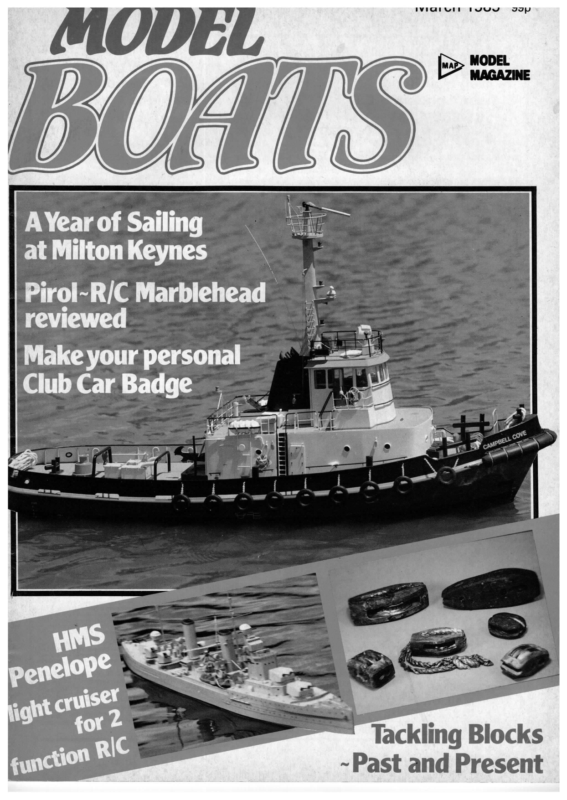
- Regattas in Milton Keynes Mike Kemp reports on a significant sailing season of the new city club.
- Kit Bag Experienced yachtsman Bob Jeffries reviews Robbe’s Pirol yacht, distributed by Cougar Craft
- Starting In Sail Vic Smeed discusses classes past and present

MODEL MAGAZINE AYear of Sailng atMiltonKeynes Pirol~R/C Marblehead : reviewed Make your personal Club Car Badge = Tackling Blocks ~Past and Present
N ineteen eighty four has seen some significant sailing activity for the model yachtsmen in and around Milton Keynes. Early in the year negotiations com- menced to try and find a better lake for model yacht sailing than that already utilised. The existing lake, Willen, is a relatively large area of water with a small corner leased by the Milton Keynes Model Society. Most of the time a somewhat larger area than this had been available for use but was coming under more and more pressure from trainee sailboarders and other nonracing dinghy sailors; during the summer even more difficulties became apparent when ‘Joe Public’ descends upon Willen to bathe, picnic and row boats on and around its shores. A lucky business contact led to an introduction to the Dovecote Sailing Clubin the North of the area, just outside the New City Boundary and close to, and visible from, the Ml motorway. Some demonstration sailing sessions were arranged in the depths of winter which led to considerable interest from the dinghy sailing members of the Dovecote Club: subsequent negotiations resulted in the forming of a block associate membership group of the Dovecote Sailing Club. The eventual first official use took place around the beginning of April 1, just in time for the hosting of the first open event seen on the lake for model yachts — The Whyte Trophy for Radio Marbleheads. The Whyte Trophy This event took place on Sunday April 29; a fine, dry but cool day with a good easterly wind. The east is just about the worst direction for the wind to appear from at this lake as it approaches over and arounda small but tall stand of trees — and we all know what sort of disturbance that causes don’t we? In order to get a reasonably good beat for the first leg the OOD had to set a start line very close to the right hand end of the operating area and close to the bank. The first leg set off towards the trees and the first mark which wasset just on the edge ofa large area of disturbed wind. This proved to be a good test of tacking technique and tactics and produced some good, entertaining racing. The entry was good at 24 from six different clubs from no less than three different districts of the MYA. The end result was a good North vs. South battle with the honours being very evenly distributed and everybody going away with good feelings about the lake and its possibilities. Racing got under way shortly 148 after 10.30am and was concluded at around 4.30pm some 24 eight boat races later; there was a lunch break of about three quarters of an hour part way through the proceedings. It became clear early in the racing that the main protagonists were going to be the Leicester trio of Dave Andrews, Tony Drury and Robert Smith matched against the Danson trio of Robert and Tony Owens and Russell Potts. Further down the final scores the battle raged between North and South, Alec Cheetham (really from the North at Doncaster) mixing it with the likes of Elizabeth Andrews, Louise Smith and past National Champion and occasional 575er Derek Stephenson. Few people suffered radio or any other trouble, the notable and unfortunate exception being Albert Akers who had the water get at his UHF receiver and needed the services of the rescue boat; his yacht never really recovered during the whole day. For the rest the racing was in general very close; in fact it was close enough to be very interesting to our ‘fullsized’ hosts. The sight of five or six yachts approaching a downwind mark line abreast— overlapped and all that — had the Club Commodore enthralled. The windward leg proved to be a good test of tacking technique, especially as the wind gusted occasionally to make life a bit difficult. Undoubtedly one of the most effective was Tony Owens from the Danson Club who used his incredibly smooth K104, K26, and K3 look almost real in this low-level shot at Dovecote. tacking technique to overcome some less than perfect starts. Even so there was no beating Dave Andrews and his Heartbeat who only just broke into double figures from the results of eight races. The overall result was an amazing alternate act with the honours going almost equally to the North and the South.
Midland District Radio Marblehead Championships The next main meeting to be hosted at Dovecote was the Midland District Championship for Radio Marblehead: this was expected to bring a good entry and repeat the good racing seen at the previous meeting. Unfortunately this was not to be, after the 24 entries of the Whyte Trophy there were only 17 who found their way to Newport Pagnell on May 28, 1984. There were a number of other events on as well, and with the Nationals only one week later there were undoubtedly some who wished to avoid risking their craft with little or no time to repair before the ‘Nats.’ Although not closed to skippers from other districts there was only one entry from outside the Midland District. This was Brian Corley who trekked across from Cheltenham as so often before to find his sailing with us. The remaining entries were from clubs only, Leicester and the host organisation. Unlike the previous meeting this was not to be Dave Andrews’ day: club two mate Robert Smith was coming to form with his newly sorted Seahorse IV and managed to be either first or second in every one ofhis eight races. Dave despite winning five of his races, also scored a three, a four and a five to end the day as runner-up. Home skipper Mike Kemp managed to beat the eventual champion once but then so did Tony Drury and Andy McCulloch, while Dave Andrews did it twice. Once again the wind prevailed but was a little kinder to the OOD allowing a rather more easily visible start line. Racing proceeded at a reasonable pace with few hiccups. Although the wind was constant in direction it was a little blustery from time to time and was quite cold even when standing in the sun, consequently spectators for this event were fewer than might have been expected as they all went around the other side of the clubhouse to sit in the sun and be sheltered from the effects of the wind. The eventual result was almost a whitewash job by the Leicester Club, obviously they were keen to have a go on their alternative water later in the season with the Champions Cup. Left: K26, Simon Redford and K212 Jim Parker, both from Ashton, manoeuvring at the start. Above: OOD Andy McCulloch out for a paddle. K104 Below: K179, Brian Hull, and K212 – somebody must know the right way. Mickey Finn National Championships The delayed Mickey Finn National Championship was a disappointment; firstly for Ken Shaw, the Association Secretary. Ken was disappointed on two counts, firstly at the dismal support shown for the event by Mickey Finn skippers everywhere: secondly because Ken had deliberately planned himself out of the active sailing so that he could make some video recordings of the racing, then forgot to bring his camera to recorder cable! The other disappointed parties were the dozens of Mickey Finn skippers who didn’t bother to attend. With the pleasant rural surroundings, grassy banks and shady trees; a licensed clubhouse, barbeque and, finally, good open water with wind on a day when the rest of the country had none. What more could one ask for the scene of the only MYA billed National One Design Championships? The seemingly MORE ENTRIES! inevitable answer is ‘lhe 1984 event was set out on this year’s MYA calendar for a Saturday in June: this it seem, was a mistake that was realised only too late. The result was that the meeting was postponed: a new date, August 27th, was settled at the original venue, Bournville’s newly lined lake in the heart of Birmingham. Unfortunately, at the last minute, it was realised that the lake could not be used on a Bank Holiday Monday so another venue had to be found. The newly acquired water just outside Milton Keynes was the obvious answer. Although nearly an hour further south on the M1 the lake is easy to get to and is proving to be an ideal site for March 1985 149
K3, Barry Jackson, K26 Simon Redford and K104 Mike Kemp hanging around waiting for the grass to grow. Radio Yacht Racing, the aforementioned facilities being complemented by a friendly group of dinghy sailors keen to see the modelling counterpart succeed. The weather, and in particular the wind, was very still at the appointed start time of ten o’clock. It was decided, therefore, to hold the Mickey Finn Association Annual General Meeting before racing commenced. It was hoped that outdoor gathering would give the air time to start moving, or might even generate enough hot air to cause some thermal movement! Racing finally got under way at around eleven when the meeting was finished and a very light breeze could be felt on the perspiring backs of the anxious combatants. Seven boats took to the water to sail a port turn Olympic style course of one triangle and a sausage. Officer of the Day Any McCulloch, normally known for sailing an impossibly wide Marblehead, ordered that he wanted no one on the ‘wrong’ side of the start line during the one minute countdown. Unusual and not entirely popular at first, this was probablya wise move as a brief lull in the wind would cause the Mickey Finns to drift helplessly such that start line infringements would have been very difficult to avoid. Fortunately the whole day was marked by an almost complete absence of ‘infringement aggro.’; those incidents that did occur were followed almost immediately by acknowledgement and one penalty turn. Proving, once again, that Mickey Finn sailors are nice people! Another of Andy’s rulings was that he intended to allow one discarded race for every five sailed. Although it did not actually make any difference to the overall result it did prove to bea psychological boost when one had a particularly bad race due to the*odd ‘hole’ in the wind prevalent during the early part of the day. Having started with four races in an anticlockwise, port rounding, direction the wind switched its attack to the other direction. So off we went, in a clockwise, starboard rounding triangle and sausage. Racing was close, as might be expected of a fleet of one design craft and a good start was a vital factor in determining success. Close though things were, the finishing order, particularly the first place, was getting boring; Barry Jackson the defending Champion kept winning. However, in race four, local skipper and last 150 and The start approaches, MikeJim Barry look like being late;and shot, into Parker coming . Brian Somerville couldr.be early All photos by the autho year’s runner up Mike Kemp broke Barry’s sequence with the first of two wins. Race five was completed just before 1.00pm when it was decided that a break was called for, particularly as the barbeque was cooking. At this point Barry Jackson was firmly in had a new start line. It was drawn between the second and third marks and thus very long. That it was fair was demonstratded when boats from all along the line arrive at the first mark in a big heap! Despite the : the lead with four wins and one second one Mike Kemp was in second place with . first, two seconds, a third and a fourth Simon Redford was holding on to third spot with a two, a three, a four, a five and asixth place. Simon managed a seventh later in the added excitement of a great charge to the first mark and some really fast broad reach- day but could not complete the set! ing the drama of the day was over. Barry kep on winning, Mike continued to always be there in around third spot and Simon finally found his form to achieve two third places and a second. At the end of the planned sailing just after five o’clock we had all completed 15 races in a wide variety of conditions from nothing to almost the limit of the top suit. There had been fewer equip- Racing recommenced at 2.15pm, by which time a certain amount of liquid relaxation had been applied. Subsequent racing was ment failures than in previous years, even more good natured but looked like am Hull avoided pulling the mast out being just as boring with that fellow Grah boat although his batteries did let him his of Race Jackson winning again in race six. in the penultimate race. There had down seven brought a major upset to the divine also been fewer apparent infringements on ded stran left Mike and plan with Barry than in previous years. All in all everyone the start line. By this time the wind had a good day; even the dinghy sailors had had reverted to its original direction and ular had with some of the Mickey Finns after the go a fresheneda little, but not on their partic r, official racing. As a matter of interest, they part of the line. The other local skippe are very keen on the idea of racing a one Brian Somerville, got away witha good lead design such as the Mickey Finn. ually and the pack in hot pursuit. Eventjoined g the items discussed at the AGM Amon Mike and Barry found the wind and the state of the One Design Association the chase. By the time the finish was nigh was it remains without a manufacturer. It whilst front, in still but Brian was a nervous wreck d that it is only possible for the agree was four his Graham Hull gained the first of to ‘tick over’ until a new source ation Associ second places, Barry scraped into third components can be found. and s yacht place while Jim Parker succeeded in holding of will be a 1985 National there er, Howev Brian old Poor place. Mike down into fifth will be on Sunday June 2 it ip: ionsh Champ ement excit couldn’t stand the strain of this Lake, Newport Pagnell; ote Dovec the at and retired from the next race with some If any Mickey Finn event. 1984 the of minor boat ailment (a likely story) leaving scene and get in some early come to wants r skippe the all hard Barry Jim and Mike to chase ce, ring either Mike Kemp on 0234way to the line. Jim was within three practi 4 or Brian Somerville on 0908-583372 85277 lengths of the finish line when he obviously to arrange a visit. felt that his boat was not going to fetch the port end of the line on his starboard tack. He tacked onto port which slowed him sufficiently to allow Mike to squeeze his a eae Funky Mice past, still on starboard, and into another second place. Results Race nine saw some more drama as Mike Officer of the Day — A. McCulloch held and 9 stole a good lead from the start Ashton K9 1st B. Jackson 26.5 K104 Milton Keynes onto it all the way to the finish. Behind him, 2nd M. Kemp however, Barry and Graham were battling it out all the way to the finish when the OOD announced that he could not split them, so they collected two and a half points each. Race ten saw the wind really fill in such that the short dash to the first mark was insufficient so from race eleven onwards we 3rd J. Parker 4th S. Redford 5th G. Hull 6th B. Somerville 7th R. French K212 K26 K179 K33 K582 Ashton Ashton Woodspring Milton Keynes Ashton 44 47 50.5 53.7 63 ees 2 Model Boat
appears heavy, but when one considers that there are no stringers, no deck, no fin box, the weight compares very favourably with the average glass-fibre hull, but it is very much stronger. It will I am sure stand up to the rough and tumble of club sailing very well indeed. I feel the hull to be unbreakable. The hull moulding includes a sliding hatch for immediate access to the interior, and a semi-scale cockpit which adds to the appearance considerably. Pirol is not inelegant amongst today’s Marbleheads. he Robbe Pirol Yacht Kit was introduced to the trade at the Nurenberg Toy Fair in 1982. Model Boats in their May issue of that year referred to it as a Marblehead, but Robbe quoted it as a yacht conforming to the NAVIGA class F5M. There are significant differences between that class and the internationally recognised M.Y.A. ‘RM’ class of radio Marblehead. Robbe must have realised this, as the kit now marketed has been modified and will now pass the M.Y.A. specification. The chief problem was the overall length. The Marblehead specification calls for a length of 50in. with a tolerance of plus or minus ¥,in. This hull was at least ‘/,in. too short. They now supply two pieces of the same material as the hull to cement on to the bow. These just and only just bring the length within rating, and on mine I have added a further thickness, as some M.Y.A. measurers area fussy lot, and I don’t want my boat to be refused | registration for that reason. The distributors, Cougar Craft of Woodhead Road, Holmbridge, Huddersfield, have been advertising this kit for some time, but the illustration and description do not do it justice. Now I have had an oppor- tunity of examining the kit, I am delighted with it. I am sorry to say, but suppliers of British kits can learn a lesson on how to present a really complete kit; no lumps of wood that one has to shape up to form fin and rudder; no keel to be cast, just splendidly formed mouldings, and completely finished keel. The fin is supplied in two halves, which just need to be cemented together, and cemented into a recess in the hull. The rudder is completely finished with a stainless steel shaft. Hull The hull is supplied finished. It is moulded in Plura which is a material I have not come across before. It is moulded in two halves, and joined by the suppliers. The joint is SO good, that only a slight sanding down of the moulding ‘flash’ is all that is necessary. The hull weighs 2’lbs. which at first glance Mast The mast supplied is of sufficient length to fit the top suit (high aspect) and is also used for the lower rigs. It is made of anodised aluminium, and is in a nice blue colour. It has the usual slot to fit sails as in full-size. The kit includes one set of sails. Mine were for the high aspect, and only suitable for light winds. On checking their dimensions I was dismayed to find the area a lot below the They say this is a complete kit, I can really confirm that statement. It contains everything required with the exception of the appropriate cements and paint, plus of course permitted 800sq.in. On measurement, it was only 735sq.in. total, whereas for the Marblehead rule including the 2in. allowed on the roach, and the lin. on the foot, the total allowed area is almost 1000sq.in. For competitive sailing this loss of area would be a big handicap. On attempting to fit the sails to the mast, I found the ‘bolt rope’, the part that fits into the groove, to be too soft and too small in diameter, it just kept slipping out of the groove. I was able to remedy this by replacing it with a piece of blind cord of appropriate size. The pocket for this was just formed by folding the sail cloth back on its self. This makes for a very stiff hinge, and will not allow the sails to form a good aerofoil shape when sailing. The remainder of the rig is up to the would be just a little lighter. I did not want to areas, I cut my booms slightly longer in anticipation of fitting proper sails of the As supplied the bow is left open. I previously stated that additional material is to be fitted to bring it within rating. Before this however, the design calls for a pulley to be fitted in the extreme bow for the successful operation of the sail winch. This design I feel is wrong. It would be virtually impossible to replace the sheets when they come off the pulley. I fitted a shrouded pulley in the position recommended, and when the time comes to replace the sheets, the new one can be drawn through as the old one is removed. the radio and winch which will be of the builders’ choice. They even includea piece of rubber to form the bumper. I didn’t fancy that, and decided to make a bumper out of cut-down wine corks, as I thought they start redesigning, so I at least tried carving the bumper as suggested. I used a sharp ‘Stanley’ knife, and was surprised how easy it was. I dropped the idea of my corks, and am well satisfied with my rubber bumper. The hull is moulded in a one-piece plastic moulding from Robbe’s Plura, a strong yet not heavy material. standard I would expect from such a kit. A section of aluminium is included to make the main and jib booms. The drawings make the dimensions clear. In view of the small sail approved areas. Keel Most British kits either don’t supply the keel, or at best supply a lump of lead, with vague instructions how to mount it onto the wooden fin. Not so this kit. The keel is in cast iron, machined and drilled, and only needed a rub over with an old file before painting. The keel weighs 6¥,lbs., and as the all-up recommended weight finished is only 12lbs., this appears correct, being over 50% of the sailing weight. Hatch The hatch is in transparent plastic, and adds considerably to the finished appearance. I had a bit of a shock when I weighed the components that went to making the hatch and found they weighed 5¥,ozs. I felt this was unnecessary, so I cut alarge holein the pieces forming the slide, and reduced the weight to just over 30zs. which was acceptable to me. Radio Referring to the drawings, these show that the radio on/off switch is fitted inside the front of the cockpit. Fitted thus, would mean disconnecting the mainsail sheets to remove the hatch, every time the switch was needed. The illustration on the outside of the Model Boats 152
packing box shows a switch fitted to the same place, but immediately available from outside. I fitted mine in this way. Inside the hull, and adjacent to the on/off switch, I fitted the charger plug and a small edgewise voltmeter (of Japanese manufacture, and quite inexpensive) I am surprised more do not fit such a useful device, by no means essential, but I find it useful to know the state of my batteries at all times. The radio equipment I used is the latest Futaba two-channel equipment, the type number is FP/T2MR; this is the one that has reversing switches, and is a big help in setting up. One major grumble however. The equipment as supplied has both sticks with spring return. This is fine for the rudder control, but for the winch control I wanted the ratchet system. Reading the literature supplied with the gear, clear instructions were given how to convert to this system. It just meant removing the spring and fitting a small phosphor bronze strip. Searching through the packing I could find no trace. A telephone call to the supplier, and they has obviously been given much thought, and I can say there is some Tutonic thoroughness built into the design. I feelitis an example to all manufacturers of like kits. The price the advertisements say is £89.78, but that does not include either the Mast or the Keel. The Mast is £12.11 andthe Keel £21.69 making the complete Kit £123.48. At this figure it is the cheapest kit on the market. I have checked current prices of several equivalent British kits and they vary from over £150 to over £250. Sailing I had to await suitable weather before commencing sailing trials. However time and weather eventually coincided. The boat sat on the water correctly. Whilst static the bow just broke water. I rigged the mast in the centre of its adjustment, and subsequently have not found it necessary to ‘depart from this setting. A range check of the radio proved entirely adequate. Rangeis certainly beyond optical range, so is all that is required. mine with Humbrol Enamel — two coats, the first lightly rubbed down. The colours I chose were light and dark blue, with a thin black line separating the colours and the finish I obtained was for me, quite good. I did take a lot of care in painting in a dustfree area, and left a good time between coats. Humbrol appears to havea good adhesion to the hull material. Summary How can I summarise this kit? It is a comparatively cheap way of getting into Model Yacht Racing. It is a kit that is complete, and doesn’t need much technical skill to assemble. The instructions in German, English and French are simple and easy to understand. The tool requirements are minimal, and I would say it can certainly be built on the kitchen table. The drawings make everything abundantly clear, although J think in inches, so I converted all the relevant figures from millimetres to inches. During construction and testing, I have avoided doing anything to the design. However after several weeks sailing, several points have arisen where the boat could be improved. Firstly as mentioned earlier, I have two suits of sails. The high aspect fit the mast, but when the working suit is used, at least 18in. of the mast is unused, and means The deep fin and spade rudder feature prominently in this side view. agreed that Futaba no longer supply this tiny bit, but it can be obtained at an extra cost of 20p. A pretty poor show I thought, but anyway, what is 20p. ‘Sorry’ they say ‘We have been waiting for weeks for supplies from Ripmax’. After waiting for six weeks, in disgust, I made myself the component needed. Why do they annoy customers by such poor service on an otherwise excellent product. For the control of the sails, I chose the latest Andrews ‘Whirlwind Sail Winch’. I chose the one for 7.2 volt operation, which has an inbuilt voltage regulator to supply the 4.8 volts needed for the receiver and the rudder servo. There are just two leads to fit to the battery, and the connecting lead, already fitted with a plug to fit the new type Futaba receiver, connects the power to the receiver. The normal socket on the receiver is left unused. When the ‘Whirlwind’ was first announced, I was a bit concerned over its small size;and the fear that it might not prove reliable or long-lasting. However, there are several members of my local Yacht Club using it with complete satisfaction, and my earlier fears were groundless. It is very rapid in action, ample power for a Marblehead, and I am informed, often used on 10-raters. It has a tiny screw on the side to adjust the total number of turns to meet actual requirements. weight in the worst Sailing was tried first on port tack then on starboard tack. The boat steered well, and did not require constant helm to hold course, showing that the mast position was right. Being such a lightweight, it picks up speed very quickly, but unfortunately slows up equally quickly. The rudder was set to give about 30 degrees each way, and this was ample to turn quickly in a quite close turn. Care was needed on the rudder stick, as too much rudder and the boat pulls up. It needs a gentle feel. I immediately realised the limitations of the sails. Firstly the way they ‘set’ is poor, and the lack of permitted area clearly shows. I felt the boat has enough potential to justify fitting better sails, so a journey to Fordingbridge to see Frank Parsons of Nylet to discuss the problem. As a result I ordered two sets, one a working suit, and the second a high aspect panelled set, for light air. The working suit I chose in _ 3.5o0z. material, but the high aspect set we decided should be panelled in 2.750z. Dacron for best performance. Further trials with these new sails show the boat has a lot of potential — only time will tell how it competes with the Trappers, One can always be critical of any product. the Seahorses, the Pirates, the Ashanti’s and the wide range of other designs found in any club. One thing I am sure, it will not be out of place in whatever company it finds I have studiously avoided modifying anything (except that pulley up front!) This kit itself. I have not mentioned finishing. I painted March 1985 unnecessary possible place. Furthermore it is a slow job Although designed as a functional racing model, the rear cockpit lends an air of scale – but unfortunately is prone to filling with the wet stuff. All photos: author. at the pondside to change the sails. I therefore obtained another mast (from Nylet) and made a new boom, gooseneck and kicking strap. I now have two complete rigs that take barely two minutes to change when there is a variation in the wind strength. The other problem that causes me concern is the weight of the keel. 6, lbs. is allright in very light airs, but in any wind at all, the boat heels alarmingly. Two options are open to me, either to add a spacer between the bottom of the fin and the keel (about 1¥,in.) or to make a completely new keel of around 8 to 91bs. The other matter is the way the cockpit keeps filling with water. I must add a selfdraining pipe to automatically clear the build-up of water. 153
A can be read in Log Book, the 36 Restricted class rule, revised a year ago for the first time in many years, has been slightly amended, partly to resolve the anomaly of an elderly and distinguished yacht having been made illegal, but mainly because there is a strong feeling that the original rule, intended to produce a smaller yacht than those current in 1903, had got the general idea right. Advances in materials; need only be considered when something very expensive gives an advantage; if the class is intended to encourage newcomers, it should be as inexpensive as_ possible. Advances in design are acceptable when they are within the spirit of the rule, but clearly where there is some doubt, itis better to spell out what can and can’t be done. The background to this rule is that in 1929-30 there was only one international 9lbs. weight, and these suggestions caused some discussion. The magazine of the time, The Model Yachtsman, published several class, the A, but there were numerous British classes — 10-rater, 12m, 10m, 8m, 6m, 18-footer and so on, several of similar size, but nothing smaller than 6m. The 10rater is a length-and-sail-area, a formula devised in the 1970’s to replace (in full-size) a rule going back to 1730 which had evolved to a point where unsatisfactory or even unseaworthy yachts were being built. In full-size the 10 rapidly developed into long- overhang skimming dish type hulls which led to their abandonment on open water and, eventually, their demise on inland waters. As we know, they continued in model form and were numerically by far the strongest fifty years ago. *Scale-type classes followed basic full-size rules. The 12m was nearly as big as an A but suffered from too little draught. In the 1920s the M.Y.A. recognised what were termed ‘Combined Classes’, which included the 10m at lin. to 1ft., the 8m at 11/,in. to 1ft. and the 6m at 124in. to 1ft., for an experimental period to determine which to back. Asis now obvious, the6m proved the one with a future, and it was later adopted as the second international class. The 18-footer was another full-size class, devised by Maldon _ Heckstall-Smith, and experimented with as /models during WW1 by the M.Y.S.A. |Neither full-size nor model versions survived for long. None of these classes was simple or small enough for wide popularity, which is no doubt why the Marblehead rule found a ready reception. 1930 was something of a watershed year when the rules came under close examination, the adherence to scale-type rules began to weaken and a strong body of opinion pushed for a smaller, simpler class suitable for juniors. One outcome was the 36 Restricted rule, and it was indicative of the need to see that Fleetwood club expected to have over 100 36s afloat by the end of 1982. One aside on this demonstrates the ‘plus ca change’ principle. Shortly after the introduction of the 36, a prominent Midlands club joined the M.Y.A. They had a popular club one-design which did not quite fit the new rule, and they pressed for the rule to be amended (more draught and beam) to accept their boats. Refusal caused something of an upset, but as H. B. Tucker said at the time, once an inch or two were added to the depth and a bit to the beam, some other club would ask for a pound or two on displacement and the boats would be nothing like the original designs, but the interest dwindled away. Part of the idea was that finished boats could be made available commercially, through the kiosks and shops adjacent to many model yachting lakes, and it was suggested that a price list should be fixed to prevent a wealthy father buying success for light, slim boat with the same l.o.a., wl and draught we could have 750sq. in. of sail for about 8.1lbs. displacement; beam could be say 8.%4in. A 10lb. boat should have 832sq.in., a 12-pounder 912sq.in. Which would be fastest, or best all-rounder? Any of these could be pretty boats, and all fairly fast and, with the overhangs, weatherly. With radio in mind, the lighter end is perhaps a shade too light, though , and with a standard hoist height feasible his son. t the smaller sails could be more class draugh and tional interna an of On the subject aspect ratio) while despite on (higher t Robins efficien Mark E. smaller than the A, a Mr. maximum put forward a suggestion in 1929 for aclass the lower total weight, the carrying which even today would have much to draught used could mean the yacht heavier the than longer for suit the of top its aware fully was He it. commend es is a produc tion sugges the What . dein t designs interes man’s average model yachts r 10-rate with yacht length of head and Marble signing and building his own model, bunch of the complications arising from modellers of appearance and a fascinating different nationalities interpreting a rule, variables. As it turned out, the vacancy for asmaller for which reason he felt that something the 6m, simple, giving maximum and minima for international class was filled by leading dimensions but leaving displacement and sail area as free as possible. Mr. Robinson’s suggestion for an International B Class was therefore: L.O.A. 50in. (or 1.25m) Draught: 1; of l.o.a. Beam: 22.¥, p.c. of l.o.a. L.W.L. not to exceed .75 l.o.a. Displacement max.: 14lbs. Height of sailplan: 2 x l.w.1. max above w.1. 70 p.c. min: and 75 p.c. max. of sail area aft of the mast. though only for a short time and there never was an international race (except possibly of the Scotland v. England variety); the writing was already on the wall with the surging growth of the Marblehead. If E. Mark Robinson’s suggestions had been taken up, who knows? Because of its size the 6m would probably have gradually disappeared, while because of its simplicity the M might never have taken over the mediumsize slot. ,3 Jib: 25-30p.c. of sail area measured as 85p.c. of the Triangle. He added that a rating formula containing sail area displacement and a constant to equal a rating figure (to be fixed), but this could be Dx SA + C,CXSA’ D, or C X D= SA. Possibly the sail restrictions could be deleted or amended nowadays as far as disposition of area is concerned, but the remainder stands up well. If we take the middle formula, use the square root of the displacement in cu.ins. a constant of 5, a rating of 250, and for convenience allow up to 14’,lbs., we could have 100sq.ins. of sail on a maximum 50 L.o.a., 37.5wl, 8.3 draught and 11.25 beam yacht. If we drop to a very A 24in. overall model designed by W. J. Daniels published in The Model Yachtsman in November 1929. idea. Fleetwood wanted to go even further and suggested two smaller classes, 24in. in length, Jin. beam, 8¥,in. depth, 7lbs. weight, and 30in. length, 8in. beam, Yin. depth and Model Boats 154 ” =
Certainly it would result in attractive yachts and would be worth consideration if ever a new class was being discussed. In the smaller sizes the 36in. has done very well. It faded considerably 15-20 years ago, but with radio is beginning to increase in numbers again: it has taken over third place (behind M&A) from the 10-rater in England and we expect to see increasing numbers in future. Once again the Pugwash Trophy (vane 36) proved one of the most popular meetings, topping the entry list of all 1984 events with 34 boats racing. Although the restrictions are tight — everyone is likely to use 36in. length, Qin. beam and as little freeboard as they can to ensure as much draught as possible from the 1lin. overall depth allowed — there is still room for a lot of experiment in the class, as evidenced by the variety of rigs seen at the R36R Championships, due to the absence of limits on sail area and disposition. Although una rigs on RMs do not seem viable, despite the success of one or two in the early days, single sails where the area is unlimited seem to be more competitive. Or perhaps the shorter, fatter, high prismatic coefficient sort of hull typical of a 36 suits this form of rig better? From observation, a well-cut, well-set conventional jib and main seems to us to have the edge, but there would certainly be those who disagree with that. Given that one can experiment with rigs in this class, there is not a lot that can be done with hulls, and performance tends to be fairly even among the better set-up boats, just asit is in the RM class. For radio racing this is acceptable, even desirable, but we are getting to the stage where the chap who likes to experiment with hulls had nowhere to go, unless he is prepared to get involved with the bigger classes, the 10-rater and the A. How many people build power boat multiracers now? Commercially-available g.r.p. hulls have taken over, all of similar appearance, to the point where a reaction is taking place — see ‘Scale Class 40’, page 461 of last November’s issue. It is suggested that this very sameishness in yachts is a contributory factor in the loss of interest which has been worrying the M.Y.A. for the last couple of years. Glass- March 1985 fibre is a part of it, since the competitor whose interest is in racing is quite happy to buy a reputable hull and the variety of hulls used has gradually diminished. Those available are good, highly developed designs from a handful of designers, but it is not always easy for a newcomer to lay hold of one, though it is better now than it was ten years ago, when the showing up of recruitment may have started. A high proportion of new members since then have been racing skippers rather than build-it-yourself types. Most of the readers of this particular column are practical modellers who enjoy building models, and the foregoing comments pass on views which they have expressed. There is a feeling that stagnation is not far off for medium-size models, which is why this month we have discussed some of the assorted classes which existed, or were mooted, in the past. Some people build yachts for youngsters and a 24 or 30in. model would be all they would ask. Others, building to sail for themselves, would like something bigger. The numbers of non-class yachts built are surprising (People still buy the 45in. Star-C plans) and even in class models prefer a design with character, i.e. usually an older design. Is there scope for a new class intended for home builders? After all, if present classes do not appeal, what is the way forward? A new, all-wood (or at least, all home-built) class offering scope for variation in hull design, small enough ‘to be portable but large enough to sail well with radio, might provide a target attracting back to the sport some of those who have left it as well as new blood and all those hundreds of ‘nonaligned’ modellers who are interested in building and sailing, but not in formal racing. The Robinson B class, 56 years after it was suggested, might well form a basis for discussion? Practical tip Because this month’s article has been largely theoretical — although it is hoped that it may have given some insight into class rules and history — at least one useful practical idea should be included. This one concerns making a lead bulb without casting. Lead, as will be realised, is a pretty malleable material, so if you roll a tight cylinder from a sheet of damp-course lead or similar you will find that it is quite easy to hammer it into a taper at each end. Next cut some small panels and tap them to fit parts of the original lump. Sand the mating surfaces and epoxy them in place. Lead is greasy, but if sanded well the epoxy will stick to it. Continue to fit panels and layer them with the joints staggered, building up the shape for the bulb required. Gaps between the panels do not matter too much as long as they are well smeared with epoxy. You can work with a piece of fin material in place to form a mounting slot, and towards the end epoxy the bulb to the fin itself and finish it in place. Keep a check on the weight and when you estimate that you have one layer to go you can cover the surface with strips of bandage or glass tape. Add the last layer and leave to set, then fill any gaps with car body filler and file or sand to finished shape. Most bulbs are not too critical in shape, but it is of course important that complete symmetry is maintained and that the bulbis truly mounted on the fin. Otherwise you will have a permanent built-in turn! You can use templates cut from card and you will find it easy to tap a sheet thinner or feather the edge out before fitting or before the epoxy has set. It is not a one-evening project, but a few minutes each day will soon see an acceptable bulb ‘grow’, and to the exact weight you require. Sounds dodgy? Well, we have one seven years old, 9lbs. weight, hung ona ply keel and it shows no sign of any movement, not even a hair crack in the paint finish. Made with care it seems as good as a cast bulb and is a lot less work. Of course, if yours drops off no responsibility can be accepted (!) but it does work for us. A 30in. overall design by Major G. B. Lee adapted from the A class design Frolic by J. G. Feltwell; first published in The Model Yachtsman in June 1932. 155
Ithough thisis written only just afterthe AGM, held on December 1, its publication comes close to the first ‘national’ event, the Model Maker trophy, for vane Marbleheads, at Clapham on March 3. Since this is a relatively easilyreached venue for a good many people in the south, it provides a good opportunity to come along and see what vane racing is all about and have the opportunity of asking questions about model yachting generally. Clapham MYC is active and successful in both vane and radio sailing and has a clubhouse at the waterside which contains examples of all classes of yacht. The Long Pond is in the north-east of Clapham Common, i.e. at the opposite end of the circular rowing-boat lake which is the one most frequently shown on maps, and is quite close to bus routes and a tube station. Also in March is the Marblehead Team Championship (teams of two boats, total score to count), on the 30th and 31st at Bournville, and also vane. Another vane event is the A Team Championship at Witton Lakes, Birmingham on April 27/28, and the Marblehead National Championship is at Fleetwood on May 4-6. The first major radio regatta is the RM National Championship, also at Fleetwood, May 25-27. All these lakes are fairly easy to find and spectators are welcome. the total Association clubs. Possibly the apparent lack of controversial matters in the agenda and the cost of travelling reduced the club support, but there is also undeniably a degree of apathy which is hard to overcome. The lack of feed-back from half the clubs makes the Council’s job much harder; they have to proceed on the assumption that their actions meet with agreement, though they know that at races they will encounter gripes from members of clubs who never attended administration meetings and only make their own views known when something occurs which displeases them. In fact all clubs have a voice in the annual elections of the officers and district representatives who form the Council and The AGM in a well-run district the Councillors are briefed by the clubs they represent before and postal votes, covered just about half of amplifying the minutes, after meetings. Major decisions are referred to the AGM for votes to be taken from the membership. _ The Annual General Meeting was attended by representatives of about one third of the affiliated clubs and, with proxy This radio version of the 50+ year-old Marblehead rule (RM class) is Harem, which has some semiscale features, though these do not affect its sailing ability. Available in MM Plans. a meetings and the Councillors report back, Any of the MYA officers can be voted out at the AGM, and Councillors at district AGMs, so the degree of involvement of any club, or any club member, is a matter of choice. If someone disagrees with the decision, he is free to campaign, to have it changed, and if he convinces enough people of his viewpoint, changed it will be. The meeting started in the customary way, passing the previous year’s minutes, but there were no unresolved matters arising except, indirectly, the announcement that a video film on model yachting, together with film on the recent R36R Championship, running nearly two hours, has been compiled by Harry Cutter of Guildford. This film will run continually on MYA stands at exhibitions, copies can The Chairman’s report was accepted, as was the Treasurer’s, the latter with one query in respect of registration fees; probably registrars still hold some of the fees. Financially, the Association is more buoyant then it has been for years and this should be reflected in future activities which have not been affordable previously. A small amount of advertising is an initial step. Missing from the reports was the number of 6m yachts registered, due to information not received, but it was established that the number has now crept up to 22 and distribution is no longer confined to the Birmingham area. Other class registrations, with last year’s figures, are shown in the accompanying table, from which it can be seen that the 10-rater and 36 classes show the biggest up and down variations, next to the RM, which shows a 20 per cent increase. The grand total of 647, an increase of 60 boats over 1983, is welcome, but that still averages out at only ten boats per club, which at a guess is about a third of the yachts regularly sailed. Three potential and worthy candidates for the Eric Nuttall Award were put forward at the September meeting, calling for an extremely difficult decision to be made. In the event, it was presented for 1984 to Chris Jackson, editor and producer of the non-profit-making Model Yachting Newsletter. Chris’ address, and that of the Newsletter, is now changed, incidentally, to 33 Yorke Gardens, Reigate, Surrey RH2 9HQ (Reigate 49365). Item 7, Election of Officers, is usually a Statistics from MYA League Results for 1984 Nationals District Opens Average Average A (+A team) 10R 6m M (+M team) 36r RA R10R RM 33 (+10) 9 18 24 (+8) 26 24 10 58 32 4 13 38 35 22 18 52 28 a 30 8 3 7 315 11 4 13 13 12 12 9 17 9 Zs 10 8 3 7 19 R36r 24 Total entries Races Average entry Total competitors Total clubs Races per competitor Entries per club Competitors per club 156 loans/sales. Class Entries F be borrowed free of charge (though a £10 refundable deposit is required) by clubs, or copies can be bought for £10. Ken Shaw is getting the copies made and handling 14 1984 547 31 17.6 216 37 2.5 14.8 5.8 Entry Districts 14 Radio 1983 571 33 LAS: 214 38 2.6 15.0 5.6 1984 323 25 12.9* 96* 14 3.4 231 6.9* Entry Opens Vane 1983 360 26 13.8* 97* 14 3:7 25.7 6.9 *In vane races only skippers have been noted; in most races there will be a number of mates. Model Boats —
matter dealt with in reasonably short time, this year there was one registration and alternative nominees for two further posts. After lengthy discussion the voting saw Chris Jackson elected as Vice Chairman, Russell Potts as General Secretary and Peter Maskell as Racing Secretary. Chris Jackson will continue in the role of Publications Secretary, which he undertook just a year ago, but Russell Potts, already publicised as the regatta secretary for the 1986 World RM Championships, will relinquish the post of Radio Control Secretary. The Council has the power to coopt a member to fill this post until formal elections at the 1985 AGM and hopes for a suitable nomination, with of course the nominee’s consent, at the next meeting; although Peter Somers from Bournville the host club. The OOD is also given discretion to allow an incorrect entry to sail on payment of an increased fee (which some people insist is a fine!) provided he considers that the irregularities will not affect the fairness of the event and that he satisfies himself that the yacht is in rating. Intending entrants should familiarise themselves with the new procedure by studying the schedule of motions, the minutes, or the amendment itself when received by the club secretary, and not rely on hearsay. Motion 3, regarding the 36R rules, was in three parts, 1 and 2 being alternatives. No. 2 was carried and means that a 36R yacht registered before 31/12/83 need not comply with the requirement that the mast and spars must be of wood or metal tube. The July 12-19, with a limit of 100 yachts. There are matters yet to be decided; for example it is understood that some East European countries would like to be represented, so should a number of wild cards be allocated? They are not IMYRU members, but possibly seeing what a world championship really is would havea positive effect on future activity and some temporary qualifying membership might be possible. These are not official comments, of course! Allocation of entries will, as previously, be on the basis of numbers of registered RMs, which means an early acceptance date so that allocations not taken up can be fairly distributed. What is virtually certain is that there will be more English skippers wishing to take part then the number of places allocated, hence the need for selection. Surprisingly, in view of the discussion and argument engendered in the past by this subject, there was effectively instant and unanimous approval for the suggestion that the MYA 1986 RM Championship be held early (probably over Easter, which is the end of March, or at the latest possibily the May Day weekend, i.e. the first week in May, if entry date permits) at Fleetwood, accepting the offer of the same OOD (Derek Priestley) and requiring skippers who would wish to be considered to commit themselves if they qualify. Selection will thus be based solely on this event, but the advantages and drawbacks of sucha procedure have been exhaustively discussed in the past and the conclusion was that the pros heavily outweight the cons. One very distinct advantage is Radio controlled 10-raters (R10Rs). This is the oldest class, but modern boats bear little resemblance to those of the 1870s. Note masthead jib is permitted. (who produces the league results) was suggested and would be prepared to fill in on the job, he himself points out that he is primarily a vane skipper and an experienced radio sailor would be a far better choice. A sincere vote of thanks was recorded to Clive Colsell and Roy Gardner, who have each served the Association well for many years; Roy held the onerous position of Hon. Gen. Sec. for some 15 years and his diligence and dedication will continue to find an outlet in his other capacity of the IMYRU Racing Rules Secretary. Motions and amendments were then taken and motion 1 was carried by a large majority. This is a change in the Constitution regarding voting procedures at General Meetings. The principle change is to one member, one vote in place of the previous one vote per ten members of a club, but other changes should streamline and make more logical the decision-making the GMs. There were seven amendments to Motion 2, but after discussion these were lost and the original motion accepted. Once again, this is a major revision, this time of entry procedures for national events, effectively allowing individuals to enter directly (or through club secretaries) by contact with the host club rather than, as in the past, being obliged to enter via the club secretary and the Racing Secretary. This should make entry easier and as a result closing dates for entries will only be two weeks before the date of the event (except RM and A, which will be four weeks) but the onus of acceptance, checking accuracy etc., falls on March 1985 main effect of this will be to legalise again one yacht which has several times won the national championship but which has a mast and booms made from bits of an old grp fishing rod found discarded at the lakeside years ago. However, it did give an opportunity to reconsider whether all restrictions on mast etc. should be removed in the class, but the view that the class should be kept simple and inexpensive prevailed. A lot of money could be spent on a hull without too significant an effect on performance, but on a restricted draught class such as this the expenditure of £30 plus on a carbon fibre mast could noticeably enhance the performance, thus putting newcomers unwilling to spend that much at a disadvantage. The third item of Motion 3, requiring the rudder to be attached during measurement, though it can be turned about its normal axis of rotation, was accepted by a large majority, thus returning this part of the rule to its original conception. The last motion, No. 4, was a redefinition of measurement of curved edges of 10 rater sails, clarifying how they are to be measured and closing a controversial loophole which could allow a few square inches of sail area to be ‘pinched.’ This was carried, again, by a large majority, and will be put as a motion to the IMYRU by the MYA, since the present wording has caused disagreement in some other countries. With the business of the meeting completed comparatively early, the Chairman took the opportunity of raising the matter of selection for the 1986 World Championships, to be held at Fleetwood, simplicity — at least aspiring skippers know what they have to do! Vane A 10r M 6m 36R New Re-reg 11 5 11 4 22 32 14 23 ? 13 Current 73 22 (74) (14) 63 22 40 (56) (18) (45) 220 (207) Radio RA R10R RM R36R New Re-Reg 7 10 87 37 20 16 44 1 54 37 291 45 Current 427 (52) (73) (243) (12) (380) RA class yachts, the biggest, follow arule now over 60 years old, but which still allows development. Size and weight means that international races are infrequent.