- CURVED AIR With Model Yachting Association General Secretary Russell Potts.

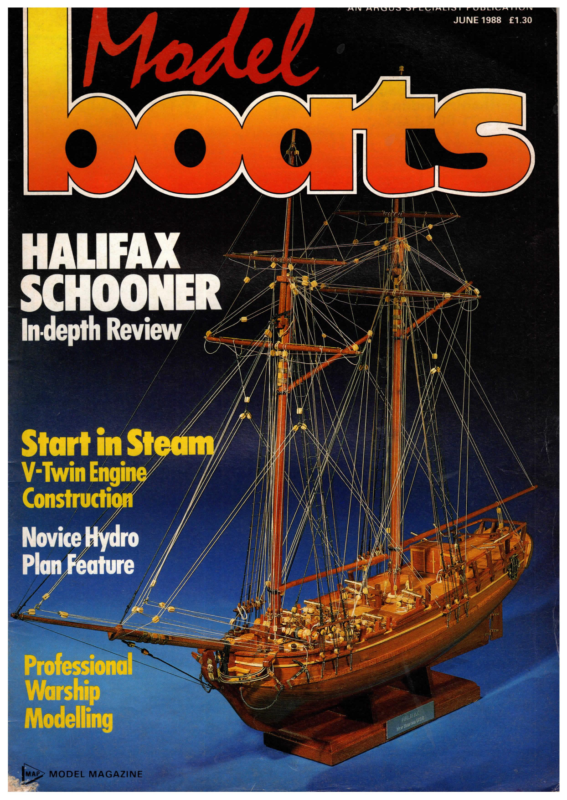
JUNE 1988 HALIFAX Ono _.. oang Y ll A Indepth Review < £1.30
MYA News ions has A sudden flood of new affiliatting groups produced new clubs or news,yach in club boat el mod in existing Scarborough, Harrogate and Leicester; Association With ModelcrYaetchartiy ng Russell Potts — General Se put in touch with anyone who wants to be ld get in touch with these new groups shouwho wants to know me, as should anyone club in their area. whether there is an MYA you advice on If there isn’t, we can give how to get one started. Commercial News shops that The number of local modelmod el the to r cate to even attempt be counted on the yachtsman’s needs canlate d hand. This is fingers of a badly muti smal l size of the the n give le ndab understa sed nature of iali spec er rath the market and on to also is t our requirements, buti that isa reas welcome and support one modelgoing to try to do something for the r Hodson, a yachtsmen in Thanet. Pete and an member of the CanterburyforMBC some years active model yachtsman rement from his now is taking an early reti you read this time the by will, day job and model shop in have taken over an existing as Margate Margate and will be trading carrying a be se cour of will r Pete ls. Mode ucts but he tells full range of modellinyg aprod range of bits and intends to carr me he model _ pieces specifically for thecan continue to do he r the Whe . man hts yac and return over turn the on nd so will depe that the hobby can generate for him. It’s up to you. Docklands still trying hard to The Docklands club is On 14 February we London Trophy nd. grou the off f get itsel acre’, at Mass Day e’s s club laid on held a “St. Valentin On 13 March the Docklanddon beginners to Trophy. Lon the for ing which we invited absolutehav sail d the thir g usin go, a e and e successful y com ectl to perf ing sail than o radi The day was less looks after for the k was Doc n too Pon the of the boats that the club r wate the as are an evenly long London Youth Games. TheseRM’ inaccessible to us because thethe from ding work on south side matched set of Sea Scorpionthey sdon’ buil ed aten thre geta t k has now started. Squire Kay, and given thatthat enough of of the Royal Victoria Doc moved to the relatively lot of use, we were pleased time of asking be to had race The ects the them functioned at the first narrow neck of water thatn conn y. The This runs . dock mai the to keep all our customers happ to k Doc oon we had a bright Pont ered by bord is and weather was kind to us andwind h sout and h nort t s, just righ ict, are sunny day with moderate buildings which though now derel radio . Had the strong high eys for beginners to get the hang ofabou stor ten to t eigh two from the north or sailing. There must have been t tot well gusty wind been blowing eigh an exciting day. had have dozen customers, aged from h, we should es of the day and sout west, and the the from e advanced, at various stag cam it was, it As as a dozen ed in vari r wate the at one time we had as many yone on ze bree al actu was given Ever down gusts k knoc to ing boats actually sailing. noth from strength the hang eivable y ever t abou a session under instruction to get came from just whetherconc you twiddled the and the wind on g of what the boat did when at ndin depe n, ctio dire t one race or the other of knobs, and then each had leas was coming round one end or ear to keep bouncing top, the with a guide whispering in his over mill, r the flou racing wasn’t the eastern side on e him on the right track. Thether hous ware the off back wide a e was very serious of course, andthe mini of the cut. Often it seemed. to be blowing in mal variation in ability after able to get several directions at once in the something of experience that they were yone seemed This meant that racing wasfrom to last to ng comi short time available. Ever several s boat a lottery, with course of half a leg have enjoyed themselves and ng again the in fleet the in first k on expressed the intention of comi and the tactical approach to a mar sailing strous disa a into ed when we lay on another informal turn be d coul d starboar the gust ing head a day on 20 March. We shall see how by port tack approach all very frustratating new successful this method is of finding very was It nt. mome g wron r frustration members for the club, which is still ers and some skippers allowed thei a lot of were e Ther . short of members, particularlythememb them of er bett to get the cold The er. temp based locally who could give cluba bad protests and some continuing existence. 310 variations weather and the irrational wind cularly made the job of the observers parti going were s dent inci y man too but cult, diffi be to had sts prote y man too uncalled and abandoned because there was no clear evidence of the facts of the case. The results are shown in the detail in the The panel, and there are no great surprs.ises. It is usual people came in the top place Owen worth noting, however, that Tony mustsbe placed well, sailing a Trapper thataps five or six years old at least. Perh more to do getting to the top of the fleet hasnt with ability than with the amou yu spend on equipping yourself with the very latest high technology weaponry. Vintage Yachting Exhibitions As I write this, preparations are beingage Vint completed for the first specificalllyand craft Group display ata general modecan makea exhibition. Mike Williams, who r that fair claim to be the grit in the oystewe now initiated the creation of the pearl ed know as the Vintage Group, has rush about and organised us into a weekend e show ata school in Shefford, Beds. Ther of some , boats old of tion selec a will be them in the course of restoration, anda show the couple of up to date equivalents to state of the art and the contrast in lves approach to modelling between ourse ss, and our grandfathers. If this is a succethe on there is talk of a Vintage presenceition . MYA stand at the next ME Exhib MODEL BOATS
Stop Press The exhibition was a considerable success. We recruited four new members on the spot and made contact with several owners of potentially interesting old boats, some of whom promised to bring them along to the Vintage Day at Dovecote. One man who talked with our people on the Saturday came back on the Sunday to show us his boat, a commercially made 36 dating, I think from the immediate post war years. The idea of putting on a small scale show of this sort at a local venue has a lot to recommend it to clubs seeking new members and greater exposure in their own area. It hits a local audience, it takes relatively little effort to arrange and it doesn’t make the heavy demand on time and effort that is involved in mounting a week’s coverage at the ME Exhibition. We had two people there on Saturday and four on the Sunday and were kept sufficiently busy throughout. It could have been done with two on each day. Worth thinking about as a way of spreading the message. Schooner models Over the years, the model schooner has exercised a fascination out of proportion to the amount of racing that has been available for them. The very first printed record of model yacht racing, in a club that sailed on open water in the Plymouth area in the 1840s, says quite specifically that the majority of the boats were schooners; a similar report of a London MYC match on the Serpentine in 1857 also records a fleet of schooners and two masted luggers, with only a single cutter. In the years immediately following the victory of America in 1851 there was a steady flow of models of her or influenced by her. The full size fleet in the 19th century had a significant proportion of schooners. This was because many Victorian gentlemen needed a yacht that could be used as mobile accommodation for their winter forays to the Riviera and elsewhere. (Much more reliable than the local hotels; however, good the cuisine might be, you could never be sure that the drains were up to British standards.) Lord Raglan commanded the Light Brigade in the Crimea from on board his yacht for much of the campaign and found it more comfortable than life ashore under canvas. Such owners required very high standards of comfort that could only be achieved in craft of significant size. These were generally too big to be comfortably rigged as cutters, even with the extravagant crews that a Victorian gentleman would think appropriate. The schooner rig was the obvious next step up, though some yachts were rigged as brigs, ships or barques. Lord Brassey’s Sunbeam is a case in point, though she was very big for a private yacht, being built and equipped to carry the owner and his family on round the world cruises. A large part of this “travelling hotel” element in the schooner fleet was replaced towards the end of the century by steam yachts, as the triple expansion steam engine was perfected to give economical and reliable steam plant in relatively small sizes and with modest requirements of fuel. Schooners were of course raced and some of the most famous yachts of the mid century were schooners America, Titania and Livonia are examples and there were many more. They raced on “time on distance” handicap against all other styles of yacht, and so long as the Rating Rule in use did not bring into play the sail area of the yacht, they could do so on reasonably equal terms. Once the Length and Sail Area Rule of 1887 was introduced, greater emphasis was put upon the efficient use of sail power and the division of area was found to be inefficient compared to the greater concentration obtained in the cutter rig. In the latter years of the 19th century schooner rigs were given a 15% allowance against cutters to compensate for the decreased effectiveness of the divided rig. This concept of rig allowance persisted in ocean racing until the introduction of the International Offshore Rule to replace the RORC Rule. The number of schooners in the full-size fleet fell sharply for a period, but revived in the years immediately before 1914, when there was a strong fleet of schooners racing in the open handicap class. The Kaiser’s Meteor, designed by Max Oertz and built in 1909 and Westward designed by Nat Herreshoff for A. S. Cochran in 1910 and later owned by the South African millionaire T. B. F. Davies, were typical. The hull forms were similar to those of other yachts of the period and the rigs were also influenced by the parallel developments in cutter rig. The mainsails were, very gradually, getting taller and narrower and much more effort was going Docklands Model Yacht Club London Trophy — Prelim. — Entrants Tot. Best 1264 4 [| Geetok © 0 3 [idle 6 4 0 Fleet Racing 56 17 17 _MWeston 17 17 5 34 6 0 0 5 TOwes 0 3 12 3 Peiwerds 2 3 H ) 17 6 6 Uvee 8 F 66 67 «(14 3 3 . : 3417 3 464234 4 7 BI G7 4 6& 3 F 12 * 10 7 6.8 (8 4.8 6 S & 427307 7 23 61 38 8 @=9 Above: three quarter size model of Prospero built by Vincent Collins in 1936 and shown restored in the heading picture. Below: a Prospero model at Clapham in the late 1920s. “44.«13 «10 1.7 59.7 457 -R. Owens _ 69.7 46.7 R.Potts © T Ryan 62 48 70 56 _P. Galea 100 77 | M. Baker —16 117 J. Sanday 7 M. Childs 8 -. 4 Cs M. Golding RCuts (2 12 6 _R. Curtis 12 «(12 5 ‘ODement 8 9 |, Taylor 5 JUNE 1988 1 & 201141 2 12 4% 23 3 ee: eo 6 | 12 10 17 8 0 @ 17 23 17 47 «56 4 _sOverton 0 4 5 17 57 23 TD |B Becoe Total Min. . kt 34 _ 2 _ 12 17 311
rovee the cut toalsoimpsom of sail themandetace.ilThe into was re perfor in the case of influence, particularlyfro pmeingnt m theBandevkselo s, gner desi an ric Ame fish nd Gra fast and e ofschtheoonlarg ers that sailed out of ports in the American north east and from the t of Britain. Among regattas round the coas newspaper the most attentive of these men , and hts yac el mod e wer readers produce a to was rest inte r thei eventually ooners. sch el mod ng ldi second wave of bui fairly was er oon sch the m for el mod In as a er eith ury, cent h 19t the common in inces. CanTheadiseanschmaroonitiermeyacprov hts looked even more cutters with which magnificent than the resiansion on imp a e mad and ed ygroracwing number ofbig _ the ard Edw the followed the newspaper readers who of big yachts at d on a hull essentially schooner rig mounte used by the cutter models reports of the racing t the same as tha able a style more compar of the period, or inoon er, which tended to to the full-size sch less extreme in form have a hull that wasnk on edge racer of the than the typical plamples shown are first, a 1880s. The two exa lished in 1886 in Model schooner design pub eist. She was Yachtsman and Cano y of the Lowestoft sle designed by F.C.lyTan moderate hull as MODEL SCHOONER YACHT, Furnished ly Mr. F, J. Tansley, Lowestoft. Min. = tin. club and is a fair cutters of her day. compared to the 10 ton e by any rem ext r, The rig is howeve e single headsail, standards. Note thet larg divided rig much more efficien thabyn the owing full size foll ated dict be ld that wou ed unb ng ppi rla practice. The ove ing fromoom size foresail was a borrow rica andfull pilot her Ame as h suc ers oon sch en giv e hav ld wou and ors enit boat prog est sugg use Its es. ntag adva considerable sailed a lot of that the Lowestoft club it would have been reaching courses, ascour se required tack the if ent eni inconv y was the second sle Tan ing. and tack sail ly of Lowestoft modofel generation of a fami a member of one the yachtsmen and wasies that operated the pan Com ch Bea local ls as tenders, yaw ch bea olk famous Suff to the large amount salvage and lifeboatscons tantly passing to of shipping that was t. His son F. C. coas the nd rou and fro e and Hov the of r nde fou Tansley was r the war was MODEL SCHOONER YACHT, t. Furnished by Mr. F. J. Tansley, Lowestof Brighton club in 1930 and afte Chairman of the MYA. m the first (1899) The second plan is frodbo ok Building han k Wor edition of the h more like Model Boats. This is a boat muc of twenty years T, EL SCHOONER YACH SAIL-PLAN forngMOD an improved Foresail. Shewi ht the full size schooner yacmor e extreme and, rig is earlier, though the than a full-size naturally, much simpler se two models The . been e boat would hav schooner model represent the style of fullsize craft before corresponding to the the LSA Rule came in. wave of schooner designs big § —Sheer plan of Sch ooner; The second a Bill Daniels’ started with Prospero,bot h a reflection of is She . 1912 of ign des had made their that s oner scho e the full-siz elsewhere and nt Sole the appearance in eding years and round the coast in the’sprec gns for 10-raters a development of Bill desi Onward of and -6 1905 of NC XPD such as 41, sail lw] es, inch 61', 1911. Her loa was displacement a area about 2200sq. in. and a very light 20lb. She would have rated as —eeere Fig. §.—Half-breadth Plan of Schooner. F.C. racing schooner by Top: design for6afrom Model Yachtsman § Hasl schooner from , but reflecting full-size design arather earlier period. ofoats 1899 j\ ey, Y/y} = Tansley in 186 and this figure: and Canoeist. Aboveuck (ed) Building Model iy \ BS Ds —— Rowsenlt \}SHROU » ie ri ATER SS Fie 84 —Method of Rigging Schooner. Scarce WATERLINE Fig. 35.—Alternative Method of Rigging Schooner.
—— —= if De 4 i) = +S os : | cat Se | \ yr. \ a Prospero designed by Bill Daniels in 1912; a beautiful design and probably the most built to of all Bill’s work. 15-rater under the Length and Sail Area Rule. She was commissioned by a now unknown owner and used by Bill to develop his concepts of hull balance in what he regarded as an extremely difficult situation. The unbalance of the schooner rig, with its very large mainsail and narrow and rather ineffective foresail made it susceptible to luffing up in gusts and, according to Bill’s write up in an article in Model Engineer, traditionally a very difficult boat to sail efficiently if the hull was not perfectly balanced. Bill having invented a system of hull balance by calculation on the drawing board, it followed that any previous schooner had been balanced only by the merest coincidence and that Prospero was going to be something quite new. The article made it clear that Bill had succeeded beyond all expectation and was illustrated with good photos of the boat performing on the Round rewriting of the ME handbook Model Sailing Yachts, which was put into the hands of Bill Daniels by Percival Marshall. They stayed there throughout the life of the book, which was reprinted for the last time, so far as 1 can find, in 1951. The cover picture on many of the printings during the 1930s was a drawing of Prospero. For at least part of this time a full-size plan was also available from ME. The availability of this plan naturally had tremendous influence. There were photos in ME and Boy’s Own Paper in 1913, showing a meeting of the South Eastern MYC, which raced on the tiny and tree girt Princess of Wales pond on Blackheath. There are 17 yachts visible in one of the photos, many of them are schooners and at least four of them are clearly indentifiable as Prospero clones. In 1922 Smith’s Dock Monthly, the house Pond. She was built to the highest magazine for the North Shields ship repair boat to use metal tube masts. The lower jointly by their Apprentice Association and % and %/, inches diameter. She also introduced the first known kicking strap in either model or full-size practice. It was used to control the twist in the tall narrow dozen model yachts. Two are recognisable standards and seems to have been the first masts were in 26 gauge aluminium tube of foresail. The drawings published were a reasonable size and were accompanied by a table of offsets which made taking off the shadows a matter of much greater certainty than could usually be expected. Immediately, boats started to be built to the design and reports of versions at half, two yard, carried a photo of an exhibition held the Tynemouth MYC. Among the very varied models filling the hall of the Mechanic’s Institute there are perhaps a as Prospero and another is to the same or very similar design. Unfortunately all of these pictures are half tone prints in magazines and not good enough to reproduce . The photo reproduced was taken at Clapham in the late 20s or early 30s. Among the 10-raters laid down at the end of the pond is a Prospero. The popularity of the design with model thirds and three quarters size were yachtsmen was paralleled by a steady flow offsets were incorporated into the 1913 model yachtsmen, but active in some other published in ME. The article, plans and ———SSS Sail Pian of Schooner * Prospero."’ branch of the hobby. This is understandable as Bill’s plans have a great attraction and cry out to be built to. The example of Prospero that I currently own was built in 1932 by a man whose employment as a draughtsman was backed by a lifelong commitment to model engineering and a succession of elaborate live steam locomotives of very high quality. His Prospero was the only boat he built, and in some respects it shows, but she has survived in very good condition for over 50 years. Another example of similar age is shown in the photos, a three quarter size version dating from 1936. She is the work of Vincent Collins, a Vintage group member from Yeovil. He tells me that, as would be expected with a reduction in scale, she was tender and the sail area had to be reduced to make her manageable. More recently he has reworked the model for radio control and has deepened the fin and rudder, as well as addinga little extra weight. She now floats a little low in the water, and is sluggish in the light, but performs well in a decent breeze. Other more recent examples of the breed are Gil Hutchings’ version that has been pictured in earlier columns and a new plank on frame hull just completed by Colin Ready, a schooner buff who has built to other designs from the same period. There is some thought of taking a mould off this hull for the benefit of the unskilled or lazy who would like to build to this classic design. We shall continue with this theme next month. of examples built by men who were not LOOKING FORA SAIL WINCH? The Champions’ Choice is the WHIRLWIND Whirlwind Sail Winches are used by Winning R/C Yacht Skippers throughout the World. LOW PROFILE - OLYMPIC WINCH for 36” & 1m yachts to the same high specification as ALL Whirlwind Winches approx £45.00 incl. plug & drum. OLYMPIC WINCH for ‘M’ & larger yachts with new electronic specification for 1988 Whirlwind The Name In Sail Control BINDERS FOR YOURVALUABLE COLLECTION OF MODEL BOATS MAGAZINES = #7 "Sy t 3-954 Spas fd woe * SMART * EASY TO USE * TOP QUALITY * To ASP Readers Services, PO Box 35, Wolsey House, Wolsey Road, Hemel Hempstead, Herts. HP2 4SS (0442) 41221 Please supply .......... Model Boats Binders at £5.95 inc. P&P Metal. € scxisccasss (Please make cheques payable to ASP Ltd.) Send large S.A.E. for details DAVID ANDREWS 49 Aberdale Road, Leicester, England LE2 6GE Tel: (0533) 883309 JUNE 1988 Please allow 21 days for delivery 313