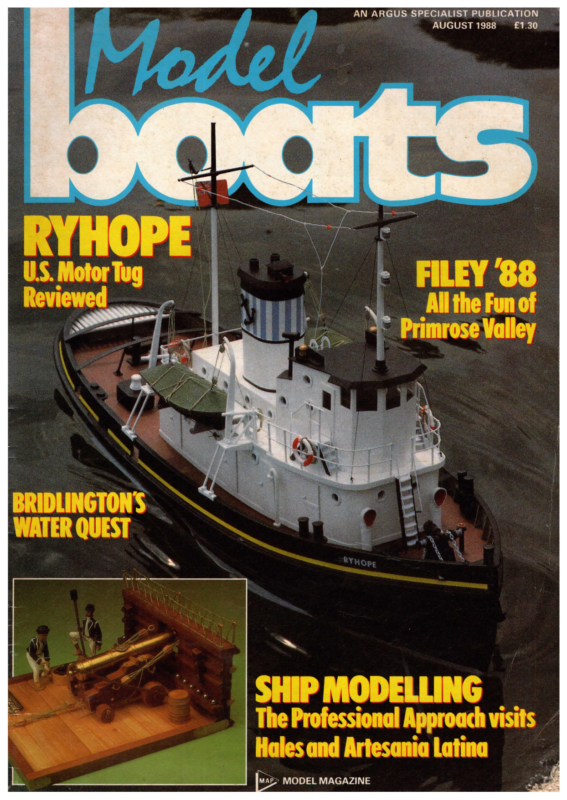
- FILEY ’88 Ray Brigden reports on our eighth Model Festival at Primrose Valley, North Yorkshire.
- MASTER’A’ MYSTIQUE Trevor Reece offers a computer-aided approach to the ‘A” Class rating rule
- CURVED AIR With Model Yachting Association General Secretary Russell Potts.

AN ARGUS SPECIALIST PUBLICATION AUGUST 1988 maP> MODEL MAGAZINE £1.30
he first week in May and it wastime to head North again for the 8th Model Festival to be held at Primrose Valley, Filey, on the North Yorkshire coast. The Festival is organised by Argus Specialist Publications in conjunction with Haven Holidays and the Holiday company make available their luxury caravans and chalets, all fully equipped with even a colour television, but there’s not much time to watch it if you wish to take partin all the model boating activities organised by the ten practising marine modellers assembled by Argus Publications. First main event on the programme is the Sunday Calder Craft Grand Exhibition. Eighty three scale boats kept judges Jeff Stocking and Dave Abbott busy all afternoon. Their findings for best boat was Roger Thayne’s new model of the coastal tanker Shell Technician, second place went to Peter Turner’s lifeboat R.N.L.B. John Fison, and Alan Miller who at last year’s festival purchased the Sirmar hull of H.M.S. Beaver, this year returned with the completed model to take third place. A regular visitor to the Festival is Frank Hinchliffe, Managing Director of Calder Craft Models. At the exhibition Frank had Adcock had packed everything into the van including Mum and Dad and set up shop at the Festival to provide all with anything they needed for their models. While browsing in his Chalet Shop Ian showed me his latest model, a 1/192 scale 1942 King George class Battleship H.M.S. Duke of York. Ian still has to make a few more fittings for completion of the model and when finished he intends to market it in Kit form and if well received, the York will be the first in a series of four of its class. Watching the model sail at one of the free sailing sessions, the 46 x 7 inch hull handled well in “choppy” conditions and should prove popular with working warship modellers. Yacht skippers are well catered for at the Festival. Terry Costigan from the Bradford Club wore his O.D.D.s hat to give 575-590 and trimaran fans four days of competition sailing and skippers with 36R yachts the deck cabins have all gone together to make an excellent model for Jake, and sailing performance is as good as his racing yachts. Spectators were treated to some first class racing by the multi boat enthusiasts, 3¥, and 6¥,cc I.C. powered boats witha sprinkling of 6¥, scale powered models trying their best to keep up with the racing boats. At a boating forum held one evening and attended by ninety plus model boaters, the Festival’s power boat organiser Jeff Stocking promises that with a better turn out of IC powered scale boats he would lay on some separate racing events for them, so if you have a Huntsman or its like come and join in some friendly competition. Wednesday night in the swimming pool was another good night for spectators. Scale boat judges Jim Worner, Roy Stonnard and Dave Abbott worked hard to put eighteen two man teams through a three new models on view to be kitted later this year. One of the models was displayed unfinished to disguise its identity. Frank invited all to fill in an entry form with their thoughts on which ship the model represented — when it was built and how employed etc. No one got all the answers but Dave Wilson was very near, and for this Frank awarded him with Calder Craft’s latest release kit of the Ryhope tug. Frank’s mystery model was of the Volcano built by Thorneycroft for the Portugese Navy in 1808 for service as a mining and torpedo training ship. To a scale of *% in. to the foot, the model has an O.A.L. of 414, inches. Frank has packed the model with some super detail including an on-deck railway with miniature carriages for transporting the torpedoes. When kitted the Volcano should prove another winner for Calder Craft. The first steering event of the week saw an old model beginning a new lease of life — arummagein the loft found a model that Grandad built as a steam driven straight runner forty years ago. Father and son John and Michael Greenslade repaired a small split in the solid wooden hull and unfortunately they had to remove the steam plant due to the suspect soft soldered boiler, but with an electric motor and radio installed both were delighted with the Cormorant’s performance, gaining second place for Michael in the Junior competition. Hope you were not phoning Midway Models during the first week in May — Ian 430 Ray Brigden reports on our eighth Model Festival at Primrose Valley, North Yorkshire travelled to nearby Scarborough for two whole days of racing under the watchful eye of Mike Kemp. Top skipper after sixteen races was Fred Catt, closely followed by Peter Holmes with Ian Damont taking third place. Always to be seen among the 575 and 36R skippers at Primrose is Tynemouth M.B.C. member Jake Kelso. This year Jake treated us to a look at his skills at scale building, bringing with him his scratch built Grandbanks schooner. Apart from laying the 52 x 8Y, fibre glass hull he also did all his own sewing on the realistic sails. The model is fitted with a Monoperm motor with microswitch for control, two winches are employed for control of the huge sail area and neatly laid corked deck planking along with some delicate timbers work on MODEL BOATS
tricky course manoeuvring Calder Craft’s heavy tanker. Derek Leslie and Dave Wilson teamed up to pull and push the tanker home and take the first place trophy to great applause. If you have any spare time from all the boating, you can watch many other modelling activities; seven classes of indoor and outdoor R/C car racing wargaming and figure painting; radio controlled planes, gliders and helicopters; steam features greatly at the Festival with two live steam experts Geoff Sheppard and Stan Bray staffing a well equipped model engineering workshop; a 3¥, and 5¥, inch elevated track is available for those who bring their locos and a special steering event is organised for steam power boats. Phew! So if you have a week’s holiday to spare book it for May 1989 and treat yourself toa feast of six days of modelling. But hurry! Heading: 18 skippers enjoyed two full days — racing with 36R yachts on Scarborough Mere with OOD Mike Kemp. Opposite bottom: Jake Kelso’s super scratchbuiit Grandbanks – schooner. Above and bottom right: John and Michael Greenslade with Grandad’s model of Cormorant, buift 40 years ago. Top right: Roger Thayne puts his Shelli Technician neatly through the bouys to score a clear round. Next down: ivor Broughton’‘s realistic modei motor sailer going through the bouys. Next: 590-575 and trimarans enjoyed daily competition sessions at the Festival. Below: we were not sure whether Organiser Jim Worner was controlling or marking our feathered friend! \, AUGUST 1988 431
the cover for half truths. Th yachtis no exception and we often hear of odd statements being made such as, that below a certain waterline length, the rating cannot be reached, and in MYN someone said in the context of heavy or light nts that cmatbemalically the: one reteg rule and thisiis ap ll A Class boats regardless of : eight but I think I know what h Perhaps the most authoritive vering the A Class boatis the pub ca MA © Model Racing Yachts by Priest and Lewis which was first published some 22 years ago, but unfortunately all displacement measurements seem to refer to the weight of salt water displaced. Whilst enjoying a day with Solent MYC I checked with Eric ot isplace ‘refer to fresh the book, allthe culations for displacement and sail area are deceptive. Its impossible to just look at a formula and visualise exactly what will A typical selection of RA class yachts at Poole. Inset: RA National winner in 1976 and 1977, Jenny to Arabesque design with wooden hull. happen if a particular dimension is Now lam nota designer of hulls but changed and there is at present no easy way out other than to get hold ofa calculator and do some key bashing. Even having sailed A Class boats for some 20 years, I have always been intrigued by the mathematical aspects of the rating rule and comparisons between different designs because given the length, and displacement application, and decided to take a omopletelyanew approach aidedby my then, it is very difficult to make ng il by the questionable ‘facts’ surrounding its area,one cannot knowwithout factors are as follows:- 1. The load water line controls the minimum and maximum displacement, and the draught and the quarter-beam length. 2. The displacement controls the freeboard ul ore calculations whether the design or maximum displacement or minimum_ placement or whether themaxallowable il areaisbeing used. _ ly ‘To all who sail A Class boats, one of the most intriguing aspectsis the enormous range of waterline, displacements and sail areas which can be designed within the Rating Rule, and I came to the conclusion that an up to date Table was needed overing the most practical ranges of ut referen detailedmathematics as after all.whatiis the point in exploring endless Trevor Reece offers a cone a ok aterlinesanddisplacementssothatthe —__ computer aided app: ain parameters such as sail area, draught ce ules” dated Januarymulaand‘ore with the IMYRU “Guide for Measurers” and I could not have compiled this article without the use of my computer which is an Amstrad PCW 8256. Apart from its more mundane use as a word processor (to type this, for example) itis a very good es | pene with aprinter,Asso often 444 A) | displacement that I wanted,and produced y incre the printed output typified by Tables 1 a,b &c. (I could equally have made it in ¥,, inches or every ounce, for example). For the first time, I was able to obtain an instant evaluation of any length or weight of boat that I wanted computers are for. But for those ithean is an upperlimit on LW The Formul vie displacement face with a sail insatiable quest for knowledge, I have appended all of the formulae relating to the rating rule together with the ones I found in limbo. 22 | y; the sail area will be so small and the boat will be so heavy that even if it could be lifted, there would be next to no drive from the sails. Typically, at an LWL of 85in., the MODEL BOATS
Highlander at an LWL of 54in. Compare (SAHONI)GYVO 443ds WAWINIW out of all fe cearements for thie range at intervals of 1 inch and with the weightin increments of 1lb. In Table 2, I have shown the figures from Model Racing Yachts for pages of condensed text ie. fairly sma print, and consisting of one table for each inch of waterline. I decided that whilst such a print-out would be invaluable toa designer or perhaps for measurers, it would be hopeless for a layman to assimilate all 30 40 50 60 70 80 90 WEIGHT(pounds) successful own-build late Roger Dehon, Nationals. values as calculated. The sail area is measured 6n scales to avd the ameiguity of displacement. It provides a wealth of information at a glance providing you know what you are looking for, so lets have a good look at it. Asummary of the findings is given in the form of notes later on. L..Follow.the.50.in.LW.L up-to the W dependant on both displacement and waterline and at that stage I could not re visualise how the sail area curves would an off on the left, the Wnmaximum value of lie 48lbs. with a sail area of 1825 sq. in. or where their start and finish were. I wrote another program which was relatively complex but it produced the co-ordinates I wanted and I drewin the sail area curves between the limits of minimum and 2. Try the other way now. Take a weight of 40lbs, move right to the W maximum line and read downwards to find the LWL of 46. sedeinn with a sail area of 1950 sq. in. 3) n the 40lb. li ght ) 3. At 45in LWL hesminimum and ximi maximum weights are 30 and 36lbs., a difference of 6lbs. The difference in minimum and maximum sail area is 145 sq. in. At 58in. LWL the minimum and S x = Fe re) = wan 12 2 1 a 10 Sal heck in2. above where the differences in LWLis exactly 3in. 5. One of the points made in Model Racing Yachts is that a change of approximately 3lbs. in weight causes a change in waterline of 1 inch. This can be seen at a 40 50 60 LOAD WATER LINE(inches) AUGUST 1988 445
Cc70 ie ma | ! | | i The intersection of any weight and length ona sa il area curve will provide the maximum rating of 39.37 w th maximu m sail area. For intersections between sail area curves, the sa | area will need to be estimated by { interpolation and the rating will be approximately 39.37. i m~AVAS 195 2000 Wa L A = ACAD Bs LAMA LAA ALAL Cg T Be
“ ’ ‘ | t ? Pring) Roa : = | H c ; * . Fs a $a ny ‘ t “a + = ‘ ‘ | i ‘ + -— i + = H | ) OF 9 5 ae T fi i, 16/0: 4 | T \ | | ! ‘ i it ‘ ‘ t i i !+ i Bu + | | ! i ‘ a UW = me eee oa ++ eo ! i pie —_+ SiS Awan i A tA 1A AR LA Zs it VA Aa hal Hoag + 7 4 AAL Y ve ae gal gn Be ae fn uk Aa By y. I 7 Pa y Ams y. Vay AvaPp ar Z oo at A 4 m NIN. ae s Fa La v4 al a EECE L | | BOY Vaid
Chart showing some ‘A’ & ‘RA’ boats The first 20 below are from Page 70 of Model Racing Yachts and were all (UK) ‘A’ Class National champions but some of these designs were also used in ‘RA’ Class from the 1950’s onwards. No. Year 1 1930/1 | 3. 1933/4 7. 9. 11. 13. 15. 17. 19. 1938/48 1947 1950 1962 1955/8/9 1957/61/63 1964 5. Yacht Albion No. Year 2. a19032 Lady Nell 6. Seri/Tinkerbel Rhapsody Naiad 1935 4. Glengarry 1936 Yacht Hermione Aktis 1937 8. 1939 10. 1949 Ester Yeoman Moonraker/Nordlys Highlander Debutante 12. 14. 16. 18. 20. Heather Glen Scamp Revanche Arabesque Calypso Nocturne Moonshine 1951/54 1953 1956 1960 1965 lereisa minimum and maximum LWL with respectively, a maximum and minimum sail area. Note 3 The shorter boats have a smaller range of weight but a larger range of sail 2 ii Some ‘RA’ Class (UK) National winners:- 21. 1969/70/1980 & 1971 Jaquita & Huntress 22. 1972 MIMI 14. 1976/7 Jenny 23. 1981 Pele To design by Lance Designed by R. Dehon An ‘Arabesque’ Designed by F. Walker Later ‘A’ Class national winners:- 24. 1983 25. 1976 26. 1978 to 83 Others:- raf 28. Baker’s Dozen Clockwork Orange Lollipop Designed by R. Stollery Designed by R. Stollery Designed by R. Stollery Saxon Portia Designed by Priest Designed by J. Lewis The International ‘A’ Class Rating Formulae (Imperial) Definitions L = Load water line in inches as determined for formulae including projections and any quarter and maximum than the heavier boats but for any given weight, there is a constant limit of 3in. on the waterline range of all boats. Note 5 The absolute measurement of weight is very much more critical for the especially for designers and sail makers and also for modifications, but it must be realised that if a boat has actually been built complete and upon being measured is found to exceed the rating, the only practical recourse usually, is to reduce the beam length penalty. S = Sail area in square inches as measured for formulae. D = Volumetric displacement in cubic inches in fresh water. W= Weight in pounds = Rll realm of the designer. 3 er f 1. Rating = 39.37= L+vS 4 + LxvS Quarter beam length 12×3/D 2. Minimum displacement in pounds = ( ie ay. 3. Maximum displacement in pounds = ( bt. The beam of the A Class boat is not ? (} 2 27. 10 iz PAS 100 – on this topic, (I especially sent for a copy so LWL 4. Maximum quarter beam length in inches = 2. x LWL 100 5. Maximum draught in inches = L x 0.16 + 3.5 that I could refer to “the voice of authority” but Section C which details penalties does not mention QBL). (Just a drop off perhaps!) The QBL penalty is meant to be, thatif the measured QBL exceeds the ~ 6. Minimum freeboard in inches = (3\/W x 27.7) x 0.28 + 0.9 39.37 —penalties— ‘ \ 2 4 7. Maximum sail area in square inches = 0.25 +[L/(12 x 3/W x 27.7)] actual weight, to determine the maximum sail area allowed. Derived formulae 8. Maximum L in inches = 5 x (3\/ W x 27.7 – 0.4) From 2. 9. Minimum L in inches = 5 x (3\/W x 27.7 – 1.0) 10. Laax – Law = 3 inches. From 3. Minimum Displacement From 8 &9. If a boat is designed to be less than the 4x 39.37-V/S 11. Lin inches = 14 ( VS 3×3 Wx 27.7 Lx V/S 12. W in pounds = ) From 1 3 From 1 aE MODEL BOATS
This is a print out of all variables required to produce the maximum rating of 39.37 with Load Water Lines from 53 to 56 inches, in increments of 1 inch, with displacement increments of 1 pounds. (a) LWL 53 Displacement D MIN Ibs 48.1 SA MAX D MAX Ibs 56.4 F/Board min 48 49 1606.607 1620.258 50 1633.711 3.979 4 4.021 52 1660.047 4.062 53 54 55 56 1672.94 1685.659 1698.208 1710.591 4.082 4.102 4.122 4.141 LWL D MIN Ibs D MAX Ibs 51 (b) 1646.972 54 Displacement 50 51 QBL MAX 50.27 -as per 59.3 F/board MIN 4.021 4.042 52 53 54 55 56 57 58 59 1591.572 1604.024 1616.309 1628.43 1640.393 1652.202 1663.862 1675.375 4.062 4.082 4.102 4.122 4.141 4.16 4.179 4.198 LWL 55 D MIN Ibs 53.5 D MAX Ibs 62.4 Displacement SA MAX F/board Min 53 54 55 56 57 58 59 60 61 62 1538.057 1549.92 1561.626 1573.181 1584.588 1595.851 1606.974 1617.962 1628.818 1639.545 4.082 4.102 4.122 4.141 4.16 4.179 4.198 4.217 4.235 4.253 the reseietised as specifiedin the rules fo not affect the rating formulae and therefore do not affect these findings. 4.042 50.7 SA MAX 1566.142 1578.947 (c) DFT MAX 11.98 ‘ In Conclusion DFT MAX 12.14 QBL MAX 51.19 ers a po Vit not yet Feat’ There’ s plenty of room left for years of patient designing and it is very apparent that we are likely to see a return to some of the pre-war thinking, especially in some countries with only very light DFT MAX 12:3 | QBL MAX 52.12 in a dinghy!) It goes without saying really that although I have shown some vane and radio design points on this chart, there is a world of difference between the design philosophy of the two types, a point brought home to me whilst chatting to i 4 i Table 1. Typical print-out Highlander LWL 54” Freeboardmin 4.15” Freeboardactuat 4.22” Draughtmax 12.20” DRAUGHTacruat 12.10” QBLaax 51.16” QBlactuat 51.05” Displacementmn 52Ibs started. Three cheers to my little computer for having sweated its way through some 50,000 calculations just to produce the original, basic information. However, having produced an initial chart and thus being able to see the overall dimensions to il H i ! | Displacementacruat 52Ibs Sail Area 15500)” Table 2: Extract from *‘Model Racing Yachts” 1s to red re owed, so I wrote another program to plot the values of sail areas below the W minimum line and then drew these in as well, joining them up to the non-penalty curves above W minimum. Note well that these ‘penalty’ sail area lines and it would have been difficult to read off values. Maximum Displacement At the other extreme, if a boat is designed AUGUST 1988 Draught If the maximum draught is exceeded, then the excess is multiplied by three and LWL, displacement, and sail area and it would be necessary to know at least two of these factors to determine the result, ie. one would need details of an actual boat. Note, the maximum draught is a function of the LWL only. (See Table 3). than pure mathematics because the formulae do not encompass such aspects of shape, sail plan, scantling or overall length etc, so the aspects I have discussed are only asmall area of the designer’s realm and I We have superimposed a number of previous winning models on the Analysis sheet printed on the previous pages. The details of these boats are given in the table at the top of the opposite page 449 ii h| i! i
his month an almost wholly vintage column, as I am just between MYA Council meetings. Horace Boussy Horace Boussy, the doyen of French model yachtsmen, died at the end of March while he was on a visit to Australia following the tall ships that were reenacting the “First Fleet” voyage of 1788. He was born in 1897 and first went to sea in a square rigged ship during the First World War. He had many adventures, including an encounter with a U-boat in the Channel, when he and other crew members of the ship Chateaubriand were given an hour to get clear before she was sunk; they made an open boat voyage home using an oilskin jacket as an improvised sail. After the war he spent several years in the large French square riggers on the Australian run round Cape Horn, but left the sea in the late 1920s to marry and take up ajob asa locksmith in Paris. He told me on one occasion that despite the joys of being newly married he was unsettled and felt a constant nostalgia for his seagoing days. Then one day he was walking in the Bois de Boulogne and saw for the first time model yachts being sailed. He could still remember the exact date of this first encounter which, he said, changed his life and allowed him to reconcile himself to a shore side existence. He became a dedicated model yachtsman. His main field of activity was the “A” Class. He competed more often and more regularly for the “Yachting Monthly” Cup that anyone else, whether British or foreign, taking part in the competition for the first time in Fleetwood in 1935. He was back again in 1936 and 37 and after the war, he hardly missed a year throughout the 1950s and 60s. After many attempts he finally won the Cup in 1963. So far as I can determine, he competed for the last time in 1966, at the age of 69. After his retirement from competition, he became an inveterate traveller, criss crossing the globe in pursuit of tall ships and major model yacht events. He was always welcome for his good humour, his modesty and his great fund of anecdote, which in the right company he would supplement by performances of the sea shanties he had learned in his youth. His death removes one of the grand old men of model yachting as well as one of the last links with the era of working sail. It was a privilege to have known him. He most recently visited Britain in September last year for the first sailing of the Boussy Medallion meeting, an international RM event promoted by the Scottish MYA, for which he had donated the major trophy. As he left after that visit, he said to Chris MacKenzie, who had been his host, “So, perhaps you will remember the old sailor”. He will be hard to forget. Jenny, a Toy Boat Recreated In next month’s issue there will be a plan by Douglas McGhee which reinterprets and brings up to date the sort of good quality toy that you could have bought from a Model Dockyard, a big department store or good model engineering supplier in the 456 1920s. I think that there will be a number of these built, as she is very pretty and offers a quick and relatively easy way into the world of the vintage model yacht. I certainly intend to havea go. Toy sailing boats have been available commercially for a very long time, at all levels from the very basic, as still seen in seaside sweet shops, to models which straddle the gap between the serious model yacht and the top quality toy. In terms of what we know about them, it is the top end of the range, described in catalogues and bought for middle class children by indulgent uncles that are documented and have survived as family heirlooms. The less elaborate models tended to be made and sold in a much more casual way and were very seldom preserved. After all, would you store away a solid hulled twelve inch boat with dowel masts and tatty sails when your children discarded it? Would you even bother to bring it home at the end of the annual seaside holiday? There was a “Model Dockyard” in Fleet Street as early as the middle of the eighteenth century, but we know nothing of what it sold. By the 1850’s, it was run by a man called Farley and combined a business in making glasscase models for museums, collectors and patentees with scales of sailing models of the famous full size yachts of the day. These may not have been too accurate as models of their originals as they were certainly intended to sail, but the offer of America in two separate scales (not sizes) suggests that they were at least intended to be accurate. The prices, from £2, 10 shillings to £20 suggest that this was right at the top end of the scale of quality. A little later there is evidence of specialist toy warehouses in the City and West End. These dealt mainly in imported German toys, but several are recorded as dealing in model sailing boats which were made for them by individual craftsmen in seaport towns. This looks like an extension of the
practice of fishermen and others of making models for sale to summer visitors. In the middle of the 19th century there was a whole Arcade to the north of the Strand given over to cheap toy shops. It was characteristic as “A rubbishy place’, where you could get 48 presents for a children’s party for only £2 12 shillings and sixpence (£2.62). The illustration dates from the 1880s and shows the type of model they sold to have been based on fishing boats rather than contemporary racing yachts, or on what serious models of the day looked like. One of the models even seems to have a dipping lug. It is characteristic of this sort of toy throughout its long life that it was always a good few years behind the game The sails are replacements that were made in the family when the originals wore out, but so far as we know they are the right sizes and proportions. They give an area for the main and two inner headsails of 492 square inches, with an additional 100 in the jib topsail. There is now nothing set above the main, but there would probably have been a jib headed topsail with an area of about 70 square inches, giving a total light in its style. The 1913 Gamage’s catalogue contains eight pages of boat models, nearly all of them sailing boats, but none, except the pukka racing yachts that they offered, “designed by naval architects and made by specialists to your order’, reflected the current style of boat in use either model or full size. Though they are well made from good quality materials, hollowed, and usually fitted with weighted rudder steering gears, none looks like a serious model of the same date. Even the rigs, which are usually variants on the Solent rig, reflect a pattern that had first become common for small boats and for model yachts some 20 years earlier. weather area of 660 or so. These proportions seem to be entirely practical for a sailing model, particularly one intended for achild sailing on park lakes in Glasgow.The City Fathers were very good about providing parks with boating lakes, but also filled them with ornamental shrubbery, through which even a decent wind was filtered and attenuated to next to nothing. This probably explains why Scotland and Glasgow particularly clung to the heavily canvassed 12-metre class much longer than model yachtsmen in England and why they were the main proponents of The first set of photographs show a boat called Britannia that dates from the early years of this century; given her name she is very unlikely to have been built before 1893, when the full size Britannia was built for the Prince of Wales. She was bought in Glasgow, possibly from the Clyde Model Dockyard who traded in Argyll Street for many years, for an ancestor of the present owner and has been in the family ever long keel hull forms which gave greater directional stability to boats that had to cope with guests and flurries coming round and between the rhododendron plantations. The next photo, top, shows two hulls of slightly later date, smaller size and rather since. In her early days she was sailed on Kelvinside pond. Considering her age, she is in good condition, partly because she was fairly massively built in the first place; it is unlikely that the deck is a cut back to the or ,, thickness that you would find ona racing model of the period. Chris MacKenzie is‘now restoring her for the family. She is 30 inches overall and about 24 on the waterline. The beam is 6, and the displacement about 9lb. pounds. The interesting thing about her is that despite her known date and the provision ofa simple form of sheet to tiller automatic steering gear, the style is that of a fairly moderate full size yacht of the 1870s or 80s. There is a plan for a very similar, though larger, model in an early issue of the Model Yachtsman dating from 1884. This also originated in Glasgow. AUGUST 1988 — Well-finished Cutter. 69 — BENETFINKS OF Beautifully painted and varnished. Imitation plank deck. 11/- Post7d. 18in., 1Sin., 7/6 Vost 6d. Model Cutter Yacht. CARVED FROM FLAWLESS PINE Spars, Deck, and Hull beautifully vamished. ifind ~~. Pe, 13in., painted hull ‘iciy eRe POwt 4d, .. 311 speeds CHEAPSIDE GAMAGE’S SPECIAL SAILING 15} in.long.. ra YACHTS. – 4/11 Post and packing Sd. 17 in. long .. is .. Pine 6/6
‘tne of wood block before cutting scribing, wale! for painting 7 Detail of Masthead Gear smaller pretensions as models. Dating probably from the 1920s, both have hull forms influenced by those of full size boats in the use of the full keel. The upper model in the photo is 24%,in. long and weighs 3lb. 130z.; the lower is marginally shorter at 24, inches, but is a bit heavier at 4lb. 20z. Both are carved from pine. The lower boat seems to be earlier in style, having a weighted rudder, provision for a bowsprit and the mast positioned forward, implying a low gaff rig, probably with multiple headsails, and rather more sail area than the other boat, whose mast position looks as if she was intended to have a bermuda rig all set within the hull dimensions. There is no rudder left on this boat, but there is a rudder tube, so she probably had some form of simple automatic steering gear. These two are very similar in concept to Douglas’s Jenny design, as is the design for a 24 inch sloop from the article “Boat, how to build a model”, in Harmsworth’s Household Encyclopaedia which is a prototype do-ityourself collection for young marrieds and was published as a part work in the 1920s. The design is by EW Hobbs, who had lots of experience in both sail and power models, and wrote excellent handbooks on each aspect of the hobby; he was the first secretary of the Model Yacht Racing Association when it was founded in 1911. This boat was clearly intended as a home project for the proud do-it-yourself to build for his lad when he had finished the revolving bookcase and fretwork whatnot for the drawing room and the folding clothes-line prop. The design looks entirely sensible and would build into a reason smallboat, but the compromises needed to avoid casting lead ballast have resulted in a rather paltry piece of folded lead sheet that surely wouldn’t be enough to hold up the quite large rig. I don’t imagine that many builders got as far as finding this out for themselves, as pressure of space has meant that the instructions in the article are cursory in the extreme and very few abolute beginners would have managed to finish a boat from them. The sail making bit, to which I was looking for guidance, tells you absolutely nothing that you really need to know. I hope that the piece I have written on how to make cotton sails for next month’s design is better for having seen this example of how not to do it. Vintage Day at Dovecote The weather did us proud with bright sunshine and a smart breeze when the Vintage Group went to Dovecote on 24 April. We were a small but select band, perhaps the lack of facilities for free sailing models had reduced the turnout, but we had a good day and there were some new boats on the water and on the pondside. First, as perhaps a bridge to what I have written above about toy boats, a superior toy from the late 1930s, or perhaps even after the war. This one is 30 inches or so in length and rigged as a bermuda sloop. The sail area is quite large and Richard Howlett who was giving her her first outing since