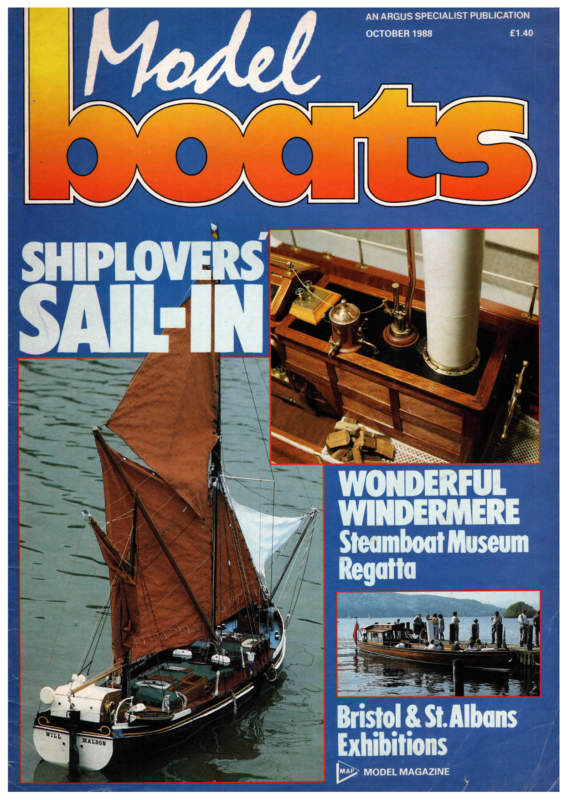
- SHIPLOVER’S SAIL-IN
- Ray Brigden visits the Thames Shiplovers Model Society’s Annual Rally at the Round Pond, Kensington
- CURVED AIR With Model Yachting Association General Secretary Russell Potts.

AN ARGUS SPECIALIST PUBLICATION £1.40 OCTOBER 1988 Steamboat Museum Regatta Bristol & St. Albans Exhibitions — MODEL MAGAZINE ; ad
SHIPLOVER’S. f you would like a good day’s model boating make a date in your 1989 Diary. It’s an annual event and always on the first Sunday in June, and attending as a spectator or with your model you will be made most welcome. The event is the Thames Ship Lovers Model Societies Rally and you would be hard put to find a more prestigious venue, being on the famous Round Pond near to the front lawns of Kensington Palace. The Society has been holding its rally at the pond since 1950. Vice Presidents John Fisher and Rick Hogben, who have been attending the Rally since it began, said that in the early days the event was for free sailing scale sail models that were judged by their on-the-water performance, and for the builders skill in producing a realistic model. The rally is still run to a similar pattern but with the addition of more classes due mainly to the popularity of radio control. Among the Societies’ membership can now be found enthusiasts for most sea going and inland craft, as was evident by the splendid array of models at this year’s rally, steam powered tugs and launches, electric powered paddlers and submarines, free sailing square riggers of all types – and as to be expected from Thames Lovers, an excellent display of Thames barges both radio controlled and free sailing. Society chairman Brian Wilson, with a team of members, marshalled the obstacle course for the radio controlled models while static judges Alan Crisp, John Fisher and Don Brown were kept busy throughout the day finding the best built models in each class. The sight of nine radio controlled Thames barges racing across the huge pond really was impressive together with the free sailing square riggers. Trevor Wilkinson mastered the tricky light winds Ray Brigden visits the Thames Shiplovers with his steam powered model of the launch Donola was adjudged winner of the Brunel trophy for best steam powered craft. The warship class winner was Tom Andrews with his now famous X-Craft. Not all the competing skippers were from the Society. The entry was hosted by a team of Bargees from the Southgate-London club. Among them was Mick Martin who told me they now have near to a dozen R/C barges at their club. He was competing with his own model of Alf Everard. The 43 inch hull he built bread and butter fashion from old floor boards and along with some very neat deck detail he has built a very attractive model. Model Society’s Annual Rally at the Round Pond, Kensington and by making many tacks to complete the outward run and letting loose the large sail area, he was able to keep ahead of the fleet on the homeward run to win the Barge Challenge Trophy with his model of the barge Westmorland. Deryck Brown 560 MODEL BOATS
sinh wh OCTOBER 1988 561
There was even a barge from Caerphilly M.B.C. in Wales, Will Everard, being sailed by its builder Philip Anstiss who had made the long journey with a party of club members to take part. Another group who had travelled many miles to sail on the famous pond were members of the Barrow S.M.S. One of them was Ian Sharp who has been attending the rally since 1973. This year he sailed his model of the 1910 schooner Westwood. There was nothing to match the massive sail area of Westwood as it screamed across the pond to win the him to keep ahead of the fleet and take home the Fred Pearson Memorial Trophy. Another wind powered enthusiast, Ken Williams, who hasa fleet of square riggers ~ some of which he built thirty and forty years ago – still look good and perform very well. His model of Star of the South sailed home to win the T.S.L. 25th Anniversary Cup. No Scale Sail rally-regatta or exhibition would be complete without attendance of Mike ‘Barge’ Taylor. Michael, a T.S.L.A. member, was giving his gold medal winning Green Dragon an powercraft, to his model of Chieftain, with outing. Michael did a good P.R. exercise for the Society and for the hobby in general throughout the day, answering the many questions of spectators who found somewhat over powered (Flames) smoke unit, it looked impressive as it made its first Sunday in June, put on by an Thames Trophy for Ian. Trevor Wilkinson stepped up to take another winner’s trophy, awarded for best feathering paddles turning and a way through the bouys. Tony Lench from near Canterbury, Kent, a great enthusiast for wind powered models, sailed his excellent 46 inch model of the Thames Barge Kate, sporting a very smart blue and white striped racing jib, but Kate bought no Trophies for Tony. That was left to another of his fleet. The well-set sails of his square rigger allowed the models of great interest. As said, a good day’s model boating the enthusiastic and friendly Society. If you would like to get among them before next June give secretary Alan Crisp a call on 01-602-9378. Monthly evening meetings are normally attended by an invited expert to talk on something nautical, and with a rise in membership we might be able to persuade T.S.L. to increase their Rally calendar.
t’s sufficiently long since I started a Vintage strand in these columns for it to be worth while recapping where we have got to in the three years or so since I first wrote about my experiences sailing three old model yachts that had survived from the pre-radio, pre-GRP era of model yachting. First off, there was a warm response from a number of people who had similar boats. Very few of these people were or had been active model yachtsmen, so I found myself dishing out advice on basic construction techniques and the sailing of models as well as on the The Vintage Group has over 50 members appropriate styles of rig and fittings needed to complete a period restoration. at present and there will certainly be more by the time that you read this, as vintage days like the one that is upcoming at Gosport usually add a few more. Exhibitions are also a good recruiting The Vintage Group which grew out of this informal band of boat restorers was a device to ensure that the MYA got something out of the people for whom their Secretary was providing an advice service. It is an alternative form of individual membership which gives access to the archive which I have assembled on the way things were done in the past, and to the network of specialist knowledge and skills that has been revealed among the membership of the Group. Almost any job that an owner finds too difficult or beyond his equipment can be farmed out to someone who has the right tools and experience and who will produce an acceptable result for, usually, a very modest charge. Even more important than the practical help is the encouragement and support that the members can give each other as we struggle with the many problems of period restoration. One problem that I have not quite succeeded in laying to rest is the tendency of some boat restorers to regard me as a vintage boat guru, who has all the medium. We did well at Shefford (photo 1) and we hope to form part of the MYA stand at the next “M.E.” Exhibition in January. Through the Group and through this column there is a steady trickle of old boats for me to see and write about. Some of them come with charming photos of their owners in earlier years like the one here (photo 13). The young man is now grown and has children of his own, but the pride of ownership shows through. The boat is a commercial seaside toy boat brought back from Landudno in the years immediately after the war. SECOND QUALITY. ” odel, lined as Se deck, els, Pole Mast i : ad Rudder, <—s. answers, not only to the practical questions, but to the moral problems as well. “Is it all right to put radio into a boat rt made to Sails, and Rigging fnisked. we. e 5 Ql-in. 1» 94-in. 1» Q71-in. » 6. 30-in. 36-in. » » 1. 42-in. » ae be yes, if that’s what you want to do with the boat. There’s no point in trying to run a vintage group Gestapo hauling people off for questioning about inauthentic restorations. If it’s your boat, you can do what you like with it. I am concerned only with two things. First, that a boat should be kept and sailed rather than be thrown away or (a fate worse that death) sold into the interior decorators’ market. Second, that you should know when you are deviating from 19-in. long 1 eo THIRD s000oo” plywood to replace a solid pine deck?” “Are terylene sails acceptable on a pre 1939 hull?” The answers to all these must Ps a that wasn’t designed for it?” “Can I use QUALITY. Size Ms 19-in. ” ” S: Q1-in. ” Us re 24-in. ” ” correct period practice. Those who ask this Top, Vintage Group stand at the Sheffield Show in March. Above, Stevens’ Model Dockyard Britannia, available from 19ins to 42ins overall. type of question are already among the blessed, because they know that there is a question to ask. If and when the boat passes to another owner, conscience will demand that they tell them “The deck should really be pine, but I cheated”, or whatever other deviation from period practice has been made. Radio seems to me to be an almost essential adjunct of old boats, if only because so many of their owners are not model yachtsmen of long experience and because to learn to sail a boat effectively with a weighted rudder, a Braine gear or a vane takes more time on the water than most vintage sailors are able to give. There is also the important social consideration that the occasional vintage days that we have are important opportunities for the exchange of news OCTOBER 1988 and gossip of all sorts. Because we don’t have a formal race structure to the meeting, there are none of the inter heat or inter round intervals that make organised model yacht racing such a sociable sport. All the boats are in action all the time and conversation needs to be combined with operation, so a radio that permits you to stand and chat while simultaneously displaying your boat to the admiring multitude is much to be preferred to having to hare off round the pond to catch a free sailing boat. Some more toy boats Following up the material in the August issue on toy boats, I have some more illustrations from old catalogues which bear out the point I was making about the time lags in the style of toy boats. They all come from the Stevens’ Model Dockyard catalogue of 1924 and I am grateful to Basil Harley for making them available. Stevens were founded in 1839 and were one of the leading model boat and model engineering suppliers for the next hundred 585
years. The “Britannia” model has a hull that pays more thana passing tribute to G.L. Watson’s original, though she has more displacement and more depth of keel than would result from a straight scale translation. The rig however is very much a model rig rather than anything the real yacht would have carried and is about as simple as it could be. The only concession to scale reality is the topsail, which only appeared on the larger sizes of model over 24 inches long. The steering gear is at least 20 years behind the game and is just a straightforward weighted rudder. Even more interesting are the part finished hulls for cutters in a wide range of sizes up to 42 inches, as well as schooner and brig hulls in smallish sizes. These all came complete with the spars for the chosen rig and left the purchaser to make his own sails. If, on the other hand, you felt you could make a hull but didn’t fancy sailmaking, Stevens would sell you a set of spars and sails for a cutter in a range of sizes from 15 inches to six feet. The smallest size were six shillings (30p) and the largest cost only £4 in 1924; in terms of average earnings, this is the equivalent of about £300 at present values, BEST QUALITY CUTTER HULLS. No. 13. in two colours. Lead Keel, Deck lined in Selected wood, well dug out inside, with sets of Spars, Vainted and varnished for rigging up. planks, Rudder, Deck Fittings, &c., ull ready No. 14. 22in. 27/- 32-in. 55/- 27-in. 40/- MODEL CUTTER YACHTS (Hulls only). 30-in. 27-in. 25-in. 21-in. 18-in. 15-in. Pee 60/47/6 36/24]17/6 11/6 bao Cut and dug out, with Deck and Rudder, unpainted, ready for fitting up and finishing. Size Price «ss No. 15. Size 36-in. 87/- MODEL CUTTER YACHTS (Hulls only). Britannia Model, cut and dug out, with deck and rudder, unpainted, ready for fitting up. Price No. 16. 19-in. 21/- Length of Hull a Price 35% ose 87/- 65/- 59, - 39/- 27/- 25/- 36-in. 30-in. 27-in. 25-in. 21-in. 19-in. J 42-in. 120/- MODEL FORE AND AFT SCHOONERS. Best quality selected Wood, well dug out inside, Hull and Spars only, Puinted and varnished in two colours. Lead Keel, Polished Masts and Spars, Rudder, &c., all ready for rigging up. 15-in. Length of Hull No. 17%. 24/- oe Price 17-in. 31.- 24-in. 20-in. 60/- 40/. MODEL SQUARE TOP SAIL SCHOONERS. Best quality selected Wood, well dug out inside, deck lined in planks, Hulls and Spars only. Painted and varnished in two colours. Se Length of Hul ae Tice... Keel, Polished Masts and Spars, all ready for rigging up. 25-in. 22-in, 19-in. l5-in. 13-in. BA oes 30/- 60/- 42/- 75/- 100/- 28-in. 140/- No. 18. BEST QUALITY MODEL BRIGS. Selected Wood, well dug out inside, Hull and Spars only. Painted and varnished in two colours, with Painted Ports, . Ii Legis of Hull.. eso seo 20-in zen in Lead Keels, Polished Masts and Spare, decks lined in planks all ready for rigging up. 30-in. i so the purchase of rigs for large model yachts must have been limited to a small No. 87 CUTTER SETS OF SPARS AND SAILS. With Riggings and Fittings ————— CURA ETT TURE Fim mireteee a) Seen