- CURVED AIR Model Yachting New from Russell Potts

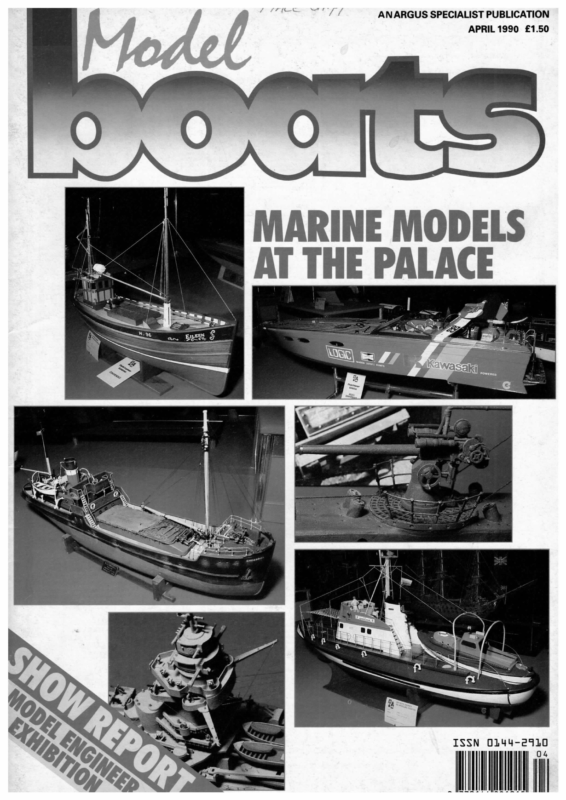
ANARGUS SPECIALIST PUBLICATION APRIL 1990 £1.50 MARINE MODELS AT THE PALACE ISSN 0144-2910
RM World Championship Fleetwood New Club on Old Water The lake at Forest Gate, adjacent to Dames Road, has played an important part in the history of model yachting. It was built about 1908 by the Conservators of Epping Forest specifically for the purpose of model boating and was the home from that date both of the Forest Gate MYC and of a parallel power boat club. Forest Gate was one of the founding clubs of the Model Yacht Racing Association in 1911 and the lake was the venue for the first ever National Championship for model yachts when a 12-metre event was run there in the late summer of 1911. It occupied a single afternoon and attracted only a handful of boats, all but one from London clubs, but it was the start of serious competition on a nationwide basis. Many Nationals were overhead, it was the equal of any such factility elsewhere. After the second world war the lake was allowed to fall into a poor condition and the club’s numbers gradually declined. Sailing there was finally abandoned some time in the mid-1960s. The club folded up and there are, so far as I know, only two or three former members still alive. At the back end of 1988, the Conservators took the lake in hand as part of their rolling programme of improvements to the many ponds and lakes in their care. A JCB spent a week or so scouring the concrete bottom of the pond of the silt accumulated over several decades and when this was hauled away, there was a nice big hole suitable for a model boat pond. The idea was that the pond would fill up naturally from the small stream that runs through it. As you As expected, the International Yacht Racing Union – Model Yacht Racing Division (IYRU-MYRD) Permanent Committee (as we must now get used to calling it) decided, at its January meeting that the Las Palmas event should be transferred to Fleetwood. All National Authorities will have had details long since, but for the benefit of those who aren’t plugged into their national information network, they are as follows. The dates are August 18-24. The venue is Fleetwood, the premier model yacht lake in England and probably in the world. Entry, through National Authorities, is limited to 75 boats (five fleets each of fifteen) and racing will be under the MYRD Radio Control Racing System of 1989. The entry will be £40 per boat and entries close on 31 May. Planning is well advanced, considering the very short notice that the organising club have had of the need to mount so complex an event and is much assisted by being able to call on many of those who were involved in the running of the last RM World’s at Fleetwood in 1986. Despite my attempt to disentangle myself from the MYA’s competitive racing scene, I find I am drafted to do the pre-race paperwork Seaspray, a gaff rigged schooner model dating originally from the late 1920s. Photo: John Noble. wil recall, the summer of 1989 was unnaturally dry and there still has not been anything like as much rain as we would normally expect. The result was that there was only about 9in. of water in the centre of the lake and very difficult access from the sloping concrete apron. Things might have stayed this way, had Just to remind you what a competitive RM looks like, a shot from the Mermaid Trophy at Gosport last November. held there in the early days of MYRA, when its membership was concentrated in and around London. In 1913 an event at Forest Gate was filmed for one of the new Newsreel companies. The film was shown to great acclaim at a music hall in the Tottenham Court Road, but has unfortunately not survived for us to enjoy. Over the years, the Forest Gate club played an important part both in competition and in the administration of the MYA and provided themselves with a palatial clubroom in a nearby railway arch. Apart from the occasional rumble 52 not a group of aeromodellers from the club that flies on the other side of Wanstead Flats decided that they wanted to sail boats as well. They approached the Conservators, who said that they were prepared to spend money on filling the pond from the mains if there was a club which could show that it intended to make regular use of the facility. Things then moved fast. A club was formed with a nucleus of about a dozen members, a meeting was held with the Conservators and we now have a lake with sufficient water to float a Marblehead and a new club. The Forest Model Boat Club will be sailing yachts and electric powered boats. Internal combustion engines are barred from the water. The water is available for casual use by modellers every day of the week, but it would be nice if those who want to use this new facility were to support the Forest club, whose initiative has secured its provision. The Secretary is Roy Hunter, 13 Boleyn Gardens, Dagenham, Essex. Tel: 01-592 6560. again and to handle the phone calls at 0530 hours from the other side of the earth from people too mean to phone from home and too inconsiderate to think what time it might be at the receiving end. The Race Officer will again be Derek Priestley and the computer will be operated by Ian Taylor. Beachmaster will be Bill Winstanley, who did such an efficient and cheerful job last time and David Rose, who managed to balance last time’s budget to within single figures, is holding our spending hands in check again this time. Financial control will be even more vital than last time, as there doesn’t at present look as if there will be even the low level of sponsorship that we had in 1986. This will not matter, as we are satisfied we can lay on a satisfactory event without outside financial help if we have to. Perhaps in the long term we shall see Fleetwood becoming a regular venue for such events because no-one else can raise the money to mount them. Several proposed World Championships have had to be called off late in the day because a suitable sponsor could not be found and others have gone ahead only in severely reduced form when expected deals have fallen through. Another plus point for Fleetwood is that the organisation is geared to maximising MODEL BOATS
the amount of racing offered. Even with entries of this size, we confidently expect to offer over thirty races to each competitor in the course of the meeting. This is a lot better than has been managed recently in big events elsewhere and seems to me to be the minimum we should aim at, given the cost to competitors of travelling round the world to an event. Making all allowances for local habits, like leisurely lunch hours and not too much activity in the heat of the day, I think that organisers must make a real she can be taken up there to be shown off to the RM competitors, most of whom regard the early 1970s as the prehistoric era of model yachting. We also hope to have K1 Dainty Lady on show during the meeting and at the very least a small exhibition on the history of the class, mainly illustrated by plans and photos. Whether the budget will run to producing a souvenir booklet on the lines of the one I wrote for the R10-r World’s in Sweden in 1987 remains to be seen. I intend to put a radio facility into the boat was renewed in the 60s and sailed again. She is reported to be “quite fast’, but suffering from insufficient rudder area. _ Twelve Metre Some photos of a boat called Madalin, sent to me before Christmas by an enquirer in the Wirral. The boat is 60in. overall, 11in. beam and the hull depth from keel to deck is 10’2inches. The displacement is 26 pounds and I think that she is a 12-metre to the first (1907) version Another late 20’s model Bermuda cutter rig over a hull whose designer was frightened by a 30 sq. metre during the gestation period. Photo: John Noble. Sagitta so she can have some informal racing with the current breed and give a photo opportunity to those who want “then and now” shots of their own boat with a suitable antique. Other Vintage News As I’m pressed for time this month, there is only a little bit of vintagery this time and it’s largely cribbed from the material that is being generated by members of the Vintage Model Yacht Deck view of Seaspray. Photo: John Noble. effort to see that there is sufficient racing to make it worth the trip and to ensure that the competition is long enough to give an unquestionably fair result. As I am only the paper pusher this time, I shall not be involved in the whole of the organisation and reports in this column on the build up to the event will be limited to the particularly significant or bizarre. When it comes to reporting on the event itself, Mike Kemp, who writes in RC Boat Modeller and is more closely involved in the RM racing scene, will no doubt give a bow by blow account. I shall limit myself to what we journos call “colour” and personality pieces and to an analysis of the lessons, if any, to be drawn from the experience. Effects of RM World’s on Vintage Model Yachting Yer what? Well, what I mean is that the RM event in Fleetwood provides an incentive to move K26 Sagitta up the project list and get my finger out so that APRIL 1990 Group, as they respond to my request for information to build up a register of old and replica boats. First, a pair of boats built in the late twenties for the present owner’s father when he was relatively young. They were built at sea by a ship’s wireless operator and are very typical of the model boats of the period that were not class racing yachts. By this, I mean that they are clearly boats whose design was not drawn from the continuous tradition of competitive sailing which by then went back at least fifty years. They are much more influenced by full-size practice in the hull design than were the class models of the period. Seaspray is 3lin. overall, 27in. on the waterline and a modest 5in. beam. She is rigged as a gaff schooner. The sails were renewed and the hull renovated in the 1960s and, as the boat has been sailed quite a bit, are about due for another — major overhaul. The steering is by Braine gear and the other fittings are sparse and functional. This boat sailed at an early Vintage Day, but is now being refurbished for a further lease of life. Though she has the typical fin and skeg profile associated with the Braine gear, the rest of the hull is not particularly like any model yacht of the period. The same is true of the second of this pair. The hull form is akin to that of a boat to the full size “Square metre” Rule, popular in the Baltic at the period, though rather more beamy. There were models to this Rule in Germany in the early 1930s and a few 10-raters were clearly influenced by it. This boat is 40in. overall, 30in. on the waterline and 8in. beam. The fin follows full-size practice, though the rig as a Bermuda cutter owes nothing to either full-size or model racing practice. Again, of the International Rule. The dimensions are about right, as is the general style of the hull; the displacement initially seemed, perhaps a bit light, but I have checked it against my records of the boats engaged in the 1907 and 1909 races under the Rule held by the London MYC and it fits very well. It is just possible that she is a 42 “Madalin, a 12 Metre to the first International Rule of 1907. Photo: Charles Pearson. rater to the immediately preceding Linear Rating Rule of 1897, but I think it unlikely. The 12-m class died out in England in the early 1930s, but continued to flourish on the Clyde until Scottish model yachting went into a period of near terminal decline in the 1950s. The Rule is, of course, a full-size Rule to which the America’s Cup 12-m are built, among others. The Rule has undergone a few changes over the years, which affect the characteristic shape of the hull, so it is fairly easy to be sure that the boat was built in the first, pre-1914, phase of the Rule. Models were designed to the Rule at a scale of one inch to the foot. They were not scale models of existing boats, but 53
miniature examples designed to the Rule, taking account of the need for different relationships between the displacement and sail area in a model. (You can’t scale the power of the wind.) In any case, there were several model 12-m sailing by March 1907 in London and on Merseyside, well before Tommy Glen-Coats (who was a member of the London Model Yacht Club as well as several full-size yacht clubs) designed the first full-size example, which raced on the Clyde only towards the end of the 1907 season. Those model yachtsmen who held closely to the idea of following full-size rules and practice slavishly, wanted to call their boats “one-metres” and tended to favour “miniature” rather than “model” as a description of their boats. There was such a strong local team of designers in the Wirral club, that sailed on the lake in Central Park, Wallasey and was a strong advocate of the 12-m class. At that period they were an active designing club and relished the complexities of the Linear Rating and International Rules as separating the men from the boys as far as naval architecture was concerned. No MYA records before the mid-1920s have survived and central registration of boats only came in about 1925, so it is impossible to be certain whether Madalin was a Wirral boat. It is nevertheless very likely that she originated in the Wirral club, though there were others built in other Merseyside clubs before 1914. Sheer view of Madalin. Note very full hull form. Photo: Charles Pearson. The style of construction and the fittings are consistent with the period suggested by the shape of the boat, though the deck looks as though it might be a replacement in plywood. The original would have been in Bin. pine and almost certainly elaborately lined to simulate planking. An original deck of that period would almost certainly have split by now. The fittings look to be home made, both from the slightly clumsy style of the Braine steering quadrant and from the fact that they appear to be made in copper, which is very unusual in commercial products. Also by this period, commercial fittings were usually, though not universally, nickel plated. 12-m were typically over-canvassed and with their very big mainsails, hard to control off the wind. In the early 1930s the Birkenhead club raced them to windward only. When it comes to re-rigging her, Madalin’s owner may feel that discretion recommends a second suit rather than a top suit for recreational sailing. Contact Addresses: MYA Matters: Ian Taylor, 115 Mayfield Avenue, London N12 9HY. Tel: 01-446 1625. Vintage Group and Old Boat Queries: R. R. Potts, 8 Sherard Road, London SE9 6EP. Tel: 01-850 6805. SaIL PLANS OF IST, 2ND, AND 3RD Suits OF 1t2-METRE DeEsicn “ Yum.” Hatch and mast step on Madalin. Photo: Charles Pearson. Right, Madalin’s rig would probably have big gaff main and minimal jib as per this Daniels 12-m of about 1972. 54 MODEL BOATS