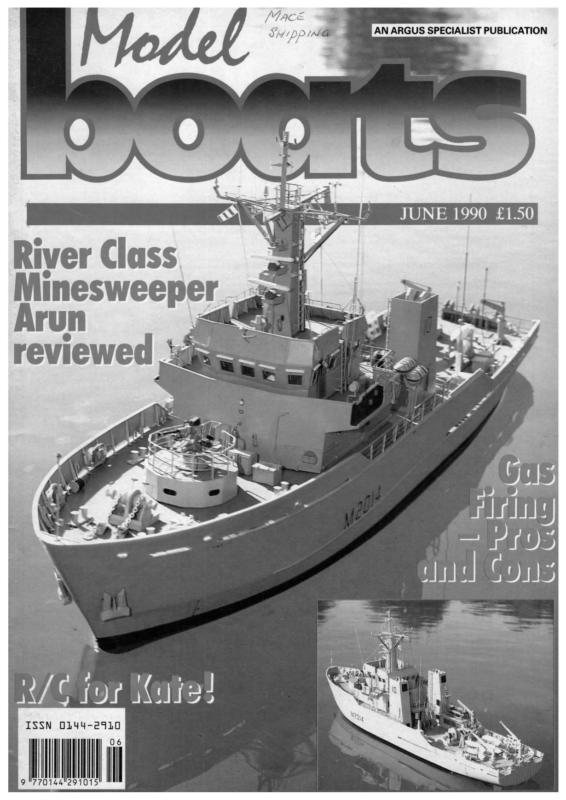
- Petruchio~R/C for Kate Basil Harley fit R/C tp his restored Edwardian sailing boat.
- CURVED AIR Model Yachting New from Russell Potts
- The Model Yachtsman
- Yachts Rule OK? A practical introduction to IYRU rules – by Nick Weall – Part Two

River Class , Minesweeper _2o8 Arun ae reviewed ‘ae ring = P15 4 d “OLS: R/ Caran Gree ISSN 0144-2910 9-7101 4 4°291 015
ate is an artisan built sailing boat, made in 1910, which has been the subject of careful restoration work which I described in Model Boats in March 1990. In the article I suggested the possibility of fitting her with a removable radio steer unit, albeit with some hesitation. When restoration work is done on an early artifact of any kind it is essential to respect, as far as possible, the design, craftsmanship, materials and intentions of the original maker. And Edwardian sailing boats did not have radio control. Ideally no changes should be made at all; in other words pure conservation techniques should be adopted to keep the forces of change and decay at bay for as long as possible. However, with working models of boats, as distinct from glass case models, some repairs and replacements are usually necessary to bring the vessel back to sailing condition. Much of the satisfaction of doing such work is finding out as much as possible about the original and using similar materials and techniques in the restoration process as were employed initially. This I did with Kate. Nevertheless, I see no reason why modern radio control should not be used to increase the pleasure of sailing vintage boats always provided that no significant modifications are made to the original Top. with the vidder control boisin TOT in a very light wind. Alita Kaate, Seutorédt toher 1910 condition, sailing free on Bournville Poolin Birmingham. Continuing in on a starboard tack Kate is brought head into wind before pulling away on a port tack. This simple manoeuvre can be repeated to make t close hauled boat travel the length of the pool. 26 MODEL BOA’
Steering alone For the first experiments I felt that a steering control alone should be sufficient to increase considerably the pleasure of sailing her. As T.E. Biddle in Model Yacht Building and Sailing (1879) pointed out “A properly constructed vessel, when pressed down on her side, has a strong tendency to shoot up into the wind; but as the wind lessens this decreases and therefore the degree of helm necessary to keep her straight in the height of a squall will then turn her head right away after it is over. Therefore, as it is impossible in a model to have somebody at the tiller to ease the helm, an apparatus is necessary by which the helm can be altered at various degrees of inclination.” Biddle recommended a simple weighted rudder, later more sophisticated gear was adopted but since it is now possible to have “somebody at the tiller” by radio why not use it? Kate’s control rod from the servo is a flexible steel wire cable housed in a brass tube which carries it safely under the sheet horse and clear of the brass wire hook which serves as a traveller. An inch or so of the cable is unsupported by the tube and allows sufficient movement up and down to accommodate the sharp angle at which the tiller moves relative to the deck. The rudder did not work as freely as I should have wished for the servo to move it. Indeed, after sailing it seemed stiffer than before, and I was astonished to find, on dismantling it that neither the wooden rudder post nor the hole through which it worked had ever been painted and so, distorted by the wet everything had tightened up. So a little easing with a round file and sandpaper to give extra clearance was followed by three coats of yacht varnish. Hiding the R/C I have used the relatively inexpensive Technidrive 2-channel outfit made by Acoms working on 27MHz. I am sure that there must be many plastic boxes which could be adapted to house the gear but one seemed inappropriate for an Edwardian boat and I wanted the unit to look reasonably like the aft cabin on a Bristol Channel pilot cutter. So I made a wooden box from mahogany with a ‘,in. ply bottom curved to follow closely the camber of the deck. Although perhaps it would not Middle, the only permanent modification to Kate is the tapped brass insert let into the deck. Above, mahogany control unit fastened to the deck by a single screw. The servo push rod is carried under the sheet horse in a brass tube to activate the brass tiller. All photos: author. fabric. Whilst it might be possible to fit radio inside some yachts which have removable hatches this is not possible with Kate. Her hull was carved from the solid and she has a very permanently fixed deck about *%in. thick with no access to the interior. There are many toy and simple model yachts now being rediscovered which are of this type. For these the ideal way of fitting a radio would be to clip or clamp it to some of the existing fittings – sheet horse, bollards or whatever – and this is obviously the first possibility to be examined. On Kate I have JUNE 1990 had to compromise since there is no suitable fitting to which the unit could be fastened. So the control box is screwed to the deck with a single */,,in. coarse thread screw inserted into a threaded brass socket recessed into the deck. This is the only permanent addition to the boat and is quite inconspicuous. Although the wooden rudder post comes up through the hull there was no trace of an original tiller and the rudder is not weighted. So a simple tiller with a brass ball for the plastic socket on the servo push/pull rod is the only new fixed item for the control system. have mattered if I had raised the main boom to give more clearance I was anxious to avoid having to change this and, by placing the “cabin/box” fairly well aft, about an inch in front of the main sheet horse, there was just enough room to fit battery, receiver and servo and allow the boom to clear the lid. The servo is screwed to blocks of wood to position it whereas the receiver is held by double-sided sticky tape. The battery slots in to the remaining vacant space. I have put the operating switch outside. The unit is quite weatherproof and the openings (switch, cable tube, lid) are all well above normal splash levels. In really rough weather a broad electric band, like the postmen use, seals the lid joint and also covers the switch toggle. After all, Kate is not a submarine so it doesn’t have to be watertight. A single screw secures the unit – the deck camber inhibits it from turning or 27
twisting round – and the same fastener, made from a short length of *%in. across-the-flats brass, is tapped on the top to accept a similar coarse thread screw for fastening the lid. This only needs to be removed for access to the batteries or to remove the complete unit. I have taped the aerial into the lid of the box and it works perfectly well over the distances I have so far controlled Kate but there is no reason why it should not be run up the mast except that it is a bit untidy and could get mixed up with the running rigging. A new dimension as far as you wish until the rudder is put hard over, when she will turn into the wind and, after a moment’s hestitation, swing on to the other tack and come home. This is the basic way of running her but quite significant changes in direction can be made even though you are not able to from the straight run which means that the boat has to be turned round by an assistant on the other side of the pool. Running round at my age isn’t on! Control is not, of course, as effective as it is with a power driven boat on rudder only but to give many of these older vintage boats the adjust the sails. Close hauled she can tack very successfully up the length of the pool. full treatment with sail winch as well would often involve re-design. I think that Kate would be better with a bigger rudder but, once you start thinking on those lines you really should get a modern boat because your old one will soon cease to have any antiquity left. I sail her across the wind with the Above all, you don’t have to be running about all the time and when the wind is a little bit blustery it is great fun to try to anticipate wind conditions by watching the catspaws on the water. Oh, why Petruchio, you ask? headsails set to give a slight bias to Well, how does it work? The first thing to say is that it does give a whole new dimension to sailing. It gets one away Shakespeare, of course, The Taming of the Shrew (or the musical Kiss Me, Kate if you prefer). After all, he knew all about controlling Kate! windward with the rudder held over a few degrees to correct it. Biddle’s weighted rudder did just that. Kate will then sail out DEAN’S MARINE The Old School, Main Street, Farcet, Peterborough. Telephone 0733 244166 Our New Catalogue £3.50 inc. P&P SERIES 1. A.S.R. LAUNCH L32” x 6” most probably one of the seaworthy exciting most added to our range. models SEE YOU AT SANDOWN PARK Free info sheets on this model S.A.E. THE SPECIALIST SHOP FOR ALL MODELLERS OF SHIP AND BOATS. THAMES SAILING BARGE At long last, HMF have completed and released their working, sailing model of a THAMES SAILING BARGE. Length overall 34” (Hull 26”) Beam 6%”, Height 26”. The kit is pre-formed in high impact styrene, and contains all the fittings. 2 removeable keels are supplied for light and heavy weather sailing (ballast is required). Also material in brown and white for the sails. Designed for 2-channel radio. No expensive sail winch servo is needed. All 6 sails will work off a standard servo £74.95 + £3.50 post and packing. The following books are also available:- Spritsail Barges of the Thames and Medway £17.95, Barges (Leather) £18.50, Sailing Barges (Case) £25.00. (P&P on each book £2.50) PROPORTIONAL DIVIDERS That elusive tool essential for all those scale conversions. Both linear and circle divisions. 8” length, machined aluminium. Replaceable points £38.45. VERNIER CALIPER Also of considerable value is a vernier caliper with dial reading. Metric only. From 0.1mm to 150mm. Internal/external and depth facility £14.89 RED OCTOBER The hunt is on! Watch for the release with Sean Connery and then build the models:- USSR Typhoon 1:350 £13.99, USS Ohio 1:350 £9.50 (both from Italieri). USSR Typhoon 1:400 £10.25, USS Dallas 1:400 £6.99 (Both from Revell). USS Ohio with USSR Alfa 1:700 £5.99 (Italieri); USSR Typhoon with USS Dallas 1:700 NOW WITH 24-HOUR ANSAPHONE £5.99 (italieri). CUTTY SARK – NEW MODEL A new, smaller kit for the Cutty Sark. Scale 1:135, Length 59cms (23”). Features a pre-formed solid wooden hull and is complete with fittings. £59.95 – GOOD VALUE. READY TO RUN In stock again is the good looking VEESPORT 2660 fast motor cruiser. Completely fitted out WITH Radio Control, motor, speed controller almost ready to run. Requires battery packs, with considerable choice of power and duration. £149.95. PLANKING AIDS Plank bender (nipper type) Amati “Form-A-Strip”. Get the curvature to suit the model £8.65 or invest in the Aeropiccola electric plank bender £22.10. Also helpful is a pin pusher to help in getting the nails smoothly into the hull £7.30. Finally, to hold the keel while working on the hull, there is a choice of 3 Artesania Latina £13.50, Aeropiccola £14.65 and the De-luxe Amati versatile vice with swivel base and multiple position jaws £34.50. GO PADDLING Already announced is a super set of FEATHERING in paddle wheels designed for the Graupner kit of the paddle tug Glasgow. This 5%” pair of wheels offers new scope for this subject. Will suit Forceful and Director class paddle tug hulls and also the Talisman hull. The Paddle wheels set is £32.50. (RMINIATURE TABLE SAW The Proxxon miniature table saw is available again. In our opinion this is the best small table saw available at present. Table area 160 x 160mm. Uses 60mm saw blades. Depth of cut 10mm. Voltage 230-240 volts. Saw dust collecting box. Straight guide and mitre gauge £89.95. Good value. OPENING HOURS BOOKS FOR MODELLERS Here is a small selection of useful books for modellers. More than 200 titles are carried in stock. Modelling Brig of War Irene …………….. £35.00 Plank on Frame Models Volume One .. Plank on Frame Models Volume Two .. £14.00 The Arming and Fitting of English Ships OE VV OT POO BG UO veccasccstccscssvaccasescecs £30.00 The Construction and Fitting of the Sailing Man of War 1650-1850 £3 Ship Models from Kits ……….. Ship of the Line Volume One Ship of the Line Volume Two …………… £20.00 Seamanship in the Age of Sail …………. £30.00 Masting and Rigging. The Clipper Ship and TOON OIE ves peccioescoscsivccscscsencicecess £18. Construction of Model Open Boats …….. £3.25 From Tree to Sea (Steam Drifter) ……… £17.95 Sailing Barges (Carr) ……………0..e0ccee £25.00 Naval Weapons of World War Two …… £30.00 The Tea Clippers their history and development …………..-:::s:seegeee0 £1 Merchant Sailing Ships 1775-1815 …. £1 Merchant Sailing Ships 1815-1850 …. £1 Merchant Sailing Ships 1850-1875 …. £1 Great Ships the Battle Fleet of King Charles the First ………………000 £2 British Steam Tugs …… Old Time Steam Coasting y Steam Coasters and Short Sea Traders . £14.95 THE ANATOMY OF A SHIP SERIES The 100 Gun Ship Victory ……………….. £14.00 The Type Vil U-Boat 000.0000… £14.00 The Frigate Diana ………… The The The The 4 20 Gun Ship Blanford . . Royal Yacht Caroline …………………. Fairmile ‘D’ Motor Torpedo Boat … Battleship Warspite …………………. £14.00 £15.00 £14.00 £14.00 The Cruiser Belfast …….. ; The Bounty ……………… The Liner Queen Mary The Sullivans Fletcher Class Destroyer £14. Post and Packing on books priced under £25 is £2.50. Over £25 the cost is 10%. We are the only UK stockist/distributor for U.S. magazine SHIPS IN SCALE £3.50 per issue, 6 MON-SAT 9.15 am-6.30 pm Maritime* Models » Greenwich e per year. Suny 7 Nelson Road, Greenwich LISTS AVAILABLE Timber 60p; Fittings £1.00; Hulls 50p. Send SAE ~Y London SE10 Telephone 081-858 5661 0 ii for other lists available including ranges of plans and other catalogues and listings. Post & Packing is additional to all quoted prices and enquiries must be accompanied by SAE or International Reply Coupons. Prices shown include VAT. Listed prices are On sea per MAIL ORDER SERVICE THROUGHOUT THE WORLD : ACCESS : BARCLAYCARD : AMERICAN EXPRESS 28 Kindly mention Model Boats when replying to advertisements MODEL BOATS
CURVED 42% One of the reasons that the VG keeps growing is that it contains a small number of individuals who are enthusiastic beyond the normal level. Most clubs have this hard core of very active members, but the VG has perhaps a few more of them. In the average club, there are the people who actually do the donkey work of organising club events and producing club newsletters. Because MYA News: An important correction In last month’s column I wrote of radio 6-m races at the Birmingham National Exhibition Centre on 26 and 27 May. This was a moment of mental aberration. The races, which are indeed to take place organised by Mike Ewart, are for 1-metre boats not 6-m. Sorry, I just got carried away with the idea of a burgeoning of radio 6-m activity and attributed this imaginative scheme to put radio sailing before a large audience to the 6-m sailors rather than the 1-m boys. Met & Southern Vane 6-m The Metropolitan and Southern District Vane 6-m Championship, was held for the first time for very many years, if not for the very first time ever, at Clapham on 11 March. Though dependent on a Midland influx to make up the numbers, a very satisfactory meeting was held. I was told the result, but I confess I have forgotten it. It is of much less importance than the fact of the meeting being held at all. One of those who was on the lakeside for most of the meeting was Philip Leigh, who must be our oldest model yachtsman still active. He joined the Clapham Steam and Sailing MYC as a boy of 14 in 1919. After a career embracing serious competition in the 1920’s and in the years after the war as a member of the YM6 and South London clubs, he rejoined the present Clapham club a few years ago and sails a vane 36 with the assistance of a runner. Another sidelight on this 6-m meeting is that several of the casual strollers on the side of the pond, who are a feature of racing at Clapham in any but the most unpleasant weather, commented that these were different boats from the ones usually to be seen there and that they looked nicer and more like a proper boat. This is rather surprising to me, because I would not have expected the world and his wife walking the kids on a Sunday afternoon to be able to tell the difference between a Marblehead and a hole in the water. While no-one would suggest that a class should be supported simply because the casual onlookers think they look nicer than another, it is an interesting commentary on the aesthetic appeal of the modern M that even inexpert observers find them hard to like. RM Worlds Some people seem really keen to come to Fleetwood for this meeting. We have had five firm entries (with money) by the first week in March and a number of 40 Helios, Admiral Turner’s last ‘A’ class design. Photo: Quayle. enquiries that suggest that the entry will be well filled and that a number of old faithfuls from Spain and Switzerland enjoyed themselves enough last time the World’s were at Fleetwood to want to come again. The organisation of the meeting is going forward smoothly and it looks as though we have just about completed the recruitment of the Protest Committee. We may have to look for another member if there are enough surplus entry places to redistribute at the second round to allow John Cleave to sail, but this should not pose insuperable problems. VMYG Keeps on Growing The aesthetic impulse I mentioned in the context of the Met & Southern 6-m event is an important motivator for many members of the Vintage Model Yacht Group, who find modern shapes of boat and modern materials less pleasing than the designs of earlier years and construction in real wood. Despite the usual loss of numbers at the time for renewal of subscriptions, membership is now over 80 and there seems every reason to hope for a membership of 100 by the end of the year. This would make the VMYG the biggest affiliated group in the MYA by a considerable distance. It’s only our good nature that prevents us from mounting a coup at a General Meeting and insisting that the MYA goes back to wooden boats with cotton sails as the norm. Another shot of Helios, built in 1948, now restored and radioed. Photo: Quayle. there is no regular sailing activity ata single geographical centre for the Group, the keener members find themselves organising local events which often take the form of participation in modelling exhibitions. These always attract a few additional members and bring to light a few more boats. MODEL BOATS
THE MODEL, YACH, I SS ay Now the VG is a separate organisation, we have our own logo and letterhead. This was designed for us by one of our members who is a graphic designer. Older readers will no doubt recognise that it has a close affinity with the masthead of the magazine Model Yachting on its foundation in 1928. It’s not quite the same, as the image has been compressed to fit into the oval and the rig of the boat has been transformed to a gaff rather than a bermuda sail. Purists who know that the original image is a photo taken in 1925 of Bill Daniels’ “A” boat Crusader may feel that this is a sacrilegious amendment, but we decided that a gaff rig spoke more directly to the uninitiated of what we were trying to do. As we get ourselves better organised this logo will be appearing on our published output and on exhibition stands. In the longer term, it may appear on members’ boats as well, we have (as yet uncosted) plans for a small VG brass plate, incorporating the logo and leaving space for the engraving of the boat name and some historical information. This would be an upmarket (and suitably VG) version of the silk screen-on-plastic club sticker that is seen on many modern boats. Pastime, a boat after Feltwell’s Pat design of 1927. Again rescued, restored and radioed in Barrow. Photos: Quayle. H Hardey Simpson Last time, I wrote enthusiastically about my discovery of this forgotten master modeller in the pages of the pre-1914 Yachting Monthly; since then, I have got well on into 1917 in my researches without turning up the articles on spar and sailmaking that I expected. Whether they were subjects he didn’t feel competent to deal with or whether the war prevented him from completing the series I don’t know. I hardly think the latter can have been the case as Yachting Monthly was hard put to find material to fill its pages during the war years and would have been glad of more modelling material to fill the void left by the cessation of all full size racing and nearly all cruising. Small snippets of information about Simpson himself can be gleaned from the occasional letters he wrote to the magazine. He was born and brought up in Canada and his first sailing exploits were in Vancouver Sound on a variety of ill designed craft that convinced his family that he was not born to be drowned. It’s not clear when he came to England, but he had been sailing cruising craft in the Irish Sea for many JUNE 1990 years and by 1914 he was too old for active military service. He therefore felt justified in spending some time on designing new full size boats to the Conway SC Restricted Class. He also reveals that he had built two of his earlier designs for the class with his own hands, using outside assistance only in cramping up the more recalcitrant planks. On the modelling side, he became involved in a controversy with Alfred Turner, who in 1917 contributed a long and theoretical article on the sort of design required by models for success in the International Rule classes. This argues for lighter displacement and more acceptance of the penalties arising from the girth difference term in the formula than was found in Simpson’s 12-m designs or in those of Bill Daniels, published in the 1913 edition of Marshall’s Model Sailing Yachts. Turner supports his arguments with designs for a number of 80cm boats all rigged as schooners. Some of these had not been built and others Turner himself suggests did not have the power to carry the rigs that they were entitled to under the Rule, so he may have been arguing his case for lighter boats without a lot of real evidence. The Turner article is interesting as containing what are probably his first serious attempts at model design. They also show very clearly his methodical “engineering” approach to the problems posed by the International Rule and his level of theoretical understanding. There is, at this stage, no suggestion of the theories of balance on the metacentric shelf that he was to develop in the 1930’s, but it is clear that this is the sort of mind from which that sort of theoretical study was likely to grow. In defending his “maximum D, minimum d” style of 12-m, Simpson quotes instances when boats to his design had been successful in competition in both heavy and light conditions when sailing at Southport and at West Kirby. These locations suggest that Simpson’s model sailing activity was Mersey based and, as he makes clear that neither of these was his own home water, reinforces the assumption I made last time that he was a member of the Wirral club. 41
Looking back at the last few paragraphs, I get a slight qualm that this sort of historical detective game, which I find fascinating, may not appeal to all my readers. Then I think to myself that nearly all the people who write in MB are enthusiasts for their own narrow segment of a pastime that is amazingly various in its activity and in the scope it offers for personal obsessions. The question is not whether other people are as fanatical about your specialism as you are, but whether you can make it sufficiently interesting to hold the audience for the few minutes it takes to read. No doubt you will let me know if you find this sort of thing a bore. Old ‘‘A”’ Boats ‘Helios’ and ‘Pastime’ The other leg of my obsession with model yacht history is old boats and this, All Nations race that replaced the Yachting Monthly cup for that year. She was a big boat even by Turner’s standards, loa 80.5, lw] 53.5, D 62.5 and SA 1650. In 1949 she was among the leaders of the fleet in the early stages of the A championship, but faded towards the end in light conditions. Another version of the design, Moonraker, built and sailed by Peter West, placed second in 1954. After a few years at Gosport Helios went north to Barrow, where she still is, and has been beautifully restored by her present owner as the photos show. She has of course been converted to radio, with an enlarged rudder mounted on what is probably the original size of skeg. Another boat in Barrow that has been there all her life is Pastime. She is based on a Feltwell design, Pat, dating originally from 1927 but, as the match the sheer perfectly. If you can’t, the boat will never look right, quite apart from the need to get it exactly the same on both sides. I know no-one can see both sides at the same time, but the builder always knows that it isn’t quite right. This boat is again converted to radio and is a credit to her restorer. I include “before and after” of a 10-r to a design by a local Barrow builder, Mr Coade; these show what can be done even with unpromising material. She never was and never will be a handsome or distinguished boat, but what a fine job has been made of the restoration. Cygnet II Another Feltwell boat just rescued from neglect and awaiting restoration has turned up in East Anglia. Originally from the Highgate club, she is K174, Above, Cygnet Il, a Feltwell design built in 1930. Very probably a Frolic. Photo: Ralph Smith. Below, a crude home built toy from the early part of the century. Worth a restoration if you are prepared to risk all the work for a boat that can’t be made to sail properly. Photos: J. Brookes. I know, is shared by at least a fair proportion of my readers. This month some significant boats from the history of the “A” class that have been preserved and restored. First a real classic. Alfred Turner’s Helios, K580, first registered in 1948 was effectively the last “A” boat that the Admiral designed. She was an enlargement of his Seri design, a version of which, under the name Tinker Bell, had won the 1948 British Championship but had been defeated by the American Ranger in the 42 certificate honestly records, ‘“‘altered”’ by her builder. Pastime was first registered in August 1934 by her owner and builder, J Rowe, one of the stalwarts of the local club, and was on the register until 1937. She was not re-registered after the war. One of the photos shows her during restoration with the planking cleaned up and varnished. A very satisfying result for the restorer. The darker sheer strake shows up well in the original photo and demonstrates the builder’s confidence that he can get the run of the plank to Cygnet II. The register shows her to be a Feltwell designed boat, built and owned originally by E J Bullock. She was registered in April 1930 and seems not to have been re-registered after this first certificate expired. There are no records of her competitive performance that I have been able to trace. Her dimensions, roughly taken off the hull, without the benefit of a measuring tank, are loa 69, lwl 42, beam 14. Though the Iw] is a bit small to match exactly the dimensions of Feltwell’s design Frolic, published in MODEL BOATS
fairly certain that she was intended to be to this design. No other “A” design by Feltwell was published before Cygnet was built and Frolic, which dates originally from 1925, was one of the more popular of the early designs to the Rule and several boats were built from it before publication. The hull profile and general style matches the Frolic drawing closely. The displacement intended in the original design was 37.7 pounds, with a sail area of 1900 square inches, but the original boat was inadvertently over this by a pound and a half, changing the lwl measurement and reducing the SA to 1846. She went so well that no attempt was made to reduce the D to get additional sail area, and later versions were generally built to the larger hull dimensions and smaller SA. Indeed, several hulls were built with the sections opened out from a design Iw] of 45.6 to one of 47 inches, distributing the increased D of 38.09 pounds over a longer and finer hull and further slightly reducing the SA. Cygnet is in fair condition under some very grungy paintwork and came with several suits of sails including one belonging to a Highgate 10-r K250, Gauntlet, first registered in 1931 and scrapped in 1935. The sails, which were possibly used as a second suit for the “A” boat, have remained with her through her wanderings since the mid 1930’s. The hull is built plank on frame in mahogany but the deck is in ply, which suggests that it is not the original. Toy Boats From the sublime of the “A” Class to the near ridiculous of the toy end of the market. One of the people attracted to the VG by our showing at the ME Exhibition came up with the set of photos shown here. They are of a 39.25 loa hull and.some spars and are thought to date from the 1930’s or possibly earlier. The displacement is 12 pounds and the sail area must have originally been quite large as the mast is about as long as the hull, but is clearly lacking a top section of indeterminate size. This is very clearly a home brewed toy boat, and its preservation must be attributed to the “bald teddy” syndrome that I spoke about last month. It is so far removed from any conscious process of design that it is impossible to date it on grounds of style. It may be as old as the turn of JUNE 1990 An example of what can be achieved in the restoration field by hard work and patience. Photos: Quayle. the century, it could have been made last year by someone completely ignorant of what model yachts should look like. The hull has neither shape nor make about it and is little removed from a tramp steamer “floating box” concept with a fin grafted onto it. The actual construction however is not bad as a piece of carpentry; it would not have survived as long as it has if it had not been fairly well put together. The hull is made on the “bread and butter” method and the deck is a very solid piece of pine at least a quarter of an inch thick with the camber planed into the thickness of the wood. The relatively small ballast weight suggests that the construction is quite crude and most of the weight is in the hull. I fear that the desperately crude plate and bolts holding the ballast and fin together may be the original builder’s idea of how it should be done, as the fin is hardly thick enough to take a keel bolt of the more normal style. Certainly at the period of the boat’s construction there would have been no possibility of using an epoxy glue to make a simple butt joint between lead and fin as I should be inclined to attempt now, if I wanted to make a boat of this form. The rudder seems to be a later addition and is no more than a trim tab that can be set before the boat is released. There is a small piece of metal folded round the rear of the rudder, possibly intended to make it a swing rudder, but the weight is clearly inadequate for its purpose, even if the pintles were originally free enough to allow the rudder to swing. It is easy to sound superior about a boat like this, but provided you don’t expect to get a sparkling performance out of her and regard it as an exercise in nostalgia rather than the restoration of a classic boat, she will repay the effort to make her look good again. Whether she will ever sail worth toffee is another question and can only be discovered by trial and error. Unfortunately this process of trial on the water can only begin when a substantial amount of work has already been done. Not a task to undertake unless you are prepared to run the risk that, after all your work, she will only be good for the mantelshelf. Contact addresses:MYA Matters: Ian Taylor, 115 Mayfield Avenue, London N12 9HY. Tel: 01 446 1625. Vintage Group and Boat Queries: Russell Potts, 8 Sherard Road, London SE9 6EP, Tel: 01 850 6805. 43
A good example of the first windward beat in a SW Ranking Race at Cotswolds. Chris Dick’s white hull leads the starboard tackers with Graham Bantock to windward of him on his starboard stern quarter. Brian Corley, nearest the camera, has broken away for clean air on to port with boat immediately behind him looking about to follow. Photo: Lindsey Kirk. The position so far… This is the second article in a series aimed at introducing the International Yacht Racing Rules and the tactical applications of those rules in a gentle manner to the Radio Controlled Novice Yacht Racer. In the first article we covered the start and a lot of basic information. If this article interests you and you have not got or read the first article, it would be well worth your while to contact the publishers to purchase a copy of last month’s issue, (May). This series will cover forty eight issues, going into the subject in easy stages through the basic rules and tactics on to intermediate and finally advanced tactics and interpretations of the rules. There will be many useful tips and aside lines along the way to help you get the best from your boat and yomrself. As time goes by it is planned to report on interviews with the top Skippers in an effort to try and understand all there is to know about racing Radio Controlled Model Yachts. Our correspondence corner invites you to write in to get my opinion on that incident that has been puzzling you and our little question posed each month gives you a chance to win a very useful rule book, which includes masses of illustrations of the rules in action. Those of you who read last month’s article may well recall that our novice skipper had made a good start, being on starboard, crossing the line just after everybody else, but right up close to the 58 Starboard boating up to the windward mark at the ‘89 RM Nats at Rhyl. David Coode (far right) seems to be ‘pinching up’ to try and lay the mark. Frenchman Patrick Gerodias (32) is well placed, as is Tony Ryan’s XI1, sandwiching Graham Elliott’s 42 with fellow club member Les Robin’s 93. Mark Dicks’ 66 in hot pursuit. My money is on the Frenchman! Photo: Lindsey Kirk. starboard starting mark. I confidentally wrote that if he/she could manage to do that, then there was a very good chance that they would not be in last position going round the windward mark. Diagram 1, shows the position of the five racing yachts a few seconds after the start. Yachts X, A, B & C had all started on starboard, with X, A&B having reasonable speed. Your yacht C had to slow downa little because B did not leave you any space between itself and the starboard starting mark – so you had eased your sails out a bit and headed slightly up into wind, so as to slow down a bit. You then almost immediately sheeted in again gaining speed and just missing the mark. You then hardened up on to a close hauled course covering B’s starboard stern quarter. Yacht D had started with good boat speed on the Port Tack right down by the port start mark. She then had to tack to starboard to miss X, since port tack boats must give way to starboard tack boats. (Rule 36). She might have chosen to bear off under the rest of the fleet’s sterns – but she wasa little too near to X to be able to do that without having to lose too much speed. This sets the scene for our first windward beat. Now the windward beat should, if the windward mark has been laid correctly and there has not been a sudden wind shift, consist of a series of close hauled tacks beating up to windward and thus to the windward mark. In diagram 2, accepting that the wind is being very kind and blowing at a steady strength and direction, then sailing along any of the courses shown will bring you to the mark having covered approximately the same distance. (O.K. wise guys, we are ona lake, so we do not have to worry about different tidal strengths or river currents!) You will notice that the outer lines radiating from the windward mark are called laylines. So called because when you arrive at a point intersecting those lines – it is time to tack – because you MODEL BOATS
DIAGRAM 1 ARTICLE 2 “A FEW SECONDS AFTER THE START” How to make good use of an old bicycle frame! The front forks have been cut down and padded to allow a yacht’s keel fin to be located between them with the hull resting on the forks. An extension welded to the forks has two little forks holding the keel fin 2/3 of the way down towards the bulb. This main frame is cut off, flanges attached and fixed to the base. To use, simply place the yacht in a close hauled position to the wind, sheet in and you can easily adjust the sails to achieve your idea of perfect trim. Designed and made by Eric Roberts, Commodore, Gosport MYC. Photo: Lindsey Kirk. also need to consider the waves and any gusts of wind moving across the water. It is a waste of time trying to tack into a wave, it will usually push you back to the tack you were trying to tack from! Tacking in a gust is even harder than tacking in the already strong wind, so wait until the gust has passed if you can. So the point is that the most experienced skipper should lose the least amount of speed when tacking and regain any speed lost the quickest. Thus it is up to the novice to practise tacking and to observe how better skippers do it. Remember that the rudder acts to some degree like a brake – the more you turn it, the more it will slow you down. can then “lay” the mark. That is reach it on a close hauled course without having to tack again, (except to actually round the mark if you are approaching the mark on a port tack.) So the basic conclusion that one should arrive at, after having studied the diagram, is that from a distance point of view you are likely to cover the same distance as any other yacht however many times you tack going up the windward beat. Why then do yachts tend to get separated outto some extent on the windward beat? Well, they will not all enjoy the same boat speed for one thing, not only because they will all be tuned differently, but because not all of the racing yachts will be sailing in clean air or water. Tacking Supposing however that they were all to enjoy the same boat speed, there are still a number of factors that will make some courses better than others. The most obvious fact is tacking. Usually JUNE 1990 tacking will reduce boat speed, especially in model yachts. Models cannot produce the drive you can get when executing a roll tack in a dinghy, which in light airs can produce more drive in the sails than wind alone would do.) The amount of speed lost depends very much upon the skills of the skipper tacking the model yachts. Methods of tacking vary with the type of yacht being sailed and the strength of the wind. In light airs, one should be very very gentle with the amount of rudder used, the objective being to maintain momentum at all costs. You will quite likely turn through more than ninety degrees letting the sails out a touch to gain maximum boat speed on the new tack before sheeting in and hardening up on your new course. In medium winds, you might well still turn gently for the first half of the tack, but as you go through head to wind, you speed the turn up a bit until on the new course. In heavy winds you may need to sheet out slightly, bear off a touch and slam the boat around to the new tack, sheeting in and away. In these conditions you You’re not alone The other most important factor is that boats around your yacht do not allow you to do everything you might wish to do if you were simply out there all on your own. Thus you may get carried along way beyond the point where you could have tacked to lay the mark by a yacht to withward of you. Also of course, yachts on a starboard tack can force you to tack back from port to starboard to avoid them. Thus it pays to look well ahead and plan what you are going to do to get to the windward mark with the least hassle. Other points that will vary boat’s performance are the ability to point high to windward, i.e.: some boats will be able to sail a course closer to the wind than others, which will enable them to get to the windward mark quicker. Concentration will differ from skipper to skipper. Some boats will overlay the mark, some will get involved in incidents and the resultant penalty turns, others might pick up a piece of weed or rubbish to slow them down etc. etc. 59
Wind strengths DIAGRAM 2 ARTICLE 2 Also once we get into the real world instead of basic theory we will soon discover that the wind is anything but the nice steady predictable thing that you might of thought it was before getting involved in some activity using the wind. It is very annoying to first discover that the wind seldom blows from a single direction for any length of time. It will very often come from a general direction, whilst shifting from that mean direction either side from a few degrees up to twenty or twenty five degrees or so. The strength that the wind blows at does not remain constant either. It tends to wander up and down with gusts of heavier wind moving through. Different directions of wind do have different characteristics, which we will “COURSE OPTIONS TO THE FIRST MARK” > | | v | A > o > > za o = > oO xz PORT MARK a upon. > oe eee A x 2 A Ss “tp Wind shift – a Let’s now look a little more closely at one or two basic things about the wind in A =” on relation to the windward beat in particular. How do we know when the wind shifts? The easiest way for the novice to notice is by keeping an eye on how the other boats beating to windward are behaving. If you notice for example that all the other boats on the same tack have started heading up to wind more than your boat, then you should try the same heading if in the same area. If you are beating up to the withward mark on a close hauled tack and the wind shifts allowing you to sail in a direction more directly towards the windward mark it is called a “‘lift’’. i.e. you are getting lifted in the direction of the mark. It should follow that if you are enjoying this sudden kindness from the wind, that anyone on the opposite tack is getting “Headed” that is they are now sailing a course that it taking them further away from the windward mark than before being headed, and more importantly they are not sailing anything like as a direct course as the opposite tack. Thus the sensible thing for a headed boat to do if possible is to tack to the favoured vt a ao go into later in the series. The main thing at this stage is to be well aware that the wind can vary in strength and direction as this goes by. You also need to know that it can vary in strength and direction at the same time on different parts of the course that you are racing WINDWARD MARK ®) Lpont TACK LAvLINE > – Ko S& Se s — ee STARBOARD START MARK “lifting tack”’. If you study diagram 4 you can see the extremes of effect that a minor 10 degree shift of wind can have, favouring on this occasion the boat on course A. If you have no idea what the wind is going to do next, then it can be wise to sail a course not too far away from the rhumb line – that is the imaginary line going straight from the start line to the windward mark. However windshifts can develop into a regular pattern and experienced yachtsmen will, if they have the time before the start of a race, make a note of the wind’s direction and make a note of the timing and direction of any wind shifts. This should take them from between ten and thirty minutes to establish. This way they have a chance of predicting the side of the course they choose to sail up and where they want to be on the start line. It is not a thing for 60 cap ap 2 oe veers doa yan on the right looks towards Pitstop. Photo: Lindsey Kirk. as cnr: Race. Russell Potts at left. ‘Swanley’ member Tony his ‘cheer leader’ who is inspecting the novice to worry about at this stage, but reacting to a wind shift that has occurred is, especially if all the other yachts racing have. Another way of getting a clue of what the wind is up to is by the patterns the wind will make upon the waters surface. Easiest to spot are gusts. As they move across the water they will darken and ripple the waters surface – making their direction very obvious. You will need to learn how your yacht behaves in varying strengths of wind, so as you may respond appropriately to such gusts. If you are lucky your yacht ” R sl as i llery’ iil will screw up tighter into wind and hold or increase her speed. If not you may have to sheet out the sails a bit, whilst maintaining a close hauled course, to let some of the winds increased pressure out of the sails, to avoid the yacht being flatted, and increasing drive. In my opinion you should tune up your yacht to respond to such increases in the wind by gently heading up to her new close hauled course but not beyond. I like my boat to be almost able to sail up the windward course without my touching my transmitter except to tack. It is worth noting though that there are many MODEL BOATS
DIAGRAM 3 ARTICLE 2 DIAGRAM 4& -ARTICLE 2 = “a 10° WINDSHIFT, FAVOURING COURSE ‘B’” WIND SHIFTS IN THIS DIRECTION ARE CALLED GOING ROUND OR VEERING i.e. THE WIND HAS GONE ROUND FROM SOUTH TO WEST. THE WIND HAS VEERED TO THE WEST. WIND SHIFTS IN THIS DIRECTION ARE CALLED “BACKING” i.e, THE WIND HAS BACKED FROM EAST TO NORTH. S WINDWARD MARK @ ORIGINAL COURSE DISTANCE 9-6 5-4 — 17-5 32-5 = NEW DISTANCE HEADED 10° COURSE ‘B’ Sac LIFT 10° — SHIFT ORIGINAL DISTANCE 30-1 > +17: THE EFFECT OF A 10° WIND SHIFT DIAGRAM 5 7 4 NS se WIND SHIFTS 10° 227-6 NEW DISTANCE ARTICLE 2 DIAGRAM 6 ARTICLE 2 (i) as CLEAR AHEAD CLEAR ASTERN sae OVERLAPPED; ‘A’ HAS ‘LUFFING’ RIGHTS OVER ‘B’. ~< rss x ~ WS < s. “ oN je Se ~ B = — Slats NOS eS ST SS Ss ~~ — = ae = et = ~ ad = za Ss SS —_ - Soe = = Sa a ee Sn —_ See — a = = aes a —_ one Ss << ~ ‘ aS ~s. 7 \ oe TM x Sth 2 pee \ Z N ! \ roy | \ ! ne Ne \ a ~ ~ & "THE EFFECT OF THE WIND TO WINDWARD OF ‘A’ WILL PREVENT °B’ FROM POINTING QUITE SO HIGH AS ‘A’ JUNE 1990 - BE CAREFUL" ' e | on ~ (iii) !| OVERLAPPED- BUT ‘A’ HAS LOST ‘LUFFING’ RIGHTS OVER ‘B’ ‘B'S MAST !S ABREAST OR FORWARD (AS HERE) OF THE STEM (BOW) OF THE LEEWARD YACHT(‘A’), 61
different opinions as to how to tune your yacht, how to set sails etc. etc. Some just as good as others. Listen, read and experiment so as you can form your own opinions. Back to diagram 1. We are Boat C managing to hold more or less the same speed as B, A, X & D. What happens next? All the boats will continue on starboard evaluating their relative speeds and positions. Boats D & X will find it very hard to overhaul A because they are to some extent in the wind shadow of the boat to windward. What is wind shadow? Well it is the area of space to leeward and slightly to windward of a yacht that is effected by the winds passage over the sails, causing variations in wind pressure and direction. Diagram 5(i) shows the worst position, when B tries to pass A to leeward - it will slow B down and she will not be able to pass - unless her relative boat speed was so much greater than A’s to carry her through this turbulent area of weak wind. One solution is to ease out the sails a little and bear off to pick up speed to clear A before sheeting in and hardening up to windward again. In 5(ii) the situation can be worse, although the turbulence is much less it has the effect of heading the overtaking boat. The solution here is to work your boat further to windward before you attempt to pass to windward. (Easier said than done!) DIAGRAM 7 ARTICLE 2 po fee mee REF: RULE 38.2(e) ‘A’ HAS LUFFING RIGHTS OVER BOTH ‘B AND ‘C SO CAN LUFF - ‘B’ AND ‘C’ SHALL RESPOND, EVEN THOUGH NORMALLY ‘B’ WOULD NOT HAVE LUFFING RIGHTS. Overlapped Now going back to the concept of fairness in racing I can explain Rule 37 a little more. First however let’s define the term overlapped. “A yacht must be either clear ahead or clear astern of each other or overlapped. Yachts are overlapped when they are both within two boat lengths of the longer yacht. Diagram6 (i) & (ii) should clarify things. Rule 37.1. When overlapped a R REF. RULE 38.2(e) ‘A’ CANNOT LUFF NOW BECAUSE ‘D’ IS FORWARD OF MAST ABREAST STEM. wishes to pass on. 37.3. Transitional. A yacht that establishes an overlap to leeward from clear astern shall initially allow the windward yacht ample opportunity to keep clear. Again that seems fair, the boat ahead must be given time to respond to the new situation. However once the boat ahead has been given that time it must be very careful indeed, because if the overtaking At the Mermaid, Chris Dicks leads round the windward mark. Lindsey Kirk skippering 90 approaching the mark correctly will be 3rd round. On far left is Nick’s old Hush Hush owned and sailed by Louis Dann of Leicester, a former Olympic standard dinghy skipper, who will no doubt give us a hard time once he gets the hang of transmitter twiddling instead of ‘hanging over the side’. Photo: Nick Weall. windward boat shall keep clear of a leeward boat. That is surely fair, the leeward boat is struggling to sail upwind - the yacht to windward if converging presumably is sailing to another destination and so can bear away under the close hauled yacht’s stern. If she is beating towards the same mark as the leeward yacht, she should not be on a converging course, but a parallel course and thus should be able to keep clear. If it is that she simply cannot point to wind so well, though 62 she’ll have to tack or go under the boat is sailing a slightly higher course to windward than the over taken boat is able to sail, then the boat being overtaken will have to tack away. The overtaking boat should bear this eventuality in mind and be aware that as the other boat tacks away it’s stern may swing towards the overtaking boat. leeward boats stern. If she is bearing Luffing dump some dirty wind on the leeward major rule we need to consider in this down onto the leeward boat so as to boat then that is quite O.K. as long as the windward boat keeps clear. Rule 37.2. When not overlapped. A yacht clear astern shall keep clear of a All this paves the way for the last article. Rule 38 - Same tack - luffing after clearing the starting line. This I’m afraid is a lengthy rule, but yacht clear ahead. Well that seems fair. since it provides you with your main than the boat clear ahead, it can see need to know it well. You also need to be If the boat clear astern is sailing faster better what is going on and choose which side of the boat clear ahead it defensive weapon as a boat ahead you prepared to respond to a luff, when you are overhauling a yacht to it’s windward. MODEL BOATS
How the windward beat can look on this bank side. | took this picture over Mike Kemp's shoulder he has already rounded the windward mark - so has turned round and is walking back towards and in time past the rest of the skippers so as to be as near as possible to his boat as it approaches the next mark. From r. to |., Chris Dicks, Les Robins, David Coode’s head, Lindsey Kirk, and Hugh McPeake in bobble hat. Photo: Nick Weall. WIND INDICATION (Fa Q& The definition of luffing is: Altering course towards the wind. This means up to just before head to wind, remember as soon as you pass through head to wind you are considered to be tacking and come under Rule 41. Rule 38.1. Luffing rights. After she has started and cleared the starting line, a yacht clear ahead or a leeward yacht may luff as she pleases, subject to the following limitations of this rule. Rule 38.2: Limitations (see diagram 6(iii) (a) Proper course limitations. A leeward yacht shall not sail above her proper course while an overlap exists, if when the overlap began or at any time during it’s existence, the mainmast of the windward yacht has been abreast or forward of the stem of the leeward yacht. (b) Overlap limitations: For the purpose of Rule 38 only: An overlap does not exist unless the yachts are clearly within two overall lengths of the longer yacht; and an overlap that exists between the two JUNE 1990 A PLASTIC PRACTICE GOLF BALL ON TOP OF YOUR TRANSMITTER AERIAL, PROTECTS PEOPLE'S EYES IN CASE OF ACCIDENTS. yachts when the leading yacht starts, or when one or both of them completes a tack or gybe, shall be regarded as a new overlap beginning at that time. (c) Hailing to stop or prevent a luff. When there is doubt, the leeward yacht may assume that she has the right to luff or sail above her proper course unless the skipper of the windward yacht has hailed (i) Mast to stem or words to that effect, or (ii) “Obstruction” or words to that effect. The leeward yacht shall be governed by such a hail and curtail her luff. When she deems the hail improper, her only remedy is to protest. (d) Curtailing a Luff: The windward yacht shall not cause a luff to be curtailed because of her proximity to the leeward yacht unless an obstruction, a third yacht or other object restricts her ability to respond. (e) Luffing rights over two or more yachts: A yacht shall not luff unless she has the right to luff all yachts that would be affected by her luff, in which case they shall all respond, even when an intervening yacht or yachts would not otherwise have the right to luff. That, you will be glad to read, is it! Please remember that you do not have to learn the rules off by heart, all you need to know is the rough idea of what it is all about, you can always look the rule up in the book if it ever goes to a protest. So rule 38 has an important defensive part to play, because it is difficult to overtake a beating yacht to leeward, it is natural to want to overtake it to windward and steal it’s wind. This rule gives the boat being overtaken to windward a powerful weapon. I hope you can see the fairness of the rule here, allowing the leeward boat to try and stop the overtaking windward boat from sailing too close to the leeward boat stealing it’s wind. A luff by the leeward boat is going to force the overtaking boat to head higher up to wind and slow her down. Certainly the luff will also slow down the leeward boat, but since she is in command of the situation she can choose when to stop luffing and bear off again to pick up speed. The windward boat can only respond once she realises that has happened and thus will fall back a little. If the luffing boat can time it right and luff up sharply, then she may catch the over taking boat out and actually touch the over taking boat. This action will force the overtaking boat to accept a penalty, she will either have to do two turns on the water or retire. That is the most effective way to use the luffing rule to stop someone overtaking you to windward. Remember that the luffing boat must protest the overtaking boat the moment that contact however minor takes place. The luff can be as sudden and as violent as you like, provided you do not go beyond head to wind. A couple of points worth noting are that your luff must not cause serious damage to the overtaking boat, in practise it is very difficult to cause damage even with the most violent luff, because all that tends to happen is that the overtaking boat will contact with your bow or bow quarter and push it to leeward. I remember seeing at the 1988 R.M. Nationals a yacht in very windy conditions literally luff so violently on the crest of a little wave that the front half of the yacht leaped out of the water, up to windward and on to the overtaking yacht. No damage was done and I’ve always though of it as the perfect example of the violent luff, quite legal and very effective. The other point is that you must be careful as the luffing boat not to get into irons, which can be very embarrassing. Even worse, do not get pushed by the wind beyond head to wind. The other boat can then claim that you are attempting to tack in his water and you would be the one to do penalty turns. A gift Here is a wonderful gift - you can be nasty to overtaking boats to windward and actually impose a penalty on them if they are not wide awake and you manage to touch them! WhenI first discovered this rule - I had to do the penalty turns! (Well I was the hopeful and ignorant overtaking boat!) But once 63
the rule had been explained to me and I had purchased a rule book and looked it up, I fell in love with it. My arch rivals and I, would luff each other everywhere, I’d even slow down a bit to find a boat to luff. What fun, at the back and middle of the fleet, penalties were being doshed out like Smarties. However gradually I began to notice that whilst I was having a lot of fun, other boats that were not actually involved with me and my luffing, would be slipping quietly by from behind, gaining two places at least. That is the danger of using this rule too much, it is not worth stopping one boat LEAD COUNTER WEIGHT WIRE FRAME CLOCK TISSUE PAPER (DOPED) er a OR SOLAR FILM PIECE OF THIN FLEXIBLE SILVER FOIL STIFFEN AT THIS POINT MOUNTING WIRE from getting by you, if it allows others by you to leeward whilst you are luffing. I suspect however that the only way to learn how to use this rule to your best advantage is to go out there and have some fun. Without doubt used correctly it is a fine defensive weapon and we'll be referring to it alot in this series. So go and have a luff or two! Now with a little knowledge of rules 35, 36, 37, 38 and 41 vaguely swimming around inside our heads lets tackle the windward beat a bit further up towards the windward mark. Beating to the mark Remember you do not need to be able to quote either the rule number or the complete rule whilst on the water - you merely have to remember for yourself the bare bones - so as you know what you can and can’t do, when to accept penalty turns and when not to, but to protest the other boat instead. Don’t even worry too much at this early stage if you can’t even remember some of the rules we’ve covered so far, just accept that if you are involved in an incident and you don’t understand the in’s and out’s of it, you are going to have to do two penalty turns right or wrong. Look again at diagrams 1, 2, 3 & 4, we are boat C and it should now be obvious that none of the other boats can tack at the moment until we do. (Rule 41.1 Basic Rule: A yacht that is either tacking or gybing shall keep clear of a yacht ona tack.) Plus of course we are on starboard, close hauled. For the moment we are in command of the fleet! Although for the novice I doubt that this state of affairs appeals too much because it will seem that his decision on what to do next is all the harder. The points to consider are these. If we and B, A & X tacked to port immediately B, A & X would all be to windward of us and would then control our course, because we would not be able to tack back to starboard until they did. So whilst we have command of the fleet we must use it and progress up the course towards the layline on starboard as at present. If you could retain the same sort of boat speed and direction as the rest of the fleet of five, it would pay you to maintain this course up to and beyond the layline for the mark. Look at diagram 8, the reason for sailing beyond the layline is that if all the boats retain roughly the positions as in diagram 1, when you tack to lay the mark B at least would tack also and promptly be on top of you to windward. By going beyond the layline it means when you tack, that you can bear off further to gain speed whilst laying the mark. Since you choose when 64 ! wouldn't try passing this to windward or leeward! USSW Iowa visits Gosport and Portsmouth. Photo: Nick Weall. to tack, you have a slight advantage over those who have to respond to your tack. That combined with the different angles of approach involved will increase your chances of getting to the mark clear ahead but on port and thus needing to tack onto starboard to round the mark without tacking in the water of any following boat. We will cover this point further in next month’s issue “Rounding the windward mark”. However in reality, going back to diagram 1, as a complete novice our boat C is not going to be moving quite as fast as the other four and they are drawing slowly ahead. We are possibly suffering a little from the leebow effect of boat B (Diagram 5[ii]), so we put in a tack to try and get some clean air and water. (Sailing through another boat’s wake will slow you down as well!) The other good reason for doing this is that we want to be approaching the windward mark on a starboard tack when we are about to round it. Once we have tack to port the decision on what to do next lies with B, who is very well placed to cover the rest of the fleet. Does she continue on her starboard tack covering the rest of the fleet or does she tack to port too. If we ignore possible wind shifts it is a difficult decision to make. Basic theory would say cover the fleet, but if B tacks she would still be in clear air and ahead of the rest of the fleet anyway. Thus she is likely to consider what sort of threat C is likely to post in the future as they beat up the course. The major potential problem is that if B holds course on starboard, and puts in as she must some time, a tack to port - there is a danger of C tacking back to starboard and forcing B to tack back to starboard to give way to C when their courses converge. (Rule 36 - A port tack yacht shall keep clear of a starboard tack yacht.) Now if this happens on or beyond the starboard layline no problem, B tacks to starboard and lays the mark. But if B cannot lay the mark, then the situation in diagram MODEL BOATS
DIAGRAM 8 ARTICLE 2 "SAILING BEYOND THE LAYLINE TO BREAK A POTENTIAL OVERLAP” WIND POS.(ii) “ Y e C ee POS.(i) B _PORT TACK TAYLINE vA x Se ra WINDWARD idee) cs A 4~ t 8 can occur again and even worse if B cannot lay the mark but C can, then B is in a very bad position. If B is aware that C is a novice she might well continue on her original starboard course from diagram 1, concentrating on keeping herself between the windward mark and the rest of the fleet until such times as she wishes to tack to port. Otherwise she’d be wise to follow C’s tack almost immediately, which would keep B to windward of C and in command of C and keep the rest of the fleet astern of B. By B being in command of C, I mean that C cannot now tack to starboard because she would be tacking in B’s water (Rule 41.1 - Basic Rule- A yacht that is either tacking or gybing shall keep clear of a yacht on a tack.) However C may well have luffing rights. C’s tactics in this situation have to be to try and sail as high as she can, pinching up to windward in an attempt to outpoint B, thus encouragingB to tack. Or if B gets too close a nice sudden luff might do the trick. In our situation though being a novice, we will simply carry on sailing our port tack course until B tacks back to JUNE 1990 A starboard at which time we will tack back to starboard ourselves. This will most likely be when B can lay the mark, so we have a good chance of rounding the mark in second place! Next time That is the end of this month’s look at the rules and tactics. Next month we will cover the rounding of the windward mark, this includes Rule 42 which is even longer than rule 38, but please don’t worry. I need to set out in these first few articles most of the rules that we will be covering in great depth throughout the series. We will be referring back to these rules time and time again. Each time that we do, should help you to understand that particular rule a little better. We’ve got four years to gently go through them gradually acquiring more knowledge and tactical skills. So relax, as I keep writing you do not have to learn the rules off parrot fashion. If you do, it will probably only serve to confuse you more, until you have acquired the actual experience of racing on the water. Summary Lastly a summary of this article’s main points: the basic objectives to remember on the windward beat. Keep your boat moving, make smooth tacks, avoid going into irons and maintain boat speed. Keep in clean air and water if possible. Approach the windward mark on starboard for the final run in. Try and keep your boat between the windward mark and boats astern of you. Keep calm, it is only a race! If you have not yet found a club, buy a copy of the M.Y.A. Yearbook, cost £1 including postage from: David Hackwood - 10, Grangewood, Coulby Newham, Middlesborough TR8 ORT, this will give you the address and contact name of your nearest club and get out there and try some racing. 65