
- Match Racing Organising a Match Race, and Measurement — discussed by Bill Green
- CURVED AIR Russell Potts on Akela, RA’s in Denmark, One Metres in New Zealand, and Vintage
- Yachts Rule OK? By Nick Weall — Part Ten

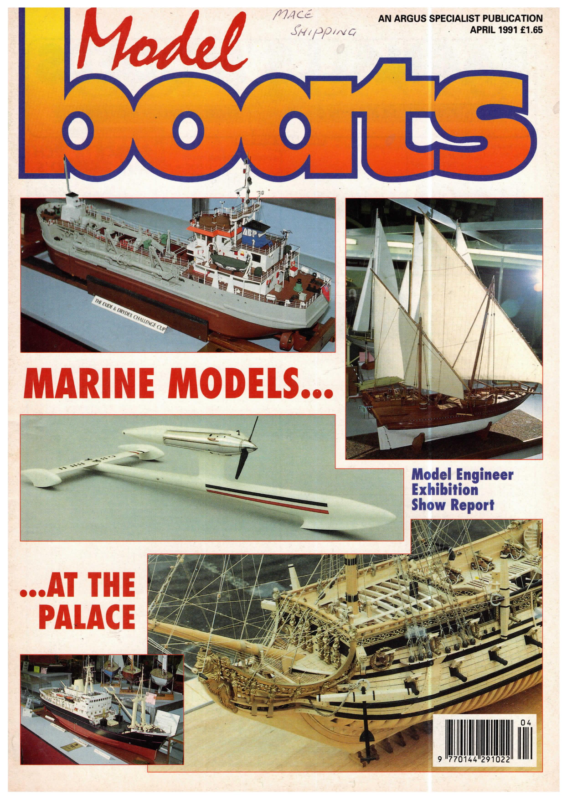
PIACE SH / PPING AN ARGUS SPECIALIST PUBLICATION . APRIL 1991 £1.65 Model Engineer Exhibition Show Report
Organising a Match Race, and Measurement — discussed by Bill Green n my last article I said that I would be covering several areas of interest in this article. As this article is being written when there is little competitive action on either the vane or the radio front to report I’m going to concentrate on organizing a match race and the measurement of displacement boats, the remaining part I’ll save for the future. On the radio match racing front I’d like to clear up a few misconceptions which may have arisen. First at the time of writing the MYA does not have a set of Rules to cover Radio Match Racing or match racing events. A set of Match Racing Rules has been drawn up by Mike Kemp and myself and these have been circulated around the existing fleet for comment and amendment prior to being submitted to the MYA for their ratification and approval. We have also produced a set of Rules for the Match Race Series which will also be submitted to the MYA for their approval, so that the Series can produce a MYA National Match Racing Champion. Until both have been ratified by the MYA the Match Race Series is an informal series of events. Both these items are being submitted to the MYA at the January 1991 Council Meeting and I shall keep you informed on the outcome. In the meantime the Match Race series will go on as advertised. Bill Sykes with his Gold Medal winning A class yacht Sakina. The MYAis also following the line adopted by the full size RYA in the encouragement of Owners Associations for the various classes, the ‘A’ Class has an internationally recognised owners association which is currently examining the ‘A’ Rule. At the same time that the I ‘A’ OA was formed a 6metre Owners Association was formed. The 6M OA has been dormant for a couple of years but with the upturn in interest in the class it is now prudent to make the Association active. If you own a 6m, be it registered or not, and you want further information on the Association then contact me through the magazine or you’ll find my address in the Figure 1 Wind Direction MYA Year Book. Finish Line Windward Mark Organising a Match Race Organising a match race event is no different to organising any other event. What is needed is some planning, some co-operation and the ability to learn from the mistakes of the first time so these can be corrected for the next time. For radio sailors match racing is a little strange because the style of competition is different, every competitor must sail each other as a pair as opposed to the normal of sailing in fleets. Schedule Leeward Mark Start Line The match race schedule, which is the basis of competition, is exactly the same as used by vane sailors. These are available from the MYA Supplies Officer David Hackwood whose address appears in the MYA Year Book and are available to cover up to 20 boats sailing. Competitors are allocated a AMERICAS CUP COURSE (as used in 1987 races) number up to the number taking part ie:- 8 competitors numbered 1 to 8. The schedule is then referred to for the pairings. What is obvious is that for pre-event planning you MODEL BOATS
Figure 2 Windward Mark have to do is to add everyones’ score and the one at the end of the event with the greatest score is the winner. Now all that’s very easy if you first of all complete the event and second if you have a clear points advantage for say the first three. More often than not neither of these two will be Wing Mark satisfied. In the first case of not completing the full board then normal vane sailing rules can apply, providing more than 66% of the heats have been completed then a Leeward Mark Rec result can be declared by simply adding up the individual scores. If there are byes, then a percentage of the heats sailed is taken and the result declared on percentages. We have found that it is possible to sail more than one board, in which case the choices are reversed for the second board and the result can be declared on the overall score. If the second and any ees Line TYPICAL OLYMPIC TRIANGLE & SAUSAGE COURSE {as used m most model yacht races) need a clue as to how may are likely to take part, that’s where some of the co-operation comes in. The vane schedules allocate for a pair the choice of starting berth, in radio match racing the choice is allocated to which end of the start line the opponents enter the start area at the time when Racing Rules apply ie:- 1 minute before the start. You then simply call up the pairs, in sequence, until the race is complete. I have drawn up a dummy version (Fig 3) and this is shown. If there is an odd number of you sailing that is no problem either, one of you has a bye in each of the heats. The schedule that I have used as an illustration is for a 7 boat race and you can see how the bye works, this can lead to some complications when scoring but I’ll deal with that later. Start Tape You will require a continuous start tape based on a 2 minute ‘Get ready to race’ followed by a 1 minute ‘When racing rules apply’ finishing with the starting gun with the usual countdown. As soon as one pair are started then the next pair are on the water ready to start and so on. This keeps the event moving and it is not unustal to have three pairs racing on the course simultaneously. Course The typical match racing course has an emphasis on windward performance and therefore the courses set must reflect that. The Americas Cup course (Fig 1) is a triangle and several sausages unlike the more usual Olympic course sailed in model yacht racing (Fig 2). On the normal model boat lake it is usually impracticable to lay an Americas Cup style course and therefore a compromise has to be made. The Olympic triangle course is the one usually set, but when laying*one for match racing you need subsequent rounds are not completed then call a halt to the event at the heat closest to the 66% on the second board and declare a result at that point. The second case of sorting out the ties is more difficult to try and explain. First concentrate on the first three Sailing Rules and Strategies As I mentioned in the start of this article the Match Race Rules have not yet been agreed with the MYA but if any one wants a copy of the provisional set then contact me or Mike Kemp. The normal rules of sailing generally apply but the strategies are different. Remember that it is head to head competition, you don’t have a fleet of others to worry about just one, so a good start is essential. The pre-start manoeuvres are all about getting yourself into the prime position when the race begins, this means gaining advantage right from the off. During the race itself, if you are leading, be aware of what your opponent is up to and cover his manoeuvres. There is a match racing maxim that says that you should keep yourself between the mark and your opponent if you are ahead, the actual winning margin is irrelevant. As a trailing boat you can employ all sorts of tactics in an attempt to deceive your opponent and gain the advantage, dummy tacks are not unheard of. Match racing demands a high level of concentration, awareness and anticipation and like all things practice makes perfect. Scoring A typical Match Race start. Rival (background) has the advantage over the near boat. This was the start of a grand tacking duel between them. The foreground boat is very interesting. The boat was designed by Richard Pierce from Scoring is simple; in match racing you get nothing for coming second, you only get points for winning whether by a nose or by a country mile. In the series so far we have used 1 point for a win, 0 for a loss. All you Windermere and as you can seé by the markings on the hull it has spent some time as a tank test model. Figure 3 HEAT 1 HEAT 2 HEAT 3 Pp 1 4 6 2 Pi] 2 4 a P} 3 6 1 4 S bail gs’ 3 ? S| B 4 1 ba B ? oS 2 2 a P| 5) 6 P] 4 ? to be aware that it is possible for two pairs to converge on the same mark because of the timing. It could be necessary to lay the sausage part into a different part of the lake to avoid congestion at a mark, only experience will provide the answer to that problem. Please also remember that the emphasis is on windward performance and adjust the course accordingly. You may also find it necessary to alter the course, particularly the start, during the event to maintain a true beat, again the conditions on the day will determine that. APRIL 1991 HEAT 4 P|} Ss 4 B 7 1 HEAT 5 6 3 HEAT 7 S B 6B B HEAT 6 fe 4 Ss 6 no zZ 1 Bye P| 7 3 o 1 P= Port End Start S ae 2 6 SS Starboard End Start A TYPICAL PAIR SCHEDULE FOR 7 BOATS a
MATCH RACING SERIES FOR THE Rém CLASS SCORE SHEET Race 1996 Series Board 1 Name W W M A § M N Green fkers Ewart Bright Bright Kemp Rothwell Board 2 Name z Heat No 1 2 3 4 5 6 ? No W W Green Akers 1 2 A Bright 4 M § HM IN Ewart Bright Kemp Rothwell 3 5) | ? 1 |Heat § 8 i @ i 1 Heat 1 Pair B 3 2 1 AL 62 3 3 B 3 2 1 1 2 | Heat 8 1 8 les 1 sorted out on count back ie;- who has beaten whom. If none of these sort it out then there is always the flip of the coin, not the fairest way but pretty effective. I’ve shown a typical score sheet (Fig 4) which came from the last series which should help sort out any mysteries. Co-operation The co-operation comes in for the first event, all this match racing business is probably a bit new and just a bit strange. The answer is simple: come to the line when you are called, if you are not able to compete because of genuine difficulties then say so, another pair can go on in your place. The essence is to keep the event moving, if you miss heats they can always be caught up with later, if time an conditions permit that is. This may sound simple in theory but in practise its not so easy, a little ‘urban terrorism’ by the Race Officer helps but it very much depends on the co-operation of all to make it really work. Race Officer The MYA has some pretty strict rules when it comes to this chap, especially when Nationals are concerned, as we know from last season. According to the MYA Rules the Race Officer cannot sail, but for the match race series we have adopted a slightly different approach in that the Race Officer can sail but in the event of any protest then he must withdraw from the event to fulfil his duties. All his score is void as are those who have sailed against him. As yet we have not had a protest to see if this creates any problems we have 46 g & 1 i 3 B 3 2 1 1 2 & Us) 8 1 1 3 4 Heat ore| Pair |Score | Pair 1 3 2 B 2 3 1 2 3 B 3 2 1 1 2 | Heat Pair |Score| positions, if there are ties the first course of action is to have a sail off between the tying boats to determine the result. If there are more than two boats are tied then a fleet race between the contenders should sort out that minor difficulty. If time or conditions do not permit the sail off to take place then very often the result can be not foreseen. 2 | Heat Pair |Score| Pair |Score| B 3 2 1 1 2 3 Birmingham 3. Name i A N A MN W W S 2 3 B a & 2 oy ae | 8 1 1 af 2 3 B 3 2 Kemp Rothwell Bright Ewart Green Akers Bright I hope that has sorted out some of the mysteries involved in organising a match race event, if you have any problems or any suggestions to improve the above then don’t hesitate to contact me. Measurement of Displacement Boats Displacement class boats such as the 6 metre and the ‘A’ class require significant effort to measure. Most radio sailors who are used to say the Marblehead measurement, which is primarily about measurement of sail area, find displacement boat measurement a bit of an ordeal. This is because the measurement process is slanted more towards the actual Another of the Windermere 6m’s. This one is designed by no lesser person than lan Howlett of 12 metre fame and is a replica of a full size 6. This boat has a few intriguing features, including a most peculiar winged keel complete with trim tab. It was built and sailed by Paul Legge from bi aka in the last of the recent Match Race eries. Heat 6 Heat ? 6 8 1 1 3 2 a 1 2 3 B 8 i 1 ‘] 8 1 Pair | Score | Pair | Score | Pair | Score Series Summary 3 Pair |Score 5 |Heat Bi B2 | Total 5 5 2? 2 3 if 4 2 2 8 2 1 8 6 Fi ? 6 4 5 2 8 hull form than the sail area. In both these classes the actual sail area is not measured; what is measured are the triangles into which the nett sail must fit. I am not going to concentrate on the sails but rather to try and ease the process for the uninitiated in the measurement of the hull form. I am going to use the 6 metre as the prime example, ‘A’s’ are similar but there are differences mainly brought about by the requirements of the rule. Figure 5 shows the main measurement points on the hull and as you can see they all spring from the load water-line. This is also where most measurement problems spring from as well, so it is vital to get the boat sitting on its true LWL in racing trim. It helps the measurer considerably if you can do this before you offer your boat for measurement. It takes about 2-3 hours to measure a ‘6’ even when it is right, so you can imagine the trauma of measuring one that isn’t right. I’d like to suggest four things which may help you. First build accurately to the design. Second ensure that the overall weight of the boat matches the designer’s statement on displacement. Third make sure that it is sitting on its correct LWL. Most sixes will fit into the average domestic bath and with some careful jiggling of the lead ballast this can be achieved. If this doesn’t do the trick then you have little or no choice but to use trim weights in the bow or stern to achieve the desired effect. Don’t forget to make a note of the size and accurate position of any trim weights as the measurer needs to know. The fourth thing is to come to an arrangement with your sailmaker. As I said earlier the actual sail area is not measured but the triangles into which the sail must fit are. So a temporary suit of sails will do for measurement so long as they are similar in weight to the final set. The sailmaker can then make the sails to suit the measurements. The other alternative is to have an oversize suit which can then be adjusted by the MODEL BOATS
Figure 5 sailmaker. Most of the sailmakers understand the problems with displacement boat measurement and will accommodate you, if they know what you are doing. The sails will have to be subject of a final check by the measurer of course. Finding somewhere and someone to measure a six can also be a problem. Clubs like Bournville, Birmingham, Gosport, Birkenhead have the facilities and the 13mm(0.5″) expertise to measure the class. It is normal for them to make a small charge for the use of the facilities. Contact the relevant Club Secretary who I’m sure will be only to pleased to help, if they can’t help then contact me. Gold Medal for Model Yachtsman at the Model Engineer Exhibition Main Measurement Points for a 6metre Li (Bow & Stern) is measured 13mm(0.5″) above LWL L2 (Stern) is measured 25mm({1″) above LWL Unfortunately I wasn’t able to get there this year but I’d like to add my congratulations to Bill Sykes of the Bournville Club for his Gold Medal. The medal was awarded to Bill for his new vane ‘A’ boat Sakina. I saw it not long before it went to the ME and it was a pleasure to see. Bill manages to combine a superbly competitive boat with magnificent engineering and he does it with together with something that is going to work very efficiently and effectively in a competitive situation. In the past Bill has had one Gold and several Silver medals for his yachts, his last Gold Medal was for another ‘A’ boat ‘Spinaway’ and that was in heavier in displacement, more sail area and Everything, but everything, is done to perfection, it seems a pity to sail it, but it successful model yacht design in the history of model yachting, more successful than the acknowledged ‘A’ Highlander by the late Dick Priest, and is not truly recognised for National where it came second in the hands of Dave Geldard. So its competitive future is bright. Sakina is destined to be sailed at the ‘A’ National at Fleetwood this year and monotonous regularity. He does everything from the design to all the fittings and sails. will be because that is what it was intended for. Bill’ does not produce glass case models to be drooled over. I’m sure he could do if he put his mind to it, but he doesn’t. Bill produces boats to win races and their superb construction and beautiful functionality assist in that process. It takes a not inconsiderable skill and ingenuity to put something that is a joy to behold which Bill then developed into the now all conquering V2. His latest ‘A’ design, of which Sakina is an example, is the next move on. Slightly the 70’s. Bill has produced the most a slightly different shape. Its first major competitive outing was at last year’s ‘A’ it. That design is Venceramous. Boats to the design have won5 of the last 6 ‘A’ it will be very interesting to see how it performs against its well proven and Nationals and figure considerably in the current ‘A’ fleet. Peter Maskell won three ‘A’ Nationals on the trot with Syan, a Venceramous 2 which is an incredible achievement. The original design was a collaboration between Bill and Ken Butler quality of fittings which look good and Four detail shots of Sakina. Note the vane gear is unusual with the dial are superb to use in competition. The rudder by gears instead of the usual positioned on top. The vane drives thefunctiona l, as is the deck layout, and tiller arm. The sharp end is clean and is the whole boat is steeped in competitive experience. It’s Gold Medal proudly displayed on the hatch cover. 4 # popular sister design. As a member of Bournville Club all I can add is that we are very proud to have a man of Bill Sykes’s stature and capability as our President and the Gold Medal just confirms that which we already knew.
Russell Potts on Akela, RA’s in Denmark, One Metres in New Zealand, and Vintage Akela Last time I wrote of the version of John Bone’s Akela that I was building and the small differences in construction and radio installation that I was making to adapt the design to the materials I had to hand and to my own style of doing things. Now we have a few photos of the nearly completed hull, showing how I have gone about it. The first two shots show the radio installation area with the radio gear fitted and with the saddle carrying the two servos removed. The “horse” over which the saddle fits is a piece of %in balsa fixed to the floor of the boat. Originally it was a plain piece just big enough to take the saddle and was gluedronly along the bottom edge and where the forward edge butted up against the fin. This proved to be unsatisfactory as the horse flexed excessively when the sheet servo was operated. I solved this by extending it sufficiently to take a pair of triangular gussets aft of where the saddle would come. The saddle is a push fit on the horse and is not fixed in any way. The pull on the sheeting servo tends to drive it up against the fin at the forward end and this should be a sufficiently secure fixing. If it does prove to need better location, a pin through the top of the saddle straight into The 1880’s Five Tonner Laura at Beale. . the horse will do. The stresses generated by rig and rudder in a boat this size are not going to be very great except when she is being held on the bank. Shot 3 shows the saddle out of the boat, simplicity itself with 0.8 mm ply either side of a balsa spacer. The servos are fixed to the ply with servo tape. In these photos you can also see the light framing I have put into the forward area of the hull to ensure that it stays true without a solid deck. When the hull has been painted there will be a shrink fabric deck to go on as almost the last job. Photo 4 shows the rest of the radio installation. The battery and the receiver will each fit (just!) into the space forward of the servo saddle and are retained by it when it is fitted. The weights are not Radio installed in Akela. 48 Radio saddle for Akela. MODEL BOATS
The 1880’s Five Tonner, Laura, at Beale. attempt to organise international competition for the radio class. One of the smaller groups of RA boats is Battery and receiver positions in Akela. perfectly balanced, but I don’t expect this will be significant when the boat is on the water with its 12 ounces of lead at the end of a long fin. I preferred this arrangement to that proposed by John as it avoids making a battery pack specifically for this boat. You can see that the hatch space is The final photo of this stage of construction (6) shows the fin which I shaped from in balsa and covered with carbon fibre weave. This doesn’t show up too well in the print, but it makes a very easy job using the materials I had to hand and is amply strong enough. Interestingly, rectangular (photo 5). I have made a thin ply hatch with a pair of balsa stiffeners and locating pieces underneath. This will be taped down and thus the switch, which is a miniature DPDT, has to be mounted on the say, rather plaintively, that boats must conform to the Rule. This is a valiant effort by a small group of RA enthusiasts that hatch. It should survive reasonably well if it is slathered with silicone grease before it goes on the water; alternatively you could deserves the support of British RA skippers. I hope that some of them will be persuaded to go. Further details from the MYA Racing Secretary, Martin Roberts on make a tiny brass ring to hold a thin rubber membrane over the switch to protect it. Or you could just say “what the hell” and carry a spare hatch with another switch harness and regard the switches as expendable. in Denmark, centred on the Viborg RC Klub. The club announce that they will be holding a “friendly” RA regatta on the weekend of 8-9 June this year. The club is situated in central Jutland and there is a camp site adjacent to the water and a youth hostel within a short distance. Entries close on 24 May and the entry fee is £7.50. The event is intended for all types of RA, both modern and vintage, and is going to be so friendly that they aren’t insisting on the production of certificates, though they do 051 608 8252. The hatch on Akela. it weighs about the same as the aluminium fin that John proposes. I think it could be made lighter with no loss of strength by paying more attention than I did to rolling the resin out very thin or even putting it under a vacuum. Either of these techniques would also give a better finish and require In the return direction, I hope our Danish friends realise that all MYA National Championships are open entry and that they will be very welcome. The RA Nationals will be held at Gosport this year on 21-22 September. Again, details from Martin Roberts. less work to get the fin to the standard of smoothness you want. Alternatively if, like one of my correspondents in Northern Ireland, you have a relative with access to the right machinery, you can have a-pair of fins done in the lunch break, profiled and shaped by computer to a glass like polish and knife edge sharpness. But the kitchen table can produce an equally acceptable result. It just takes longer. International RA Meeting in Denmark The days when international model yacht competition meant the Yachting Monthly Cup for free sailing “A” boats are long gone and the vane “A” class, overtaken by the popularity of the radio “M”, has become confined to the UK and there is no real hope of the revival of serious international competition for this class. The radio “A” is sailed in a number of the member countries of the [YRU-MYRD, but as the major The fin on Akela. APRIL 1991 concentrations are in England Australia and Italy, there has not so far been any Laura stripped down. 49
New Zealand Style In a recent post bag a very professionally produced 24 page souvenir brochure on the first New Zealand One Metre Championships held in Auckland last October. It comes from Mark Steele who wrote and organised most of it in his dual role of competitor and sponsor of the event. Mark is the local director of the Fiji Visitors Bureau, who thought it worth their while to put some money behind the event. They produced a very nice record of what happened, together with some material on the organising club, the Northern Maritime Model Society of Auckland, and on the class and its development. There is also some very interesting material on how the sponsorship was sparked and arranged and on the vast amount of work that went into ensuring that the weekend event went off successfully. Much of the organisational effort came from the grand old man of NZ model yachting, Fred Marten, whose letter to Model Boats I discussed last month. His efforts were crowned with great success and an entry of 37 boats from 10 clubs for three days of sailing, representing over 50% of the known Kiwi One Metres. The championship was a one day event and there were separate events on each of the other days. The weather seems to have been kind and the racing was close. The National event was won by David Watson, who edits the NZMYA Newsletter, thus proving that an ability to read and write does not automatically mean that you can’t sail for toffee. As is usually the case with any worthwhile model yacht event around the South Pacific, David Coode made an appearance and placed respectably. The results are in the panel alongside. New Zealand On eM Championship Skipper 1 David Watson 3 Bruce Edgar Pj idi ae 6 Keith Harris K. r Fai : Maida 9 Sam Allison 10 Peter Tait ; Andrew McGa ughe – es Le Breton ugene Amor 18 Les Wheele r 19 Bruce Ewin g 20 Brian Head ley 21 Trevor Lis ter s mo Chis holm * urray Lis ter Barry Stewar t a R. J . Hender son 6 Eric Kelly 27 Paul Le Bret on | Retired Mark Steele “a ierow 8 David Cood e Brown y Rest eee Saal It oe Hell Raise Teresa T : Vocdoc Ir; “ihre= Prince Swe ti E sie ong “I Ele tri ae Queensland Cougar Tangil si Wack D Ch ee Sting Fiji Flyer The boats sailed were in the main British and French designs, with Geoff Draper’s Impala and Plane Jane well represented. Geoff seems to have a particular corner in the affections of Kiwi skippers, who have been sailing his RM 1000 and its 50 in New Zealand over very many years, died sas 7 Paul Simmon ds 1m the North Island, but most skippers seem at present to follow European fashions. In his covering letter, Mark tells me that Fred Marten, who was responsible for so much of the organisation of this event, as well as myriad services to model yachting ieie 5 Andrea Chisho lm rhe Allan skipper and designer from the far north of because the small amount of sailing that I did with this boat over the summer revealed that the paintwork which had been put on her when she was restored as a display piece was not tough enough to stand up to even gentle use in her element. The paint was beginning to peel from the lead ballast and the rubbing of the keel revealed a nice brass covering strip that ran from the forward water-line to the heel of the lead. The paint in general was not rt : 4 Paul Chisholm 1m Watson derivatives for several years. There are local designs, particularly from Steve Marten and John Spencer, a full size heB 2 Scott Archer e Pane oe Per tit Laura stripped down. Steering gear on the 10-Rater. in December. Even though model yachtsmen seem to lead charmed lives, it has to end sometime. He will be sadly missed. Laura It is inevitable that if you use two reels of film at an event, the second one, which doesn’t get finished and is not available when you write the report, is the one that has the better pictures on it. This happened to me at the Vintage Day at Beale Bird Park in October last and I make no apology for including some more and better pictures of my 5 Tonner Laura doing her thing in the sunshine. There is some point to this really sufficient to protect the wood work, and as it was clear to me that this was a boat that would be sailed more often than most of those I own, I decided to strip her down and start over with a proper protective paint treatment. The photos show her down to the wood and reveal the fairly serious work that Cliff Money had had to do on the hull to get it back together. There are new screws all along the lower part of the hull to hold the two halves together. Wooden blocks had been fixed inside the hull with screws from the outside either side of the joint between the lower portion of the hull and the top horizontal layer of the bread and butter construction. The separated upper and lower portions of the hull had been strained together again with cord bindings round the projecting blocks on the interior of the hull. Until I had all the paint off, I had not realised quite how heroic the original restoration had been. I certainly hadn’t realised that there was string holding it all together inside. All the more reason to make a thorough job of the new paint system. So far I have got umpteen layers of undercoat on all over the wood of the hull and I have filled the few gaps between the wood and the brass strip with undercoat bulked out MODEL BOATS
straight while benefiting from the reduction in surface area that could be achieved by cutting away the hull profile. This style of boat would be notably faster through the water, size for size, than a Tonnage Rule plank on edge like Laura, but the hull form is much more difficult to keep on track than a long keeled boat with a lot of grip on the water. Given that racing A 5-Rater also from the turn of the century. with glass micro balloons. I am a believer in keeping the medium the same through the whole paint system. It’s seldom a good idea to fill with a cellulose or polyester based product if you’re painting with an oil based paint. It’s difficult enough keeping paint on wood that is going to move when it gets damp without adding to your problems by yoking it with a rock hard and impervious filler like Plastic Padding. The hull is now just about ready for some top coat, but this will have to wait a bit. I still have to decide exactly what paint scheme to use. I think probably the underwater area will be green rather than the indian red that was used before and I fancy a white boot topping to set off the junction between the green and the black topsides. I don’t see that the topsides can be other than black, given that no in the period just before the invention of the Braine gear. The first is a ten rater hull that I saw and photographed in a London auction room recently. The photo is a bit murky, so I have drawn out the steering gear separately as well. The hull is fairly typical of the twin fin style of boat that was common from the late 1890’s to the first world war and represented the best attempt that could be made at the time to produce a hull that would sail reasonably requires some accuracy of aim as well as speed, the success of the cutaway hull in competition was by no means a foregone conclusion. To keep the boat straight going to windward when he rudder was locked central and the boat steered on the sail trim alone, the fins were spread as far apart as possible to provide the maximum straight running force to counteract any turning tendency introduced by lack of hull balance or by changes in wind direction. Off the wind, boats of this style absolutely had to have some form of rudder control that would keep the boat straight under the eccentric forces introduced by the movement of the Centre of Effort of the sails when the sheets were freed. There were a whole range of styles, most of which were variations on the sheet to tiller system that formed the basis of the Braine gear. This boat has a very simple rearward facing tiller, so that the pull of the sheets is transformed into a helm movement tending to turn the boat away from the wind. The power of the rudder movement could be “TRIANGLE” SHEET TO TILLER STEERING GEAR circa 1890 – 1914 Deck Russell Potts 2. 91 ~———_—_. Rear facing tiller takes main sheet — || | ee \-————__ 1 ——_-]J / [| on \\ \\ Rudder post (=~ ——, ae Triangle revolves with rudder post Another shot of the 5-Rater. Two Early Steering Gears Now two pairs of photos of boats of essentially similar style and date, which are primarily of interest in illustrating two different approaches to automatic steering APRIL 1991 if ° gentlemen painted his yacht any other colour until well after the period of this boat. One of the reasons that Tommy Lipton was blackballed so many times by the RYS was that his Shamrocks were painted green. “What can you expect from a grocer?” All you need to set off the black is a fine gold coving line under the deck edge and Laura, being a quality boat, has a beautifully cut groove to take the gold leaf and keep it protected once it is on. The lead and the brass strip will be left unpainted as the brass is so nicely done that it is a shame to cover it up. Also it’s bound to get scuffed in use, so it might as well be bright all over. // Pin timits movement of triangle either aide of centre line / \ > | V\ [ii 9 \ / © Oo ©) Pin to adjust length‘of main sheet: insert in a series of holes in wooden strip on deck. C) oO oO O 51
SHEET TO TILLER STEERING GEAR circa 1900 Forward facing arm runs under pin rack, extent of movement controlled by pins. / ] — E Deck — wy ——— Russell Potts 2. 91 \ Rear facing tiller with holes for main sheet attachment. Tiller springs under rear clip to lock central. a lo| ° fo} S fo) ———> IK : fo) => ° fo} = controlled by adjusting the take off point on the tiller to give greater or lesser degree of leverage. This would be balanced against the force of the slipstream acting on the rudder, a concept that also plays its part in the theory behind the simple weighted rudder. The absolute extent of the rudder movement was controlled by a forward facing extension that ran under a pin rack. This would allow the movement either side to be set differentially so that if the boat was set off on one jibe and was flipped onto the other by a flaw in the wind, she would for obvious reasons as triangle gear. There is only one take off point for the sheet, which ran through the ring on the end of the rearward extension to a pin that was moved along the wooden strip to give sheeting adjustments. This method of differential settings with this gear. The all important lock is provided by moving the adjusting the sheets is immensely ancient on models and possibly pre-dates the use of bowsies, though the two systems ran in “And who”, you ask, “was Jim Steinberger?”. He was the man who in 1930 pin to the forward end of the triangle, as is seen in the photo. Two Steinberger Boats built Phoenix, the first truly modern 10- ca in e ih cepa quickly be steered back onto the course and setting that had been determined as the right ones for the board being sailed. Most pin rack systems also havea facility for the helm when going to windward, but in this gear the device is a pin lock operating at the extreme end of the rearward arm. I’m not sure why this was chosen. Possibly the pin rack wasa later addition to the system and originally there was only an adjustable leverage rear arm and a centering lock. There seems not to have been any elastic component in the system to assist in returning the helm to the central position. The second set of photos are of a 5-rater that is in a workshop awaiting restoration to its original glory. The hull is a deal more elegant than the 10-rater, but the basic style is very similar. It is interesting to see on the photo that shows the foot of the mast how low the gooseneck is set. This was very typical of boats of the period and the higher gooseneck only comes in rather later, in the 1920’s, when kicking straps come into general use. With so low a boom setting the foot of the sail had to be steeved up at a steep angle to keep the end of the boom out of the water. The steering gear is again a reverse tiller type but of a different construction, known 52 Steering of the 5-Rater. This triangle style has been around since the early 1890’s, but died out almost as soon as the Braine gear was invented. parallel for very many years. There is no leverage control and no elastic line, but the triangle does provide control of the amount of helm given. This is achieved by the triangle passing under the brass strip extending aft from the wooden sheet adjuster. A pin is mounted in this strip and as it is moved along the strip the degree of movement of the helm is controlled by the shape of the triangle. There is of course no facility to have rater. This seminal boat used the available knowledge and technology to reduce the sail area and arrange it in a more efficient tall bermuda rig, thus permitting the water-line to get longer and (with further improvements in sail technology over the years) facilitating the development of the very long and very narrow 10-r characteristic of the latter days of the vane 10-r fleet. The original boat of 1930 has been lost sight of but one of Jim’s MODEL BOATS
subsequent pre-1939 boats, Coquette, is being restored in Norfolk and may see the water again some time. The photos show first a boat to the 18 foot Rule which was built in 1930 at the same time as Phoenix. She is called Jessie and must have been one of the last of the 18 footers as the class was demoted from national status in that year to make way for the 36 inch Restricted. Jim was a member of MYSA at Kensington, which had been the original home of the class in its model form They started to build from full size designs to the Rule during the 1914-18 war and went on to develop their own designs. The boat is typical of its period, beautifully built and finished with a very full complement of serious racing skipper’s gadgets including jib steering lines to the Braine quadrant and provision for a guy to the main boom. The photo is not all it could be, but is the best I could do in the auction room where I found her. I would perhaps have bid for her had she not been yoked in a single lot with another very tatty and undistinguished model. It was obvious that the price was going to be high, so I gave her a miss and have regretted it ever since. The second boat is a 10-rater and must date from the late 1950’s or early 1960’s. She comes pretty well at the end of Jim’s designing career. The hull is both long and very powerful. The fin is still the style incorporating the lead, so the design dates from before the introduction, or reintroduction, of bulb keels on 10-raters in the mid 60’s. Her superb condition is the result of a recent restoration by John Gale. Vintage Group Activity The pattern of Vintage days will be much Jim Steinberger’s 18 footer Jessie, first registered in 1930. “regional” events, in the sense that the first time, there will be a brief teach in on organisation would be undertaken by the local VG members and I would not myself how to use the Braine and vane steering gears. Bournville has a continuing tradition of free sailing competition and thus plenty of people who know about vane gear. It also has, in the shape of Mick Harris, a man guarantee to attend. At the Bournville meeting there will be a number of innovations. For the first time there will be some very simple and unserious racing. Details will be announced in the forthcoming VG Newsletter. The most important rule of the competition will be that no protests of any kind will be entertained by the Committee. If this is a success and is popular with the members, similar simple competitions will be provided at other Vintage days during the year. Also at Bournville, and again for the who claims to be the last man to win anything important using a Braine gear. He must have been a child in short trousers at the time, but he says he can remember what to do. It must be rather like riding a bicycle, you don’t ever forget. Finally there are plans for a rally of Harvey Middleton’s very successful scale Thames barges which would share the water with us. This is a bit of an experiment. Another shot of Jessie. Contact Addresses MYA Matters; Ian Taylor, 115 Mayfield Avenue, London N12 9HY. Tel: 081 446 1625; Vintage Group, Old Boat Queries, Curved Air Press, Russell Potts, 8 Sherard Road, London SE9 6EP. Tel: 081 850 6805. A late 10-Rater, also by Jim Steinberger. the same as in 1990. but the number is increasing to meet the demand for regional meetings. The dates so far fixed are as follows: April 28 Bournville June 16 Poole July 14 Dovercourt (Bastille day; tricoleurs will be worn) September 15 Clapham October 13 Beale Bird Park, Pangbourne We are also hoping to get a day at Gosport in August and possibly one at Eaton Park, Norwich. These would be APRIL 1991 Another shot of the Steinberger late 10-Rater. 53
DIAGRAM | “X LEADS THE RACE, BUT…. B HAS AN INSIDE OVERLAP! C IS CLEAR AHEAD OF A & HAS AN INSIDE OVERLAP ON D” By Nick Weall — Part Ten his is the tenth article in a series that to date has been introducing would be Model Yachtsmen and Yachtswomen to the tactics and strategies of yacht racing. It has been necessary therefore to include quite a lot of basic references to the International Yacht Racing Rules as amended to apply to Radio Controlled Model Yachts. Lots of people would rather ignore the rules completely, but I’m afraid if you want to get the best out of racing you have to pay some attention to the rules. If you want to start winning races you have to pay even more attention to the rules, so as you can keep yourself out of trouble, defend a position gained and attack a yacht clear ahead to your best advantage. In fact it is quite pdinless to learn the rules, you do not have to sit down and swot up for hours on end. The easiest way is to read these articles, the next easiest way is having read this first series get on out there racing. You’ll know enough to survive quite easily and every time you are involved in an incident you can quietly refer to your own copy of the rules after the race to find out who was right and who was wrong. Listening to other people’s protest hearings is always educational if allowed. As long as you keep quiet there is no reason why you should not 54 This month’s pics should have accompanied last month’s article, so apologies to Nick, and we hope you still have last month’s issue! A big fleet approaching the leeward mark — you have to keep your wits about you in such a fast changing situation as this. Taken at the RM Worlds’ Warm Up Day at Fleetwood last year. be allowed to sit in listening to a hearing. You will not be allowed to hear the protest committee discussing the case after having heard all of the evidence, but you should be able to hear the presenting of the evidence by parties concerned and witnesses. Then the result of the hearing will be made public immediately after the committee have reached a decision and notified the Skippers involved. It is an awful lot easier to simply do penalty turns on the water than get involved in a protest hearing. The catch is of course you have to know a bit about the rules so as to know whether it is you or the other boat involved that ought to be doing the turns. I often see, when observing races, the wrong boat do the penalty turns, presumably because the Skipper of the boat doing the turns does not know enough about the rules to know that in fact he was in the right. How on earth a Skipper like that expects to win races I do not know. Perhaps he doesn’t, but he just enjoys joining in and sailing round with the fleet. If so, fair enough I suppose, but for a little more investment in his time, over the years he could get a good basic understanding of the rules and I think enjoy himself even more. You will find in fact that whena lot of top quality Skippers are racing amongst themselves, that whilst there may be quite a few calls on the water, there are in fact very few incidents and even fewer protests. Everyone knows the rules fairly well and consequently know what their obligations are in a developing situation. Extremely MODEL BOATS
DIAGRAM 2 “C GYBES FROM STARBOARD TO PORT” complex situations can develop that at a normal club level of racing would be frightening, that at higher levels simply unfold into dramatic close quarter manoeuvres without contact. Of course occasionally even the best misjudge it and there is a collision, usually resulting in the offending boat immediately acknowledging the fault and breaking clear of the fleet at the first opportunity to execute a penalty turn or two before chasing back up towards the rear of the fleet. Now and then both Skippers think that they are in the right in such an incident and that is when a protest hearing ought and does take place. If the protest committee are lucky it is an interesting and unusual situation that has them all desperately leafing through the various rule books with their different interpretations to find some previously heard case that is similar. All too often the incidents are in fact quite straight forward, once the evidence has been given and the facts established. The hardest job of all is establishing the facts! Each Skipper of course has a quite different idea of what occurred usually and it is necessary to get the race observers to give their version of what occurred. You can end up with half a dozen different stories from which you have to try and find the common threads to establish a set of plausible facts. Once you have established the facts you can apply the rules. Sometimes both Skippers will agree the circumstances then the task is again much easier, it is simply a matter of rule interpretation or applying the correct rule. I write all of the above just to give you an idea of how rules are applied. As written before the main reason for having rules is firstly safety and secondly to make the racing as fair as possible. In fact you wont go far wrong if you always apply those two criterion to any situation. A judgment based on safety and fairness is likely to be very near to what ever rule applies. Model Yacht Racing is about enjoying an outdoor pursuit, being near water and enjoying the magnificent spectacle of a group of model yachts quietly work their way around a set course. The best racing to watch is in my opinion the race that has plenty of close tight manoeuvring with places changing throughout the race as first one and then another take the lead with similar exchanges taking place DIAGRAM 3 ar Q D A view of Janusz Walicki’s (No. 1) with its wide, wide wings. His sails are goose-winged, ie., one to each side of the mast, thus catching the most wind whilst on the run. Janusz also has the means to remotely move the jib further out to the side, thus catching the most wind possible with a conventional rig. Very effective on occasions. Again taken at Fleetwood. throughout the fleet. Drawn out processions are equally boring to the leader, back marker and spectator. The cut and thrust of the close encounter is where the thrill is and tremendous satisfaction can be gained in seeing someone pull off a good manoeuvre, even if that manoeuvre beats you! After all now someone has demonstrated a new idea to you, there will come a time when you may be able to use it yourself to equal devastating effect! Others may enjoy their racing more because they have designed the boat, sails or rig themselves and are pleased to see it hold its own against other competitive boats. Some may just enjoy the companionship of yachty types or model freaks. Still others simply enjoy offering up their valuable free time to help run events or record results. The main thing I hope for all people involved whether sailing, organising or simply watching is that they are for the most part enjoying it. These articles are written to help people enjoy their chosen sport/hobby more and hopefully to persuade a few people hovering on the brink to abandon their reservations and come along and join in. Don’t be frightened, we all start off the same way, knowing very little about anything. If you ask there is always someone only too pleased to give you help with good intentions. People will be dying to show you how to point the thing in the right direction and how to set the sails etc. Usually you will just have to ask, occasionally the advice will just be offered. Almost everyone in the sport is only to pleased to help. If there is a well known name around in person you will find they are all human and just as willing to chat and help as the rest. The only thing is if they are racing or about to race then wait until the racing is over, because most of them will be concentrating upon the task at hand – racing. Even when they are not actually racing, if another race is going on, most of them will be watching it, studying the wind’s behaviour and looking for any local knowledge that is there to be gained. It also pays to know how other competitors sail their yachts so as to know how to react when near to them ina race and so on. APRIL 1991 55
DIAGRAM 4 Back to the Race This brings nicely back to the imaginary race that we have been following to date, wherein five radio controlled yachts have been battling it out around an Olympic type of course consisting of one triangular course bd followed by a consecutive sausage course. We are on the downwind leg of the sausage about to round the leeward mark. Yacht C is the yacht we are supporting, skippered by a complete novice, who has however been reading these articles, luck, common sense and the author have all been on C’s side and she is at present lying in — S third position. Diagram 1 sets the scene. X has managed to gain ground over B, but B still holds the inside overlap at the mark so she is not worried about X at all. C has managed to keep D on the outside and A has not managed to gain an inside overlap by the time the four boat lengths from the mark was reached. Thus it looks at present and if so C should be able to hold third place around the mark. C will have to watch out for either B or X slowing down and keeping clear of them if they do. It is a hazard that is quite often encountered at the leeward mark and if you are not prepared for it, you simply end up in trouble either hitting the boat in front or hitting the mark as you attempt to avoid the boat with the brakes on. Diagram 2 simply shows the progress of the yachts as they go round the mark with C gybing from starboard to port. Diagram 3 shows the start of an interesting development: C has not made the best of her rounding, having made quite a large turn, A is definitely going for the large gap C has left and D is almost committed to having a bash as well. What is C to do? Neither A or D have any rights, but of course are quite welcome to take the risk of diving for the gap at their own risk. C has lost some speed having recently gybed and is in the process of hardening up to find her close hauled course. She hardly has the speed to luff D or A up into the mark. Meanwhile X has not given up the idea of trying to win this race. She is gently luffing B up in an effort to encourage B to ° DIAGRAM 5 A TACKS TO STARBOARD TO ESCAPE C. C, HOWEVER, IMMEDIATELY FOLLOWS D SAILS ON WITH GOOD SPEED. B GETS BACK UP TO OPTIMUM SPEED AFTER TACKING X TACKS TO GET A LOOSE COVER OVER B tack to Starboard so as to get B off her back. By the time we get to diagram 4, B has tacked across to port to avoid further luffing contests with X and also to get into some clear air, since she was being slowed down by the disturbed air around X. C meanwhile has swung up as far as she can to windward and has closed the gap somewhat; she cannot stop A, since she does not have enough way on to point up any higher. If she had had more speed she could have luffed A right into the mark where he deserved to be. As it is we have to smile graciously, D however has had to good sense to realize that there certainly was not going to be room for him as well as A so is swinging down and around C’s stern. D has it in mind to try and gain speed over C and A as they have their little battle and to slip underneath the pair of them and come out in front enough to be able to tack to starboard in front of the pair of them! Which if it works would seem like a good idea. (ie. B CANNOT TACK BACK TO PORT BECAUSE SHE WOULD IMMEDIATELY BE PUSHED BY TO , Diagram 5 shows D that she was lucky, A has tacked across to starboard in an STARBOARD BY STARBOARD TACK X). effort to get away from C only to have C immediately follow suite and tack to starboard herself. X has tacked across to starboard also to keep a loose cover on B. All boats are now firmly on the final windward beat and there is still plenty of time for fortunes to change. A lot of places are often given away on the final windward beat by Skippers who simply do not follow a few basic rules. If we take B and X in isolation for a moment or two their objectives are easy. X had rounded the leeward mark in a fairly bad position, in so much as it would have been much better to have been the inside boat. She managed however to retain her speed throughout the turn so as to be in position to harass B by luffing her up, thus Approaching the leeward mark on the run. 54 (extreme left) Bjorn Hellberg has the inside best position and overlaps 00, Francois Beaupain plus 27, Phil Playle (the yacht in the foreground). Now in theory Phil is in 3rd place or 1st… see what happens. BERGHE ERIE POL LLEELLEL IEEE LIL E John Cleave (144) with no overlap rights tucks inside 00 as does No. 13 Chris Boisnault! “Merci Beaucoup Francois!” Pedro Stier Neto with No. 9 from Brazil is another nut on the end ofa tiller who thinks about taking him out!
encouraging B to tack away to starboard and allowing X to choose when to tack to cover B. The very basic objective for a yacht that believes itself to be in front of another is to keep the other boat between itself and the finish line. It it can achieve that it is almost certain to win. This is almost the sole objective in match racing and it certainly holds true for the two leading yachts PROVIDED that they are both well ahead of the rest of the fleet. Their problems start when the third placed boat is also close on their heels. Because if the second and third placed boats choose to beat up towards the finish line on different tacks, the leading boat cannot cover them both. The leading boat will have to make a choice. The choice usually made is to cover the largest threatening group of yachts. That way you stand to lose the least number of places should things go wrong. If you are in third position or so you have to balance between trying to beat the two boats in front and trying to stop the boats behind overtaking you. It all depends on how many boats are racing, or at least how many boats are tracing near enough to you to have a chance of beating you or of you beating them. It is always better to try and stop a big group of boats overtaking you on the final beat than it is to overtake one or two boats yourself, only to see a larger group take the line from behind you on the option of tacking and tacking the covering boat’s stern is removed. Under a tight cover the covered boat has only the options of bearing away and gybing, which is time and distance wasting. Slowing down and trying to tack once X is clear ahead, is also time wasting and of course the covering boat can slow down also if it so chooses. The other options are to luff the covering boat up, which is where a loose cover is an advantage, or to sail on until the covering boat tacks for the line and then tack shows up better how nervous tension in the Skipper freezes up the thinking and reaction abilities. Mistakes made on the final leg are terminal, there is no longer any time to romp after the fleet and overtake them all again after having done two turns for a penalty. You will drop places and it will hurt. It hurts even more to be actually crossing the line on port and have a starboard tack yacht clip your stern and protest you. You have to do your two turns and recross the line from the direction of immediately also. FINISH LINE MARKS DIAGRAM 6 AS LONG AS THE FINISH LINE IS PERPENDICULAR TO THE WIND DIRECTION, ALL COURSES MEASURE THE SAME. THIS LINE IS UNBIASED! opposite tack. When you are at the back of the fleet the oppositevapplies. All you have to do is to take the opposite tack to the majority of the fleet in front of you and hope for a friendly windshift. Gambling on doing the opposite to the majority of the fleet is always a risky business and the odds are never in the favour of the gambler, but on the final beat with nothing to lose and everything to gain, what the heck if it is the only option left to you to try. In any case if it fails you were last anyway, if it works you may gain at least a place and maybe more. Finish Lines Now finish lines come in all shapes and sizes; the one thing that is constant about them is that you always must approach them from the direction of the last mark, and that if two boats on opposite tacks are converging upon the line the starboard tack boat has right of way and is going to put the port tack boat about. Thus to approach the finish line on starboard can be an advantage in close finishes. No leg of the course shows up better the speed that can be lost on tacking; and no leg of the course LEEWARD MARK Cre hoo earls lei the last mark in order to finish again!! Expensive! | ee ee as ae Other factors that come into play on the last windward beat to the line include how So going back to diagram 5, when I write that X has tacked to maintain a loose cover over B, I mean that X has tacked so as to maintain a position over B that effectively stops B from tacking back to port. Because although B has just enough room to tack back to port, she would then immediately be on a collision course with X and would have to tack immediately back to starboard, which would of course be a waste of time and speed for B. B could of course always the lime is laid; does it have a favoured end? The favoured end may be because that end of the line is nearest to the leeward mark or X would have to do is tack across to port take in relation to the rhumb line from the windward to the leeward mark, that is at right angles to it. Ideally the finish line marks should be placed equal distances from the rhumb line. For anyone who doesn’t know the rhumb line is the shortest distance between two points, in other words a straight line. The line from the windward tack slowly and go under X’s stern, but all herself as B is taking X’s stern and thus remain with then close cover over B. The difference between loose cover and close is just that. When you are covering the other boat at close quarters, you do suffer from the windshadow or disturbed backwind created by the boat you are covering. The, advantage of the tight cover is that the ~ Phil is slowly getting there! Towards high blood pressure that is as this gang thumb their noses at him. But the final proof that sailing on the run three abreast towards the leeward mark does not mean you are 1st for long, especially if you are on the outside of the wheel rounding the mark! . . it may be that the favoured end enjoys a better wind. There is also the very real consideration that the end of the line nearest to the line judge is likely to be the end to go for in a tight finish, because it is nearer to the judge’s sight and your boat may obscure the opposing boat’s finish! Lets take a quick look at diagram 6. This illustrates the ideal aspect the line should to the leeward mark should of course also … can be seen here. Even Pedro is now safely through. To be fair, | suspect he arrived at the position in the first photo by coming down with greater speed and nowhere to go. He seems to have more wake behind him and almost seems to be de-powering his sails, but the sequence does illustrate one or two points well – so thanks Phil. “
__ They should give him some idea of the expected wind and possible wind speeds. This has to be balanced against the time of year, local features and the possibilities of a sea breeze setting in later in the day. If thunder is expected, you can be prepared for some dramatic swings in the winds direction and strength as such storms move across the area. If such weather is expected it is worth laying some extra buoys to use as the wind swings. A lot depends of course as to whether it is simply a club race or a rather more important open event. At internal club level some clubs are quite content to simply sail around permanently laid buoys. If it is an open every effort ought to be made to lay a proper course and that course should be altered as the day progresses if required. The windward beat part of a course is essential as a tactical arena where developed skills come into their own. It is much easier for everyone to simply sail a course that only involves reaching and running. Right, now that we have some idea of what we are looking for as we leave the leeward mark for the last time to beat back HEADER NOW WHICH END IS FAVOURED? THIS LINE HAS A PORT END BIAS. MORE DISTANCE THAN BEFORE AIM FOR THAT END! LEEWARD. MARK (91 L- be the exact direction of the wind. On a day when the wind was blowing from a constant direction this might be possible, but the wind rarely obliges novice sailors or course layers in this way. Diagram 8 shows the dramatic effect of a small ten degree wind shift. Immediately the two outer layline courses become different lengths to each other, If the wind backs it will favour the port end of the line and if it goes round it will favour the starboard end of the line! All of a sudden windshifts become rather important, because the result of being headed or lifted becomes rather obvious. Diagram 7 simply shows what happens if the course layer gets it a little wrong; once again the line has a bias. It is very difficult to set a good course that is going to last the day. The course setter is usually laying the course early in the morning before the wind has set in for the day. A wise course setter will have looked at the shipping forecast for the areas around his district and will also have looked at the local forecasts as well. DIAGRAM 7 LET US MOVE THE LINE A FEW DEGREES. __ LESS DISTANCE THAN BEFORE up to windward and the finish line, let’s go back to our little race. As we left them in diagram 5, B and X and A and C were entering into their own little battles. This left D able to continue to stern so calls for water to tack to miss a starboard tack boat. B immediately responds by starting to tack to starboard. X in turn starts her tack but is lucky enough to be able to poke her bow over the finish line as she heads up into wind with such little forward motion left that she comes to sail at optimum speed on the port tack into clean air and undisturbed water. The other reason D continued on this tack instead of following the herd was that he did not want a halt before drifting back off the line and falling back onto a starboard tack, ten degrees as shown in diagram 8. This immediately lifted D’s course putting him (Diagrams 10 and 11). B circles round and comes back to the line on port ahead of A. C who had miss judged the layline (calculating it before the wing swung back) cannot lay the line and thus has been on a course sailing more directly towards pinching up above a close-hauled course in the line. The other two pairs were too an effort to lay the line and to beat A. She engrossed in their own battles to notice immediately what was going on. The two pairs of battling yachts were now approaching the layline to tack to lay the finish line in any event, so both pairs tacked to port, X and B to lay the port end of the line and A and C to lay the starboard end of the line, and at much the same time D tacked to starboard. Now of course D was being headed and the other boats were enjoying the lift, but you’ve guessed it …. the wind rounded to its original direction! Thus we got to the position shown in diagram 9. X has left it too late to bear off under D’s lost such speed though that A was easily able to sail past to take forth place. Poor old C from third to last. Some to tack until he could tack and lay a course that put him above all of the other boats. Luck then played a part, the wind backed people may think D was lucky to go from last to first. But was it really luck? She first made a sensible decision to swing round wide at the leeward mark and to go for speed and remaining on the port tack. The other two pairs got too engrossed in their own little battles. So engrossed in fact that they did not even notice when the wind shifted. The wind shifting was a lucky break for D, but only if the other boats did not take advantage of the shift. If the other four boats had tacked to take advantage of ae 9 > G Ko et w Y.et “4 S DIAGRAM 8 THE WIND SHIFTS! IT BACKS JUST 10° o > ms J oy H a NOW WHICH COURSE DO YOU CHOOSE? F THIS LINE BECOMES BIASED, AND THE MORE UNBALANCED THE FINISH MARKS WERE LAID EACH SIDE OF THE RHUMB LINE BETWEEN WINDWARD AND LEEWARD MARKS, THE MORE BIASED THE LINE BECOMES AS THE WIND SHIFTS! E ax y t, \o Lo x G LEEWARD MARK CoM A 13-4 COURSE AKG = 27-1= ABG ACF = 25-8 = AJF ADE = 26-1 = AHE AZ = 23-3 B 16-7 c 18-4 7 D LIFT 23-3 z
DIAGRAM 9 “X CALLS FOR WATER TO TACK TO STARBOARD TO MISS OBSTRUCTION” (STARBOARD TACK BOAT D) B RESPONDS BY STARTING TO TACK TO STARBOARD IMMEDIATELY C & A CONTINUE ON PORT. A CAN LAY THE LINE! C CANNOT! the windshift, they would have probably still beaten D to the line. C’s inexperience was against her, and her Skipper did very well to keep up with the fleet in any case. I think as a novice any reader who had been sailing C could quite justifiably feel pleased with themselves. Hopefully this last leg will have given you a taste of some of the skills that need to be developed in order to get the most out of a constantly varying situation. The wind varies in strength all the time, and the direction rarely stays still for many minutes, it usually swings from side to side of an average direction and that average direction may swing round or back as the day progresses. The wind does not even behave the same over the area of water you are sailing on. Surrounding trees, hedges, bushes, buildings, hills, banks and people all divert the course of the wind to some degree. There can even be holes in the wind, patches on the water where for some the general theory being lighter fin weights in light weather and heavier weights in heavy weather. On top of all this is the constantly changing pattern of the racing yachts themselves. Thus the need for intense concentration. It is no good just concentrating on your boat though. You must be constantly aware of what is going on around your yacht and with the fleet in general. You should be keeping an eye on the wind direction and any local lifts or headers that are being caused by local 68, Alistair Law from Scotland, on the run on port must keep clear of the three starboard tack close-hauled yachts. The leeward mark hides behind 168, Oliver Williams from Ireland. 88 (myn number) in this instance belongs to Ulf Neuman from Sweden. 8 is Dennis Astbury of Brazil. Again at Fleetwood. ¥, D TAKES THE LINE AND THE RACE. X’s BOW CROSSES THE LINE AS SHE COMES TO A HALT. SWING ACROSS TO STARBOARD B CONTINUES TO CH THE LINE. BEFORE GYBING ROUND TO RE-APPROAAS SHE TRIES A GAINS ON C WHO IS LOSING SPEED pushing the water up hard against one a cold business even in the summer. You imagine you are on a vessel in the water that wants to make more wind by going as fast as it can. The only time you feel little wind on your body is when you are on the run and then its sod’s law that the sails will in, then you cannot beat a good model yacht =. we usually sail in ponds or this country to lakes and thus do not have to worry much about that sort of thing. Howeverbeif the wind is blowing hard it is bound to and we are in a much better position to Paradoxically the only full sized sailing activity that used to keep me warm winter or summer was windsurfing, because there your body is always moving about generating heat, whereas in a yacht or dinghy you are often just sitting around holding a tiller extension and/or the odd sheet. I suppose winch grinders might argue with me. But if you want to enjoy a good sunny day and get some good racing > areas, especially if there is any sort of current or tidal effect involved. Luckily in racers is that we do not have to be super fit, be blocking out the sun! TO “PINCH UP” TO LAY THE LINE. moments there is no wind at all. The water itself can behave differently in different These are some of the factors that contribute towards making yacht racing one of the most demanding and challenging sports going. The one major advantage we have as Radio Controlled Model Yacht protect ourselves against the elements. Full size yacht or dinghy racing is in my opinion p DIAGRAM 10 obstructions to the wind. race meeting. DIAGRAM 11 B TAKES THIRD PLACE HAVING See AGED 10 DRIFT, BACKWARDS Aaa Lost sO MUCHSPEEDPINCHING UP, OR NOT SHE’Suae” re NOME Lote ea ANDSAS. OFF Meee bank resulting in larger waves at that point, the smoother water elsewhere will be easier to sail through. Different strengths of wind will require different sets of sails with different types of settings to suit the conditions. Some people will vary the weight they have upon the keel of the yacht if the class rules allow it, according to the expected wind strength; 59 APRIL 1991