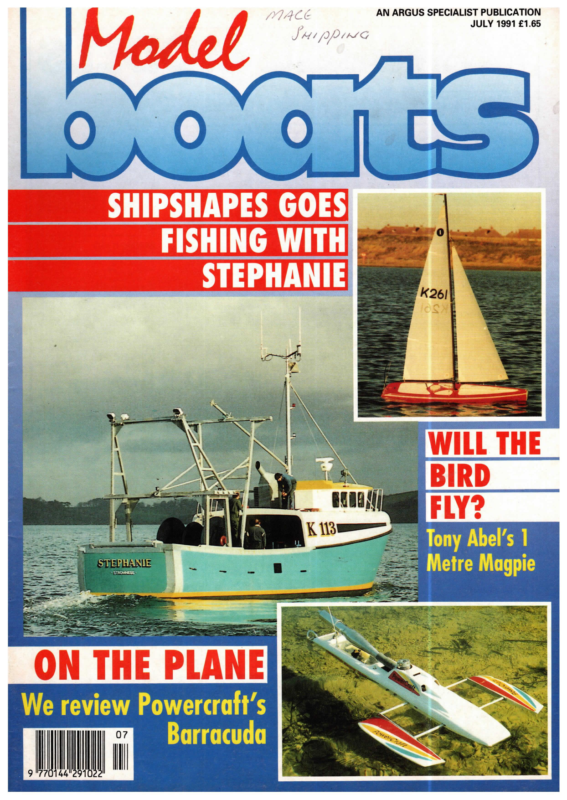
- Magpie ~ High Flyer? Richard Webb reviews Tony Abel’s new one Metre yacht
- Yachting Xmas Quiz Results Nick Weall reviews and answers the questions set in our January issue
- IYRU-MYRU International Yacht Racing Union — Model Yacht Racing Division Press Release
- MAILBOAT
- Match Racing The season starts — reviewed by Bill Green

AN ARGUS SPECIALIST PUBLICATION JULY 1991 £1.65 SHIPSHAPES GOES} WILL THE BIRD FLY? Tony Abel’s 1 Metre Magpie
Richard Webb reviews Tony Abel’s new one Metre yacht t is human nature to fancy a new car when the manufacturers brings out a new model but finance usually restricts us. When a new model yacht kit is announced it is also very tempting to go for it, but this is not nearly so expensive, especially if one can sell the current model for a reasonable amount. I heard that Tony Abel was designing a new kit so I made it my business to find out more. I first saw it at the Model Engineer Exhibition on the MYA stand, a 1 metre that looked very similar to his very successful RM Osprey. The MYA representatives were saying the Magpie looked good and should be a winner, I decided to call on Tony Abel and find out more. Concept Tony is always willing to talk and help his customers and he explained the concept of the new boat. Firstly the new hull is similar to Osprey which will give the bows more lift downwind, and with a flatter stern section she will plane better. The deck is fitted to the hull when delivered and this will make the kit much easier to build than the Cygnet. The Bantock keel is a finer section and lighter and this allows a heavier lead weight, so makinga stiffer boat. The new lead is 15lbs 80zs. Some very nice ideas have been incorporated in the design such as the well for the tiller arm and a plastic pot for the radio and batteries facilitating easy crystal and battery changing. A novel idea is the stub Tony Abel’s prototype on its first test sail with working suit. Ma ae. High Flyer? mast box which allows the mast to be moved back and forward or raked (fig 1). Tony has made the mast and sails the same as Cygnet so anyone buying Magpie can use their existing rigs. Also, almost everything is adjustable to suit the man who intends to race his 1 metre. I took the plunge and ordered a red hulled Magpie. Making a start Late January my kit was ready; the weather was freezing — in fact the coldest winter for four years with 3in of snow in The deck with the covers over the fore and aft hatches, plus the stub mast, booms and kicking strap. JULY 1991 17
the garden and the central heating on full into the shed and cure resin! When starting a kit the first job is to check all the parts, and here Tony has included a so newcomers will be able to identify part each item and name them. A very good FORESAIL TRACK : and radio pot and halliard eyes positions on the deck. Out to the cold shed and I ENN hole for the rudder shaft and the mast box, ro RADIO POT SOSORNS ee a with the wife’s dressmaking tape which wraps around the hull from the hull/deck joint line. I marked the fin position and x masking tape along the bottom of the hull and marked a centre line by measuring ‘i WOODPACKERS drilled a series of %in holes around the fin (ADJUSTABLE) box and radio pot markings using a piece of Junior hacksaw blade with one end airy | S out the hull for drilling. I put some SA ALAARL ii i I took the kit into the kitchen to mark DECK x SONS . — ALLELE full check-list with little drawings of each idea Tony. KICKING STRAP le MAST bore. Certainly not the weather to go out FINBOLT \ MAINSHEET FAIRLEAD FINBOX HULL BOTTOM FIN Fig 0 protected with tape. The holes which were cleaned up with wet and dry paper. I cut the deck and marked the centre of the fin box, which was also drilled “sin as well as the top of the fin. Putting a piece of “sin wire down through the deck and into the fin for alignment, I checked that the fin was straight and true with the hull and the 18%4ins was still correct. Now was the time to correct any mistakes. When happy I used a couple of small blobs of 5 minute Araldite to hold the fin box in place top and bottom, and drilled for the rudder tube, making sure it was vertical with the fin. I marked 19.2ins from the bows for the mast position and Bow section showing half round (return) sheet Well at stern with tiller arm and pushrod. fairlead. Centre section of the deck showing rudder servo, winch and radio pot. the fin to length and marked a position 9in from the water-line for lining up. I gave it a coat of sanding sealer, which is supplied, to stop any dirt getting into the grain, and then marked the water-line at the bows and stern and placed the hull upside down on the Workmate. I needed %in packer under the stern to bring the water-line horizontal. I dry fitted the fin through the hull and into the fin box. The drawing says you need 18%in from the transom to the 9in mark on the fin (fig 3). This all checked out well and I drew a horizontal line lin from the end of the fin to help align the lead weight parallel to the water line. I turned the boat over and gripped the fin in the workmate and drilled a %ein hole through the centre of 18 Lower mast, boom, gooseneck fitting and kicking strap. MODEL BOATS
al apply. The rudder was made by Aralditing the two halves with a %in stainless steel shaft as the join in the sandwich. The shaft was bent at the lower end to stop it twisting. The rudder was clamped between two pieces of %in ply in the vice with a bit of Cling Film to stop it sticking. I shaped the rudder to an aerofoil form with a razor plane and sanded it before applying a couple of coats of sanding sealer. I made a piece of %4in by %in spruce to go across the fore deck under the attachment point of the fore sail, and another piece of spruce to tee down to the hull bottom, both held in by Araldite. I drilled the deck for the halliard eyes and put a short piece of spruce under each ee Aft deck with main sheet fairlead and rudder pushrod. hole, and held these with Araldite, bolting the eyes through and tightening the Looking forward showing radio pot and winch. backnuts — very easy but strong. The kit includes an aluminium track for the fore sails to be fixed to, and this is held down with 6BA screws and nuts. I drilled the deck in the appropriate position and made a small brass plate %in x %in with a 6BA tapped hole, and glued the plates to pieces of 2in x %in spruce which was glued under the deck (fig 4). This would enable me to fit the track when the fore deck ie Fore deck showing aluminium track and wood support. L a hatch cover had been fitted. The main sheet fairlead, a “in aluminium tube with a chrome eye epoxied to the top, was fixed next. This tube goes through a grommet in the deck and is drilled a 4in hole. The mast box was put under the hole and the stub mast pushed through the deck and into the mast box. When I was happy all was straight I fixed the mast box with a small blob of Araldite (fig 2). I cut two pieces of 1/8in ply 4%ins.x 4%ins to fit either side of the fin box to the hull sides and marked out and cut a hole in each piece to take the rudder servo and winch, and again fixed the ply in place with a couple of blobs of Araldite. A tip here. When using Araldite in cold weather put the box of in your trouser pocket and let your body heat warm the tubes; makes it a bit easier to mix and Rudder servo is very easy to access. HORIZONTAL LINE- FOR GETTING THE LEAD PARALLEL TO THE WATER LINE. Complete with tall rig. JULY 1991 19
— | TAPPED 6BA FIG IV 3″ <—__> 345″ BRASS SHEET APPROX SHEET RETURN FITTING rg SHEETS Sa _DECKHATCH ~ we PP-ELASTIC TO WINCH PTO WINCH DRUM HULL SHEETING ARRANGEMENT AT THE BOWS SERVO & Complete with working suit from Cygnet. WINCH SHROUD EYE agai = © es (_® \ sd fl yi – FIN BOX SHELVES LY i y ra GLASS FIBRE MAT & RESIN FIN stainless steel fishing line with tubular crimps. Lead and fin The lead comes in two halves. I cleaned up the flash with a sharp coarse file and drilled the three holes in each lead with a friend’s pillar drill. Tony suggests using paraffin as a lubricant to stop the drill binding. Drilling rudder tube holes through the hull. Note drill is vertically aligned with fin. Winch on its plate. Again there is easy access. . epoxied to a small packer on the bottom of I counter-bored each hole on the outside with a %in drill in a large hand brace. The end of the wood fin was trimmed to fit the leads and drilled (fig 3). Some P38 body filler was smeared on the joint of the leads and they were bolted together on to the fin until the body filler oozed out of the joint. I filled the nut holes with body filler and rubbed the whole lead down with wet and the hull. Rig The weather was still bitterly cold so I made the rig next. The stub mast was cut to length and drilled for the gooseneck fitting. The main and jib booms were cut to length and drilled as per the drawings, and the main boom fixed to the gooseneck and the kicking strap made and clipped in. I had ordered the tall rig as I would be Drilling the in holes around the fin hole. using the working rig from my previous . Cygnet. I drilled the mast for the backstay bracket and crosstree fitting and the three Y%ein holes for the shrouds have “sin stainless steel wire hooks and chrome plated turnbuckles at the bottom for adjustment. The shrouds and stays are Adjustable mast position and elastic sheet return fairlead. MODEL BOAT 20
dry paper, used wet with a bit of soap, until the bulb was smooth. I checked the weight of the lead and fin to make sure it was within the class rules. Remember the line I drew on the fin lin from the bottom? Well I used it when assembling the fin to the lead to maintain them at the correct angle and painted the bulb red to match the hull. I drilled out the %sin hole through the deck and fin box to %sin to take the holding screw, and drilled the fin to accept the nylon retaining plug and screw hole. The nylon was too wide for the fin box so I sanded it with an abrasive disc in the electric drill (fig 2). It was late February and the weather changed, the snow melted and it became Spring like. (That’s nearly poetry!). I now had my chance to resin the joints in the hull. I cleared the decks on the bench and Workmate and cut the chopped strand matting into pieces to fit each joint, mixed up an egg cup full of GRP resin bought Fittings kit for mast and rigging. aes from the local car accessory shop, and using the wife’s toothbrush, sorry — start again — using a cheap %in paint brush, I painted each GRP-to-wood joint with resin. I placed some glass mat on the joints and wetted the mast with some more resin until the mat showed wet. It was a bit tricky under the deck doing the fin box and mast box to the underside of the deck. I should have covered the deck with masking tape as I dripped resin on it. It cleaned off okay but I will remember next time, perhaps. The temperature was about 6 degrees Centigrade so I left the infra-red heater on in the shed for 12 hours to cure the resin. Building a boat is much easier in the Summer! I drilled the radio pot for the leads and fixed it into the deck with clear silicone Tony Abel sets JULY 1991 fore sheet ready for the maiden voyage. It was a bit chilly! 21
sealant. I screwed in the rudder servo and connected the linkage to the tiller arm. Tony supplies two lengths of stainless steel with adjustable ends for the linkage, and a length of spruce to stiffen the linkage which is tied or tapped on. The kit has a half round fairlead for the sheeting line to exit the hull at the bows and this screws in with a drop of séalant. I made a short tube to return the sheet back to the drum and screwed the winch to its shelf. The sheeting lead was fixed to the lower section of the drum and fed out of the half round fairlead. I connected up the radio and checked the sheeting length. With the winch fully in, I made a loop near the bow fairlead. Tony suggests you make the return section of the sheet loop back to the drum from dressmaker’s elastic, approx Yein diameter. I took the main and fore sheets from the forementioned loop and tied them off into stainless wire clips on each boom. The boat was taken out into the garden and the mast was set up and the sails fitted. The kit has a surplus of three hole bowsies and sheeting line, and I spent a happy afternoon adjusting and setting the rig. I sealed each knot with a cigarette lighter to stop them slipping. I made cardboard templates for each hole or hatch in the deck and from these I cut the Venilia (similar to Fablon but better quality) %4in bigger all round. I made three sets of covers from the Venilia supplied. So the boat was ready for its first trial sail after sealing the holes in the radio pot where the leads enter, and stuck on the deck hatch covers. Conclusion The first outing for Magpie was an invitation open 1 metre sail-in at Eastleigh Stern showing rudder and linkage. Tony Abel’s prototype ready P J Sails (optional). az ‘or its first sail with on March 3rd. The boat sailed very well and seemed competitive with the other 1 metres. I was somewhat out of practice but managed to hold a position near the centre of the pack. With a bit of practice and some more tuning the Magpie should ‘swoop down and pinch all the silver’. I’m very impressed with the kit of parts. The one piece hull/deck is well moulded, the joint is triple sealed and the trim tape is fixed on when supplied. The sails on my boat are from House Martin and are very well made. The spars and fitments are black anodised aluminium and chrome plated brass which look good and should stand up to corrosion even if used in brine. Tony Abel has made a real effort with three sheets of good, accurate drawings and two sheets of what he calls helpful hints and tips, from which I think even a beginner should have no problems constructing the kit. I would recommend it to anyone wanting a good competitive 1 metre yacht. Time to construct kit was 19 hours. Price £155 — with working suit of sails. £100 — short kit including hull, stub mast, fin leads. £57 — total suit of sails and mast rigging. £65 — racing winch. Magpie awaits the water in the cold, dry, winter sun. 22 Supplied by Tony Abel, Model Racing Yachts, Highnoon, Petersfinger Road, Salisbury, Wilts, SP5 3BY. Tel: 0722 324677. MODEL BOATS
achting Xmas Quiz Results — Nick Weall reviews and answers the questions set in our January issue The winners of our quiz should now have received their spoils and could soon be joining these Metre boats for a happy Summer of Sailing. “Rounding the Windward Mark” at Eastleigh. Photo: Nick Weall. would have done. Anyone attempting to use rule 43 gets no brownie points. Question3 This was set by Peter Wiles of P.J.Sails: What effect does altering the tension in to down haul have upon the mainsail? oeres His answer Alters luff tension CONCRETE BANK Question 4 Also set by Peter: What effect does altering the tension in CHRISTMAS QUIZ QUESTION 2 the uphaul have upon the mainsail? His answer Alters luff and leech tension. Those of you that mentioned that you could also alter the position of the mainsail relative to the mast by a combined use of both, must be agreed with, I think. Those of you that mentioned that the down-haul in particular can get rid of nasty creases in the sail, I agree with also. Those of you << WIND t last the time has come to review last year’s Christmas Quiz! If you remember the closing date for his competition was the end of February 1991 so as to give overseas entrants a fair chance of getting their answers to us in time. Let us review each question and give my answer to each question immediately after the question. Question 1 You are luffing a windward yacht when her skipper calls “Mast abeam Stem”. What must you do? Answer Rule 38.2(c) Hailing to Stop or Prevent a Luff: When there is doubt, the leeward yacht may assume she has the right to luff or sail above her proper course unless the helmsman of the windward yacht has hailed either: (i) “Mast to Stem” or words to that effect, or (ii) “Obstruction”, or words to that effect. The leeward yacht shall be governed by such hail and curtail her luff. When she deems the hail improper, her only remedy is to protest. The leeward yacht has to return to her proper course because 38.2. (a) Dictates it. So the correct answer to question one was, Stop luffing immediately and return to your proper course. 26 Question 2 You are on starboard, close-hauled and approaching the bank. Several boats are approaching your projected course, running on starboard close to the bank and on a course parallel to the bank. They are on a collision course to you if you tack off the bank on port. What do you do? This question was put to me by Graham Bantock and it is of course a real stinker. Some of you fell into the trap of thinking rule 43 was going to save you, but rule 43 only applies to close-hauled yachts on the same tack. Yachts sailing off the wind do that mentioned flattening the sail,I’m not so sure. I expect the outhaul to flatten the main or put more belly in the main. I will readily accept that the down-haul will move the maximum draft of the sail forward with extra tension, especially whena sail maker tells me so! So two easy little questions that most of you scored full points on. Question 5 CHRISTMAS QUIZ QUESTION 5 ONIM . Looking at the distance shown in the illustration of the situation, I think we would have got away with it and still have retained steerage way.The other alternative would have been to put in immediately a very quick tack to port and set a broad reach course to accelerate away from the slower moving running boats. Again from the distance shown in the illustration that might have just been possible. This is one of the rare situations where a close-hauled starboard yacht has no defence! Either of the above answers not come under it!! So what do you do? Answer Panic! Any sensible skipper would have never put their yacht in such a position! Since the quiz has put us in such an unenviable position we have to find a safe solution. We could ease out our sails to slow right down and then remaining on a starboard tack luff up almost head to wind very close to the bank. The running yachts, then all being windward yachts, would have to keep clear of us. The only danger to us is that we might lose all “CONTACT!” "PROTEST!" forward motion and start to reverse downwind and away from the bank back into the path of the running yachts. MODEL BOATS
Also posed by Peter: You are acting as a one person protest committee and hear the following case. Yacht A on port protests yacht B on starboard. Yacht B counter protests yacht A. Yacht A was on port, close hauled, approaching yacht B who was on starboard and crossing A’s bows. Yacht A bears off just enough to miss B and duck under her stern. However as A is in the process of ducking under B’s stern, B luffs up prior to tacking. A’s jib boom, touches B’s backstay (sorry I know we published A’s backstay in the original question, but you all seemed to guess that we really meant B), before B actually goes through head to wind. This is the situation described to you by A, and B completely agrees with A’s description. What is your decision on the facts found? What rule or rules apply? If B had gone beyond head to wind, would your decision be different? What rules now apply? Oh dear, what a long winded question! It is an interesting situation however and deserves our attention. My answer to Peter’s little poser is: a) B is guilty of infringing rule 35 - Limitations of altering course and is thus DSQ; b) B is guilty of infringing rule 41.1 - A yacht that is tacking or gybing shall keep clear of a yacht on a tack. Question 6 This is one of my favourite questions and the right side.” (More bonus points Alan!) My great heroine Mary Pera does not mention this in her excellent book “The Yacht Racing Rules — A complete guide” and Paul Elvstrom does not mention it either in his book, Paul Elvstrom explains the yacht racing rules. Now as I wrote above, I put this question to our august panel, although I expanded upon the question to say that whilst the offending yacht had hit the mark on the wrong side as she wheeled away to find clear water, a large approaching group of yachts forced her to turn right around and round the mark on the correct side, she then broke away and executed her two turns. Should she be disqualified for not doing her penalty turns BEFORE rounding the mark? This sparked off a lively debate, the Yacht Racing. Everyone got this answer absolutely correct. Rule 69(b) and Fundamental Rule A (Which of course is mentioned in 69(b) rendering additional mention of fundamental rule A unnecessary!) I was very pleased that you all got this very important basic attitude right - Every yacht shall render all possible assistance to any vessel or person in peril when in a position to do so. I know with sailing models that lives are not at risk, but we all love our model yachts and hate seeing them damaged. That concern should be extended to our opponent’s yachts as well! I have never witnessed this rule being invoked other than at club level, although I’m sure if the circumstances were there, someone would immediately come to the conclusion of which was — no we would not rescue! disqualify a yacht caught.up in such a Question 9 Prompted by Graham Bantock. dilemma! So the absolutely corat answer would be, break away and find clear water immediately to execute turns before rounding the mark, unless the area is so congested that it is safer to round the mark correctly and then immediately break away to clear water to execute turns. Alan Chidgey is the only person in my opinion to answer question 6 completely and correctly., although a lot of it has taken me up to this February to get a proper answer to it! I was attending a two day seminar for you correctly wrote go away and do two Natiorial Judges run by the R.Y.A. at Nottingham. I thus had the opportunity to presented a very well argued case for doing the turns before the mark and also enjoys bonus poms = discuss this problem in depth and also to put the question to the rules committee of the R.Y.A. chaired by Bryan Willis! First the question: If you hit a mark on the “wrong side” before rounding the mark and you wish to avail yourself of the alternative penalty, what does this involve? PLEASE GIVE THE EXACT SOURCE OF YOUR INTERPRETATION. The reason why I wanted you to give the exact source of your interpretation was that the rule books are extremely vague on this particular problem. Most people think that if you hit the mark on the wrong side you must do your turns before rounding the mark, but not many of them could find printed word to justify that opinion. Only © one entrant quoted their exact source and for that fact alone that entrant gets bonus points! The answer Rule 52.2(a) When a yacht infringes rule 52.1 (Touching a mark) she may exonerate herself by sailing well clear of all other yachts as soon as possible after the incident, and remaining clear while she makes two complete 360 degree turns (720 degrees) in the same direction, including two tacks and two gybes. The key words of that rule are “as soon as possible after the incident”. Itis those words that have led to the interpretation that if the mark is hit on the wrong side the immediate action for the offending yacht to take is to start sailing clear for room to execute her 720. As Alan Chidgey of Avon correctly quoted from The Rules Book by Eric Twiname as revised by Bryan Willis “When a yacht hits the wrong side of a mark (Sails the wrong side of it and hits it) she must first go off and complete her 720 penalty and then come back and round on JULY 1991 complete turns before rounding the mark correctly. Well done! Mr.R.D.Warf of Luton Question 7 oe After the start and having cleared the startline, a yacht to leeward that has never been clear ahead, but has always had the front half of its hull ahead ofyour bow, suddenly and violently luffs you up, just touching your hull before ae away again. What do you do? Answer Retire or accept an Alternative Penalty i under Appendix 3 for infringing Part IV!i.e. 720 turns. I thought question would catchmore peop since it certainly leads to misunderstandings on the wat Rules 38.1 and 3 ee Question 8 — You are takinie part iin a race ona day when the windis blowing hard. Your boat is running before the wind on a course parallel to the far bank whichis a vertical concrete one. An out of control yachtis on a converging course with your yacht and approaching the bank with good speed. You have the opportunity to push the out of control yacht around onto the opposite tack and thus point back heading towards the bank the Skippers are standing on. Alternatively you can simply avoid the out of control yacht and let it sail straight into the bank, inevitably damaging itself. You are lying in third position at the time, clear ahead by some boat lengths of the following boats, so you decide to save the out of control yacht. You successfully divert the out of control yacht, but drop three places whilst doing so. Can you ask for redress? If so under what rule or rules? do you think redress would be granted if requested? Rather a long question I’m afraid. Out of control yachts are a fairly regular feature of Radio Controlled (or uncontrolled!) Just before the start of the first race of the day in an open race, a skipper comes up to you and tells you he intends to protest your yacht because the mainsail numbers are mounted too low. After the race, because you are off in the next race, you have the time to replace the numbers in the correct position. Meanwhile the protest has been lodged and you have to attend a protest meeting. What action do you think they will take? This question provided some interesting answers. The overwhelming consensus of opinion was that the protest committee would allow the results of the first race to stand. R.Warf of Luton put it well: “The action that SHOULD be taken is that the protest be upheld and recognition be given that the offending yacht has complied with its obligation under rule 19.2. Equally under 19.2 the result of the first race should stand.” Personally I would allow the result to stand under rule 25.6. I think 19.2 defeats the argument of the person who was suggesting that it is really the measurer who was at fault. Whilst it certainly is true that the measurer _ deserves shooting., rule 19.2 firmly puts _ the responsibility where it belongs with the Skipper. You might all like to reflect ~upon what you would have done as the protest committee if the offending yacht had not (or could not) corrected the offending misplaced numbers and had continued to sail in subsequent races that day? Question 10 Whilst on the second circuit of a triangle, sausage course, you forget that you do not have to round the wing mark and you sail the second circuit going round it! Unfortunately as you go round it you hit it and an Observer calls out the touching of the mark. What must you do? Oh you are all far too smart! The idea was that by this stage of the quiz you would all be so full up with mince pies and liquid refreshment that you would throw in a couple of quick turns before zooming off to the leeward mark overhauling all in your path! Answer Do nothing of course! Except perhaps to tell the observer that you are in fact on the second circuit of the course, not the first! (He might have had even more of the liquid refreshment than you!) Question 11 27
CHRISTMAS Quiz wwe eqs QUESTION 11 —_—s ——_ Oryza! CONTACT! as J Ve ( POSITION —— \ az / (\ ee 2 \ LAP OVERLA 11) Everyone but you. I think Geoff ,;who supplied these answers and one or two more, most certainly entered into the spirit of the quiz and possibly the spirit of Xmas too! His final suggestion is: “Alternatively sail a 590 and ***** the rules! Well I guess there are other things that need stuffing besides the turkey! Anyway Geoff thanks for the light entertainment, especially the answer to number 10! As to Geoff's suggestion, I quite agree, anyone that finds the rules a drag can find )- / POSITION You are approaching the finishing line on a close reach. At the four boats length there is a boat overlapping you to windward. The windward yacht calls overlap. You hold your course just aiming to cut close to the mark, not allowing the overlapping yacht room. The overlapping yacht bears off so as to also aim to cross the line, passing the mark on the correct a lot of fun in racing a 590. They are great little craft and one was recently reviewed in our sister magazine — Radio Controlled Boat Modeller — March/April 91 issue. Without a doubt though there comes a time when a little more finesse is required and more of a challenge sought, then is the time to consider participating in proper model yacht racing under the IYRR’s. Back to the quiz, the time has come to reveal who presented the most correct answers. metre Nationals when Phil Playle of the Chelmsford Club sailed one to first place! I think that perhaps that was written a little bit tongue in check. Obviously the Racing Rules Committee members were reluctant to use their experience at the expense of ordinary model yachtsmen. The same thing applied to a lot of our top class Skippers; they restrained their natural temptation to answer to allow less able readers more of a chance! Or did they? easy question 12: congratulations and my thanks in taking Once again what a clever bunch of contestants - 100 per cent right. Answer sense of security, here comes the last oh so You are rounding the windward mark to starboard. You have just tacked to port and are beginning to bear off to aim for the wing mark, when to your total surprise a yacht on starboard comes round the mark on the wrong side! (She thought she had to leave the mark to port, as we usually do!) It all happens so quickly that there is a collision, although it is a very minor one, you having managed to bear off enough just to brush the starboard boat’s stern. But, a contact is a contact, who has to do the penalty turns? Or if it goes to the protest committee, what“are they likely to decide? Actually most of those people that entered the quiz got this one right as well, it caught one or two of you out, but most of you either know your rules pretty well or have been studying well. Answer The mark is irrelevant, remove it and apply rule 36! Nasty as it is the port yacht is in the wrong and must do turns. The starboard tack yacht by the time she turns about to re-round the mark on the correct side is likely to loose lots of places in that manoeuvre as a small consolation! Now before we go on to reveal the lucky or skilful winners, let’s give a bit of space t6é some of the very amusing answers I received from one particular reader: 1) Say “The same to you with knobs on by the time he’s recovered from the 2) 3) 4) 5) 6) 8) shock,your well away! Close your eyes and think of England. Rips it Rips it a bit more! Marquis of Queensbury. Turn the other cheek. You shouldn’t be redressing in a public place. 10) Eat the sausage and save the wing to later. 28 with a copy of Trevor Reece’s very the time and trouble to answer my scored 166 points out of a maximum possible of 185 points! Of that 185 The leeward boat is at fault. Rule 42.1.(a) Now having lulled you all into a false Who is at fault? Now in third place is Jeremy Offord from Waterlooville. He thus wins a set of sails from the sail loft of Peter Wiles of his choice. This was the prize that Pete Wiles was generous enough to donate. I and many others have been using Peter’s sails for many years with varying degrees of success. They keep me moving at the sort of speed I want. Peter cuts his sails so as I can put in the sort of shape that I want, which in truth is simply the shape that Peter wants! I can recognise good shape whenI see it. Thank you for entering the quiz Jeremy and let Peter know what sort of set of sails you would like. Jib and main, for a model by the way! Lastly slipping in fourth place and possibly relieved that he didn’t win third prize is another previous winner of a monthly question Roderick A. Carr of the good old U.S of A. Rod amongst other things is a sail maker which is why I guess he’d rather receive a free year’s subscription to this magazine together successful book R/C Model Yachts. Congratulations Rod, thanks for entering into the spirit of the quiz. I'll now quote the last paragraph of your entry letter: “I am looking forward to hearing of the response you get from the model yachtsmen. If there is not 100% response from each of the YYRU-MYRD Racing Rules Committee then we ought to toss the scallywags out and replace them with new sea lawyers. Let’s find out how good these fellows are when it comes to unravelling the racing rules in the situations you have Mr. R. D. Warf of Luton is that man. He maximum possible points were a total of 15 bonus points available, 5 points for spotting the printing error‘and mentioning it and 10 points for correctly quoting the exact source of your interpretation for question 6. Other than that 10 points were available per question or part question. side. In doing so, she gently hits your boat. for your new winches. Mr. Warf, please accept my questions so well. ’'m sure we could enjoy a good evening around a warm pub fire tossing questions to and fro. Mr. Warf you will soon be the happy owner of the Graham Bantock designed and produced hull kit for the one metre class called Rhythm. This design you may recall proved its worth at the first one I hope you enjoy making up the yacht and better still enjoy considerable success with the end product later in the season. This prize, donated by Sails ete, with a small contribution from myself is a fitting reward for such a superb set of answers. | had set a few traps, but you managed to escape the vast majority, well done indeed! Now in joint second place we have on 150 points Alan Chidgey of Avon and someone who has regularly entered and even won once one of the monthly competitions, Ken Clark of Brentwood with 147 points. Alan gets the Whirlwind winch so generously donated by Dave Andrews which will give Alan years of loyal service. Ken has the choice of any one of the range of winches from the Abel Stable, all he has to do is let Tony Abel know which of his strong, reliable winches he would like and Tony will send it off to him. Tony was generous enough to donate this as his contribution to our little quiz. I have personally used Tony’s winches for some years now and found that even with the occasional under water treatment they are very reliable. Lindsey has always used Dave Andrew’s winches and again despite the odd ducking has been more than pleased with them. Alan and Ken thank you for your sets of answers and I hope you both find good use presented.” Who knows? Perhaps next year we should have two quizzes. One open to all and one that any skipper that has appeared in the top half of any ranking list or won district or national events is barred from! What do you think? Or is it all too boring anyway? I recently spoke to John Doerr who had run a rules quiz in Yachts and Yachting the previous Christmas and our level of entry compares reasonably well with the level of entry he received. I think we both agreed however that we would like to see far more entrants without reducing the level of questions set. Such.quizzes should be a fairly painless way of re-enforcing knowledge of relatively obscure bits of the rules and reminding us of some of the slightly more obvious parts. After all the best way of meeting some unusual situation out on the race course is if you can immediately bring to mind a similar situation described in some rule interpretation. To all those hardy souls who entered and didn’t win a prize, well done, thank you for taking the time, better luck next time. To all those who found it an amusement over the Christmas period, great I’m glad you enjoyed it but do try to put pen to paper next time. To those of you that simply fell asleep, sorry... you can’t please everyone. MODEL BOATS
course to the President and Chairman of the Model Yachting Association Norman Hatfield. Norman has sent me a potted history of the progress made over the ten long years he has been battling for recognition. September 1980 An application was made to the IYRU for IMYRU Associate status. This was declined, but in order to establish a link with the IYRU it was resolved that the IMYRU President should become an Individual Member of IYRU. July 1982 At the IMYRU General Meeting held in Dunkirk during the World Championship week, it was resolved to adopt the IYRR and Measurement Instructions and to follow the IYRU Constitution and Regulations as closely as possible. December 1983 Applied to the IYRU for permission to refer to the new IMYRU Appendix to the TYRR as ‘Appendix 11’ and to have the Appendix included in the IYRR book. April 1984 Informed that the IYRU President had stated that there was unlikely to be any objection to the application. January 1985 The application was declined by the LYRU RRC on the grounds that ‘it had no relevance to the IYRR.’ June 1985 IMYRU published its own Appendix and sent a copy to TYRU as a matter of courtesy. Reply received regretting that IYRU could not publish it because IMYRU was not a member! July 1987 At the European Championship in Holland, a Vice-President of the Dutch NA suggested at the prize giving ceremony that IMYRU should make a submission to IYRU to become a Committee or Division and offered to support that submission. Action was taken immediately and supporting submissions were made to TYRU by the NA’s of Belgium, France, Germany, Italy, Luxembourg and the U.K. (R.Y.A.). International Yacht Racing Union — Model Yacht Racing Division Press Release ovember 1990 saw the culmination of ten years efforts to get proper recognition by the I.Y.R.U. of Model Yachting by the IYRU’s Racing Rules Committee approving the new Appendix 16 - Model Yacht Racing Rules. This Appendix has been included in the 1990/91 Supplement to the International Yacht Racing Rules (TYRR). On the 15th February 1991, Mike Evans who is Executive Director of the [YRU circulated the following explanation, included in a letter regarding the supplement. Appendix 16 - Model Yacht Racing 44 Rules. ‘The International Model Yacht Racing division has been using the amended International Yacht Racing Rules for many years. These amendments were approved as Appendix 16 in November 1990 and will formally become part of the IYRR in 1993, although Model Yachting will be using Appendix 16 prior to that date.’ Whilst many people have worked towards the inclusion of our Appendix to the rules being included as an official appendix by the IYRU and indeed for recognition of Model Yachting, one name stands out over the ten years as a man dedicated to achieving that aim. I refer of January 1988 An application made by the IMYRU to become a Division in IYRU on the dissolution of the IMYRU. February 1988 Interview with Mike Evans, Executive Director of YRU and Norman Hatfield, President of IMYRU. October 1988 A meeting was held between the Chairman of IYRU Class Policy and Organisation Committee (CP & OC) and Norman Hatfield, John Cleave and Roger Stollery. November 1988 Norman Hatfield invited to attend the MODEL BOATS
Annual Meeting of [YRU CP & OC at the Cafe Royal, London to present the IMYRU’s case and to answer questions. December 1988 IYRU Permanent Committee accept the CP & OC’s recommendation for affiliation. The Executive Director reverammnded acceptance as a Division. January 1989 Norman Hatfield, John Cleave and Jan Dejmo discussed terms with the Executive Director and the Racing Manager of IYRU at their Knightsbridge Offices. August 1989 Norman Hatfield and John Cleave attended an interview at the IYRU Offices. They were informed that the TYYRU Executive Committee had accepted Divisional status and that on the dissolution of the IMYRU it would become the IYRU Model Yacht Racing Division with effect from the lst January 1990 1990 Saw much effort by many people to revise the existing Appendix 15. By the Ist May the new Division was operational. By October Henry Ericsson of Finland, Chairman of the Division’s Racing Rules Committee was invited to attend the annual meeting of the TYRU Racing Rules Committee. John Cleave in fact was appointed to deputise. By November the Appendix was approved. Work still goes on sharpening up the final minor spelling mistakes and other ition Model Boats Argus House Boundary Way ’ Hemel Hempstead HP2 7ST (From page 14) Keel Boat Skipper and you can immediately grasp the potential. Couple that to the marvellous overall aspect we enjoy of a complete fleet racing within our field of vision and most keen Skippers will readily appreciate it is a side of yacht racing they ought to devote a little time to. The final point is of course that the standard of rules application is in any serious meeting as high as they are likely to encounter anywhere. We owe it to our sport and to yacht racing Skippers everywhere to cultivate these new areas of cross fertilisation. Towards that end myself, I have recently applied to become and been appointed a National Judge for the Royal Yachting Association, not only to develop further my knowledge of the rules and their application but so as I can participate still further in the overall sport of yacht racing in all disciplines. We need, as Radio Controlled Yacht Racing Skippers, to be seen to be taking the sport as seriously as any other branch of the overall sport. I believe we do and in my new capacity as Publicity Officer of the TYRU-MYRD, I hope I can help to spread the word. Towards that end please note that Model Boats has kindly agreed that I may use their pages to communicate to the World at large. As the leading Model Boat magazine with a world wide circulation, Model Boats is the ideal vehicle for this task. If you are one of our many overseas readers might I ask that you do your bit to ensure that all those Skippers known to you are advised on this fact. We shall of course welcome every new overseas reader who subscribes. Anyone that has forthcoming news or news of relevance to the YYRU-MYRD please be kind enough to forward it for my attention care of Model Boats. Everything will be read and if appropriate published. Please bear in mind that there is a long delay in actually getting things published owing to production techniques, so the sooner things are sent from around the World the better. suggestion. is so called, because a vessel, at night, is If any of your readers are members of a society or know of any person nationwide who would be prepared to undertake boiler testing and certificate issue to nonmembers; if they were to send me details of the person whom should be contacted and the fee that will be charged, I will collate a full typed list of boiler testers throughout the country which can be made available to anyone who would like their steam plants certified. In this way we may possibly avoid an deemed to be overtaking another vessel, minor matters within the Appendix and by the 1st January 1993 it should be a part of the 1993-97 TYRR. Such a potted history does not really give a true picture of the many frustrations and set-backs that were experienced upon the way. Undoubtedly the appointment of Mike Evans as Executive Director of the [YRU opened up the dialogue between the IMYRU and the IYRU. To all of those people in many Countries who so freely gave of their time and efforts the remainder of us Model Yachtsmen owe a debt of gratitude. It is a marvellous achievement and must be seen as the foundation stone of a new era in Model Yacht Racing. We must now take the opportunity to communicate whenever possible with full sized Racing Skippers to give them some idea of the challenges awaiting them when they pick up a transmitter and enter the cut and thrust of competitive Radio Controlled Model Yacht Racing. The fact that as Model Yacht Racers we can pack in maybe ten to twenty races per day means that all racing tactics can be rapidly developed within our sport. Compare that with the one or two races per day you might enjoy as a Dinghy or when she can only see the sternlight even accident which could be so detrimental to the hobby. if both are on convergent courses, and therefore, must keep out of the way until past and clear. If she can see the mastlights and sidelight, she is a crossing vessel and different rules apply. Thus the setting of the arcs of these lights is very carefully measured. The positioning of the sidelights depends on the height of the foremast light and is, in no way related to the position of the sternlight. The 225 degree arc refers to the mastlights i.e., from right ahead to 22% Judy Storer 37 Barnstaple Road South Ruislip Middx HA4OUW degrees abaft the beam on either side. The sidelights combined, cover the same arc. Thus, if you add the 225 degrees forward facing arc to the 135 degrees aft facing arc you end up with the full 360 degrees of the circle. Sternlights Boiler Certificates. Dear Sir, I read with great interest Mr D N Aylott’s letter (April 91) concerning the testing of model boilers. Like many boat modellers my husband has constructed model boilers and although he is satisfied with their integrity, he has no certificates to prove it. Enquiries with the local model engineering society were met with the same response as Mr Aylott had received, being that he would have to join the society prior to making use of their facilities. So I would like to take up the Editor’s challenge and make the following JULY 1991 Dear Sir, I was interested to read Roger Thayne’s comments in April MB. concerning the sternlight positioning on Norrix and agree with his letter, but feel a few more details could be of help to modellers. As correctly stated, there is no requirement to place the sternlight anywhere but at the stern, and in the case of some ships with sternramps and so on — not necessarily in the middle. The critical part of the rule is that it can be seen over an arc of 135 degrees, from right astern to 67% degrees on either side (the old 2 points abaft the beam). At that point, on either side — the mastlights and sidelights come into view - hence the name “the overtaking light” — being given to the sternlight. This Incidentally, the after mastlight also depends on the height of the foremast light and also the length of the vessel being considered. There is no specification as to where the sidelights are carried apart from not being placed so low as to be interfered with by deck lights. Indeed, some of the large 290m. long container ships that I pilot, have their sidelights on the forecastle head as the forward visible arc of the lights would be restricted by the containers if placed further aft. The same reason of visibility, I imagine, induced sailing ships to carry out the same practice. I hope this may be of help to readers. R S Francis Blagdon Avon 45
Match Racing ee The season starts — j, Ny reviewed by ts hi Bill Green ell when the season starts, it starts, I know I should have completed a lot of work during the winter but somehow other things seem to get in the way. Its the same every year, I just don’t know how it happens but it does. Enough of this rambling let’s get down to the action. Drury Anchor - Marbleheads Bournville — 3 March This the first of the Open events on the Vane circuit attracted its usual entry from the local clubs of Birmingham and Bournville. The conditions were just a trifle draughty which is unusual for Bournville, most of the competitors were in ‘C’ or ‘C2’ suit which again is most unusual for a lake that is renowned for its fickle winds. This time it was a pretty true beat with spinnaker runs. Two complete rounds were sailed with Chris Harris (Bournville) winning from Peter Hopkins (Birmingham). R6m Match Race Series - Race 1 - Brentwood - 3 March Yours truly had been looking forward to this race ever since the last series finished. The entry list, as it came in during the week before confirmed my suspicions, 21 skippers from 9 clubs entered 16 boats from 7 different designs, which was tremendous news for me. It meant that all the hard work over the last couple of years had been worth it The class had now established itself and it was definitely here to stay. I sorted out the The two Peters (Hopkins nearest) and Maskell start the “M” Team National off at Bournville. RESULTS R6m MATCH RACE SERIES 1991 RACE 1 BRENTWOOD 3 MARCH 1991 Entrant M Kemp B Corley D Trippe R Neeve V__Bellerson M_ Ewart Der Mann C Chambers G Williams C Carter | Taylor J Daines A Bright P Heys J Day R_ Utley C Clements R_ Ferreday C Coventry J Gale Final | % score 5 BOARD 6 BOARD 7 BOARD 8 BOARD 1 |BOARD 2 BOARD 3 BOARD 4 BOARD Score Score | Score C/F Score Score Score Score Score Score 1 2s 1 1P 1 3S 1 7 100.00% Boat Name Design Red Dwarf Renaissance [22 Black Magic {Florentine Radio Rumour Le Mer Deux Pammie Bleu Jean Lady Luck If Only {Vermillion |? Revival Renaissance |Wild Rumour Renaisance Revival Tern Revival Tern Tern Renaissance Rival Flair Petrel Revival Flair Petrel 5P| 1 ss| 1 6P| 1 3S| Sn 5S | 4S | 4P 1S 6S 9S|_ 9P} 7S| iP: sP} 2P 3P | 7P 10S 8S 9P 5S 7P 1 0 6P 1 7S eS 6S 4 1S 0 8S 1 4P (e) 3S 1 28 0 5S 1 9S O §£ 1 10P O fess 0 4S 0 5P 0 7S i 2P ) 9S 0 8P* 1 2s 0 1 (e) 6S fe) 3P ee 6S | 1 1 0 AS 1 1 1 8P 3S 5P 24 10S } 10P 1 1 9P o | 10S | Oo 9P 1 2P 1 3S 0) 6P 1 the’ e) 10P 1 7P 8P (e) 9S 1 1 6P 0 7S (e) 10P 1 3P io) 6S ¢) i 1 4P 0 1S (e) 2P 0 sP 1 5S L 4P 10S | 0 7P 1 6S : 0 8S 0 9P 0 ie} 1S 1 0 3S 1 0 4S 1 (¢) 28 fe) S20 1P 0) Scoring:- 1ptwin, 52 3P ee «9S gP 1 { 6P | o | 7S 1 8S6P 9S 1 1 [ee 3P 2s 2P 1 5S 1 1 ESS 1 1 1 1 10S | 1 7S ) 0 (e) 1 10P ie) 3S 0 1S 0 3P =] 9S 8P 4P 9P 5P 6S 1 5S 1 10P e) gP 1 1 6P 9S 0 8s 1 5P 0 1P (e} 1S 1 7P 0 10S fe) 6S ie} ie) ) ) 1 ) 1 1 1 1 1 0 0 ) 1 } ) ) 6 85.71% 6 85.71% 6 85.71% 5 5 5 4 4 3 3 3 2 2 2 2 2 2 2 0) 71.43% 71.43% 62.50% 57.14% 57.14% 42.86% 42.86% 37.50% 28.57% 28.57% 28.57% 28.57% 28.57% 28.57% 25.00% 0.00% Opt loss MODEL BOATS
Martin Kinder helps out a couple of the Fleetwood Juniors at the “M” Team. schedules as there were such a large number sailing I had to make one or two adjustments to the race arrangements. INDIVIDUAL SCORES “M” TEAM NATIONAL Pos First I split the complete fleet into two halves and drew up the schedules on that basis. Secondly the split between the fleets Reg |Team Boat No was arranged on a seeding basis using last year’s results as the starter; the results from this race would decide the seedings for the next and so on. If we sailed half of the complete schedule that would mean over 100 individual races and at 3 minutes per race, over 5 hours of continuous sailing, enough for the start of the season I thought, and went to bed on the Saturday night full of anticipation. Anticipation wasn’t all that I was full of, because I was struck down in my sleep with a dose of the dreaded OOO! Nasties which laid me out for well over a week. So I can only report the race on a second hand basis. What I can tell you is that the conditions were not ideal for boats new out of the box, of which there were a few. Just like it was at Bournville for the Drury Anchor, definitely draughty. The main problem was that of being over canvassed, those that had skinny mains or reduced area suits were OK, those that didn’t were in trouble. The boats were either being knocked flat (“seriously pressed” was the phrase used to me) or virtually al uncontrollable downwind (“all over the place” was another phrase used). A lot depended on the skipper’s ability to trim his boat for the prevailing conditions and The Race Officers’ Briefing at the start of the “M” Team |Skipper Indidvual]|] % Score 1 |K 3667 | Guilford A |Bitz Bitz |K 3597 |Fleetwood 'A' A |Sarasola Sula Bula 71 78.89 |W Sykes | D Priestly 65 | 72.22 3 |K 3999 |Bournville ‘A’ B 4 |K 4241 |Bournville ‘A’ A |Measure 4 Measure Skibo W Sykes | C Harris 63 | 70.00 |Grey Fox Bitz AAustin 60 5 |K 3907 |Fleetwood 'D' A | Nimrod |66.67 Ninmrod J Brookes | D English 59 | 65.56 6 |K 3520 |Leeds & Bradford A |One Fin Off 7 |K 4220 |Leeds & Bradford B |Mrald OD D Creed |P Maskell 58 |64.44 Sula Bula |W Sykes | N Sharpe 55 | 61.11 AAustin | A Austin | M Harris 8 |K 4400 |Birmingham A |Warlock Sula W Sykes | P Hopkins 51 56.67 9= |K 2319 |Fleetwood 'A' B Ashanti D Hollom |G Butler 46 |51.11 9= |K 4240 | Guilford B | Bitz & Pieces Bitz AAustin |M Dovey 46 151.11 9= |K 3886 |Bournville 'B' A |Scorpio Skibo(Mod) |W Sykes |W Green 46 |51.11 12=|K 4373 |Boumville 'C' A |Broadsword Aquaplane A Etherington 44 | 48.89 12=|K 4530 |Fleetwood 'C' A |Pifee Chrissy Ashanti |C Taylor(Ms) 44 | 48.89 }K 1713 |Birmingham B | Gretel OD Cooke 42 | 46.67 16 |K 4526 |Fleetwood 'C' B Ashanti D Hollom |S Mills(Mrs) 30 =| 33.33 17 |K 3860 |Boumville 'C’ B | Peewitt Bee R Stollery |C Etherington 28 =| 31.11 18 |K 3899 |Fleetwood 'D' B |Jitterbug Zypher D Hollom | B Webster 24 | 26.67 19 |K 4521 |Fleetwood 'B' B |Gnasher Ashanti D Hollom | P Whiteside 23 25.56 20 | K 4523 |Fleetwood 'B' A Ashanti D Hollom | K English 7 7.78 14 |Ashanti 2 ? D Hollom is | 15 Race Officer: - P Salt. |Boozie Suzy |Gerry Bournville MYPBC Bourneville 16/17 March 1991 TEAM SCORES Pos |Team Team |Team Score | % be aware of the boat’s foibles in these sorts 1 {Bournville ‘A’ 123 | 68.33 of heavy airs. Inevitably the top skippers 2 |Guilford 117 | 65.00 came out on top, Mike Kemp had a clean 3 |Leeds & Bradford | 113 | 62.78 sheet, 7 wins out of 7 races, with Brian Corley, Roger Neeve, and David Trippe all having 6 wins out of 7. The complete set of results is shown and as you can see it was a closely fought event. What was 4 |Fleetwood 'A' 111 | 61.67 5 6 7 |Birmingham |Bournville 'B' |Fleetwood 'D' 93 | 51.67 86 | 47.78 83 | 46.11 8 |Fleetwood 'C' Hint 74 | 44.11 pig | 16.67 was that no one desi prédemibetae Each of the ie had : : 3 : their merits. The two new Lewis designs Tern and Petrel showed that they are going to be force to reckon with when a JULY 1991 Designer 2 interesting Jean Bleu showing its underwater shape to all during the R6m event at Brentwood. Design Name little tweaking and tuning has taken place. The general consensus on the Tern and Petrel designs is that they look good and perform well. The Petrel hull, immaculately planked by John Gale, showed great promise, but this was John’s first excursion into radio racing and he had a minor problem with his thumbs, they weren’t connected to his brain, especially when the boat was coming towards him. John, like most of us vane sailors, trying our hand with this new fangled radio sailing lark for the first time finds that the straight line philosophy is deeply ingrained, and that this going round corners business is a concept which is a little difficult to grasp, but we shall prevail. be ae i leetwood 'B 30 coca I am told that everyone had great time, in spite of the conditions, and that they will all be back for Race Number 2 at Dovecote in early April. I am very grateful to my clubmate Vic Bellerson for stepping into the breach and to Ian Wheeler who took over the scoring and starting duties so ably. Also thanks go to Alan Bright for supplying the accompanying photographs. ‘MW’ Team National - Bournville - 16/17 March To Bournville’s absolute amazement 10 teams entered this race, the normal entry in previous years was about 5-6 teams. For those of you not familiar with team races, a team consists of two boats representing the Club. The two skippers in a team sail 53
as a team, which means that considerable effort on the tactical side comes into play. Teams are usually formed from skippers who have a strong understanding with one another and sail in a similar fashion. They are usually long-standing relationships and will have sailed together either as a team in other races, or as a skipper and mate. A good example of this is the Guildford team of Alex Austin and Martin Dovey, they have been sailing together now for many a year. What was good to see was four teams entered from Fleetwood, didn’t I tell you that they were going to be a force to be reckoned with this year, and also to see Peter Maskell sailing with Nigel Sharpe from Leeds & Bradford club. Bournville members cannot remember the last time Peter ventured into the Midlands and were so impressed that they seriously considered erecting a stone tablet to honour the occasion. I believe the inscription would have read “Peter Maskell was ’ere. 1991”. Now about the race itself, conditions were interesting, a southerly “A” suit breeze gave reaching in both directions. Some of the skippers found the vagaries of Bournville a little confusing at first but soon were into the swing of things. Dave English and Peter Whiteside sailing Nimrod for the Fleetwood “B” Team were Saturday’s highest scorers with a whole *. pack chasing behind them. The team situation was interesting, no one team had established predominance. Bournville “A”, Mike and Chris Harris, had the edge overnight. The Sunday was similar in its conditions, the only differences was that the rain, which had been incessant on the Saturday, had eased and the breeze had lightened. A full board was sailed by Race Officer Peter Salt, racing finishing at about 4.30pm. Dereck Priestly and Alex Austin, individually, had a sparkling day on the Sunday but their team mates were not on song and as such missed out on the top prize. The “M” Team Champions for 1991 are Mike and Chris Harris (Bournville “A”) who displayed the consistency that is essential for a team to win. Their scores are virtually identical, with Chris having the edge over his dad. The final results are shown in the table and are worth studying. I couldn’t complete this write up without mentioning the efforts of the Juniors who made up a considerable proportion of the fleet and who thoroughly enjoyed and acquitted themselves well. A special award was made to the top scoring Junior which went to Chris Etherington of Bournville who came a creditable 15th overall in his first major competition. I will close this section with a little something from one of the Fleetwood juniors who when asked how he was doing said “I’m doing alright and my team mate is alright, but his boat is travel sick”. New Boats on the block That stalwart of the 36 fleet the Taxashun, designed by Alex Austin, has undergone a change to even further improve its performance. It is now known as Deductshun because there is less of it. Changes have been made to the bow water-line entry shape and to the underwater form. These modifications have been brought about by studying the performance of Taxashuns over a lengthy period of time and by listening to skippers’ comments both from the radio and vane fleets. Competitively priced hulls, in both glass and carbon, along with the various other ancillary mouldings such as fins, rudders, centre deck,etc., are being produced and are only available from Harold Dovey, 75 Henley Crescent, Solihull, West Midlands. Telephone number 021-705-5525. The prototype vane version was in play at the tail end of last season and shows that the changes are worth it. The prototype radio version is in the throes of construction and will soon be seen on the R36r circuit. The design will, I think, be the backbone of the 36 fleet into the future following in the footsteps of its’ illustrious predecessor. I have been informed that Bob Mike Harris proudly points out the day he wonhe his Braine steered 36r race at Bournville when was 12. Where’s the short trousers, Mike? Underwood is producing another 6m to add to the Glenrosa. The design is relatively old, if that matters, and is the scaled down Kubernetes. For the uninitiated Kubernetes was designed by John Lewis to the “A” class rule in 1966 and was a monster at 80lbs displacement with 1450 sq ins of sail. The 6m derivation design, by Roger Hatfield, is called Dolphin and has a fin keel. Neil Rothwell sailed one last year and it was impressive. This design tests the other end of the scale in that it is a high displacement, 32lbs, and still manages to carry a reasonable sail area of 970 sq ins. I know that one hull disappeared into the back of a estate car at Brentwood very smartly, soon to reappear as a complete boat in the near future. I, for one, look forward to seeing it in competition and knowing where it has gone am certain that this boat and skipper are going to bea considerable force on the R6m scene. If you are interested the contact Bob Underwood, 6 Winsley Road, Bradford on Avon, Wiltshire. BA 1QR. 02216-5224. Braine steer I was considerably amused to read Russell Potts’ “Curved Air” column in the March issue where he referred to Mike Harris winning the last of the Braine steered races and that he must of been a lad in short trousers. A little more background, the race was for the Bournville Shield, which is a really attractive trophy so attractive that it spends its life decorating the committee room wall in the club house. It is also rather on the large side which is perhaps why it spends its life in the club house. Mike won the 36 event with a boat called Harlequin and was so pleased that he took the Trophy home on the bus, history does not reveal how it got back into the club house. Apparently the race was for juniors and that the senior members were not allowed to help the juniors in any way. and Rival go separate ways whilst scurrying downwind at Brentwood at the Jean Bleu, left, Race Series. R6m Match first of the Mike was 12 at the time, the photo shows him in current trim, I’m sorry that I couldn’t oblige with the short trousers but I can assure you that it isn’t a pretty sight. MODEL BOATS 54