- Description Match Racing Bill Green at the ‘A’ Nats
- Sailing to Win In Part Five, Nick Weall is at the intermediate stage in helping club members to win

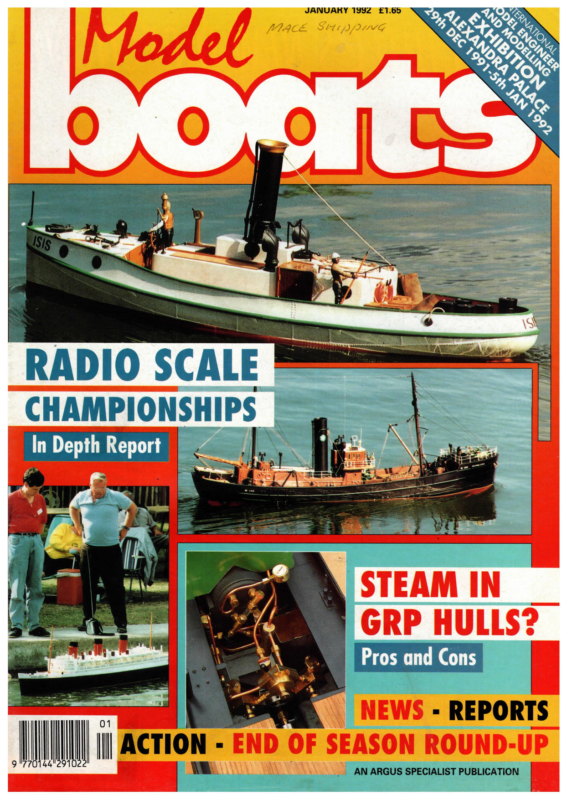
JANUARY 1992 £1.65 RADIO SCALE ® CHAMPIONSHIPS | In Depth Report Ee STEAM IN GRP HULLS?
practice, a draught in excess of 16ins is not advisable as the sides of the loch are shelving and the wearing of regulation thigh waders imposes a natural limit. So heavy displacements and large sail areas are in order. Several of the yachts were modern A Class boats with deeper draught and large sail areas right up to their stability limits in prevailing conditions. It is not unusual for a yacht to have seven suits of sails of various sizes. Think about it, why should sail area be artificially limited when there is a natural limit? Among the fastest boats were several older type of M Class enlarged to 66ins OA, 42lbs displacement and plenty of sail. In other words, there was the water-line length, power and Angus Murray and Willie Thomson bringing Dunlin to the water’s edge. Model Yachting at Wick abundant driving force. Dear Sir, If you wish to see Model Yachting with a difference, then go to Wick and join in with the men from Shetlands, Orkney and Caithness. Forget rating rules, racing rules and complicated scoring systems and get down to basics and seamanship. However, a handicap system is applied and this simply comprises say 10 seconds per inch of LWL greater than the shortest boat and say 10 seconds per pound of displacement over the lightest boat. Shortest and lightest start first and the penalty. A race comprises down the loch and back twice and the fleet is very spread out at first, but remarkably close at the finish. The system is not perfect but the events are conducted in an atmosphere of tolerance and dignity. At a meeting the night before, the number of handicap seconds was agreed and a trial race run in the morning to establish that all was fair for the prevailing conditions and boats competing. One or two boats were fitted with either a form of Braine type steering gear or conventional vane, but most had no such equipment. Therefore, there is no point in having rudders either! Off wind sailing is controlled by a small triangular spinnaker on the end of a long boom. Very effective this is too. The standard of boat building and fitting out is high and as one would expect from people with such a sea-faring tradition, sailing skills are superb. Also impressive was the family atmosphere throughout the weekend. Wives, daughters, some grandmothers and small children were all there enjoying themselves. Great hospitality and friendliness was extended to me and I am sure this would also be the case if anyone wished to visit the Wick Model Yacht Club. I shall certainly try to get up to Shetland and Orkney in due course and see their particular variations on the theme of Earlier this year, I had the great pleasure of seeing a three day event on Loch Sarclet just south of Wick. An ideal sailing water some % mile long and with absolutely no obstruction to the wind. The sheer size is at first daunting, but it does sort out the boats and also the skippers after a full day’s sailing. Naturally, I was particularly interested to see the variety of the yacht designs which tradition and circumstances have model yachting. John Lewis Rednal Near Birmingham developed. In basic terms, hulls are within an overall length limit of 66ins with no limit on draught, displacement or sail area. In by Roy Leaskrand above “Chaser others follow according to their time — right, an enlarged Marblehead. Right, Argo the club record holder. Note: no rudder! 10 MODEL BOATS
Bill Green at the ‘A’ Nats s you may have guessed by now most of my interest is in competition; I enjoy competition at all levels, but the competition I enjoy most is at National level. It is at this level that you have your best opportunity to test your yacht and not least yourself against that which is the best on offer for that year. The National should be the culmination of the year’s effort in that particular class. The National event should also be a social event when you meet up with old friends, make new ones and enjoy their company. The “A” Class National is all of that and more. The “A” Class National has always been, and always will be the premier event in the free sailing calendar. It is special, the race takes 6 days to complete, it attracts the best in free sailing and it alternates between two very good venues. This year had an entry of 40 boats which meant that the event would need to crack on if it was to be completed. Race Officer Gordon Keely made this plain in his briefing and we all agreed to co-operate to make it possible. “A” National — Fleetwood July 28-August 2 1991 Sunday In Vane sailing terms, there are desperate days and there are desperate days. Sunday, in terms of the wind conditions, was a desperaté day, in every other way it was wonderful. The winds were very light and generally South Alex Austin (22U2) and Nigel Sharpe (NVEE) dropping only one beat. Then there was a whole host of others in the twenties and a significant pile in the teens. A couple of boats which didn’t do quite as well as expected was Vic Bellerson (Ironside) and Dave Potter/Bernie McNulty (Pottamac), both just couldn’t seem to get their boats going in these sorts of conditions. It was one of those sorts of days when it mattered to be in the right place on the lake, if you were not, you had lost. There were a lot of folk who were bs 2 Prognosis, nearest, and Kialoa head off into one of the tricky reaches. or less straight up and down the lake. Dave Potter/Bernie Mac really got the, now proclaimed legal, Pottamac going and was the highest score of the day with Peter Maskell running hima close second. 6 heats were sailed for both fleets and now the overall position was Peter Maskell 55pts with a commanding lead from Ray Baker (Revolt) 46 pts, who also had a great day. Then there was a serious gaggle of assorted good skippers including Alex Austin, Dave Latham, John Brookes, Graham Elliot, Ken Roberts, Dave Rose, Mike Harris, Nigel Sharpe, Derek Priestly, and Ian Taylor all in the 40 pts or more bracket. If the wind stayed like this it was going to be a very tight National indeed. Tuesday Easterly, for the uninitiated that is from over the clubhouse. This is a two sail reach in both directions with the occasional spinnaker in use. By lunch time it had swung round to be off the sea wall and again was a reach in both directions. It was a tight day’s sailing, 6 heats were completed and the pecking order ran Derek Priestly sailing Corsario dropping only one run, Peter Maskell sailing Syanco 30 John Simpson’s Hippie up on the plane and really moving downwind. hoping that this was their bad day of the week, and I included myself in that. Monday The fleet now was split up in to two halves, “A” fleet sailed in the morning, “Bo fleet sailed in the afternoon. The weather was quite simply superb, the sun was shining and the wind (force 3ish) was more I had to disappear for the day, due to business commitments, and I left my boat in the capable hands of my mate, ably assisted by its maker John Gale. As always, when I do a runner something happens; I missed an excellent demonstration of walking off, and into the lake courtesy of Richard Costigan, and a totally unexpected piece of boat kicking by a skipper who will remain nameless. The conditions I am told were very similar to Monday. Peter Maskell was again the highest scorer for the day closely followed by Dave Rose and Dave Latham. The overall position now saw Peter with a 12pt cushion over his nearest rival which was Dave Rose. The race now had a Peter Maskell National No 5 feel about it and the pace was stepping up for the placings. Wednesday The wind god decided to play silly MODEL BOATS
beggars today. He started off with that which can only be described as best Bournville imported to Fleetwood especially for the occasion. It came from every where and any where and ina variety of velocities ranging from nothing to virtually nothing. The first “beat” saw some high entertainment in the race between myself and Ian Muir. We set off together, Ian gently patrolled the _ bandstand bank whilst I got myself well and truly stuck under the sea wall bank. I eventually retrimmed it across the lake to my mate, by which time Ian had got to ar} Bice: j he i Harris also had a good day. Peter Maskell maintained his overall lead but the margin had been reduced to 9 points from Alex Dave Latham sailed Kialoa, his now rather old Lollipop superbly and demonstrated that it is possible to do well even with Austin. Unless something peculiar happened Peter Maskell was on course for “A” National No 5, but the heat was still on for the placings. Friday Only five heats left to sail, the weather what seems to be an outdated design in was superb the wind was lighter than the day before, but still strong enough to make it interesting. In the first heat Peter lost his beat, something was up, Syanco was decidedly off wind, in the second Peter -* a within 30 feet of the line, as far as I was concerned it was all over. Paul completed a superb retrim and Hi-Point took off on a broad reach (Oh! what is to have a good mate with whom you have a complete understanding). Ian had retrimmed his boat and his boat took off on a broad reach, only problem was that the wind shift now had us in opposite directions, this time I was heading for the line and Ian was heading away from the line, The boats crossed by the bandstand and I won the points. Ian retrieved his boat from up by the clubhouse. As you can imagine the Model Yachting equivalent of the Mount Stand at the SCG where highly amused by the action, which took the best part of an half an hour to execute. That first heat took over two hours for all the competitors to complete. Eventually the wind settled in to being off the hotels which was very tricky. Graham Wyeth had a good day, as did Graham Butler both were the highest scorers for the day. Peter Maskell slightly increased his lead at the top and Dave Latham, Alex Austin and Derek Priestly were tied for second place, 13 points behind. Thursday Thursday was a kind and gentle day, the wind was still on the reachy side but a nice gentle pace, just enough to make it interesting. 8 heats were sailed, Alex Austin was todays best performer along with Chris Elliot. John Brooks and Mike JANUARY 1992 conditions that were not best suited to the design. It just goes to show its not what you’ve got, its the way that you use it that counts, now where have I heard that before? There was a great deal of interest in the boat that I had the pleasure of sailing. First the boat was built by the “immaculate planker” John Gale and the hull finish was absolutely superb, secondly it had been designed by John Lewis and so had the pedigree to perform well, thirdly Mike Harris had fitted the boat out and had done a cracking job. It all worked, kept working, and was well thought out. It is all well and good to have a boat that looks the part but it has to perform well . otherwise in competitive terms it is no good. The design did not appear to have any vices and once it was in the groove it had all the makings of a potential winner. It sailed high and fast to windward and was no slouch downwind either. I only hope that I’ll have the opportunity to sail it again. Zzuz in light airs rig. again lost the beat as he did in the third. In the mean time Alex Austin had been picking up his points and now they were tied. In the fourth Alex took the five points and then Peter dropped the beat. For the first time in the week Alex Austin was in the lead. That was the finishing result, again the “A” National was decided virtually at the death. Alex and Peter were well ahead of the field, Dave Latham finished third, Derek Priestly was fourth, David Rose fifth and Mike Harris sixth.. Round Up Alex Austin’s victory in the “A” National completed an unprecedented double, he is the only person in free sailing history to have won all of the Nationals twice. This is a remarkable achievement. Alex has won the remaining Nationals several times, but the double on the “A” National had eluded him for some considerable time. All our commiserations went to Peter Maskell, he had the race in his pocket, and for some inexplicable reason Syanco just did not want to know, in spite of Peters’ desperate efforts to make it go. It may just be that the conditions on the Friday were not suited to Bill Sykes latest design, most of the other Syanco’s did not fare well on the Friday either, the only one that did was sailed by my club mate Martin Kinder. R/C Boat Modeller yachting columnist Mike Kemp captured Bill Green as he prepared to present the Midland District 6 Metre Trophy. It was good race, a vast variety of wind conditions to test everyone’s metal and still leave you with enough energy to enjoy the social events that the host club laid on. The Race Officer, Gordon Keeley, ran it quietly and efficiently and there where no problems in that direction, he had to maintain the pressure to make sure that it was completed and as a result the International was diverted from its usual place on the Wednesday afternoon and was sailed on the Friday after the “A” National was completed. As you can see from the score sheet it was very tight, all the way down the order and most of us had their own private battles. The Fleetwood juniors were very much in evidence but this time as mainly as mates. Ian Taylor gave his old boat “Nuffin Tuit” to a couple of the 31
”A” National 1991 Results Summary SailNo |Boat Name Skipper A Austin 1191|22U2 P Maskell 1294|Syanco D Latham 1118|Kialoa D Priestly 1212|Corsario D Rose 1245|WYSIWIG M_ Harris 1318|Sakina 1203|Whisky Chaser GN Elliot Sharpe 1250|/NVEE J Brookes 1332|Taxman M_ Roberts 1279\Zog G Wyeth 1194|Syan G Butler 1028|Ipi Tombe 1303|Core Wrecked Cc Elliot M_ Kinder 1331|Kaos R Baker 1253) Revolt | Taylor 992|Fairy Nuf D Potter 1330)|Pottmac J Simpson |Hippie 1261 K Roberts 1232|UR12 Dicks 1242|Bactko the Future |M_ West P a 1283|Mytin VY Bellerson 1296 |lronside 1160|Dear Prudence J Taylor W Green Point 1335|High F Percival 1268|NMEE H_ Shields 43)Hot Pursuit Cc Harris fied 1322|Mysti | Muir 1263|Kayliegh A Bell 1240|Teide B Anderson 1280|Gentiana R_ Costigan 1219\INXS T Claxton 1272|Alcazar A Taylor 1258|Prognosis D_ English 1338|Comet E Watkinson 1158/Slo Mo Shun P Hopkins Dance 1325|Wind A Lees 1190}Hot Pursuit R Bell 1097|Zonda B Baines 1107|Razamataz D Whittaker 1132|Nutfin Tuit Pos Frid Wednesd Thursd Sun |Mond Heat |Tuesd Day Heat | Day | Heat Day | Heat | Day | Heat | Score Day | 34 |Score| 39 19 |Score| 26 | H6 |Score| 25 27 20 28 23 23 20 25 17 18 20 17 10 6 24 22 7 16 16 18 14 8 23 6 17 5 12 12 16 13 4 14 9 10 15 7 5 9 10 3 18 28 22 16 21 21 24 20 25 19 18 15 15 19 22 18 32 17 27 13 19 10 13 21 17 21 23 23 4 9 8 10 6 6 11 10 4 10 13 0 12 |Score| 43 55 42 44 44 44 44 45 42 37 38 32 25 25 46 40 39 32 43 31 33 18 36 27 34 26 35 35 19 22 12 24 15 16 26 17 9 19 23 3 27 29 27 27 28 24 18 22 13 22 13 25 15 17 16 10 16 22 17 20 18 19 13 9 16 24 8 17 18 5 12 13 12 13 5 11 10 7 2 2 70 84 69 71 72 68 62 67 55 59 51 57 40 42 62 60 55 54 60 51 51 37 49 36 50 50 43 52 37 27 24 37 27 29 31 28 19 26 25 L 28 27 29 27 22 20 24 20 17 23 32 31 16 22 24 15 14 23 18 21 21 19 10 19 12 17 16 10 16 16 21 15 16 8 11 10 14 8 4 4 98 111 98 98 94 88 86 87 72 82 83 88 55 64 86 65 69 77 78 72 72 56 59 55 62 67 59 62 52 43 45 52 43 37 42 38 33 34 29 9 36 «6134 | 25 ~ 32 143 13 30 128 | 18 23.«121 18 27. «#121 | 16 33. «121’| «+212 28 #114] 15 24 111 15 35 107 17 27. «©1089 | 15 19 102 | 20 20 108 12 36 91 22 28 92 21 21. = 107 6 27 92 20 21 90 21. 19 96 15 21 99 11. 19 91 18 20 92 11 33 89 9 25 84 11 20 75 19 19 81 11 16 82 7 18 77 6 12 74 3 16 67 9 17 60 13 14 59 11 8 60 10 8 51 12 11 48 7 2 44 10 12 50 3 6 39 10 7 41 2 0 29 2 10 19 7 189 1 156 2 146 3 #8139 4 137 5 132 6 129 7 126 8 124 9= 124] $= 122) 11 120 12 =113 | 13= 113 | 13= 113 | 13= «#112 | 16 «111 :’| *17= 111 | 17= «110 | «+19 109 | 20 103 | 21 98 22 95 23 94 24 92 25 89 26 83 27 77 28 76 29 73 30 70 | 31= 70 | 31= 63 33 55 34 54 35 63 36 49 37 43 38 31 39 26 40 V1, Quick step, Zonda and Clockwork Orange Peel are definitely off the pace: the most successful designer is Bill Sykes, closely followed by Roger Stollery. There where 17 different designs in the fleet of 40, from only 8 different designers. The analysis was only a simple one, is influenced by the sample size and it does not take into account skipper ability which will no doubt affect the analysis. The next article will have reports on the remaining vane Nationals and the conclusion of the Match Race Series for Radio 6 metres. I am conscious that race reports can be a little dull especially if you were not there so I am going to expand the article scope and bring some build and advice bits “H” indicates Heat Number youngsters, David Whittaker and Karl English, and whilst they propped the bottom up they gave a few of us a serious fright, because as the week wore on they got better and better. They certainly added a few grey hairs to Mike Harris’s The can and the grin says it all – Alex Austin (left) and Martin Dovey have won the ‘A’ collection. It was also good to see a number of the older “A” skippers who now can’t sail, Dennis Lippet was heard to remark “ If ’’d of known it was so much fun to be a bank judge, I would have given up sailing National in 1991. an even longer time ago”. Boat Thoughts The “A” Class yacht is something that as model yachtsman you are inevitably drawn to. They are big, beautiful, and a bad one can be a beast, but all of that does not matter one jot when you get one really going. The “A” Class rule is delicate: balance of water-line length, sail area and displacement all of which must be juggled by the designer to produce a boat that can win consistently. Vane “A”s have been dominated in design terms by Bill Sykes’s Venceramous 2 for the last few years and there are a number of seriously competitive V2’s around. A couple of years ago Bill moved on to design and produce Syanco which does not seem to have the general appeal of the V2 Time will only tell whether Syanco will outdo the success of V2. You would have thought that the Lollipop design by Roger Stollery would have had its day, after all it was designed in the mid 70’s. The design still its devotees but is probably now outdated. John Lewis’s designs have always provoked interest and are striving to extract the maximum out of the rule. What is the design way forward for vane “A”’s? 32 of Peter Maskell’s Syanco went so well for most the week, finishing a winning run into the hands of Mike Parkinson. Is it down the heavy displacement route (ie 50lbs +) which seems to find favour with most free sailing designers or is it towards the lighter displacements (ie less than 30lbs)? The answer to that question will only be sorted out in time, experimentation and trial. An analysis of the results of this year’s National makes interesting work if you have the time. The most popular design was the Venceramous 2 of which there where 9: Syancos on average were more successful than V2’s: a modified Robot is more successful than a plain one: a Lollipop on average is marginally more successful the Lollistick: the older designs such as the Tei Chi is now obligatory for all vane skippers. Bernie Mac demonstrates the sideways shuffle. MODEL BOATS
Sail to Win In Part Five, Nick Weall is at the intermediate stage in helping club members to win his is the fifth article in the second series of articles on yacht racing. We are at the intermediate stage of aiming to help the aspiring club member to improve their performance sufficiently to be able to start winning club events. The first series has now been consolidated into a book with lots of new information added. It will be published late in 1991 by Argus Books and full details will appear in Model Boats. So far in this second series we have only covered preparation for racing, the start and the wind. It is now time to actually get our nose over the starting line and sniff out the best course of action to get to the windward mark first or well up in the racing fleet. A Good Start You will not be surprised to read that your plan of action is very much going to depend upon the sort of start you made. The start is so important, with a good boat you can most definitely win the race with a cracking good start. If your boat is on the line at the gun with speed and a good position, then it is going to be yery hard for any other boat to overhaul you provided you keep your wits about you and read the wind and course correctly! Different tactics now come into play. The yacht that has the theoretical lead after the start has to immediately plan how to consolidate that lead. How is it going to keep the rest of the fleet between itself and the windward mark? That will be the prime objective of the leading yacht and 20, Catspaw skippered by David Trippe, 8th overall, sits to windward of 08, Deterrent by Johnny Brooks. 76, by Peter Maskell is well to weather of the pair of them. whilst the remainder of the racing fleet is on the same tack the task is quite simple. The leading yacht simply stays on the same tack until such times as it can lay the mark. Just before reaching this point the leading yacht will pay careful regard to any yachts that are close enough to it to effect its tacking when at the mark. If it is going to be finally approaching the mark on starboard leaving the windward mark to port, it will not want to run the risk of Radio A’s at the start during the 1991 National Championships at Gosport. Jest by Vic Bellerson, a picture of elegance. having any port tack yacht tacking under its lee bow at the mark thus squeezing in and taking a late overlap and the lead! If there is a chance of that it will want to be approaching the windward mark so tight that any yacht trying such a manoeuvre will simply end up on the mark – thus encouraging any yacht considering that manoeuvre to simply take the stern of the leading yacht instead. If the leading yacht has started on MODEL BOATS
Sequence of two pics. Derek Priestley’s Ecky Thump comes in with speed two seconds before the start at the starboard end of this line. favoured? If it is the port tack – can I tack to port as well and retain the ability to tack back to starboard when I want to without infringing rule 41. If I tack across immediately to port can I retain a cover on the other port tack yachts by stopping them from tacking back to starboard because they in turn would then be infringing rule 41? Am I going to retain clear air ifI tack? IfI stay on my starboard tack with good speed can I control the remainder of the fleet and get to the mark either first or at least third after the two port tackers? oe starboard as is usually the case then there is going to have to be one tack to port and another back to starboard to leave the windward mark to port as a minimum. Thus when taking that first tack to port the leading yacht will want to be sure that it is going to be able to tack back to starboard without infringing rule 41 tacking in someone else’s water. If there is a chance of that then it might be worth considering sailing beyond the port layline in an effort to get all the other yachts in line astern when eventually tacking for the mark. Now the task of tacking back to port should be much easier, especially if approaching the mark above the port layline and tight to the buoy. It will be then impossible for any yacht close astern to be sailing to windward of the leading yacht without hitting the windward mark! The rounding in such a situation needs to be very slick, the leading yacht concentrating on not allowing its stern to swing into the path of the following yacht. The following yacht may not sail above close-hauled in an effort to hit the tacking leading yacht. (Rule 42.2(b).). The real problems though for the leading yacht begin after the start when the racing fleet splits into two, with some of the fleet tacking soon after the start or maybe some of the fleet even started on the opposite tack. Now the leading yacht has a much more complex situation to evaluate. For one thing is it really the leading yacht of the race or simply of its section of the race on the same tack? Well if the line had been laid square to the wind and the leading yacht had started at the starboard pin end with speed on the line at the gun it can be fairly sure that it is going to be the leading yacht because even if another yacht had managed to do the same on port at the port end of the line with the same good speed, it is going to have to tack to avoid our leading yacht and others close to it, in which case the starboard leading yacht will retain overall command of the fleet. If the port tack yacht simply ducks the starboard fleet and hardens up with good speed again in clear air other considerations come into play. Now the starboard leading yacht is going to have to start thinking properly! First and foremost it is going to have to evaluate the wind direction. In real life it is extraordinarily rare for the wind to be square to the line. A good course layer will in fact always put some port bias on the start line to encourage some of the fleet to consider JANUARY 1992 w= trying a port tack start – thus removing some of the congestion at the starboard end of the line. Relative Wind Directions The next point is once the start is out of the way, the only thing that matters about the wind is its direction in relation to our course to the windward mark. There are three alternatives: firstly the rare one that neither tack is favoured., secondly that the port tack is taking you more directly to the mark (a lifter) or thirdly the opposite – the starboard tack is taking you more directly to the mark. It follows that if one tack is taking you more directly to the mark, the opposite mark is increasing the actual distance required to travel through the water close-hauled to reach the mark. There thus becomes usually a correct tack to be upon. : Now because the wind has a habit of swinging around its mean direction, it is also usually the case that the favoured tack quite regularly changes if a proper windward beat type of course has been laid. If the leading yacht at the start sails up the windward beat on the least favoured tacks getting the tack and course wrong each time, whilst another yachtsails up the windwards beat getting the lifts all the time instead of being headed, then that yacht is going to reach the mark first! Thus the starboard leading yacht after the start needs to be very much aware of that point. However the leading yacht’s objective has to be to cover the fleet also. If only one or two yachts go off on the opposite tack the following thoughts should go through the leading starboard yacht’s skipper’s mind. Which tack is And gets a jolly good start at the Radio A National Championships. Now those are just the basic questions that ought to be running through a possible leading skipper’s mind. They are also the considerations of watching out for different wind behaviour on different parts of the water. The first race of the day might well be the first opportunity to get a proper feel for these local conditions, although of course a good skipper would have been sailing the course before the racing commenced, trying out the alternative courses up to the windward mark. It is of course much easier to spot the subtle differences when you have yachts on all parts of the course at once. It then all becomes much more obvious – at least it does to the person that is looking out for it. To recap the leading starboard skipper is going to cover the majority of the fleet. If there is no majority then he will go for the favoured tack, provided he retains clear air and room enough to be able to tack when he wants to tack back. He will be constantly projecting in his mind his course up the water and will be projecting the course of any other yacht that is likely to enter into his water. If it is the first race ofa day’s series he will not be obsessed with winning the first race, nice though that would be, he is more concerned to simply get a good result and to gain some useful experience of the conditions upon the course. If a decent course has been laid with plenty of proper windward beating, then there will be time later in the race to pick off any yachts that get round the first windward mark in front. 49
those boats to windward of you having to sail even higher. This will slow them down or encourage them to tack away from you. You have to maintain good speed which will mean going up easing off and coming A Simple Scenario Now believe it or not, that sets the scene for a fairly simple scenario. Itis in fact fairly unlikely that the ne hh ee . back up again, squeezing the yachts to _ windward higherand higher, until they _ either give up and tack or fall astern of you. Sometimes, ifyoucan see that you are being held on the wrongtacki.e. you are o beingheaded, it will ~~ lose a littlein that theeareiketo e one-or yachts there at leasthoveri – without much speed just before th rt, Mind you those that got to the line a few seconds too soon will be bearing off down © the line, in which case a gap might be left. It all depends on the overall quality and experience of the racing fleet. At club level naturally enough all levels of experience will be racing and there usually will be plenty of gaps for the experienced skipper staying on the wrong tack. A be patient and awaitopportunities to develop. At worst there will come a time when the fleet tacks having reached the layline. At that time you might then in fact to find. Bearing in mind however that we are at this stage looking at the race from gain a good windward position over those yachts that were previously slightly ahead and windward to you. You may thus be able to stop them tacking back to the : Soe tack until such times as you wish an intermediate point of view, we had better not get too smart in our starting procedures. We will though, just point out that the leading yacht could in fact have come from the middle of the line and thus k. Your best opportunity for picking up Pp aces on the first windward beatis whilst on starboard it now has the very likely to be close to the mark. You are going to have to be very careful and to try real consideration of other yachts on starboard and to windward of it, albeit and plot the courses of all those yachts approaching the mark on both tacks. You are going to need to be able to predict their clear astern. The million dollar question now has to be – can the leading boat tack to port and courses and their likely tacking moments. clear the fleet? If it can then it is most certainly leading. If it can’t, then it is not in command of its own destiny and is You are going to have to get right in close iina late fack amongst them either putting ; unlikely to reach the windward mark first, unless the yachts to windward are obliging enough to tack to port before reaching the port layline, which happens more times_ shouldgiveyou annkding of of the thoughts that ought to be some going through your mind if you are lucky enough to get a good start. If you are always getting those sort of starts, you should have by now worked out most of what we have covered by now anyway. For every good starter there are of course many more slightly worse starters. These are the people we wish to help most. No one ever gets every start right anyway – so what do you do when you are stuck in the middle of the fleet or at the back? Once again the tactics are going to depend upon where exactly you are in the fleet. It is easier for the chap right at the back of the fleet in a way because the rest of the fleet are not in his way. His first objective ought to be to get into clear air. Remember that all the air behind the — under the bows of a yaé the layline for the mar across the bows or stern of an opposite tack yacht and tacking to _ windward of it to round the mark. If you are not good enough to be able to engage in – suchtightmanoeuvres then you must play it safe and look for a slightly wider gap, because the last thing that you wantis to get involved in an incident that at least slows you down and at worst obliges you to execute a few penalty turns. Softly softly will pay off best. Picking up Places There will be opportunities after the first windward mark in the average club race to pick up places. So if you are caught in a bunch of beating yachts after the start do what you can to break them up to put yourself in a position where you can tack if you want to. To gain clear air and clean water should be the objective of any yacht A close up shot of Ecky Thump, Derek Priestley’s Radio A at the Nats. racing fleet is disturbed by their passage though it, so break away and sail into clear air and water. Then try to evaluate which tack is the favoured tack – the behaviour of the rest of the fleet should make that obvious for you. Get on to the disturbed air and disturbed water. In such situations the ability to tack to follow alert to the wind’s Penavicar and to the . _ behaviour of the rest of the racing fleet upon the windward beat. You alsoneedto —_—©T be looking ahead tosee how the leading =—s_— yachts round the mark, working out the pra. Thereis a 2] most efficien ee ey ey ack slightly too then slow down by trying to point too high for the mark and often stall upon or near the mark. If you see that there is a chance of that happening ahead of you, overstand the layline, tack late and approach the mark with good speed, sailing around the struggling yachts! Remember always that your objective is to be approaching the windward mark on starboard with speed. As soon as you have started if not before, you should be planning several courses that are all going to end with that basic objective achieved. You also need to have an emergency plan in your head should you get forced into a position that makes you approach the windward mark on port. Think Ahead rhaps it is the ability to think ahead and to have ready made options availablein your mind that starts to give you the opportunity to get in front of your fellow club members. It is not enough to simply sit upon the water responding to events as they occur. If you do that you are wasting valuable thinking time responding to each such event and that in turn wastes sailing time. You have to pay due regard to the remainder of the racing fleet and to be able to predict other yacht’s courses. By doing so you can keep out of trouble and you don’t have yachts leaping out of nowhere on starboard hitting you on port! Contact! You can almost guarantee that in club racing some contacts between yachts are going to occur. If the club observes the rules correctly, that should automatically give you a better result if you can keep out of trouble. A basic knowledge of the rules is most certainly going to help your safe passage through the water and the better your knowledge of the rules is the more secure you are going to be in any tight situation if you really know your obligations and those of other yachts around you. Whilst you want:to avoid incidents at all costs, because whoever is right or wrong they tend to slow you down at best and at worst you get tangled or damaged, you need to be able to use the rules to attack and to defend positions. Going back to the position where we have started in the middle of a little band of yachts with yachts to leeward and windward, we want to get rid of the yachts to windward. To do so we need a good understanding of rule 38. That is the rule all about luffing and it is not commonly a favoured tack, concentrate on maintaining good speed and keepa close eye out for the next wind shift by watching the behaviour of the rest of the fleet. If you do these things then you have a good chance of starting to pick up places before reaching the windward mark. For the poor chap caught in the middle of the fleet things are not so easy. The first objective must be to try to get into a position whereby you can tack should you want to. To achieve this the first objective is to get good boat speed and then use that speed to harden up, sailing as close to the very well understood rule. It is a popular misconception that after the start a yacht has to have been clear wind as possible. The objective is to get 50 lot of the time however, having put yourselfin a bad _ position at the start, you will just have to racing, but of course in reality the majority | of the racing fleet have to put upwith JH np MODEL BOATS
ahead before it can legitimately luff a windward yacht! That is not in fact the case. This is what the rule actually states: 38.1 Luffing Rights. After she has STARTED and cleared the starting line a yacht CLEAR AHEAD ora LEEWARD YACHT may luff as she pleases, subject to the following limitations of this rule. 38.2 Limitations (a) Proper Course Limitations; A leeward yacht shall not sail above her proper course while an overlap exists, if when the overlap began or at any time during its existence, the mainmast of the windward yacht has been abreast or forward of the stem of the leeward yacht. (b) Overlap Limitations: For the purpose of rule 38 only: An overlap does not exist unless the yachts are clearly within two overall lengths of the longer yacht, and an overlap that exists between two yachts when the leading yacht starts, or when one or both of them completes a tack or gybe, shall be regarded as a new overlap beginning at that time. Now that is rather a lengthy rule and it is thus easy to see why people can easily mis-understand it. Let us look at it a little more carefully. We want to establish that my claim is correct – a yacht after the start does not have to have been clear ahead to have luffing rights over a yacht to windward. 38.2.(b) gives us the clue the second part reads: and an overlap that exists between two yachts when the leading yacht STARTS or when one or both of them completes a tack or gybe, shall be regarded as a new overlap beginning at that time. So after you have started and CLEARED the line (38.1) provided the yacht or yachts to windward of you do not have their main mast position forward of your stem (Bow) then you may luff them as you please! I can assure you that this tactic will take most Skippers completely by surprise. They still are in starting mode and just starting to relax after having made what they think is a reasonable start when – wallop you luff, hit them and protest them awaiting indignant responses such as “You can’t do that!” Just protest them twice for failing to respond to your luff and carry on. Either they will break away and do turns or they will be disqualified after the race, when you explain to the protest jury the rule! Either way they should not be effecting your result in the race too much after that. If they continue to sail however another sharp luff may be required. You won’t win any friends this way, but you will gain places! Eventually other club members will get the rule firmly fixed in their heads and the tactic then simply becomes one that encourages yachts to windward of you to tack away pretty quickly when you start luffing manoeuvres. As I have written before do not let luffing battles slow you down to the extent that the rest of the fleet hailed either: (i) “Mast to Stem” or words to that effect,or (ii) “Obstruction”, or words to that effect. understanding of the rules that I have and will not accept the argument that I put forward. (I can always be-wrong anyway although it would be on my reading of the position of yachts on the water, not on rule interpretation usually, although of course is to protest. read properly. Whilst writing about luffing do Yachts: A yacht shall not luff unless she has the right to luff all yachts that would be affected by her luff, in which case the shall all respond, even when an intervening yacht or yachts would not otherwise have the right to luff. JANUARY 1992 to the normal restraints of the rule. However at the windward mark for example the last thing an outside yacht is going to expect as the inside overlap yacht rounds the mark is for that yacht to suddenly luff! Ho Ho, the re-action of the outside yacht is going to be stunned shock and another cry of “You can’t do that” or even “Protest!”. Put in your two loud calls of Jib No. X protests Jib No Y” and carry on. I feel that this tactical nuclear device should be used sparingly and only applied to an outside yacht that has normally a better finishing record than your yacht, then to give it the handicap of a couple of turns is no bad thing. 42.1(e) allows the same trick at the gybe/wing mark. The last interesting applications of rule 38 are 38.2(b). People tend to always look at this rule in simple terms of fore and aft relationships when establishing the two windward yacht, although a more common situation might be that the leeward yacht simply continues to sail a higher even I can remember things incorrectly.) However on this one you should be safe, the rule is fairly plain to understand, once (d) Curtailing a luff: The windward yacht shall not cause a luff to be curtailed because of her proximity to the leeward yacht unless an obstruction, a third yacht or other object restricts her ability to respond. (e) Luffing rights over Two of More into the four boat lengths circle holding luffing rights retains those rights subject you appear before a protest committee or one man jury that does not have the you any friends. Now in my opinion I do not have any friends upon the water. Off the water yes, I hope I can be friends with everyone, but on the water I am there to race and I will use the rules to my full advantage. The only problem being when The leeward yacht shall be governed by such hail and curtail her luff. When she deems the hail improper, her only remedy which to date I have never used, but will when the opportunity is right is luffing whilst rounding a mark! A yacht that goés Now you’ll have noticed no doubt that I wrote just now that this tactic will not win Friends and Friends! (c) Hailing to Stop or Prevent a luff: Where there is doubt, the leeward yacht may assume that she has the right to luff or sail above her proper course unless the helmsman of the windward yacht has have so far covered exist. Another interesting tactical option boats length, but it is important to consider the overall two boats distance. For example we could have a situation where the windward yacht has been clear ahead, the leeward yacht comes up from leeward and from beyond the two boats passes the battling luffers. Neil Rothwell’s Radio A pictured at Gosport. The sails are a brilliant reddy-orange colour. happens so as to have a chance of winning your protest hearing after the race. (After all the yacht luffing you up clearly believes that it can and is thus very unlikely to do turns on the water). If in this situation the luffing yacht puts you on the mark, just still protest the yacht and continue to race. Do not do turns for hitting the mark, your argument will be that the infringing yacht forced you upon the mark. Provided that the other yacht does turns for the incident or is subsequently disqualified it relieves you of any obligation to do turns under rule 52.1(a)(i) refer to rule 52.3(a) and (b). You would be surprised that even in top class racing the two misunderstandings we remember that rule 40 applies before the start and continues to apply until you have CLEARED THE STARTING LINE, this rule too is often misunderstood. The usual scenario being just after the gun a yacht goes for a gap between the mark and a leeward yacht, only to have the leeward yacht luff up ABOVEa closehauled course to shut the windward yacht out or to put it on the mark. This is quite wrong and you need to be very quick to shout your protest, bringing observers attention to the incident almost before it lengths establishing an overlap to leeward at a point where the windward yacht has not had its mainmast forward of the leeward yacht’s stem. That now satisfies 38.2(a) and the leeward yacht may luff the 76, skippered by Peter Maskell, 4th overall, bears off to chase 85, Flapjack, skippered by Peter Wiles, 3rd overall, at the A Champs.
Rounding the windward mark at Gosport. This brings us to the end of this article, I hope that I have given you food for thought and further investigation. Yacht racing is most certainly not only about getting the optimum boat speed from your craft, it is also about the positioning of your yacht in relation to the others racing and it is most certainly about using the rules to your full advantage. rules and their tactical interpretations. Stick to my interpretation and you are not going to run in trouble in converging course with the windward yacht shouting you have no rights, stop luffing or stop sailing above a proper course – all calls of course being quite incorrect. Call the windward yacht to keep clear or once close enough give a luff. The difficulty here though is establishing to the protest committee that you did in fact gain your overlap as described. It is simply beyond most witnesses or observers to appreciate the subtleties of this rule. You are thus advised in such a situation to rely more upon the rule 37. The final popular misconception I wish to touch upon at present is that when the windward yacht gains the position of having its mainmast abeam of your stem _and thus hails to curtail your luff you shall immediately curtail your luff. Now frankly I think curtail is an odd word to use in this day and age – it comes from the word curtal used early in the sixteenth century to mean: ‘a horse with its tail docked’. This then went on to mean anything cut short. Curtail is the verb: to make a curtal of – to dock and then on to what we want – to shorten in length, duration, extent or amount, to abbreviate, abridge or reduce. The point I am trying to make is that none of these definitions makes any reference to returning to a proper course! There is no case in either the USYRU Appeals or the IYRU Cases that relates to the curtailed luffing yacht having to return to a proper course. The most reasonable interpretation must be that once hailed the previously luffing yacht immediately stops coming any higher to wind, but may hold her highest point of normal sailing – her best closed hauled course. Her best closehauled course is a very different thing to a proper course. A proper course is usually understood to mean the optimum course to choose to reach the next mark in the shortest possible time! You’ll notice that I use the word time, not distance – there are situations where it pays to sail a longer distance, perhaps by sailing inshore to find less current when sailing against a tide or current or maybe to find a better set of wind conditions. I have read that all that is required is to stop sailing any higher and that you need not even return to a close-hauled course. I cannot quite see the tactical sense to this attitude – once your luff has been curtailed it simply makes sense to fall off a touch to regain or retain speed. Your luffing action obviously has failed to make the windward yacht tack away, slow down or be touched. I merely mention it because it is written somewhere within the various books on 52 the protest room. If you do run in trouble in the protest room, then appeal. Finally on Rule 38 Now the very last bit on rule 38 is that a lot of us model yachtsmen forget that a new overlap for the purposes of rule 38 starts every time one or both of the yachts involved tacks or gybes. This gives an opportunity on the run, for example when the windward yacht has just reached a mast abeam stem situation and then fallen back again, for the leeward yacht to throw in a couple of gybes to regain full luffing rights instead of having to pull clear ahead of the windward yacht. Mind you it might be difficult to retain your boat speed through two gybes – but it is a thought. The same applies, of course, on the windward beat – two yachts tack and the new leeward yacht whilst never having been clear ahead may luff as hard as she likes as long as the windward boat has not been forward of the mast to stem a position on the new tack. That is a tactic that may well have the surprise element in it. Remember of course that you really want to be up to full boat speed for the conditions before luffing hard, otherwise you simply slow yourself down too much. This tactic may have a part to play especially in match racing situations, where the manoeuvring is often tight. John Cleave’s B.A.T.O. takes the finish line. The rules whilst having the safety of man and yacht as their main priority have also evolved to give racing yachts opportunities to attack and to defend. You cannot possibly develop proper racing tactics without fully appreciating and using this fact. Yacht racing is a thinking man’s sport and presents so many challenges that the reward is high when you finally do get it all together. Go and enjoy some racing and please remember that whilst it may be cut and thrust upon the water, after the race is over you should enjoy in friendship the thrill of it all with your fellow competitors. There is nothing better that to see the two rivals after a protest hearing smile and shake each others hands, remaining friends. It is only a race and another one will start pretty soon, there should be no room for grudges. That sort of attitude will spoil the day for both the parties concerned. The final word is please don’t get nervous if you are going to visit the protest room or attend a protest hearing on the bank-side. The purpose of the protest hearing is to try and establish the facts, that is to try to determine just really what did occur during the incident. Once the protest committee have established as best they can what did really happen, then they are in a position to find the rules applicable and apply them. No one gets hanged or even lectured, it is usually the case that one or more yachts get disqualified for that one particular race. There is no shame unless either fundamental rule C or even worst rule 75 has been found to have been infringed. Try using some of my tactical points sparingly when the moment is right and I hope you get some benefit from them. Letters as always are welcome on any subject and will be answered. Please send them care of the Editor. Grateful thanks to the [YRU for permission to publish extracts from the TYRR. And finally… Regular readers of this column will have followed the progress of Lindsey Weall’s successful R/C Marblehead, a Hush Hush with pink hull, designed by Graham Bantock. The boat is now offered for sale in full racing trim with all electrics and six suits of swing rigs. The A and B suits are new during the second half of last year (1991), and included is a Whirlwind winch, JR rudder servo, receiver and 27Mhz transmitter, plus two packs of rechargeable batteries – in fact a ready to go package to sail and win races with. Offers are invited around £750. A small packing bag and transit packing case for the complete hull are available at extra cost if desired. The November 1991 issue has some pictures of the boat (Sail No. 4190), the bag and box. Please ring Nick Weall, not our offices, on either 0703 422482 in the evenings, or 081 450 9100 during working hours. MODEL BOATS