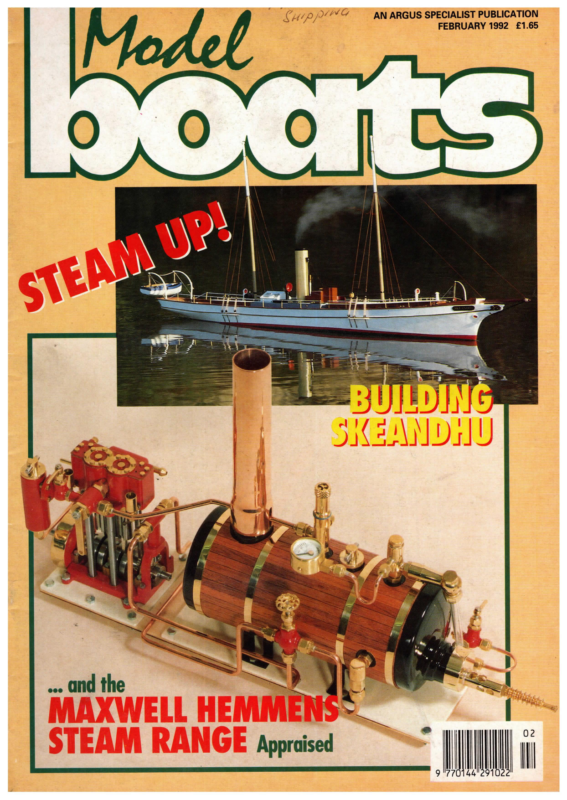
- CURVED AIR Russell Potts looks at the origins and history of the ‘A’ class
- Sailing to Win Nick Weall’s second series looks at improving your sailing — Part Six

AN ARGUS SPECIALIST PUBLICATION FEBRUARY 1992 … and the Appraised ee 9 i £1.65
Russell Potts looks at the origins and history of the ‘A’ class and concerned that his failure had put something of a damper on his plans to so stimulate model yachting as to enable him to make a living from it, turned to Malden Invader winning the YM Cup in 1923, the first year of the competition. Credit; Daniels & Tucker, Model Sailing Craft, 1932. A Daniels “A” Boat and its Offspring This month I want to write something about the origins and early history of what became known as the “A” Class after its adoption by the International Model Yacht Racing Association at its foundation meeting at Gosport in 1927. I’m afraid the illustrations leave something to be desired, as they are photocopies from existing half tones, some of them of only moderate quality to start with. The occasion for the excursus into early “A” history is that one of my correspondents has sent me photos ofa half size version Bill Daniels’ Crusader of 1923 which he had from a Mr Palmer who bought in the late 1940’s from one of the members of the YM6 Owners Association, then a very strong “A” Class club, based at the Rick Pond in Hampton Court Park. Subsequently he discussed the model with Bill Daniels who told him that he had built eight of these small replicas in 1924. I think that these were intended as a shrewd commercial venture by Daniels to cash in on the fame that Crusader had gained after she had won the YM Cup in both 1924 and 1925. Origins of the “A” Class The “A” Class, or “Yachting Monthly 6metre”, as it was originally known, was a side result of Daniels’ unsuccessful challenge to American model yachtsmen which took place in 1922. There is a small book to be written about early international model yachting contests as disorganised fiascos, but the races that took place on a Long Island bay between Bill’s Endeavour and the defending Polka Dot must rank as the prize event. I shall probably give you an insight into how not to conduct such a challenge when I have gathered all the material and photos together. For the moment it is enough to know that Bill, smarting from his defeat 48 Heckstall-Smith, the editor of the magazine Yachting Monthly; at that time this journal gave much more space to yacht racing than it did after Maurice Griffiths became editor and also gave some coverage to model yachting, which was largely supplied by Daniels and by his faithful henchman H B Tucker, most of it tending to suggest that Bill Daniels was model yachting, which was not strictly true, despite the very large contribution he had made to the development of the sport. Heckstall-Smith was interested in models because he believed that sailing trials of models could give useful data on the potential of designs for full size boats. Several designers before 1914, including Linton Hope, had carried out such trials but the results had been at best inconclusive. He had encouraged modellers to build to the BRA 18-footer Rule during the 1914-18 war, when no full size boats were being built, and he also had doubts about the long term suitability of the TYRU 6-metre as the smallest racing keelboat used for serious international competition. Bill went to him and suggested that a suitable cup for international competition would stimulate model yachting and would be an opportunity to introduce an alternative Rule that would give a better style of 6metre. A “100 Guinea Solid Gold Cup” was donated by Yachting Monthly and a Rule devised. The latter is usually credited to Heckstall-Smith, but there is some evidence that Daniels and possibly other model yachtsmen also made important contributions. The Nature of the Rule The basic concept of the YM 6 Metre Rule was derived from the BRA (Boat Racing Association) 18-footer Rule, carrying over the inclusion of D (displacement) on the bottom line of the formula, so that there is a counter balancing effect to the offset between length and sail area. As the measured length increases the sail area falls, but as the displacement increases (a natural concomitant of increased length) the formula adds back some sail area. This is the probable cause of the ability of the Rule to continue to produce very close racing despite the pressures of very different approaches to design in the 70 years it has been in use. Like the 18 Footer Rule the “A” Rule uses penalties rather than absolute prohibitions of what are deemed to be undesirable proportions, but these are limited to displacement, draft and freeboard, while the 18 Footer Rule specifies a preferred range of figures for each of the major dimensions in the formula. In combination, these give a much tighter control of the style of boat than is possible under the “A” Rule, which, over the years, has accommodated changes to reflect advances in technology and sail plan design in a way that would probably not have been possible under the 18 Footer In 1925, by now the boats have sail numbers. The other boat is No. 29 Hermione, which even tually won the Cup in 1931. She still survives and is being restored by Richard Howlett. When my Crusader replica is ready, we shall recreate this historic scene. Does anyone have a black sou’wester | can borrow? Credit; Daniels & Tucker, Model Sailing Craft, 1932.
Rule. (The two Rules are set out in the panel alongside). This has left designers free to go outside the expected range of values if they thought it worth their while; and in particular has allowed the Rule to absorb the effect of the greater efficiency of sail plans and lighter construction methods without needing any significant alterations. Most modern free sailing “A” boats are well below the range of “penalty free” displacements, but absorb the penalty by taking advantage of the greater efficiencies of modern sail plans and sail materials. The element of the Rule that was most probably introduced by Daniels is the use of Quarter Beam Lengths to determine sailing length rather than adjusting LWL by girth measurements to control the shape of the ends. This is borrowed from the American (full size) Universal Rule. Daniels had designed his Endeavour to a ‘modelised’ version of this Rule in 1922. Though full size designers in the UK had given some consideration to the Universal Rule they had almost no experience of it in practice and HeckstallSmith was keen to see them take it on board in preference to the use of girths to control the form of the ends of the boat as were used in the International and 18 footer Rules. Aims and Objects The idea in Heckstall-Smith’s mind was to promote the new YM6-metre as a full size class by showing its success in model use. The model competition was to prove the Rule and eventually to test the potential of full size designs. The models, built at 2 inches to the foot, (1/6) would be bigger and heavier than any preceding class of model yacht since the MYRA had taken on the organisation of model yachting in 1911. Daniels hoped to raise the profile of model yachting so as to establish a “serious” competition for large (and expensive) boats, built to a complex Rule, which might attract the participation of the class of man who was currently _ engaged in full size yacht racing, thus creating a market for his skills as a designer, builder and skipper which would be big enough to enable him to support himself from supplying the sport. Though there was and had always been an element in model yachting who were also involved in the full size sport, most model yachtsmen were of much more modest Panel 1 – 18 Footer and “A” Class Rules Panel II — Text of BassettLowke Catalogue The formula is as follows: International 18 Footer, 1919 “6-metre Model Racing (2in. to 1ft.): L+/8 Yachts” International L/S = Rating, 36in. + 4 363/D That is – one quarter of the sum of L and //S added to proguct of Land /S divided by 36 times °/D. L is length on load water-line in inches in sea water, with the addition Champion. The “International” model is (1) of 1% times the difference between the girth (in inches), covering board to covering board at bow water-line ending, and twice the freeboard at that point, and (2) one-third the difference between the girth (in inches), covering board to covering board at the stern water-line ending, and twice the freeboard at that point; to be measured as below. /S is the square root of the sail area in square inches, taking only 85 per cent of fore triangle for rating. /D is the cube root of displacement in full racing trim in lbs. (after the deduction for crew only). The “A” Class The Class shall consist of yachts not exceeding 6 Metres (19.68 feet} on the scale of 2ins = 1ft (39.37ins.) by the following formula: Le JS LA + 4 An outstanding feature of 6-metre models is their fidelity to the prototype. They are replicas in miniature in the fullest sense; the action and performance of the models exhibiting all the characteristics of the full-size boats. Invader Built to a scale of 2in to 1ft, was the celebrated model which won the 100guinea International Cup, and was designed and built throughout by Mr W J Daniels, who also sailed her in all the events. His boats, Invader and Crusader, won the International model yacht races The “International” 6-metre =— iD Where L is Load Water-line in inches plus half any excess in Quarter Beam Measurement. _§S is the square root of the total Sail Area in square inches. D is the cube root of the displacement of the model in cubic inches, in full racing trim with largest suit of sails, including spinnaker. Model (Scale 1/10th) Brief Specification The hull is most accurately shaped and built of selected dry timber under Mr Daniels’ personal supervision. The keel is of lead, weighing about 7 Ibs. and correctly placed. Mast and spars fashioned from straight grained timber, varnished and calibrated. Fittings. All fittings of the latest type, evolved from years of practical experience. Page from Bassett-Lowke catalogue 1929. Steering Gear. Improved modern pattern automatic steering gear, Model Racing Yachts beautifully nickel-plated. Sails. Selected Union silk, perfectly cut and finished, ensuring the utmost driving power. Dimensions. Length on deck, 3ft 2ins; Beam 8ins; Weight, 1 1lbs. complete. Price complete, £191.50 International Minor design and build their own boats to it. There was a lively correspondence in Model Engineer in the pre 1914 years A smaller model of the above, but conforming to a similar specification, but with a deck length of 24 inches., and a decrying complex Rules “which put the club modeller into the hands of the proportionate increase in beam and draft in order to maintain the same relative sail carrying power. Price complete, £11. 00. professional” Organisation at race built under lr tte “INT! NATIONAL ules, At the outset the Rule and the conditions of competition were established by the are se ~Popular, ang Universa l w tes thbo fano n:soi %sche ting Char? ‘0 the p; D. ominated itthetmode eeabitingThey aly are Folica magazine in consultation with an ad hoc committee of model yachtsmen invited by FEBRUARY 1992 can truly be denominated a scale model. against Denmark in 1924, and America retained the favour of the majority of club modellers precisely because the Rule was relatively simple and most skippers could to the committee, Alfred Turner, was less built to a scale of one-tenth full size, and in 1925, thus winning the cup outright a performance unique in model yachting. pretensions. The widely popular 10-rater Daniels, rather than with the MYA, which was the national governing body for the sport. Probably, Bill feared that the MYA Council of the day would not give enthusiastic support to his ambitious plans; certainly the only MYA nomination The “6-metre” boats built under the International Rules, are justly popular, and universal favourites in great races. We have made arrangements for the supply of the highest grade models of this class, designed by and built under the personal supervision of Mr W J Daniels, the World’s Model Yachting S all the character: ne theesptl na na Houdtbe ee bt t aces 1 he Nene repens F, beautity 4 TERA si ‘o ‘ f the ntmose driv, Mckel-plated, 1 Ibs.compe power. Above vibi nd : than glowing in his endorsement of the idea and the Scottish MYA representative was barely more than lukewarm if subsequent disputes about the relationship of the SMYA to the YM Cup competition are to be taken at face value. Unfortunately the MYA and SMYA Council minutes for this period have disappeared and there is only the very 49
of paid mates drawn from the working class members of the Gosport club because if they had not done so many of the entrants in the British Empire championships would have been forced to withdraw for want of assistance. Influences from the Corinthian tradition which determined the formal position of the MYA on amateurism are overlaid with echoes of the practice of the day in full size yachting, where the employment of paid skippers and paid hands and the acceptance of large money prizes did not invalidate the amateur status of the owner. The modellers seem not to have become involved in the confusions over the treatment of those who earned their living in the yachts supply industry that bedevilled full size practice at this period. A Staines MYC came into existence from which Freeman entered, but there is no evidence that it had any other activity, though there is one other Staines owner with a Daniels design recorded in the early register. So far as is known this second member never competed in any model yacht race and Freeman himself disappeared from the model yachting scene as soon as he had won the first YM Cup outright. It was claimed that his duties as clerk to the Court in Staines made it impossible for him to sail the boat himself, but it seems clear that he had effectively hired Daniels as skipper to give himself the best chance of winning. , Crusader on her acceptance trials on Staines reservoir, 1923 or 24. No number on sail yet. From Model Engineer, 1924. scrappy printed record in Model Engineer and Yachting Monthly to work from. Entry to the British Empire Championship and selection trials for the British entry to the separate international competition was open to any boat from any model yacht club in the Empire, whether affiliated to the MYA or not. This meant that the Scots and, later, entries from South Africa and other Dominions could compete directly, though the Scots were not entirely happy with the arrangements and wanted a direct Scots entry into the international competition. The MYA agreed to take on the administration and conduct of the races on behalf of the magazine. The first contest was held in 1923 and, given the short time between the final publication of the Rule late in 1922 and the competition at the end of the following July, it is not surprising that only 12 boats entered, at least two of which were [YRU 12-metres re-measured to the new Rule. Bill Daniels was clearly on an inside track in terms of design as he had been so closely involved in the development of the Rule and he also had the advantage of a patron who was willing to put serious money into a campaign to win the YM Cup. Find a Client J Scott Freeman was a Staines solicitor who was a keen small boat sailor on the Thames and active in the affairs of the BRA. His A-rater was usually in the first three or four boats in the season’s results in the Upper Thames regattas and he became Commodore of the Upper Thames club in the 1930’s. Bill persuaded him to have two boats built to the new Rule and 50 these were Invader and Crusader, which became numbers 7 and 8 on the register when it was gathered together in 1925. The class was not originally recognised as an MYA Class and it is clear from comparisons between the entry lists and the early pages of the register that a number of boats involved in the first two years of competition were never recorded as they had dropped out of use before the register was compiled. Though similar in concept, Invader and Crusader are two distinct designs; the deal that Bill struck with Freeman was to design, build and sail the boats for him. It is not now possible to discover what the exact financial arrangements were between Freeman and Daniels, but other evidence suggests that between the wars Daniels charged from £40 to £120 to design and build an “A” boat as a one off project for a private client; this range was clearly adjusted to what he thought his client could afford and some of his later clients were extremely wealthy men.-There are also strong suggestions that the upper end of the range was pitched to include his services as a skipper in major races. These sums should be considered in the light of the wage figures discussed later. Freeman had two boats and retained Bill’s services as sailing master for three consecutive championships. It is just conceivable that Bill and his family effectively lived off Freeman’s patronage for most of those three years, but more likely that he needed to scrabble fairly hard to make ends meet. Who’s a Professional then? There is more work to be done on the position of “shamateurs” and professional sailing masters in the apparently amateur sport of model yachting in the inter war years. It is perfectly clear that for a long period the MYA winked at the employment The Early Races In 1923, Invader narrowly won the British Empire title from Mary, a Feltwell design sailed by George Braine, who was regarded as something of a phenomenon for successfully sailing through four days of arduous competition at an extremely advanced age. The International challenge came notionally from Denmark, with V V Graae entering on behalf of the Royal Danish YC. Graae was a UK resident and a prominent racing yachtsman in Solent races. His designer, builder and skipper was another UK resident Dane, this time a model yachtsman, Tottrup, who was a member of MYSA at Kensington. Their boat Dana I, was outclassed and Invader won the YM Cup easily. In the two following years Freeman entered Crusader and, with Daniels as skipper, won again. In each year the contest in the British selection trials was much closer than the International. In 1924 the Danes were again the only challenger and their new boat, Dana II, was again convincingly beaten. By 1925 the entry had risen to 27, but only 20 of these actually started. Crusader won the selection races by a fairly comfortable margin from Dayspring, a Turner boat sailed by W Arberry of the Solent club. The international challenge came for the first time from the USA, with Joe Weaver of the Central Park MYC sailing his boat Slipper. Crusader was a convincing winner by 46 points to 14 over two days of racing and following the international races a consolation race was held in which Slipper, sailed by Cuthbert Pyne, who had acted as Weaver’s mate in the International, placed behind seven boats that had been eliminated in the selection races. Slipper was not built specially for the contest, but was a boat built to the MYRAA “C” Class, altered to fit the YM6 MODEL BOATS
Rule so that she could be used as a trial which had failed to attract much interest until much Jater in their horse for the American boats designed for earning career. superior to all other entrants and was chosen to Zo to Gosport, despite the fact overseas or to bring more rich yacht owners into the model sport, Many model yachtsmen at home were resolutely opposed to it as too big, too expensive and, in the light of Daniels’ domination of the that her very small freeboard attracted a early years, not a level playing field for significant penalty under the YM6 Rule. competition. Tucker, writing in Model Engineer, is scathing about her design which was not properly balanced by “Daniels & Tucker” by making it widely known that it was his the international competition. In the American selection trials she proved standards, so that she squatted badly when heeled and had difficulty finding her head going to windward. One way was to capitalise on his success boats that had won what were extensively hyped as the most important model yacht races of all time. Though they were the first serious attempt to run a series of international competitions, it could hardly The catalogue page illustrated is from the 1929 edition and does not reproduce very well. Indeed, John may decide that it’s not good enough to use. In case he does so decide, I have copied out the text, which is going to be pretty hard to read from an illustration anyway. This page does not appear in the 1937 edition which I have discussed in earlier columns. From internal evidence the text dates from before 1927, when the name of the class was changed. It was probably written by Bassetts, rather than by Daniels himself, as it contains more misinformation about the class and the The Fate of the Boats be claimed that either in numbers or Under the terms of the competition Freeman had won the 100 Guinea Gold Cup outright and having achieved his aim quality of competition the YM Cup races were as big as they were later to become, or even as important as the National history of the early races than I would have thought possible in so small a space. he retired from model competition. His boats seem to have been laid aside (though there is one suit of sails in Crusader’s bag bearing an “IM-A” class mark that must have been made after 1927). Eventually competitions for other, more popular, The specification is also very curiously classes. Nonetheless, his advertising to fellow model yachtsmen in the specialist worded. The illustration used shows the they went to the RYA offices and from there to Dick Priest, and on to Ken Jones. Crusader was destroyed when a mould was taken off her for a GRP radio controlled boat in the late 1970’s and I bought Invader from Ken. I was a bit dismayed to discover when the sail bags were opened they contained lots of beautifully preserved cotton suits for Crusader and none for Invader. Somewhere along the way the hulls and rigs had been mismatched and there was no way of recovering the original Invader suits. In due course, when Jnvader’s hull has been restored, I shall have to make some new sails for her. There are no drawings, but a number of photos of her and her sisters will give a good idea of the sizes. I pondered for a long time over the Crusader sails and after weighing the possibility of making a glass hull and recovering some of the cost by making a few more to sell, finally decided to have a hull built to match them. Luckily, there is a good lines drawing in the 1932 edition of the Daniels and Tucker classic Model Sailing Craft. I expect to take delivery of a John Gale planked masterpiece very shortly and to have the fully restored Crusader on the water by the end of the year. So we shall be able to get a very good idea of the performance of one of the classic models of all time was really like. Where do we go from here? But what of the aims of Daniels and Heckstall-Smith? The aim of stimulating serious international competition had barely been achieved, and the original cup had disappeared to a mantlepiece in Staines after only three years. Yachting Monthly bit on the bullet and provided another Cup, this time not so costly as the original and this time with the conditions amended to make it a perpetual challenge cup. At the time it must have been less than obvious that the YM Cup was going to become the instrument through which model yachting was to develop an international organisation. Apart from the two boats for Freeman, Bill Daniels had managed to get commissions for a number of boats to the new class; most of the early ones were built to the Invader design, including number 9, Defiance, which was to win in 1926. But how was he to make a living with the relatively slow growth of the class FEBRUARY 1992 press and in his flysheets claimed that he was the designer and builder of the winners of “The International Races” and of “90% of the successful model yachts of the Metropolis”. While the first claim was undoubtedly true, the second was equally certainly false. Another venture was the construction of a series of smaller replicas of Crusader which he sold both direct from his own workshop and through the up market original Crusader, rather than one of the 1/10 scale (38 inches overall) models, and derives from a photo which appeared in Model Engineer in 1924 showing her on Staines reservoir. This was almost certainly taken on her acceptance trials on completion and was probably the only occasion she sailed there, as she would have to be sailed from a skiff, which A preserved example of the Daniels built half size replicas of 1924. Photo: Brian Mitchell. model engineers, Bassett-Lowke. As an aside, it is hard for those of us who only knew Bassetts in its post war declining years to realise how resolutely up market its products were and how it aimed quite specifically for the pocket of the upper middle class enthusiast who wanted, and was prepared to pay for, the very best. There is very little in their catalogue that could be described as cheap or even reasonable in price by the standards of the time. It is very difficult to make direct price comparisons, but the sort of figure to bear in mind is that in the inter war period we are dealing with here, a craftsman in industry would be lucky to earn £3 a week on a regular basis and many workers earned significantly less. Even among the middle classes, incomes of £200 to £300 a year were regarded as sufficient to bring up a family in modest respectability. Older modellers who were young in the 1930’s recall saving their pennies or, very commonly, blowing their first week’s apprentice wages when they left school on some item from Bassetts which was recognised as a massive extravagance which marked a rite of passage to man’s estate with a discretionary income. It was a rite because it was not to be repeated neither Daniels nor Freeman would have relished. I think that there must be some confusion over the actual sizes and proportionate reductions of the various small scale versions of Crusader. The panel shows the leading dimensions and proportions of the original “A” boat and 51
her offspring together with the figures for a notional model which would be an exact 54% scale replica of Crusader. The figures for the Bassett boats are taken from the catalogue; those for the extant half size model from the hull itself and for the sail area from dimensions scaled from the photo. It will be obvious that all the small versions have solved the problem arising from the “square/cube law”, (which results in scaled down versions of a design having a displacement far too small to sustain the sail area), by increasing the displacement rather than reducing the sail area by more than its normal scale proportion. It seems very unlikely that the relative increase of beam shown for the Bassett 1/10 model could have produced a displacement of 11 pounds without very substantial increases in the hull depth and Another view of the preserved Danbiels boat. Photo: Brian Mitchell. Contact Addresses 1625. Vintage Group, Old Boat Queries, Curved Air Press; Russell Potts, 8 Sherard MYA Matters; Ian Taylor, 115 Mayfield Avenue, London N12 9HY. Tel: 081 446 Road, London SE9 6EP. Tel: 081 850 6805. Panel III Relative Dimensions of Reduced Versions of Crusader draft which would have changed the character of the boat and robbed it of any Boat (in) LOA (in) Beam (lb) Displ SA (sq in) 38 (54%) 7.56 (54%) 5.82 (16%) 564 (29%) give ins 1924 37.8 (54%) 9 853 (23%) 502 (25%) oe 1/10 ee = ae poi serious family resemblance to its original. As the extant boat weighs in at just over eight and a half pounds and is known to Crusader seems at least possible that the 11 pound displacement figure for the Bassett boat is notional model at 54% linear scale have been built by Daniels himself, it an error. Alternatively Bill decided to make fairly radical alterations to the design before offering her to Bassetts. If so it would be directly contrary to the text of the catalogue, and though I’m prepared to believe that Bassetts were misinformed 70 14 37 1936 Daniels about the relationship of these models to full size classes, I don’t think they would : practise a gross deception on their Bassett 24 customers. I should be very interested to know if any of the Bassett boats survive from which direct measurements can be ”) . oi?) . 24 1925? (34%) o rake : : the draft, as is Increased proportionately, to retain the same relative sail carrying power. taken. Keep your copies in first class condition Keep your collection of Model Boats in mint condition with these specially commissioned binders. The price is just £6.95 which includes postage and packing.” wod ELW 99 O RID How to order Send cheque/P.O. to A.S.P. BINDERS OFFERS, Argus House, Boundary Way, Hemel Hempstead, HP2 7ST TELEPHONE ORDERS (24 HRS) 0442 66551 Friday 21st February — Sunday 23rd February *U.K. only, overseas please add £1.50 (0442) 66551 Friday 12 noon — 7pm, Saturday 10am — 7pm, Sunday 10am — 6pm Show organised by the Sussex Association of Model Railway Clubs. Please:Supply scissors snccssssssliavateng es MB BINDERS @ £6.95 each inc. p&p | Overseas please add £1.50 p&p. | | Total £ ues (please make cheques/postal orders payable to A.S.P.) | Adults | YY| ee £3.00 Children/OAP Family Ticket (2 Adults and 2 Children) THE £750 Group bookings available from December 2nd. Discounts on application. Ring 0273 202881 (‘Al Be I |( a ay Oo N 2 ic. ETS | nts | ss idactaCcu coast vsspesve sovssusssassensonvesks Sie Se ce eee | HE, Sep ee MMENNE Por aceNyinadsevtenetanvaedeneseissesees [Sede my LLTCET Tee ETT epiy ACO CESSIVISA Siggrietheire’ …….rfS see eMedia ean tuseetbnencosortnssnsstnmnnabvvnvavsconsie ere, allow 28 days for delivery. 52 SO Ne, Se | | | | | _| MODEL BOATS
Sail to Win s this is the sixth article in the second series on yacht racing it seems a good opportunity to have a close look at match racing. At the present time the class of model yacht that will give you the most experience of match racing is the six metre class, which for the last year or two have almost exclusively used match racing for their events. Within the Marblehead Class Nick Weall’s second series looks at improving your sailing — Part Six sink in to the heads of the organisers that appendix 4b was written for a purpose. If the above rules are not used it simply allows you to engage the other yacht in a loose cover at any time you like after launching your yacht! If the other yacht does not know what is going on this can lead to an unfair advantage. If the other yacht does know what is going on it can the race of champions has one day devoted to match racing and one two day event at Swanley also has one day devoted to match racing. Some clubs may devote some of their racing days to match racing, but on the whole there is not too much opportunity to try some match racing which is a great pity since there is much to be learnt within match racing that can be put to good use in fleet racing. A lot of the basic tactics can be much more easily understood when match racing where one is able to concentrate entirely upon racing one other yacht and not have to worry about looking out for other yachts coming into the picture from all directions. The start is made so much easier and rounding marks again is much easier to cope with when only one other yacht is involved. Match racing is a whole lot of fun and I would certainly like to see much more opportunities available to indulge in this particular branch of our sport. Preparation Now the first most important lesson to learn is that the battle starts long before the start of the race. In fact it is quite possible to win the entire race by the actual start of the race! Because of the lack of opportunities to race under match racing rules a lot of remote control skippers do not seem to realise this rather Above: 39 – Peter Stollery as usual in the thick of the action during the 1991 RM European Championships. Peter was top placed Englishman at 3rd. Below: Tony Ryan’‘s well turned out RM Raven from the Graham Bantock boatyard, pictured at the Cleveland Northern Ranking Race. lead to the actual launching of the yacht assuminga tactical significance which is ridiculous. Anyway, whichever system you are racing under let us look at what you wish to achieve before the start. Rule 4.3 (c)(i) of appendix 4b states that when the penalty is signalled before she has started, it shall be taken as soon as Clean lines of Klaus Schroeder’s new design. Klaus did not have a good week, finishing 18th. fundamental point. If you take a moment to refer to your rule book and look up appendix 4, section B you will find “Match Racing Rules”. This appendix is now in fact obsolete, it has been replaced with appendix 4b from the 1990/1991 supplement, published by the IYRU. Copies of this supplement are either available directly from the IYRU or from our general secretary of the MYA – Ian Taylor. It would be worth your while to read that entire section now and then come back to this article. For those of you that don’t have access to a current supplement we shall cover some of the appendix as we proceed. Rule 3 of the appendix covers the PreStart Procedure:- 3.1 At her preparatory signal a yacht shall be outside her assigned end of the starting line. 3.2 Within the two minute period following her preparatory signal, a yacht shall cross and clear the starting line from the course side to the pre-start side. 3.3 Yachts not racing shall keep well 54 clear of yachts racing (and their umpire boats when used as in paragraph 4) Now I have not to date been to a Marblehead meeting where this particular rule has been used. That in my opinion is quite wrong, but hopefully in time it will MODEL BOATS
possible after starting. So if you can get the other yacht into a losing rule infringement situation you are likely to pre-start manoeuvres especially. It is most important to realise that the starboard yacht can continue to manoeuvre when win the race before the start, because all other things being equal after doing its penalty turn after the start it should not yacht so long as the port tack yacht by taking further avoiding action can manage governed of course by rule 35 starboard not make every effort to keep clear and the starboard yacht has to alter her course to miss the port tack yacht, the port tack be able to catch you up! So bearing that objective in mind what can you look for? Port and starboard situations – rule 36 yacht not altering course to prevent the port tack yacht from keeping clear. No I’m sorry but that is not quite correct, you have to read appendix 4b carefully. Rule 1.3 quotes: Rule 35, limitations on Altering course is replaced with: When one yacht is required to keep clear of another, the right of way yacht shall not alter course or manoeuvre against a give-way yacht unless she leaves the give-way yacht an opportunity to keep clear in a seamanlike manner in the prevailing conditions, except: (a) to the extent permitted by rule 38.1, luffing rights, and (b) when assuming a proper course: (i) to start, unless subject to rule 40, same tack, luffing before clearing the starting line, or to the second part of rule 44(b) Returning to start, or (ii) when rounding a mark. This alteration to rule 35 allows the starboard yacht much more flexibility in upon a converging course with a port tack to keep clear. If the port tack yacht does yacht will be awarded a penalty. Rule 37 situations perhaps have more potential -windward/leeward or of course putting the other yacht into one of the starting marks! However believe it or not that is not your prime objective in the pre-start manoeuvres. What is far more important is to get command over the other yacht? What do I mean by that? Well we want to put our yacht into such a position that we to some extent control the options of the other yacht. Now an easy tactic to understand is if both yachts are on the course side of the start, then if you can keep your yacht between the other yacht and the start line the other yacht cannot get back to the starting line until you allow it to. In such a situation the starting gun no longer matters; you can hold the other yacht the course side of the line as long as you like. All that matters is Now the same sort of idea can work if you are both on the pre-start side of the line and you as leeward yacht are able to push the windward yacht the wrong side of the starting mark, even if by doing so you are unable to cross the line yourself. Again all that matters is that when you do manoeuvre back towards the line the other yacht is going to end up behind. Another option is to put yourself in the leeward position and carry both yachts over the line just a few seconds before the gun! Your tactic now should be to bear off and recross the line once you have encouraged the other yacht to tack away to circle back to the line; you should gain an advantage from this manoeuvre if done correctly. These few suggestions ought to be enough to get your mind working to develop tactics of your own. Try to always have a few surprise tactics up your sleeve and use them very sparingly. After all it does not pay to teach the opposition too many tricks all at once or you are likely to have them thrown back at you at some stage. Of course if you have really thought your tactics through you will have already found an escape option to each particular tactic. Naturally enough you need to find escape tactics for the basic tactics I have suggested above! One escape option that can be effective if used fairly early in the countdown period that at some point you can get back to the line and cross it correctly well before the other yacht. If you can head to wind and stop. It is very difficult for the covering yacht to be able to stop at the same time and much more difficult to an immediate advantage that again ought to be held in the same direction. This may give you the opportunity to break cover or even to achieve that you will have for the entire race if you keep your wits about you. Left: Too much wind on too large a sail and the bow goes down. Too much sail in such conditions slows you down! Variable wind conditions can make it very hard though to make the correct choice. In this race the wind increased in strength during the race. Below: Nick Weall walking backwards in front of a fleetfull of Radio ‘A’ skippers approaching the windward mark at Gosport. is simply to stall your yacht! Yes put it up arrange to start again at the same time or gain cover on the other yacht. This is a dangerous tactic to employ if you are not very good at getting your yacht out of irons and underway again. The nearer to the starting gun that you do it the more risky it becomes! It is most definitely not a tactic to employ after the start! Another fairly common tactic is simply to start wheeling your yacht around in ever decreasing circles, hoping at some point to break out of the circle to a position whereby the other yacht loses the cover it held. As the experience of skippers generally improves so will the tactics employed before the start. At present the level of awareness is fairly low. Hopefully after people have read this article, thought about it, practised it and talked about it, more tactics will be employed and the whole standard of match racing will become more challenging and more fun. After all although it is very useful to put your opponent out before the start, it is rather a disappointing result. A closely contested race that you end up winning is much more satisfying. What you really want though is a good battle with lots of complicated manoeuvres being tried out. Thrust and counter-thrust with each yacht skilfully avoiding the traps being laid by its opponent. Finally the gun goes and the pair of you cross the line in close proximity to engage in a fine tacking dual up the windward beat! All to often that simply doesn’t happen, but it should it you want to savour the full satisfactions of match racing. A race where one yacht retains the lead for the entire race is utterly boring, unless the other yacht was close enough to be snapping at the leading yacht’s heels for the entire race. Depending upon the stakes, I often will put in a voluntary turn if I get to far FEBRUARY 1992 55
ahead of my opponent, even letting them take a short lead, simply to make a race of it. Of course in a Championship or other important meeting no one is going to do that, but at club level it is well worth doing so as you can practice more manoeuvres. You are not going to learn very much either by being too far ahead or too far behind! Developing Tactics One of the interesting things about tactics is that there is nothing to stop you developing your own! If fact the best way to develop your tactics is simply by racing experience and experimentation. The object of articles such as this is to put some ideas into your head, for you to try at some time or other. Naturally enough any tactic mentioned has been used effectively within the parameters described. Objectives Now let’s go back to the start and look at the objectives supposing that our two yachts have both managed to start fairly well and close to each other. Neither yacht has incurred any penalty turns for prestart infringements so they are both free to consider their options as they begin the first windward beat. Assuming that both yachts are on the same tack, one will be to leeward of the other or clear astern. If they are not on the same tack then you can be sure that very soon they will be. One of the basic objectives on the windward beat should be actually not to get too far ahead of the other yacht with the risk of putting your yacht into a different set of wind conditions. If you are ahead you concentrate on remaining on the same tack as the following yacht as much as possible and on keeping your yacht between the next mark to be rounded and the following yacht follows! Do this enough times and you will soon prove who can tack the smoothest. Throw in the odd dummy tack in an effort to break free of the leading yacht’s cover. Try and encourage the yacht clear ahead to make a mistake and pounce. Get on top of the other yacht and call the tune. Remember that with models you do not get exactly the same wind shadow effects that you do on full sized craft. To be slightly to windward and astern on a full sized craft is a deadly position that ends up with you sailing below the course of the yacht ahead and slightly slower. In a model you can get away with that position much easier, or perhaps it is that the scale demands that the yachts are so much more closer to each other than full sized yachts before the full effects of the wind shadows are experienced. Another point to bear in mind is that if you are on port as the slightly behind yacht and the other yacht is coming to cross your bows on starboard forcing you to tack or to bear off under its stern, consider tacking just before the yacht is about to hit you and try and get a good leebow position on the now windward yacht. Now as long as the new windward yacht has not been beyond the mast abeam stem position you will be able to give it a sharp luff, after having given it room and opportunity to keep clear. You might just find that you in fact end up in command of the other yacht, forcing it to tack away to avoid the chance of being violently luffed. If so you can tack after it to maintain a loose cover over it, whereby you are to windward of the other yacht sufficiently far enough away to avoid all the ill-effects of wind shadows, but near enough to stop the leeward yacht tacking in your water. The other alternative to consider if the previously slightly ahead yacht is crossing your bows on starboard hoping to put you about is to bear off, duck its stern and immediately tack to starboard to maintain the same loose cover to windward of the other yacht still ahead but to leeward. You need to re-read rule 41.4 here, it covers simultaneous tacking to quote: “ When two yachts are both tacking or both gybing at the same time, the one on the other’s port side shall keep clear.”. In the situation just described where you ducked the stern of the starboard tack yacht, if you both start to tack together the onus is one the other yacht to keep clear since it lies to the port side of your yacht. So on the windward beat as yacht clear yacht. That way you are likely to enjoy much the same benefits or disadvantages due to wind shifts, bends in the wind, tidal conditions, current etc. It is awfully embarrassing to be on one side of the windward beat and your opponent on the other, only to see your opponent enjoy a massive wind shift that lifts them straight up towards the next mark and heads you further away from the same mark! It is not quite so much of a risk on the reach or run but on the beat it can be a killer. So if the leading yachts objective is to keep itself between the mark and the following yacht, what is the objective of the following yacht? To get in front of the other yacht! Yes of course, but how? By trying to gain command over the other yacht! If it can sail higher than the yacht in front it may be able to sail itself into a position where it is to windward of the previously leading yacht and thus getting nearer to the windward mark than the other yacht. By getting to windward of the leading yacht even whilst still astern of the other yacht the following yacht can gain command over the leading yacht to leeward, because now the leading yacht to leeward cannot tack without tacking in the water of the windward slightly astern yacht! Of course in an evenly matched class the pointing abilities are going to be eee much the same. So the next favourite tactic is to engage in a tacking dual. As the following yacht you tack to find clear air and clean water. Of course the other leading yacht tacks to cover, so you tack back to your original tack and the leading 56 Above: More shots of Janusz’s winning Skalpel design, so well built it needs a vent in the deck to allow for variations in internal pressure. To save weight he removes the outer cases of his winches. This boat is dry and fast! Left: Janusz Walicki No. 6 ahead of the fleet at the RM European Championships in Finland. MODEL BOATS
ahead – try and keep between the yacht appendix 4b 1.4: Rule 39 Sailin g below a astern and the windward mark. Try and stay on the same tack as the yacht astern and try not to allow it to pinch nearer to windward than your yacht. Every time the yacht astern tacks, tack to cover it if possible and if you have enoug h speed. If the yacht astern tacks into a clear header there is no reason why you shoul d not stay on the lifting tack if it is clearl y taking you more directly towards the windw ard mark. You should now keep a very carefu l eye out for windshifts and ensure that your yacht is increasing its position over the other yacht. As the yacht clear astern – think about getting into clear air and clean water – if far behind consider trying to sail to the opposite side of the windward beat – if nearer consider trying to set up a tacking dual keeping your tacks smoot h and fast, not putting in another tack until you have regained optimum speed for the conditions. Try and set up situations where upon you are on oppos ite tacks, allowing you the option to leebo w the other yacht with a fast tack unde r its bows or duck its stern and immediatel y tack to sit on top of it. The main objective must be that if you cannot get past you must stay as close behind the yacht clear ahead as possible rounding the windward mark , because then a new set of tactics come into play offering the yacht astern a few more chances. Going around the windward mark immediately should get the brain shifting a mode and exploring diffe rent options. The course set for match racin g should not include a wing/gybe mark, it should just be a beating and running course, We will however look firstly at a reach ing course towards the gybe mark. The yacht astern now has the choice of tryin g to sail above proper course, after start ing is deleted and replaced with: “A yacht that is on a free leg of the course shall not sail below her proper course when she is clearly within three of her overall lengths of a leeward yacht.” Now you may feel that this is going to make getting the inside overl ap extremely difficult if sailing a port rounding course and in that opinion you would be correct. However the correct match racing course to use is one where the marks are left to starboard! The usual course being a startline laid square to the wind with a windward mark centrally placed to the starting line dead up wind. The leeward mark will be on the course side of the start/finishline and directly down wind of the windward mark. The complete course will be start, windward mark, leeward mark, windward mark and running finish! All marks being left to starboard! IT IS IMPORTANT THAT THE ORGANISERS OF YOUR CLUB S MATCH RACING ARE MADE AWARE OF THIS ARTICLE AND MORE IMPORTAN TLY OF APPENDIX 4B IN THE 1990/ 1991 SUPPLEMENT. Umpiring There is also available from the TYRU ata cost of £16.00 an umpires manu al that covers everything a club needs to know about running a match racing series. If you want to get the very best that you can get out of match racing , it is important to use the correct rules and the correct type of course. It is equally important to use the correct sort of umpiring. We are all withi n the model yacht world used to actin g as observers in fleet racing. We now have to develop that skill into actively umpiring the yacht ahead into a position where by it match racing. To be able to actively umpire a match race prope rly it is of risk of some sever luffing or it can endeavour to sail below the leading yacht the rules being applied thoro ughly. Firstly such umpires must have a good knowledge of the IYRR and a proper under standing of can blanket the wind to some degree getting to the leeward yacht and run the to gain an overlap by the time the four boats length is reached at the gybe mark. The yacht clear astern has the protection of rule 39 or so it thinks, until it reads More details of the winning Skalpel. just calling to the offending yacht . Please course going to be neces sary to understand appendix 4b. An umpire needs to be able to award a penalty within ten to twenty seconds maximum of the incid ent being protested. Let us have a closer look at what is required. Firstly the yacht protesting an alleged infringement of a rule of sections B and C of part 4 under appendix 4b may protest immediately by hailin g protest and conspicuously displaying the Code flag “Y”. Now obviously as models we are not going to use the Code flag “Y”. So-we will need to modify this rule to hailing protest twice. Now under 4.3(b) of the Appen dix 4b “As soon as possible after a “Y” flag is displayed, the umpires shall decide whether a penalty shall be impos ed note very carefully though that it is only the yacht that has been protested that may be penalised! If in the umpir es opinion it is in fact only the protes ting yacht that was at fault, then they can only award an all clear. If both yachts have protested, then one or both yachts may be awarded a penalty or both given the all clear according to circumstances. How do the umpires actually operat e? In full sized events there will be two umpires following the two match racing yacht s in one power vessel and one wing umpire in another power craft. The wing umpire is always looking for the overlap and mast abeam positions. The two main umpir es adopt one racing yacht each and constantly talk their yacht’ s actions through. For example Umpire 1 “I am on starboard, clear ahead and may do as I please.” Umpire 2 “I am on starb oard, clear astern and must keep clear. ” Ump 1 “IT am on starboard, bearing off still clear ahead.” Ump 2 “Starboard, Clear astern, I must keep clear, bearing off.” Ump 1 “Gybing to port, I must keep clear. ” Ump 2 “Starboard, bearing off.” Ump 1 “Port, hardening up.” Ump 2 “Gybing to port” Ump1 “Luffing, tacking, starbo ard.” Ump 2 “Port, I must keep clear”. Get the idea? The pre-start is a very busy time with lots of very tight manoeuvring taking place; according to the evenness of the match the entire race might be as complex, but is far more likely to calm down some. The reason the umpires talk throu gh the actions of the yachts is so as they have it very plainly fixed in their minds what is going on the whole time. Then when they see a flag “Y” go up they can respond immediately. The other task the umpires have of course is to keep their craft right up by the action so as they are constantly in the best position to see poten tial incidents. As such they need to have a good appreciation of the likely tactics to be employed and the appropriate responses to those tactics. Match racing is a very young but fast growing part of the total Sailin g scene. It is not going to go away, it is a lot simpler for television to cover and for the public at large to understand. The racin g is tight with plenty of close inter-acti on between contesting yachts. On the water yachts have either a yellow pennant for starboard entry or blue pennant for port entry flying. Umpires hold up either a yello w or blue flag to penalise the yacht flyin g that coloured pennant. A green flag means no penalty. Whilst the ultimate deter rent is a black flag for immediate disqua lification. (This is only used as a desperate measu re, the umpires would normally award a second penalty first and then only after on the protested yacht. Only the protested yacht will be penalised. The umpires will then immediately signal their decis ion by displaying a visual signal acco mpanied b~ a sound signal as follows: (i) A green flag means “The umpires are not satisfied that the protested yacht has infringed a rule., no penalty is imposed” (ii) A visual signal identifyin g the yacht means: The designated yacht has infringed a rule, is penalised and shall exonerate herself in accordance with parag raph 4.3(c)”. Again within the model world we need to amend this rule slightly to the umpires ; that consider a black flag if the yacht refused to take the penalties for example.) All of this is fairly easy to under stand, it is certainly easy to explain in a programme for the public to buy, when watch ing such events. What of the penalties? The penal ty awarded depends on whether the yacht is on the windward or off wind leg of the course to windward and pre-start incidents being resolved after the start the penalty is one gybe. Thus the usual tactic is bear off, gybe and harden up on the new close hauled course. The other yacht will normally tack across to cover the penalty taking yacht as soon as it sees the yacht bear off to gybe. It will need to be aware 57
percent, but certainly no more than that. It is critical that the starting sequence is kept in its entirety or you will remove a lot though that the penalty taking yacht might just choose to put in a quick tack after. hardening up to a close-hauled course to take the covering yacht by surprise and thus possibly break free of cover. On the free leg of the course the penalty is a tack. Now on full sized racing the penalty may be taken if the spinnaker is up after the spinnaker is dropped at the end of the off wind leg but BEFORE starting the next leg, the point that defines the end of the leg, being a line projected beyond the leeward mark from the windward mark. of the potential for a good race. This article has been written immediately after my attending a two and a half day seminar on Umpiring run by the RYA and by John Doerr in particular. It was attended by all of the UK’s top potential National Umpires prior to the RYA setting up a National Umpire scheme. Under a dozen of us attended and The tack must be done before that line is crossed or another penalty will be warded. Now in RC models we do not use spinnakers so the tack would have to be done as soon as possible after receiving the penalty. We need to consider carefully within the remote controlled world how we can best apply the umpiring at our match racing events most effectively. Firstly we will need to train such people up over a period of time, since the skippers themselves are going to take sometime to get fully used to racing under appendix 4b as well, this might be easier than one might imagine. There has to be a general willingness within our sector of the sport to fully embrace the application of appendix 4b. Since this will be the only way to keep up with developments within the full sized sector of the sport, I’m sure most people involved will want to. It will most definitely result in a better class of racing with a much higher enjoyment factor. We could probably get away with using just two umpires per pre-start manoeuvring and start and then use just one umpire to cover the remainder of that match’s race. The other umpire could then fall back to cover the next pre-start and start etc etc. The number of umpires required would then be governed by the number of matches on the water racing at any one time. The following definitions are being adopted by the [YRU for use in match racing events: Match: A race between two yachts. Flight: A number of matches which are started in a single starting sequence, in which each yacht of the group sails one match. Round Robin: A series of matches in which each yacht of a group is scheduled to race against each other yacht in that group. Group: A subdivision of the total number of competitors. The yachts of each group participate in their own round robin. Series: A number of matches scheduled either to determine the place order of the yachts competing or to select which yachts shall progress into a following series. In this year’s RYA National Match Racing Championship Qualifiers we used three matches per flight. There were thus three umpire boats with two umpires in each, plus one wing boat with one umpire covering all of the three starts and then progressing to the closest match requiring potential additional help of determining overlap or mast abeam judgments to be made. For remote controlled events I think we would be governed by the number of umpires available minus one., if we are to _ use the system suggested above of two umpires covering the start and then just one umpire per match after the start. This will obviously needa bit of trial and error to perfect a system. 58 The Gosport Club’s way of informing onlookers what is going on. Back to the Start We need now to revert back to the prestart part of the match. This is without doubt the most important part of the race. It is essential that we apply the proper procedures and times to this part of match. Each yacht in a match is allocated an end of the line. Blue is port and yellow starboard. We should consider attaching small pennants to our back stays for this simply identification method. The line itself becomes in effect an H where the cross bar is the actual start line. At the five minute sound each yacht must be outside of its respective end. It must NOT cross the upright of its side of the H until the four minute signal is sounded. It now has two minutes to cross from the course side of the line to the pre-start side. If it does not achieve this objective it is awarded a penalty to be taken of course after the start and after clearing the starting line. This part of the starting sequence in itself immediately opens up attacking tactics, especially against the yacht that is late in coming in to attempt to cross the line from the course side. The yacht that timed it correctly may be able to get itself into a position whereby it can prevent the latecomer from being able to cross the line, thereby imposing a penalty upon it. That penalty is awarded by the umpires without anyone protesting by the way. In the final two minutes before the starting gun or as soon as both yachts have come in from the four minute sound and both cross the line from the course side, close manoeuvring ought to be taking place during which there is every chance of incidents occurring and penalties being awarded. This is a very important part of the match and we must not make the mistake of reducing the amount of time that it takes. There are a lot of skills to be developed precisely in this part of match racing and done properly it is extremely exciting to watch. So there you have it: five minute gun, four minute sound into the H and over the line from the course side, two minute sound you must have crossed that line from the course side or suffer a penalty gun which becomes the next matches five minute gun. Thus it takes fifteen minutes to get off three matches. It might be possible to reduce all these timings by fifty one day was theory and the remaining time was spent on the water actually umpiring the RYA National Championship Qualifiers. These qualifiers were run over four days and included some of the big names in yacht racing circles. I had Lawrie Smith for example to umpire in one race as my boat to watch. The RYA obviously will be expanding their scheme next year‘with more seminars, which includes a ninety minute written test on the rules by the way. There are more people interested in becoming umpires than there are places or opportunities for them to practice at the moment. Good rule knowledge is vital as is the ability to make decisions within a few seconds under pressure and an ability to drive small power boats. Within our remote controlled sector of the sport we can do without the ability to drive small power boats but we do need to develop people able to meet the first two requirements. Those people with a lot of observing experience are going to find themselves half way there already. I should think it will take me another year or two to get appointed as a National Umpire because I need to get more experience of umpiring at principal events. For those of you who are keen six metre match racers I give you notice that there is just published or about to be published the first book ever on Match Racing. Written by John Doerr, International Umpire who has great experience of actually racing and even more experience of umpiring. It is being published by Adlard Coles and I shall be rushing out to buy a copy the moment it hits the shelves. There is a lot more to match racing than most of us within the remote control sector appreciate at present and it is well worth us over coming the hassle of learning the differences because the benefits are many. For example on light wind days when fleet racing becomes very frustrating and a bit of a lottery, match racing still retains masses of challenges and close boat work. Within clubs where the active membership is low, here is an ideal way of getting some good racing in and developing skills. At such levels, two racing and one umpiring is all you need to get going. The next advantage as shown by our six metre class is that it is a good way of building up new members, since interested parties can be lent a boat. In fact there is something to be said for all clubs considering investing in a minimum of two and a maximum of six identical boats for this very purpose. The entry fees for every day’s match racing could then be set at a level that allowed the club to get back its investment say over two to four years. As word got around more people would come along and some of them would of course invest in their own boat maybe of a different class to try other forms of yacht racing. Give it some thought. Letters please from anyone interested in match racing are very welcome. MODEL BOATS