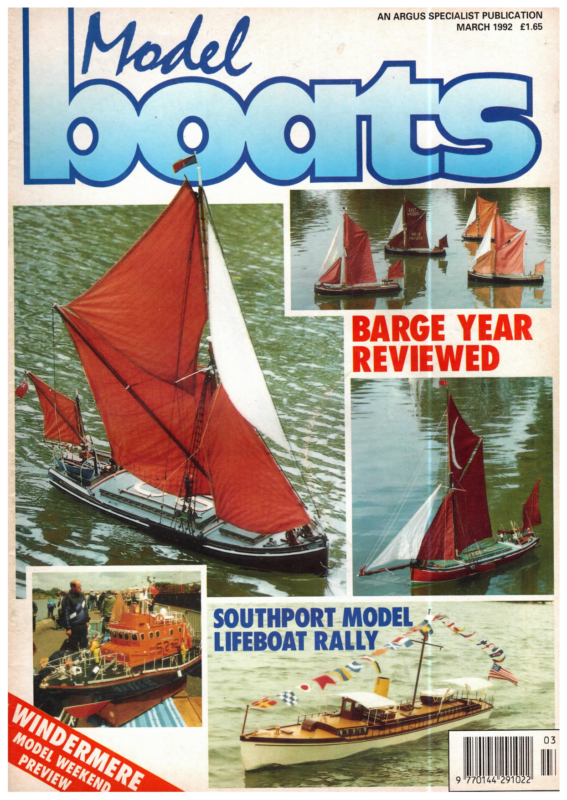
- MARINE MISCELLANY by BASIL HARLEY Sailing at Bournville
- Sail to Win Part Seven of Nick Weall’s course to improve your Sailing
- Match Racing Bill Green rounds up end-of-season events

AN ARGUS SPECIALIST PUBLICATION MARCH 1992 £1.65 910 l
————— by BASIL HARLEY Sailing at Bournville any of the older model yacht ponds, or as they were sometimes called, children’s boating lakes, are featured in early postcards. They often show a range of toy boats, usually sailing ones but there are occasionally clockwork or even steam powered ships and launches. The Vintage Group occasionally meets at Bournville in Birmingham and one of the postcards which turns up quite frequently at collector’s sales shows Rowheath Pool, taken in the mid-1920s, with a nice selection of Bermuda rigged racing yachts on the water. At first glance this appears to be the present pool which is the home of the Bournville Model Yacht and Power Boat Club. However, it is in fact an older one which is situated about halfa mile away. It is still there, little changed as my photograph shows, though it is not easily accessible for model yachting these days. The Rowheath estate was bought in A rare photograph of Bournville yacht pond taken about 1938. A vane steered yacht is on the left. Photo: Courtesy Bournville Village Trust. yachting was a popular recreation in the 1920s. In 1923 the Bournville Model Yacht and Power Boat Club was founded by Mr P. Cadbury, CBE, together with Mr W.H. Davey and Mr Cyril Butson. The Cadbury family had a real interest in model yachting and, with occasional breaks, Mr Cadbury was President until 1964. He was followed by Mr M.H. Cadbury until 1967. Another member of the family, Mr L.J. Cadbury, had a fine collection of models, including boats, which was described in the Model Engineer in 1960. Among the many educational classes run by the company was one devoted to building and sailing model yachts. Clearly model yachting was regarded as of some – 2 ae oe : THE POOL, ROWHEATH RECREATION GROUND — BOURNVILLE 1913 by Cadbury’s, the chocolate firm. Fairly well-known postcard of the pool taken in which was, and still is, situated the mud. This had obvious disadvantages when attempting the rescue of models. The Cadburys, a Quaker family, had _—_______—_—\ yy Some 75 acres, only five minutes from the works, were set aside for recreation. In the middle of this is the natural pool behind company’s sports pavilion which is visible in the postcard and in my pictures. The pool is quite deep – some 15 feet in the middle – and the bottom consists of soft 12 the 1920s. long been the leaders in the provision of housing, education and other welfare facilities for their employees. Model importance and the inadequacies of the Rowheath pool soon became evident. Owing to the Depression in the early 1930s there was a higher level of unemployment than at any time since. The Bournville Village Trust initiated three experimental schemes to relieve the very considerable distress among local people, one of which was to convert a marshy area near the Bristol Road into a purpose made model yachting pond. This is the present Bournville Pool. In all 64 men were engaged on the work which was done over a period of 15 months in 1932 and 1933. Conditions laid down required the men to work four and a half days a week on the construction and MODEL BOATS
Rowheath Pool today. The sports pavilion and many of the trees shown in the early postcards are still there. attend instructional classes for two half days designed to give them new interests and skills. A fascinating booklet detailing the arrangements made, the pay offered and the way the work was done, was produced by the Trust. A copy of this has been made available to me through the kindness of Mrs B Wall, the wife of Arthur Wall who is the present Commodore of the B.M.Y.& P.B.C. The pool is approximately 500 feet by – £96.95 + plans we are now able to offer a range of fittings to include: Main Armament Turrets & Barrels, Brailing Davits, Aerial Spacers; Fairleads; Searchlights; Twinbuckles; Port holes; Secondary Armament Barrels; Deck Vents; Coal Holes and Deck Lights. Complete fittings price £69.95 MORE 700’s Latest in the slow releases of Pit Road/ Skywave. Apart from the Charles Adams/ Perth Class; DDG21 COCHRANE (C. Adams Class) has been released. This can also be used to make the German Navy LUETJENS Class. Both are priced at £12.99 each. NEW STEAM PLANT Cheddar Models have launched the “PIPIT” a single oscillator in component form with finished tested boiler and fully machined engine parts. Designed for the young and not so young. Price £79.00 081 853 1508 NOW WITH 24-HOUR Wee 1) orate As ANSAPHONE OPENING HOURS \ 4 lever. £159.60 HMS HERMES The Limited Edition hull was shown at the Model Engineer Exhibition for the first time. Available in the scale of 1:96, itis the largest aircraft carrier hull in production. The hull is complete with deck in- corporating ski-jump, angled structures overhangs and markings for openings and bilge keels. Price £355 + JECOBIN plans /% size £11.85. (Full size plans can be obtained at approximately £60). Nine fittings packs are available + running gear sets.(rudders and props) are also in stock. We are endeavouring to hold a complete emt at all times in stock. formation sheets 60p. CALDERCRAFT The new catalogue is now available, bigger, better and more detailed – with colour. £3.75 + p&p 80p MAKE SMOKE Still available are the 6v “ae sa wl aN. These small units ie fit Y easily inside the funnel and can be filled using an eye dropper. The unit is £9.10 and includes 2 capsules of oil. Replacement oil (50m) is £4.25 BILLINGS MAIN STOCKIST All available models are usually in stock together with the appropriate fittings packs. We also carry a selection of the special timber and the general fittings cabinet. Main catalogue (kits) £2.95: (Fittings £1.50) PLUS OTHERS We are also main stockist for AMATI, MANTUA, SERGAL, PANART, AEROPICCOLA, COREL, ARTESANIA, LATINA & others. Send for list of lists enclosing a S.a.e. ‘J’ CLASS YACHT Amati kit of a %2model of “Endeavour” the J. Class Yacht of 1934 to ascale of 1:80. This 19″ model features a ready made 2 hull for mounting on a plaque. The kit contains the fittings and is supplied with a “stump” mast andis not a full rig. Albeit thatthis is a half model it does portray the most elegant lines of this class of classic Americas Cup Racing Yachts £45.95. PLUS PLANS We are now able to offer plans for the J. Class Yacht Endeavour, 3 sheets including the lines plan at % – 1 foot. £34.00 the set. LISTS AVAILABLE Timber 75p; Fittings £1.20; Hulls 65p. Send SAE for other lists available Hf | fi TN and enquiries must be f including 7 Nelson Road, Greenwich London SE10 Telephone 081 range of plans and other catalogues andlistings. Post & Packing \ i un is additional to all quoted prices Bd ‘i a Vi Wits.fis accompanied I) by SAE or Reply Prices shown include VAT. Listed prices International Coupons. -858Pe i,Hea alteration “without MAIL ORDER SERVICE THROUGHOUT THE WORLD: ACCESS: BARCLAYCARD: AMERICAN EXPRESS MARCH 1992 smoke making devices. es aN SJ Models Greenwich messy and slippery surround. Bantock on his success with the America’s Cup Style Yacht CR914. This “one design” is proving a popular entry into model yacht as a 36R. Hull and deck joined and torpedo keel weight supplied. Suitable for 2 channel R/C with a sail j MON-SAT 9.15 am-6.30 pm anywhere. And, in deference to wildlife, there is a large and vociferous population of Canada geese, over 100 at the last count. Unfortunately this makes for a very exclusive feature. Today most of the provisions are used by a wide range of people and the Pool is no exception. LION in the Queen eens class and the availability of a 1:128 GRP hull @ 64°” FAX Surrounding trees and buildings make the wind directions somewhat unpredictable and it is said that if you can sail successfully at Bournville you can sail employees this has never been an HMS LION Further to our announcement re HMS THE SPECIALIST SHOP FOR ALL MODELLERS OF SHIPS AND BOATS. Although there is firm access all round its disadvantages are only too well-known. 150 feet of an interesting shape with a firm, concrete bottom. It is about 2 feet deep at the edges and some 4 feet deep in the centre – easily accessible in waders. Although the facilities provided by the Bournville Village Trust were originally conceived as being for the use of the subject to notice. 13
that there is usually more than one windward beat per race, thus if you get it wrong on the first windward beat there is every opportunity to get it right on the Part Seven of Nick Weall’s course to improve your second windward beat. Another interesting little point is that in the Northern Hemisphere gusts of wind will normally lift you higher towards the windward mark whilst in starboard. It is thus worth tacking to starboard if convenient when you see a gust moving towards your patch of water. Now to be in sailing his is the seventh article in our second series aimed at helping the intermediate radio controlled yacht skipper to improve his or her performance. In the last article we concentrated on some of the attractions of match racing and how participating in match racing events could help develop your skills for fleet racing. We thus have to go back to article five to find where we had left off our studies of fleet racing tactics. In that article we had concentrated on gaining positions after the start and up the first windward beat. We had paid particular attention to luffing as a tactic to encourage yachts to windward to break away to the other tack, the objective being to get your own yacht into the best position to take advantage of wind shifts you need to be sailing a fairly central course up the windward beat. If you are too near either of the lay lines you may be forced to stay on a headed tack simply because the alternative takes you way beyond the lay line! One of the easiest ways for a yacht with a large lead over the rest of the fleet to lose that lead is precisely by failing to take any notice of this advice. Sailing far in advance of the remainder of the fleet our brave leader goes into automatic pilot mode and simply holds a long port tack right across the water until laying the starboard lay line a position whereby it is in total command when- all of a sudden there is a major wind shift that puts the leader on a header. The remainder of the fleet who were all over the other side of the water near to the port lay line suddenly find themselves on a lifter sailing more or less directly towards the windward mark! They all round the mark well in front of the previous leader who has rather a lot of egg on his face! Yes it has happened to me of its own destiny – free to tack at any time it chooses to. The reason for trying to achieve this objective is that then you are in a position to respond to wind shifts and can also cover the bulk of the fleet if necessary. The windward beat will normally offer the best opportunities for large gains in positional terms dependent upon the wind and how much it is shifting. The more it is swinging around the more the opportunities for people to get either headed or lifted up higher towards the windward mark. The obvious winning tactic is to be in a position to be able to respond to each wind shift quickly and before other yachts. The objective has always to be sailing as direct a course as possible towards the windward mark in the absence of any other criteria. Lifted? or not The easy way to establish whether or not your yacht is being lifted on a course to take it more directly towards the windward mark, or being headed on a course that takes it further away from the windward mark than was previously the case, is to project a line in your mind from the stern of your yacht at ninety degrees to the direction of travel on the side of the yacht that will allow that projected line to bracket the windward mark with another imaginary line projected forward along the yacht’s existing course. You now draw in the line from the mark itself to the stern of your yacht. If the angle between this line and the line projected forwards along the direction of the yacht’s course is less than forty five degrees, you are being lifted. If the angle between the line projected from your stern and the line from the 38 more than once! At the RM Europeans, Klaus Schroeder of the 2nd placed German Team holds his yacht. mark is less than forty five degrees, you are being headed and ought to consider tacking at the first opportunity. This is a simply system that works very well on waters where there are no obstructions to the wind. Where there are obstructions to the wind upwind of the windward mark there are likely to be wind bends upon the water. This may well mean that one side of the course or the other will offer better wind direction for getting to the windward mark more directly. The prudent skipper will have tried out both sides of the course to windward before the start of the first race and will thus have some idea of which side of the windward beating course is favoured. Those skippers that did not have the time to do this will just have to learn such information during the first race of the day and remember to apply it in subsequent races. It is however important to remember that conditions often change during a day’s racing and what applies in the early races of the day may well change to the opposite as the day progresses. One of the nice things about most fleet races is The moral of this story has to be that if you are leading a race by a large distance you must sail very carefully, covering the remainder of the fleet. If the rest of the fleet really are so far behind that it is difficult to work out any sort of cover then simply stick to the middle of the windward course, sailing fairly short tacks right up the middle of the course. This way you can not get too far removed from the action should a major shift of wind direction come into play. If the wind is very very light it is even more important to ensure that you keep your yacht directly between the remainder of the fleet and the next mark to be rounded. In light wind conditions there can be areas of the water where no wind is blowing and no wind is going to blow for some considerable length of time. As a leading yacht with a very good lead it is vital that you do not go and sail yourself into such a hole. The remainder of the fleet will be able to spot your predicament and will possibly be able to find a way of sailing around the wind hole and past you to the next mark! Spotting Windshifts Going back to the windward beat and spotting windshifts, what do you do if you MODEL BOATS
second! There is no sense in putting your opponent down into the B fleet if by so doing you yourself go down as well. Because in the next race there is always the chance that one of you will not get out of the B fleet and then one of you is really going to be in trouble! Can you guarantee that it isn’t going to be you? All you need is one B fleet skipper to sail into you at the start that momentarily delays you – the other yacht does its turns – you have only been delayed momentarily and thus cannot seek redress – but you are now near the back of the fleet and mentally not in good shape to pull back those places! Your opponent goes up and you remain in B fleet and remain mentally unsettled with every chance that your next race may not see you performing at your best either. Do be careful when indulging in such tactics. There does come a time when you do have to consider other contenders for first place in the series; the easiest way is simply to beat them in each race. You certainly need to be very aware of their position before the start and to ensure that they are not taking a very different start half a chance. It is far better to simply sail a clean race if you can. Whilst racing is all about winning that is not the sole objective. You need to be able to enjoy your racing whatever the final result. The real fun in fact in my opinion is to be able to enjoy some very close racing where you really have to fight hard in every race to gain a result. Racing where you are leading the pack in every race soon becomes boring – it might win you prizes, but it does not offer very real satisfaction. There has to be a real challenge and a real battle. In those circumstances it does not really matter whether you are fighting for first place or last place, you have enjoyed good close racing with lots of opportunities for tactical battles. I can appreciate someone out manoeuvring me just as must as me out-manoeuvring them. This is the real beauty of yacht racing – it is such a complex game that there are all sorts of subtleties to be enjoyed. : Whilst it is true to say that spotting and using the wind shifts best will gain the most distance over the other competitors there are obviously other considerations as well. Clear Air and Water Janusz Walicki’s Skapel design named Safala puny leads Peter Stollery’s K4239 around the eeward mark. Peter, from the Guildford club, was the highest placed British entry, finishing 3rd, and helping to take the British three-man team to 1st place. have a yacht close to windward that you cannot luff and it is holding you ona headed course? I suggest you try talking to the skipper tell him that you both are being headed and is that what he really wants? You may be unlucky enough to have a skipper whose personal objective is just to beat you or to make life as difficult as possible for some reason! Maybe you had upset him in a previous race! If that is the case you will have to try different tactics, otherwise the talking option is usually quite effective if done in a friendly way. If it doesn’t work then you will have to either just wait until such times as the windward yacht decides to tack or gybe away and come up to close hauled under its stern. Never bother to enter into a grudge match with another yacht – it is not worth it; the end result nine times out of ten is that you both get slowed down because you are both concentrating far too much on your own little battle instead of keeping an eye on the rest of the fleet. Match Racing within a Fleet? The only time you allow yourself to indulge in match racing within a fleet is when during a series there are two of you battling it out to win the series. Even then it is only worth doing if the pair of you have a sufficient lead points wise over the remainder of the racing fleet. I have seen commanding positions in a series thrown away by the battling leaders concentrating too much on their individual battles and thus allowing the third and forth placed skippers to climb above them to first and MARCH 1992 Janusz with the RM European Champion’s title already assured leaves the compound to launch his yacht for the final race of the week long series in Finland’s Hanko harbour. to the one you plan, unless you are sure that your plan is the only correct plan. If of course they put themselves into a position where you can push them over the line early or shut them out at the starting mark then of course do so, but bear in mind also that they will most likely be looking to do exactly the same to you given The next most important objective or perhaps in reality the most important objective is to be sailing in clear air and water. Coupled with this objective is the natural tactic of trying to keep your opponents in dirty air and water as much as possible. Why? Well you should know by now if you have been reading this series and the previous series that sailing through disturbed air tends to slow a yacht down. The same thing can be said if a yacht is sailing through another yacht’s wake. The water at that point will be more disturbed than the surrounding water. If you are sailing in roughly the same direction as the other yacht and overhauling it from behind then your yacht will experience a problem in getting up and over the leading edge of the other yacht’s wake. In full sized yachts once you are up and on the leading edge of the other yacht’s wake it is possible to actually surf on it. This can be of advantage where an overhauling yacht has a shorter water-line than the leading yacht and thus has a theoretical slower maximum speed whilst moving through the water. However once surfing it is possible to exceed the waterline speed significantly. I have never witnessed this being achieved with model yachts, maybe because we usually are only racing one class design at a time. The wake of a yacht naturally dissipates as it leaves the yacht, and thus becomes easier to pass through the further away from the stern of the yacht creating the wake. That is not always possible. In such circumstances I try to sail a course will within the wake, trying in fact to sail exactly the course of the leading yacht. Once I feel that my yacht’s speed is faster than the leading yacht’s I will then luff up a little, maintaining speed, in an effort to break through and over the leading edge of the wake. Once over that hurdle I can then concentrate on responding to any luff that the yacht now to leeward cares to throw at me – looking to call “Mast abeam stem!” as soon as achieved to curtail or stop any 39
such luffing action. This is a tactic that will only work where there is a marked difference in the relative speeds of the two yachts. Which would suggest that the overtaken yacht either is out of trim or has picked up a small piece of weed or similar impediment Peter Stollery’s yacht 39 shows Janusz Walicki’s yacht 6 the way home in this race. to its proper progress. In closely matched racing it is far more likely that you will remain close astern of the leading yacht within its wake, waiting to establish an inside overlap if possible when approaching the next mark. That overlap will then, if you are lucky, allow you to overhaul the other yacht by means of the tighter turning circle you will be able to execute as you round the mark. Anyway besides the problems of crossing another yacht’s wake there is the much more difficult problem of the other yacht’s dirty wind. That is the disturbed air to leeward and to windward of a yacht as it passes through the air. Remember that the wind is the motive power of the yacht and that that power is generated by harnessing a little of the strength in the wind by deflecting the wind from its natural course. This in turn creates high and low pressure zones each side of the sail, and according to your point of view, that has the effect on the sail of either pushing from the high pressure side or sucking from the low pressure side – such motion being controlled by the stability of the sails _and governed by the mast connected to the hull which in turn has the keel and rudder acting to resist lateral forces and to encourage forward movement of the hull through the water. This movement whilst beating, naturally has some leeward movement to it as well, depending upon how successful the rudder and keel are at resisting such movement and how efficient the sails are at smoothly deflecting the wind’s direction rather than trying to hook in the wind as a spinnaker might. Now all this deflection of wind by a yacht’s sails creates a certain amount of confusion to the wind in the area to windward and leeward of the yacht’s sails, and of course to some degree behind the yacht if it is beating to windward. Water Flow Air is a fluid which behaves much like any other fluid if studied closely enough. If you do not have access to a wind tunnel the best way of trying to understand what is likely to be happening with the wind, is to study the flow of water in a stream or river as it passes over or by obstructions in the main flow of the water. A rock that protrudes high above the surface of the water in the middle of a stream, for example, will naturally force the water to split into two and run each side of the rock. On the upstream side of the rock the water will tend to pile up a little, folding back on itself and then slipping around the rock. On the downstream side the water quickly moves back to form a solid flow of water again, but immediately downstream of the rock there will be, depending upon the speed of flow, an area where the water level is much lower and the water will be falling over itself to try and fill that void. It will be eddying in swirling patterns for quite some distance downstream of the rock. This is exactly the sort of thing that will be going on in the air around your yacht as the wind passes over your sails. 40 Flow on the Sails To the windward side of the sail an area of high pressure will be formed as the wind piles up against this area of resistance to its passage. It will swirl around looking for the easiest way to pass over and around this obstruction. That is why the sails need to present the sort of shape to the wind that guides the wind in the smoothest possible way towards the direction we would like it to pass over the sails. That is into the belly of the sail and on smoothly across the remainder of the sail and over the leech. That is why we put some twist into the leech to encourage this smooth passage and also because the wind will be moving slightly faster at the top of our yacht’s mast that down, by the water’s level where the resistance offered to the wind as it crosses the water slows it down a little. Now on the downwind side of the sails an area of low pressure is formed as the wind is unable to reach this side of the sail, and exactly like the water passing an obstruction an area of low pressure is formed. This low pressure sucks the sails towards it; this combined with the area of high pressure on the windward side of the sails moves them through the air and the yacht’s hull through the water. Now downwind of the sails is an area of wind swirling and tumbling as it moves to refill the area of low pressure, and to windward there is an area also where the wind that has being piling up forming a high pressure area finds a way around the problem and again has bends to the mean wind’s direction and a certain amount of eddying as well. Now if you try to pass a close hauled yacht to its windward side near to it, you will be trying to sail through all this disturbed wind to windward. The bend that the sails put in to this wind is such that it has the effect of heading the overtaking yacht slightly; that combined with the general confused state of the wind makes for a slight loss of driving power, making it very difficult to pass a yacht to windward at close quarters. Naturally the further away from the yacht your are attempting to overtake you can be, the easier and better are your chances of succeeding. The area to windward that is affected is not so great as the area to leeward. If you really wish to overhaul the yacht to its leeward, you really have to be going at some faster speed relative to the yacht being overhauled. These problems seem to be much more apparent to full sized yachts than they are to our small craft, but they are problems that do exist and it is up to you to develop your own particular techniques to solve them. The one thing you do not want to be doing if you can avoid it is to be sailing in another yacht’s dirty wind for too long. It is better to tack away, searching for some clear air and better speed if possible. There are however times when you simply have to accept that you have no reasonable alternative than to suffer the short term effects of dirty wind. For example when you are getting too near the mark to be rounded for any other course of action to make any sense. As mentioned earlier in this article, at this time you ought to be considering ways of trying to gain that all important inside overlap before and at the four boat lengths from the mark. If that is not possible you then ought to be considering you best line of rounding the mark and what position you wish to assume as you exit the mark. MODEL BOATS
Leeward or Windward Overhaul Are you going to try and overhaul the yacht in front to leeward or windward? Which side do you want to be on to gain an overlap at the next mark? For the moment though let us return to the windward beat and ask if there are any other factors that can have an influence on the relative positions of yachts as they fight their way towards the mark? The one other factor that often presents itself to model yacht courses in particular is the bank or shore. Since we are usually sailing upon purpose built lakes or natural lakes it can often be that you reach a bank before reaching a lay line for the mark. In this situation rule 43 comes into play and the opportunity to change from being a leeward yacht into being a windward yacht. Let us imagine that we are the leeward yacht on port sailing slightly behind a leading windward yacht also on port. As the leading yacht nears the obstruction, in this case the bank of the lake, it has no need to request water to tack to any other yacht, it simply picks its moment and tacks across to starboard. All we have to do now though, as yacht astern and to leeward, is to try and harden up a little, refraining from tacking to starboard until the new tack is going to put us well to windward on a projected course of the leading yacht. If we can achieve this and at the same time retain decent speed relative to the other yacht, we have a chance of gaining a loose cover over the other yacht. If we are close enough to then has to tack immediately, which ought manoeuvres are impossible simply because tacking from port to starboard the onus of keeping clear of the tacking yacht will be on the still port tack yacht once the tacking yacht has completed her tack, but if you had fair speed at the time of hearing the hail you really ought to be able to be you are too well overlapped and to windward of the other yacht as you both clear of the tacking yacht before it becomes a problem. You can then simply tack as approach the bank. In these circumstances as soon as the leeward yacht calls for water, respond by immediately tacking. you approach the obstruction yourself. This is likely to be measured in seconds, since obviously the leeward yacht could not have called for water too far away from the obstruction. It is however well worth pointing out that the timing for the calling of water is strictly the decision of the hailing yacht. The yacht being hailed has no option other that to respond to the hail, to gain you precious seconds and space to be able to tack across to put a loose cover on her astern but to windward. There comes a time when such However, make your tack long and slow for the first half, retaining best boat speed and getting your yacht as far to windward as possible. Gain speed and then immediately pinch up to windward some more. The objective here is to try and Detail of Janusz Walicki’s winning design Skapel. To the front of mast foot is the ‘butterfly’ housing. This device enables the jib to be mechanically ‘kicked’ across to the opposite side to the main when the sails are sheeted fully out! Note the bottom mounting of the airfoil groovy carbon fibre one-piece mast. The piece of chrome tape marks the lower measurement band. The line disappearing under the main boom’s mounting point continues up and inside the main boom, ending up attached to the mainsail’s outhaul. This enables full adjustments of camber and twist! A similar line controls the jib and slot. by either immediately tacking herself or prevent the other yacht from tacking back to port because of rule 41 then we may be truly in command of the game. We will now be able to control when the other yacht tacks today the mark. We can carry the yacht way beyond the port lay line if it Left, the counterweight is used in light airs only. The pivoting device for the jib boom is attached by a continuous line to the patented ‘butterfly’ device. Jib pivot is adjustable as regards its axis from the horizontal fore and aft by means of the screw at the front. This . keeps the line of the rotating axle in line with the jib luff. The knurled knob on the boom adjusts boom angle up and down, acting as kicking strap. make it very difficult for the formerly leeward yacht to gain any sort of loose suits us to. (Provided of course that there cover command over you. Remember that the formerly leeward yacht that called for is not another bank in the way on the water to tack has to start her tack the opposite side of the lake.) Thus the objective obviously remains the moment she sees that you are responding by tacking. It should thus be fairly easy to gain the sort of position set out above. Lastly if you are approaching the bank again on port with another yacht to same if you are the rearmost of two yachts overlapped approaching the bank. If possible you want to be able to allow the yacht nearly ahead and to leeward to tack across to starboard before you. To achieve this you may have to slow downa little and cut across the formerly leeward yacht’s stern as you reply to her call for water by calling “You tack.” Remember she MARCH 1992 leeward where you are both overlapped, but with your yacht forward of the mast abeam stem position; when the leeward yacht calls for water simply reply either “You tack” or “You tack and take my stern.”. Now when the hailing yacht will be replying “You tack.” She cannot start arguing that the hailing yacht is too far away from such obstruction. Her only recourse is to protest the yacht that she believes has hailed too early after the tacks have been made. She must also accept that she is going to need some very clear evidence indeed to convince a protest committee that the call was indeed made too early. Now the other time rule 43 can be used with benefit is in the situation whereby you are the leeward of two overlapped beating yachts wishing to tack to starboard but unable to because of the yacht to windward. As soon as another yacht approaches on what seems to be a converging course, you are able to call for water to tack to miss an oncoming obstruction to the yacht to windward of your yacht. That yacht has no choice other than to tack immediately to starboard and you in turn must then follow that tack immediately yourself. If the yacht to windward does not respond you must hail it very loudly one more time – if it still does not respond you must take evasive action to miss the now rapidly approaching starboard yacht by bearing off under its stern if possible and protest the windward yacht loudly and clearly twice. If there is contact between your yacht and the starboard yacht, you are advised to reply upon your protest against the 41
degenerate into an argument. We all do some pretty daft things at times and I guess none of us like to be reminded of it to often. If you know that you have done something pretty silly on the water then it is not such a bad thing to apologise to the other yacht/s involved at the time and to get on with breaking clear of the fleet to do formerly windward yacht being successful. If that protest is successful you will be exonerated for the contact between your yacht (on port) and the starboard approaching yacht, so doing turns for the incident on the water would be a waste of time. If you are not quite sure of the ‘ins and outs’ of the incident then by all means do your penalty turns on the water and still protest the other yacht. You will lose your turns. We are involved in a sport and we are all meant to be doing it for the fun of it. We are lucky that the prizes we compete for are largely just token prizes, no one is some time on the water but will cover yourself against any chance of gaining a DSQ in the protest hearing through going to get rich by winning or lose the: chance of getting rich by losing, so one big having touched the starboard tack yacht. pressure should not be with us. As to winning well only one guy is going to win (Rule 36.) The Drawback The major drawback of this manoeuvre is the day – it might be nice to win the odd race but if you feel that you are not sailing to your potential, well check out your yacht and sails, If they are OK check out that whilst you are able to push the previously windward yacht across to starboard and get onto the starboard tack yourself, you have another yacht on your attitude. Clear your mind of clutter and concentrate on sailing your best. Try probably in such a position as to prevent you tacking back to port when you want to. starts, concentrate on gaining a good tactical position within the fleet and to get reasonable starts rather that perfect starboard then sitting to windward of you, control your tacks carefully to retain speed However at least you are now going in the direction and on the tack that you wanted to be on. You are now just going to have to hope or to find a way of encouraging the and distance. Above all keep out of trouble, widen your field of vision to take in more the potential incidents and have escape new yacht holding a loose cover on your yacht to tack back to port when the circumstances demand it. It can sometimes be worth talking to the Skipper of a yacht holding you upon a certain tack if you feel that the wind has ‘shifted or that the pair of you are sailing too far away from the main block. Just ask the question “Do we really want to be staying on this tack?” or “Do we really want to let the fleet get away from us?” If all the Skipper of the other yacht has in his mind is stuffing you out of the race, such questions are not going to help very much, but as ought to be the case, if the other Skipper also has ambitions to win or get a reasonable result then such questions may help. It could of course be the case though that the other Skipper seriously believes that the course he and you are sailing is still the best option, in which case you have little option but to wait to find out who is right and who is routes planned. The Bikini Bantock by Matthew Simmonds;d Formula One. Lowly placed at New Zealan Championships, although his father’s boat, another Bikini, was fifth. Photo: Mark Steele. incident on the water. It simply continues to break your concentration and you may well find as a result that you become involved in another incident and so it goes on, It is funny how in some races you can keep coming up against the same yacht time after time. It is very dangerous to allow any When you are not racing keep a close eye on the race in progress and try to understand more how the wind is behaving especially on the windward beats. Is there a definite bend somewhere upon the water that can be used to advantage? How often is the wind shifting? How did the start go? Was there any advantage to being one end of the line or the other? Gradually you ought to get yourself back into your best operating mode, wrong as the race progresses. If you really think the course is crazy you always have the option to wheel away, throwing ina tight gybe to adopt the new tack – this obviously wastes time and distance – but in a desperate situation might well be worth considering. It serves you right for getting in such a situation anyway! Under Control! The one thing you must not let happen is to allow such a minor inconvenience to get to you, It is important to keep your temper under control, it you allow yourself to get rattled by such an event it will undoubtedly effect the remainder of the race and might even upset your equilibrium for one or two subsequent races as well. You have to be able to shrug off such problems, finding a way around them and then to get on and steadily try to work your way back up the fleet. The same applies if you get caught up in an incident where for whatever reason you feel that not only were you in the right but how unreasonable it is to have been delayed by the offending yacht. Apart from registering your protest do try to avoid entering into a discussion with the other Skipper as to the rights and wrongs of the 42 Winning boat at the N.Z. Championships was Martin Firebrace’s Gopher Gold, seen here leading Geoff Davies Spencer’s design Metric Mess. Photo: Mark Steele. thoughts of revenge or anything else enter into your head. You are there to race against a fleet of yachts, not to enter into a private war with one other skipper. Again try and put such incidents behind you, calm down and get on with the race. I really think that it is best to continue with this sort of approach after the race as well, If you must have a chat with the other guy, but bear in mind that he has a side to the story as well and the chat might just concentrating upon the things that matter. At the end of the day’s racing you can then relax and allow emotions to take over again. You can now take stock of your performance over the course of the day and once back home you ought to be able to rerun through your mind those incidents that occurred during the day that might have cost you places. Whose fault were they really? How would you handle the same situation if it occurred again? What was the winning boat doing that you were not? File away in your mind all the points of interest or even put them down on paper if that helps. MODEL BOATS
Bill Green rounds up end-of-season events ust when you thought it was safe to get back into the water, here am I, back again, with more assorted ramblings. This month’s offering concerns itself with a round up of the remainder of last season’s events happenings, a look at the new season and what it holds in store and a review of some of the goodies likely to come your way. 6m National – Bournville – 30 August to 1 September 1991 Sixteen competitors turned up on a nice pleasant weekend at Bournville, most were local to the Birmingham area with visitors from Leeds, Birkenhead and for the first time from Newcastle. The sun shone and shorts were in abundance, not a pretty sight I can assure you. The wind conditions were quite reasonable for the lake, being generally Southerly, a close reach in one direction and a broad reach in the other. With these sort of wind conditions the trees that surround the Southern side of the lake come very much into play and they can play nasty tricks on the unsuspecting. Bill Sykes (Race Officer) made his intentions clear during his briefing, he wanteda fair clean fight and he’was going to get it. On the Saturday 6m’s trolled up and down the lake in generally the right directions, with the odd one or two folk being lulled into the doldrums created on the Boat House side. The wise ones stayed on the other side and took advantage, whenever they could, of the reflected wind off the hedge on the opposite side. One guy who was really on a roll was Dennis Cluley from Birmingham, his battle scarred Bionic Leek was on rails; overnight he was in 2nd place and it was a pleasure to see someone whose name is not generally recognised doing well. The combination of Dave Potter and Bernie McNulty with Northern Lights was also doing very well and led évernight. The Sunday saw similar conditions as Dave and Bernie held onto their lead and Peter Hopkins pulled himself up into second place. The remainder of the field were well behind the leaders when the scores were added up. The wind conditions favoured the heavier, traditional style boats and as you can see from the results, 4 of the top 5 boats were either heavy (28lbs ish) or old. It will be interesting to see how some of the latest radio designs such as Tern and Petrel, which are beginning to find their way onto the vane circuit will fare against the older designs. 48 Bernie Macnulty (left) and Dave Potter, this year’s 6M National winners, with Northern Lights. Photo: Bill Lees. 10r National – Gosport – 28/29 September 1991 The 10 rater, in its vane form, has been a class which over the last few years has been struggling to keep going. Enthusiasm for the class has waned quite simply because this class fulfils its requirements to the full, boats are designed for high performance, particularly downwind, and as the majority of vane sailors are getting older the physical limitations of age are more pronounced when chasing one of these greyhounds! The net result is that is that both the number of boats and the number of skippers wanting to sail them has declined. Over the last few years conditions have been such that the potential problem has not been realised, most of the Nationals have been fairly gentle affairs which have been coped with, without too much exertion. As a result, interest in the class was beginning to pick up and some new designs are beginning to appear. The Saturday had wind and weather conditions which were horrendous, force 8+, heavy rain and as a consequence several entrants dropped out at the last minute and racing was curtailed on the day. The competitors agreed, some reluctantly, not to sail any runs, so it was beats only. Mark Dicks/Martin Roberts were sailing the new Chris Dicks design and it went well. Martin Dovey/Nigel Sharpe sailing the aptly named Breathless also went well in the heavy conditions. Ray Baker/Roy Gardner were sailing a Nike design as was Graham/Shaun Wyeth. The conditions on the Sunday could not have been more different to the Saturday, virtually no wind and just the occasional ripple on the water. Mark Dicks won with 6 metre National – Results Sail No Competitor W Sykes Club Bournville Birkenhead K 834 |D Potter Birmingham K 855 |P Hopkins Bournville K 809 |C Harris Birmingham K 825 |D Cluley Bournville K 876 |W Green L&B K 829 {RQ Costigan Bournville K 908 |P Salt Bournville K 836 |M Kinder Bournville K 835 |M Harris Birmingham K 850 |P Locke Birmingham K 858 |C Hartland Bournville K 658 |S Smith Birmingham K 819]|S Jones K 812A Etherington(Mrs) |Bournville Birmingham K 818 {1 Cooke Newcastle K 823 |A Lees(Mrs) Boat Name Race officer |Northern Lights |Merlin Titania |Bionic Leek Billy US Magenta Peaseblossom Nemesis ET 2 |Cameo |Hat Trick Lapwing jExit Elvira |Treble Chance Something Else Design Sigma Psyche Oberon TC Rennaisance Sigma Oberon Polaris Polaris Wild Rumour Psyche Lapwing TC Elvira TC Ss Final {Position Score 55 53 46 45 45 44 41 40 38 33 33 31 29 24 24 19 1 2 3 4= 4= 6 7 8 9 10= 10= 12 13 14= 14= 16 MODEL BOATS
Graham Wyeth in second place followed by Sed Martin Dovey in third and Ray Baker in Midland District “A* Class – Birmingham – 17/11/91 fourth. . I know I was not there, and it could be . ss considered unfair of me to make comment, A Amati but all the skippers that where present are experienced vane sailors, they knew the D Priestley K Roberts potential of the class and therefore they C Harris Sos aoe Officer Design Guilford 22U2 Fleetwood |Sakina Birkenhead |UR12 Robot (Mod)} Syanco Robot The race represented a – Score Position 23 1 to say on the subject later. in . . Lollistick event to the full. The vane 10 rater class will not survive unless the perceived fears Gamingnem |Timewarp = V2 Hebe v2 Atrit ie 15 og 5= are dealt with. I, for one, do not want to see the class disappear into the annals of P Hopkins R Costigan Birmingham |Long Tall Sally |Robot L&B INXS — v2 14 13 8= 10 W Green Bournville _ |Black Jack meee Th for specific high speed and not to achieve it D Potter . . . happen. It is the only class which is bred when the conditions permit somehow D English seems to me to defeat the purpose. Maybe C Etherington differently, but I know there is nothing to K’Whorwood. if I had been there I might have felt compare with the sight of a 10 rater barrelling downwind at actual speeds in the region of 15 mph. | Cooke oouaee on Birkenhead |Pottamac Fleetwood |Boumville |Comet _|Boserndie._ 2 vEgeisise—__ from information from a variety of sources. The wind was in the North and was light and variable. Northerly at Clapham means a reach in both directions, it also means that peculiar conditions can apply. Mark Dicks sailing the original Realistic won with Alex Austin sailing Srcooloose in second place. A’ Weekend – Birmingham 16/17 November 1991 This event has become a must on the vane calendar with a good entry of 11 boats for the Saturday, and would you believe 18 boats for the Sunday. Wind conditions were light and swinging so once again there was not a spinnaker to be seen. Derek Priestly sailed Corsario on the 5= 8= merit and appeal. I have more the article which deals with Match Race management. mt Mr Blue Sky| 10 14 MRS No 5 – Sneyd 16 Sneyd, just north of Walsall, iS venue and the club is growing Lollipop v2 (Quickstep as a consequence the club will also disappear. Both would represent a sad loss to the model yachting community. Again this is a second hand report culled 15 14 * Ve iclipon longer be suitable for model yachting and 36r National – Clapham – 19/20 October 1991 16 oe |Roaring Fortes |Lollipop Birmingham |Citronella shall be doing in the near future is to evaluate the format and see whether it has Bournville | Mystified model yachting history, which is likely to and was worth a try. What I 2 3 Gosport H2 L&aB NVEE Bournville | Taffy ws speimlan normal straight match race 20 18 J Gale N Sharp P Salt should have been prepared to sail the different format than the Midland District R6m Bournville The Bournville Club decided to ring the changes for this event and to sail it using similarity to full size match race competition. A round robin eliminator series to select the finalists would be sailed, the finalists would then sail off ona knockout basis until one emerged victorious. That was the game plan; two things conspired against that, one was the number of entrants, the other was the wind conditions – 23 entered, which is in itself amazing, from all over the country. Everyone came out to play. The wind conditions were very light, and being Bournville that meant racing was going to be slow going and precarious. The total fleet was split up into four groups of 6, one fleet would have a bye boat, for the 12 8 6 4 : — ‘1 15 17 1991 Match Race J 9 Series for R6m’s is a superb model yachting in stature. 18 skippers took part and a good proportion of the schedule was sailed. Conditions were light to moderate winds and Stan Styler and the bunch from Sneyd, under the guidance of Vic Bellerson, handled the race organisation superbly. Roger Neeve had a cracking day and did not lose a race, Jack Day sailed a blinder for second place, Brian Corley was third. We took the opportunity to try out some ideas we had on alternative race formats, which would be used with great effect, in the last of the Match Race Series at Bournville. MRS No 6 – Bournville The Series was now all over bar the shouting, Mike Kemp was unbeatable having a virtual clean sheet for the series. It was mathematically possible for Roger Neeve to overall Brian Corley for second place and David Trippe had fourth place to himself. For the rest of us, honour and self respect was at stake. The now usual 16 skippers gathered at Bournville’s Club House ready for the fray. This time the Plant Cup – Birmingham – ‘A’ Class Open Race – 16/11/91 Name Club Boat P Lock Birmingham |Race Officer Design Score |Position D Priestley Fleetwood |Corsario V2 88 1 C Harris Bournville Mystified Lollistick 85 2 R Costigan L&B INXS V2 60 3 P Salt Bournville Afrit 52 4= D Potter Birkenhead |Pottamac Mr Blue Sky 52 4= | Cooke Birmingham |Citronella v2 50 6 T Mills C Etherington D English Fleetwood Bournville Fleetwood _|Ipi Tombe Lollipop Roaring Fortes | Lollipop |Comet Lollipop 44 40 32 7 8 9 P Hopkins Birmingham |Long Tall Sally |Robot 25 10 K Whorwood Bournville {Winterlude 20 Wien | Taffy Quickstep Saturday which was not his intention. He intended to sail Taxman but he packed the Fleetwood kids into the car and forgot the rig, perhaps he would have been better the Right, Tern kit from Russell Ferriday. Pekabe fittings and frames other way round. On the Sunday Alex eliminator series the top two from each Austin won sailing 22U2 with Derek fleet would then go forward to the finals. We only managed four heats before time started to run out. All of the quarter finals and the semis were pretty tight affairs with experience in radio racing turning up trumps. Bill Akers had Brian Corley on the ropes at one stage but let him off the hook on the run for home. Mike Kemp’s Renaissance Red Dwarf was in no position to compete with the Revival of Dave Mann, the conditions just did not suit the Renaissance no matter how hard Mike tried. Dave Mann went on to beat Brian Corley in an all Revival final. Priestly sailing Sakina in second place. It was a good event, the only problem being the current state of the lake at Birmingham. Over the last few years it has started to silt up, it is filthy and year round weed is a considerable problem. Birmingham Model Yacht Club have tried all they can to enlist the help and support of the local authority to improve the lake and return it back to the superb model yachting venue that it was, but to no avail. This is a crying shame, for it would seem that very soon that this venue will no MARCH 1992 conditions were kind, a nice steady Westerly and we were able to put into practice some of the lessons learned from previous events. This time two courses were laid and used and it enabled more racing for the competitors. Mike Kemp finished the series as he had started with a clean sheet of victories, Brian Corley was as usual second, followed jointly by Roger Neeve and David Trippe. An interesting new boat appeared, designed and built by Tony Riley of the Bournville Club, called Attempt. What is extraordinary is that Tony had little experience of model yachts, knew the best 49
R6m MATCH RACE SERIES 1991 – SERIES SUMMARY MIDLAND DISTRICT R6m – Bournville – 18 August 1991 Race Officer:- Bill Green Position |Skipper Entront 25pts League Club Points 1 D Mann 3= |W Akers 3= |MKemp B Corley 2 5= 5= 5= 5= 9= 9= |C Harris |JRollison |M Dovey |RNeeve |J Day |MRollison Birmingham – Dovecote Boumville Mkt Bosworth Bournville Cotswolds Dovecote Mkt Bosworth re PS i Kemp Dovecots 100.00 | 100.00 | 100.00 | 91.70 Fs | Discard} Diecari] SERIES | RACES} Sneyd | Vie 1 2 TOTAL AVE | Final SCORE} Position 100.00 | a00 | 91.70 | 40000 Overs * 5 | sase 1 100.00% Corley Cotswolds 85.71 | sass | 7692 | 91.70 | 77.77 | 9000 | 7e92 | 77.77| 35630 6 | 8517 2 89.08% R Neeve Cotswolds 85.71 | 77.78 | 61.54 | 75.00 | 10000 | 80.00 | 6154 | 75.00| 34349 6 | 8001 3 85.87% 46 0 Trippe Cotswolds 85.71 | 8333 | DNC | aa30 | DNC | 80.00 | aco | aco | sa2% 4 | 83.00 4 83.00% 23 J Day Dovecote 4250 | DNC | 7692 | DNC | sass | 6000 | aco | aco | 22580 4 | 67.08 5 56.45% C Chambers =| Dovecots 57.14 4 | 4981 6 48.81% 42 21 42 21 17 17 Cotswolds Cotswoids Leicester 15 14 14 12= |MC-Sykes North Wales 14 12= 16 17= 17= 17= 17= |M Peabody |ARobertson |V Bellerson |R Ferriday |MColyer |D Andrews Sneyd Cotswolds Bournville Gosport Leicester Leicester 28 10 9 18 9 9 |G Casey Sneyd 8 |P Knowles Birkenhead 4 part of naff all about design and had only ever built one model yacht in his life. Now these are all the reasons that are often quoted for why not, but Tony talked to people who knew, he borrowed books, he learned, he took his time (nearly 18 months), he never gave up and he succeeded. The boat was effective, he found himself in joint 5th place alongside the likes of Jack Day and Paddy Chambers. It does not need me to tell you that he was delighted. One of the things that I have maintained about the 6 metre Rule is that it may not be the easiest Rule to read but it does tell you what is required and how the basic design parameters relate. In other words it gives the designer a fighting chance. I would encourage anybody to follows Tony’s lead and have a go, it really isn’t as difficult as you may care to think. As I said the boat is interesting and only time will tell whether it is effective in all conditions. Match Race Series Summary The top 22 skippers are listed in the overall series summary sheet and my apologies to the remainder that I’ve had to miss off. Here are just a few statistics from the series to consider. An average of 17 competitors took part in each race of the series. A total of 39 skippers from as far apart as Darwen in Lancashire and Colchester in Essex took part. Ten skippers took part in four or more races, three of them in all six. Mike Kemp only lost one race throughout the whole of the series. The next three places are separated by 6% points for the whole series and are in the 80-90% region. There was not one protest throughout the whole of the series. What does all this mean? Simple, it means that a class is now firmly established and that competition within it on the Match Racing circuit is tight but respectful. No one design has proved itself predominant although the Renaissance does seem to have the edge across the range of conditions. For next year the Owners Association take command and there will be a few changes Peaseblossom is a new boat built by Peter Salt on old lines with moving carriage vane gear. Photo: Bill Lees. 50 re) B |J Macdonald |DTrippe |E Andrews 22= Fe 24 11. 12= 12= = Rt Bwood | D’cote | Lee Vy | Cwolds| 25 Mkt Bosworth Cotswolds Cub | ONC | 4615 | 3640 | 5555 | DNC | aco | aco | 19524 Green | Bournville DNc | 1667 | 4815 | DNC | 666s | 50.00 | aco | aco | 17948 4 | 4487 7 44.87% J Daines | Dovecots 3750 | a00 | 3077 | 3330 | 5555 | 2000 | a0o | aco} 177.12 6 | 2052 8 44.28% Mo Dovecots 71.43 | 3750 | 6154 | DNC | DNC | DNC | aoo | aco | 17047 3 | ses2 9 42.62% 3 Ewart D Mann Mit Bosworth 6250 | 50.00 | 5417] 10 40.63% C Wiliams Guilford 57.14 | 20.00 | 3848 | DNC | 4444 | DNC | aco | aco | te00s 4 | 4001 “1 40.01% |Emsworth 28.57 | 57.14 | DNC | 70.00 R Ferraday ‘A Bright A Filey | DNC | 5000 | DNC 3 | 5190] 12 38.93% 4 | 254] 13 29.54% B DNC 11555 2 | sv7a| 14 28.89% R Utley Emsworth 2857 | 57.14 | 2308 | DNC | DNC | DNC | aoo | a00/ 10879 3 | saz] 15 2% P Chambers |D pnc | pNc | DNC | 830 | 3333 | 0.00 | a0o | aco | 10163 3 | ses] 1 25.41% Me Peabody =|Sneyd DNC | DNC | DNC | DNC | 4444 | Saco | aco | a00 | 94.44 2 | az] 7 23.61% Me Colyer Leicester DNC | DNC | 1538 | DNC | 3333 | 4000 | aoo | ooo | 887i 3 | ws7] 18 22.18% P Heys Brentwood 2857 | DNC | 5385 | DNC | DNC | DNC | aco | aoa} a2s2 2 | 4121 19 20.61% R Lewis Sneyd DNC | DNC | DNC | DNC | 4444 | 3000 | ooo | aoo | 74.44 2|)72] w 18.61% VY Bellerson 71.43 71.43 1 7143 | 21 17.86% Me Dovey Boumvile DNC | DNC | DNC | DNC | 6668 | DNC | ooo | ooo | 6666 1 eses | 2 16.67% J Rollason Mit Bosworth DNc 6360 1 e680] 23 15.90% S Davies DNC | DNC | DNC | ONC | 5555 | DNC | 000 | 000 | 55.55 1 5555 | 24 13.80% J Macdonald DNC | DNC | DNC | 50.00 | J Gould Gipping Valley DNC | DNC | DNC | 4550 | DNC | Taylor C |Bournville ‘Sneyd | Cotswokds | DNC | DNC | | | DNC | DNC | DNC | DNC DNC | e360 | | DNC | a00 | aco | 1250 15571 | DNC | DNC | aco | aco | 2857 | ONC | 3848 | DNC | 11.11 | 4000 | ooo | aco | 11814 | Cheimstord | DNC | 5555 | 60.00 | a00 | aco | DNC | DNC | DNC | aco | aco | a00 | o00 | 3000 | 000 | a00 | 50.00 2 DNC | ooo | aco | 45.50 1 4550 | Lee Valiey 4286 | DNC | DNC | DNC | DNC | DNC | aco | 000 | 4286 1 4296 | 27= 10.72% Carter Brentwood 4286 | DNC | DNC DNc | DNC | ooo | aco | 4286 1 4286 | 27= 10.72% P Knowles Birkenhead pnc | 3333 | DNC | o10 | 3333 | DNC | aco | ooo | 4243 3 | 22] R Palmer Dovecots DNC | 37.50 | DNC | DNC | DNC | DNC | Ooo | a00 | 37.50 1 3750 | 20 9.38% G Casey ‘Sneyd DNc | DNC | DNC | DNC | 3333 | DNC | 200 | o00 | 3333 1 3a33 | 31 8.33% MW Akers Birmingham pNc | a00 | DNC | DNC | 2222 | 1000 | a00 | aco | 3222 3 10.74 | 2 8.08% J Gale Gosport ooo | DNC | 3077 | DNC | DNC | DNC | aco | aco | 3077 2 1539 | 33 7.69% C Clements —_ | Brentwood 2857 | DNC | DNC | DNC | DNC | DNC | 000 | a00}] 2857 1 2s7 | 34 7.14% C Coventry —_| Brentwood 25.00 | DNC | DNC | DNC | DNC | DNC | Goo | a00 | 2550 1 20 | 3 6.38% J Robinson =|Mit Bosworth DNC | 1 1818 | 38 4.55% | DNC DNC | | DNC | 1818 | DNC | DNC | ooo | aco | 1818 DNC | 1666 | DNC | DNC 12.50% 2 11.38% @ 10.61% Taylor Mit Bosworth pNc aco | aco | 1666 1 16.66 | 37= 4.17% Roloson Mid Bosworth pnc | DNC | DNC | 1666 | DNC | DNC | 000 | o00 | 1666 1 16.66 | 37= 4.17% S Bright Cheimstord onc | DNC | DNC | DNC | DNC | 1000 | 000 | a00 | 10.00 1 1666 | 2% 250% 4 4 16 18 16 |. 3 B 2 | | 400] 8 No Entronts | DNC | DNC | 20 ONC: Did Not Compete which have been brought about as a result of valuable experience gained particularly over the last Series. For the 1992 series all boats entering will have to be measured and registered, it will have to be one skipper one boat, and entry will have to be advised to the Owners Association one week prior to the event. The Owners Association will be circulating all members with the requirements for next year and if you haven’t joined yet, then I strongly suggest that you do. The Secretary is Alan Bright, 17B Anerly Road, Westcliffe on Sea, Essex (Tel No 0702-337154) Match Race Management One of the major lessons that we have learned, albeit slowly, is how to handle large numbers of entrants, by large I mean in the region of 16 to 25 entrants. Up to an entry of 16 is not much of a problem, it is just a matter of effective organisation and it is possible with the right conditions to complete the schedule without having to | |
resort to extraordinary lengths. The problem comes in when entry numbers get above 16; we can now revert to plan ‘B’ which is either to split the fleet into two halves or Plan ‘C’ which is to do as we did at Bournville and have two courses where both pairs start simultaneously from a common start line. This means that twice as many boats are on the water than before and as a consequence the timing of the individual races needs to be carefully judged to avoid foul ups particularly with the start and finish line. We have some experience now to build on and we will be refining it during the next series. It is all part of the learning process and we have ALTERNATIVE MATCH RACE COURSES 1. DUAL COURSE — SIMULTANEOUS START FOR BOTH COURSES 4 had to learn to keep the atmosphere that pervades the Series. I have included a sketch of the dual course that was in use at Bournville and an alternative suggestion from Roger Neeve which may help those of you who are considering match racing at club level. They do involve the use of more buoys than would be normally expected, which can give problems if it is necessary to alter the course during an event. Scoring for 1992 Series will be 3 for a Win, 2 for a Loss, Disqualifications and Retirements score 1. This will recognise those who turn up and not win one race, which has happened; another lesson learned. Again four races out of the six will count towards the overall series. The Midland District R6m race was held in a different format from the normal match race. The normal match race event is as you all know based on a skipper/ boat sailing every other skipper/ boat to a – A —_— -— = = =-_r – PORT MARK ROUNDING LEEWARD MARK 5 -* = = os ~ ~= ~ SS ~= = ~ Ps = al WING MARK – o* – – – – – = eet NOTE:- NUMBERS INDICATE BUOY ROUNDING SEQUENCE 2. DUAL COURSE — SIMULTANEOUS START FOR BOTH COURSES START/FINISH LINE predetermined schedule, and the scores are added up at the end of the event – the one with the highest score being the winner. The format for the Midland District was different in that a normal match race series for four groups was established to determine the entrants for an eliminator/ knockout to determine the winner. This style of racing is used on the full size match race circuit for major NOTE:- NUMBERS INDICATE BUOY ROUNDING SEQUENCE Anne Lees (left) from Newcastle and Bill Green prepare for a run during the 6M National, with Martin Dovey and Mike Harris (right) watching and wondering what they will learn! Photo: Bill Lees. . c) J
events such as the Americas Cup. The only problem for model racing is that after the round robin series some folk are left out for the eliminator series. As I mentioned in the piece dealing with the event, this style of race format needs to be evaluated and amended to recognise the needs of model racing which are significantly different from full size. The match racing schedules are available from the MYA Supplies Officer David Hackwood, 10 Grangewood, Coulby Newham, Middlesborough TS8 ORT (Tel no 0642-595577) and are the same as used by vane sailors. If you are running match races at your club or are considering it and you want further information then do not hesitate to contact either myself or Alan Bright and we will do our best to help. Similarly we would like to gain from your experiences which will help us to refine the Race Management. Russell Ferriday Every now and again I seem to come across someone in this sport of ours that I can’t help liking and after a while Above, Dennis Cluley’s Bionic Leek which did exceptionally well at the 6M Nationals. Photo: Bill Lees. admiring for their sheer ingenuity and ability. Russell is one of those people, his background is full size sailing and he started to race models competitively a couple of years back. He first appeared on the 6 metre Match Race scene about 18 months ago with Richard Uttley and took an immediate interest in both 6 metres and match racing. Since then he has done a lot of work, mainly on his own, in developing production versions of John Lewis’s design Tern and then developing his own boat. He produces beautifully finished Tern hulls, which feature two colour hulls with encapsulated leads, moulded decks, hatch, rudder, and fit out components, for either single or twin winches, which make the task of building a 6 very easy. Russell uses ‘F’ Board for frames and supports for radio gear which has proved to be effective. Russell will take the boat to various stages of construction including completed boats ready to measure and has one completed version with alloy mast and top suit of sails available at this moment for the princely sum of £595. Below I’ve listed the various items which are available and as you can see from the accompanying photographs the kit is very comprehensive and well finished. Costs for the various items are not prohibitive, particularly when you consider the effort that has gone into providing a high quality product on a consistent basis. Hull in two colours with encapsulated keel £158.00 Cambered Deck in two colours with fitted £55.00 beams £34.00 Rudder with fitted stock Frame out and fitting kits including all shelves etc. for single or twin winch Something Else, beating to windward at the 6M National. Photo: Bill Lees. 52 applications but excluding radio gear, £98.00 winch (s) and booms. Hatch kit including hatch combing, hole £37.00 template and hatch lid WhenI last spoke to Russell he was telling me that 6 completed Terns, in a variety of colours, were on their way to Geneva for use by the full size sailing community on the lake, so perhaps the class will become international again. Russell’s own boats employ some interesting variations which are not normally found on the circuit, such as overlapping jibs along with a the normal extras such as slot adjustment, backstay adjustment, jib twitchers, etc. One of the problems with all the additions is making sure that you return to pre-set conditions, and that is where the normal radio transmitter falls down. Russell has been using a transmitter/receiver combination which has been adapted from his experience of flying model helicopters. The electronic wizardry that is available from the transmitter allows the user to be able to pre-set conditions and to be able to ensure that the onboard bits perform exactly as planned. There was a recent article in Radio Control Boat Modeller which covered the possibilities presented by these transmitters in some depth and I don’t propose expanding that further here. The only misgiving that I have is a purely personal one, that is that I have enough trouble sorting out my thumbs with two channels of control when battle has commenced and I’m sure that I really would get my underwear in an uproar coping with 5 or 6 channels. I voiced my opinion to Russell, who quite calmly told me that it was down to practise, practise and more practice. For those of you that may be interested in the Terns, Russell can be contacted at 56 Redhill Road, Rowlands Castle, Portsmouth, Hampshire PO9 6DF. (Tel No 0705-412464) MODEL BOATS