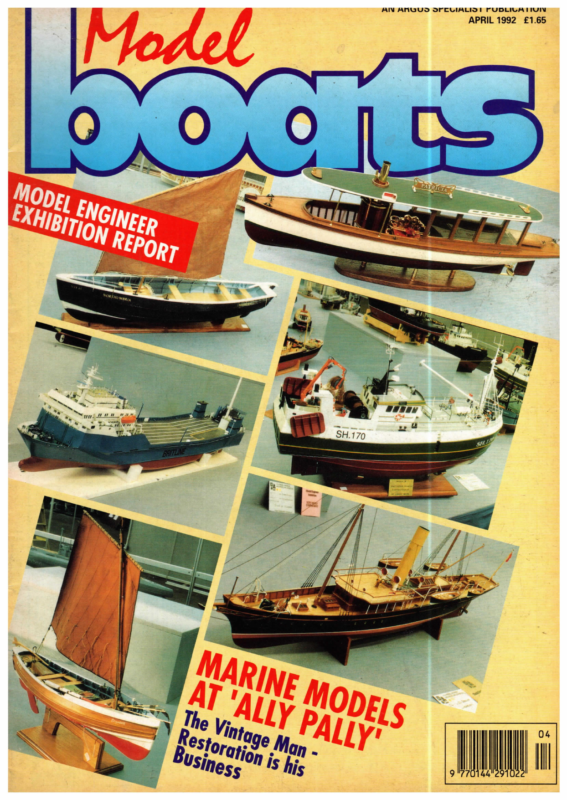
- The Vintage Man Ray Brigden visits Richard Howlett, model restorer extraordinaire
- CURVED AIR Russell Potts on the Vintage Group, winter pastimes and 6-M designs
- Sail to Win Part Eight of Nick Weall’s course to improve your Sailing

AN ANGUS OFCUIALIO! FUDLIVLATLIVIN APRIL 1992 9 “770144 £1.65
Ray Brigden visits Richard Howlett, model restorer extraordinaire reek Bridge, Deptford, was my destination on one of the sunny days we had last July. The address conjured thoughts of a busy shipping link with the past, indeed Deptford is much mentioned in maritime history, being the birthplace of many ships; giant timber built men of war and traders were launched from Deptford’s river banks – some sailing off to lay claim to fame in battle and others discovering new lands. It was in the Deptford yard that H.M. Shipwrights converted the collier Endeavour for Captain Cook’s first exploration voyage into the Pacific. Earlier this century saw Deptford as being part of London’s huge waterfront, supporting the large workforce needed for handling the massive cargo tonnages . arriving and departing on the tides of the Capital’s famous river. The coming of the container ships took the cargo business to the lower reaches of the Thames, and with the cargo and ship building yards silent, Deptford was left in decline, like many other dockland areas, but slowly in recent years life has returned to the Victorian and older buildings that served the marine companies. The buildings now serve as home for many trades; engineers, printers, furniture makers, company offices, etc., and only a few have any links with their The Vintage Man Heading, Maritime Models’ proprietor Peter Lewin with lolanthe Ill on her first outing for 40 years before Richard Howlett completes her rebuild. Left, Peter picks up a few tips from the maestro. maritime past, however the man I was visiting is now plying his skills and doing business with boats – many of which were, in their heyday, enjoying fame and providing pleasure when Deptford was a busy area. The Man The man with the skills is Richard Howlett, known to many who follow the Vintage model yacht side of the hobby, and one of the founder members of the Vintage yacht group. Richard delights in travelling, sailing and pondside chats with other enthusiasts who attend the group’s sail days around the country, and their restored yacht models now make an impressive fleet. Most of the models are from an era when our great and grandfathers enjoyed their hour of modelling with timber and brass, and more hours at the pondside watching and 12 MODEL BOATS
work in his premises which is divided into three rooms, one for storage of models awaiting their turn for restoration; keeps in touch with what’s happening in the development of full-size yachts especially racing yachts. He is a great admirer and friend of yacht designer Ian Howlett (no relation). Ian designed the another room equipped for sail making, and the third and largest room is the main workshop where it all happens. One wall is shelved to carry a selection of hulls, most of which are from Richard’s own personal collection. The main workbench is set beneath the two large windows of the room, and all along the window shelves is U.K.’s 1981 entry for the America’s Cup Lionheart. Richard is one of the many who believe Lionheart is probably one of the fastest 12 metre yachts ever. Known to Ian as a great fan of Lionheart and also an expert marine modeller, Richard was a delightful scene. Standing bow to stern is a colourful collection of toy boats, the type you could buy in toy shops or Woollies, with solid timber hulls, linen sails and untreated dowel masts. Richard’s collection, all with differing sail plan and delighted to receive from Ian a gift of one of only three fibre glass hulls made from the plug of the tank test model. Richard’s Lionheart hull is scaled to 1/10th and is close to being fitted out. Richard has planned multi-channel R/C Richard with yacht pole and a breeze, plus lolanthe Ill on Blackheath Pond. Below, from the designer’s own plug, a hull for a scale model of the racer Lionheart. enjoying their creations free sail or in match race competition with other yachts; and it is grandfather’s model yachts that are now keeping Richard busy. When Model Boats’ Curved Air correspondent Russell Potts began telling us interesting snippets in his scribblings a few years ago about an old timber built ‘M’ class yacht he had just acquired and was busy restoring, many were enthused and climbed into the loft or made that long awaited tidy up of the workshop to seek out the old hulk they thought would never again see the light of day. Many of the rediscovered models proved through research to have had an impressive record – some were also in a very sorry state and have provided their owners with much interesting modelling work. And the owners who were a touch hesitant in tackling a restoration project on what amounted in some of the models to a complete rebuild have called upon Richard for help. The Premises On arrival at Deptford I found Richard at keel shapes, helped bring back pleasant memories of schoolboy holidays spent at the pond (many moons ago). Lionheart Although most of his work is with the vintage yachts and sail models he still control for two skippers, each with a transmitter linked with a buddy lead; one skipper will control rudder and main rig while the other will control the fore sails, jibs and working spinnaker. Should you come across Lionheart on launch day keep well away if you are sailing your lightweight yacht or scale boat, as meeting up with Lionheart when she’s running downwind could hurt as she weighs in at 86lbs. The model hull sits on the shelf resplendent in an undercoat of cream, but Richard’s artistic eye can only see her finished as the full-size boat; hull in super high gloss black with striking gold line trim. Richard also believes the linked transmitter arrangement could be of great help in teaching novice skippers who are now proud owners of some of the large vintage ‘A’ boats that have been restored. Telling them you learnt to sail on Lionheart can’t be a bad introduction. APRIL 1992 13
Above, Richard seen working on the deep keeled 1890’s straight line racer. Right, laying on the first coat of varnish to the twin keeled 1910 10 Rater, Gladys. Skills How did Richard acquire his skills and then decide to apply them to model yacht restoration? As a school boy he developed an interest and gained much knowledge in the performance and design of all types of sailing craft. Then, for many years he lived and worked in Greece near Athens running his own company building fullsize yachts. In 1979 Richard felt it was time to head for home but not before thoroughly enjoying himself on a working holiday. The many years spent building yachts had denied him much sailing time, and one of . the last commissions in his Athens yard was to refit a large steel sea going yacht for its German owner. When completed the happy owner asked Richard if he would like to skipper the yacht. Sailing in the sun for a season was an offer he could not refuse. Finally back in the U.K., he decided to work with another of his skills to keep his new Bank Manager happy. Having an abiding interest in prints, watercolours and drawings, he set up a company with a restoration workshop to buy, sell, and restore prints etc. While visiting art sales and their like, Richard often came across Vintage yachts and sailing models that he added to his personal collection, many of which he restored to their former glory and Richard checking lolanthe III’s vane gear. 14 then sold on to help his survival fund. Needing to know the history for rebuilding and to be able to place a value on restored models means much research which Richard enjoys immensely. Experience on so many models over a number of years has made Richard a walking text book on the statistics of vintage sailing models. He quotes with enthusiasm details of famous racing models built and sailed over the past hundred years. So home again, a new business established and living in the new residential area of St. Katherines by the Tower, sailing or restoring his models at weekends, Richard could be talked of as a happy man, but as so often happens when one believes all is well something is put in our way that disturbs our life style. With Richard a severe illness showed him a red light and curtailed his business and model sailing activities. Twelve long months away form the workbench and pondside, plus the realisation that his workload from now on would have to be less than before, meant yet another decision, resulting in closing down the restoration workshops at Wapping for a move across the river to Deptford and setting up the present business to work exclusively on model yacht and sail boat restoration. MODEL BOATS
had a closer look. If you see a brass plaque on the stand of a model reading ‘Restored by Richard Howlett’, take a close look at the paint surface and I think you will agree that its something special. It’s not a mat, nor a gloss; best described as a sheen. Richard gave me a run down. A desirable surface is given two undercoats both rubbed down with 600 grade wet & dry; six coats of enamel are then built up, each being rubbed flat using soaking wet 400 grade wet & dry abrasive paper, and a final coat is added and rubbed down with 1200 grade. Each coat is allowed to thoroughly harden before progressing, and final sheen is achieved with a coating of Getting Started How to get started in such a specialist occupation was my next question. Richard replied “with a lot of help from my friends”. Of course from his previous business he had built a reputation, An 1850’s East Coast Smack in for a refit. metal polish and buffing. Anaconda The keel-less and sorry state of the 10 Rater Anaconda. But much work will have to be made on Richard’s latest commission before he applies his skills with the wet & dry. A pleasing many clients with his skilled work on their models, and often he is called by the Institute of Marine Engineers. Richard tells the story that it was the Engineers who gave him his most difficult restoration work to date. A member and former sea Captain had bequeathed his favourite ship model built by himself many years ago while not on watch during his years at sea, and the Institute wished to display the model along with the Captain’s sextant and compass, but not before the three masted schooner model had received some attention. Richard tells how replacing the rigging and some varnish work made for a straightforward restoration exercise, but when cleaning off below the water-line, Richard found that the Captain, like most sea-going modellers, had used whatever materials were available aboard ship, and beneath the water-line to waterproof his model had used planking tar. Richard said he never thought as a model maker he would ever be called upon to lay tar, but being a stickler for perfection he acquired some ‘black stuff, had a sticky time laying it, but was rewarded with the well done smiles from the Institute when he presented the expertly restored model. Richard’s building methods allow him to work on two or three models in the same period; the drying of adhesives when replacing planking or the waiting for a coat of varnish and his expert paint work to harden allow him to make progress on the next model. Painting friend who has helped Richard very much His painting methods would leave the novice gasping. I gently felt the surface of a finished model – not a blemish could be felt or seen – I glanced around the room to see which type of spray gear was used. With none in sight I said “Nice paint work Richard,” fishing for my answer. “All Humbrol brushed” he said. I gulped and business is Peter Lewin from that well known marine model shop just along the road in Greenwich. Peter recently arrived with another customer who was clutching the remains of a family heirloom. Richard has researched the sorry looking hulk as being a 10 rater to the 1906 XPDNE design by Daniels, though her battered red to establish his exclusive restoration and white paint work bore the name Anaconda. Her builder was obviously very skilled in timber work; the bread and butter built hull has been carved out to plank thickness and carries no frames to help maintain its sleek shape, although a few frames might have saved Richard some time on what seems a monumental task in bringing Anaconda back to life. Nearly every seam is split somewhere along its seven foot length, but this was not due to a bad choice of adhesive by the builder 70 years ago, but by the somewhat hazardous storage place of the hull. Over the past few years the model was stored in a cow shed would you believe, and one of the four legged ladies stretched a hoof one night and split poor Anaconda’s sleek lines asunder. Iolanthe The king-size splits in Anaconda’s hull planking. APRIL 1992 Regular visits to Richard’s workshops by 15
Peter Lewin with customers wanting to meet the maestro who was to rebuild their model have understandably given Peter the enthusiasm to own a working vintage model, so the next cloth capped gent who strode into Maritime Models spouting “ere Guvnor, our much for this?” went away happily minus his wares after Peter had given him a little something from the till. The in-need-of-repair hull Peter had purchased was hastily delivered to Richard’s workshops. It has the unusual feature of a stern design the same shape as the sharply pointed bow; “a double ender” announced Richard as he carefully parted the deck from the hull to assess the amount of work needed to get Peter sailing. A rare sight was found beneath the removed deck – the builder had signed his name and the date which all greatly helped Richard with research. A call to Russell Potts, who has many of the official M.Y.A. registration records, gave the information that Peter’s model was a 10 rater named Iolanthe III, built and registered by Mr H. Boniface of Highgate and given a registration number of K.717 in May 1936. A little work on the hull and a borrowed suit of sails and vane gear provided Peter, Richard and myself with a pleasant morning’s sailing in the August sunshine on Blackheath Pond. Iolanthe III glided gently across the pond on her first sail for near forty years, providing pleasure for us three as no doubt she had for her builder some fifty six years before on Highgate Peter Lewin about to have his first run with lolanthe Ill against Richard’s ‘M’ model. my turn to go with his Lordship and run after his toy boat, etc.” The model’s owner also dressed for the outing, white shirt and tie, blazer, grey flannels and straw hat. How about making an effort at the next R.M. Nationals, lads?. Tools Surprisingly there are no great arrays of tools in Richard’s workshop; a Unimat lathe with sawing attachment, a large collection of small wood chisels and modified gouges, a good selection of planes some with only a half inch cutting blade as used by violin makers, a Mini-craft drill with a selection of bits, and a unique timber bending machine with a two inch \ Pond. The morning’s experience watching Richard and Peter tuning the old yacht for better performance, and thoroughly enjoying the challenge of making something old come to life gave me the answer as to why the Vintage Group is gaining in popularity. To celebrate the successful relaunch of Iolanthe III before Richard completes the rebuild, we called for a glass of ale from the nearby Prince of Wales Hotel, Peter paying – of course. A Ten Tonner One model being worked on during my visit was a most unusual shape; very slim beam but very deep from deck to keel, no rudder and about 50lbs in weight. “A straight line racer, 1890 to the Ten Ton 16 Richard with his beloved Hermione. rule” said Richard, seeing me staring and wondering at this beastie. He explained they were mostly owned by the gentry and who had the top boat was keenly contested. The large rig would be set to sail the model as close to windward as possible. I remarked that with the great weight of the model and all the needed running for recovery, the skippers must have been super fit. “Not so, you had a man” said Richard. The gentry would apparently order the coachman, gardener or footman to be ready at such times to travel to the pond with the heavy yacht. One can imagine the chat below stairs with the not so keen members of staff. “It’s Rigging a rebuilt ‘M’ yacht for trial sailing. MODEL BOATS
A scratch-built hull from a Daniels’ design So was this hull with an impressive record enough to keep Richard happy? “Yes sir”, he said with a twinkle in his eye, as one hand gently rubbed her hull planks, seeming to give the same contentment as one would get when finding an old master. Richard said the hull has proved to be beautifully built, a long racing career and over the last 30 years she has been without a deck, but still her shape is correct. He has owned the famous hull for over five years now so I asked Richard when he would start the restoration. Richard explained that his illness, the moving of workshops, and of course keeping up with the important workload have all helped delay the start, but things are on the move. He proudly showed me, the completed set of fittings in high quality brass. Another reason for getting on with oval centre piece that allows numerous curves to be made. Getting a stock of good quality timbers is not easy these days. Good quality mahogany with a light grain can normally only be found in used timber that has to be cut from disused doors or furniture etc. For planking Richard sometimes needs to cut eight foot lengths of mahogany for repair of the’ large models, and apart from keeping good friends with the local furniture maker for off cuts of fruit woods he has also made contact with companies who build musical instruments such as cellos and violins, who can often provide off cuts of maple wood, a fine grained Hermione the build is the chance to have an historic match race rerun. The well known model yachting book by Daniels & Tucker carries an excellent photograph taken at the start of a race between Hermione and Crusader. The Apart from being happily married Richard latter is now owned by Russell Potts, who admits to another lady in his life, and her statistics he knows by heart – over six feet, a curved beamy body, and also she has a record of being a very fast lady. Her name like Richard, still has some work to do, but a rerun of sixty years ago is possible for is Hermione. I jest, as Hermione K.29 is yachts. In fact the oldest model in the store at this time is an 1870s fishing the pride of Richard’s own collection. some time this year. Not all the models in his workshop are At work on a model of a Greek sailing fishing boat in the main workshop. Nan, a 1912 model yacht fully restored by Richard. “¢ While buying, restoring, and selling he has cutter, and there’s a Thames Barge that always wanted to own a famed vintage yacht model with a good record. When Hermione became available Richard was prepared to part with the family silver, so was even happier getting what he wanted on the first bid. Hermione was built as an ‘A’ class boat in the mid 1920s, designed and built by suffered by being left on a gas ring; but whatever, cutter, barge, or yacht, they all leave this master craftsman’s workshop looking far better than when they arrived. See that ‘Restored by Richard Howlett’ plaque affixed to the stand and you will know that the model you see is better than the original. Richard has recently been appointed secretary to the Vintage Group. He also does some good work with recruitment for the Group. Often customers who call at his workshops are surprised to learn that timber that is good for repairing sections and building fittings. I asked what was his favourite adhesive for his specialised work. He replied that the hoof glues that grandfather made up himself have proved to have good lasting qualities. The formulas are still available and a brew could easily be made up, but he prefers to use the modern adhesives available. He believes them to be easily equal in adhesion but the water proofing qualities for working boat models is far the 30s when her design proved how it all works Richard produces a membership form and on gaining a signature he congratulates the new member as now being like himself – A superior. uncompetitive. Vintage Fan. APRIL 1992 T.H. Willey who raced her with success during the 1920s. One season at Gosport Hermione was holed. She was repaired and the new planking did not seem to effect her performance as she went on to win the British Championships in 1930 against what is said to have been the cream of the British fleet. She then progressed on to win International races, and she raced successfully until the end of there is so much organised model boating happening. After a speedy explanation of 17
Fe at aE Seo ——_— = Russell Potts on the Vintage Group, winter pastimes and 6-M designs t seems a long time since I sat down to write one of these columns. The pressure of other material has meant that John has held over my pieces from a number of issues recently, so that the one that appeared last time was in fact written some several months ago. YAEKVOIY ~ eRe racers PETOSIE ayy x Sruspplervyet Vintage Group Reorganisation Since then, The Vintage Group has held meetings at Gosport, Hull, Clapham and Beale Bird Park, all of which have been Above, Helmsman, a sailing board game for wet Sunday afternoons. Left, Olyimic Yachting, a rather better conceived and presented variation on the sailing boardgame, but stil not very attractive Nautical Board Games. All these have come to light over the past few years in junk shops, church bazaars and charity stalls over a fairly small area of East London. As well as those illustrated, the collection includes ‘Wooden Ships and Iron Men’, a fearsomely complex war game for wooden walls marketed by the American Avalon-Hill company in the late 70’s and early 80’s. This has a Rule Book the size of a small paperback and a set of scenarios enabling the players to recreate a whole range of actions from single frigate confrontations to the battle of Trafalgar. Games, it is claimed, can last up to several days and I can well believe it; this may have frightened off the original purchaser who had not pressed any of the many successful, though that at Hull attracted only a small attendance. The VG has also gone through a constitutional sea change and emerged with a three man executive committee consisting of myself, Richard Howlett and Mike Burn. Each of the other two are extremely active members and the idea is that by spreading the load between us we can give a better service to the membership. Richard will act as secretary and will handle the increasing amount of administration generated by our growing membership; his address and telephone number are at the foot of this article. Mike will be producing a rather different form of newsletter from what has circulated in the past, less frequent but longer and with more meat to it. I shall continue to run the historical consultancy side of the Group. In due course there will be a formal constitution enshrining these changes and establishing a mechanism through which the Group can have a continuing existence without depending on particular individuals. 44 Winter Pastimes cardboard counters from the sheet in which they had been supplied. Most of the games that Geoff has collected seek ‘to recreate the thrills of sailboat racing on your living room table’. As we are still in the winter months, it seems an appropriate time for.a lodk at some silly games. What does a model yachtsman do on the days when the weather is really too bad to sail? Admiral Turner in the 1920’s envisaged members of the London MYC sitting round the stove in the clubhouse engaged in discussion of the factors in design that would influence the performance of boats. To that end he gave a large roll of his drawings, complete with The models for Sailor Buoy! see pic next page. notes on their performance and the personalities of the owners who commissioned them. This is a high toned idea and only applicable to serious model sailors. The problem of how to entertain the kids ranges much wider and needs a less intellectual answer. Some commercially proposed answers from the more recent past are found in Geoff Turner’s collection of board games with a sailing theme, which bids fair to be the foundation of the National Museum of When you recall that the real thing has been accurately described as about as thrilling as watching paint dry you can see that the designers of the games have their problems and that surviving examples are pretty rare. They can never have threatened the supremacy of ‘Monopoly’ and ‘Trivial Pursuit’. There are two examples that use a board and dice to simulate the action. ‘One MODEL BOATS
Sailor Buoy!, a different approach to indoor sailing games. unsatisfactory variation on this theme designed as a travelling version with tiny slip-in plastic symbols in a nasty tight plastic folder. It didn’t photograph well so there is no point in going on at length about it. A much more successful attempt to make a worthwhile game from yacht racing was produced by Lines Brothers in the late 60’s. ‘Sailor Buoy!’, – as seen on TV – bears almost no relation to real racing, but by using ingeniously designed models and small electric fans produces a fast and furious game that really will keep a family engaged for some hours. The boats are plastic mouldings with wheels beneath. That under the bow has a Helmsman’, uses a chart with a number of fixed hazards and adds to the complexity by having a wind direction indicator mounted in the centre of the board which is adjusted by a throw of the dice before each round of players’ turns. This means that the course is at a randomly changing relationship to the wind. This constitutes the main action of the game as the boats are assumed to move a different speeds depending on the course they take. There are special dice which determine what each boat is able to do on each turn, including an enforced anchoring (effectively ‘Go to jail for one turn’ in Monopoly-speak. Despite the unrealism of the action as compared to the real thing, the game comes with a set of ‘basic rules’ and an additional booklet ‘the racing helmsman’s supplement’, which sets out the full TYRR, though I don’t now recall how these were to be applied to the action of the game. The counters are rather poor things, little conventional representations in plastic on a stand. It’s easy to understand how a complete unmarked copy ended up in a junk shop. A more elaborate and somewhat better conceived attempt along the same lines is ‘Olympic Yachting’, a game licensed by the IOC to Pro-Games (UK) at the time of the Montreal Olympics. This is done in a bilingual presentation obviously aimed at sales in Canada and contains a lot of well presented information about the way Olympic races are conducted and the various classes of boat that were used in the competition. The game itself proceeds by throw of the dice round one of a number of possible courses and the incidents of competition are simulated by a series of cards, comparable to the ‘chance’ cards in ‘Monopoly’, which inflict capsizes, wind shifts and boat to boat incidents on the competitors. Again there is a full treatment of IYRR. Though this is a bit more realistic than ‘Helmsman’, it still leaves a lot to be desired both as a simulation of real sailing and as a game to keep all amused from 8 to 80. This again is in nearly mint condition, despite its twenty years, and I surmise that it was not used between the day it was received as the classic unwanted present and the time it was thrown out when the family moved house. Geoff also has an even more rubber tyre, so that when the boat is blown along from the rear this forward wheel is in contact with the table and the boat will run straight. At rest, the boat sits on the central wheels and a roller at the stern and can be blown round by playing the draught on the mizzen. The main sail has a modicum of movement, limited by an arm that runs down into the cockpit, so that the boats can be seen to be on port or starboard tack. The blowers are battery powered and look like small hair dryers. And away they go with help from the tiny ‘hairdryer’ blowers Unfortunately, the electrics had given up the ghost and Geoff and I had to blow the boats round the table by lung power alone. This is hard work but can be managed over short periods. This is great fun and ought to have been a success, but it seems that it didn’t sell at all well. Richard Lines, who is still involved with Hornby Hobbies, who took over Lines Bros., only vaguely remembered it and was extremely surprised that any examples had survived. Alexander 6-M Designs The vintage day at Gosport was blessed with quite admirable weather and sailing continued from mid morning until well into the evening. The attendance was good, as this seems to be a popular venue with VG members, and there were 25 boats actually inscribed on the record sheet as being present and probably quite a few more that didn’t get recorded for one reason or another. The 6-m Chili Pepper, owned by West Vintage day at Gosport; some of the boats and skippers enjoying the sunshine. Photo: Eric Shaw APRIL 1992 45
Country member Mick Chelmick was there again. This is built on a glass hull by Bob Underwood that is derived from an Alexander design of the mid 1940’s and has always been assumed to be Glen Rosa of 1944. At Gosport Eric Shaw had with him a newly built plug from the Glen Rosa design and it became clear that though Chili Pepper is definitely an Alexander boat, she is not from the Glen Rosa lines. The differences are not great, but are more than can possibly have been introduced in the course of development and manufacture by a moulder as experienced as Bob. The photos show Chili Pepper on the bank at Gosport and the new plug alongside a hull to the latest Bantock 6-m design. For a long time it has been conventional to say that one of the attractions of the 6m class is that old and new designs can race together with reasonable hope of equality because the rate of design development is relatively slow. This has certainly been the case in the small vane fleet that was the stronghold of the class over the last thirty years or so. As the pace of competition in the class has increased under the influence of the radio match racing series that has developed over the last few years, this may be becoming less Above, Chili pepper, an Alexander 6-M, but not from the Glen Rosa lines steering, but this has still to be properly sorted out. I suspect that, as on my much smaller Blue Flash, the weight mounted on the tiller needs to be a good deal heavier to have any real effect on the way the boat performs. The Gosport event was something of a Glen Rosa and a modern hull to a Bantock design laid out for comparisan. Photo: Eric Shaw true. I had at one stage envisaged refurbishing a 1930’s Alexander 6-m that I own and entering the 6-m match race arena, but I think this is now unrealistic, even if the boat were equipped with a modern rig and the turning ability improved by replacing the original skeg mounted rudder with a larger spade type. It looks as though Mick and I will have to start a Vintage 6-m match race circuit of our own when my boat is ready. Other boats at Gosport included Gladys, a twin fin 10-rater from the early years of the century, which had been fully restored by Richard Howlett and had a new suit of sails. Though these were exactly the same proportions as the original suit which was on the boats when Paul Croxson bought the lead, with appalling effects on the sailing capacity of the boat on any course. Gladys had had her rig amended by the time she came to Clapham and seemed to be going much better. She was also fitted with a weighted tiller arrangement for Howlett showcase with the A boat Iris also showing her paces. This is a boat designed in the 1950’s and given the full Howlett restoration treatment and a radio installation.. The paint work in a deep red is particularly fine. A boat that was still awaiting the magic touch to bring her back to her full glory was a 10-rater of indeterminate age and provenance which Len Thompson had found in the Poole area. From her appearance, she dates from the years just before or just after the 1939 war. She is her, they were clearly wrongly balanced over the hull, with too much area forward of the mast, and nothing that any of us could do would make the boat sail to windward. We also discovered one of the disadvantages of the twin fin and torpedo layout of the appendages. Any weed that is about seems to be magnetically attracted to the boat and wraps itself firmly round Gladys with her original rig reproduced; trials showed that there is too much area forward. Photo: Eric Shaw 46 MODEL BOATS
The ‘A’ boat Iris in action. Obituary Philip Leigh 1904-1991 Philip Leigh, formerly Philip Levey, has died at the age of 87. He was both the oldest active model yachtsman and the longest serving, having joined the then Clapham Model Steam and Sailing Yacht Club in the middle of 1918. At the time of his death he was a member of the current Clapham Club and Honorary Life Member of the Vintage Model Yacht Group. In the 1920’s and 30’s he worked as a musician in dance orchestras here and on the Continent and his yachting had to be fitted into the few gaps in a busy professional life. He was nevertheless active in the YM 6 OA and South London clubs and sailed in some notable races, inning the Bradford Cup for the ‘A’ class at the first competition in 1928. In his later years he worked as a restorer of stringed instruments and continued to compete in the ‘A’ class which quite nicely built in plank on frame, but the fittings are mostly improvised from existing material. For instance the mast is quite a bit thicker than you would expect because it has been made to fit the light fitting that has been adapted as part of the mast slide. The sails leave a lot to be desired and the hull will have to be carefully treated to make good the shrinkage that has opened most of the plank seams. Eventually she will be a good looking boat, as the basic hull form is very pleasing. An earlier boat that may have been built as a 10-rater was also on show, but not sailing at Gosport. The hull and fittings suggest that she dates from the turn of the century and the disparity between the form of the after end of the fin and the rudder, (which is fitted with a rather crude home made style of Braine gear), suggests that the latter is an addition and that she An unidentified 10-R from the mid 1940’s, | think? enough to be original to the boat and the very low gooseneck fitting and the way in which the rotational movement is secured different in various respects. This suggests that they were made as one offs by the was originally designed without any steering gear at all. The sails look old by the whole thing revolving round the mast suggest that this also is an original fitting. I have seen one or two goosenecks like this, all quite nicely engineered but all remained his great love. He never original builders to a suggestion in some how to do it book or magazine article from the late 19th century that I have not yet managed to track down. . managed to win a championship but placed second on one occasion. I first met him whenI was starting to seek out model yachtsmen with long careers and long memories to assist me in putting together a history of the sport. It became one of my most rewarding relationships; as well as a fount of information on all aspects of the sport in his time, he was a man of great charm and spirit. When well over 80 he accepted an invitation to become a Life Member of the newly formed Vintage Group and rejoined the Clapham club. As well as attending all the Vintage Days he could get to, the last just over a month before his death, he built himself a new boat to sail at Clapham and restored a number of classic ‘A’ boats which he had admired during his long career. He will be sadly missed by all who knew him. Contact Addresses: MYA Matters; Ian Taylor, 115.Mayfield Avenue, London N12 9HY. Tel: 081 446 1625. Vintage Group Administration; Richard Howlett, 3 Maudlin’s Green, St Katherine by Tower, London E1. Tel: 071 480 5288. Old Boat “ati Another boat from the turn of the century; possibly intended as a 10- Rater, measurment. APRIL 1992 but hard to tell without full Queries, Curved Air Press; Russell Potts, 8 Sherard Road, London SE9 6EP. Tel: 081 850 6805. 47
Sail to Win Part Eight of Nick Weall’s course to improve your Sailing T= is the eighth article in the second series aimed at helping the intermediate radio controlled yacht skipper to improve his or her performance. If people spent as much time considering tactics as they usually spend on trying to find that extra little bit of speed out of their boat, they would find that the time they invested in the former would result in far more improvement than success in the latter. Boat speed improvements for the intermediate skipper are at best going to be marginal, if one assumes that the intermediate skipper has a fair idea of how to set his sails and get the trim of his yacht into reasonable shape. My first book Sailing to Win covers all of those points and more. I have often written that you cannot buy success. A high tech expensive boat on its own will not win you races. You must have yacht racing rules so as to be fairly sure of your obligations in any given situation. Once you have developed all of these qualities it is then perhaps worth considering whether or not you have the yacht with potentially the fastest speed. a very good idea of where to place your yacht in all situations, and have a good sense of predicting the likely development of situations involving the close grouping A World Beater? I have to write all of this because after having owned and raced very successfully one of Graham Bantock’s Enigma designed of yachts especially while rounding marks. You must have a good tactical ability coupled with a working knowledge of the Marbleheads I have to confess to having Columnist Nick Weall is pictured by ‘rival’ columnist Mike Kemp from sister magazine Radio Control Boat Modeller. Nick reflects a chilly prizegiving at Guildford club’s Mermaid Trophy in early November 1991. invested in one of the most expensive Marbleheads in the World. Yes in a moment of foolish exuberance I ordered from Janusz Walicki a Skapel after the Europeans in Hanko last August. The Europeans was the second major event that I had had the opportunity to study Janusz and his yacht in operation, the previous occasion being the Worlds at Fleetwood the year before. One of the drawbacks of being on the protest 2 committee is that you do not have much time to watch races, as you are usually sitting in a room somewhere listening to someone else’s tale of woe. What I did see of Janusz’s yacht on each occasion though impressed me greatly. On the day after the Europeans was over, since Janusz was staying in the same guest house as myself, I was able to spend sometime with Janusz talking to him about his boat with the help of Klaus Schroeder acting as interpreter. I became even more impressed, because in my opinion the yacht has many good technical solutions to problems. Some of these solutions are related to boat control, others are simply there to simplify the swapping over of winches for example or the fact that the rudder is simply a push/pull fit from the underside of the yacht making for easy transportation of the yacht hull in between events. These sort of things become more important once you have to start flying your yacht around the world to compete. The points that no doubt will appeal to most yachtsmen though are the facilities = = Rest of the pics this month were taken at last year’s National 1-Metre Championships at Swanley. The ‘A’ fleet crowd on the mark awaiting the wind to strengthen. 54 to be able to alter the camber and twist of the sails whilst racing; the ability to also alter the slot in tandem with the above; and the ability to be able to automatically MODEL BOATS
kick the jib across to the other side when goose winging. The rotating mast and its airfoil section are of great interest too. All this coupled with a precision of control for setting up the yacht offers one a lot more than I am used to. I have always held the opinion that the simpler you can keep the controls of a yacht the better, mainly because in the heat of the battle it is so easy to forget to alter the twiddly bits. Also the more twiddly bits you have the more there is to go wrong. I will certainly have to start to look after this yacht a lot more carefully than the more usual simple rigged yachts I am used to. So am I guilty of trying to buy speed? The answer has to be yes I suppose, although in defence I would argue that I have got to the stage in racing where the very marginal differences to be gained really mean something. I am racing with the best in the land, where little differences in boat performance are noticed. Where quite a few people all have the tactical ability to win and the depth of experience to win. They can all set up a boat to get the best from it. It those circumstances it is vital to ensure that you have a yacht that can provide you witha performance that matches that of anyone else. You can then only blame yourself if you do not do as well as you expect. You know at least that the yacht has the potential to win and all you now have to do is to develop the same potential yourself. Over the coming 1992 season I will give you reports on the success or otherwise of my ability to use the yacht to its best advantage. So far I have had it on the water in a force eight for an hour or so sailing against my old boat and its speed is impressive. Now I must get it measured and then off to war. 4711 Beau de Cologne enters the scene! I will also get some photographs of all the little goodies and write a separate article on the boat shortly. In the meantime back to the series. bank so as to try and place their relative positions and size in proportion to your yacht thus once racing you can be sure to round them fairly closely. Once that is in your mind you ought to go back to studying the windward beat and the windward mark. You should try approaching it from both of the laylines, as well as more or less straight up the centre of the optional courses. You are looking for any possible windbends acting upon the windward beat, which may well prove to you that one side or other of the course is favoured at that moment. Because of this it may well be the case that it pays to approach the windward mark on port rather than the otherwise favoured starboard tack if the windward mark is to be left to port as is normally the case. In fact even if the windward mark is to be left to starboard it will still pay to approach the mark on starboard if the wind is even on both sides of the course and the windward mark was a true towards the windward mark on port with good speed whilst others have recently tacked across to starboard, and while they are approaching the windward mark on the superior tack they do not have quite so much speed. Now the skills of manoeuvring and judgement come into play in a big way. The skippers of the port tack yachts have to make up their mind pretty quickly. Are they going to cut across the bows of some starboard yacht that is laying the mark and then tack to windward of it or are they going to tack just before reaching the starboard tack yacht ending up on starboard slightly to leeward of the other yacht? If they make the second choice will they have enough speed left to be able to luff up and around the mark if necessary? Judging speed and course We have immediately identified two skills here that you need to develop to perfection The Windward Mark We have finally got as far as the windward mark. In a normal closely fought racé it is critical to get round the first windward mark as near to the front as possible. There are ‘positions to be gained and lost at this first coming together of the racing fleet. In many races it will be the most action packed part on the entire race. Perhaps the only way to get a good idea of what happens or is likely to happen at the windward mark is by experience. I would be the first to admit that, but hopefully what can be passed on by the written word is guidance as to what to be looking out for and how to react to given situations. Even then it is going to take any aspiring reader quite sometime to get it right. The action simply occurs far too fast for anyone to try and remember what should I be doing now. You have to develop yourself to be able to react almost by instinct to a wide variety of possibilities. Consideration of the windward mark should have started long before the first race of the day. If you are lucky enough to have enough time before the start of the first race, it most definitely pays to get your yacht on the water checked for tuning and then sailed straight up the first windward beat and around the windward mark. You should then sail to and around the marks of the course furthest from the APRIL 1992 windward mark! For the moment let’s us look firstly at our tactics assuming that the mark is to be left to port, the wind is behaving the same all over the area of water to be sailed upon to reach the mark and that it is a true beat from the startline to the first mark. In such circumstances we will probably want to start on starboard with speed near to « the starboard end of the starting line. We will have already have plotted our preferred course up the windward beat if other yachts allow us to sail it. That course will have put us onto the starboard layline sufficiently far from the mark so as to not have any potential problems under rule 41 – tacking in another yacht’s water. Now if we have been very clever and not only had a wonderful start, but read the wind well up the first beat we will not have anything much to consider as we approach the windward mark other than to make sure we miss it as we round it in first place. For every one yacht leading the race at this point there will be maybe fifteen other yachts close on its heels, all with the single objective of overtaking that yacht or at least getting around the first windward mark well up in the fleet. Usually some of these avenging angels will be hammering Nick Weall No. 43 seen leading in a ‘C’ fleet race. if you wish to survive in the cut and thrust of top level racing. You must be able to judge another yacht’s converging speed and course sufficiently well so as to be able to accurately judge whether or not it is safe for you to sail your yacht straight across the bows of the starboard yacht. A small point worth noting here is that if it appears that you have got it fractionally wrong by bearing off at the last moment after the bulk of your yacht has crossed the path of the other yacht, you can effectively swing the stern of your yacht out of the way of the other yacht! Since this manoeuvre losses you a bit of distance it is only done in emergencies. There is no easy way to develop this skill other that practice. It is also inevitable that you will to start with get it wrong more than once, so be prepared to execute some penalty turns. Also do not try this manoeuvre in strong winds until you are really sure that you can really clear the other yacht! The other inoffensive option to sailing across a converging yacht’s bows is of course simply to bear off and take its stern. But – if you 55
a there will be other yachts also on on a tack to enable this yacht to keep clear without having to begin to alter course until after the tack or gybe has been you are rapidly approaching. This may well remove such an option from you. We The whole object in leebowing another yacht is to tack just underneath the other are on port approaching the windward mark, you can bet your bottom dollar that starboard close on the stern of the yacht thus now come back to the second skill we need to develop to second nature – tacking under the bow on the starboard converging completed. lengths of the longer yacht, and an overlap that exists between two yachts when the leading yacht starts, or when one or both of them completes a tack or gybe, shall be regarded as a new overlap beginning at that time.” yacht. Tacking under This tactic is incredibly useful at the windward mark and executed correctly can gain you many places. It is however not enough just to be able to leebow the other yacht nicely, you have to be able to judge very finely if you are going to have enough speed and room after tacking to get around the mark. In this sort of situation a heavier boat shows a definite advantage since its mass will retain the speed of the yacht far longer than a lighter boat. Naturally these factors come into consideration only very near to the mark. If there is a bit of room to bear off a touch and regain optimum speed before pinching up to lay the mark so much the better. You also have to be able to gauge fairly accurately the speed of the other converging yacht with your own. The reason being there is a very fine dividing line between leebowing the other yacht successfully and being accused on tacking .in the other yacht’s water! Just to look at this a little bit closer, let’s refresh ourselves as to the correct definition of tacking. Tacking – a yacht is tacking from the moment she is beyond head to wind until she has borne away to a close-hauled course. Now please be kind enough to stop a moment and consider just how long it takes a modern radio controlled racing yacht’s course, ending up in such a ‘A’ fleet crosses the line for a clear start. position that the other yacht is to windward and overlapping your yacht with its front quarter. It will then suffer the windward effects of the dirty wind coming off your sails, which will either slow the other yacht down or prevent it from sailing as close to the wind as it might have been previously. You are thus in a position to slow the other yacht down. The main reason for leebowing a yacht at the windward mark however is simply to get into a position whereby you can round the Obligations So we have just leebowed a starboard tack yacht within the four boat lengths of the windward mark, what are our obligations if any? Having ensured that we did not force the starboard tack yacht to take avoiding action while we were tacking, we have no obligations other than to get around the mark as long as the starboard yacht has not passed the mast abeam stem position relative to our yacht. Once that happens we can no longer either luff the outside yacht. It will however still be in order to luff up to clear the mark, since it cannot possibly be argued that by so luffing we are sailing above our proper course! Conversely the outside yacht has a duty to keep clear of our yacht once we have completed our tack. She also would be wise to be prepared to respond to any violent luff on our part until such times as she is able to hail “Mast abeam stem”, at which time the leeward yacht shall curtail any luff in progress and return to a proper course. As mentioned in the previous paragraph however a proper course close to the windward mark can be exceedingly high to the wind. Shooting the Mark It is perhaps worth repeating at this point Another ‘A’ fleet start — yes, really! yacht to move through thirty-five to fortyfive degrees. When I have put a stopwatch to the task of timing a Marblehead I find the answer is measured in fractions of a second. Keeping this in mind let’s us also have another look at rule 41.2 – Transitional: – a yacht shall neither tack nor gybe into a position that will give her right of way unless she does so far enough from a yacht 56 windward mark as quickly as possible and in front of as many other yachts as possible. The fact that your manoeuvre may slow the other yacht down slightly is simply a bonus. However should it be the case that you have good reason to slow the other yacht down, such as in match or team racing perhaps, it is as well to remember rule 38 – Same tack luffing after clearing the starting line. In particular remember 38.2(b) “For the purposes of rule 38 only: An overlap does not exist unless the yachts are clearly within two overall for some readers the best method of shooting the mark. This is where you are approaching the marka little below the layline. Methods vary a little depending upon whether or not you are overlapped to windward or have a yacht to windward close astern. With the immediate environment clear of other yachts the best method is to concentrate on holding or achieving maximum speed up until a boat length or so from the mark, even at the expense of aiming the yacht towards the wrong side of the mark. At a boat’s length ease the sails somewhat and simply use MODEL BOATS
the momentum of the yacht to luff up sharply and around the mark. If you go slightly beyond head to wind it does not matter provided your yacht is on its own. however if there are other yachts close behind it is essential that you do not go beyond head to wind or else you will fall foul of rule 41.1 – Basic rule- A yacht that is either tacking or gybing shall keepclear of a yacht on a tack. Any yacht thatis to windward of your yacht will have to allow you room to carry out this manoeuvre, because as long as you do not go beyond head te wind you can successfully argue that you have not sailed above a proper course! Thus mast abeam stem etc. does not come into it! Before we leave the subject of leebowing it is perhaps worth mentioning that leebowing does not seem to have the very definite effect upon other model yachts as always have them frowning upon such tricks. claiming that boat speed alone is what they endeavour to win races with. I usually study such claimants sailing for a race or two – it is always the case that they are quite happy to apply what rules they do know as it suits them. You cannot win races by boat speed alone other than by leading from the front for the entire race. If you think about it to have got into such a position you must have had a pretty good start, which thus shows that you must possess good tactical application of the rules whilst getting into such a position to gain a good start. In top level racing I have never seen a yacht simply milling around at the rear waiting for all the other yachts to clear the line so as it could start in the best position and simply use better boat speed to overhaul the fleet! genuinely feel that it is necessary to alter your yacht’s course to avoid a collision it is entirely your right and obligation to do so. In those circumstances it is quite in order to protest the other yacht and thus remove said yacht from your sector of the race. Againin top level racing you’d be surprised how certain boats still seem able to get right back into the thick of it, even after having to execute one or two turns. There is at present a strong move towards only requiring one penalty turn to be done instead of the usual two. The reasoning behind this move is that it keeps the yachts racing and out of the protest room, Skippers being far more inclined to accept the penalty of one turn and a good chance of keeping up with the main body of the fleet rather than running the risk of gaining a DSQ afterwards in the protest hut. When the penalty is two turns upon the water, which usually puts a yacht at the back of the fleet, there is naturally a greater tendency to take the incident to the protest room. Hearing such protests inevitably delays subsequent races and thus race officers will do everything in their power to encourage the taking of penalties on the water. This is of course also in the interests of the majority of the racing fleet as well, so it is usually a popular choice for all parties concerned. Model yacht races tend to be so short compared to full sized races in any case that it is in fact highly likely that one turn is the more appropriate penalty in any event. Match Racing In the ‘A’ fleet, Graham Bantock’s model Strad accelerates away from Swanley’s Tony Owens Miss Chief. it does in full sized racing. There is however the very useful weapon whilst upon an ordinary windward beat when being forced back to starboard by a converging starboard tack yacht of leebowing it, followed say two seconds later by a violent. You will have a very good chance of catching the other skipper off his guard, making contact and obliging the other yacht to accept a penalty. If the other yacht does not break away to accept that penalty fairly quickly then protest it again for failing to do so! This can be an ideal way of removing a yacht quickly from the control it seemed certain to gain over your yacht. Its a tactic best used sparingly; it will not win you any friends and ought not to be used unless the other yachtis a real threat. I must admit however that pfgen when I am kind to another yacht it is surprising how often I then go on to regret having been so kind later on in the same race. The objective of the race must be to finish as high up the fleet as possible. The full use of the rules and related tactics are fair game, although you will always find that there are those skippers whose slightly less detailed knowledge of the rules will APRIL 1992 Now if one of the major options to the yacht approaching the windward mark on port to leave the mark on port is to leebow or tack under any approaching starboard yacht on or above the starboard layline, what tactics should the starboard approaching yacht employ to try and discourage this particular tactic? Defence The answer has to be that the starboard approaching yacht has to be approaching, the mark almost below the layline so as it appears impossible to the approaching port tack yacht’s skipper to tack underneath you and lay the mark. In which case he will have to elect to take your stern and either leebow the yacht astern of you or cross its bows. If it is able to, of course it will attempt to cross your bows, it is in your interests to allow it to do so and under rule 35 in any event you are not allowed to attempt to frustrate its aims by luffing up or altering course to windward. Simply hold your course and bear off a little if you feel it will prevent a collision. If you bear off to genuinely avoid a collision you may choose whether or not to protest the other yacht, but there is no obligation so to do. You must be scrupulously fair applying this rule and in fact it is better to verge a little in favour of the other yacht if anything. However if you The one area race officers do need to apply themselves more carefully to however is match racing, and appendix 4b Match Racing wherein the penalties to be applied for incidents are less even than one turn. On a beat the penalty ought to be one gybe and on the run the penalty is one tack. In full sized match racing the penalty on the run may be taken at the end of the run, after dropping the spinnaker. In fact you may not take the penalty with the spinnaker up or partially up! It would thus seem only fair that model yachts, whilst not carrying a spinnaker, be also allowed the luxury of delaying the penalty turn until the leeward mark, because it is at this point that the most economical tack can be made. You simply run on slightly beyond the leeward mark, harden up and make your tack, laying the mark at the same time. Now what do you do if you are a port tack yacht on the port layline approaching the windward mark with a long string of starboard tack yachts in line all close together approaching and rounding the mark? The easy answer is that you learn why it is so much better to be approaching the mark on starboard in the first place, but no you thought you knew better or you gambled that the wind would be better on the port side of the course and now you have lost! Well whatever the reason you are stuck with the predicament. Your options are to bear off and sail down the starboard fleet until you find a hole or the back of the fleet that allows you to tack and take your turn to approach and round the mark, or you continue to gamble and simply leebow to most favourable looking yacht. If the options really are take the back of the fleet or gamble, well gamble 57
every time; after all you have little to lose round the mark ahead of it. and something to gain. Mind you As a yacht clear ahead it ought thus to be obvious that you too should be sailing well above the layline and bearing off a little to approach the mark with maximum speed, leaving no room between the yacht and the mark. You then use that speed to turn around the mark so fast that the yacht close astern has no chance to nibble sometimes the cost of doing the penalty turn if it goes wrong may put you out of contention for the rest of that race, so do try to think it out carefully before rushing in where angels fear to tread. It might be better to bear off a little tacking to starboard outside the four boat lengths circle and come up hard to windward on a yacht to windward but mostly astern; since you have luffing rights over this yacht it will have to make room for you. You have not gained your overlap from clear astern so rule 42.3 cannot apply! Leaving to Starboard Before we go on to look at more complex situations we ought to now have a quick look at the tactics employed when leaving a windward mark to starboard. If you are not used to doing this believe me when I write that it is a whole different kettle of fish. your stern. The slow alternative is ‘that you again leave no room between the mark and your yacht, but this time you start your turn slowly, not going beyond head to wind until you are sure that the yacht astern cannot touch you, then slam it across and get out of it fast. Now for the poor old yacht that again is stuck out on the port layline with a string of starboard tack yachts approaching and rounding the windward mark, the only option is to take the mark so wide as to allow the starboard yachts room to tack and round the mark. At least by doing this you ought to loose less places than the same situation with a port rounding mark! layline and losing their speed too much as they attempt to pinch up and round the mark. This usually ends up with the inside yacht stalled upon the mark and it is also quite usual to have at least one other yacht to windward lying upon the stalled yacht as well. The other favourite is of course the port tack yacht that got it wrong and which is now tangled with the unfortunate starboard tack yacht that happened to be in the way. In both instances it will pay you to sail well wide of the obstruction while rounding the mark. Because of the likelihood of this occurring a back marker has little to lose by overstanding the starboard layline in the first instance. You then have the options of sailing close- hauled and wide of the mark or bearing of gaining speed and rounding the mark tighter if the coast is clear. Having rounded the mark near the back of the fleet you will immediately want to be sailing a low course towards the gybe or wing mark so as to try to gain an inside overlap on yachts ahead. Now if you are unfortunate enough to be approaching the windward mark to be left to port in a bunch on port, with some starboard tack yachts approaching the mark as well, you are going to have to be very observant indeed. You not only have to try and plan your own point of entry you also have to try and predict the likely behaviour of all those port tack yachts around your yacht. For a start overlapping yachts to windward are going to have to be given special attention, while any yachts overlapped to leeward need to be hailed with calls of overlap. You now have to be very alert for any need by the yachts to leeward to tack to starboard to avoid an All in a line. If you imagine for a moment a yacht approaching the windward mark on starboard with another yacht in line astern also on starboard of course, the leading yacht draws abreast of the mark and proceeds to alter course towards the wind and tacks! Her stern swings out straight into the path of the yacht astern! The leading yacht has passed beyond head to wind – she is thus tacking. The yacht astern simply brings her course up to close hauled as allowed under 35b(ii) and as governed by 42.2(b) and by so doing just nudges the rear of the leading yacht’s starboard rear quarter. The leading boat now has a penalty to do! Rounding windward marks to starboard is dangerous and has to be done with the utmost care. Race offices should avoid setting such courses if at all possible. With a little imagination it is usually possible, but there are occasions when it is unavoidable. It is not a good idea to approach starboard windward marks on port unless you haye planned to put in a short dog leg on starboard before rounding the mark or the coast is exceedingly clear since you are leading by a mile or at the rear of the fleet. The starboard rounding windward mark does offer opportunities for the trailing yacht to make up a place or two. The trick is to sail beyond the starboard layline and crank off for speed. The yacht that is just ahead of you is going to have to pay very careful regard to your yacht, especially if There nearly always seems to be however a starboard tack yacht that is obsessed by sailing beyond the mark and forcing you about onto starboard, before tacking itself to round the mark – they can’t resist it, so be prepared! Right that takes care of the simple roundings of the windward mark and in most club races and the like, that is all that will be required. However when the racing is close, whatever the standard more factors come into play. At the end of the first beat the fleet are likely to still be fairly close together and it is often the case that whilst the fleet may have split into two main groups towards each side of the course, as they approach the mark they are on opposite tacks converging towards a common point with every likelihood of all getting there at the same time. It is now that one needs to be able to read a developing situation fast and plan the best course of action. If you are in the lead there is not a problem. You can see how utterly boring it can be to be in the lead! Let us go a few boats back though, we have now seen a boat or two actually round the mark and see if they did it with ease or if they were pinching up to get around. They have shown the actual layline to the following yachts. Now apart from having almost a natural position at will have a good chance of preventing it this stage to round the mark in, is there anything that can be done to gain places? The easy thing that comes to mind is to advise you to look out for potential pile ups ahead, either caused by starboard tack from tacking and thus will slip though and yachts approaching the mark below the you warn it not to tack in your water. You 58 approaching starboard yacht. They do not need to call for water, but in the event of a protest it will help them if they so do. If they call for water you in turn will have to call for water to any windward overlapped yachts or yachts close astern to windward. All of this in a couple of seconds. Now the inside overlapped port tack yacht or yachts have no right to be claiming that their overlap allows them to lay the mark. If the leeward port tack yacht has to tack to avoid a starboard tack yacht thus meeting its obligations under rule 36, then the remaining port tack yachts effected must also tack regardless of whether by doing so they lay or miss the mark! They have no choice even if the leeward yacht is able to lay the mark and they are not. (Appeal 11 USYRU.) Should the leeward port tack yacht elect to take the stern of the approaching starboard tack yacht then it must also leave enough room for all of the port tack yachts to windward of it to take the stern of the starboard tack yacht as well. Without a doubt there are many risks involved in approaching the first windward mark on port in a bunch even if there are no yachts approaching the mark on starboard. You must bear in mind rule 41 at all times here. You cannot tack in another yacht’s water, thus the tactics to be applied for this point become like the mirror image of the tactics used to round the windward mark to starboard. Keep tight to the mark and do not swing your stern into the path of yachts following you close astern. (to be continued) MODEL BOATS