- Hints & Tips A number of readers are now contributing to this new column — as well as our regulars. This month, Peter Arnot wins £15. Next time it could be you.
- CURVED AIR Russell Potts on Vintage Models
- Sail to Win Concluding Part twelve of Nick Weall’s course to improve your sailing completes the indepth discussion on his new yacht, and follows her progress at the RM Nationals

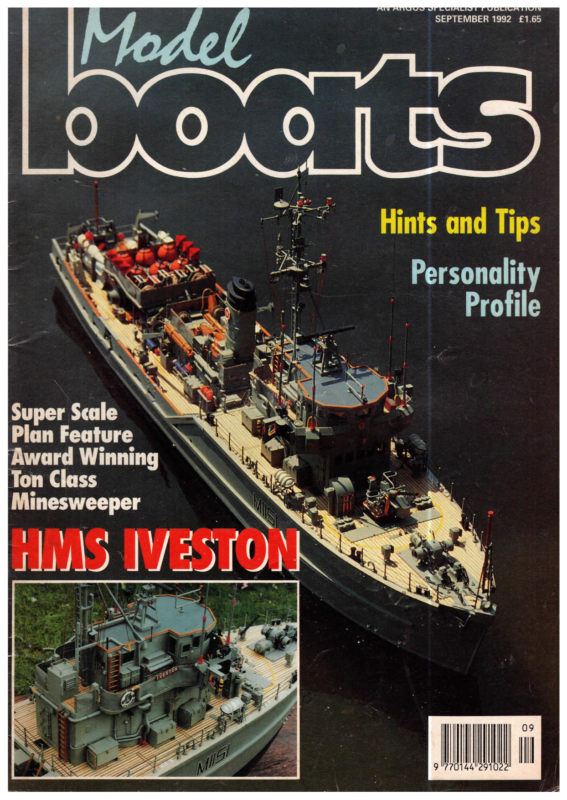
SEPTEMBER 1992 £1.65 Hints and Tips Personality Profile Super Scale Plan Feature >. Award Winning Ton Class Minesweeper 7 77014 O01 Ane I i 2
BOWSIE LINE TO MAIN BOOM LINE TQ JIB BOOM MAIN FAIRLEAD PTFE RING / “EYE OR PULLEY JIB FAIRLEAD = , cs, N@ee LOWER DRUM THROUGH DECK PULLEY A number of readers are BOWSIE ELASTIC LOOP AT END OF RETURN LINE PULLEY MOUNTED THROUGH DECK TOMAINTAIN TENSION now contributing to this COPPER PIPE FOR RETURN LINE GRP IN PLACE new column — as well as our regulars. This month, Peter Arnot wins £15. Next time it could be you. ehedts to the Winch Reon” WINCH RUM. ae) BOTTOM DRUM One of the questions that I have been meaning to answer for some time is: ‘How do you set up the line from the winch drum to sheet the sails in and out?’ WINCH ELASTIC LOOP a RN LIKE STERN DOUBLE ile For some reason this problem seems to puzzle a lot of people. Even worse some of the solutions used tend to let their owners down at the most inconvenient moments. Because of that chance I like to use a belt and braces approach that has only let me down once when the screw holding the keel box with the rudder servo on the other BOW PULLEY PULLEY ABOVE DECK 2 ee A tC ~ 7″ 7 OUTWARD LINE WINCH winch drum to the servo was not done up properly and the winch drum came adrift! No doubt by now the suspense is killing so on with the solution. I always mount my winch vertically somewhere around the keel box, since this ought to be the strongest part of the hull if built correctly. Naturally it will need to be one side of the GUIDE PULLEY ip, ee ee Sn oe PULLEY On BOW PULLEY OUTWARD LINES 3 a a OUTWARD LINE—— RETURN LINE—— ELASTIC LOOP RETURN LINE4 CED) STERN PULLEY ABOVE DECK side. It must be said however that the system will work perfectly well with the winch mounted fore or aft of this point, provided that the mounting for the winch ELASTIC LOOP = tWo COPPER OR /P.T.F.E. TUBES – FACING STERNWARDS is secure enough not to allow flexing of the mounting. I use a double grooved drum and attach two lines to the drum so as one line will go out and the other in when the winch is revolved. One line is led away from the winch and up towards the bows of the boat and toa through the deck mounted pulley. The other line is led away towards the stern of the boat and again to a through the deck mounted pulley. The pulleys naturally enough are a point at which the deck cannot be fully sealed against water ingress. There are some solutions to this particular problem; the best being to use a PTFE tube or a copper tube of a diameter just larger than the line you are using for the winch line. If the tubes exit pointing towards the stern of the yacht then water ingress is kept to a minimum. Now the line that goes towards the stern does so above the deck and a deck mounted pulley is simply used to divert the direction of travel at the stern. Now the line coming up through the stern of the 24 boat has a hook attached to it by means of a very small bowline knot which in turn is sealed with a drop of Superglue. The length of line is calculated by having four turns round the winch drum with the transmitter adjustment for the winch fully in the cranked in position. The hook should now be as close to the stern pulley as possible. The other line should now have only halfa turn or so around the winch drum and should be attached to the hook by the means of small piece of elastic tied into a loop using two fisherman’s knots. The line should be attached to the loop of elastic using another small bowline sealed with a drop of Superglue. It is in fact wise to use two separate loops of elastic so as to have an emergency one in place in case one breaks. The elastic loops should have enough tension in them to keep the lines tight with enough stretch capacity to take up the minor variations in line lengths due to wetness, and how the lines wind around the winch drum. It is the line with the hook attached that does all of the work. As the winch pulls the hook towards the stern it should also be pulling in the main sail boom, and if a conventionally rigged yacht, the jib boom as well with a different line also attached to the hook. The lines to the booms should be attached to the hook by means of MODEL BOATS
bowlines again sealed with a drop of Superglue to prevent the knots from working loose. The lines should be attached by passing them up from under the two elastic loops and then onto the hook. This way the elastic loops can then be pulled over the one or two bowline loops Lyon, in France, for Vaporama. Sao Paulo was fitted with a Stuart Turner D10 Therefore, in many installations you will powered bya gas fired Babcock and Wilcox type boiler of quite moderate size. There funnel. The ceramic needs to be sealed into was never any shortage of steam and this was largely due to his design of burner which not only produced a lot of heat but to stop the lines coming off the hook. The main boom line should be passed through was also economical with gas. The EPlgas 250 canister (85/15 butane/ propane mix) a fairlead and positively attached td the main boom. I do not like the sort of fairleads that are attached to the deck. I prefer to have a hard circle of PTFE plastic held in position by two or more adjustable lines going out sideways to attachment points on each side of the deck. The boom line to the jib boom, if used, is best fed through a guiding pulley or eye near to the foot of the main mast so as to prevent any chance of the jib boom line tangling around anything when sheeting produced all the gas required. The sketch gives the general idea, the dimensions should suit your own installation. The ceramic material is the kind that you find in portable gas fires which have a out. (13mm) thick and is pierced by a large This system of running a continuous large 15lb (10kg) bottle of Butane in the back. The problem is getting hold of the stuff!! I have not managed it yet and if anyone knows of a source of supply then please let me know. (I am not yet at the stage where I am prepared to destroy my own fire!) The material is about “in number of Imm holes through which the loop from the winch drum works fine and avoids the common problems of losing a turn off the winch that often seems to happen with those people using just a long piece of elastic to maintain tension on a single line system. gas can pass. It is reasonably soft and Edmar assures me that you can shape it with a hack saw. The surface is quite rough and when the gas is lit the ceramic glows red hot which of course produces radiant heat. This type of burner lends itself admirably to Babcock & Wilcox, Yarrow and all the other water tube boilers of the Simpson Strickland, Blackstaffe and Nick Weall similar designs. It can probably be adapted to Locomotive and Vertical Fire Tube Ceramic in Burners for Model (VFT) boilers as well but I haven’t seen it Boilers tried. Edmar Mammini made a heroic effort this year to bring his tug Sao Paulo (which is based on Cervia) all the way from Brazil to There are disadvantages. One of the biggest being that water should not be allowed to fall onto the glowing ceramic. not be able to pipe the exhaust up the its box with fire cement. The temperature at Vaporama was about 30 degrees C. In mid-winter in UK a larger gas canister or a lower temperature mix (60/40 butane/propane) may be required. However, Edmar’s burner seemed so efficient that butane should also be tried on its own. Finally, the inevitable note of caution. Gas is dangerous stuff, always treat it with the greatest respect and NEVER try out a new burner indoors until it has been well proven in the open air. What Size Steamboat? A question often asked and very similar to that about the Chicken and the Egg. Malcolm Beak and I have talked about it quite a lot. It must be pointed out that what follows assumes that engines have two, double acting, cylinders. Also that small oscillators will be working at about 20-40psig (1%-2%bar) and engines with valves at about 40-60psig (2%-4bar). Propellers will have a pitch/diameter ratio of about 1:1%-2. Malcolm, who has a more scientific approach than I, has come up with a very smart graph and he has kindly agreed that it can be published. Let’s look at a couple of points on it, from my own experience. His graph suggests that an engine of Nein (8mm) bore and “%in (13mm) stroke should swing a prop of 24%in (67mm) diameter. My oscillator, when the boiler is fired with ‘Caricook’, swings a 2in (51mm) CERAMIC — FIRE BED BOX RECTANGULAR OR SHAPE TO BOILER CASING ALTERNATIVE GAS INLETS prop quite happily (1 would ‘guestimate’ steam pressure at about 25-30psig (12bar). It WILL swing a 2%in (64mm) prop but the performance of the boat is not so good. However, another Swindon Club boat, Dave Stratford’s Perseverance tug, is fitted with the V-Twin and has a gas fired boiler which produces copious quantities of steam at 40psig (2. 7bar). It turns TWO 2in (51mm) props very happily. At the other end of the scale my boat Henry which is driven by a Stuart Turner D10 started life with a 3in (76mm) three bladed prop. This gave the engine very little work, it buzzed round and generally wasted steam! When the boat was designed I had no solid information to “JET 0.3-0.5MM (0.012£0.026″) work on, a 3in (76mm) prop seemed \ le enormous at the time and it was used on. = a: Wide- A-Wake on which Henry was based. The boat is now fitted with a 3%in (92mm) HOLES FOR GAS/AIR MIX CERAMIC SEATS ON ANGLE SUPPORTS— et ANGLE SUPPORTS FOR CERAMIC ~ : wee Oa Pe ere 9/16)” (14MM)® MIXING TUBE a] BOX a18G (1.2MM) BRASS – SILVER SOLDER. ALL JOINTS a\ . Lak AND SUPPORT ber THIS END OF MIXING a7 i four bladed prop which is the biggest I can fit in the available space. I feel it is still too small and the engine hardly knows it’s there. Gordon Drew’s large drifter Diana used to be powered by a ST D10 and went well with a 4%in (114mm) prop. A further pointer to boat size which I personally find helpful is displacement. I “al that if you cube the propeller diameter (an inches) then you have an indication of a reasonable maximum displacement (in pounds) with which the engine/propeller combination, taken from Malcolm’s graph, will cope, and will give an acceptable performance. But, always bear in mind that long, thin, light boats tend to be fast while short fat heavy boats will be more sedate. All require adequate pressure. Peter Arnot SEPTEMBER 1992 25
Russell Potts on Vintage Models The Vintage Group seem to like Dovercourt as a venue; certainly we usually get a good turnout and as our visit there usually falls in June or July, we tend to get good weather as well. This time a number of members of the local club, which has recently been reconstituted, were also sailing, which added to the pleasure. The Secretary of the club has been combing the junk shops of East Anglia and further afield and has come up with some interesting finds dating from the turn of the century. More about these later. Se Cygnet II There were a number of ‘new’ boats on the water for the first time. Ralph Smith has now completed his restoration of the 1930 Feltwell ‘A’ boat Cygnet II, and was trying Cygnet Il, an ‘A’ boat designed by Feltwell and built in 1930. Stern view at right (next page). radio inserted, or a boat of similar concept with maximum Iw] and minimal sail area. In the early 70’s there were lots like this converted from the vane fleet and they gave good racing so long as all the boats were essentially similar. They are a bit underpowered down wind, as the designs gleaming varnish and the amount of effort that had gone into her rebuild, and perhaps unduly doubtful of his own skills as free sailing skipper, he elected to sail her under her storm rig, which must have been two or three suits down from the top suit. After a few false starts he had her trimmed out and she went well in the fairly light breeze, but nothing like as fast as she could have done with a bit more canvas. The beautifully executed planking on the deck attracted a lot of admiring glances and the pristine finish remained unsullied by any contact with the concrete, so we hope that Ralph will pluck up the courage to give her a bit more porridge had assumed the use of a spinnaker on the off wind legs that more or less doubled the sail area. As soon as someone stared thinking about what a radio 10-r should be like and traded some length for more sail, they were outclassed, the more so as construction was refined to reduce the dead weight and improve the ballast ratio. That said, she was an impressive next time out. A 5-rater built in Calcutta in 1930. A very late example of building in this class. Photo: A M Sangster. es Stolen Moment I gave a first run to a 1972 10-rater, now named Stolen Moment. She was originally Tenafly, built to a Dick Seager design of the opposite page. 30 first generation of British radio 10-r, essentially an existing vane design with her for the first time. Conscious of her A 5-rater of the East Anglian style of the 1920’s? The Bermuda rig is a very early example. The steering gear is shown in close up at the bottom about to install radio, so I retained her in this form and did her up to represent the Greenfly, and looking very like the sort of 10 that Chris Dicks was producing at that period. the sail area is only just over 1000 square inches, so the theoretical wl is in the region of 74 inches. WhenI got hold of her, someone had already chopped her performer. The wind was pretty light, but with occasional stronger gusts. As I wanted to see exactly what she was doing as I altered the trim, I was keeping her close to bank and walking alongside her. With any other class of boat this is a comfortable saunter. With a long, thin 10-r like Stolen Moment, every time there was a puff, I had to put in two or three brisk trotting paces to keep up and this applied whether she was going up wind or down. I had hoped to give her a run with a jury rigged spinnaker, but the ‘M’ spinnaker I had with me wouldn’t go on conveniently, so this will have to wait. I aim to run her under vane gear from time to time, if only because I have recently laid hands on a lovely Corby vane gear, all hand made from stainless steel and a much more impressive piece of engineering than anything before or since. The boat of course has a spade rudder, but I don’t anticipate any great problem arising from that cause. A number of boats used vane gear and spade rudders in the past. The real problem is whether I will have the legs and lungs to get down the pond before she does on a free sailing spinnaker run. The vane experiments await the finishing MODEL BOATS
of a spindle for the gear to be mounted on and I rather doubt that she will be ready in time for the next V Day at Poole. In any case Poole is a very big lake to run up and down; something a bit smaller seems to me the right place to start with. Is It a Vintage Boat? It seemed almost like cheating to regard this boat, which is essentially similar to the first competitive radio 10-r that I sailed, a converted Cracker, as a vintage boat, but she is over twenty years old in her design and radio 10-raters of this type have ceased to exist in competition. Stolen Moment will stand as an example of the first attempts to produce competitive 10raters for radio racing. Two Typical Boats of the Turn of the Century Among the boats that were not sailing, but had been brought along for the instruction tah = : = a a Phillip Large sailing his 1950’s vane steered M at Dovercourt. Stolen Moment, a 10-rater to a 1970 design by Dick Seager, newly restored and radioed by Russell Potts. Ralph Smith’s restoration of Cygnet Il showing the stern view. She should now be good for another sixty years! and entertainment of the membership, were two that had recently been found in junk shops. Both date from the turn of the century in their style and are very unlikely to have been built later than 1920 at the very latest. One was what I regard as a late and ‘decadent’ style of model to the 1881 Tonnage Rule. Long after most modellers had abandoned this Rule in favour of the Length and Sail Area Rule that produced the 10-rater, a small number of clubs, particularly in the north east continued with it and developed it further to také account of the new knowledge of the effect of wetted area on performance. The hull was shrunk to a minimum and to retain stability the lead was left at the same sort of depth that it would have had in a full hull Tonnage Rule boat and connected to the exiguous hull by a centrally mounted fin. The example shown in the photos is typical in all respects with its very narrow hull and fixed rudder. Boats of this type could not be sailed off wind and the clubs which used them raced only to windward. SEPTEMBER 1992 The steering gear, which combines a weighted tiller with a series of fixed position settings, of the 5-rater seen opposite. 31
The only slightly untypical aspect is her size which suggests that she will measure up as a 5 Tonner. 5T are rare enough at all periods of the Tonnage Rule and this is the first late style 5T I have come across. Most of the surviving examples from the North East and from the Clyde clubs that sailed them into the early 1920’s are 15, 20 or even 30T, very much bigger beasties than this. j The other boat could have been built at about the same time. It is a 5 Tonner to the LSA Rule and shows in its twin fin layout and primitive steering gear characteristics that suggest a turn of the century origin. The only doubt is raised by the rig which though a low and primitive example is clearly a bermuda style, which was not seen in models until after the 1914-18 war. Given where she was found she may be a locally built boat dating from the 1920’s. Several clubs in East Anglia continued with twin fin designs in preference to the typical Daniels fin and skeg profile that became more or less standard after 1906. The Felixstowe club are known to have kept their twin fin 10-r as late as 1928 and to have sailed ‘round the pond’ courses requiring a touch in a designated stretch of each side of the pond and the rounding of marks set close to the bank. In the eyes of the more traditional skipper who reported this in The Model Yachtsman, this was ‘trick sailing’ and not ow a A5 Tonner to the ‘1730’ Tonnage Rule, probably dating from the turn of the century. proper racing. What he meant was that he couldn’t do it with his boat with a normal Braine gear. The type of gear on this 5-r which, as well as an auto steering function, allows for fixed helm to be put on regardless of wind direction, is much more suitable for the sharp hooks round a mark that were often called for to get into the right goal to score a touch in this style of sailing. Colonial Construction As a pendant to these 5-r photos a shot of a different and very late style of 5-r. This is a boat that was built as late as 1930 in Calcutta and used in part wood from the cabin fittings of one of the British India Steam Navigation Company’s steamers that ran between Calcutta and Rangoon. The hull form is very much of its period and the mast clearly requires a tal+ bermuda rig. Except for the use of a full keel, the whole effect is very much like a scaled down 10-r of the early thirties. We don’t know much about the boat’s owner and origins but it is possible that the design was influenced by full size ideas as much as by contemporary model practice. Sugg Boats I have written from time to time about the commercial toys produced in the first part of the century by the Sugg company of Liverpool and sold by Gamages, Stevens’s Model Dockyard and no doubt by other outlets as well. They come in various sizes and are typically cutter rigged and all painted the same way, with black topsides and salmon below the wl. All have a very fine salmon cove line which I think must have been produced by gluing a length of thread to the salmon undercoat before the topsides were painted. A little while ago I saw a collection, not to say a fleet of these boats which was of great interest because it contained schooner and yawl rigged models as well a cutter; these are undoubtedly in their original condition and Below, a fleet of Sugg boats. The one in the background is probably not from this source, but the others certainly are. this was their factory fit. Also of interest is the straight stemmed hull which, despite some cutting about and the painting of a name on the bow seems almost certain to be a Sugg boat. The style of painting is identical to all the others I have seen. I have not previously seen one that has a straight stem and I wonder whether it was an earlier style which was discontinued when the more familiar hull form was introduced some time in the early years of the century. Contact Addresses Old boat enquiries, Russell Potts, 8 Sherard Road, London SE9 6EP. Tel 081 850 6805. Vintage Group Secretary, Richard Howlett, 3 Maudlin’s Green, St Katherine by Tower, London E1. Tel 071 480 5288. MYA Secretary, Jim Wheildon, 50 Elmgrove Road, Harrow, Middlesex, HA1 2QH. Tel: 081 861 3207. 32 MODEL BOATS
Concluding Part twelve of Nick Weall’s course to improve your sailing completes the in-depth discussion on his new yacht, and follows her progress at the RM Nationals the thing through the British Parcel Force that I find the speed of service from Office. Admittedly this was in late November perhaps getting near to the Janusz in response to my problem is first Christmas build-up, but it is not a good advert for the services of the International arm of Parcel Force. In fairness to them the parcel was well handled and I was easily able to keep track of its progress through their clearing office in London and on down to the Southampton sorting office. At Southampton they were very good, keeping the parcel to one side for me to collect once they had received it from London. The masts had come via Air freight and Service On the Sunday afternoon I received a telephone call from Klaus Schroeder. Klaus is a very good friend of Janusz. Janusz had just returned from three months spent racing in Australia and New Zealand and Klaus had told Janusz of my stupid problem with the butterfly device. Janusz requested via Klaus that I return the butterfly device immediately to Germany and he would repair it. Thus I removed the device from the hull which is quite an easy job and took it up to London with me. On the Monday morning it took me an hour or so to find the best way of sending the device back to Hamburg so as to arrive without fail the following of course were much quicker, although it is always a hassle to actually get a parcel out of the Heathrow Cargo Area. Lufthansa have their own big cargo shed in the cargo village and in fact it took under thirty minutes on a late Friday afternoon to pick the masts up. They were very well packed in a plastic drain pipe! The sails came direct rolled in a very large drum. Klaus later purchased some bits and pieces for me with the agreement that I would buy him a few beers when we next meet in New York for the Worlds in September. As class. Friday night had me busily crouched over Beau de Cologne getting the butterfly set up correctly again on the yacht. This only took half an hour or so and we were ready for the forthcoming race meeting. Swanley Test We left Southampton at 0700hrs with the wind coming from the south-west behind us. There were three lows moving over the North Atlantic promising to provide us with some good wind. Swanley lake is situated in a little dell with a hill between the lake and the south west wind which tends to make the winda little unpredictable. The racing started off as a fresh breeze and the top end of a tall suit. Now and then gusts would come through overpowering a lot of the yachts. The entry of twenty four yachts was divided into two fleets of twelve and three seeding races sailed back to back. I managed to pick up a fourth, third and first I think from memory. The jib was on the forward position and around twelve mm of belly in the jib anda little less in the main. The yacht whilst competitive seemed to lack the drive and extra speed morning. noticed in previous weeks albeit the wind The Post Office could offer no such service! My usual overnight delivery was stronger. The first real race saw a slight increase in wind speed and as in one service to Germany offered by Danzas to my company could not guarantee the same or two previous races boats contrived to service to Hamburg as they offer me to Oberderdingen. So I looked to TNT to help me. Their Skypak service collected the little jiffy bag from our London company on Monday afternoon and delivered to Janusz in Hamburg the following morning. Tuesday afternoon Klaus rang me back to tell me that Janusz had fixed the device and was returning it via TNT again so as I would receive it Wednesday morning. That dear reader I find most impressive. I find it even more impressive that Janusz was generous enough to repair my Butterfly device under guarantee. He had no need to do that what so ever. I had bows on port with insufficient room! On the last race before lunch, the already confessed to him via Klaus that the fault was all mine. If I had not been so stupid as to have tried to have weighed the all up weight of the yacht hanging it from its removable mast stub – there would be no problem. The fact that I did not realise the mast stub was removable is neither here or there. If I had only thought about it I would have surely realised it. I should take a moment to mention that Klaus has been very patient over the last two or three months. He has been the go between for Janusz and myself since Klaus speaks very good English and I only speak very bad German. Klaus informed me of the forthcoming delivery of the yacht in the first place and kept both sides informed over the month long period it took to get 48 get in my way, usually by crossing my mainsail headboard attachment came off the supporting hook, which was pointing out sideways just before the start of the race. Whilst I was just able to get it back on the bottom two luff guides were left hanging out which of course made a very bad shape. The yacht finished in the bottom three but not last. After lunch the wind picked up some more and The receiver mounted to the underside of the access trap. the weeks went by I would be ringing up Klaus asking him all sorts of basic questions, such as what sort of camber unfortunately I got trapped into staying in the tall suit. The wind was now quite strong and the yacht was hardly controllable. Even so I managed to develop a very good lead, although that lead was does one use as the middle setting for the adjustable camber device. What sort of slot etc., etc. Obviously I could have worked all these things out for myself given time, but it seemed much wiser to have the good advice of Klaus to start off from. Janusz sails his yacht so well that it would be very nearly lost be being unable to tack after foolish of me to imagine that I could get any more out of the yacht than he, and Klaus has had plenty of opportunity to gave me two very good races, during which rounding the leeward mark for some little while and then getting into irons when I finally managed the tack. Despite this handicap I still managed to win the race. I then changed down to the B rig which of course had never been tried. This rig then return and hope that the two inch icé at Swanley will have all disappeared by the coming Sunday. in one the yacht was still over powered. The final two races of the day saw me back up in A rig, only for the wind to pick up slightly again. There is nothing to be gained from carrying the tall suit too long. Lessons learnt from this day in which I finally finished in sixth place behind Peter By Thursday TNT Skypak had returned the butterfly device to me. I must write Dicks and Roger Stollery with Chris Dicks study Janusz’s style. So now we wait for the butterfly to Stollery, Mike Weston, Phil Playle, Mark MODEL BOATS
over at Gosport. The wind was still us blowing from the South West, force five to six. I put up the small set of sails to start with. One race was sufficient to tell me and Lindsey next in line were that the support hooks should and can be twisted upwards and that the down haul system needs perfecting. I must experiment more that the wind was not really quite strong enough for the set, so I changed to the B rig. | immediately put some tell tales on the jib and set the main with more belly with camber settings and the amount of twist used in the sail. I must also practice rig changing and time how long it takes 10mm at the normal setting, least 15mm. A generous amount of twist was introduced into both and the mast jack was up two and half turns. The jib before the serious season gets under way andI still have a lot to learn. Sunday morning was windy and fairly bright we set off for Chichester in high spirits. The wind was coming from the North West which means straight over a load of trees surrounding the far side of the Chichester Club’s water from their control bank. The wind was itself squallyns and shifty, this coupled to the obstructio to the winds passage made sailing a very unpredictable pastime. It was useful to get more used to my B rig, before changing ed down to the little C rig. The yacht handl itself well again although I could not get any extra speed out of it than my old yacht which Lindsey now sails. In the evening after the morning’s sailing, I noticed that the radius of the jibs attachment point for the sheeting out andm in sheet was 290mm as opposed to 260m for the main. In my opinion this is wrong, although it appears to be the same on held Janusz’s yacht. To date I have alwaysout the opinion that the jib should sheet faster than the main and in fact I have altered Beau de Cologne so as the jib is now attached at 240mm with alternative holes drilled at 250 and 260 so as I can play about with the alternative settings. Missing Gosport I am really missing the facilities of the Gosport water. The ability to be able to walk the bank for long distances whilst sailing the yacht in relative clean wind a conditions are vital when trying to tune new yacht up to top racing conditions. Hopefully in another couple of weeks we will have the water back at Gosport and some serious tuning can be done. Tommy Grant has agreed to come along to be both coach and trial horse. I respect Tommy’s ability to get the most out of a yacht from a tuning point of view. So I feel with Tommy, Lindsey and Derrick I should be able to finally get the yacht into top competitive form for the first Ranking Race of the season in mid March. Bad news on Saturday morning 22nd February. I rang up Tommy Lance only to learn from his wife that he had been admitted to hospital the previous Monday having suffered a heart attack. Luckily he seems to be recovering well and ought to out in a few days and he is expected to recover fully. , The wind was blowing at around gale force from the South West and I was keen to get to learn how to use the boat better and to test the various jib radii options I had made last Sunday night. Janusz had set the yacht up with a radius of 260mm on the main boom and 290mm on the jib. I made new provisions on the jib boom for radii of 240, 250 and 260mm. I was having trouble keeping the speed up relative to the wind while reaching. On all my previous yachts I had always set the jib boom so as to sheet out a little faster than the main, and to be able to goose wing d them easily, and also because that seeme to retain the drive best. I must admit I had never experienced any problems following SEPTEMBER 1992 H , around than the jib. The jib had, I guess the main at me when pushed. There is little time now had more twist of course. y held in place The five cell battery pack is simpl Velcro. The on the bottom of the hull with The boat is rudder servo can also be seen. | have had a dry remarkably dry – the first time yacht! that approach, indeed Miss Q was a most competitive yacht once the wind got up and I was using her stayless conventional I went across to the Chichester Club’s rigs. water and I was able to reach the yacht up and down quite near to the bank in good strong wind. I had the setting firstly on the 240mm radius for the jib and noted that whilst most of the time the jib would be full and drawing, every now and then the yacht would almost go faster than the I concentrated to sailing a little more off the wind than usual and tried easing the sails as much as possible whilst still retaining a reasonable windward course. Once again the yacht demonstrated a remarkable superiority over Miss Q. Acceleration was good, no doubt due to the generous twist. [am finding it easier to retain the speed once acquired off the wind, but still I have to experiment more by sailing thirty degrees off on the run. As the wind lightened it became harder to retain the edge over Miss Q as Lindsey a changed up to her B swing rig, which has higher aspect ratio that Beau de Cologne’s. This resulted in some good tactical battles being fought. We sailed from 10.00 to 16.00 with a we short break for lunch and again I think new wind could fill the jib. I also noticed that there was a distinct tendency for the yacht to luff violently up if a heavier squallthat moved through. I realised then that was one of the reasons for keeping the jib both learnt a lot about our respective easier. It would also no doubt keep the jib full and driving even in the heaviest of that some of the rather enclosed waters we occasionally have to suffer. Both Chichester and Eastleigh fall into the further in – it would put more pressure on the jib and thus help hold a true course gusts. However, just to fully test the theory I jury rigged a pulley and bowsie line toorthe jib boom sheet so as I could increase decrease the radius easily. I also put tell tales on the jib and off we went again. A further hour of reaching proved as I suspected that as usual Janusz had it right. I further realised that where I had been going wrong in the previous two or three weeks sailing was that I had been concentrating on the angle of the main I boom to the wind rather that the jib’s.ising spent three of four hours simply pract reaching, tacking and bearing off; all the while trying very hard to retain the best boat speed. It is so very important to get these rather basic skills set firmly in youry sub-conscious. In proper racing you simpl cannot afford the time to be checking that you are always tacking correctly or powering around a mark- it has to be automatic. Saturday helped me enormously to become more in harmony with my yacht.the Besides using the opportunity to study and performance of my new yacht in peace quiet, without interruption, I also rediscovered the tremendous help tell tales offer both in tuning a yacht up to optimum sail setting and in using the wind to best advantage whilst actually sailing. I found them particularly useful whilst beating, any minor shift in the wind’s direction or speed was immediately shown by the tell tale’s behaviour. I returned to Southampton at the end of the afternoon quite satisfied. We learnt that evening that our favourite lake had water in it again after its recent repairs. So Sunday morning saw yachts. At the moment I have the impression that Beau de Cologne favours long tacks isto build up and hold her true speed. If this the case then she will be better suited to r the open waters around the country rathe latter group. There has been a gap of some weeks because firstly there had been no conditions favourable for proper tuning to take place and secondly because I gota nasty virus that laid me low for a week. Serious Racing The first opportunity for serious racing came with the first ranking race of the season at the Norfolk Broads Sailing Club near Great Yarmouth. The wind was blowing almost directly towards the only bank we could sail off which of course immediately gave problems, with the starting line having to have an enormous starboard bias and the windward mark being a long way off shore. It was of course the windward mark out of the two that gave the most problems, with skippers finding it very hard to judge the layline correctly. The wind was gusting force five with a good three to four in the quieter moments. Most skippers were using C rig or the next rig down of around 700 square inches. I had up my B rig which is a low aspect full area rig. I was using plenty of twist anda deep camber which provided plenty of power to drive through or over the mild chop. The seeding races were three races back to back. I-had too many incidents requiring me to do turns to do very well and I ended up in B fleet. f had been leading one seeding race only to get tangled up on port whilst taking the stern of the one and only yacht giving me any hassle – a Slick (design by Chris Dicks, made by Mike 49
Weston of Swanley) being sailed by Brian Cheatham. By the time I had done two turns I was down to around fifth or sixth place. In the B fleet race I held third place. In the next A fleet race, I experienced interference thirty seconds before the count-down and got a DNS. In the next B fleet race my yacht was only put on the water at the thirty second point in the final countdown. I got to the line a good ten seconds late, but proceeded to eat up the opposition, finishing in third position. The final A fleet race was cancelled. My conclusions on the day was that I was not sailing very well and had a bit of bad luck thrown in as well. The yacht was performing very well on B rig, but I noticed for the fun race after the event when the wind had dropped away and | changed up to A rig, that I made the mistake of putting the jib in the forward the previous day. The fleet racing was brilliant. Roger Stollery and his team of helpers acting as Observers and Race Officials gave us a marvellous opportunity to pack in masses of races. The wind increased in strength throughout the day so that at the end of the racing some people were using B or C rig. I stayed on A rig all of the day, more than anything because the weather was so wet that I did not fancy changing down in between races. Also there was so little time in between races that I doubted that I would have the time. the mast jack. The yacht sailed as well as I let it. It won me some races and helped me to recover well, when I had been silly enough to get involved in incidents. I finished the Race of Champions had learnt an awful lot more about the position. I feel that I also did not have the twist of the sails correct and too much tension in \ wind with the wake of the speed boat rolling over the racing course. I had a good result in the first and a disappointing result in the second. The second day was fully devoted to fleet racing. The weather was awful, lots of rain and to start with not too much wind, although more than Next week is the Race of Champions which I hope will be a good proving ground. John Cleave had his new yacht on the water; a Roger Stollery design with Walicki masts and Bantock sails. This hybrid will be closely watched. John had a lot of trouble getting into irons and then taking ages to get out of irons. Also his kicking strap in one race hooked up on the Velcro tabs Graham had put on the shrouds (so as to hold the shrouds to the mast when derigged.) The boat showed good potential in its first outing on the water. Slicks again were the most impressive English yachts on the water with Graham’s new Paradox helping him toa fine win. It yet has to be seen whether that was Graham’s skilful sailing or another winning design from the Sails etc., camp. I weekend in seventh position, feeling that I tuning of the yacht. It really was a most enjoyable weekend. If you ever get the opportunity to participate in a Race of Champions grab the chance with both hands. The following weekend was a club cup race at Gosport, needless to say Beau de Cologne romped home to victory with only Lindsey beating it in two races. All the other twenty odd races were straight wins. +— ee a = suspect a bit of each. These slim line boats are all being developed for New York (venue of the 1992 RM World Championships this coming September.) The variety of new designs in top skippers’ hands should make this season very interesting after the domination of the Enigma, Hush Hush and No Secret designs of the last two or three years. The first day of the Race of Champions held at Guildford this year was devoted in the main to match racing. Every one of the sixteen entrants had to sail once against other entrant. The wind was fairly light and whilst the match racing got underway in peaceful conditions under the competent control of Roger Stollery as Race Officer the peace was soon shattered by the water skiing club using its one speed boat to tow skiers up and down the far side of the lake. This had the unfortunate result of introducing varying heights of wave to be negotiated. However it was the same for everyone and it most certainly did not spoil the racing. I was of course very grateful for the opportunity to try and get my new yacht into race trim, tuning it up against the best. Most of the morning was spent by me losing races, but slowly getting the sails tweaked up. The afternoon saw much better results and I finished up winning one more race thanI lost overall for the match racing. We then rounded the first day off with two fleet races, still in a light 50 The removeable rudder of Beau de Cologne. The locking groove and ‘O’ ting seal are plain to see. This is a very useful idea, making the yacht with its removeable keel very easy to transport safely. Silver Ship The following Sunday we went to Eastbourne to compete for the Silver Ship. This trophy is in my opinion the best looking trophy in the land. I had been lucky enough to win this trophy for the previous three years and was naturally wondering if I could hold on to it for a further year. The entry for this early season event was disappointingly low. This was surprising in a way since Eastbourne is to host a major two day Marblehead event later in the year. Unfortunately it clashed with one or two other events in the South and it had been published with the incorrect date in the MYA year book. It was a windy day with the wind coming from the north of west. I used the B rig which is a full area low mast height rig. I kept this up all day with little problem. The long fin length of the Skapel was a slight problem, finding the one or two shallow spots in Eastbourne’s lake, plus a submerged tree branch near the wing/gybe mark. There was only one fleet racing, but the day was most enjoyable and very well run. I am happy to report that I retained the trophy for a fourth year and Lindsey came second. Birkenhead The next race of importance was the Northern Ranking race held at Birkenhead. It was a couple of years since we had sailed on the Birkenhead water. It is a magnificent lake, having a marvellous length and good width too. The wind apparently usually hammers down the length of the lake from the open westward facing aspect. Last time we were there it blew from the North West through the factories that line the Northern flank of the lake at some distance away from it. This time the wind blew from the South West. This has the wind blowing through the narrow gaps between the semidetached houses that flank the Southern side of the lake some 100 feet or so from the bank! We arrived on the Saturday before the Sunday race in time to join in the afternoon club race for Marbleheads. Again I discovered the disadvantages of having a fin length longer than most! I spent the entire afternoon discovering the wide variety of obstructions to be found on the bottom of this lake. The club were very good. After putting up with my outbursts of rude comments as to the quality of the venue for a ranking race, someone simply turned on a water hydrant and water gushed into the lake. The lake being so large, I wondered how long it would take to get a rise of one inch in the water level and gave up any thoughts of mathematical calculations immediately. Time alone would tell. Local opinion seemed to think that a one inch gain would be in evidence by the next morning. I thus continued the afternoon’s racing coming last in most races, if even finishing. A fine advert for a Skapel! That evening after dinner in our hotel, we meet up with everyone at a local pub, where we enjoyed a good evening. Lindsey woke at about four o’clock in the morning to hear a really strong wind, needless to say I too was soon enjoying the same sounds. When we got down to the lake side the following morning at around 09.00 hours, the water level was way up, at least two inches higher. Thank you Birkenhead. The wind was still strong, but not as strong as through the night. The wind conditions across the lake varied from tall rig to B rig. Thus the B rig was attached and again lasted me all day, although the wind got up even stronger in the final race and exposed Beau de Cologne’s rudder to the world, costing me several places. The wind direction, still coming from the South West, did not allow a very good windward beat to be set. The variety of wind strengths through the houses however certainly made reaching the windward mark difficult, although there were not many occasions when a tack was required other than to finally lay the mark. In the circumstances it was surprising that there were so many opportunities for back markers to catch up, but the big holes in the wind over some areas of the lake could reduce a big lead to nothing. I was very happy by the end of the day to have held sixth position. MODEL BOATS
A It certainly was a day to improve reaching skills and the only other point I learnt was to change down to my smallest suit a little quicker. Graham Bantock and Ian Cole came first and second respectively, sailing their new Paradox design with great skill. Mike Weston came third, Chris Dicks fourth and Mark Dicks fifth. The Future At the time of writing the RM Nationals are a mere three weeks away. There will be no better test this side of the Worlds in September to discover my abilities to date with the new boat. I shall be covering the odd major event and hope in the fullness of time to produce the third series and perhaps also some interviews with the top skippers. If in the meantime any of you can think of other matters that you would like me to cover, please write care of Model Boats and let me know. changed over the course of the morning. opportunity to sail against the eventual winner, Graham Bantock, than might normally be the case. Graham, sailing his new design Paradox, won his fifth National Championship by applying his usual skills to the full. He did not however have it all his own way and at the end of the second day had myself and Peter Stollery snapping at his heels. The third day however showed a change of fortunes and the challenge faded away and it was left to Chris Dicks to move in to try and close the gap. This was a Nationals that I vent to realising that there were as many as fifteen skippers and yachts that in reality had a good chance of winning. Yacht performance once again seems to have taken a step forwards with the new set of designs that have been developed, primarily with the light winds of New York in mind, for the forthcoming World Championships this September. This has produced a rash of fairly lightweight designs that are all narrow. Naturally At the Nats The weekend of the 23/24/25 May saw the 19th RM National Championship taking place at Fleetwood, Lancs. This event is considered by most to be the toughest of the various radio controlled class championships for model yachts and was no exception. Fleetwood, under the guidance of Derick Priestly once again, put on a Championship that ran as smoothly # the wind conditions as the wind slowly more skippers probably had an The sun remained in full song throughout the weekend. Boat designs showing good promise were thus the Paradox from Sails Etc., Roger Stollery’s latest design, Chris Dick’s several designs in the hands of such Skippers as naturally himself and his son Mark, Martin Roberts, Mike Weston, Brian Cheetham, Kirsty Blades etc. Dave Potter and his new boat had a marvellous weekend finishing fifth. As usual many other Bantock boats provided their skippers with good results, but further down the fleet than usual. Squire Kay had two excellent days with his new boat, only to miss the strength of wind on the final day. It looks to be a very good medium to heavy wind yacht. Our French and Spanish visitors did not, by their high standards, have such a good year. Remi Bres from CN Lavandou was the highest placed visitor in fifteenth position in a year that Graham Bantock thought might see a foreigner win the cup. Beau de Cologne demonstrated very own in medium winds. I think they yet effectively the potentials of the Skapel design by Janus Walicki on several occasions. In one race in particular | will lie. of the lake over the rest of A fleet. The boat could win the event standing on its enough these designs excel in light wind conditions and they also seem to hold their have to prove themselves in strong winds and I suspect that is where their weakness The wind range over the three days was usually force two to four. On the first two days the direction was down the lake from the bridge, an easterly and on the final ad opened up a gap almost the entire length head, unfortunately the Skipper could not! The lighter periods of wind proved my undoing plus several mistakes made over the three days. All gave me more points than I really wanted. If I had sailed faultlessly, I might have had a better chance. I always stayed in the top fleet, albeit by the skin of my teeth once or twice on the final day. For the first two days I was usually in the top five, as of course were Graham and Peter. I think for all competitors it was a marvellous weekend and it cannot be over emphasised just how well Fleetwood played host to us all. To be able to enjoy such a smooth running Championships required the voluntary combined efforts of many people. On behalf of all competitors | thank them all. A special vote of thanks to Robert Owens, who with excellent authority, ran the one man protest committee of himself to the satisfaction of all. Sincere congratulations again to Graham Bantock, a worthy winner. Chris Dicks had A sheet of clear 4mm Perspex bent with a Black & Decker hot air paint stripper makesa fine waterproof cover for my transmitter. as possible. 19 races were held over the three days, each race consisting of four heats. A total of 62 boats competed. The Roger Stollery system was used, which has the. unique feature of seven boats shifting fleets. In one race seven boats will shift down a fleet and in the next race seven boats will shift up a fleet. This of course means that every other race the top and bottom heats (A & D) are smaller heats by seven boats. The fact that seven boats have the opportunity to move rather than the usual four, I think is a major benefit that opens up a wider window of opportunity for skippers to sail against other skippers having better success. Thus SEPTEMBER 1992 day, whilst it started off from the south of east, it soon swung round to west south west and finally to westerly or beyond, coming over the sand dunes. Thus the start of the final day saw the lightest of Top Ten Results 1 2 3 4 5 6 7 8 9 10 Graham Bantock Chris Dicks Peter Stollery Nick Weall Dave Potter John Taylor Roger Stollery Martin Roberts Mike Weston Mark Dicks it right though when he warned Graham to watch out, we are snapping at his heels and providing a competitive challenge to him from several directions. Dave Potter had a few good words of encouragement to offer C and D fleet skippers at the prize giving when he reminded them that with a lot of hard work and practice, they could be standing where he was, receivinga price. The biggest prize of all though was simply to have been competing at such a well run event. Gone Mystery Razor Beau de Cologne Swag Jazz Roar Edge Zap! Wet Dream Lipstick Chelmsford Clapham Guildford Gosport Birkenhead Fleetwood Guildford Birkenhead Swanley Clapham 32.8 69.4 79.1 84.7 85.4 87.0 98.4 113:7 117.4 136.0 51