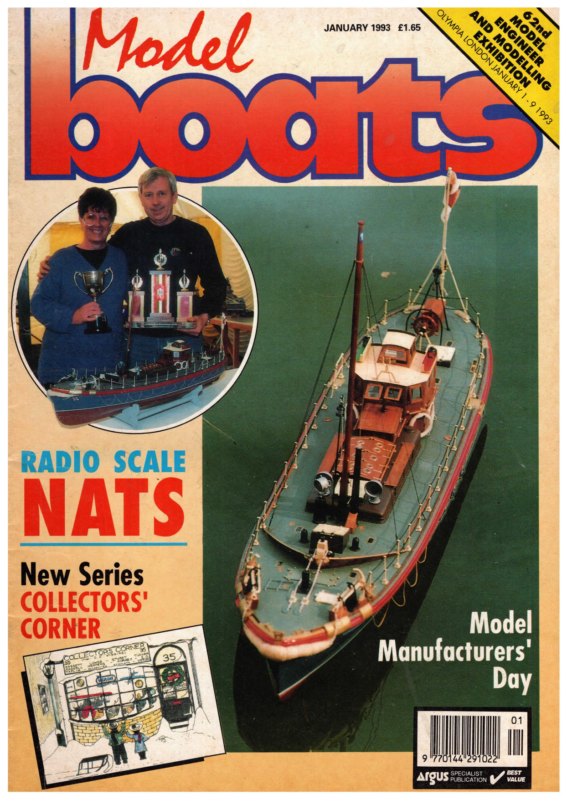
- Miss America And Cygnet Ralph Smith describes the restoration of two unusual models.
- Match Racing Bill Green returns to our pages with a resume of last year’s season

“iy <= 2 =) 4 cc > – a for) © Sel = i Ty) Manufacturers’ Day 2S SPECIALIST Agus PUBLICATION YW Best VALUE | |
condition and it occurred to me that others contemplating a similar exercise might be interested in my experiences. The ‘A’ Class Yacht Cygnet It was almost by chance that I was put in touch with a gentleman who had ‘an old yacht’ for disposal. WhenI collected it complete with a dustbin liner filled with spars and sails she was in a sorry state. Some deck fittings remained but most were missing. The deck had deteriorated beyond salvation, her paintwork was falling off in sheets and she was very, very wet. Not the easiest of models to transport around, but you must admit that Cygnet has been restored to a Examination at home revealed the name Cygnet just discernible on the hatchcover and a mainsail carried the number IMA 174. Armed with this information I was able to telephone Russell Potts whose register showed that she had been designed by J.G. Feltwell, built by E.J. Bullock of the Highgate Club and had been first registered on 30 April 1930. She is 5ft Qins overall, some 4ft on the waterline, has a beam of 13ins, a draught of approximately 1lins and a weight of 33lbs. After removing the deck and allowing her to dry out naturally over a period of several weeks, all the exterior paintwork was stripped using Nitromors and the interior cleaned to the bare wood using razor blades, scalpels, etc,. This process revealed mahogany planking on oak frames copper fastened and I determined that in her new livery the beauty of the mahogany would be preserved. I found no rot but the putty caulking was in such a bad state that it all had to come out. very impressive yacht. Miss America And ver the past few years I have derived great pleasure restoring two very different pre-war models; the first an International ‘A’ Class yacht and the second a Hobbies steam launch. They are both now in usable Close up of the deck and hull, showing the mahogany planking. Ralph Smith describes the restoration of two unusual models As with most yachts of this size the lead keel is secured by two bolts cast in the lead and passing through the deadwood to two internal wingnuts. These were well and truly rusted solid and whilst it would have made life much easier had the keel been removable, I foresaw potential disaster in trying to shift the nuts and so I left well alone. My friendly local cabinet maker introduced me to Metolux Timberfil wood filler which is waterproof and comes in a variety of colours including mahogany. This was applied over the whole of the exterior and sanded down. To add strength and assist in waterproofing, the inside was treated with a coat of clear resin. A second application was required following an immersion test in the local model boat pond. The deck beams were intact but required refixing. The original deck was in one sheet of %in thick softwood but since it had to be replaced I thought a laid deck would look better and enhance her appearance. To provide a base on which to work I used Mein thick plywood sheet and then laid “in x Mein thick planks in mahogany and American basswood supplied by Balsacraft Ltd, Watton, Norfolk. The mahogany ‘kingplanks’ and MODEL BOATS
THE MECCANO MAGAZINE ishesAWomrledsrbeistcava’lue in G a = orream Model faunches jes —— T DELIGHjust A BOY’eSlittle launch which Here’s a tophol the caer eel buzzes through ands d of boys are ontee steam. Thous them yac! having hours of delightItwith is a three-guinea pond or calm river. eautifully finished, strong model for 12|6—b GOES 20 MINUTES AT ONE FILLING little engine and the new is a real y There lamp raises a head of steam } the is fitted to safetytingvalve A ereny poase and the oscilla ou in very Back in her natural element some 57 boiler ler to “little twin bladed propel boat 20 minutes at one filling. years after manufacture. IT FOR \ NOTHING LIKE ANYWHERE I PRICE 1 2 l 6% Comlees are lamp, end full instructions Se gO sx) Dereham, Norfolk Hobbies Ltd. (‘ss<== | WHERE wa the. o, Canada it os orontm2 on shefield. Sr a gn std ns ebnolbiesaar sslennnaM t usual YouennnnTHE |lewewBUY Agencies. Miss America restored to her former glory with good old Humbrol enamels. matched easily and so a complete set was made in brass copying the originals where possible. Among the collection of spars and sails was a complete mast in two sections, two pairs of booms and two suits of cotton sails no longer white but nevertheless sound, requiring minor repairs and replacement of the batten pockets by our local bespoke tailor who enjoyed the challenge. The mast and spars required little more than a clean and varnish, the marks and numbers along the booms being replaced using edging were fixed first, followed by the nearly white basswood, all pinned in position whilst the glue set. They were all pulled to shape cold and this turned out to be reasonably straightforward, if timeconsuming, marquetry. The surviving fittings were of an unidentifiable metal which could not be The beautifully restored deckis apparent from this shot. waterslide transfers. For standing rigging I chose 7 strand 55 wire with brass bottle screws, whilst for arrangement of the running rigging, Edward Hobbs’ book ‘Model Sailing Boats’ came in very useful. Cygnet had her first outing with the Vintage Group at Dovercourt in June using the second suit of sails in quite strong conditions. After a few adjustments to the mast position she held a steady * course close hauled to windward and was impressive off the wind on a broad reach on all occasions with the rudder pinned amidships. The next stage will be to master the Braine gear. Miss America To receive this model steam launch as a gift from its original owner was indeed a delight. Naturally it had suffered the ravages of time having been purchased around 1925. However it was all there including the methylated spirit burner and the tiny single acting oscillator 14in bore x ¥%in stroke still turned freely. The hull measures 31lin overall x 4%in beam. Having noted the original colours where possible and having removed the engine, boiler, foredeck/wind shield and after deck, she was stripped down to the bare wood, again using Nitromors. The hull comprises four pieces - bottom, two sides and transom nailed together with a triangular fixing block at the bow. It was all sound, requiring only fixing and re-gluing at the bow. Painting with metallic wood primer, undercoating and finishing with Humbrol enamel was straightforward. When it came to the power plant, the owner had admitted to replacing the firebox with one of his own design. Fortunately, however, he had also passed over a quantity of old Meccano magazines 1925-1934 vintage and the inside cover of that for July 1925 (reproduced here) carried a full page advertisement for ‘Miss America’, detailing the boiler assembly. From this I was able to manufacture something nearer the original using aluminium sheet and finished in heat resistant black paint. The engine was in remarkably good condition requiring only a couple of minor replacements to eliminate ‘slop’ in the crank and drive shaft. As to the boiler, it is doubtful whether it would meet current safety criteria. It is all brass with 1%in OD seamed tube 4in long soft soldered. The whole power plant is secured by two bolts fixed through the bottom of the hull. I was surprised to find that the foredeck/windshield had been in blued steel. With emery cloth and wire wool I managed to remove most of the corrosion and then to restore the blue. The after deck carries the original Hobbies logo which has been preserved. Some minor repair work was needed after which the deck was finished as nearly as possible to the original using a base coat of cream colour (similar to the ‘secumble’ used in the old staining and graining technique), lining and varnishing. It has the rather odd overhang at the stern. Her performance on the local lake is impressive and it has been most satisfying to afford Miss America a new lease of life. 15
ttch Racing Bill Green returns to our pages with a resume of last year’s season disappointing for the host club with only four teams represented. race officer Peter Locke held two rounds and visitors Nigel Sharpe and Richard Costigan from Leeds & Bradford ran off North with the trophy. Martin Kinder (Bournville) was the highest scorer. There are two races which are the highlights of the vane calendar. The first in the calendar was the “M” National at Fleetwood, held across the May Bank Holiday. A monumental entry of 36 boats provided Race Officer Alan Bright with a rare introduction to running a vane race. He was most ably assisted by Fleetwood’s support staff of Karl Watkinson on the computer and the ladies of the canteen. The Auld Mug now has a model equivalent. This is the Class insignia of the America’s Cup boats. es, like McCarther, I am returned with tales of daringdo of the free sailing and match racing world. Hopefully this time on a far more regular basis. Where shall I begin? Well a resume of the season, so far, seems be a good starter for ten, just to bring every body up to date with what has been going on. For the time being I'll concentrate on the Nationals. Next year I'll revert to normal format with reports on as many of the District and Open races as I can obtain The entry list featured a not unexpected large contingent from the host club, now with its ever burgeoning “Brat Pack” of enthusiastic and capable youngsters. Mark Dicks, with assistance from his father Chris, held off all opposition, all weekend, to give Mark his first “M” National victory. This has been something which he has threatened to do for the last few years and this year no wheels fell of. Interestingly Mark was sailing one of Chris’s discarded RM’s Krystik which was a stunning performer under vane having retained a large portion of its radio heritage. The 10 Rater National was held at Gosport, in June, in far kinder conditions than last year. There was a marginally increased turnout of six boats in comparison with last year so perhaps there is some interest in the free sailing 10 rater. Mark Dicks sailing his Chris Dicks designed 10 rater ran out the winner. Two wins at National level during the season so far, for Mark, not bad, huh! The major race of the vane calendar has always been and always will be the “A” National. This year it was Gosport’s turn to host the event under Race Officer Peter West. The turnout this year was on the low side, only 28 boats, with a number of notable skippers unable to attend for a variety of plausible reasons. The race was sailed in a variety of conditions with a combination of howling gales and flat calms. Peter Maskell sailing Syanco was in devastating form, having the race sewn up by Thursday night. That’s “A” National victory number 5 for Peter and all with Bill Sykes’ designed boats. That makes a pretty good combination don’t you think? Rather interestingly, Peter sold his boat after the race to Graham Wyeth and promptly commissioned a new one from Bill Sykes, so it will be intriguing to see what Bill comes up with. The next National on the calendar was the 36r National. This was Birkenhead’s turn to host the event in late August under the watchful eye of Race Officer Bernie McNulty. Sixteen contenders turned out to play and Bernie made it plain two complete rounds was the target for the three days of racing. Dave Potter came out on top of this particular heap with Mark Dicks in second place. The last of the vane Nationals arrived in late September. This was for the 6 metre Class. In the recent past this event has Mike Harris (foreground), this year’s 6m National Champion sailing ET against Peter Salt (Peasblossom) who was third after losing the second place sail-off to Dave Potter. information on. The season started with the “M” TEAM National at Bournville in March, March and the “M” Team and with it the vane season came in like a lion. An entry of 17 teams from all the usual vane clubs made it one of the largest for a very long time, this had perhaps more to do with the “secret” 50th birthday celebrations of one of the stalwarts of the vane fleet than the venues Race Officer Peter Salt kept the pace of the race going, knowing full well that it would be impossible to complete a full schedule in the time available. As it was, Peter did well to terrorise, cajole, pat on the head, the competitors into completing 20? heats. Conditions were kind, Bournville’s notorious wind patterns behaved themselves and Birkenhead “A” team of Ken Roberts and Dave Potter came out the winners. The next major race of the season was the other team race, the “A” Team National at Birmingham in early April. The turnout for this race was a little 38 MODEL BOATS
League also recognises the importance of Race Officers, the work they do in organising the event and ensuring that all the requirements are met. The scoring system has been refined over a number of years and in its present form suits the vane scene fine. The Radio League in some respects has been overshadowed by the Ranking Race System which is about deciding who can represent the UK at International events. There is no need for an equivalent to the Ranking System in the free sailing world as the likelihood of International events for free sailing is a lot like the search for rocking horse droppings. The Vane league is about determining the best club and the best individual skipper. Most of the vane clubs and skippers sail the majority of the MYA free sailing classes and therefore the League result is representative of the best in the sport and as such is worth winning and the winners deserve and get the result that the victory brings. The League Year has been a two horse race between Fleetwood and Bournville. At one stage Bournville had a clear lead over Fleetwood but with only one entrant in the “A” National their chances of snatching a victory from under the noses of Fleetwood evaporated. Even so it was close at the end with only a few points separating them. The Individual League Championship was a clear victory for Chris Harris who was following in his fathers footsteps. It is good to see a youngster like Chris win the individual and I hope it provides a good model for some of the up and coming youngsters that are now appearing on the scene. Chris won the league through sheer determination, effort and consistently good results across the board. He has attended over 16 league races this year at venues all over the country, have boat will travel has been Chris’s motto. The runner up this year was Peter Maskell who put in consistently high performances, where ever and what ever he was sailing. A noticeable feature of this years League results has been a significant increase in the number of ladies and juniors taking part. This is great because it says to me that the vane scene has an appeal across the board and as such is here to stay. Also Dave Potter, second in this year’s 6m National with Northern Lights to the Sigma design by Graham Bantock. Dave has won the 6m National for the previous two years. attracted a good entry of 18-20 boats, this year’s entry by that target was very low only nine boats. This does not represent a lack of interest in the Class but rather sums up a catalogue of assorted late holidays and accidents. I think falling over and breaking an ankle or attempting to remove a thumb with the aid of a circular saw are pretty legitimate excuses, don’t you? What the event sorely lacked was the presence of Birmingham Club members, Peter Hopkins along with Clive Hartland as Race Officer were the sole representatives for Birmingham. Also the event had to be transferred at the last minute from Birmingham to Bournville, as the lake at Birmingham was badly weeded up. the event was held in light airs from a generally easterly direction and was very close thing for the first three places. Mike Harris won closely followed by Dave Potter and Peter Salt. MYA Vane League 1992 This year I’ve been helping Mike Kemp (MYA League Secretary) to collate all the Free Sailing results for the MYA League. First I'd like to thank all the Clubs for getting their results in without being Attempt, Tony Riley’s own design radio 6M which has been very successful in this year’s Match Race Series. Part of Fleetwood’s “Brat Pack” which have helped to win this year’s Vane League. The jib no’s were used to individually identify the boats. terrorised into producing the overall result and second I'd like to thank all the individuals who have collected the League race results and fed them through to me. This has made my job very much easier. At the time of writing the final results are not yet in but the position is as shown in the table. The positions for the primary positions had.been settled prior to the 6M National The winning club was Fleetwood very closely followed by Bournville and the individual League Champion was Chris Harris. Fleetwood have dominated the vane league for the last couple of years by shear weight of numbers and good luck to them for encouraging as many of their members to travel to away events. This for me is what the League is primarily about. It’s about recognising the efforts of folk who are prepared to travel to away events and support Open, District and National events where ever they are held. The JANUARY 1993 39
Bob Stern boat. In the mean time Richard Pierce had not been idle and had produced two boats, each different, but at the lighter end of the scale and based on full size overall the numbers who took part is up on 1991 and the results are more closely spread. This means that competition within the sport is very much tighter and practise. therefore a victory in an event is more satisfying. When all of the results are in then is the time for further analysis So six boats to five designs, all of them different, met at Windermere on Sunday 6 September for trials with a Match Race event set for the following day. Windermere was dry but starting off in light airs but building eventually to about twenty knots. All the boats had top suit on and they looked magnificent. As the wind built up some of the designs started to be overpressed but the Lewis boats kept going without to much fuss. All the skippers . were enjoying the conditions, the boats where hammering to windward and flying down wind. It was a great shakedown session and for me one of the most exiting and pleasurable days sailing I’ve ever had. We were all looking forward to the next America’s Cup Class’ I first saw a copy of the rule about 18 months ago and on first sight didn’t see much in it that a good “A” Class couldn’t provide. A basic interest at the club for new classes and big ones, at that, led toa day’s racing. My own John Lewis designed America’s Cup boat (K4), Force Majeure. The photo gives no real indication of the physical size of the class. have to get my finger out. Paul Heys eventually came to my rescue and produced a superb hull about six weeks prior to the event. Then it was a case of a liberal application of midnight oil to get it finished. The boat hit the water three days before the event. I am deeply indebted to Bernie McNulty of MacFit for coming up with some cracking fittings in double quick time and to Martin Roberts of Housemartin Sails for doing the same on the sail making front. Mark Dick’s (this year’s “M” National winner) ex RM Krystik now under vane on a broad reach at Fleetwood. number of brief case meetings in the boat house with a number of Bournville’s best. John Lewis, also one to take a good look at new subjects, found himself with a challenge on his hands from Richard Pierce for a match race for the class to be held at Windermere in early September. John and Richard decided that the best course was to accept the Rule as drafted and operate in the spirit of the Rule where it was unclear. John designed two boats, one for himself and one for David Trippe who had also got a dose of the AC bug. Both designs had their lines based very firmly based in many years of designing competitive free sailing “A”’s with the lessons learnt from the recent lightweight RA’s. John’s boat featured moderate overhangs at the bow and stern. David’s boat featured a destroyer style bow (a-la full size). John Gale planked the hull for David and David finished off above the deck. John Lewis built and finished his own boat. My interest by this time was seriously whetted, even more so when I first clapped eyes on Johns’ planked hull. I made myself a promise to be at this inaugural event with a boat. My boat is very similar to John Lewis’s but with different appendages, ie fin and rudder, to determine whether there would be any discernible difference. My biggest problem was that I had little or no chance to plank a hull for myself and that if I wanted to be part of the first event for this embryonic class I was going to 40 John’s boat hit the water about three weeks before the event and as soon as it did, all the efforts were worthwhile. All the potential that was apparent in the lines and during the building stage was realised. These are incredibly exiting boats to sail, they are big, powerful, manoeuvrable and seriously quick. The basic dimensions set the scene 1/12 full size ie 78in long, 17in beam, 16in draft, 29 lbs displacement and just over 2000 sq ins of sail area. The rule is formulae based, similar to the “A” and 6 metre, which allows the designer freedom within a range to produce to ring the changes and come up with a design which is the best possible compromise of the selected parameters. John Lewis worked with Mike Harris to tune the boat and after a few changes soon had the boat in flying mode. All was set for the Windermere bash, David Trippe also was working the oracle, as Gerry WestonWhite from Swanley who had imported a When the Monday dawned it was raining and blowing hard about, 40 knots. No one was prepared for these sort of conditions. It was soon obvious that the race, as such, was off but by lunch time conditions had moderated to the point when sailing could be considered. John, David and I had a dig in the alternative sails that we had with us and witha little ingenuity we where on the water. By this time Derek Priestly and Brian Corley had turned up as had Hughie Shields and Chris Mckenzie form Scotland and they where itching to play, so play they did. They had some splendid battles, one “race” in particular will live in my mind for ever. It demonstrated to me what the class can provide, excellent performance and tight competition. Were our efforts worthwhile? You bet your boots they were. I, for one, cannot wait for the opportunity to sail these boats in proper competition and I know the others who participated feel the same. When we do I'll let you know what happens. 6 Metre Owners Association Just at the time of the copy date for this article we received the news that the MYA had formally recognised the Association. just what the effect this will have I'll expand on in my next article. All that remains is to wish you all A Good New Year and I hope to see you on the free sailing and Match Racing circuit in ‘93 Paul Heys’s beautiful finished and cracking performing R6M Promises designed by John Lewis and features a bow bustle.